Liberty Matters
History and Liberty in Edward Gibbon’s Decline and Fall of the Roman Empire
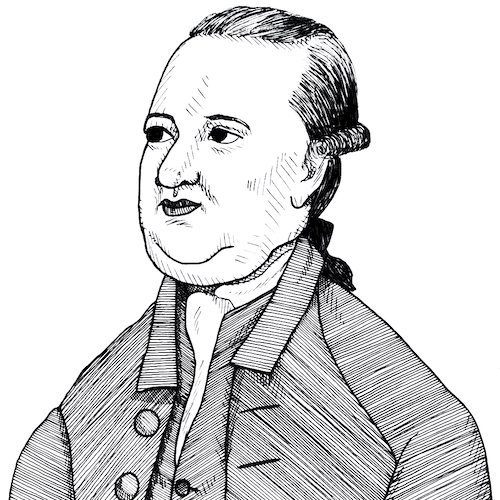
Edward Gibbon (1737-94) began his literary career in French, publishing his Essai sur l'Étude de la Littérature in 1761; he had originally planned to go on to write a history of the Swiss in the same language. These were intellectual ventures that could only have appealed to a distinctly small, decidedly self-selecting audience. Happily for his many subsequent readers, Gibbon reverted to writing in English, sagely following the advice of David Hume, who had presciently looked across the Atlantic to see a new empire emerging for the English language; and Gibbon’s historical ambitions enlarged greatly, turning from the liberties of the Swiss to no less a theme than the History of the Decline and Fall of the Roman Empire. The first of the six volumes of this monumental study in philosophical and narrative history appeared in London in 1776, and it was soon republished in Philadelphia. The Decline and Fall effectively established Gibbon’s credentials as a master of English prose in the very years in which the new Republic of America was created. Hume, calmly contemplating this political climacteric, had the great consolation as he lay painfully dying of cancer in Edinburgh in 1776, to read two newly published masterpieces of the British Enlightenment: the opening volume of The Decline and Fall and Adam Smith’s Wealth of Nations. 1776 was an annus mirabilis for European as well as for North American liberty. Liberty, both religious and political, was a matter of great moment in the Decline and Fall, initiated in the year of the Declaration of Independence, and completed shortly before the outbreak of the French Revolution.
J.G.A. Pocock (1924-2023), the leading Gibbon scholar of his generation, identified the historian as the greatest exponent of a conservative, clerical English experience of Enlightenment, one which placed him at odds with many of his stridently atheistic francophone contemporaries. It took the long aftershock of the violent end of the ancien régime to usher in the conservative liberal tones in which in 1812 a young François Guizot (1787-1874) translated and annotated the Decline and Fall for a French readership. Guizot’s father had been executed in the Terror, and his mother had fled with her young son to Geneva, where he was subsequently educated. The Swiss had readily reciprocated Gibbon’s interest in their history. Seven years after Guizot’s work on the Decline and Fall appeared, the Swiss political thinker Benjamin Constant (1767-1830) would deliver a celebrated oration in Paris comparing the liberty of the ancients and the moderns; but Constant’s admired ancients were the Athenians, not the Romans who primarily concerned Gibbon and Guizot. In the era of Lord Byron (1788-1824), who died defending Greek liberty against the Ottomans, the newly recovered ideals of ancient (and modern) Greek Republicanism animated a younger, more radical, and defiantly idealistic generation. Byron had described Gibbon in his epic poem Childe Harold’s Pilgrimage as ‘the lord of irony’, ‘Sapping a solemn creed with solemn sneer’[1]; this was heavily qualified praise for an historian whose own commitments to liberty were altogether more mitigated and judiciously balanced than were those of the politically radical poet and his like-minded contemporaries. Gibbon, living in literary retirement in Lausanne when the French Revolution broke out, was far too attached to the old order to side with his erstwhile friend Charles James Fox in welcoming its challengers. He was closer to Edmund Burke, a fellow member of The Club (Dr Johnson’s literary society). In common with his admirer Guizot, Gibbon was a conservative liberal. Irony was appropriately and subtly the key to Gibbon’s conception of liberty.
But what was that conception of liberty? To echo Isaiah Berlin’s dichotomy in ‘Two Concepts of Liberty’ (an essay inspired by Constant), Gibbon celebrated negative over positive liberty. The Geneva to which he had been sent by his family to recover him for the Protestant fold after his conversion to Catholicism at Oxford, was balanced, conservative, prosperous, mildly hierarchical, cautiously luxurious, nominally Calvinist. This was the Geneva against which Jean-Jacques Rousseau, Berlin’s primary agent of positive liberty, had rebelled as he launched himself into voluntary exile from his native city. Rousseau’s tendency to act all too influentially as a terrible simplifier was the reverse of Gibbon’s taste for refined complexity; the Decline and Fall is a study in the many contradictions of political and religious liberty, a consummately civilised meditation on the many ambiguities of civilisation. Not for nothing was Gibbon’s preferred mode of historical generalisation constituted by profoundly ironic and invariably measured antithesis.
Fundamental to the English Enlightenment was the defence of a political nation uniquely dedicated to the pursuit of negative liberty. An historian of a younger generation, Thomas Babington Macaulay (1800-59), praised the ‘Glorious Revolution’ of 1688-89 as a preservative revolution, denouncing the French Revolution, in the style of Burke, as a destructive revolution. This was the conception of political liberty that had allowed Burke consistently to defend the rights of Americans to self-determination and later to condemn the illusory philosophy that inspired the French Revolution. And this was a perspective shared by Gibbon, although he had served in the administration of Lord North, who effectively lost the American colonies; he would, nonetheless, as a man of integrity and loyalty, dedicate the fourth volume of the Decline and Fall to North, by then long out of office, in 1788. Gibbon was a sceptical Whig, just as he was a sceptical member of the Church of England. Balance and irony formed his personal as well as his historical philosophy. He much preferred a conservative variety of Enlightenment to any form of religious or political ‘Enthusiasm’, be it represented by the Transatlantic ‘Great Awakening’ or the rootless, relentlessly rationalistic ambitions of Radical Enlightenment. Succumbing neither to reaction nor to revolution, Hume’s essay on ‘Superstition and Enthusiasm’ provided the lodestar of Gibbon’s thinking; he was a mitigated sceptic, opposed to excess of any kind, religious, philosophical, or political.
Quintessentially a product of an age of continuing exploration and colonialism, Gibbon imagined the world accurately and geographically, organising his opening study of the world-historical situation of the Roman empire through a minutely attentive survey of the many regions comprising it, from Britain to North Africa. A characteristic criticism of a fellow scholar occurs in one of his inimitable footnotes, where he declares of Thomas Templeman’s Survey of the Globe, ‘I distrust both the doctor’s learning and his maps.’[2] For Gibbon, the past persistently informed the present, as when he noted of Croatia and Bosnia that ‘the former obeys an Austrian governor, the latter a Turkish pasha’, contiguous territories marking ‘the doubtful limit of the Christian and Mahometan power.’[3] This was a passage that firmly resonated as the former Yugoslavia descended into civil war in 1991, fully two hundred and fifteen years after it was originally composed. As this example economically demonstrates, Gibbon, though never exactly a geographical determinist, nevertheless limited the possibilities of the potential for liberty in any region by reflecting deeply on its geography and its history. He also considered theology both regionally and internationally as a prime determinant of intellectual and moral liberty.
Religion is one of the prime motors of the Decline and Fall, reflecting Gibbon’s own experience of cradle Anglicanism, brief and youthful conversion to Catholicism, and ultimate Protestant reconversion into something like religiously observant scepticism. He was not the first European to undergo such a spiritual journey: Pierre Bayle (1647-1706) had converted from his Huguenot origins to Catholicism before reverting to a highly sceptical variant of Protestantism. In his 1682 tract, Reflections on the Comet, Bayle had mischievously imagined the possibility of a thriving society of atheists, something literally unthinkable to the great majority of Europeans. It was a provocation that led to many responses, including Vico’s New Science, but there is a more positive echo of its sentiments in Gibbon’s celebrated account of Roman polytheism as he invoked its ‘Universal spirit of toleration’: ‘The various modes of worship which prevailed in the Roman world, were all considered by the people, as equally true; by the philosopher, as equally false; and by the magistrate, as equally useful.’[4] Something of this spirit informed his controversial account of the purely natural causes of the rise of Christianity, complete with a tacit critique of the miraculous and a subtle merging of the eighteenth-century present with the second century past, the sceptical historian referring knowingly to ‘an age of science and history.’[5]
Religion was regularly to be called into account in Gibbon’s own ‘age of science and history’, and respect for its usefulness tended to be more esteemed by him than its supposed philosophical plausibility, as when he had implicitly contrasted the antisocial virtues of early Christian monasticism with the sociability of Zoroastrian practice: ‘The saint, in the Magian religion, is obliged to beget children, to plant useful trees, to destroy noxious animals, to convey water to the dry lands of Persia, and to work out his salvation by pursuing all the labours of agriculture.’[6] Once Christianity had been established, however, there was no point in reverting to Roman polytheism. The dead could not be restored to life; and hence Gibbon’s highly critical portrayal of Julian the Apostate, whose attempt to reverse the religious revolution enacted by Constantine was condemned by the historian as an outbreak of Neoplatonic ‘enthusiasm.’[7] For the rest of the unavoidably religious story told by the Decline and Fall, the Christian West and the new Rome of Byzantium are subject to dispassionate irony, with an outburst of confessionally tolerant zeal as Gibbon lamented the impact of the Crusades as he did all religiously motivated outbreaks of cruelty, from the murder of the female philosopher Hypatia - in the ‘bloom of youth and in the maturity of wisdom’ – mercilessly undertaken by crazed celibate monks instigated by Cyril of Alexandria, onwards.[8] Sharing the suspicion of metaphysics of most enlightened thinkers, he had some regard for the unitarian rationality of Islam, having earlier in his history excoriated newly orthodox Trinitarian violence launched against Arians in the fourth century due to purely grammatical differences over an iota in philosophical Greek.[9] Irony was a uniquely powerful register.
As he closed the Decline and Fall in the fifteenth-century Renaissance of papal Rome, Gibbon appealed admiringly to the pacific example of Erasmus, the ‘father of rational theology’, as the violence of the Reformation and Counter-Reformation led to a new age of religious war and persecution in the sixteenth century, out of which Enlightenment Europe had painfully and slowly made its way.[10] Politics and religion were constantly intertwined in the logic of the Decline and Fall, and while similarities between Gibbon’s thought and that of Machiavelli in the Discourses on Livy can occasionally be discerned, Gibbon was no tirelessly resolute celebrant of ancient Republicanism as he surveyed the new realities of a world in which America had become a new Republic. What Pocock had identified in a 1975 magnum opus as The Machiavellian Moment - encompassing Machiavelli’s Florence, seventeenth-century England, and the founding of the American Republic - was but one of many political moments recorded in the Decline and Fall. If Gibbon idealised any such temporal political scrutiny, it was through what might be called a Tacitean Temporality.
Tacitus was for Gibbon the ‘first of historians who applied the science of philosophy to the study of facts.’[11] The Roman historian was nostalgic for Republican Rome, but he was a realist who demonstrated how the Emperor Augustus had created a dictatorial dynastic regime through a deliberately delusory reimagining of republican ideals. (It was as if the Founding Fathers had veered off towards instituting the monarchy some Americans had favoured once independence was gained.) For Gibbon as for Tacitus, liberty was to be exercised wisely within necessarily accepted constraints. Political nostalgia would inevitably lead to the violence endemic to positive conceptions of liberty, as in Rousseau’s idealisation of Sparta as realised through Robespierre’s Terror. For Tacitus and Gibbon, on the other hand, politics was impure, the product of history and circumstance, and hence the variety of polities across the eighteenth-century globe. It was the historian’s task to narrate that history in a manner that encouraged readers to celebrate the many negative liberties made possible through the commercial wealth of nations. Modern liberty, as Gibbon reminded his readers in the preface to his first volume, was the paradoxical product of ‘the subversion of the Western Empire, by the barbarians of Germany and Scythia, the rude ancestors of the most polished nations of modern Europe.’[12] And it was as he wrote those words that liberty was extending across the Atlantic.
Endnotes
[1] George Gordon, Lord Byron, Childe Harold’s Pilgrimage (London, John Murray, 1812-18), Canto the Third, Stanza CVII.
[2] Edward Gibbon, The History of the Decline and Fall of the Roman Empire, ed. David Womersley (3 vols., Allen Lane, Harmondsworth, 1994), I. 89, note 9.
[3] Decline and Fall, I. 51.
[4] Decline and Fall, I. 56.
[5] Decline and Fall, I. 512.
[6] Decline and Fall, I. 218.
[7] Decline and Fall, I. 864-958.
[8] Decline and Fall, II. 945-46.
[9] Decline and Fall, I. 787.
[10] Decline and Fall, III. 438, note 38.
[11] Decline and Fall, I. 230.
[12] Decline and Fall, I. 2.
Copyright and Fair Use Statement
“Liberty Matters” is the copyright of Liberty Fund, Inc. This material is put on line to further the educational goals of Liberty Fund, Inc. These essays and responses may be quoted and otherwise used under “fair use” provisions for educational and academic purposes. To reprint these essays in course booklets requires the prior permission of Liberty Fund, Inc. Please contact oll@libertyfund.org if you have any questions.