Arriving in 1776, as the Declaration of Independence gave birth to a new nation and Gibbon’s Decline and Fall gave birth to a new approach to history, Adam Smith’s An Inquiry into the Nature and Causes of the Wealth of Nations gave birth to a new discipline--modern economics.
Perspective Essay Innovation and Governance in Book 1 of Wealth of Nations
A standard criticism of Adam Smith, going back to John Rae in 1834, is that in “Wealth of Nations economic growth is caused by capital accumulation, which is in turn the result of saving. Increases in productivity through increased division of labor are a more or less automatic result of accumulation, not an independent cause of growth.”[1] This criticism has been indirectly reinforced by the tendency of more recent commentators to identify “the prudent man of" The Theory of Moral Sentiments (hereafter: TMS) with “the frugal man of" Wealth of Nations (hereafter: WN) and, thereby, find a unity in Smith’s corpus.[2] The unity is real, and Smith indeed defends the moral salience of prudence, including frugality, but the standard interpretation of Smith’s political economy also overlooks a more dynamic account in Smith centered on governance, institutions, and bottom up innovation.
This more dynamic account is introduced in the first chapter of Book 1 of Wealth of Nations, which starts with the claim that the “greatest improvement in the productive powers of labour, and the greater part of the skill, dexterity, and judgment with which it is any where directed, or applied, seem to have been the effects of the division of labour.” (WN 1.1.1, p.13) This immediately clarifies two features of Smith’s analysis: first, the fact that per capita output grows is itself the effect of the division of labor.[3]
Second, within the division of labor there is room for agency by those who apply skill, dexterity, and judgment to take advantage of it. So, initially, it seems that Smith is offering a narrative that valorizes the entrepreneur and what we would call the manager of (say) a factory where the division of labor is perfected. (In wider context, Smith clearly states that the division of labor can be pursued at greater length in manufacturing than, say, agriculture.)
However, Smith also suggests that within the division of labor there is, in addition to much saving of time, an “increase of dexterity in every particular workman.” Note that he does not claim the skill or judgment of each worker is increased. In fact, Smith recognizes that the shift from artisanal labor to machine-aided manufacture may well involve de-skilling and undermining judgment. Of course, the division of labor is both shaped by and generates, “the invention of a great number of machines which facilitate and abridge labour, and enable one man to do the work of many.” (WN 1.1.5, p. 17)
In fact, in order to explain how the division of labor generates further inventiveness, Smith appeals to his theory of human nature for the first time in Wealth of Nations: “Men are much more likely to discover easier and readier methods of attaining any object, when the whole attention of their minds is directed towards that single object, than when it is dissipated among a great variety of things.”[4] (WN 1.1.8, p. 20) Smith then continues:
But in consequence of the division of labour, the whole of every man's attention comes naturally to be directed towards some one very simple object. It is naturally to be expected, therefore, that some one or other of those who are employed in each particular branch of labour should soon find out easier and readier methods of performing their own particular work, wherever the nature of it admits of such improvement: A great part of the machines made use of in those manufactures in which labour is most subdivided, were originally the inventions of common workmen, who, being each of them employed in some very simple operation, naturally turned their thoughts towards finding out easier and readier methods of performing it…One of those boys, who loved to play with his companions, observed that, by tying a string from the handle of the valve which opened this communication to another part of the machine, the valve would open and shut without his assistance, and leave him at liberty to divert himself with his playfellows. One of the greatest improvements that has been made upon this machine, since it was first invented, was in this manner the discovery of a boy who wanted to save his own labour. (WN 1.1.8, 20)
In Book V of Wealth of Nations, Smith recognizes that this narrowing generates a kind of alienation that is both harmful to workers and has dangerous political implications.[5] So, the quoted passage is not without a politically and humanly troubling under-current, not the least the existence of child-labor.
However, the otherwise bad narrowing of attention has a salutary effect among a subset of workers subject to it.This subset finds ways to improve their own productivity either (i) by organizing their own work more efficiently (“easier and readier methods”) or (ii) by designing and developing labor-saving machines. I offer four further observations on the quoted passage.
First, Smith anticipates here an insight by Thomas Kuhn that a certain kind of constrained activity, a puzzle, promotes and even helps constitute ingenuity. As we learn from Smith’s posthumously published “History of Astronomy,” Smith understood scientific theories as machines that undergo a process of development/refinement, and then can undergo a revolutionary change.
Second, as Smith’s example of the playful boy suggests, Smith clearly valorizes bottom-up, workplace initiative. I am not the first to note this. Even early socialists like Thomas Hodgskin often draw explicitly on Smith to argue for the importance of work-place driven technological innovation.[6]
Third, as David M. Levy and Sandra J. Peart emphasize, Smith’s underlying point is a kind of intellectual egalitarianism.[7] Smith repeats that it is ordinary working laborers who are the ingenious designers of much beautiful machinery. Ingenuity is a common disposition that is, if not a context-sensitive property, at least triggered by constraints in our social environment.
Fourth, Smith’s narrative, thus, pushes back against the idea that what’s really needed in a modern political economy is to turn workers into machine-like, thoughtless, and seamless parts of an assembly-line guided by scientific Taylorism or ruled by a managerial elite, which ensures a sufficient rate of savings. Rather, what’s needed is to let ingenuity bubble up from the work floor. For Smith, ingenious workers deliver a stream of productivity gains. When much later in Wealth of Nations, Smith criticizes the physiocrats, Smith makes this very point again, “The improvement in the productive powers of useful labour depend, first, upon the improvement in the ability of the workman; and, secondly, upon that of the machinery with which he works.” (WN 4.9.35, 676)
The bottom-up mechanism of technological improvement that Smith showcases in the very first pages of Wealth of Nations shapes the division of labor. These technological improvements contribute to growing production (and to growing markets with more room for subdivision), capital’s profit, and cheaper goods and so raising living standards. Capital accumulation is an effect, not the cause, of technological innovation, and not just the result of the prudential habit to save.
In another context I have emphasized that the boy’s play involves the first mention of liberty in Wealth of Nations.[8] But here I just note that the boy who wants to play is himself working among machines designed by common laborers; he performs relatively simple operations. So, the point of the passage is very much that even laboring boys can contribute their ingenuity to improving the productivity of the mechanized factory floor.
In the first chapter of WN, Smith argues also that the activities of the sciences and philosophy, including his own, are part of the division of labor. He strongly implies that as the division of labor is extended within the sciences the growth of knowledge and productivity-enhancing discoveries will accelerate. [9]
Book 1 of WN is a lengthy affair. Smith summarizes it twice almost identically, first in the “general introduction” and then in the title of Book 1 as follows: “Of the Causes of Improvement in the productive Powers of Labour, and of the Order according to which its Produce is naturally distributed among the different Ranks of the People.”[10] This summary contains an implied contrast between the ‘artificial’ or social means of improving the productivity of the workforce, and the “natural” means of the distribution among the rest of the population of what this workforce produces. If we paraphrase Smith’s summary of his work into modern English, we can say that according to Smith the first book of Wealth of Nations is about the social causes of how workers are made to be more productive, and how what they produce is distributed among the rest of the population if that distribution is left undisturbed by government. So, the main two subjects of Book 1 are what we may call ‘productivity’ and ‘distribution.’
Smith’s main focus is to provide an analysis of a society familiar to his readers, and how to improve it for the better. We can illustrate the former by attending to how even in Smith’s summary and title the population he refers to is neither a homogeneous mass nor a small anarchic band of equals; it is a socially differentiated and hierarchical society like the one Smith’s readers lived in. That’s the meaning of Smith’s use of ‘ranks’ (and ‘society’/‘people’). Crucially, then, Smith endeavors to explain the world that he lives in.
Smith also explains the wider significance of the topic of Book 1 in the general introduction. While bracketing the significance of “soil, climate, or extent of territory of any particular nation,” Smith identifies two central factors to worker output per capita: “first…the skill, dexterity, and judgment with which its labour is generally applied; and, secondly, by the proportion between the number of those who are employed in useful labour, and that of those who are not so employed.” (WN Intro.3, p. 10; Smith uses the phrase “skill, dexterity, and judgment” three times in the General Introduction, and then again, for emphasis, in WN 1.1.1.) Smith then quickly explains that the development of the first of these causes is the more important one. Where the workforce lacks skill, dexterity, and judgment everyone will be impoverished and famine frequent. This means that where worker output per capita is high, hunger and dearth can be eliminated. This is the moral core of Smith’s political economy.[11]
Smith treats worker output per capita as a proportion like he does with nearly all major quantities in Wealth of Nations.[12] Policy can influence both sides of the proportion. So, in principle, population size ought to be rather important to Smith’s analysis. Yet, as Friedrich Engels noted in one of his first ‘Marxist’ bits of writing, Smith shows negligible interest in the significance of demography in his argument. Population size is only first emphasized by Malthus, who was a careful reader of Smith.[13]
It’s likely that this downplaying of the significance of the size of a population was deliberate on Smith’s part. Throughout Wealth of Nations, but, especially in Book IV, Smith is critical of Mercantile political economy of which he treats John Locke as the most significant representative. For Locke, “numbers of men” are central to the art of “government.” (Second Treatise, chapter V, section 42.) By treating population size as a minor factor, Smith invites focus on the mechanisms and mores that shape workers’ “skill, dexterity, and judgment.” This includes what modern economists would call their ‘human capital,’ but Smith’s view is more expansive than that because he also emphasizes workers’ judgment. So, lurking here is an account of how prudence and taste are developed in a population.[14] Smith completes that argument only in Book V of Wealth of Nations.
Let’s return to the two main stated themes of Book 1. In a commercial society, for Smith, the natural distribution of our production follows three main factors of production: labour, capital, and land, which have a counterpart in three distinct kinds of revenue streams that generate purchasing power:
The whole of what is annually either collected or produced by the labour of every society, or what comes to the same thing, the whole price of it, is in the manner originally distributed among some of its different members. Wages, profit, and rent, are the three original sources of all revenue as well as of all exchangeable value. (WN 1.6.17, p. 69)
These distinct revenue streams, in turn, map onto three great social orders or ranks (or as the Marxists would say, classes): workers; owner-entrepreneurs, whom Smith calls the merchant class; and land-holders. Of course, these categories can be sub-divided, say, between manufacturing laborers and agricultural ones or between entrepreneurs and bankers, and so on. Smith does often distinguish these when he discusses the details. Importantly, for Smith the interests of labourers, who are paid wages, and the owner-entrepreneurs who expect profits are generally opposed to each other. He thinks the landowners and the labourers can have shared interests.
Through these distinctions, Smith is creating an abstract model to be used in analysis and causal discovery. For, as Smith shows, in reality this natural distribution is always perverted and corrupted through the use of force, government connections, and government regulations. Books III–IV cover how feudalism, physiocracy, and mercantilism are, in part, systems of governance that undermine the natural distribution through the use of force.[15]
With this in place, let me return to the significance of population to Smith’s argument. After having explained the division of labor and its underlying mechanisms in the first two chapters, Smith adds an important dimension at the start of chapter 3: “As it is the power of exchanging that gives occasion to the division of labour, so the extent of this division must always be limited by the extent of that power, or, in other words, by the extent of the market.” (WN 1.3.1, p. 31) Crucially the extent or size of the market is at least partially constituted by the density and number of people involved. As he writes, for example, “There are some sorts of industry, even of the lowest kind, which can be carried on no where but in a great town.” (WN 1.3.2., p. 31) Undoubtedly, here Smith means a rich town, too, but part of what makes a “great town” great is its population size and density.
The upshot of Smith’s account of the division of labor is worth quoting:
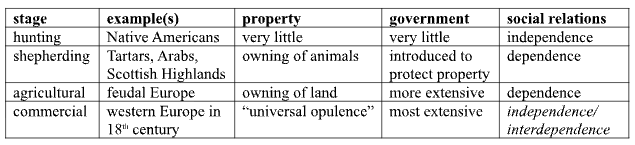
It is the great multiplication of the productions of all the different arts, in consequence of the division of labour, which occasions, in a well-governed society, that universal opulence which extends itself to the lowest ranks of the people….Observe the accommodation of the most common artificer or day-labourer in a civilized and thriving country, and you will perceive that the number of people of whose industry a part, though but a small part, has been employed in procuring him this accommodation, exceeds all computation. (WN 1.1.11, p. 22)
Both of these sentences are significant. The second one is rightly extolled by friends of the market who emphasize that it can coordinate the economic activity of incomparably many people even if we cannot compute it in real time. The first sentence has two important features: first, that the division of labour is supposed to benefit (to use Rawls’ language) the least-advantaged. Second, this universal opulence that is the natural effect of the division of labor is a by-product of proper governance. As Smith shows in Book III of Wealth of Nations, the actual history of mankind is mostly a history of disordered and violent government.
Part of the point of Smith’s science of the legislator in Wealth of Nations, then, is to teach the art of government of managing a great people that facilitates “good government or happiness of their society.” (WN 5.1.f.51, p. 783) One of the first examples Smith offers of good governance is the state’s role in regulating and securing coins, weights, and measures (WN 1.4.7, pp. 40-1). When the state debases any of these Smith calls the effect ‘disordered.’ (WN 1.5.41, p. 63)
Importantly, Smith also inscribes governance and citizenship within the division of labor. This is eloquently expressed in a passage that he added to the sixth and final, 1790 edition of TMS that is worth quoting in conclusion:
The prudent man is not willing to subject himself to any responsibility which his duty does not impose upon him. He is not a bustler in business where he has no concern; is not a meddler in other people’s affairs; is not a professed counsellor or adviser, who obtrudes his advice where nobody is asking it. He confines himself, as much as his duty will permit, to his own affairs, and has no taste for that foolish importance which many people wish to derive from appearing to have some influence in the management of those of other people. He is averse to enter into any party disputes, hates faction, and is not always very forward to listen to the voice even of noble and great ambition. When distinctly called upon, he will not decline the service of his country, but he will not cabal in order to force himself into it, and would be much better pleased that the public business were well managed by some other person, than that he himself should have the trouble, and incur the responsibility, of managing it. In the bottom of his heart he would prefer the undisturbed enjoyment of secure tranquillity, not only to all the vain splendour of successful ambition, but to the real and solid glory of performing the greatest and most magnanimous actions. (TMS 6.1.13, pp. 215-216, emphasis added)
While drawing on the republican language that rejects faction and the spirit of party, Smith simultaneously rejects here the republican-democratic ideal of permanent, collective governance. Rather, Smith invents here liberal citizenship. The division of labor permits citizens to pursue activities other than ruling. For, as Smith discerns, many of us lack a taste for politics. As the last quoted sentence suggests, Smith is not wholly admiring of this preference. He thinks there is real and solid glory in public service, and heeding the call of public duty.
Smith is a friend of competitive markets and the division of labor and the institutions that secure these. But within the division of labor and the governance of these institutions, the population needs to be not just prudent, but also to become educated in skill, dexterity, and good judgment, as Smith shows in Book V.
Endnotes
[1] Brewer, Anthony. "Economic growth and technical change: John Rae's critique of Adam Smith," History of Political Economy 23.1 (1991): 1. Brewer cites Rae’s Statement of Some New Principles on the Subject of Political Economy.
[2] See the editors introduction of the Glasgow edition of TMS, p. 18
[3] That Smith is interested in analyzing per capita output is clear by the way Smith defines annual national purchasing power, which he treats as a ratio between the annual total worker output and the number of people who consume that output (subtracting net imports from abroad). Or to put this anachronistically, worker output per capita is fundamental to a nation’s wealth according to Smith
[4] This is consistent with and further articulated in Smith’s account of scientific discovery in his posthumously published “The History of Astronomy” in Essays on Philosophical Subjects.
[5] See Levy, David M. "Marxism and alienation." New Individualist Review 5 (1968): 34-41.
[6] Popular Political Economy. Four lectures delivered at the London Mechanics Institution (London: Charles and William Tait, 1827). https://oll.libertyfund.org/titles/hodgskin-popular-political-economy-four-lectures-delivered-at-the-london-me chanics-institution
[7] Peart, Sandra, and David M. Levy. The street porter and the philosopher: conversations on analytical egalitarianism. University of Michigan Press, 2009.
[8] Schliesser, Eric Adam Smith: Systematic Philosopher and Public Thinker (OUP 2017), chapter 8.
[9] Rosenberg, Nathan. "Adam Smith on the division of labour: two views or one?." Economica 32.126 (1965): 127-139.
[10] Why ‘almost’? In the introduction the last word of this summary is not ‘people’ but ‘society.’ In other places Smith does not use these interchangeably. However, both are politically constituted and have an implied social hierarchy (‘ranks’).
[11] Williams, Callum. "Famine: Adam Smith and Foucauldian Political Economy." Scottish Journal of Political Economy 62.2 (2015): 171-190.
[12] Schliesser, Eric, 'Smith and Anti-Mathematicism', Adam Smith: Systematic Philosopher and Public Thinker (OUP 2017), Chapter 13.; 13
[13] Friedrich Engels’ (1843/44) “Outlines of a Critique of Political Economy.” https://www.marxists.org/archive/marx/works/1844/df-jahrbucher/outlines.htm
[14] Fleischacker, Samuel. On Adam Smith's Wealth of Nations: A Philosophical Companion. Princeton University Press, 2009.
[15] Pack, Spencer J., and Eric Schliesser. "Adam Smith, natural movement and physics." Cambridge Journal of Economics 42.2 (2018): 505-521.