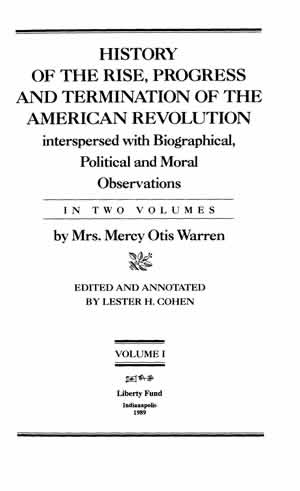
History of the Rise, Progress, and Termination of the American Revolution vol. 1

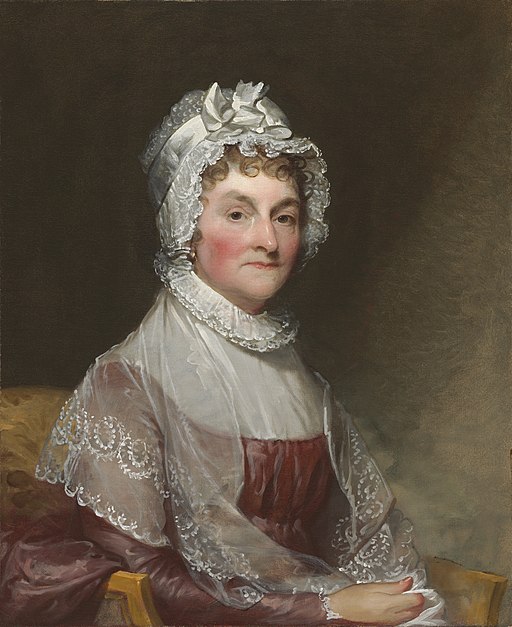
Vol. 1 of a 2 volume work. Mercy Otis Warren has been described as perhaps the most formidable female intellectual in eighteenth-century America. This work (in the first new edition since 1805) is an exciting and comprehensive study of the events of the American Revolution, from the Stamp Act Crisis of 1765 through the ratification of the Constitution in 1788-1789. Steeped in the classical, republican tradition, Warren was a strong proponent of the American Revolution. She was also suspicious of the newly emerging commercial republic of the 1780s and hostile to the Constitution from an Anti-Federalist perspective, a position that gave her history some notoriety.
History of the Rise, Progress, and Termination of the American Revolution interspersed with Biographical, Political and Moral Observations, in Two Volumes, Foreword by Lester H. Cohen (Indianapolis: Liberty Fund 1994). Vol. 1.
Copyright:
The copyright to this edition, in both print and electronic forms, is held by Liberty Fund, Inc.
People:
- Author: Mercy Otis Warren
- Editor: Lester H. Cohen
Found in:
Part of:
- History of the Rise, Progress, and Termination of the American Revolution 2 vols (Mercy Otis Warren)
Quoted 1 time:
Formats:
| Format | Description | Size |
|---|---|---|
| Facsimile PDF | This is a facsimile or image-based PDF made from scans of the original book. | 22.9 MB |
| HTML | This version has been converted from the original text. Every effort has been taken to translate the unique features of the printed book into the HTML medium. | 1.32 MB |
Table of Contents
- Contents: VOLUME ONE
- [VOLUME ONE OF THE 1805 EDITION]
- [VOLUME TWO OF THE 1805 EDITION]
- Foreword
- Bibliography
- The Writings of Mercy Otis Warren
- MANUSCRIPTS AND COLLECTIONS
- PUBLISHED COLLECTIONS
- WARREN’S PUBLICATIONS
- Secondary Sources
- Editor’s Note
- Warren’s References
- Acknowledgments
- List of Abbreviations
- AN ADDRESS TO THE INHABITANTS OF THE UNITED STATES
- INTRODUCTORY OBSERVATIONS
- The Stamp Act • A Congress convened at New York, One thousand seven hundred and sixty-five • The Stamp-Act repealed • New Grievances • Suspension of the Legislature of New York
- Cursory Observations • Massachusetts Circular Letter • A new House of Representatives called • Governor Bernard impeached • A Riot on the Seizure of a Vessel • Troops applied for to protect the King’s Officers • A Convention at Boston • Troops arrive • A Combination against all Commerce with Great Britain • A General Assembly convened at Boston—removed to Cambridge • Governor Bernard after his Impeachment repairs to England
- Character of Mr. Hutchinson • Appointed Governor of Massachusetts • The attempted Assassination of Mr. Otis • Transactions on the fifth of March, one thousand seven hundred and seventy • Arrival of the East India Company’s Tea-Ships • Establishment of Committees of Correspondence • The Right of Parliamentary Taxation without Representation urged by Mr. Hutchinson • Articles of Impeachment resolved on in the House of Representatives against Governor Hutchinson and Lieutenant Governor Oliver • Chief Justice of the Province impeached • Boston Port-Bill • Governor Hutchinson leaves the Province
- General Gage appointed Governor of Massachusetts • General Assembly meet at Salem • A proposal for a Congress from all the Colonies, to be convened at Philadelphia • Mandamus Counsellors obliged to resign • Resolutions of the General Congress • Occasional observations • The Massachusetts attentive to the military Discipline of their Youth • Suffolk Resolves • A Provincial Congress chosen in the Massachusetts • Governor Gage summons a new House of Representatives
- Parliamentary Divisions on American Affairs—cursory • Observations and Events • Measures for raising an Army of Observation by the four New England Governments of New Hampshire, Massachusetts, Rhode Island, and Connecticut • Battle of Lexington • Sketches of the Conduct and Characters of the Governors of the southern Provinces • Ticonderoga taken • Arrival of Reinforcements from England • Proscription and Characters of Samuel Adams and John Hancock, Esquires • Battle of Bunker-Hill • Death and Character of General Joseph Warren • Massachusetts adopt a stable Form of Government
- A Continental Army • Mr. Washington appointed to the Command • General Gage recalled—succeeded by Sir William Howe • Depredations on the Sea Coast • Falmouth burnt • Canadian Affairs • Death and Character of General Montgomery
- Dissensions in the British Parliament • Petition of Governor Penn rejected • Boston evacuated • Sir Henry Clinton sent to the Southward—Followed by General Lee—His Character • Sir Peter Parker’s Attack on Sullivan’s Island • General Howe’s Arrival at Sandy-Hook • General Washington leaves Cambridge • Observations on the Temper of some of the Colonies
- Declaration of Independence • Lord Howe’s Arrival in America • Action on Long Island • Retreat of the Americans through the Jersies, and the Loss of the Forts Washington and Lee • Affairs in Canada • Surprise of the Hessians at Trenton • Various Transactions in the Jersies • General Howe’s Retreat—Makes Head-Quarters at Brunswick—His Indecision—Some Traits of his Character
- Desultory Circumstances • Skirmishes and Events • General Howe withdraws from the Jersies—Arrives at the River Elk—Followed by Washington • The Battle of Brandywine • General Washington defeated, retreats to Philadelphia—obliged to draw off his Army • Lord Cornwallis takes Possession of the City • Action at Germantown, Red Bank, c • The British Army take Winter-Quarters in Philadelphia • The Americans encamp at Valley-Forge • General Washington’s Situation not eligible • De Lisle’s Letters • General Conway resigns • The Baron de Steuben appointed Inspector General of the American Army
- Northern Department • General Carleton superseded • General Burgoyne vested with the Command for Operations in Canada • Ticonderoga abandoned by General St. Clair • Affair of Fort Stanwix—Of Bennington, and various other important Movements of the two Armies, until the Convention of Saratoga • General Burgoyne repairs to England on Parole—His Reception there • Reflections and Observations on the Event of the Northern Campaign
- Observations on the Conduct of the British Parliament, previous to the Capture of Burgoyne • The ineffectual Efforts of the Commissioners sent to America, in consequence of Lord North’s Conciliatory Bill—Their Attempts to corrupt Individuals and Public Bodies • Negociation broken off • Manifesto published by the Commissioners • Counter Declaration by Congress • Sir William Howe repairs to England
- Evacuation of Philadelphia • Battle of Monmouth • General Lee censured • General Clinton reaches New York • The Count de Estaing arrives there—Repairs to Rhode Island—Expedition unsuccessful. French Fleet rendezvous at Boston, to refit after the Damages sustained by a Storm • Lord Howe leaves the American Seas • Marauding Exploits of General Grey • Destruction of Wyoming • Expedition into the Indian Territories
- Foreign Negociations • Dissensions among the American Commissioners • Deane recalled • Mr. Adams appointed • Mr. Lee and Mr. Adams recalled • Spain declares War against England • Mr. Jay sent to the Court of Madrid • Sir George Collier’s Expedition to Virginia—His sudden Recal—Ravages on the North River • Depredations in the State of Connecticut, in aid of Governor Tryon and his Partizans • General Washington seizes Stoney Point—Recovered by the British • Penobscot Expedition • Destruction of the American Navy
- A Retrospect of some Naval Transactions in the West Indies, one thousand seven hundred and seventy-eight, and seventy-nine • Affairs in Georgia concisely reviewed • General Lincoln sent to take the Command at the Southward • The Count de Estaing’s Arrival in Georgia • Savannah closely besieged by the Combined Forces of France and America • Repulsed by General Prevost • The Count de Estaing leaves the Southern Clime • The Count Pulaski slain in Georgia • Some Anecdotes of Count Kosciusko
- Sir Henry Clinton and Admiral Arbuthnot sail for South Carolina • Charleston invested • Capitulates • General Lincoln and his Army Prisoners of War • General Clinton returns to New York • Lord Cornwallis’s Command and Civil Administration in Charleston • Mr. Gadsden and other Gentlemen suspected, and sent to St. Augustine • Much Opposition to British Authority in both the Carolinas • The Count de Rochambeau and the Admiral de Tiernay arrive at Newport • British Depredations in the Jersies • Catastrophe of Mr. Caldwell and his Family • Armed Neutrality • Some observations on the State of Ireland • Riots in England • Cursory Observations
- APPENDIX TO VOLUME FIRST
- Note No. I. Page 7.
- Note No. II. Page 18.
- virginia resolves
- Note No. III. Page 19.
- Note No. IV. Page 20.
- Note No. V. Page 29.
- Note No. VI. Page 32.
- Note No. VII. Page 32.
- Note No. VIII. Page 55.
- Note No. IX. Page 64.
- Note No. X. Page 83.
- Note No. XI. Page 99.
- Note No. XII. Page 111.
- Note No. XIII. Page 118.
- Note No. XIV. Page 124.
- Note No. XV. Page 145.
- Note No. XVI. Page 153.
- Note No. XVII. Page 169.
- Note No. XVIII. Page 194.
- Note No. XIX. Page 197.
- Note No. XX. Page 216.
- APPENDIX TO VOLUME SECOND
- Note No. I. Page 228.
- General Burgoyne’s Instructions to Lieutenant Colonel Baum
- Note No. II. Page 230.
- Note No. III. Page 237.
- Note No. IV. Page 252.
- Note No. V. Page 288.
- Note No. VI. Page 292.
- Note No. VII. Page 316.
- Note No. VIII. Page 333.