Part of: An Inquiry into the Nature and Causes of the Wealth of Nations (Cannan ed.), in 2 vols. An Inquiry Into the Nature and Causes of the Wealth of Nations (Cannan ed.), vol. 2
- Adam Smith (author)
- Edwin Cannan (editor)
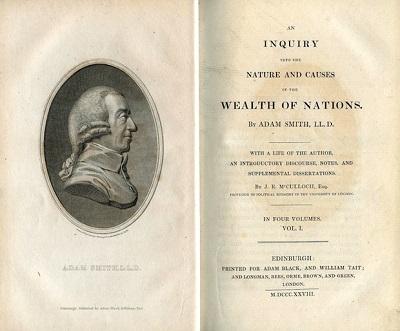
Cannan’s justly famous early 20th century edition of Smith’s Wealth of Nations with his introduction and notes.
Table of Contents
- Back to Top
- CONTENTS
- BOOK IV
- CHAPTER IV: OF DRAWBACKS
- CHAPTER V: OF BOUNTIES
- Digression concerning the Corn Trade and Corn Laws1
- CHAPTER VI: OF TREATIES OF COMMERCE
- ART. I
- ART. II
- ART. III
- CHAPTER VII: OF COLONIES
- Part First: Of the Motives for establishing new Colonies
- Part Second: Causes of the Prosperity of new Colonies
- Part Third: Of the Advantages which Europe has derived from the Discovery of America, and from that of a Passage to the East Indies by the Cape of Good Hope
- CHAPTER VIII: CONCLUSION OF THE MERCANTILE SYSTEM1
- CHAPTER IX: OF THE AGRICULTURAL SYSTEMS, OR OF THOSE SYSTEMS OF POLITICAL ŒCONOMY, WHICH REPRESENT THE PRODUCE OF LAND AS EITHER THE SOLE OR THE PRINCIPAL SOURCE OF THE REVENUE AND WEALTH OF EVERY COUNTRY
- BOOK V: Of the Revenue of the Sovereign or Commonwealth
- CHAPTER I: OF THE EXPENCES OF THE SOVEREIGN OR COMMONWEALTH
- PART I: Of the Expence of Defence
- PART II: Of the Expence of Justice
- PART III: Of the Expence of public Works and public Institutions
- Article I: Of the public Works and Institutions for facilitating the Commerce of the Society And, first, of those which are necessary for facilitating Commerce in general1
- Of the Public Works and Institutions which are necessary for facilitating particular Branches of Commerce1
- Article II: Of the Expence of the Institutions for the Education of Youth1
- Article III: Of the Expence of the Institutions for the Instruction of People of all Ages
- PART IV: Of the Expence of supporting the Dignity of the Sovereign
- Conclusion
- CHAPTER II: OF THE SOURCES OF THE GENERAL OR PUBLIC REVENUE OF THE SOCIETY
- PART I: Of the Funds or Sources of Revenue which may peculiarly belong to the Sovereign or Commonwealth
- PART II: Of Taxes
- Article I: Taxes upon Rent. Taxes upon the Rent of Land
- Taxes which are proportioned, not to the Rent, but to the Produce of Land
- Taxes upon the Rent of Houses
- Article II: Taxes upon profit, or upon the Revenue arising from Stock
- Taxes upon the Profit of particular Employments
- Appendix to Articles I and II Taxes upon the capital Value of Land, Houses, and Stock
- Article III: Taxes upon the Wages of Labour
- Article IV: Taxes which, it is intended, should fall indifferently upon every different Species of Revenue
- Capitation Taxes
- Taxes upon consumable Commodities
- CHAPTER III: OF PUBLIC DEBTS
- APPENDIX1
Loading...
Related People
Key Quotes
Colonies, Slavery & Abolition
The sovereign himself can never have either interest or inclination to pervert the order of justice, or to oppress the great body of the people. In the capital his presence overawes more or less all his inferior officers, who in the remoter provinces, from whence the complaints of the people are…
Free Trade
There may be good policy in retaliations of this kind, when there is a probability that they will procure the repeal of the high duties or prohibitions complained of. The recovery of a great foreign market will generally more than compensate the transitory inconveniency of paying dearer during a…
Taxation
In France there are both stamp–duties and duties upon registration. The former are considered as a branch of the aides or excise, and in the provinces where those duties take place, are levied by the excise officers. The latter are considered as a branch of the domain of the crown, and are levied…
Free Trade
To expect, indeed, that the freedom of trade should ever be entirely restored in Great Britain, is as absurd as to expect that an Oceana or Utopia should ever be established in it. Not only the prejudices of the publick, but what is much more unconquerable, the private interests of many…
Education
The discipline of colleges and universities is in general contrived, not for the benefit of the students, but for the interest, or more properly speaking, for the ease of the masters. Its object is, in all cases, to maintain the authority of the master, and whether he neglects or performs his duty,…
Economics
In the payment of the interest of the publick debt, it has been said, it is the right hand which pays the left. [52] The money does not go out of the country. It is only a part of the revenue of one set of the inhabitants which is transferred to another; and the nation is not a farthing the poorer.…
Free Trade
Were all nations to follow the liberal system of free exportation and free importation, the different states into which a great continent was divided would so far resemble the different provinces of a great empire. As among the different provinces of a great empire the freedom of the inland trade…
Economics
By means of glasses, hotbeds, and hotwalls, very good grapes can be raised in Scotland, and very good wine too can be made of them at about thirty times the expense for which at least equally good can be brought from foreign countries. Would it be a reasonable law to prohibit the importation of all…
Education
The discipline of colleges and universities is in general contrived, not for the benefit of the students, but for the interest, or more properly speaking, for the ease of the masters. Its object is, in all cases, to maintain the authority of the master, and whether he neglects or performs his duty,…
Money & Banking
It would be too ridiculous to go about seriously to prove, that wealth does not consist in money or in gold and silver, but in what money purchases.
Connected Readings
What to read next.
Commerce, Culture, and Liberty: Readings on Capitalism Before Adam SmithHenry C. Clark