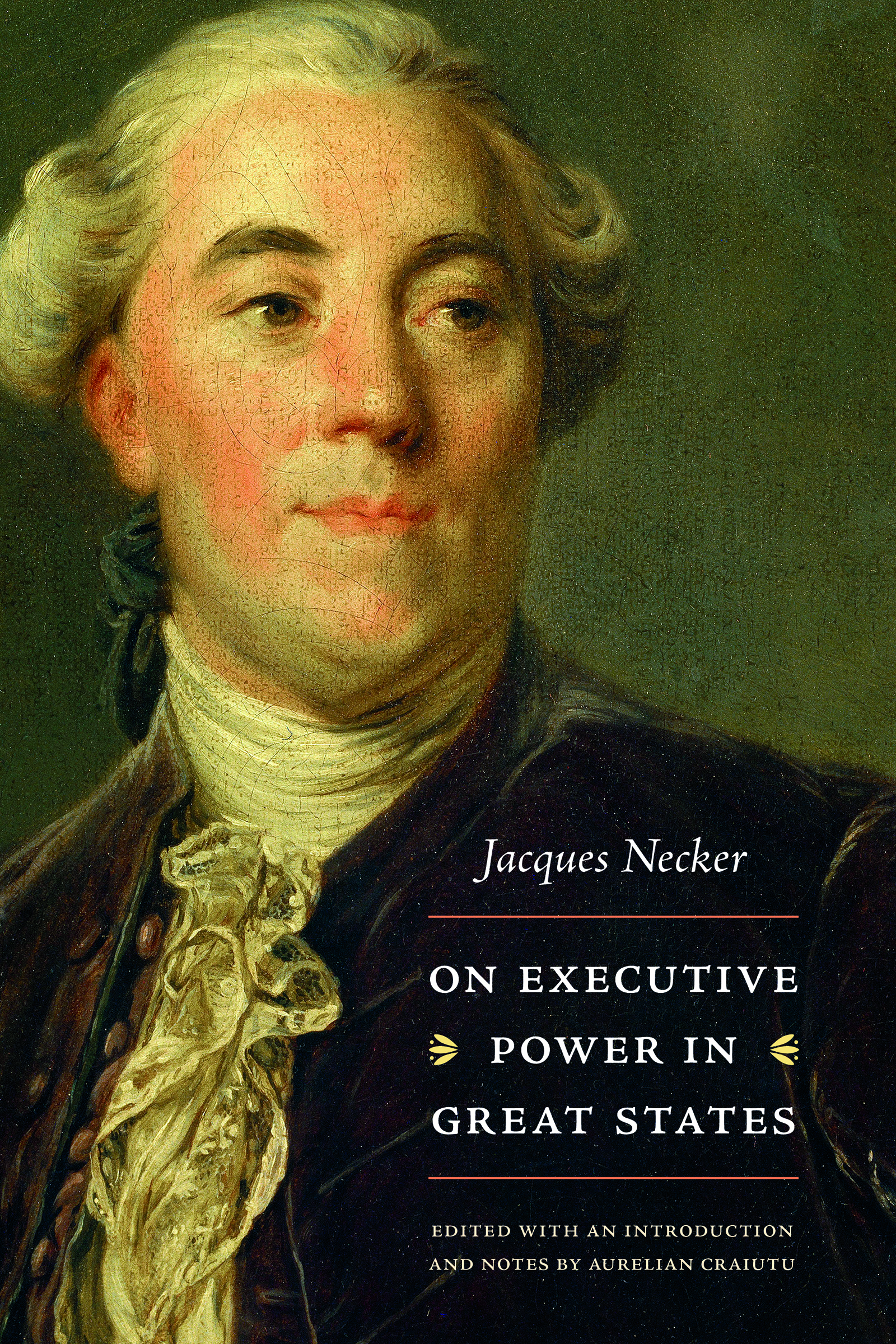
On Executive Power in Great States
- Jacques Necker (author)
- Aurelian Craiutu (editor)
On Executive Power in Great States (1792) is arguably one of the most important texts ever written on the issue of executive power in modern society. It includes memorable formulations regarding liberty and public spirit among the English and the Americans, the relation between economic prosperity and political freedom, and the seminal influence of religion and morals on liberty. Necker provides a defense of representative government and offers an examination of the French political system, which he compares on several occasions with England and America. Before Tocqueville, Necker understood the importance of America for the Old World as the first successful example of popular self-government and free institutions.
Show more
In his book, Necker called upon French legislators to study the principles of the U.S. Constitution. His bold innovation was to replace the theory of the functional separation of powers with the “intertwining of powers” that were dependent upon the existence of effective links between the executive and the legislative. In the absence of such links, Necker maintained, “all would be contest and confusion.” Necker’s fundamental premise was that it would be impossible to establish effective cooperation between different powers solely through the exercise of constant watchfulness and mutual distrust.
Related People
Critical Responses
Journal Article
On Executive Power in Great States by Jacques Necker (review)Henry C. Clark
Clark’s article is useful because it explicitly flags reasons to be skeptical of big claims about the book’s stature and helps you see where Necker departs from Montesquieu and the American founders (e.g., giving the executive more weight; preferring “interlacing” over strict separation).
Book
Four Moderation and the “Intertwining of Powers”: Jacques Necker’s ConstitutionalismAurelian Craiutu
Craiutu’s framing helps you isolate Necker’s distinctive move (collaboration/links between branches rather than strict separation) and, by doing so, clarifies exactly what a Madisonian/Montesquieuian or radical-republican critique would target.
Connected Readings

Book
Inventing the French Revolution `: Essays on French Political Culture in the Eighteenth CenturyKeith Michael Baker