The Theory of Moral Sentiments and on the Origins of Languages (Stewart ed.)

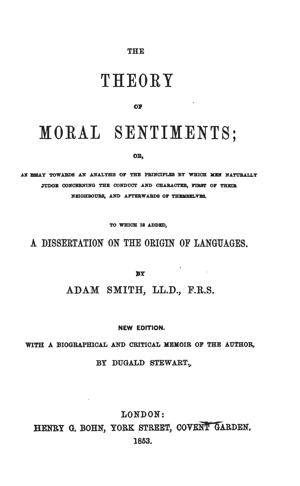
The Theory of Moral Sentiments; or, An Essay towards an Analysis of the Principles by which Men naturally judge concerning the Conduct and Character, first of their Neighbours, and afterwards of themselves. To which is added, A Dissertation on the Origins of Languages. New Edition. With a biographical and critical Memoir of the Author, by Dugald Stewart (London: Henry G. Bohn, 1853).
Copyright:
The text is in the public domain.
People:
- Author: Adam Smith
- Editor: Dugald Stewart
Found in:
Formats:
| Format | Description | Size |
|---|---|---|
| ePub | ePub standard file for your iPad or any e-reader compatible with that format | 454 KB |
| Facsimile PDF | This is a facsimile or image-based PDF made from scans of the original book. | 14.8 MB |
| HTML | This version has been converted from the original text. Every effort has been taken to translate the unique features of the printed book into the HTML medium. | 1.22 MB |
Table of Contents
- CONTENTS.
- ACCOUNT OF THE LIFE AND WRITINGS OF ADAM SMITH, LL.D., BY DUGALD STEWART.
- From his Birth till the Publication of the Theory of Moral Sentiments.
- Of the Theory of Moral Sentiments, and the Dissertation on the Origin of Languages.
- From the Publication of The Theory of Moral Sentiments, till that of The Wealth of Nations.
- Of the Inquiry into the Nature and Causes of the Wealth of Nations.*
- Conclusion of the Narrative.
- THE THEORY OF MORAL SENTIMENTS.
- Part First.: OF THE PROPRIETY OF ACTION, CONSISTING OF THREE SECTIONS.
- SECTION I.: OF THE SENSE OF PROPRIETY.
- CHAPTER I.: Of Sympathy.
- CHAPTER II.: Of the Pleasure of mutual Sympathy.
- CHAPTER III.: Of the manner in which we judge of the Propriety or Impropriety of the affections of other men, by their concord or dissonance with our own.
- CHAPTER IV.: The same subject continued.
- CHAPTER V.: Of the amiable and respectable Virtues.
- SECTION II.: OF THE DEGREES OF THE DIFFERENT PASSIONS WHICH ARE CONSISTENT WITH PROPRIETY.
- INTRODUCTION.
- CHAPTER I.: Of the Passions which take their origin from the Body.
- CHAPTER II.: Of those Passions which take their origin from a particular turn or habit of the Imagination.
- CHAPTER III.: Of the unsocial Passions.
- CHAPTER IV.: Of the social Passions.
- CHAPTER V.: Of the selfish Passions.
- SECTION III.: OF THE EFFECTS OF PROSPERITY AND ADVERSITY UPON THE JUDGMENT OF MANKIND WITH REGARD TO THE PROPRIETY OF ACTION; AND WHY IT IS MORE EASY TO OBTAIN THEIR APPROBATION IN THE ONE STATE THAN IN THE OTHER.
- CHAPTER I.: That though our sympathy with sorrow is generally a more lively sensation than our sympathy with joy, it commonly falls much more short of the violence of what is naturally felt by the person principally concerned.
- CHAPTER II.: Of the origin of Ambition, and of the distinction of Ranks.
- CHAPTER III.: Of the corruption of our moral sentiments, which is occasioned by this disposition to admire the rich and the great, and to despise or neglect persons of poor and mean condition.
- Part Second.: OF MERIT AND DEMERIT; OR, OF THE OBJECTS OF REWARD AND PUNISHMENT; CONSISTING OF THREE SECTIONS.
- SECTION I.: OF THE SENSE OF MERIT AND DEMERIT.
- INTRODUCTION.
- CHAPTER I.: That whatever appears to be the proper object of gratitude, appears to deserve reward; and that, in the same manner, whatever appears to be the proper object of resentment, appears to deserve punishment.
- CHAPTER II.: Of the proper Objects of Gratitude and Resentment.
- CHAPTER III.: That where there is no approbation of the conduct of the person who confers the benefit, there is little sympathy with the gratitude of him who receives it: and that, on the contrary, where there is no disapprobation of the motives of the person who does the mischief, there is no sort of sympathy with the resentment of him who suffers it.
- CHAPTER IV.: Recapitulation of the foregoing Chapters.
- CHAPTER V.: The Analysis of the Sense of Merit and Demerit.
- SECTION II.: OF JUSTICE AND BENEFICENCE.
- CHAPTER I.: Comparison of those two Virtues.
- CHAPTER II.: Of the sense of Justice, of Remorse, and of the consciousness of Merit.
- CHAPTER III.: Of the utility of this constitution of Nature.
- SECTION III.: OF THE INFLUENCE OF FORTUNE UPON THE SENTIMENTS OF MANKIND, WITH REGARD TO THE MERIT OR DEMERIT OF ACTIONS.
- INTRODUCTION.
- CHAPTER I.: Of the Causes of this influence of Fortune.
- CHAPTER II.: Of the Extent of this influence of Fortune.
- CHAPTER III.: Of the final cause of this Irregularity of Sentiments.
- Part Third.: OF THE FOUNDATION OF OUR JUDGMENTS CONCERNING OUR OWN SENTIMENTS AND CONDUCT, AND OF THE SENSE OF DUTY.
- CHAPTER I.: Of the Principle of Self-approbation and of Self-disapprobation.
- CHAPTER II.: Of the love of Praise, and of that of Praise-worthiness; and of the dread of blame, and of that of Blame-worthiness.
- CHAPTER III.: Of the Influence and Authority of Conscience.
- CHAPTER IV.: Of the Nature of Self-deceit, and of the Origin and Use of general Rules.
- CHAPTER V.: Of the Influence and Authority of the general Rules of Morality, and that they are justly regarded as the Laws of the Deity.
- CHAPTER VI.: In what cases the Sense of Duty ought to be the sole Principle of our Conduct; and in what cases it ought to concur with other Motives.
- Part Fourth.: OF THE EFFECT OF UTILITY UPON THE SENTIMENT OF APPROBATION. CONSISTING OF ONE SECTION.
- CHAPTER I.: Of the Beauty which the Appearance of Utility bestows upon all the Productions of Art, and of the extensive Influence of this Species of Beauty.
- CHAPTER II.: Of the Beauty which the appearance of Utility bestows upon the Characters and Actions of Men; and how far the Perception of this Beauty may be regarded as one of the original Principles of approbation.
- Part Fifth.: OF THE INFLUENCE OF CUSTOM AND FASHION UPON THE SENTIMENTS OF MORAL APPROBATION AND DISAPPROBATION. CONSISTING OF ONE SECTION.
- CHAPTER I.: Of the Influence of Custom and Fashion upon our notions of Beauty and Deformity.
- CHAPTER II.: Of the Influence of Custom and Fashion upon Moral Sentiments.
- Part Sixth.: OF THE CHARACTER OF VIRTUE. CONSISTING OF THREE SECTIONS.
- INTRODUCTION.
- SECTION I.: OF THE CHARACTER OF THE INDIVIDUAL, SO FAR AS IT AFFECTS HIS OWN HAPPINESS; OR OF PRUDENCE.
- SECTION II.: OF THE CHARACTER OF THE INDIVIDUAL, SO FAR AS IT CAN AFFECT THE HAPPINESS OF OTHER PEOPLE.
- INTRODUCTION.
- CHAPTER I.: Of the Order in which Individuals are recommended by Nature to our care and attention.
- CHAPTER II.: Of the order in which Societies are by nature recommended to our Beneficence.
- CHAPTER III.: Of universal Benevolence.
- SECTION III.: OF SELF-COMMAND.
- CONCLUSION OF THE SIXTH PART.
- Part Seventh.: OF SYSTEMS OF MORAL PHILOSOPHY: CONSISTING OF FOUR SECTIONS.
- SECTION I: OF THE QUESTIONS WHICH OUGHT TO BE EXAMINED IN A THEORY OF MORAL SENTIMENTS.
- SECTION II.: OF THE DIFFERENT ACCOUNTS WHICH HAVE BEEN GIVEN OF THE NATURE OF VIRTUE.
- INTRODUCTION.
- CHAPTER I.: Of those Systems which make Virtue consist in Propriety.
- CHAPTER II.: Of those Systems which make Virtue consist in Prudence.
- CHAPTER III.: Of those Systems which make Virtue consist in Benevolence.
- CHAPTER IV.: Of Licentious Systems.
- SECTION III.: OF THE DIFFERENT SYSTEMS WHICH HAVE BEEN FORMED CONCERNING THE PRINCIPLE OF APPROBATION.
- INTRODUCTION.
- CHAPTER I.: Of those Systems which deduce the Principle of Approbation from Self-Love.
- CHAPTER II.: Of those Systems which make Reason the Principle of Approbation.
- CHAPTER III.: Of those Systems which make Sentiment the Principle of Approbation.
- SECTION IV.: OF THE MANNER IN WHICH DIFFERENT AUTHORS HAVE TREATED OF THE PRACTICAL RULES OF MORALITY.
- CONSIDERATIONS CONCERNING THE FIRST FORMATION OF LANGUAGES, AND THE DIFFERENT GENIUS OF ORIGINAL AND COMPOUNDED LANGUAGES.
- CONSIDERATIONS CONCERNING THE FIRST FORMATION OF LANGUAGES, &c.
Loading...