The Works of Tacitus, vol. 3 - Gordon’s Discourses II, History (Books 1-2)

This volume contains Gordon’s Discourses upon Tacitus and Books 1 and 2 of The History.
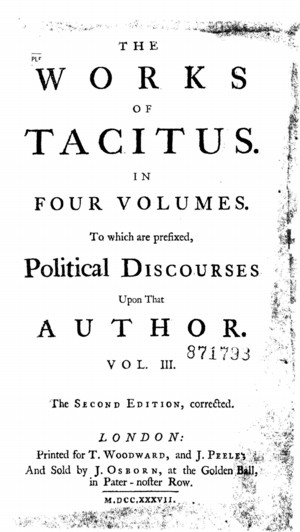
The Works of Tacitus. In Four Volumes. To which are prefixed, Political Discourses upon that Author by Thomas Gordon. The Second Edition, corrected. (London: T. Woodward and J. Peele, 1737). Vol. 3.
Copyright:
The text is in the public domain.
People:
- Author: Publius Cornelius Tacitus
- Editor: Thomas Gordon
Quoted 2 times:
Formats:
| Format | Description | Size |
|---|---|---|
| Facsimile PDF | This is a facsimile or image-based PDF made from scans of the original book. | 48.5 MB |
| Facsimile PDF small | This is a compressed facsimile or image-based PDF made from scans of the original book. | 32.9 MB |
| HTML | This version has been converted from the original text. Every effort has been taken to translate the unique features of the printed book into the HTML medium. | 985 KB |
| Kindle | This is an E-book formatted for Amazon Kindle devices. | 555 KB |
Table of Contents
- TO HIS Royal Highness, FREDERIC PRINCE of WALES.
- Political Discourses
- THE CONTENTS OF THE DISCOURSES.
- THE INTRODUCTION.
- DISCOURSES UPON TACITUS.
- DISCOURSE I.: Of the Emperors who are the subject of the ensuing History: Of their Ministers, their Misfortunes, and the causes of their Fall.
- Sect. I.: An Idea of Nero’s Reign, how mildly it began, how terrible it grew. The deceitfulness of prosperity.
- Sect. II.: The weakness of Galba, and the iniquities of his Ministers.
- Sect. III.: The folly of the evil measures pursued by these Ministers, how pernicious to themselves and to the Emperor.
- Sect. IV.: Galba’s blindness in trusting intirely to his Favourites, who by their wickedness blasted his reign, and their own hopes.
- Sect. V.: The infatuation of men in power; they generally rely upon it as never to end, and thence boldly follow the bent of their passions. Instances of this. Guilty Ministers how dangerous.
- Sect. VI.: Weak and evil Princes rarely profit by able Ministers; they like flatterers better: These frustrate the good advice of others.
- Sect. VII.: How difficult it is for a worthy man to serve a bad Prince, and how dangerous.
- Sect. VIII.: Under wicked Princes, how natural and common it is to wish for a change. Their different treatment living and dead. In what a Prince is chiefly to confide.
- DISCOURSE II.: Of competition amongst the Ministers of a Prince, and their corruption. The evil effects of indolence in a Prince.
- Sect. I.: Discord between Ministers, how fatal to their Masters.
- Sect. II.: An indolent Prince a ready prey to the falsest and worst of all men: These disgrace his Reign, and provoke his people. — Their amazing corruption.
- Sect. III.: The Reign of an indolent Prince, how destructive it may prove, however harmless the man. Into what contempt he falls.
- Sect. IV.: A Prince beset with evil Counsellors, how fast he improves in evil.
- DISCOURSE III.: Of public Frugality.
- Sect. I.: The Prodigality of the Emperors; its terrible consequences to the Public, namely, Tyranny, Murders and Oppression.
- Sect. II.: Only the worst men share in the bounties of an extravagant ‘Prince, and carefully seclude the best — How ruinous his extravagance to himself and the State.
- Sect. III.: The waste of public Money, its tendency to produce popular Commotions and civil War. — How much men love themselves better than the Public. — Such waste seldom answers any end.
- Sect. IV.: The wisdom of Parsimony in a Prince ---- The certain distress and disgrace of such as are prodigal.
- Sect. V.: Public Frugality and public Profusion compared in their effects. ---- Princes brought by extravagance into distress have no resource in the hearts and purses of the People.
- Sect. VI.: The greatest Revenues insufficient under ill management----How grievous this to the People, how baneful to the State. The true Liberality of a Prince, what. The vile spirit of flattering Casuists.
- Sect. VII.: Public Frugality advantageous to all; disliked only by a few.----Public Bounties ill bestowed, how dishonourable.
- DISCOURSE IV.: Of Princes.
- Sect. I.: The Duty of a Prince, what. His motives to be good, and content with limited Power: That of the Roman Emperors bounded.
- Sect. II.: The wisdom of governing by Law ----- No just power without Law ---- Just Government requires sense ---- Any wretch capable of tyrannizing ---- No good man fond of boundless power.
- Sect. III.: How amiable the character of a good Prince, who rules by Justice and Law, who loves and relieves his People.
- Sect. IV.: The miserable Spirit and Infamy of Princes who consider themselves above Law, and independent on their People.
- Sect. V.: Princes seeking or possessing arbitrary Power, rarely exercise any themselves: Their Ministers and Creatures generally rule all.
- Sect. VI.: The arbitrary will of Favourites often proves the only Law of a bad and arbitrary Prince — How apt they are to abuse his Power, and at last to desert him.
- Sect. VII.: Princes guilty of the Oppressions committed by their Authority. Their Ministers are generally, like them, bad or good. A limited Authority safest to Kings and Ministers. The best Ministers obnoxious to clamours.
- Sect. VIII.: The benefit of standing Laws to Princes and their Ministers, further illustrated. What regard Princes should have to posthumous Fame, what dread of Infamy.
- Sect. IX.: Idle Princes seldom come to be able Princes. How much application to business imports them, for their own accomplishment and the good of their Government.
- Sect. X.: The most wretched and wicked of all Princes are wont to account themselves most sacred, and to claim Attributes divine.
- DISCOURSE V.: The same subject continued.
- Sect. I.: The example of a Prince its efficacy: When good how advantageous to his People and himself.
- Sect. II.: The Character of a Prince to be learnt from that of his Company and Favourites, and his designs by the Opinions which become in fashion about him.
- Sect. III.: Doctrines in defence of lawless Power, and against civil Liberty, to be punished as Treason against the Public. How Princes discover their spirit.----They seldom take warning.
- Sect. IV.: Of the Veracity of Princes----The folly of Falshood----The worst and silliest men practise it most ---- it is inseparable from Tyranny.
- Sect. V.: Princes of noble and good minds scorn to deceive: thence their Glory and Popularity.
- Sect. VI.: The consequences of Falshood in a Prince, Scorn and Impotence----It is the mark of a poor and dishonest Spirit----Great and virtuous Spirits abhor it.
- Sect. VII.: Tyranny worse than Anarchy, or rather nothing but Anarchy.
- Sect. VIII.: Bad Princes ought to be treated with severity and abhorrence, in honour and justice to the good ---- No worthy Prince offended to see a wicked Prince exposed.
- DISCOURSE VI.: Of Bigotry in Princes.
- Sect. I.: The mischief of Bigotry in a Prince: Its strange efficacy, and what Chimera’s govern it.
- Sect. II.: How easily a bigotted Prince is led against reason and interest: What ravages he is apt to commit.
- Sect. III.: A bigotted Prince how subject to be drawn into Guilt and Folly — The dictates of Bigotry how opposite to those of true Religion.
- Sect. IV.: Further instances of the great mischiefs occasioned by Bigotry of Princes.
- DISCOURSE VII.: Of Ministers.
- Sect. I.: The choice of Ministers how much it imports Prince and People. Of what sad consequence to both, when bad. The bad only serve themselves, not their Master.
- Sect. II.: A sure rule for a Prince to know when he is advised faithfully. The duty of a Minister to warn Princes with freedom. The interest of Princes to hear a Minister patiently. Few will tell them truth, when telling it is offensive. A wise Prince will encourage it.
- Sect. III.: Ministers to be narrowly observed, as well as heard. They sometimes combine to nourish corruption and blind the Prince. How nearly it concerns him that all about him be uncorrupt.
- Sect. IV.: What selfish ends the Counsellors of Princes sometimes pursue, yet pretend public good. They gratify private passion to the ruin of the State. What a reproach to a Prince the corruption of his Servants.
- Sect. V.: Under a Prince subject to be blindly managed, a change of Ministers rarely mends the Administration He often hates his Ministers, yet still employs them. Ministers most in danger where the Prince has most Power.
- Sect. VI.: Ministers trusted without controul, sometimes threatening and perillous to a Prince. How fatal this often to themselves, and to the State.
- Sect. VII.: The great mischief of exalting Favourites beyond measure, especially such as command great Armies.
- DISCOURSE VIII.: The same subject continued.
- Sect. I.: Good Ministers often ruined and destroyed for their virtue by a combination of the bad. The spight and wicked arts of the latter. How ready to charge their own guilt upon the innocent.
- Sect. II.: How hard it is for a good Minister to support himself with a Prince surrounded by Sycophants and Seducers, or to preserve him and his State. Their execrable Stratagems to execute their Malice. How such sometimes abuse the Prince, mislead him, distress him, and murder him.
- Sect. III.: Reflections upon the fate of King James the fifth of Scotland seduced and undone by Minions, who withdrew him from the direction of an honest Minister.
- Sect. IV.: Where Flattery is encouraged, Flatterers rule, and sincerity is banished. Ministers sometimes fall not through guilt but faction; yet always accused of guilt.
- Sect. V.: A Minister may be disgraced for his Virtue, and Fidelity to his Prince. Mercenary Courtiers certain Enemies to upright Ministers. Justice done to both by time and history.
- DISCOURSE IX.: Of the People.
- Sect. I.: The variable Character of the People: very good or very bad, according to their education and government. Hence the improvement or depravation of their manners.
- Sect. II.: The People under good Government apt to be peaceable and grateful: often patient under Oppression: often moderate in opposing Oppressors: inclinable to Justice when not misled.
- Sect. III.: The People generally fond of old Names and Habits. The difference between the same People under different Governments: How generous and friendly when free; how vicious and false when enslaved.
- Sect. IV.: The People when deceived by names and deluders, how extremely blind and cruel, yet mean well.
- Sect. V.: The power of delusion further illustrated. The dreadful wickedness and impieties committed under the name of Religion. Religious cheats surpass all others.
- Sect. VI.: The People not turbulent unless seduced or oppressed: slow to resist Oppressors: sometimes mild even in their just vengeance: brave in defence of their Liberties.
- DISCOURSE X.: The same Subject continued.
- Sect. I.: The infatuation of Men in power: they are much apter to oppress, than the People to rebel. People oppressed rejoice in public misfortunes. In disputes between Magistrates and People, the former generally to blame.
- Sect. II.: The gentleness of the People in their pursuit of Justice against oppressive Magistrates. How readily Men who have oppressed the Law, seek the protection of the Laws. The People not revengeful: they shew mercy where they have found none.
- Sect. III.: The People not hard to be governed, nor unconstant, nor ungrateful, at least not so often as they are accused.
- Sect. IV.: The People falsly charged with Fickleness, and Ingratitude, and Rebellion in resisting Oppressors and Tyrants. All Tyrants, all who assume lawless rule, are Rebels, and the greatest.
- Sect. V.: People who are slaves love not their Prince so affectionately, nor can defend him so bravely, as those who are free.
- Sect. VI.: The weak and precarious condition of the greatest Prince, who is not beloved by his People. No Tyrant can be, and why.
- DISCOURSE XI.: Of Nobility.
- Sect. I.: The political cause of Nobility. They are readily respected by the People: apt to oppress. Nobility without Virtue, what. The Spirit of Nobility, what it ought to be.
- Sect. II.: The Duty of a Nobleman to his Country. In Virtue and public Spirit he ought to surpass others.
- Sect. III.: A Nobleman void of good Qualities, or possessed with bad, a miserable Character. The Baseness and Corruption of the Roman Nobility; its fatal consequence.
- Sect. IV.: The beginning of public Corruption generally from the Nobility: How ruinous this to the Public, and to themselves.
- Sect. V.: The advantages of public Liberty to the Nobility. How fast Tyrants destroy them. The strange degeneracy of the Roman Nobility: contemptible, yet proud: subject to be degraded for base Morals or Poverty.
- Sect. VI.: Public Virtue justly due from the Nobility to the Public. They ought to be zealous for Liberty upon their own account.
- DISCOURSE XII.: Of public Teaching and Teachers.
- Sect. I.: Whoever is head of the State ought to be head of the Religon of the State. The force of early impressions, with their use and abuse.
- Sect. II.: The ignorance of the People no pledge of security to to their Governors. The ignorant Rabble always most tumultuous.
- Sect. III.: The untaught vulgar, how liable to be seduced. The great Power of their Teachers over them.
- Sect. IV.: The deceitfulness of Doctrines which are against Reason and Nature.
- Sect. V.: The foregoing Reasoning further illustrated. How much it behoves Rulers that their Subjects be well and rationally taught.
- Sect. VI.: Power in the hands of the public Teachers how dangerous to Rulers; and how ill it suits with Christianity.
- Sect. VII.: The absurdity of implicit belief in any set of Teachers, with its mischievous and monstrous consequences. The natural progress of Persecution.
- Sect. VIII.: The Will of God not deposited with any set of Men. The use of public Teaching, with the Character necessary to public Teachers. How much they are corrupted by Pomp and great Wealth.
- Sect. IX.: Public Teachers have no Power, no Creation but from the State. Their Folly and ill Policy in claiming any other.
- Sect. X.: The fatal and ungodly consequences of allowing force in matters of Religion and Conscience; how inconsistent with the nature and end of religious Teaching. The contempt of public Teachers, whence it arises, and the cry of Priestcraft how founded.
- Sect. XI.: Power in the hands of any public Teachers, leads naturally to Popery, and is Popery. How apt they are to differ amongst themselves, yet claim conformity from all others. Persuasion and good example their only province; the sanctity of their doings their only sanctity.
- Sect. XII.: How it is that public Teachers fail of respect, or gain it.
- Sect. XIII.: Excessive Revenues of the public Teachers, how pernicious to the World. A decent and easy maintenance to be allowed them.
- Sect. XIV.: An inquiry why the Christian Dispensation has, with all its advantages and excellencies, so little mended the World. Whether and how far public Teachers are chargeable with this.
- Sect. XV.: Of Public Spirit, its use and efficacy. How little promoted by public Teachers. Some Considerations upon the importance and character of Public Spirit.
- THE HISTORY OF TACITUS.
- BOOK I.
- The SUMMARY.
- BOOK II.
- The SUMMARY.
Loading...