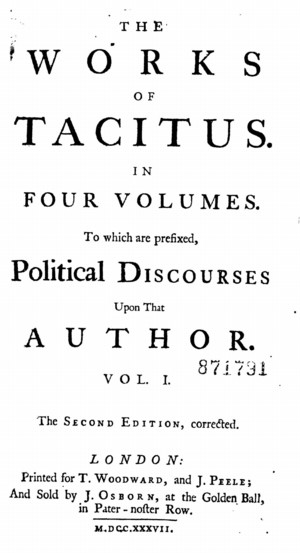
The Works of Tacitus, vol. 1 - Gordon’s Discourses, Annals (Books 1-3)

The historical works of Tacitus are a history of the period from A.D. 14 to 96 in thirty volumes. Although many of the works were lost (only books 1-5 of the Histories and 1-6 and 11-16 of the Annals survive), enough remains to provide a good sense of Tacitus’s political and moral philosophy. He recognized the necessity for strong rulers but argued that more should be done to manage the succession of power and allow for the ascension of talent. Tacitus asserted that it was the dynastic ambitions of Rome’s many emperors that caused the decline of moral and political life and precluded the possibility of recruiting leaders of real ability. Moreover, the dynastic temptation caused political instability because military force was now required for political change. His works point to the necessity of systematic institutional restraints on power for the preservation of liberty. Gordon’s translation and his lengthy Discourses on Tacitus bring Tacitus’ ideas up to date and apply them to the British state of the early 18th century.
The Works of Tacitus. In Four Volumes. To which are prefixed, Political Discourses upon that Author by Thomas Gordon. The Second Edition, corrected. (London: T. Woodward and J. Peele, 1737). Vol. 1.
Copyright:
The text is in the public domain.
People:
- Author: Publius Cornelius Tacitus
- Editor: Thomas Gordon
Quoted 1 time:
Formats:
| Format | Description | Size |
|---|---|---|
| Facsimile PDF | This is a facsimile or image-based PDF made from scans of the original book. | 33 MB |
| Facsimile PDF small | This is a compressed facsimile or image-based PDF made from scans of the original book. | 26.4 MB |
| HTML | This version has been converted from the original text. Every effort has been taken to translate the unique features of the printed book into the HTML medium. | 1010 KB |
| Kindle | This is an E-book formatted for Amazon Kindle devices. | 580 KB |
Table of Contents
- TO The Right Honourable Sir Robert Walpole,
- THE CONTENTS OF THE DISCOURSES.
- DISCOURSES UPON TACITUS.
- DISCOURSE I.: Upon the former English Translations of Tacitus.
- Sect. I.: Of the Translation by Greenway and Sir H. Savill.
- Sect. II.: Of the English Translation by several hands.
- Sect. III.: Of the last Translation of the first Annal.
- Sect. IV.: Of the last Translation of the second Annal.
- Sect. V.: Of the last Translation of the third Annal.
- Sect. VI.: Of the last Translation of the fourth, fifth, and sixth Annal.
- Sect. VII.: Of the last Translation of the eleventh Annal.
- Sect. VIII.: Of the last Translation of the twelfth and thirteenth Annals.
- Sect. IX.: Of the last Translation of the fourteenth, fifteenth, and sixteenth Annals.
- DISCOURSE II.: Upon Tacitus and his Writings.
- Sect. I.: The Character of Tacitus.
- Sect. II.: How much he excells in Description and Force.
- Sect. III.: Further instances of the justness of his Genius, and of his great Thoughts.
- Sect. IV.: The Morality of Tacitus, and his spirit virtuous and humane.
- Sect. V.: The Stile of Tacitus, how pertinent and happy: his Obscurity, a charge of the moderns only.
- Sect. VI.: A general Character of his Works.
- Sect. VII.: Tacitus vindicated from the imputation of deriving events from counsels too subtle and malevolent.
- Sect. VIII.: More Proofs of the Candour and Veracity of Tacitus.
- Sect. IX.: Mr. Bayle’s unjust censure of Tacitus; and how well the latter knew and observed the Laws of History.
- Sect. X.: An Apology for the wrong account by Tacitus given of the Jews and Christians, and for his disregard of the Religion then received.
- Sect. XI.: The foolish censure of Boccalini and others upon Tacitus.
- Sect. XII.: Of the several Commentators and Translators of Tacitus.
- Sect. XIII.: A Conjecture concerning the modern Languages, more largely concerning the English.
- Sect. XIV.: A Conjecture concerning the present state of the English Tongue, with an account of the present Work.
- DISCOURSE III.: Upon Cæsar the Dictator.
- Sect. I.: Of Cæsar’s Usurpation, and why his Name is less odious than that of Catiline.
- Sect. II.: Of the publick Corruption by Cæsar promoted or introduced; with his bold and wicked Conduct.
- Sect. III.: Cæsar might have purified and reformed the State; but far different were his intentions. His Art, good Sense, and continued ill Designs.
- Sect. IV.: The probability of his waxing more cruel, had he reigned much longer.
- Sect. V.: Cæsar no lawful Magistrate, but a public Enemy.
- Sect. VI.: Of the share which Casualties had, in raising the Name and Memory of Cæsar. The Judgment of Cicero concerning him.
- Sect. VII.: How vain it is to extol any Designs of his for the Glory of the Roman people.
- Sect. VIII.: Of his Death; and the rashness of ascribing to divine Vengeance the fate of such as slew him.
- DISCOURSE IV.: Upon Octavius Cæsar, afterwards called Augustus.
- Sect. I.: Of the base and impious Arts by which he acquired the Empire.
- Sect. II.: Of the vindictive spirit of Octavius, and his horrid Cruelties.
- Sect. III.: Of the treachery, ingratitude, and further cruelties of Octavius. That the same were wanton and voluntary.
- Sect. IV.: Of the popular Arts and Accidents which raised the Character of Augustus.
- Sect. V.: Though Augustus courted the people, and particular Senators, he continued to depress public Liberty, and the Senate.
- Sect. VI.: What Fame he derived from the Poets and other flattering Writers of his time.
- Sect. VII.: Of the false Glory sought and acquired by Augustus, from the badness of his Successors.
- Sect. VIII.: The Character of Augustus.
- Sect. IX.: Of the Helps and Causes which acquired and preserved the Empire to Augustus. His great Power and Fortune no proof of extraordinary Ability.
- DISCOURSE V.: Of Governments free and arbitrary, more especially that of the Cæsars.
- Sect. I.: The Principle of God’s appointing and protecting Tyrants, an Absurdity not believed by the Romans.
- Sect. II.: The reasonableness of resisting Tyrants asserted, from the Ends of Government, and the Nature of the Deity. Opinions the most impious and extravagant, why taught, and how easily swallowed.
- Sect. III.: The danger of slavish Principles to such as trust in them, and the notorious insecurity of lawless Might.
- Sect. IV.: Princes of little and bad Minds, most greedy of Power. Princes of large and good Minds chuse to rule by Law and Limitations.
- Sect. V.: The Wisdom and Safety of ruling by standing Laws, to Prince and People.
- Sect. VI.: The Condition of free States, how preferable to that of such as are not free.
- Sect. VII.: The Misery and Insecurity of the Cæsars from their overgrown Power.
- Sect. VIII.: A representation of the Torments and Horrors under which Tiberius lived.
- Sect. IX.: The terrible Operation of lawless Power upon the minds of Princes; and how it changes them.
- Sect. X.: The wretched Fears accompanying the Possession of arbitrary Power, exemplified in Caligula and other Roman Emperors.
- Sect. XI.: What it is that constitutes the Security and Glory of a Prince; and how a Prince and People become estranged from each other.
- Sect. XII.: How nearly it behoves a Prince to be beloved and esteemed by his Subjects. The terrible Consequences of their mutual Mistrust and Hatred.
- Sect. XIII.: Public Happiness only then certain, when the Laws are certain and inviolable.
- DISCOURSE VI.: Of the old Law of Treason by the Emperors perverted and extended.
- Sect. I.: The antient Purpose of that Law; the Politics of Augustus in stretching it.
- Sect. II.: The Deification of the Emperors, what an engine of Tyranny, and snare to the Roman People.
- Sect. III.: The Images of the Emperors, how sacred they became, and how pernicious.
- Sect. IV.: What a destructive Calamity the Law of Majesty grew, and how fast Treasons multiplied under its Name.
- DISCOURSE VII.: Of the Accusations, and Accusers under the Emperors.
- Sect. IV.: The pestilent Employment of these Men, their Treachery and Encouragement.
- Sect. II.: The traiterous Methods taken to circumvent and convict Innocence. The spirit of accusing how common, the dread of it how universal; and the misery of the Times.
- Sect. III.: Plots feigned or true, an ample field for Accusations and Cruelty; and upon what miserable Evidence Executions were decreed.
- Sect. IV.: What ridiculous Causes produced capital Guilt. The spirit of the Emperor Constantius; with somewhat of his Father Constantine.
- Sect. V.: The black and general carnage made under Constantius, by his bloody Minister Paulus Catena, for certain Acts of Superstition and Curiosity.
- Sect. VI.: The Ravages of the Accusers continued; their Credit with the Emperors; yet generally meet their Fate. The Falsehood of these Princes. The melancholy State of those Times.
- Sect. VII.: The increase of Tyranny. Innocence and Guilt not measured by the Law, but by the Emperor’s Pleasure and Malice.
- Sect. VIII.: What Tacitus means by Instrumenta regni.
- Sect. IX.: How much these Emperors hated, and how fast they destroyed all great and worthy Men. Their dread of every Man for any Reason.
- Sect. X.: Reflections upon the Spirit of a Tyrant. With what Wantonness the Roman Emperors shed the blood of the Roman People. The blindness of such as assisted the Usurpation of Cæsar and Augustus.
- Sect. XI.: Why under such Tyrants, the Senate continued to subsist.
- Sect. XII.: How the unrelenting Cruelty of the Emperors hastened the Dissolution of the Empire. The bad Reigns of Constantine and Constantius. The good Reign of Julian. The indiscreet behaviour of the Christians. Continued Tyranny; and end of the Empire.
- Sect. XIII.: The Excellency of a limited Monarchy, especially of our own.
- DISCOURSE VIII.: Of the general Debasement of Spirit and Adulation which accompany Power unlimited.
- Sect. I.: The motives of Flattery considered. Its vileness, and whence it begins.
- Sect. II.: Men of elevated Minds irreconcileable to Arbitrary Power, and thence suspected by it. The Court paid to it always insincere, sometimes expedient, but seldom observes any bounds.
- Sect. III.: The excessive Power of the Imperial freed Slaves; with the scandalous Submission and Honours paid them by the Romans.
- Sect. IV.: The excessive Flattery of the Senate, how ill judged.
- Sect. V.: The free Judgment of Posterity a powerful warning to Princes, to reign with moderation and to detest Flatterers. The Name and Memory of the Roman Tyrants how treated.
- Sect. VI.: How lamentably Princes are debauched and misled by Flatterers.
- Sect. VII.: The pestilent tendency of flattering Counsels, and the Glory of such as are sincere.
- DISCOURSE IX.: Upon Courts.
- Sect. I.: Of Freedom of Speech; and how reasonable it is.
- Sect. II.: The Spirit of Courtiers what; some good ones.
- Sect. III.: The Arts of Courtiers; their Cautiousness, and its Causes.
- Sect. IV.: Of Slanderers and Tale-bearers in Courts. The Folly of Craft.
- Sect. V.: How much worthless People abound in Courts, and why.
- Sect. VI.: The remarkable Fickleness and Insincerity of Courtiers.
- DISCOURSE X.: Of Armies and Conquest.
- Sect. I.: The Burden and Danger of maintaining great Armies.
- Sect. II.: Great Armies the best disciplined, whether thence the less formidable to a Country. Their Temper and Views.
- Sect. III.: Princes ruling by military Power, ever at the Mercy of military Men.
- Sect. IV.: Instances of the Boldness and Fury of the Roman Soldiery.
- Sect. V.: The Humour of conquering, how injudicious, vain, and destructive.
- Sect. VI.: The Folly of conquering further urged and exemplified.
- THE ANNALS OF TACITUS.
- BOOK I.
- The SUMMARY.
- BOOK II.
- The SUMMARY.
- BOOK III.
- The SUMMARY.