A collection of scholarly works about individual liberty and free markets. A project of Liberty Fund, Inc.


, Areopagitica, with a Commentary by Sir Richard C. Jebb and with Supplementary Material (Cambridge at the University Press, 1918). http://oll.libertyfund.org/titles/103
| Available in the following formats: | ||
|---|---|---|
| Facsimile PDF | 6.74 MB | This is a facsimile or image-based PDF made from scans of the original book. |
| M4A | 76.9 MB | MP4A Audio for your computer or iPod. |
| Kindle | 231 KB | This is an E-book formatted for Amazon Kindle devices. |
| EBook PDF | 521 KB | This text-based PDF or EBook was created from the HTML version of this book and is part of the Portable Library of Liberty. |
| HTML | 392 KB | This version has been converted from the original text. Every effort has been taken to translate the unique features of the printed book into the HTML medium. |
| Simplified HTML | 392 KB | This is a simplifed HTML format, intended for screen readers and other limited-function browsers. |
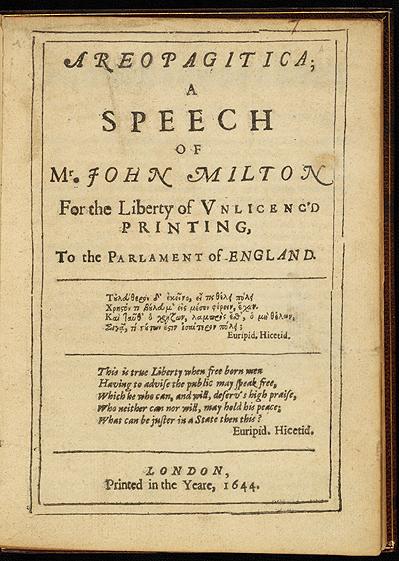
An edition based upon Sir Richard Jebb’s lectures at Cambridge in 1872, with extensive notes and commentaries on this famous work: Milton’s famous defense of freedom of speech. It was a protest against Parliament’s ordinance to further restrict the freedom of print. Milton issued his oration in an unlicensed form and courageously put his own name, but not that of his printer, on the cover.
The text is in the public domain.
This material is put online to further the educational goals of Liberty Fund, Inc. Unless otherwise stated in the Copyright Information section above, this material may be used freely for educational and academic purposes. It may not be used in any way for profit.
THEY who to states and governors of the commonwealth direct their speech, high court of parliament, or wanting such access in a private condition, write that which they foresee may advance the public good; I suppose them, as at the beginning of no mean endeavour, not a little altered and moved inwardly in their minds; some with doubt of what will be the success, others with fear of what will be the censure; some with hope, others with confidence of what they Edition: current; Page: [2] have to speak. And me perhaps each of these dispositions, as the subject was whereon I entered, may have at other times variously affected; and likely might in these foremost expressions now also disclose which of them swayed most, but that the very attempt of this address thus made, and the thought of whom it hath recourse to, hath got the power within me to a passion, far more welcome than incidental to a preface. Which though I stay not to confess ere any ask, I shallMilton1918: 10 be blameless, if it be no other than the joy and gratulation which it brings to all who wish and promote their country’s liberty; whereof this whole discourse proposed will be a certain testimony, if not a trophy. For this is not the liberty which we can hope, that no grievance ever should arise in the commonwealth: that let no man in this world expect; but when complaints are freely heard, deeply considered, and speedily reformed, then is the utmost bound of civil liberty attained that wise men look for. To which if I nowMilton1918: 20 manifest, by the very sound of this which I shall utter, that we are already in good part arrived, and yet from such a steep disadvantage of tyranny and superstition grounded into our principles as was beyond the manhood of a Roman recovery, it will be attributed first, as is most due, to the strong assistance of God, our deliverer; next, to your faithful guidance and undaunted wisdom, lords and commons of England. Neither is it in God’s esteem the diminution of his glory, when honourable things are spoken of good men,Milton1918: 30 and worthy magistrates; which if I now first should Edition: current; Page: [3] begin to do, after so fair a progress of your laudable deeds, and such a long obligement upon the whole realm to your indefatigable virtues, I might be justly reckoned among the tardiest and the unwillingest of them that praise ye. Nevertheless there being three principal things, without which all praising is but courtship and flattery: first, when that only is praised which is solidly worth praise; next, when greatest likelihoods are brought that such things are truly and really in those persons to whom they are ascribed; theMilton1918: 10 other, when he who praises, by shewing that such his actual persuasion is of whom he writes, can demonstrate that he flatters not; the former two of these I have heretofore endeavoured, rescuing the employment from him who went about to impair your merits with a trivial and malignant encomium; the latter as belonging chiefly to mine own acquittal, that whom I so extolled I did not flatter, hath been reserved opportunely to this occasion. For he who freely magnifies what hath been nobly done, and fears not toMilton1918: 20 declare as freely what might be done better, gives ye the best covenant of his fidelity; and that his loyalest affection and his hope waits on your proceedings. His highest praising is not flattery, and his plainest advice is a kind of praising; for though I should affirm and hold by argument, that it would fare better with truth, with learning, and the commonwealth, if one of your published orders, which I should name, were called in, yet at the same time it could not but much redound to the lustre of your mild and equal government, whenasMilton1918: 30 Edition: current; Page: [4] private persons are hereby animated to think ye better pleased with public advice than other statists have been delighted heretofore with public flattery. And men will then see what difference there is between the magnanimity of a triennial parliament, and that jealous haughtiness of prelates and cabin counsellors that usurped of late, whenas they shall observe ye in the midst of your victories and successes more gently brooking written exceptions against a voted order,Milton1918: 10 than other courts, which had produced nothing worth memory but the weak ostentation of wealth, would have endured the least signified dislike at any sudden proclamation. If I should thus far presume upon the meek demeanour of your civil and gentle greatness, lords and commons, as what your published order hath directly said, that to gainsay, I might defend myself with ease, if any should accuse me of being new or insolent, did they but know how much better I find ye esteem it to imitate the old and elegant humanity ofMilton1918: 20 Greece, than the barbaric pride of a Hunnish and Norwegian stateliness. And out of those ages, to whose polite wisdom and letters we owe that we are not yet Goths and Jutlanders, I could name him who from his private house wrote that discourse to the parliament of Athens, that persuades them to change the form of democracy which was then established. Such honour was done in those days to men who professed the study of wisdom and eloquence, not only in their own country, but in other lands, that cities and signiories heardMilton1918: 30 them gladly, and with great respect, if they had aught Edition: current; Page: [5] in public to admonish the state. Thus did Dion Prusæus, a stranger and a private orator, counsel the Rhodians against a former edict; and I abound with other like examples, which to set here would be superfluous. But if from the industry of a life wholly dedicated to studious labours, and those natural endowments haply not the worst for two and fifty degrees of[ ] northern latitude, so much must be derogated, as to count me not equal to any of those who had this privilege, I would obtain to be thought not so inferior,Milton1918: 1 as yourselves are superior to the most of them who received their counsel; and how far you excel them, be assured, lords and commons, there can no greater testimony appear, than when your prudent spirit acknowledges and obeys the voice of reason, from what quarter soever it be heard speaking; and renders ye as willing to repeal any act of your own setting forth, as any set forth by your predecessors.
If ye be thus resolved, as it were injury to think ye were not, I know not what should withhold me from presenting ye with a fit instance wherein to shew both that love of truth which ye eminently profess, and that uprightness of your judgment which is not wont to be partial to yourselves; by judging over again that order which ye have ordained “to regulate printing: that no book, pamphlet, or paper shall be henceforth printed, unless the same be first approved and licensed by such,” or at least one of such, as shall be thereto appointed. For that part which preserves justly every man’s copy to himself, or provides for the poor, I touch not; only Edition: current; Page: [6] wish they be not made pretences to abuse and persecute honest and painful men, who offend not in either of these particulars. But that other clause of licensing books, which we thought had died with his brother quadragesimal and matrimonial when the prelates expired, I shall now attend with such a homily, as shall lay before ye, first, the inventors of it to be those whom ye will be loath to own; next, what is to be thought in general of reading, whatever sort the books be; andMilton1918: 10 that this order avails nothing to the suppressing of scandalous, seditious, and libellous books, which were mainly intended to be suppressed. Last, that it will be primely to the discouragement of all learning, and the stop of truth, not only by disexercising and blunting our abilities, in what we know already, but by hindering and cropping the discovery that might be yet further made, both in religious and civil wisdom.
I deny not, but that it is of greatest concernment in the church and commonwealth, to have a vigilant eyeMilton1918: 20 how books demean themselves, as well as men; and thereafter to confine, imprison, and do sharpest justice on them as malefactors; for books are not absolutely dead things, but do contain a potency of life in them to be as active as that soul was whose progeny they are; nay, they do preserve as in a vial the purest efficacy and extraction of that living intellect that bred them. I know they are as lively, and as vigorously productive, as those fabulous dragon’s teeth: and being sown up and down, may chance to spring up armedMilton1918: 30 men. And yet, on the other hand, unless wariness be Edition: current; Page: [7] used, as good almost kill a man as kill a good book: who kills a man kills a reasonable creature, God’s image; but he who destroys a good book, kills reason itself, kills the image of God, as it were, in the eye. Many a man lives a burden to the earth; but a good book is the precious life-blood of a master-spirit, embalmed and treasured up on purpose to a life beyond life. It is true, no age can restore a life, whereof, perhaps, there is no great loss; and revolutions of ages do not oft recover the loss of a rejected truth, for the wantMilton1918: 10 of which whole nations fare the worse. We should be wary, therefore, what persecution we raise against the living labours of public men, how we spill that seasoned life of man preserved and stored up in books; since we see a kind of homicide may be thus committed, sometimes a martyrdom; and if it extend to the whole impression, a kind of massacre, whereof the execution ends not in the slaying of an elemental life, but strikes at that ethereal and fifth essence, the breath of reason itself; slays an immortality rather than a life. But lestMilton1918: 20 I should be condemned of introducing licence, while I oppose licensing, I refuse not the pains to be so much historical, as will serve to shew what hath been done by ancient and famous commonwealths, against this disorder, till the very time that this project of licensing crept out of the Inquisition, was catched up by our prelates, and hath caught some of our presbyters.
In Athens, where books and wits were ever busier than in any other part of Greece, I find but only two sorts of writings which the magistrate cared to takeMilton1918: 30 Edition: current; Page: [8] notice of: those either blasphemous and atheistical, or libellous. Thus the books of Protagoras were by the judges of Areopagus commanded to be burnt, and himself banished the territory for a discourse, begun with his confessing not to know “whether there were gods, or whether not.” And against defaming, it was agreed that none should be traduced by name, as was the manner of Vetus Comœdia, whereby we may guess how they censured libelling; and this course was quickMilton1918: 10 enough, as Cicero writes, to quell both the desperate wits of other atheists, and the open way of defaming, as the event showed. Of other sects and opinions, though tending to voluptuousness, and the denying of divine Providence, they took no heed. Therefore we do not read that either Epicurus, or that libertine school of Cyrene, or what the Cynic impudence uttered, was ever questioned by the laws. Neither is it recorded that the writings of those old comedians were suppressed, though the acting of them were forbid; andMilton1918: 20 that Plato commended the reading of Aristophanes, the loosest of them all, to his royal scholar, Dionysius, is commonly known, and may be excused, if holy Chrysostom, as is reported, nightly studied so much the same author, and had the art to cleanse a scurrilous vehemence into the style of a rousing sermon. That other leading city of Greece, Lacedæmon, considering that Lycurgus their lawgiver was so addicted to elegant learning, as to have been the first that brought out of Ionia the scattered works of Homer, and sent the poetMilton1918: 30 Thales from Crete, to prepare and mollify the Spartan Edition: current; Page: [9] surliness with his smooth songs and odes, the better to plant among them law and civility, it is to be wondered how museless and unbookish they were, minding nought but the feats of war. There needed no licensing of books among them, for they disliked all but their own laconic apophthegms, and took a slight occasion to chase Archilochus out of their city, perhaps for composing in a higher strain than their own soldierly ballads and roundels could reach to; or if it were for his broad verses, they were not therein so cautious, but they wereMilton1918: 10 as dissolute in their promiscuous conversing; whence Euripides affirms, in Andromache, that their women were all unchaste. Thus much may give us light after what sort of books were prohibited among the Greeks. The Romans also for many ages trained up only to a military roughness, resembling most the Lacedæmonian guise, knew of learning little but what their twelve tables and the pontific college with their augurs and flamens taught them in religion and law; so unacquainted with other learning, that whenMilton1918: 20[ ] Carneades and Critolaus, with the Stoic Diogenes, coming ambassadors to Rome, took thereby occasion to give the city a taste of their philosophy, they were suspected for seducers by no less a man than Cato the Censor, who moved it in the senate to dismiss them speedily, and to banish all such Attic babblers out of Italy. But Scipio and others of the noblest senators withstood him and his old Sabine austerity; honoured and admired the men; and the censor himself at last, in his old age, fell to the study of that whereof before he was soMilton1918: 30 Edition: current; Page: [10] scrupulous. And yet, at the same time, Nævius and Plautus, the first Latin comedians, had filled the city with all the borrowed scenes of Menander and Philemon. Then began to be considered there also what was to be done to libellous books and authors; for Nævius was quickly cast into prison for his unbridled pen, and released by the tribunes upon his recantation: we read also that libels were burnt, and the makers punished, by Augustus. The like severity, no doubt, was used, ifMilton1918: 10 aught were impiously written against their esteemed gods. Except in these two points, how the world went in books, the magistrate kept no reckoning. And therefore Lucretius, without impeachment, versifies his Epicurism to Memmius, and had the honour to be set forth the second time by Cicero, so great a father of the commonwealth; although himself disputes against that opinion in his own writings. Nor was the satirical sharpness or naked plainness of Lucilius, or Catullus, or Flaccus, by any order prohibited. And for mattersMilton1918: 20 of state, the story of Titus Livius, though it extolled that part which Pompey held, was not therefore suppressed by Octavius Cæsar, of the other faction. But that Naso was by him banished in his old age, for the wanton poems of his youth, was but a mere covert of state over some secret cause; and besides, the books were neither banished nor called in. From hence we shall meet with little else but tyranny in the Roman empire, that we may not marvel, if not so often bad as good books were silenced. I shall therefore deem toMilton1918: 30 have been large enough in producing what among the Edition: current; Page: [11] ancients was punishable to write, save only which, all other arguments were free to treat on.
By this time the emperors were become Christians, whose discipline in this point I do not find to have been more severe than what was formerly in practice. The books of those whom they took to be grand heretics were examined, refuted, and condemned in the general councils; and not till then were prohibited, or burnt, by authority of the emperor. As for the writings of heathen authors, unless they were plain invectivesMilton1918: 10 against Christianity, as those of Porphyrius and Proclus, they met with no interdict that can be cited, till about the year 400, in a Carthaginian council, wherein bishops themselves were forbid to read the books of Gentiles, but heresies they might read; while others long before them, on the contrary, scrupled more the books of heretics, than of Gentiles. And that the primitive councils and bishops were wont only to declare what books were not commendable, passing no further, but leaving it to each one’s conscience to readMilton1918: 20 or to lay by, till after the year 800, is observed already by Padre Paolo, the great unmasker of the Trentine council. After which time the popes of Rome, engrossing what they pleased of political rule into their own hands, extended their dominion over men’s eyes, as they had before over their judgments, burning and prohibiting to be read what they fancied not; yet sparing in their censures, and the books not many which they so dealt with; till Martin the Fifth, by his bull, not only prohibited, but was the first that excommunicatedMilton1918: 30 Edition: current; Page: [12] the reading of heretical books; for about that time Wicklef and Husse growing terrible, were they who first drove the papal court to a stricter policy of prohibiting. Which course Leo the Tenth and his successors followed, until the council of Trent and the Spanish inquisition, engendering together, brought forth or perfected those catalogues and expurging indexes, that rake through the entrails of many an old good author, with a violation worse than any couldMilton1918: 10 be offered to his tomb. Nor did they stay in matters heretical, but any subject that was not to their palate, they either condemned in a prohibition, or had it straight into the new purgatory of an index. To fill up the measure of encroachment, their last invention was to ordain that no book, pamphlet, or paper should be printed (as if St Peter had bequeathed them the keys[ ] of the press also out of Paradise) unless it were approved and licensed under the hands of two or three glutton friars. For example:
Milton1918: 20 Let the chancellor Cini be pleased to see if in this present work be contained aught that may withstand the printing
Vincent Rabbata, Vicar of Florence.
I have seen this present work, and find nothing athwart the Catholic faith and good manners: in witness whereof I have given, &c.
Nicolo Cini, Chancellor of Florence.
Attending the precedent relation, it is allowed that this present work of Davanzati may be printed.
Milton1918: 30 Vincent Rabbata, &c.
It may be printed, July 15.
Friar Simon Mompei d’Amelia, Chancellor of the
Holy Office in Florence.
[ ] Sure they have a conceit, if he of the bottomless pit had not long since broke prison, that this quadruple exorcism would bar him down. I fear their next design will be to get into their custody the licensing of that which they say Claudius intended1, but went not through with. Voutsafe to see another of their forms, the Roman stamp:
Imprimatur, If it seem good to the reverend master of the Holy Palace.
Belcastro, Vicegerent. Milton1918: 10
Imprimatur,
Friar Nicolò Rodolphi, Master of the Holy Palace.
Sometimes five imprimaturs are seen together, dialogue wise, in the piatza of one titlepage, complimenting and ducking each to other with their shaven reverences, whether the author, who stands by in perplexity at the foot of his epistle, shall to the press or to the spunge. These are the pretty responsories, these are the dear antiphonies, that so bewitched of late our prelates and their chaplains with the goodly echo theyMilton1918: 20 made; and besotted us to the gay imitation of a lordly imprimatur, one from Lambeth-house, another from the west end of Paul’s; so apishly Romanizing, that the word of command still was set down in Latin; as if the learned grammatical pen that wrote it would cast no ink without Latin; or perhaps, as they thought, because no vulgar tongue was worthy to express the pure conceit of an imprimatur; but rather, as I hope, for that our English, the language of men ever famous and Edition: current; Page: [14] foremost in the achievements of liberty, will not easily find servile letters enow to spell such a dictatory presumption Englished. And thus ye have the inventors and the original of book-licensing ripped up and drawn as lineally as any pedigree. We have it not, that can be heard of, from any ancient state, or polity, or church, nor by any statute left us by our ancestors elder or later; nor from the modern custom of any reformed city or church abroad; but from the most antichristianMilton1918: 10 council, and the most tyrannous inquisition that ever inquired. Till then books were ever as freely admitted into the world as any other birth; the issue of the brain was no more stifled than the issue of the womb: no envious Juno sat cross-legged over the nativity of any man’s intellectual offspring; but if it proved a monster, who denies but that it was justly burnt, or sunk into the sea? But that a book, in worse condition than a peccant soul, should be to stand before a jury ere it be born to the world, and undergoMilton1918: 20 yet in darkness the judgment of Radamanth and his colleagues, ere it can pass the ferry backward into light, was never heard before, till that mysterious iniquity, provoked and troubled at the first entrance of reformation, sought out new limboes and new hells wherein they might include our books also within the number of their damned. And this was the rare morsel so officiously snatched up, and so illfavouredly imitated by our inquisiturient bishops, and the attendant minorites, their chaplains. That ye like not now these mostMilton1918: 30 certain authors of this licensing order, and that all Edition: current; Page: [15] sinister intention was far distant from your thoughts, when ye were importuned the passing it, all men who know the integrity of your actions, and how ye honour truth, will clear ye readily.
But some will say, what though the inventors were bad, the thing for all that may be good. It may so; yet if that thing be no such deep invention, but obvious and easy for any man to light on, and yet best and wisest commonwealths through all ages and occasions have forborne to use it, and falsest seducers and oppressorsMilton1918: 10 of men were the first who took it up, and to no other purpose but to obstruct and hinder the first approach of reformation; I am of those who believe, it will be a harder alchymy than Lullius ever knew, to sublimate any good use out of such an invention. Yet this only is what I request to gain from this reason, that it may be held a dangerous and suspicious fruit, as certainly it deserves, for the tree that bore it, until I can dissect one by one the properties it has. But I have first to finish, as was propounded, what is toMilton1918: 20 be thought in general of reading books, whatever sort they be, and whether be more the benefit or the harm that thence proceeds.
Not to insist upon the examples of Moses, Daniel, and Paul, who were skilful in all the learning of the Egyptians, Chaldeans, and Greeks, which could not probably be without reading their books of all sorts, in Paul especially, who thought it no defilement to insert into holy scripture the sentences of three Greek poets, and one of them a tragedian, the question was[ ]Milton1918: 30 Edition: current; Page: [16] [ ]notwithstanding sometimes controverted among the primitive doctors, but with great odds on that side which affirmed it both lawful and profitable, as was then evidently perceived, when Julian the Apostate, and subtlest enemy to our faith, made a decree forbidding Christians the study of heathen learning; for, said he, they wound us with our own weapons, and with our own arts and sciences they overcome us. And indeed the Christians were put so to their shifts by thisMilton1918: 10 crafty means, and so much in danger to decline into all ignorance, that the two Appollinarii were fain, as a man may say, to coin all the seven liberal sciences out of the Bible, reducing it into divers forms of orations, poems, dialogues, even to the calculating of a new Christian grammar. But, saith the historian, Socrates, the providence of God provided better than the industry of Appollinarius and his son, by taking away that illiterate law with the life of him who devised it. So great an injury they then held it to be deprivedMilton1918: 20 of Hellenic learning; and thought it a persecution more undermining, and secretly decaying the church, than the open cruelty of Decius or Diocletian. And perhaps it was with the same politic drift that the devil whipped St Jerome in a lenten dream, for reading Cicero; or else it was a phantasm, bred by the fever which had then seized him. For had an angel been his discipliner, unless it were for dwelling too much on Ciceronianisms, and had chastised the reading, not the vanity, it had been plainly partial, first, to correct him for graveMilton1918: 30 Cicero, and not for scurril Plautus, whom he confesses Edition: current; Page: [17] to have been reading not long before; next to correct him only, and let so many more ancient Fathers wax old in those pleasant and florid studies, without the lash of such a tutoring apparition; insomuch that Basil teaches how some good use may be made of Margites, a sportful poem, not now extant, writ by Homer; and why not then of Morgante, an Italian romance much to the same purpose? But if it be agreed we shall be tried by visions, there is a vision[ ] recorded by Eusebius, far ancienter than this tale ofMilton1918: 10 Jerome, to the nun Eustochium, and besides, has nothing of a fever in it. Dionysius Alexandrinus was, about the year 240, a person of great name in the church, for piety and learning, who had wont to avail himself much against heretics, by being conversant in their books; until a certain presbyter laid it scrupulously to his conscience, how he durst venture himself among those defiling volumes. The worthy man, loath to give offence, fell into a new debate with himself, what was to be thought; when suddenly a vision sentMilton1918: 20 from God (it is his own Epistle that so avers it) confirmed him in these words: “Read any books whatever come to thy hands, for thou art sufficient both to judge aright, and to examine each matter.” To this revelation he assented the sooner, as he confesses, because it was answerable to that of the apostle to the Thessalonians: “Prove all things, hold fast that which is good.” And he might have added another remarkable saying of the same author: “To the pure, all things are pure”; not only meats and drinks, but all kind ofMilton1918: 30 Edition: current; Page: [18] knowledge, whether of good or evil: the knowledge cannot defile, nor consequently the books, if the will and conscience be not defiled. For books are as meats and viands are; some of good, some of evil substance; and yet God in that unapocryphal vision said without exception, “Rise, Peter, kill and eat”; leaving the choice to each man’s discretion. Wholesome meats to a vitiated stomach differ little or nothing from unwholesome; and best books to a naughty mind are notMilton1918: 10 unapplicable to occasions of evil. Bad meats will scarce breed good nourishment in the healthiest concoction; but herein the difference is of bad books, that they to a discreet and judicious reader serve in many respects to discover, to confute, to forewarn, and to illustrate. Whereof what better witness can ye expect I should produce, than one of your own now sitting in parliament, the chief of learned men reputed in this land, Mr Selden; whose volume of natural and national laws proves, not only by great authorities brought together,Milton1918: 20 but by exquisite reasons and theorems almost mathematically demonstrative, that all opinions, yea, errors, known, read, and collated, are of main service and assistance toward the speedy attainment of what is truest. I conceive, therefore, that when God did enlarge the universal diet of man’s body, saving ever the rules of temperance, he then also, as before, left arbitrary the dieting and repasting of our minds; as wherein every mature man might have to exercise his own leading capacity. How great a virtue is temperance,Milton1918: 30 how much of moment through the whole life of Edition: current; Page: [19] man! Yet God commits the managing so great a trust, without particular law or prescription, wholly to the demeanour of every grown man. And therefore when he himself tabled the Jews from heaven, that omer, which was every man’s daily portion of manna, is computed to have been more than might have well sufficed the heartiest feeder thrice as many meals. For those actions which enter into a man, rather than issue out of him, and therefore defile not, God uses not to captivate under a perpetual childhood of prescription, butMilton1918: 10 trusts him with the gift of reason to be his own chooser; there were but little work left for preaching, if law and compulsion should grow so fast upon those things which heretofore were governed only by exhortation. Solomon informs us that much reading is a weariness to the flesh; but neither he, nor other inspired author, tells us that such or such reading is unlawful; yet certainly had God thought good to limit us herein, it had been much more expedient to have told us what was unlawful, than what was wearisome. As for the burningMilton1918: 20 of those Ephesian books by St Paul’s converts, it is replied, the books were magic, the Syriac so renders them. It was a private act, a voluntary act, and leaves us to a voluntary imitation: the men in remorse burnt those books which were their own; the magistrate by this example is not appointed; these men practised the books, another might perhaps have read them in some sort usefully. Good and evil we know in the field of this world grow up together almost inseparably; and the knowledge of good is so involved and interwovenMilton1918: 30 Edition: current; Page: [20] with the knowledge of evil, and in so many cunning resemblances hardly to be discerned, that those confused seeds which were imposed upon [ ]Psyche as an incessant labour to cull out, and sort asunder, were not more intermixed. It was from out the rind of one apple tasted, that the knowledge of good and evil, as two twins cleaving together, leaped forth into the world. And perhaps this is that doom which Adam fell into of knowing good and evil; that is to say, ofMilton1918: 10 knowing good by evil. As therefore the state of man now is; what wisdom can there be to choose, what continence to forbear, without the knowledge of evil? He that can apprehend and consider vice with all her baits and seeming pleasures, and yet abstain, and yet distinguish, and yet prefer that which is truly better, he is the true wayfaring Christian. I cannot praise a fugitive and cloistered virtue unexercised and unbreathed, that never sallies out and seeks her adversary, but slinks out of the race, where that immortalMilton1918: 20 garland is to be run for, not without dust and heat. Assuredly we bring not innocence into the world, we bring impurity much rather; that which purifies us is trial, and trial is by what is contrary. That virtue therefore which is but a youngling in the contemplation of evil, and knows not the utmost that vice promises to her followers, and rejects it, is but a blank virtue, not a pure; her whiteness is but an excremental whiteness; which was the reason why our sage and [ ]serious poet Spenser, whom I dare be known to thinkMilton1918: 30 a better teacher than Scotus or Aquinas, describing Edition: current; Page: [21] true temperance under the person of Guion, brings him in with his palmer through the cave of Mammon, and the bower of earthly bliss, that he might see and know, and yet abstain. Since therefore the knowledge and survey of vice is in this world so necessary to the constituting of human virtue, and the scanning of error to the confirmation of truth, how can we more safely, and with less danger, scout into the regions of sin and falsity than by reading all manner of tractates, and hearing all manner of reason? And this is the benefitMilton1918: 10 which may be had of books promiscuously read. But of the harm that may result hence, three kinds are usually reckoned. First, is feared the infection that may spread; but then, all human learning and controversy in religious points must remove out of the world, yea, the Bible itself; for that ofttimes relates blasphemy not nicely, it describes the carnal sense of wicked men not unelegantly, it brings in holiest men passionately murmuring against providence through all the arguments of Epicurus: in other great disputesMilton1918: 20 it answers dubiously and darkly to the common reader; and ask a Talmudist what ails the modesty of his marginal Keri, that Moses and all the prophets cannot persuade him to pronounce the textual Chetiv. For these causes we all know the Bible itself put by the papist into the first rank of prohibited books. The ancientest Fathers must be next removed, as Clement of Alexandria, and that Eusebian book of evangelic preparation, transmitting our ears through a hoard of heathenish obscenities to receive the gospel. WhoMilton1918: 30 Edition: current; Page: [22] finds not that Irenæus, Epiphanius, Jerome, and others discover more heresies than they well confute, and that oft for heresy which is the truer opinion? Nor boots it to say for these, and all the heathen writers of greatest infection, if it must be thought so, with whom is bound up the life of human learning, that they wrote in an unknown tongue, so long as we are sure those languages are known as well to the worst of men, who are both most able and most diligent to instil the poison theyMilton1918: 10 suck, first into the courts of princes, acquainting them with the choicest delights, and criticisms of sin. As perhaps did that Petronius, whom Nero called his arbiter, the master of his revels; and that notorious ribald of Arezzo, dreaded and yet dear to the Italian courtiers. I name not him, for posterity’s sake, whom Harry the 8 named in merriment his vicar of hell. By which compendious way all the contagion that foreign books can infuse will find a passage to the people far easier and shorter than an Indian voyage,Milton1918: 20 though it could be sailed either by the north of Cataio eastward, or of Canada westward, while our Spanish licensing gags the English press never so severely. But, on the other side, that infection which is from books of controversy in religion, is more doubtful and dangerous to the learned than to the ignorant; and yet those books must be permitted untouched by the licenser. It will be hard to instance where any ignorant man hath been ever seduced by papistical book in English, unless it were commended and expounded toMilton1918: 30 him by some of that clergy; and indeed all such tractates, Edition: current; Page: [23] [ ]whether false or true, are as the prophecy of Isaiah was to the eunuch, not to be “understood without a guide.” But of our priests and doctors how many have been corrupted by studying the comments of Jesuits and Sorbonists, and how fast they could transfuse that corruption into the people, our experience is both late and sad. It is not forgot, since the acute and distinct Arminius was perverted merely by the perusing of a nameless discourse written at Delft, which at first he took in hand to confute. Seeing therefore thatMilton1918: 10 those books, and those in great abundance, which are likeliest to taint both life and doctrine, cannot be suppressed without the fall of learning, and of all ability in disputation, and that these books of either sort are most and soonest catching to the learned, from whom to the common people whatever is heretical or dissolute may quickly be conveyed, and that evil manners are as perfectly learnt without books a thousand other ways which cannot be stopped, and evil doctrine not with books can propagate, except aMilton1918: 20 teacher guide, which he might also do without writing, and so beyond prohibiting, I am not able to unfold, how this cautelous enterprise of licensing can be exempted from the number of vain and impossible attempts. And he who were pleasantly disposed, could not well avoid to liken it to the exploit of that gallant man who thought to pound up the crows by shutting his park gate. Besides another inconvenience, if learned men be the first receivers out of books, and dispreaders both of vice and error, how shall theMilton1918: 30 Edition: current; Page: [24] licensers themselves be confided in, unless we can confer upon them, or they assume to themselves, above all others in the land, the grace of infallibility and uncorruptedness? And again, if it be true, that a wise man, like a good refiner, can gather gold out of the drossiest volume, and that a fool will be a fool with the best book, yea, or without book; there is no reason that we should deprive a wise man of any advantage to his wisdom, while we seek to restrain fromMilton1918: 10 a fool that which being restrained will be no hindrance to his folly. For if there should be so much exactness always used to keep that from him which is unfit for his reading, we should in the judgment of Aristotle not only, but of Solomon, and of our Saviour, not voutsafe him good precepts, and by consequence not willingly admit him to good books; as being certain that a wise man will make better use of an idle pamphlet, than a fool will do of sacred scripture. ’Tis next alleged, we must not expose ourselves to temptationsMilton1918: 20 without necessity, and next to that, not employ our time in vain things. To both these objections one answer will serve, out of the grounds already laid, that to all men such books are not temptations, nor vanities; but useful drugs and materials wherewith to temper and compose effective and strong medicines, which man’s life cannot want. The rest, as children and childish men, who have not the art to qualify and prepare these working minerals, well may be exhorted to forbear; but hindered forcibly they cannot be, by allMilton1918: 30 the licensing that sainted Inquisition could ever yet Edition: current; Page: [25] contrive; which is what I promised to deliver next: that this order of licensing conduces nothing to the end for which it was framed; and hath almost prevented me by being clear already while thus much hath been explaining. See the ingenuity of Truth, who, when she gets a free and willing hand, opens herself faster than the pace of method and discourse can overtake her. It was the task which I began with, to shew that no nation, or well instituted state, if they valued books at all, did ever use this way of licensing; and it mightMilton1918: 10 be answered, that this is a piece of prudence lately discovered. To which I return, that as it was a thing slight and obvious to think on, so if it had been difficult to find out, there wanted not among them long since, who suggested such a course; which they not following, leave us a pattern of their judgment that it was not the not knowing, but the not approving, which was the cause of their not using it. Plato, a man of high authority indeed, but least of all for his Commonwealth, in the book of his laws, which no city ever yetMilton1918: 20 received, fed his fancy with making many edicts to his airy burgomasters, which they who otherwise admire him, wish had been rather buried and excused in the genial cups of an academic night sitting. By which laws he seems to tolerate no kind of learning, but by unalterable decree, consisting most of practical traditions, to the attainment whereof a library of smaller bulk than his own dialogues would be abundant. And there also enacts, that no poet should so much as read to any private man what he had written, until theMilton1918: 30 Edition: current; Page: [26] judges and law keepers had seen it, and allowed it; but that Plato meant this law peculiarly to that commonwealth which he had imagined, and to no other, is evident. Why was he not else a lawgiver to himself, but a transgressor, and to be expelled by his own magistrates, both for the wanton epigrams and dialogues which he made, and his perpetual reading of Sophron Mimus and Aristophanes, books of grossest infamy; and also for commending the latter of them,Milton1918: 10 though he were the malicious libeller of his chief friends, to be read by the tyrant Dionysius, who had little need of such trash to spend his time on? But that he knew this licensing of poems had reference and dependence to many other provisoes there set down in his fancied republic, which in this world could have no place; and so neither he himself, nor any magistrate or city, ever imitated that course, which, taken apart from those other collateral injunctions, must needs be vain and fruitless. For if they fell upon one kind ofMilton1918: 20 strictness, unless their care were equal to regulate all other things of like aptness to corrupt the mind, that single endeavour they knew would be but a fond labour; to shut and fortify one gate against corruption, and be necessitated to leave others round about wide open. If we think to regulate printing, thereby to rectify manners, we must regulate all recreations and pastimes, all that is delightful to man. No music must be heard, no song be set or sung, but what is grave and Doric. There must be licensing dancers, that no gesture,Milton1918: 30 motion, or deportment be taught our youth but what Edition: current; Page: [27] by their allowance shall be thought honest; for such Plato was provided of. It will ask more than the work of twenty licensers to examine all the lutes, the violins, and the guitars in every house; they must not be suffered to prattle as they do, but must be licensed what they may say. And who shall silence all the airs and madrigals that whisper softness in chambers? The windows also, and the Balcones, must be thought on;[ ] there are shrewd books, with dangerous frontispieces, set to sale: who shall prohibit them, shall twentyMilton1918: 10 licensers? The villages also must have their visitors to enquire what lectures the bagpipe and the rebbeck reads even to the ballatry and the gammuth of every municipal fiddler; for these are the countryman’s Arcadias, and his Monte Mayors. Next, what more[ ] national corruption, for which England hears ill[ ] abroad, than household gluttony? Who shall be the rectors of our daily rioting? And what shall be done to inhibit the multitudes that frequent those houses where drunkenness is sold and harboured? Our garmentsMilton1918: 20 also should be referred to the licensing of some more sober workmasters, to see them cut into a less wanton garb. Who shall regulate all the mixed conversation[ ] of our youth, male and female together, as is the fashion of this country? Who shall still appoint what shall be discoursed, what presumed, and no further? Lastly, who shall forbid and separate all idle resort, all evil company? These things will be, and must be: but how they shall be least hurtful, how least enticing, herein consists the grave and governing wisdomMilton1918: 30 Edition: current; Page: [28] of a state. To sequester out of the world into Atlantic and Eutopian polities, which never can be drawn into use, will not mend our condition; but to ordain wisely as in this world of evil, in the midst whereof God hath placed us unavoidably. Nor is it Plato’s licensing of books will do this, which necessarily pulls along with it so many other kinds of licensing, as will make us all both ridiculous and weary, and yet frustrate; but those unwritten, or at least unconstrainingMilton1918: 10 laws of virtuous education, religious and civil nurture, which Plato there mentions, as the bonds and ligaments of the commonwealth, the pillars and the sustainers of every written statute; these they be, which will bear chief sway in such matters as these, when all licensing will be easily eluded. Impunity and remissness for certain are the bane of a commonwealth; but here the great art lies, to discern in what the law is to bid restraint and punishment, and in what things persuasion only is to work. If every action which isMilton1918: 20 good or evil in man at ripe years were to be under pittance, and prescription, and compulsion, what were virtue but a name, what praise could be then due to well doing, what gramercy to be sober, just, or continent? Many there be that complain of divine Providence for suffering Adam to transgress. Foolish tongues! when God gave him reason, he gave him freedom to choose, for reason is but choosing; he had been else a mere artificial Adam, such an Adam as he is in the motions. We ourselves esteem not of thatMilton1918: 30 obedience, or love, or gift, which is of force; God therefore Edition: current; Page: [29] left him free, set before him a provoking object ever almost in his eyes; herein consisted his merit, herein the right of his reward, the praise of his abstinence. Wherefore did he create passions within us, pleasures round about us, but that these rightly tempered are the very ingredients of virtue? They are not skilful considerers of human things, who imagine to remove sin, by removing the matter of sin; for, besides that it is a huge heap increasing under the very act of diminishing, though some part of it may for aMilton1918: 10 time be withdrawn from some persons, it cannot from all, in such a universal thing as books are; and when this is done, yet the sin remains entire. Though ye take from a covetous man all his treasure, he has yet one jewel left, ye cannot bereave him of his covetousness. Banish all objects of lust, shut up all youth into the severest discipline that can be exercised in any hermitage, ye cannot make them chaste, that came not thither so: such great care and wisdom is required to the right managing of this point. Suppose we couldMilton1918: 20 expel sin by this means; look how much we thus expel of sin, so much we expel of virtue: for the matter of them both is the same: remove that, and ye remove them both alike. This justifies the high providence of God, who, though he command us temperance, justice, continence, yet pours out before us even to a profuseness all desirable things, and gives us minds that can wander beyond all limit and satiety. Why should we then affect a rigour contrary to the manner of God and of nature, by abridging or scanting those means, whichMilton1918: 30 Edition: current; Page: [30] books freely permitted are, both to the trial of virtue, and the exercise of truth? It would be better done, to learn that the law must needs be frivolous which goes to restrain things, uncertainly and yet equally working to good and to evil. And were I the chooser, a dram of well-doing should be preferred before many times as much the forcible hindrance of evil doing. For God sure esteems the growth and completing of one virtuous person, more than the restraint of ten vicious.Milton1918: 10 And albeit, whatever thing we hear or see, sitting, walking, travelling, or conversing, may be fitly called our book, and is of the same effect that writings are, yet grant the thing to be prohibited were only books, it appears that this order hitherto is far insufficient to the end which it intends. Do we not see, not once or oftener, but weekly, that continued court-libel against the parliament and city, printed, as the wet sheets can witness, and dispersed among us for all that licensing can do? Yet this is the prime service a man wouldMilton1918: 20 think wherein this order should give proof of itself. If it were executed, you will say. But certain, if execution be remiss or blindfold now, and in this particular, what will it be hereafter, and in other books? If then the order shall not be vain and frustrate, behold a new labour, lords and commons, ye must repeal and proscribe all scandalous and unlicensed books already printed and divulged; after ye have drawn them up into a list, that all may know which are condemned, and which not; and ordain that no foreign books beMilton1918: 30 delivered out of custody, till they have been read over. Edition: current; Page: [31] This office will require the whole time of not a few overseers, and those no vulgar men. There be also books which are partly useful and excellent, partly culpable and pernicious; this work will ask as many more officials, to make expurgations and expunctions, that the commonwealth of learning be not damnified. In fine, when the multitude of books increase upon their hands, ye must be fain to catalogue all those printers who are found frequently offending, and forbid the importation of their whole suspected typography.Milton1918: 10 In a word, that this your order may be exact, and not deficient, ye must reform it perfectly, according to the model of Trent and Sevil, which I know ye abhor to do. Yet though ye should condescend to this, which God forbid, the order still would be but fruitless and defective to that end whereto ye meant it. If to prevent sects and schisms, who is so unread or so uncatechised in story, that hath not heard of many sects refusing books as a hindrance, and preserving their doctrine unmixed for many ages, only by unwrittenMilton1918: 20 traditions? The Christian faith, for that was once a schism, is not unknown to have spread all over Asia, ere any gospel or epistle was seen in writing. If the amendment of manners be aimed at, look into Italy and Spain, whether those places be one scruple the better, the honester, the wiser, the chaster, since all the inquisitional rigour that hath been executed upon books.
Another reason, whereby to make it plain that this order will miss the end it seeks, consider by the qualityMilton1918: 30 Edition: current; Page: [32] which ought to be in every licenser. It cannot be denied but that he who is made judge to sit upon the birth or death of books, whether they may be wafted into this world or not, had need to be a man above the common measure, both studious, learned, and judicious; there may be else no mean mistakes in the censure of what is passable or not; which is also no mean injury. If he be of such worth as behoves him, there cannot be a more tedious and unpleasing journey-work,Milton1918: 10 a greater loss of time levied upon his head, than to be made the perpetual reader of unchosen books and pamphlets, ofttimes huge volumes. There is no book that is acceptable unless at certain seasons; but to be enjoined the reading of that at all times, and in a hand scarce legible, whereof three pages would not down at any time in the fairest print, is an imposition which I cannot believe how he that values time, and his own studies, or is but of a sensible nostril, should be able to endure. In this one thing I crave leave of the presentMilton1918: 20 licensers to be pardoned for so thinking: who doubtless took this office up, looking on it through their obedience to the parliament, whose command perhaps made all things seem easy and unlaborious to them; but that this short trial hath wearied them out already, their own expressions and excuses to them who make so many journeys to solicit their licence, are testimony enough. Seeing therefore those who now possess the employment, by all evident signs wish themselves well rid of it, and that no man of worth, none that is notMilton1918: 30 a plain unthrift of his own hours, is ever likely to Edition: current; Page: [33] succeed them, except he mean to put himself to the salary of a press corrector, we may easily foresee what kind of licensers we are to expect hereafter, either ignorant, imperious, and remiss, or basely pecuniary. This is what I had to show, wherein this order cannot conduce to that end whereof it bears the intention.
I lastly proceed from the no good it can do, to the manifest hurt it causes, in being first the greatest discouragement and affront that can be offered to learning and to learned men. It was the complaint and lamentationMilton1918: 10 of prelates, upon every least breath of a motion to remove pluralities, and distribute more equally church revenues, that then all learning would be for ever dashed and discouraged. But as for that opinion,[ ] I never found cause to think that the tenth part of learning stood or fell with the clergy: nor could I ever but hold it for a sordid and unworthy speech of any churchman who had a competency left him. If therefore ye be loath to dishearten utterly and discontent, not the mercenary crew of false pretenders to learning,Milton1918: 20 but the free and ingenuous sort of such as evidently were born to study and love learning for itself, not for lucre, or any other end, but the service of God and of truth, and perhaps that lasting fame and perpetuity of[ ] praise which God and good men have consented shall be the reward of those whose published labours advance the good of mankind, then know, that so far to distrust the judgment and the honesty of one who hath but a common repute in learning, and never yet offended, as not to count him fit to print his mindMilton1918: 30 Edition: current; Page: [34] without a tutor and examiner, lest he should drop a schism, or something of corruption, is the greatest displeasure and indignity to a free and knowing spirit that can be put upon him. What advantage is it to be a man over it is to be a boy at school, if we have only escaped the ferular to come under the fescu of an imprimatur? if serious and elaborate writings, as if they were no more than the theme of a grammar-lad under his pedagogue, must not be uttered without theMilton1918: 10 cursory eves of a temporizing and extemporizing licenser? He who is not trusted with his own actions, his drift not being known to be evil, and standing to the hazard of law and penalty, has no great argument to think himself reputed in the commonwealth wherein he was born for other than a fool or a foreigner. When a man writes to the world, he summons up all his reason and deliberation to assist him; he searches, meditates, is industrious, and likely consults and confers with his judicious friends; after all which done, heMilton1918: 20 takes himself to be informed in what he writes, as well as any that wrote before him; if in this, the most consummate act of his fidelity and ripeness, no years, no industry, no former proof of his abilities, can bring, him to that state of maturity, as not to be still mistrusted and suspected, unless he carry all his considerate diligence, all his midnight watchings, and[ ] expense of Palladian oil, to the hasty view of an unleisured licenser, perhaps much his younger, perhaps far his inferior in judgment, perhaps one who neverMilton1918: 30 knew the labour of bookwriting; and if he be not repulsed, Edition: current; Page: [35] or slighted, must appear in print like a punie with his guardian, and his censor’s hand on the back of his title to be his bail and surety, that he is no idiot or seducer, it cannot be but a dishonour and derogation to the author, to the book, to the privilege and dignity of learning. And what if the author shall be one so[ ] copious of fancy, as to have many things well worth the adding, come into his mind after licensing, while the book is yet under the press, which not seldom happens to the best and diligentest writers; and thatMilton1918: 10 perhaps a dozen times in one book. The printer dares not go beyond his licensed copy; so often then must the author trudge to his leave-giver, that those his new insertions may be viewed; and many a jaunt will be made, ere that licenser, for it must be the same man, can either be found, or found at leisure: meanwhile either the press must stand still, which is no small damage, or the author lose his accuratest thoughts, and send the book forth worse than he had made it, which to a diligent writer is the greatest melancholyMilton1918: 20 and vexation that can befall. And how can a man teach with authority, which is the life of teaching, how can he be a doctor in his book, as he ought to be, or else had better be silent, whenas all he teaches, all he delivers, is but under the tuition, under the correction of his patriarchal licenser, to blot or alter what precisely accords not with the hide-bound humour which he calls his judgment? When every acute reader, upon the first sight of a pedantic licence, will be ready with these like words to ding the book a quoit’s distance from him,Milton1918: 30 Edition: current; Page: [36] “I hate a pupil teacher; I endure not an instructor that comes to me under the wardship of an overseeing fist. I know nothing of the licenser, but that I have his own hand here for his arrogance; who shall warrant me his judgment?” “The state, sir,” replies the stationer: but has a quick return, “The state shall be my governors, but not my critics; they may be mistaken in the choice of a licenser, as easily as this licenser may be mistaken in an author. This is some common stuff;”Milton1918: 10 and he might add from Sir Francis Bacon, that “such authorized books are but the language of the times.” For though a licenser should happen to be judicious more than ordinary, which will be a great jeopardy of the next succession, yet his very office and his commission enjoins him to let pass nothing but what is vulgarly received already. Nay, which is more lamentable, if the work of any deceased author, though never so famous in his lifetime, and even to this day, comes to their hands for licence to be printed, or reprinted, ifMilton1918: 20 there be found in his book one sentence of a venturous edge, uttered in the height of zeal, and who knows whether it might not be the dictate of a divine Spirit? yet, not suiting with every low decrepit humour of their own, though it were Knox himself, the reformer of a kingdom, that spake it, they will not pardon him their dash; the sense of that great man shall to all posterity be lost, for the fearfulness, or the presumptuous rashness of a perfunctory licenser. And to what an author this violence hath been lately done, and inMilton1918: 30 what book, of greatest consequence to be faithfully Edition: current; Page: [37] published, I could now instance, but shall forbear till a more convenient season. Yet if these things be not resented seriously and timely by them who have the remedy in their power, but that such iron moulds as these shall have authority to gnaw out the choicest periods of exquisitest books, and to commit such a treacherous fraud against the orphan remainders of worthiest men after death, the more sorrow will belong to that hapless race of men, whose misfortune it is to have understanding. Henceforth let no man care toMilton1918: 10 learn, or care to be more than worldly wise; for certainly in higher matters to be ignorant and slothful, to be a common steadfast dunce, will be the only pleasant life, and only in request.
And as it is a particular disesteem of every knowing person alive, and most injurious to the written labours and monuments of the dead, so to me it seems an undervaluing and vilifying of the whole nation. I cannot set so light by all the invention, the art, the wit, the grave and solid judgment which is in England, asMilton1918: 20 that it can be comprehended in any twenty capacities, how good soever; much less that it should not pass except their superintendence be over it, except it be sifted and strained with their strainers, that it should be uncurrent without their manual stamp. Truth and understanding are not such wares as to be monopolized[ ] and traded in by tickets, and statutes, and standards. We must not think to make a staple commodity of all the knowledge in the land, to mark and license it like our broad-cloth and our woolpacks. What is it but aMilton1918: 30 Edition: current; Page: [38] servitude like that imposed by the Philistines, not to be allowed the sharpening of our own axes and coulters, but we must repair from all quarters to twenty licensing forges? Had any one written and divulged erroneous things and scandalous to honest life, misusing and forfeiting the esteem had of his reason among men, if after conviction this only censure were adjudged him, that he should never henceforth write, but what were first examined by an appointed officer, whose handMilton1918: 10 should be annexed to pass his credit for him, that now he might be safely read, it could not be apprehended less than a disgraceful punishment. Whence to include the whole nation, and those that never yet thus offended, under such a diffident and suspectful prohibition, may plainly be understood what a disparagement it is. So much the more whenas debtors and delinquents may walk abroad without a keeper, but unoffensive books must not stir forth without a visible jailor in their title. Nor is it to the common people lessMilton1918: 20 than a reproach; for if we be so jealous over them, as that we dare not trust them with an English pamphlet, what do we but censure them for a giddy, vicious, and ungrounded people; in such a sick and weak state of faith and discretion, as to be able to take nothing down but through the pipe of a licenser? That this is care or love of them, we cannot pretend, whenas in those popish places where the laity are most hated and despised the same strictness is used over them. Wisdom we cannot call it, because it stops but one breach ofMilton1918: 30 licence, nor that neither: whenas those corruptions, Edition: current; Page: [39] which it seeks to prevent, break in faster at other doors which cannot be shut.
And in conclusion it reflects to the disrepute of our ministers also, of whose labours we should hope better, and of the proficiency which their flock reaps by them, than that after all this light of the gospel which is, and is to be, and all this continual preaching, they should be still frequented with such an unprincipled, unedified, and laic rabble, as that the whiff of every new pamphlet should stagger them out of their catechismMilton1918: 10 and Christian walking. This may have much reason to discourage the ministers when such a low conceit is had of all their exhortations, and the benefiting of their hearers, as that they are not thought fit to be turned loose to three sheets of paper without a licenser; that all the sermons, all the lectures preached, printed, vended in such numbers, and such volumes, as have now well-nigh made all other books unsaleable, should not be armour enough against one single Enchiridion, without the castle of St Angelo of an imprimatur. Milton1918: 20
And lest some should persuade ye, lords and commons, that these arguments of learned men’s discouragement at this your order are mere flourishes, and not real, I could recount what I have seen and heard in other countries, where this kind of inquisition tyrannizes; when I have sat among their learned men, for that honour I had, and been counted happy to be born in such a place of philosophic freedom, as they supposed England was, while themselves did nothingMilton1918: 30 Edition: current; Page: [40] but bemoan the servile condition into which learning amongst them was brought; that this was it which had damped the glory of Italian wits; that nothing had been there written now these many years but flattery and fustian. There it was that I found and visited the famous Galileo, grown old, a prisoner to the Inquisition, [ ] for thinking in astronomy otherwise than the Franciscan and Dominican licensers thought. And though I knew that England then was groaning loudest underMilton1918: 10 the prelatical yoke, nevertheless I took it as a pledge of future happiness, that other nations were so persuaded of her liberty. Yet was it beyond my hope that those worthies were then breathing in her air, who should be her leaders to such a deliverance as shall never be forgotten by any revolution of time that this world hath to finish. When that was once begun, it was as little in my fear, that what words of complaint I heard among learned men of other parts uttered against the Inquisition, the same I should hear, by asMilton1918: 20 learned men at home, uttered in time of parliament against an order of licensing; and that so generally, that when I had disclosed myself a companion of their discontent, I might say, if without envy, that he whom an honest quæstorship had endeared to the Sicilians, was not more by them importuned against Verres, than the favourable opinion which I had among many who honour ye, and are known and respected by ye, loaded me with entreaties and persuasions, that I would not despair to lay together that which just reason shouldMilton1918: 30 bring into my mind, toward the removal of an undeserved Edition: current; Page: [41] thraldom upon learning. That this is not therefore the disburdening of a particular fancy, but the common grievance of all those who had prepared their minds and studies above the vulgar pitch, to advance truth in others, and from others to entertain it, thus much may satisfy. And in their name I shall for neither friend nor foe conceal what the general murmur is; that if it come to inquisitioning again, and licensing, and that we are so timorous of ourselves, and so suspicious of all men, as to fear each book, and theMilton1918: 10 shaking of every leaf, before we know what the contents are, if some who but of late were little better than silenced from preaching, shall come now to silence us from reading, except what they please, it cannot be guessed what is intended by some but a second tyranny over learning: and will soon put it out of controversy, that bishops and presbyters are the same to us, both name and thing. That those evils of prelaty which before from five or six and twenty sees were distributively charged upon the whole people will now light whollyMilton1918: 20 upon learning, is not obscure to us: whenas now the pastor of a small unlearned parish, on the sudden shall be exalted archbishop over a large diocese of books, and yet not remove, but keep his other cure too, a mystical pluralist. He who but of late cried down the sole ordination of every novice bachelor of art, and denied sole jurisdiction over the simplest parishioner, shall now, at home in his private chair, assume both these over worthiest and excellentest books, and ablest authors that write them. This is not, Yee CovenantsMilton1918: 30 Edition: current; Page: [42] and Protestations that we have made, this is not to put down prelacy; this is but to chop an episcopacy; this is but to translate the palace metropolitan from one kind of dominion into another; this is but an old canonical sleight of commuting our penance. To startle thus betimes at a mere unlicensed pamphlet will, after a while, be afraid of every conventicle, and a while after will make a conventicle of every Christian meeting. But I am certain, that a state governed by theMilton1918: 10 rules of justice and fortitude, or a church built and founded upon the rock of faith and true knowledge, cannot be so pusillanimous. While things are yet not constituted in religion, that freedom of writing should be restrained by a discipline imitated from the prelates, and learned by them from the Inquisition to shut us up all again into the breast of a licenser, must needs give cause of doubt and discouragement to all learned and religious men. Who cannot but discern the fineness of this politic drift, and who are the contrivers; that whileMilton1918: 20 bishops were to be baited down, then all presses might be open; it was the people’s birthright and privilege in time of parliament, it was the breaking forth of light. But now the bishops abrogated and voided out of the church, as if our reformation sought no more, but to make room for others into their seats under another name, the episcopal arts begin to bud again; the cruse of truth must run no more oil; liberty of printing must be enthralled again, under a prelatical commission of twenty; the privilege of the people nullified; and,Milton1918: 30 which is worse, the freedom of learning must groan Edition: current; Page: [43] [ ] again, and to her old fetters: all this the parliament yet sitting. Although their own late arguments and defences against the prelates might remember them that this obstructing violence meets for the most part with an event utterly opposite to the end which it drives at: instead of suppressing sects and schisms, it raises them and invests them with a reputation: “The punishing of wits enhances their authority,” saith the Viscount St Albans; “and a forbidden writing is thought to be a certain spark of truth that flies up in illegible the faces of them who seek to tread it out.” This order, therefore, may prove a nursing mother to sects, but I shall easily shew how it will be a stepdame to truth: and first, by disenabling us to the maintenance of what is known already.
Well knows he who uses to consider, that our faith and knowledge thrives by exercise, as well as our limbs and complexion. Truth is compared in scripture to a streaming fountain; if her waters flow not in a perpetual progression, they sicken into a muddy pool of illegible conformity and tradition. A man may be a heretic in the truth; and if he believe things only because his pastor says so, or the assembly so determines, without knowing other reason, though his belief be true, yet the very truth he holds becomes his heresy. There is not any burden that some would gladlier post off to another, than the charge and care of their religion. There be, who knows not that there be? of protestants and professors, who live and die in as errant an implicit faith, as any lay papist of Loretto. A wealthy illegible Edition: current; Page: [44] man, addicted to his pleasure and to his profits, finds religion to be a traffic so entangled, and of so many piddling accounts, that of all mysteries he cannot skill to keep a stock going upon that trade. What should he do? Fain he would have the name to be religious, fain he would bear up with his neighbours in that. What does he therefore, but resolves to give over toiling, and to find himself out some factor, to whose care and credit he may commit the whole managing ofMilton1918: 10 his religious affairs; some divine of note and estimation that must be. To him he adheres, resigns the whole[ ] warehouse of his religion, with all the locks and keys, into his custody; and indeed makes the very person of that man his religion; esteems his associating with him a sufficient evidence and commendatory of his own piety. So that a man may say his religion is now no more within himself, but is become a dividual movable, and goes and comes near him, according as that good man frequents the house. He entertainsMilton1918: 20 him, gives him gifts, feasts him, lodges him; his religion comes home at night, prays, is liberally supped, and sumptuously laid to sleep; rises, is saluted, and after the malmsey, or some well-spiced bruage, and better breakfasted than he whose morning appetite would have gladly fed on green figs between Bethany and Jerusalem, his religion walks abroad at eight, and leaves his kind entertainer in the shop trading all day without his religion.
Another sort there be, who when they hear that allMilton1918: 30 things shall be ordered, all things regulated and settled; Edition: current; Page: [45] nothing written but what passes through the custom-house of certain publicans that have the tunaging and poundaging of all free-spoken truth, will straight give themselves up into your hands, illegible ’em, and cut ’em out what religion ye please: there be delights, there be recreations and jolly pastimes, that will fetch the day about from sun to sun, and rock the tedious year as in a delightful dream. What need they torture their heads with that which others have taken so strictly, and so unalterably into their own purveying?Milton1918: 10 These are the fruits which a dull ease and cessation of our knowledge will bring forth among the people. How goodly, and how to be wished were such an obedient unanimity as this! What a fine conformity would it starch us all into! Doubtless a staunch and solid piece of framework, as any January could freeze together.
Nor much better will be the consequence even among the clergy themselves: it is no new thing never heard of before, for a parochial minister, who has his reward,Milton1918: 20 and is at his Hercules’ pillars in a warm benefice, to be easily inclinable, if he have nothing else that may rouse up his studies, to finish his circuit in an English Concordance and a topic folio, the gatherings and savings of a sober graduateship, a Harmony and a Catena, treading the constant round of certain common doctrinal heads, attended with their uses, motives, marks, and means, out of which, as out of an alphabet or sol-fa, by forming and transforming, joining and disjoining variously, a little bookcraft, and two hours’Milton1918: 30 Edition: current; Page: [46] meditation, might furnish him unspeakably to the performance of more than a weekly charge of sermoning: not to reckon up the infinite helps of interlinearies, breviaries, synopses, and other loitering gear. But as for the multitude of sermons ready printed and piled up, on every text that is not difficult, our London trading St Thomas in his vestry, and add to boot St Martin and St Hugh, have not within their hallowed limits more vendible ware of all sorts ready made: soMilton1918: 10 that penury he never need fear of pulpit provision, having where so plenteously to refresh his magazine. But if his rear and flanks be not impaled, if his back door be not secured by the rigid licenser, but that a bold book may now and then issue forth, and give the assault to some of his old collections in their trenches, it will concern him then to keep waking, to stand in watch, to set good guards and sentinels about his received opinions, to walk the round and counter-round with his fellow-inspectors, fearing lest any of his flockMilton1918: 20 be seduced who also then would be better instructed, better exercised, and disciplined. And God send that the fear of this diligence, which must then be used, do not make us affect the laziness of a licensing church.
For if we be sure we are in the right, and do not hold the truth guiltily, which becomes not, if we ourselves condemn not our own weak and frivolous teaching, and the people for an untaught and irreligious gadding rout, what can be more fair, than when a man judicious, learned, and of a conscience, for aught we know,Milton1918: 30 as good as theirs that taught us what we know, shall Edition: current; Page: [47] not privily from house to house, which is more dangerous, but openly by writing, publish to the world what his opinion is, what his reasons, and wherefore that which is now thought cannot be sound? Christ urged it as wherewith to justify himself, that he preached in public; yet writing is more public than preaching; and more easy to refutation if need be, there being so many whose business and profession merely it is to be the champions of truth; which if they neglect, what can be imputed but their sloth or inability? Milton1918: 10
Thus much we are hindered and disinured by this course of licensing towards the true knowledge of what we seem to know. For how much it hurts and hinders the licensers themselves in the calling of their ministry, more than any secular employment, if they will discharge that office as they ought, so that of necessity they must neglect either the one duty or the other, I insist not, because it is a particular, but leave it to their own conscience, how they will decide it there. Milton1918: 20
There is yet behind of what I purposed to lay open, the incredible loss and detriment that this plot of licensing puts us to, more than if some enemy at sea should stop up all our havens, and ports, and creeks, it hinders and retards the importation of our richest merchandise, truth: nay, it was first established and put in practice by antichristian malice and mystery, on set purpose to extinguish, if it were possible, the light of reformation, and to settle falsehood; little differing from that policy wherewith the Turk upholdsMilton1918: 30 Edition: current; Page: [48] his Alcoran, by the prohibition of printing. ’Tis not denied, but gladly confessed, we are to send our thanks and vows to heaven, louder than most of nations, for that great measure of truth which we enjoy, especially in those main points between us and the pope, with his appurtenances the prelates: but he who thinks we are to pitch our tent here, and have attained the utmost prospect of reformation that the mortal glass wherein we contemplate can shew us, till we come toMilton1918: 10 beatific vision, that man by this very opinion declares that he is yet far short of truth.
Truth indeed came once into the world with her divine Master, and was a perfect shape most glorious to look on: but when he ascended, and his apostles after him were laid asleep, then straight arose a wicked race of deceivers, who, as that story goes of the Egyptian Typhon with his conspirators, how they dealt with the good Osiris, took the virgin Truth, hewed her lovely form into a thousand pieces, and scattered themMilton1918: 20 to the four winds. From that time ever since, the sad friends of Truth, such as durst appear, imitating the careful search that Isis made for the mangled body of Osiris, went up and down gathering up limb by limb still as they could find them. We have not yet found them all, lords and commons, nor ever shall do, till her Master’s second coming; he shall bring together every joint and member, and shall mould them into an immortal feature of loveliness and perfection. Suffer not these licensing prohibitions to stand at every place ofMilton1918: 30 opportunity forbidding and disturbing them that continue Edition: current; Page: [49] seeking, that continue to do our obsequies to the torn body of our martyred saint. We boast our light; but if we look not wisely on the sun itself, it smites us into darkness. Who can discern those planets that are oft combust, and those stars of brightest magnitude that rise and set with the sun, until the opposite motion of their orbs bring them to such a place in the firmament, where they may be seen evening or morning? The light which we have gained was given us, not to be ever staring on, but by it to discover onwardMilton1918: 10 things more remote from our knowledge. It is not the unfrocking of a priest, the unmitring of a bishop, and the removing him from off the presbyterian shoulders that will make us a happy nation: no; if other things as great in the church, and in the rule of life both economical and political, be not looked into and reformed, we have looked so long upon the blaze that Zuinglius and Calvin have beaconed up to us, that we are stark blind. There be who perpetually complain of schisms and sects, and make it such a calamity thatMilton1918: 20 any man dissents from their maxims. ’Tis their own pride and ignorance which causes the disturbing, who neither will hear with meekness, nor can convince, yet all must be suppressed which is not found in their Syntagma. They are the troublers, they are the dividers of unity, who neglect and permit not others to unite those dissevered pieces which are yet wanting to the body of truth. To be still searching what we know not, by what we know, still closing up truth to truth as we find it (for all her body is homogeneal, andMilton1918: 30 Edition: current; Page: [50] proportional), this is the golden rule in theology as well as in arithmetic, and makes up the best harmony in a church; not the forced and outward union of cold, and neutral, and inwardly divided minds.[ ]
Lords and Commons of England, consider what nation it is whereof ye are, and whereof ye are the governors: a nation not slow and dull, but of a quick, ingenious, and piercing spirit; acute to invent, subtile and sinewy to discourse, not beneath the reach of anyMilton1918: 10 point the highest that human capacity can soar to. Therefore the studies of learning in her deepest sciences have been so ancient, and so eminent among us, that writers of good antiquity and ablest judgment have been persuaded that even the school of Pythagoras, and the Persian wisdom, took beginning from the old philosophy of this island. And that wise and civil Roman, Julius Agricola, who governed once here for Cæsar, preferred the natural wits of Britain before the laboured[ ] studies of the French. Nor is it for nothing that[ ]Milton1918: 20 the grave and frugal Transylvanian sends out yearly from as far as the mountainous borders of Russia, and beyond the Hercynian wilderness, not their youth, but their staid men, to learn our language and our theological arts. Yet that which is above all this, the favour and the love of Heaven, we have great argument to think in a peculiar manner propitious and propending towards us. Why else was this nation chosen before any other, that out of her, as out of Sion, should be proclaimed and sounded forth the firstMilton1918: 30 tidings and trumpet of reformation to all Europe? Edition: current; Page: [51] And had it not been the obstinate perverseness of our prelates against the divine and admirable spirit of Wicklef, to suppress him as a schismatic and innovator, perhaps neither the Bohemian Husse and Jerome, no, nor the name of Luther or of Calvin, had been ever known: the glory of reforming all our neighbours had been completely ours. But now, as our obdurate clergy have with violence demeaned the matter, we are become hitherto the latest and the backwardest scholars, of whom God offered to haveMilton1918: 10 made us the teachers. Now once again by all concurrence of signs, and by the general instinct of holy and devout men, as they daily and solemnly express their thoughts, God is decreeing to begin some new and great period in his church, even to the reforming of reformation itself; what does he then but reveal Himself to his servants, and as his manner is, first to his Englishmen? I say, as his manner is, first to us, though we mark not the method of his counsels, and are unworthy. Behold now this vast city, a city of refuge, theMilton1918: 20 mansion-house of liberty, encompassed and surrounded with his protection; the shop of war hath not there more anvils and hammers waking, to fashion out the plates and instruments of armed Justice in defence of beleaguered Truth, than there be pens and heads there, sitting by their studious lamps, musing, searching, revolving new notions and ideas wherewith to present, as with their homage and their fealty, the approaching reformation: others as fast reading, trying all things, assenting to the force of reason and convincement.Milton1918: 30 Edition: current; Page: [52] What could a man require more from a nation so pliant and so prone to seek after knowledge? What wants there to such a towardly and pregnant soil, but wise and faithful labourers, to make a knowing people, a nation of prophets, of sages, and of worthies? We reckon more than five months yet to harvest; there need not be five weeks, had we but eyes to lift up, the fields are white already. Where there is much desire to learn, there of necessity will be much arguing, muchMilton1918: 10 writing, many opinions; for opinion in good men is but knowledge in the making. Under these fantastic terrors of sect and schism, we wrong the earnest and zealous thirst after knowledge and understanding, which God hath stirred up in this city. What some lament of, we rather should rejoice at, should rather praise this pious forwardness among men, to reassume the ill-deputed care of their religion into their own hands again. A little generous prudence, a little forbearance of one another, and some grain of charity might win all theseMilton1918: 20 diligencies to join and unite into one general and brotherly search after truth; could we but forego this prelatical tradition of crowding free consciences and Christian liberties into canons and precepts of men. I doubt not, if some great and worthy stranger should come among us, wise to discern the mould and temper of a people, and how to govern it, observing the high hopes and aims, the diligent alacrity of our extended thoughts and reasonings in the pursuance of truth and freedom, but that he would cry out as Pyrrhus did,Milton1918: 30 admiring the Roman docility and courage, “If such Edition: current; Page: [53] were my Epirots, I would not despair the greatest design that could be attempted to make a church or kingdom happy.” Yet these are the men cried out against for schismatics and sectaries, as if, while the temple of the Lord was building, some cutting, some squaring the marble, others hewing the cedars, there should be a sort of irrational men, who could not consider there must be many schisms and many dissections made in the quarry and in the timber ere the house of God can be built. And when every stone isMilton1918: 10 laid artfully together, it cannot be united into a continuity, it can but be contiguous in this world: neither can every piece of the building be of one form; nay, rather the perfection consists in this, that out of many moderate varieties and brotherly dissimilitudes that are not vastly disproportional, arises the goodly and the graceful symmetry that commends the whole pile and structure. Let us therefore be more considerate builders, more wise in spiritual architecture, when great reformation is expected. For now the time seemsMilton1918: 20 come, wherein Moses, the great prophet, may sit in heaven rejoicing to see that memorable and glorious wish of his fulfilled, when not only our seventy elders, but all the Lord’s people, are become prophets. No marvel then though some men, and some good men too perhaps, but young in goodness, as Joshua then was, envy them. They fret, and out of their own weakness are in agony, lest these divisions and subdivisions will undo us. The adversary again applauds, and waits the hour, when they have branched themselves out,Milton1918: 30 Edition: current; Page: [54] saith he, small enough into parties and partitions, then will be our time. Fool! he sees not the firm root, out of which we all grow, though into branches; nor will beware, until he see our small divided maniples cutting through at every angle of his ill-united and unwieldy brigade. And that we are to hope better of all these supposed sects and schisms, and that we shall not need that solicitude, honest perhaps, though overtimorous, of them that vex in this behalf, but shall laugh in theMilton1918: 10 end at those malicious applauders of our differences, I have these reasons to persuade me.
First, when a city shall be as it were besieged and blocked about, her navigable river infested, inroads and incursions round, defiance and battle oft rumoured to be marching up, even to her walls and suburb trenches, that then the people, or the greater part, more than at other times, wholly taken up with the study of highest and most important matters to be reformed, should be disputing, reasoning, reading, inventing,Milton1918: 20 discoursing, even to a rarity and admiration, things not before discoursed or written of, argues first a singular good will, contentedness, and confidence in your prudent foresight, and safe government, lords and commons; and from thence derives itself to a gallant bravery and well-grounded contempt of their enemies, as if there were no small number of as great spirits among us, as his was who, when Rome was nigh besieged by Hannibal, being in the city, bought that piece of ground at no cheap rate whereon HannibalMilton1918: 30 himself encamped his own regiment. Next, it is a Edition: current; Page: [55] lively and cheerful presage of our happy success and victory. For as in a body when the blood is fresh, the spirits pure and vigorous, not only to vital, but to rational faculties, and those in the acutest and the pertest operations of wit and subtlety, it argues in what good plight and constitution the body is; so when the cheerfulness of the people is so sprightly up, as that it has not only wherewith to guard well its own freedom and safety, but to spare, and to bestow upon the solidest and sublimest points of controversy andMilton1918: 10 new invention, it betokens us not degenerated, nor drooping to a fatal decay, but casting off the old and wrinkled skin of corruption to outlive these pangs, and wax young again, entering the glorious ways of truth and prosperous virtue, destined to become great and honourable in these latter ages. Methinks I see in my mind a noble and puissant nation rousing herself like a strong man after sleep, and shaking her invincible[ ] locks: methinks I see her as an eagle muing her mighty youth, and kindling her undazzled eyes at theMilton1918: 20 full midday beam; purging and unscaling her long-abused sight at the fountain itself of heavenly radiance; while the whole noise of timorous and flocking birds, with those also that love the twilight, flutter about, amazed at what she means, and in their envious gabble would prognosticate a year of sects and schisms.
What should ye do then, should ye suppress all this flowery crop of knowledge and new light sprung up and yet springing daily in this city? Should ye set an oligarchy of twenty engrossers over it, to bring aMilton1918: 30 Edition: current; Page: [56] famine upon our minds again, when we shall know nothing but what is measured to us by their bushel? Believe it, lords and commons, they who counsel ye to such a suppressing, do as good as bid ye suppress yourselves; and I will soon shew how. If it be desired to know the immediate cause of all this free writing and free speaking, there cannot be assigned a truer than your own mild, and free, and humane government; it is the liberty, lords and commons, whichMilton1918: 10 your own valorous and happy counsels have purchased us, liberty which is the nurse of all great wits; this is that which hath rarefied and enlightened our spirits like the influence of heaven; this is that which hath enfranchised, enlarged, and lifted up our apprehensions degrees above themselves. Ye cannot make us now leas capable, less knowing, less eagerly pursuing of the truth, unless ye first make yourselves, that made us so, less the lovers, less the founders of our true liberty. We can grow ignorant again, brutish, formal, and slavish,Milton1918: 20 as ye found us; but you then must first become that which ye cannot be, oppressive, arbitrary, and tyrannous, as they were from whom ye have freed us. That our hearts are now more capacious, our thoughts more erected to the search and expectation of greatest and exactest things, is the issue of your own virtue propagated in us; ye cannot suppress that, unless ye reinforce an abrogated and merciless law, that fathers may dispatch at will their own children. And who shall then stick closest to ye and excite others? Not he whoMilton1918: 30 takes up arms for coat and conduct, and his four nobles Edition: current; Page: [57] of Danegelt. Although I dispraise not the defence of just immunities, yet love my peace better, if that were all. Give me the liberty to know, to utter, and to argue freely according to conscience, above all liberties.
What would be best advised then, if it be found so hurtful and so unequal to suppress opinions for the newness or the unsuitableness to a customary acceptance, will not be my task to say; I only shall repeat what I have learned from one of your own honourable number, a right noble and pious lord, who had he notMilton1918: 10 sacrificed his life and fortunes to the church and commonwealth, we had not now missed and bewailed a worthy and undoubted patron of this argument. Ye know him, I am sure; yet I for honour’s sake, and may it be eternal to him, shall name him, the Lord Brook. He writing of episcopacy, and by the way treating of sects and schisms, left ye his vote, or rather now the last words of his dying charge, which I know will ever be of dear and honoured regard with ye, so full of meekness and breathing charity, that next to his lastMilton1918: 20 testament, who bequeathed love and peace to his disciples, I cannot call to mind where I have read or heard words more mild and peaceful. He there exhorts us to hear with patience and humility those, however they be miscalled, that desire to live purely, in such a use of God’s ordinances, as the best guidance of their conscience gives them, and to tolerate them, though in some disconformity to ourselves. The book itself will tell us more at large, being published to the world, and dedicated to the parliament by him, who both for hisMilton1918: 30 Edition: current; Page: [58] life and for his death deserves, that what advice he left be not laid by without perusal.
And now the time in special is, by privilege to write and speak what may help to the further discussing of matters in agitation. The temple of Janus, with his two controversal faces, might now not unsignificantly be set open. And though all the winds of doctrine were let loose to play upon the earth, so Truth be in the field, we do injuriously by licensing and prohibiting toMilton1918: 10 misdoubt her strength. Let her and Falsehood grapple; who ever knew Truth put to the worse, in a free and open encounter? Her confuting is the best and surest suppressing. He who hears what praying there is for light and clearer knowledge to be sent down among us, would think of other matters to be constituted beyond the discipline of Geneva, framed and fabricated already to our hands. Yet when the new light which we beg for shines in upon us, there be who envy and oppose, if it come not first in at their casements. What aMilton1918: 20 collusion is this, whenas we are exhorted by the wise man to use diligence, “to seek for wisdom as for hidden treasures” early and late, that another order shall enjoin us to know nothing but by statute. When a man hath been labouring the hardest labour in the deep mines of knowledge, hath furnished out his findings in all their equipage, drawn forth his reasons as it were a battle ranged, scattered and defeated all objections in his way, calls out his adversary into the plain, offers him the advantage of wind and sun, if he please, onlyMilton1918: 30 that he may try the matter by dint of argument, for Edition: current; Page: [59] his opponents then to skulk, to lay ambushments, to keep a narrow bridge of licensing where the challenger should pass, though it be valour enough in soldiership, is but weakness and cowardice in the wars of Truth. For who knows not that Truth is strong, next to the Almighty; she needs no policies, nor stratagems, nor licensings to make her victorious, those are the shifts and the defences that error uses against her power: give her but room, and do not bind her when she sleeps, for then she speaks not true, as the old Proteus did,Milton1918: 10 who spake oracles only when he was caught and bound, but then rather she turns herself into all shapes except her own, and perhaps tunes her voice according to the time, as Micaiah did before Ahab, until she be adjured into her own likeness. Yet is it not impossible that she may have more shapes than one? What else is all that rank of things indifferent, wherein Truth may be on this side, or on the other, without being unlike herself? What but a vain shadow else is the abolition of “those ordinances, that hand-writing nailed to the cross”?Milton1918: 20 What great purchase is this Christian liberty which Paul so often boasts of? His doctrine is, that he who eats or eats not, regards a day or regards it not, may do either to the Lord. How many other things might be tolerated in peace, and left to conscience, had we but charity, and were it not the chief stronghold of our hypocrisy to be ever judging one another. I fear yet this iron yoke of outward conformity hath left a slavish print upon our necks; the ghost of a linen decency yet haunts us. We stumble, and are impatientMilton1918: 30 Edition: current; Page: [60] at the least dividing of one visible congregation from another, though it be not in fundamentals; and through our forwardness to suppress, and our backwardness to recover, any enthralled piece of truth out of the gripe of custom, we care not to keep truth separated from truth, which is the fiercest rent and disunion of all. We do not see that while we still affect by all means a rigid external formality, we may as soon fall again into a gross conforming stupidity, a stark and dead congealmentMilton1918: 10 of “wood and hay and stubble” forced and frozen together, which is more to the sudden degenerating of a church than many subdichotomies of petty schisms. Not that I can think well of every light separation; or that all in a church is to be expected “gold and silver, and precious stones:” it is not possible for man to sever the wheat from the tares, the good fish from the other fry; that must be the[ ] angels’ ministry at the end of mortal things. Yet if all cannot be of one mind, as who looks they should be?Milton1918: 20 this doubtless is more wholesome, more prudent, and more Christian that many be tolerated rather than all compelled. I mean not tolerated popery, and open superstition, which as it extirpates all religions and civil supremacies, so itself should be extirpate, provided first that all charitable and compassionate means be used to win and regain the weak and the misled: that also which is impious or evil absolutely either against faith or manners no law can possibly permit, that intends not to unlaw itself: but those neighbouringMilton1918: 30 differences, or rather indifferences, are what I Edition: current; Page: [61] speak of, whether in some point of doctrine or of discipline, which though they may be many, yet need not interrupt ‘the unity of Spirit,’ if we could but find among us ‘the bond of peace.’ In the meanwhile, if any one would write, and bring his helpful hand to the slow-moving reformation which we labour under, if Truth have spoken to him before others, or but seemed at least to speak, who hath so bejesuited us that we should trouble that man with asking licence to do so worthy a deed? and not consider this, that if it comeMilton1918: 10 to prohibiting, there is not aught more likely to be prohibited than truth itself; whose first appearance to our eyes, bleared and dimmed with prejudice and custom, is more unsightly and unplausible than many errors, even as the person is of many a great man slight and contemptible to see to. And what do they tell us vainly of new opinions, when this very opinion of theirs, that none must be heard but whom they like, is the worst and newest opinion of all others; and is the chief cause why sects and schisms do so muchMilton1918: 20 abound, and true knowledge is kept at distance from us; besides yet a greater danger which is in it. For when God shakes a kingdom with strong and healthful commotions to a general reforming, ’tis not untrue that many sectaries and false teachers are then busiest in seducing; but yet more true it is, that God then raises to his own work men of rare abilities, and more than common industry, not only to look back and revive what hath been taught heretofore, but to gain further, and go on some new enlightened steps inMilton1918: 30 Edition: current; Page: [62] the discovery of truth. For such is the order of God’s enlightening his church, to dispense and deal out by degrees his beam, so as our earthly eyes may best sustain it. Neither is God appointed and confined, where and out of what place these his chosen shall be first heard to speak; for he sees not as man sees, chooses not as man chooses, lest we should devote ourselves again to set places and assemblies, and outward callings of men; planting our faith one while in the oldMilton1918: 10 convocation house, and another while in the chapel at Westminster; when all the faith and religion that shall be there canonized, is not sufficient without plain convincement, and the charity of patient instruction, to supple the least bruise of conscience, to edify the meanest Christian, who desires to walk in the spirit, and not in the letter of human trust, for all the number of voices that can be there made; no, though Harry the 7 himself there, with all his liege tombs about him, should lend them voices from the dead to swell theirMilton1918: 20 number. And if the men be erroneous who appear to be the leading schismatics, what withholds us but our sloth, our self-will, and distrust in the right cause, that we do not give them gentle meetings and gentle dismissions, that we debate not and examine the matter thoroughly with liberal and frequent audience; if not for their sakes yet for our own? seeing no man who hath tasted learning, but will confess the many ways of profiting by those who, not contented with stale receipts, are able to manage and set forth new positionsMilton1918: 30 to the world. And were they but as the dust and Edition: current; Page: [63] cinders of our feet, so long as in that notion they may yet serve to polish and brighten the armoury of Truth, even for that respect they were not utterly to be cast away. But if they be of those whom God hath fitted for the special use of these times with eminent and ample gifts, and those perhaps neither among the priests, nor among the pharisees, and we, in the haste of a precipitant zeal, shall make no distinction, but resolve to stop their mouths, because we fear they come with new and dangerous opinions, as we commonlyMilton1918: 10 forejudge them ere we understand them, no less than woe to us, while, thinking thus to defend the gospel, we are found the persecutors.
There have been not a few since the beginning of this parliament, both of the presbytery and others, who by their unlicensed books to the contempt of an imprimatur first broke that triple ice clung about our hearts, and taught the people to see day: I hope that none of those were the persuaders to renew upon us this bondage which they themselves have wrought so muchMilton1918: 20 good by contemning. But if neither the check that Moses gave to young Joshua, nor the countermand which our Saviour gave to young John, who was so ready to prohibit those whom he thought unlicensed, be not enough to admonish our elders how unacceptable to God their testy mood of prohibiting is, if neither their own remembrance what evil hath abounded in the church by this let of licensing, and what good they themselves have begun by transgressing it, be not enough, but that they will persuade andMilton1918: 30 Edition: current; Page: [64] execute the most Dominican part of the Inquisition over us, and are already with one foot in the stirrup so active at suppressing, it would be no unequal distribution in the first place to suppress the suppressors themselves; whom the change of their condition hath puffed up, more than their late experience of harder times hath made wise.
And as for regulating the press, let no man think to have the honour of advising ye better than yourselvesMilton1918: 10 have done in that order published next before this: “That no book be printed, unless the printer’s and the author’s name, or at least the printer’s be registered.” Those which otherwise come forth, if they be found mischievous and libellous, the fire and the executioner will be the timeliest and the most effectual remedy that man’s prevention can use. For this authentic Spanish policy of licensing books, if I have said aught, will prove the most unlicensed book itself within a short while; and was the immediate image of a star-chamberMilton1918: 20 decree to that purpose made in those very times when that court did the rest of those her pious works, for which she is now fallen from the stars with Lucifer. Whereby[ ] ye may guess what kind of state prudence, what love of the people, what care of religion or good manners there was at the contriving, although with singular hypocrisy it pretended to bind books to their good behaviour. And how it got the upper hand of your precedent order so well constituted before, if we may believe those men whose profession gives them causeMilton1918: 30 to inquire most, it may be doubted there was in it the Edition: current; Page: [65] fraud of some old patentees and monopolizers in the trade of bookselling; who, under pretence of the poor in their company not to be defrauded, and the just retaining of each man his several copy, which God forbid should be gainsaid, brought divers glosing[ ] colours to the House, which were indeed but colours, and serving to no end except it be to exercise a superiority over their neighbours, men who do not therefore labour in an honest profession to which learning is indebted, that they should be made otherMilton1918: 10 men’s vassals. Another end is thought was aimed at by some of them in procuring by petition this order, that having power in their hands, malignant books might the easier escape abroad, as the event shews. But of these sophisms and elenchs of merchandise I skill not: this I know, that errors in a good government and in a bad are equally almost incident; for what magistrate may not be misinformed, and much the sooner, if liberty of printing be reduced into the power of a few? But to redress willingly and speedily whatMilton1918: 20 hath been erred, and in highest authority to esteem a plain advertisement more than others have done a sumptuous bribe, is a virtue (honoured lords and commons) answerable to your highest actions, and whereof none can participate but greatest and wisest men.
By A. W. Verity
Milton was very fond of the organ; see Il Penseroso, 161. During his residence at Horton Milton made occasional journeys to London to hear, and obtain instruction (probably from Henry Lawes) in, music. It was an age of great musical development. See “Milton’s Knowledge of Music” by Mr W. H. Hadow, in Milton Memorial Lectures (1908).
See the paper “Milton as Schoolboy and Schoolmaster” by Mr A. F. Leach, read before the British Academy, Dec 10, 1908.
His paraphrases of Psalms cxiv. cxxxvi. scarcely come under this heading. Aubrey says in his quaint Life of Milton: “Anno Domini 1619 he was ten yeares old, as by his picture [the portrait by Cornelius Janssen]: and was then a poet.”
An Apology for Smectymnuus, Prose Works, Bohn’s edn, iii. 111. Perhaps Cambridge would have been more congenial to Milton had he been sent to Emmanuel College, long a centre of Puritanism. Dr John Preston, then Master of the college, was a noted leader of the Puritan party.
Cf. Milton’s own words: “the church, to whose service, by the intentions of my parents and friends, I was destined of a child, and in my own resolutions” (The Reason of Church Government, P. W. ii. 482). What kept him from taking orders was primarily his objection to Church discipline and government: he spoke of himself as “Church-outed by the prelates”
He was closely familiar too with post-classical writers like Philo and the neo-Platonists, nor must we forget the mediæval element in his learning, due often to Rabbinical teaching.
Science—“natural philosophy,” as he terms it—is one of the branches of study advocated in his treatise On Education. Of his early interest in astronomy there is a reminiscence in Paradise Lost, ii. 708-11: where “Milton is not referring to an imaginary comet, but to one which actually did appear when he was a boy of 10 (1618), in the constellation called Ophiuchus. It was of enormous size, the tail being recorded as longer even than that of 1858. It was held responsible by educated and learned men of the day for disasters. Evelyn says in his diary, ‘The effects of that comet, 1618, still working in the prodigious revolutions now beginning in Europe, especially in Germany’ ” (Professor Ray Lankester).
Milton’s poems with their undercurrent of perpetual allusion are the best proof of the width of his reading; but interesting supplementary evidence is afforded by the Common-place Book discovered in 1874, and printed by the Camden Society, 1876. It contains extracts from about 80 different authors whose works Milton had studied. The entries seem to have been made in the period 1637-46.
His wife (who was only seventeen) was Mary Powell, eldest daughter of Richard Powell, of Forest Hill, a village some little distance from Oxford. She went to stay with her father in July, 1643, and refused to return to Milton; why, it is not certain. She was reconciled to her husband in 1645, bore him four children, and died in 1652, in her twenty-seventh year. No doubt, the scene in P. L. x. 909-36, in which Eve begs forgiveness of Adam, reproduced the poet’s personal experience, while many passages in Samson Agonistes must have been inspired by the same cause.
i.e. old style. The volume was entered on the registers of the Stationers’ Company under the date of October 6th, 1645. It was published on Jan. 2, 1645-46, with the following title-page:
“Poems of Mr. John Milton, both English and Latin, Compos’d at several times. Printed by his true Copies. The Songs were set in Musick by Mr. Henry Lawes Gentleman of the Kings Chappel, and one of His Majesties Private Musick.
‘— Baccare frontem
Cingite, ne vati noceat mala lingua futuro.’ Virgil, Eclog. 7. Printed and publish’d according to Order. London, Printed by Ruth Raworth for Humphrey Moseley, and are to be sold at the signe of the Princes Arms in Pauls Churchyard. 1645.”
From the prefatory Address to the Reader it is clear that the collection was due to the initiative of the publisher. Milton’s own feeling is expressed by the motto, where the words “vati futuro” show that, as he judged, his great achievement was yet to come. The volume was divided into two parts, the first containing the English, the second the Latin poems. Comus was printed at the close of the former, with a separate title-page to mark its importance. The prominence given to the name of Henry Lawes reflects Milton’s friendship.
A Latin Secretary was required because the Council scorned, as Edward Phillips says, “to carry on their affairs in the wheedling, lisping jargon of the cringing French.” Milton’s salary was £288, in modern money about £900.
Perhaps this was the saddest part of the episode. Milton tells us in the Defensio Secunda that his eyesight was injured by excessive study in boyhood: “from twelve years of age I hardly ever left my studies or went to bed before midnight.” Continual reading and writing increased the infirmity, and by 1650 the sight of the left eye had gone. He was warned that he must not use the other for book-work. Unfortunately this was just the time when the Commonwealth stood most in need of his services. If Milton had not written the first Defence he might have retained his partial vision, at least for a time. The choice lay between private good and public duty. He repeated in 1650 the sacrifice of 1639. All this is brought out in his Second Defence. By the spring of 1652 Milton was quite blind. He was then in his forty-fourth year. Probably the disease from which he suffered was amaurosis. See the Appendix on P. L. iii. 22-26. Throughout P. L. and Samson Agonistes there are frequent references to his affliction.
Milton probably began Paradise Lost in 1658; but it was not till the Restoration in 1660 that he definitely resigned all his political hopes, and became quite free to realise his poetical ambition.
An Apology for Smectymnuus, P. W. iii. 118.
The Reason of Church Government, P. W. ii. 481.
Milton’s second marriage took place in the autumn of 1656, i.e. after he had become blind. His wife died in February, 1658. Cf. the Sonnet, “Methought I saw my late espoused saint,” the pathos of which is heightened by the fact that he had never seen her.
The number of Milton’s sonnets is twenty-three (if we exclude the piece “On the New Forcers of Conscience”), five of which were written in Italian, probably during the time of his travels in Italy, 1638, 1639. Ten sonnets were printed in the edition of 1645, the last of them being that entitled (from the Cambridge ms.) “To the Lady Margaret Ley.” The remaining thirteen were composed between 1645 and 1658. The concluding sonnet, therefore (to the memory of Milton’s second wife), immediately preceded his commencement of Paradise Lost. Four of these poems (xv. xvi. xvii. xxii.) could not, on account of their political tone, be included in the edition of 1673. They were published by Edward Phillips together with his memoir of Milton, 1694 (Sonnet xvii. having previously appeared in a Life of Vane). The sonnet on the “Massacre in Piedmont” is usually considered the finest of the collection, of which Mr Mark Pattison edited a well-known edition, 1883. The sonnet inscribed with a diamond on a window pane in the cottage at Chalfont where the poet stayed in 1665 is (in the judgment of a good critic) Miltonic, if not Milton’s (Garnett, Life of Milton, p. 175).
The 1673 edition also gave the juvenile piece On the Death of a Fair Infant and At a Vacation Exercise, which for some reason had been omitted from the 1645 edition.
The treatise on Christian Doctrine (unpublished during Milton’s lifetime and dating, it is thought, mainly from the period of his theological treatises) is valuable as throwing much light on the theological views expressed in the two epic poems and Samson Agonistes. See Milton Memorial Lectures (1908), pp. 109-42. The discovery of the ms. of this treatise in 1823 gave Macaulay an opportunity of writing his famous essay on Milton, which has been happily described as a Whig counterblast to Johnson’s Tory depreciation of the poet.
Milton’s History of Britain, though not published till 1670, had been written many years earlier; four of the six books, we know, were composed between 1646 and 1649.
The lines by Dryden which were printed beneath the portrait of Milton in Tonson’s folio edition of Paradise Lost published in 1688 are too familiar to need quotation; but it is worth noting that the younger poet had in Milton’s lifetime described the great epic as “one of the most noble, and most sublime poems which either this age or nation has produced” (prefatory essay to The State of Innocence, 1674). Further, tradition assigned to Dryden (a Roman Catholic and a Royalist) the remark, “this fellow (Milton) cuts us all out and the ancients too.”
See Marvell’s “Commendatory Verses,” 17-30.
Quo veniam daret flatum crepitumque ventris in convivio emittendi. Sueton. in Claudio.
a trivial and malignant encomium.
i.e. Bishop Hall’s A Modest Confutation of a Slanderous and Scurrilous Libel intituled Animadversions upon the Remonstrant’s Defence against Smectymnuus. (Exact date uncertain: earlier than Feb. 1642.) The third of Milton’s pamphlets on the Church question (Animadversions, &c., 1641) was a criticism of Bishop Hall’s reply to Smectymnuus. In the Confutation Bishop Hall attacked Milton. Dr Hall says of the Parliament:
“The sun looks not on a braver, nobler Convocation than is that of King, Peers and Commons, whose equal justice and wise moderation shall eternally triumph, in that they have hitherto deferred to do what the sour exorbitancies on the one hand and eager solicitations on the other, not permitting them to consult with reason, would have prompted them to.”
Milton calls this praise “trivial” since it deals in commonplaces; “malignant” (disloyal to the Commonwealth) since it assumes that the Parliament is inseparable from the Crown.
the magnanimity of a triennial parliament.
After the dissolution of Parliament in 1629 (4th of Charles I) 11 years had elapsed till the long Parliament met in 1640. The Triennial Act, passed in 1641, enacted that there should never be an interval of more than three years between Parliament and Parliament; and that, if writs were not issued at the proper time, the returning officers should, without writs, call the constituencies together to elect.
prelates and cabin counsellors that usurped of late.
i.e. the Committee of Council to which Charles had entrusted a great part of the public business before the Long Parliament. Laud and Strafford were the chief members. Speaking of the whole body, Clarendon says:—“These persons made up the Committee of State which was reproachfully after called the Junto, and enviously then in the Court the cabinet” (Hist. Rebel. i. 233). Cf. Eikonoklastes: “the politic cabin at Whitehall.”
I could name him who from his private house, &c.
Isokrates in the Areopagiticus (355 bc) supposes himself to be speaking in the ekklesia; and urges the people to restore that severer form of the democracy under which the Areiopagos possessed a general censorial power.
cities and signiories.
In reference to ancient Greece, democracies and oligarchies—alluding to the correspondence of Isokrates, in particular, with despots and with oligarchical states.
Thus did Dion Prusæus. . . . . .counsel the Rhodians.
Dion Chrysostomos, the rhetorician, was born at Prusa in Bithynia about 50 ad Milton alludes to his Rhodian Discourse (Ῥοδιακὸς λόγος)—in which he remonstrates with the people of Rhodes on their practice of making old memorial statues serve again by altering the inscription (Phot. cod. 209, p. 166).
haply not the worst.
The two examples just cited of genius making itself heard from a private station were furnished by natives of a southern climate. Milton means that, though he be not equal to these men—though his genius have not all the fire of the south—yet it is “haply not the worst for Edition: current; Page: [69] two and fifty degrees of northern latitude”;—i.e. it is ardent—for England. The reading worse (instead of worst) is defensible, but less good. Milton would then mean that his genius owes to the bracing climate in which it was bred some qualities less common in the south.
that part which preserves justly every man’s copy to himself.
A book, when licensed, was entered on the register of the Stationers’ Company, with the name of the printer or publisher. It was then the “copy” of the printer or publisher; i.e. he had the copyright. The Order of the Lords and Commons, June 14, 1643, provided against the infringement of such copyright: “And that no person or persons shall hereafter print, or cause to be reprinted any Book or Books, or part of Book, or Books heretofore allowed of and granted to the said Company of Stationers for their relief and maintenance of their poore, without the licence or consent of the Master, Wardens and Assistants of the said Company; Nor any Book or Books lawfully licenced and entred in the Register of the said Company for any particular member thereof, without the licence and consent of the owner or owners thereof. Nor yet import any such Book or Books, or part of Book or Books formerly Printed here, from beyond the Seas, upon paine of forfeiting the same to the Owner, or Owners of the Copies of the said Books, and such further punishment as shall be thought fit.” (Arber’s edn of Areopagitica, p. 27.)
quadragesimal and matrimonial.
The book license might have been supposed to have expired with the quadragesimal licence and the marriage-licence. (1) The “quadragesimal,” i.e. Lenten, licence—a dispensation from fasting in Lent. Even after the Reformation such formal dispensations were often asked and given. (2) Under the Commonwealth marriages were Edition: current; Page: [70] ordinarily contracted before the civil magistrate, without a licence. For “quadragesimal”, as = lenten, cf. Cartwright’s Ordinary (1651):
that ethereal and fifth essence.
Alluding to the hypothesis of four elements which compose the material world, and a fifth element peculiar to God and to the human soul. Par. L. iii. 714:
a discourse.
The treatise of Protagoras entitled Truth, or concerning the Real, which began—“As to the gods, I cannot say whether they are or are not” (Diog. Laert. ix. 51).
Vetus Comœdia.
(1) “Old Comedy” of Athens, about 458-404 bc: characteristic—personal political satire: (2) “Middle Comedy,” 404-338: general satire, political and literary: (3) “New Comedy,” 338-260: social comedy of manners and character.
Epicurus—Cyrene—the Cynic impudence.
(1) The Cyrenaics. Aristippos, their founder, a pupil of Sokrates, taught that Happiness consists in the temperate use of Pleasure. His philosophy was summed in the practical maxim, “to subdue circumstances to himself, not himself to circumstances” (Hor. Ep. i. 1. 18). (2) The Cynics. Antisthenes, another pupil of Sokrates, was the founder of the school, but Diogenes was its chief representative. The Cynic ideal, like that of the ascetics, was a war of the mind against the body. Milton’s phrase Edition: current; Page: [71] refers to the contempt of the Cynics for the decencies as well as for the pleasures of life. (3) Epicurus (342-272 bc) defined Happiness as Pleasure, but with a higher meaning than that of Aristippos. He understood by Pleasure the equable enjoyment of a whole life: and, with a view to this, enjoined strict self-control.
the scattered works of Homer.
The story that Lykurgos was the first who collected the Homeric poems is taken by Milton from Aelian, Varia Historia, xiii. 14.
Thales.
Thales (or Thaletas) of Crete. His lyric poems were chiefly paeans and hymns for use in the choral worship of Apollo and Zeus. But he was remembered chiefly as the founder at Sparta of a new school of music—in which the solemnity of the old Apollinar ritual was blended with the animation and passion which belonged to the worship of Zeus as practised by the Curetes, his Cretan priests, and to the Asiatic worship of the Great Mother. The story that Lykurgos brought Thales to Sparta is doubtful. Lykurgos flourished about 770 bc; Thales probably about 670.
their own laconic apophthegms.
Alluding to Plutarch’s collection, under that title, of pithy sayings by Lacedaemonians.
Archilochus.
Milton’s authority for the expulsion of Archilochos is Plutarch, Instituta Laconica, p. 239 b: “Archilochus the poet, on arriving in Lacedaemon, was driven out that very hour, on being recognised as the poet who had said that it is better to throw away one’s shield than to be Edition: current; Page: [72] killed.” The account of another writer (Valerius Maximus, vi. 3) is simply that the poems of Archilochos were forbidden at Sparta.
soldierly ballads and roundels.
In “soldierly ballads” the reference is probably to the poems of Tyrtaeos. The term “roundel” (a song which comes round, or back, to a refrain) might be properly applied to some of the old Greek drinking-songs, with a burden or chorus.
Carneades and Critolaus, with the Stoic Diogenes, coming ambassadors to Rome.
In 155 bc, to pray for the remission of a fine imposed on Athens by the Roman Senate for having seized Oropos. As Diogenes (sometimes called “the Babylonian,” to distinguish him from Diogenes of Smope, the Cynic) represented the Stoic school, so Critolaos represented the Peripatetic school (the philosophy of Aristotle), and Carneades, the New Academy—the school of general scepticism. At this time the influence of Hellenism was only beginning to be faintly felt at Rome: and this was the début at Rome of Greek philosophy. “The young men who were masters of the Greek language were attracted in crowds by the scandal as well as by the lively and emphatic delivery of the celebrated man [Carneades]; but on this occasion at least Cato could not be found fault with, when he not only bluntly enough compared the dialectic arguments of the philosophers to the tedious dirges of the waiting-women, but also insisted on the senate dismissing a man who understood the art of making right wrong and wrong right, and whose defence was in fact nothing but a shameless and almost insulting confession of injustice. But such dismissals had no great effect, more especially as the Roman youth could not be prevented from hearing philosophic discourses at Rhodes and Athens.” (Mommsen, Hist. of Rome, Book iv. c. xii.: vol. iii. p. 429 in Dickson’s transl.)
at the same time.
Naevius began to exhibit comedies about 235 bc (i.e. 80 years before the embassy of Carneades); Plautus, about 224 bc
Menander and Philemon.
Poets of the New Comedy of Athens: see above, note on Vetus Comœdia.
to be set forth the second time by Cicero.
The story that the poem of Lucretius was edited after the poet’s death by Cicero is given by Jerome (probably on the authority of Suetonius) in his additions to the Eusebian chronicle. Jerome appears to mean that the poem was first published by Cicero—not “the second time,” as Milton assumes. “The poem must have been given to the world exactly as it was left by the author, with nothing added or taken from it to all appearance. If Cicero then was editor, he probably put it into the hands of some of his own amanuenses or entrusted it to the large copying establishment of Atticus; and he may have spent only a few hours in looking over it or hearing it read to him; his name rather than his time was probably wanted by the friends of Lucretius.” (Munro, Lucretius, vol. ii. p. 95.)
Lucilius—Catullus—Flaccus.
Lucilius (flourished about 110 bc?), the first great Roman satirist: only fragments of his satires remain. Catullus (60 bc) has left 116 poems in various metres and styles, some of which show the power of invective which has led Milton to name him here. The Satires of Horace are rather what satura properly meant—Miscellanies—essays in verse on social subjects.
the story of Titus Livius.
Those books of Livy’s History in which he related the Edition: current; Page: [74] civil war between the parties of Pompeius and of Octavius Caesar are lost. The bare epitomes which remain convey no hint of partiality. But Milton had in mind a passage of Tacitus (Annals, iv. 34): “Titus Livius, eminently distinguished for eloquence and for honesty, praised Cn. Pompeius so highly that Augustus called him a Pompeian; but that did not hurt their friendship.” Yet Livy, if incapable of flattering, was not backward in complimenting, Augustus: see, for instance, iv. 20.
banished in his old age.
Ovid was banished by Augustus, for an uncertain cause, in 8 ad; the poet being then 51, the emperor 68.
By this time.
Milton passes over the first three centuries of the Christian era—during which there was “little else but tyranny in the Roman Empire,” and during which, therefore, any prohibition of books must be regarded merely as part of a despotic system. He takes up his sketch again at the Christian Emperors. The first Christian Emperor was Constantine the Great (306-337 ad).
Porphyrius and Proclus.
Porphyrios (270 ad) and Proklos (450 ad) were leaders of the Neoplatonic school—the last form in which pagan philosophy made a stand against Christianity.
Padre Paolo.
Pietro Sarpi (1552-1623) took the name of Padre Paolo on entering the order of Dei Servi. He became suspected of heresy early in his priesthood, and withdrew from Rome to Venice. During the disputes between the Venetian Republic and the Holy See at the beginning of the 17th century he was prominent on the Venetian Edition: current; Page: [75] side. His History of the Council of Trent occupied the last years of his life. The first English translation was published at London in 1619.
Wicklef and Husse—the council of Trent.
Wicliff’s writing against ecclesiastical abuses began with his tract, “The Last Age of the Church,” in 1356: he died in 1384. Huss was the disciple of Wicliff: he met with Wicliff’s books during a visit to England, and brought them back with him to Prague in 1382. The Council of Constance (1414-1418) gave the first distinct expression to the alarm excited at Rome by Wicliff and Huss. It was ordered that Wicliff’s bones should be exhumed and burned—with his writings: Huss was condemned to the stake (1415). Two years later, while the Council was still sitting, Martin V became Pope, and, in view of these cases, strictly forbad the reading of heretical books. Sixtus IV (1417-1431) first established an inquisition of the press.
Milton gives Leo X (1513-1521) a prominent place in the history of the prohibitive system; but he was very unlike the Popes before and after him both in the spirit and in the measure of his restrictions. He was a liberal patron of letters—whether it be true or not that, as Ranke says of him, “his life passed in a sort of intellectual intoxication”; and his merely prudential censorship of the press appears to have been widely different from the stolid tyranny of his immediate predecessors and successors.
Paul III (1534-1549) was the institutor of that strict supervision which became more and more systematic as the Council of Trent continued its sittings. On the advice of Cardinal Caraffa, he resolved to revive the ancient Dominican Inquisition—long fallen into decay, though a special branch of it was still active under a Spanish Supreme Tribunal. A Bull of July 21, 1542, established Edition: current; Page: [76] an Universal Supreme Tribunal at Rome, designed to be the centre of a general organisation. Every branch of literature was now subjected to a rigorous inquiry. In 1543 Caraffa ordered that no book, old or new, should be printed without licence of the Inquisition; that booksellers should send their catalogues to the Holy Office, and should sell nothing without its authority; and that the officers of the customs should submit to it all packages of manuscript or printed books, before consigning them to their address. This was the origin of the Index Expurgatorius. The first of such catalogues appeared at Paris. The first Italian index, containing about 70 books, was printed by Giovanni della Casa, an intimate friend of Caraffa, at Venice. More complete catalogues appeared in 1552 at Florence and in 1554 at Milan. In 1559 a catalogue was printed at Rome in the form which long remained the model: it included the writings of Cardinals, and Casa’s own poems.
Meanwhile the Council of Trent continued its sittings (1545-1563); and the progressive severity of the enactments must have been partly due to its influence. Not only printers and booksellers were subject to these enactments; it was enjoined as a duty of conscience on all persons to inform against forbidden books. These rules were enforced with successful rigour. In 1540 a book by Aonio Paleario was published called—Of the Benefits of the Death of Christ. It gave offence to the Inquisition by appearing to depreciate works relatively to faith. The circulation was great; but very few copies seem to have escaped. (See Ranke, i. pp. 210-216: cf. pp. 140 f.)
Davanzati.
Bernardo Davanzati Bostichi, of Florence (1529-1606), best known for his translation of Tacitus.
one from Lambeth-house, another from the west end of Paul’s.
i.e. either from the Archbishop of Canterbury or from Edition: current; Page: [77] the Bishop of London. The Star-Chamber decree of 1586 had ordered that no book should be published without a license from both or at least from one of these prelates. The Star-Chamber decree of 1637 re-enacted this (Clause iii); reserving special classes of books, viz. (a) law-books, to be licensed by the Chief Justices and Chief Baron: (b) books relating to contemporary history or to state-affairs, to be licensed by the Secretaries of State, or by one of them: (c) books on heraldry, to be licensed by the Earl Marshal.
the attendant minorites, their chaplains.
i.e. Chaplains who resemble monks in the service of the Inquisition. The Franciscans were called friars minor, or minorites, because it was a rule of their order: “Let no one be called prior, but let all be called lesser brethren.”
Lullius.
Raymond Lully, (the “doctor illuminatus,”) famous for his skill in the occult sciences (1234-1315).
the sentences of three Greek poets.
(1) Acts xvii. 28, “As certain also of your own poets have said, For we are also his offspring”—a quotation from Aratos (about 270 bc), the author of two physical poems in hexameter verse: (2) 1 Cor. xv. 33, “Evil communications corrupt good manners”—from Euripides: (3) Titus i. 12, “The Cretians are alway liars,” &c.,—from Epimenides of Crete (about 600 bc).
the two Appollinarii—the historian, Socrates.
Sokrates “the Scholastic,” of Constantinople, [379-450 ad?] wrote in Greek the history of the Church during a period of 133 years (306-439 ad), from the reign of Constantine to the reign of the younger Theodosios. Edition: current; Page: [78]
The story of the two Apollinarii, to which Milton refers here, is thus told by Sokrates, Eccl. Hist. iii. 16:
“Howbeit, the law of the king [Julian the Apostate, 361-363 ad], which forbad the Christians to participate in the Hellenic culture, gave to the Apollinarii, who have already been named, a yet greater lustre. Each had skill in literature; the father as a grammarian, the son as a rhetorician: and both did good service to Christianity at this crisis. The father, in his quality of grammarian, promptly reduced the Art of Grammar to a form specially designed for Christians. At the same time he translated the Books of Moses, with the other historical portions of the Old Testament, into hexameters; he also rendered them dramatically in tragedies; and, indeed, used every manner of metre, that no fashion of Hellenic utterance might be strange to the ear of Christians. The younger Apollinarius, using his rhetorical accomplishments, put forth the Gospels and the teaching of the Apostles in the form of dialogues resembling Plato’s among the Greeks. Thus did they show themselves serviceable to Christianity, and baffle by their private labours the stratagem of the emperor.”
all the seven liberal sciences.
i.e.
| 1. | Grammar } | The Trivium. |
| 2. | Logic } | |
| 3. | Rhetoric } | |
| 4. | Arithmetic } | The Quadrivium. |
| 5. | Geometry } | |
| 6. | Astronomy } | |
| 7. | Music } |
whipped St Jerome in a lenten dream.
St Jerome himself relates the story to his disciple Eustochium, to deter her from reading the writers of pagan Rome. After describing the fascination which the classical writers had for him, and the distaste with which Edition: current; Page: [79] he turned from them to the Scriptures, he goes on: “While the old serpent was thus fooling me, about midlent a fever entered my marrow and seized on my wornout body; and without respite so preyed upon my unhappy limbs that scarce did I cleave to my bones. Meanwhile my funeral was being made ready; and, as the chill crept over my whole frame, a vital heat now throbbed only in my poor lukewarm breast;—when suddenly, caught up in the spirit, I was dragged before the tribunal of the Judge: where there was so much light, such splendour from the brightness of those who stood round about, that I cast myself to the earth and dared not look up. Asked of my state, I answered that I was a Christian. Thou liest, He saith, thou art a Ciceronian, not a Christian. For where thy treasure is, there will be thy heart also. Straightway I was dumb, and under the lash (for He had commanded me to be scourged), was tormented yet more by the fire of conscience, thinking over that verse in my heart, Who shall confess to Thee in hell? Then began I to cry and to wail, Have mercy on me, O Lord, have mercy. Those words resounded amid the blows.” (Hieronym. tom. iv. p. 42. Benedict. ed.)
Margites.
A mock-heroic poem, so called after its hero, Margites (“a mad, silly fellow”)—who seems to have been represented as a stupid man with a great belief in his own powers. Plato (Second Alkibiades, p. 147 c) and Aristotle (Poetics, iv. 10) agree in ascribing it to Homer. Aristotle regards it as the earliest Greek type of comedy, as the Iliad and Odyssey were precursors of tragedy. Only four lines are extant. One of them became proverbial: “He knew many works—but knew them all badly.”
Morgante.
Il Morgante Maggiore, a mock-romantic poem by Luigi Pulci (1432-1487), was published at Venice in 1481. It consists of 28 cantos written in the eight-line stanza; and might be described, in Hallam’s words, as a parody by anticipation of the Orlando Furioso; bearing the same relation to the poetry as Don Quixote bears to the prose of chivalrous romance.
Dionysius Alexandrinus.
Bishop of Alexandria from 247 to 265, and noted chiefly as antagonist of the Sabellians.
Mr Selden.
John Selden (1584-1654), one of the first lawyers and probably the most learned man of Milton’s time. Among his earliest works were (1) Titles of Honour, 1614, still an authority on questions of heraldry, and the occasion of Ben Jonson’s Epistle to Master John Selden containing the couplet
(2) De Dis Syris—On the Syrian Gods, 1617: (3) History of Tithes, 1618—of which two works the former excited the admiration, and the second the displeasure, of the clergy. Selden was summoned before the High Commission Court, and required to recant. He submitted “with grim facility”; and from that time became more decidedly “a leader among the English liberals, as well in ecclesiastical as in secular politics.” (Masson, Life of Milton, i. p. 484.)
The “volume of natural and national laws” to which Milton refers here was published in 1640. It was entitled De Jure Naturali et Gentium, juxta disciplinam Hebraeorum, On Natural Law and the Law of Nations, according to the system of the Hebrews. In the last chapter of Milton’s Edition: current; Page: [81] Essay on The Doctrine and Discipline of Divorce (1643) the book is cited: “That all this is true, whoso desires to know at large with least pains, and expects not overlong rehearsals of that which is by others already so judiciously gathered, let him hasten to be acquainted with that noble volume written by our learned Selden, Of the Law of Nature and of Nations, a work more useful and more worthy to be perused by whosoever studies to be a great man in wisdom, equity, and justice than all those ‘decretals and sumless sums’ which the pontifical clerks have doted on.”
Psyche.
Venus was jealous of Cupid’s love for Psyche; and, Psyche having come into her power, treated her as a slave, and set her many tasks; under which she would have died, had not Cupid helped her to do them, and at last to vanquish the hatred of Venus. (Apuleius, Metamorphoses, iv. 28.)
the cave of Mammon.
Faerie Queene II. vii. 3:
Talmudist.
The Talmud is a code, first committed to writing probably about 550 ad, of those Jewish laws, civil and canonical, which had come down from early times by oral tradition, as distinguished from the written law of the Pentateuch.
Keri—Chetiv.
Keri (pass. part.) “read”; chetiv, “written.” The Rabbinical commentators on the Hebrew Scriptures, when a word seemed to them for any reason to require alteration, avoided changing the written text by putting in the margin the word which was to be read. The latter is the keri: the former is the “chetiv” or cethib. Compare Milton’s Apology for Smectymnuus (1642): “God who is the author both of purity and eloquence, chose this phrase as fittest in that vehement character wherein he spake. Otherwise that plain word might easily have been forborne: which the Masoreths and Rabbinical scholiasts not well attending, have often used to blur the margent with Keri instead of Chetiv, and gave us this insulse rule out of their Talmud”—viz. that all unseemly words in the Law “must be changed to more civil words.”
that Eusebian book of evangelic preparation.
A work entitled A Preparation for the Gospel (εὐαγγελικη̂ς ἀποδείξεως προπαρασκευή), by Eusebios the ecclesiastical historian (265-338 ad). It is an attempt to extract from ancient pagan thought everything which can prepare the mind to receive Christianity; and forms a collection, in 15 books, of quotations or facts from old writers, chiefly from philosophers.
criticisms of sin.
i.e. subtle varieties, niceties of sin. A criticism is properly an act of discriminating: “criticisms” are here Edition: current; Page: [83] the things discriminated: a use of the word which does not occur elsewhere.
that notorious ribald of Arezzo.
Pietro Aretino (1492-1557), a writer of burlesques and satires. “It appears extraordinary that, in an age so little scrupulous as to political or private revenge, some great princes, who had never spared a worthy adversary, thought it not unbecoming to purchase the silence of an odious libeller, who called himself their scourge” (Hallam, Introd. to the Lit. of Eur. ii. 192).
I name not him.
It has been supposed that Milton alludes to Skelton, or to Andrew Borde (author of The Madmen of Gotham). Holt White suggests that the reference may be to a certain Gray, of whom Puttenham (writing about 1590) speaks in his Arte of English Poesie as having gained the favour of Henry VIII “for making certaine merry Ballades.”
by the north of Cataio eastward.
Gibbon, Decline and Fall, ch. lxiv. (vol. viii. p. 10, note 22, ed. Dr Smith): “In Marco Polo and the Oriental geographers the names of Cathay and Mangi distinguish the northern and southern empires [of China], which, from ad 1234 to 1279, were those of the great Khan and of the Chinese. The search of Cathay, after China had been found, excited and misled our navigators of the sixteenth century in their attempts to discover the north-east passage.” Milton alludes to this quest in Paradise Lost, x. 291:
Sorbonists.
Robert de Sorbonne founded at Paris in 1252 the college which took its name from him; a society of Edition: current; Page: [84] ecclesiastics devoted to study and to gratuitous teaching. As a faculty of theology the Sorbonne had a wide reputation from the 14th to the 17th century. It was dissolved in 1789.
Arminius.
James Arminius, a Dutch theologian (1560-1609), was commissioned by Martin Lydius, Professor of Divinity at Franeker, to answer a book in which certain ministers of Delft had impugned Beza’s doctrine of predestination. Arminius undertook the task; but, in the course of preparation for it, became a convert to the opinion which he had been engaged to refute.
Plato.
“Music [in the Greek sense—including poetry] and Gymnastic are regarded by Plato mainly as they bear upon and influence the emotional character of his citizens. Each of them is the antithesis, and at the same time the supplement, to the other. Gymnastic tends to develope exclusively the courageous and energetic emotions:—anger and the feeling of power—but no others. Whereas Music (understood in the Platonic sense) has a far more multifarious and varied agency: it may develope either those, or the gentle and tender emotions, according to circumstances. In the hands of Tyrtaeus and Aeschylus it generates vehement and fearless combatants: in the hands of Euripides and other pathetic poets it produces tender, amatory, effeminate natures, ingenious in talk but impotent for action.” (Grote, Plato, vol. iii. p. 177.)
It was from a fear of a demoralising influence in some forms of Poetry and Music, and of the power which they might, in other forms, give to the fancy over the reason, that Plato so strictly regulated Poetry and Music in his ideal Commonwealth. He proscribed especially (1) fictions which impute bad deeds to the gods: (2) fictions which portray vice in men: (3) fictions which impress on the mind the terror of death. Of the four “modes” or styles Edition: current; Page: [85] of music, he tolerated the Phrygian, expressive of lofty passion or inspiration, and the Dorian, with its stirring military strains; but banished the plaintive Lydian and the soft Ionian (Republic, i. p. 195).
The villages also must have their visitors to enquire what lectures the bagpipe and the rebbeck reads even to the ballatry.
Laud became Archbishop of Canterbury in August, 1633. In 1634, at his instance, the king issued to the bishops a new edition of the royal instructions of 1629; requiring, among other matters, that every bishop should exercise a strict censorship over all lecturers in his diocese, and should annually report the state of his diocese to his metropolitan. The bishops now began to hold strict visitations; and in every parish the church-wardens were bound by special oaths to assist in procuring exact information on certain questions, of which lists, called Articles of Visitation, were drawn up by the bishops.
Laud’s ecclesiastical system for every parish must now, says Milton, be applied to the literature and poetry of every village. There must be inspectors to scrutinize the discourse with which the bagpipe and the fiddle accompany the rustic ballads sung to them.
rebbeck.
An instrument like the violin; it had three strings tuned in fifths, and was played with a bow. The “rebeb” was brought into Spain by the Moors; Chaucer and Lydgate call it the “ribible”: then it came to be called “rebeck” (French “rebec,” Italian “ribecca”).
these are the countryman’s Arcadias, and his Monte Mayors.
(1) Sir Philip Sidney’s prose romance, Arcadia, (published in part in 1590, and complete in 1593,) was the only good contribution which England made to the romantic literature of the 16th century. (2) George de Edition: current; Page: [86] Montemayor (1520-1562), a Castilian poet, was the author of the Diana, a pastoral romance in prose, intermingled with lyric verse. The Diana is said to have been, in its own department, a model almost as popular as Amadis in the romance of chivalry.
Atlantic and Eutopian polities.
(1) Atlantis, the Island of Atlas, is first mentioned in Plato’s Timaeos (pp. 24 e-25 a). Solon and a priest of Sais in Egypt are conversing about ancient history. To prove that Egyptian records go back further than Athenian, the priest tells Solon that, 9000 years before that time, Europe and Asia had been threatened with enslavement by invaders from the Atlantic. Before the Pillars of Hercules (i.e. just to the W. of the Straits of Gibraltar) lay an island called Atlantis, larger than Africa and Asia put together. In this island arose a great dynasty of kings, who became masters of the neighbouring islands, of Africa up to Egypt and of Europe up to Tyrrhenia. Then they gathered their forces to conquer the rest of the countries on the Mediterranean: but the Athenians drove them back and freed all the peoples east of the Pillars of Hercules. The victory was followed by great earthquakes and floods: the earth swallowed up the victorious Athenians: the sea engulphed the island of Atlantis.
It has often been asked whether this legend was a pure fiction, or was suggested by dim rumours of a western continent. A passage in Seneca’s Medea is said to have made a deep impression on the mind of Columbus:
In his unfinished New Atlantis Bacon made the fabled island the seat of an imaginary Commonwealth.
(2) Sir Thomas More (1480-1535) had described another imaginary Commonwealth in his Utopia—so called from a king Utopus,—a name itself formed from οὐ and τόπος (place), so that Utopia means the Land of Nowhere; not the Happy Land, the meaning implied by the spelling Eutopia. The Utopia has no resemblance to Plato’s Republic or Laws; and it was only in the most general sense that More owed to Plato the idea of his perfect society.
such an Adam as he is in the motions.
“Motion” = puppet-show. Shakespeare, Two Gentlemen of Verona, ii. 1, “O excellent motion! O exceeding puppet!”—Winter’s Tale, iv. 3, “then he compassed a motion of the Prodigal Son,” i.e. succeeded in re-enacting his vagrant life.
that continued court-libel.
The Mercurius Aulicus (“Court Mercury”), a periodical which appeared weekly from the beginning of 1643 to the end of 1645; afterwards occasionally. It was written chiefly by Sir John Berkenhead, and was designed to support the cause of the King against the Parliament.
officials.
At this time a technical term:—officers of those Ecclesiastical Courts to which the Bishops delegated the cognizance of spiritual offences. In 1641 Sir Edward Dering presented to the Long Parliament a “bill for the utter eradication of Bishops, Deans and Chapters; with all Chancellors, Officials, and all Officers and other Persons belonging to either of them” (Clarendon, Hist. Rebell. i. 368, 8vo. 1807). In his tract Of Reformation, &c. (1641), Milton contends that the true function of a Bishop is not “to go about circled with a band of rooking Officials with cloke-bagges full of Citations.”
the model of Trent and Sevil.
Compare p. 12, where Catalogues and Indexes are said to have been devised jointly by the Council of Trent and the Spanish Inquisition. When the Holy Office was reestablished in Spain by Ferdinand and Isabella (1480), Seville became its chief seat.
wish themselves well rid of it.
In 1649 Gilbert Mabbot actually sought, and obtained, discharge from the office of licenser, on the grounds that the licensing system was wrong in principle and ineffectual in practice (Symmons’s Life of Milton, p. 220 note).
a punie.
A minor. Compare the tract Of Reformation, &c.: “how the puny law may be brought under the wardship and controul of lust [pleasure] and will.”
his patriarchal licenser.
The epithet “patriarchal” contains a special allusion. According to Lord Herbert of Cherbury, Henry VIII sent the Duke of Norfolk to Francis I “offering aid for a war in Piedmont, if he would suffer no more monies to go out of his Realm to Rome, and instead of the Pope to erect a Patriarch, which it seems was one of the private Articles treated betwixt them at the interview” (of 1520: Herbert, p. 386, fol. 1682). Compare A true Delineation, or rather Parallel, between Cardinal Wolsey, Arch-bishop of York, and Wm. Laud, Arch-bishop of Canterbury (1641): “They both favored the See of Rome and respected his holinesse in it: the Cardinal did professe it publickly, the Arch-bishop did professe it privately. The Cardinal’s ambition was to be Pope: the Arch-bishop strove to be Patriarch: they both bid fairly for it; yet lost their aime.” A copy of satirical verses called Lambeth Faire (1641) had on the title-page: Edition: current; Page: [89]
from Sir Francis Bacon.
The reference is to a piece of Lord Bacon’s entitled An Advertisement touching the Controversies of the Church of England (in the common 10 vol. edition, vol. ii. p. 505: in Spedding’s Letters and Life of Bacon, vol. i. p. 78): “And indeed we see it ever falleth out that the forbidden writing is thought to be certain sparks of a truth that fly up in the faces of those that seek to choke it and tread it out; whereas a book authorized is thought to be but temporis voces, the language of the time.”
to what an author this violence hath been lately done.
Milton probably alludes to the posthumous volumes of Coke’s Institutes. Sir Edward Coke died in 1634. Parts ii., iii., iv. of his Institutes were published in 1641. Holt White notices that Prynne, on the title-page to his Animadversions on Part iv. of the Institutes, speaks of that portion of the work as having been printed “with some disadvantage” after the author’s death. Bishop Nicholson, referring to Prynne’s severe criticism, says: “The learned Authour [Coke] is more severely reflected on than he ought to have been for a posthumous Work, wherein we know not what injustice might be done him by the Publishers of his orphan labours” (Engl. Hist. Library, p. 199, fol. 1714). It has also been conjectured that Milton alludes to the three last books of Hooker’s Ecclesiastical Polity. These, too, were posthumous; but they were first published in 1648-62, some years later than the Areopagitica.
monopolized.
For the metaphor, comp. Cowley’s verses to Lord Falkland:
traded in by tickets, and statutes, and standards.
(1) Tickets: acknowledgements for goods received but not paid for: “to take on ticket” = to take on credit. Now “go on tick.” Comp. Beaumont and Fletcher, The Scornful Lady, iii. i.—“I am but new come over: direct me with your ticket to your tailor, and then I shall be fine.” (2) statutes: bonds or securities given for debts contracted by the purchase of merchandise. Blount’s Glossographia (5th ed. 1681) accounts for the name by the fact that such bonds “are made according to the form of certain statutes.” Comp. Hamlet, v. i, “This fellow might be in ’s time a great buyer of land, with his statutes, his recognizances, his fines, his double vouchers, his recoveries.” See, too, Sonnet, cxxxiv. (3) standards: weights and measures; perhaps with an allusion to the rates called “tunnage and poundage” which had been so great a grievance in the late reign.
Enchiridion.
With an allusion to the double meaning of the word—(1) hand-knife: (2) hand-book.
Galileo, grown old, a prisoner to the Inquisition.
Galileo, born in 1564 (Shakespeare’s birth-year), was 74 years old when Milton saw him at his villa near Florence in 1638.
In 1616 Galileo’s writings had been condemned by the Inquisition, as involving the scientific heresies of Copernicus. In 1632 he published his Dialogues on the Ptolemaic Edition: current; Page: [91] and Copernican Systems. This was the cause of his second condemnation and imprisonment. In Dec 1633 he was released from confinement and allowed to return to Tuscany; but under restrictions imposed by the Holy Office, which justify Milton in calling him its “prisoner.” The last eight years of his life were passed at the Villa d’Arcetri, near Florence, on the south side; where a tower which was his observatory, and the house in which he lived, are still shown. “Here, in a select circle, when graver subjects were not on hand, his strong old face would relax, and he would be as charming as a child On such occasions he would recite poems of his own which were asked for, or play his own music, or descant on the Latin and Italian poets, and especially on his favourite Ariosto.......On fine evenings he would still be in his observatory using his telescope. At last, in 1637, when he was in his seventy-fourth year, blindness came suddenly over him, and the eyes that had so long scanned the heavens could see their orbs no more Precisely at the time when Milton arrived in Italy, Galileo’s blindness had become total.” (Masson, Life of Milton, i. p 716.)
if without envy.
i.e. “if I may say so much without incurring jealousy—without presumption”: modo invidia absit verbo.
Covenants and Protestations.
Alluding to (1) The Solemn League and Covenant, 1638: (2) The Covenant or League between England and Scotland—a modification of the former Covenant—adopted by the Parliament, Sept. 25, 1643. (3) The “Protestation” (= Declaration) by which, in 1641, the Lords and Commons bound themselves to maintain constitutional liberties.
this obstructing violence.
Alluding especially to the indignation excited by the barbarous sentences inflicted by the Star-Chamber (1) in 1630 on Leighton, author of Zion’s Plea against Prelacy: (2) in 1634 on Prynne, author of the Histriomastix: (3) in 1637 on Prynne again, and on Bastwick and Burton, two other Puritan pamphleteers. Clarendon says, speaking of the feeling excited by these measures, “Men begun no more to consider their [the sufferers’] manners, but the Men; and each Profession with anger and indignation enough, thought their education and degrees and quality would have secured them from such infamous judgments, and treasured up wrath for the time to come.” (Hist. Rebell i. 146. 8vo. 1807.)
“The punishing of wits enhances their authority,” saith the Viscount St Albans.
“The Viscount St Albans”—Bacon The reference is to the same Advertisement touching the Controversies of the Church of England for which, as “Sir Francis Bacon,” he is quoted above (p. 36): “Wherein I might advise that side out of a wise writer, who hath set it down that punitis ingeniis gliscit auctoritas” (“when men of genius are punished, their influence gathers new force”). The “wise writer” is Tacitus, Annals, iv. 35. For the rest of Milton’s quotation from Bacon, see the note at p. 36
professors.
Those who profess a pure and strict Christianity: a term especially applied to Puritans, and used here of rigid Protestants, or Puritans, as opposed to devout Roman Catholics. Compare May’s History of the Parliament, p. 55, 4to, “a Diocese in which there were as many strict Professors of Religion (commonly called Puritans) as in any part of England.”
dividual.
divisible, separable. Par. Lost, xii. 83:
tunaging and poundaging.
The levying of rates called Tunnage and Poundage on every tun of wine and on every pound of other goods, imported or exported, began in England about 1350, and was the origin of the “Customs.” One of the grievances urged by the Parliament which Charles I dissolved in 1629 was that these rates were then levied by the King on his own authority.
at his Hercules’ pillars.
At the goal of his ambition. The two rocks—“Calpe” on the Spanish side, “Abyla” on the African side—which guard the entrance of the Mediterranean at the eastern extremity of the Straits of Gibraltar were fabled to be pillars set up by Hercules to mark the limit of his wanderings into the far west. Pindar says of Theron, a victor in the Olympian games: “Now Theron reaches the utmost limit in deeds of prowess, and in his own strength touches the Pillars of Hercules.” (Ol. iv. 44.)
alphabet or sol-fa.
Guido Aretino (1020?) is said to have given this name to two notes of the gamut from the two first words of a Latin hymn, Sol facit.
trading St Thomas—St Martin—St Hugh. Edition: current; Page: [94]
London parish-churches, notorious, apparently, for the sale of sermons in the vestry-room.
antichristian malice and mystery.
“Mystery” here = “fraud.” “Mystery” was first used to denote the close guild of a trade. Then, like “craft” and “art,” it came to imply secret dealing, trickery.—Par. Regained, iii. 248:
the mortal glass.
Milton is thinking first of 1 Cor. xiii. 12, “for now we see through a glass, darkly”; and then also of the magic mirror of medieval romance—like that in which Surrey on his travels was shown Geraldine (then in England) by Cornelius Agrippa. In Chaucer’s Squire’s Tale the mysterious knight who gives to Canace “the virtuous ring and glass” (Il Penseroso, 113) describes the power of the mirror; it can foreshow calamities to the kingdom and to Canace; it can discover friends and foes; it can reveal the falseness of lovers.
as that story goes of the Egyptian Typhon.
“Osiris...civilized the Egyptians, taught them the culture of the fields and of the grape, gave them law and the worship of the gods; then went the world over, and after his return, by a trick of Typhon, who had conspired against him with twelve accomplices and the Ethiopian king Aso, was shut up in a coffin. The searching and sorrowful Isis is now delineated exactly like Demeter, the stories running parallel word for word. At last she finds the coffin, that had been thrown into the sea, cast upon the shore at Byblos, and hides it; but Typhon comes at the moment and cuts up the body of Osiris into fourteen pieces and throws them away....Isis sought for and found the pieces and buried them; and thus there are so many graves of Osiris, namely fourteen. The mutilation Edition: current; Page: [95] of the corpse of Osiris is a feature plainly indebted for its origin to the existing number of the tombs of Osiris and their pretensions to the possession of the real body.” (Döllinger, The Gentile and the Jew, transl. by Darnell, vol. i. p. 445.)
The application of the story was perhaps suggested to Milton by a passage in Plutarch’s treatise On Isis and Osiris: “Now Isis is a Greek name [Plutarch connects ἴσις with Ἶσημι, as if the name meant Knowledge], and Typhon is hostile to the goddess, being puffed up [τετυϕωμένος—whence Τυϕω̂ν] with ignorance and falseness; who rends asunder and puts out of sight that sacred wisdom which the goddess collects and puts together and delivers to those who are initiated into the divine nature.”
combust.
A planet, when in conjunction with the sun, or apparently very near to it, was said to be combust, “burnt up.” Compare the Reliquiae Wottonianae (Remains of the writings of Sir Henry Wotton), It is not wise “to build too near a great neighbour, which were, in truth, to be as unfortunately seated on the Earth as Mercury is in the Heavens, for the most part ever in combustion or obscurity under brighter beams than his own.”
Pythagoras.
Drayton in his Polyolbion, Song 1, ascribes to the Druids the Pythagorean doctrine of the transmigration of souls:
Selden, in his “Illustrations” of the Polyolbion (1612), says on this passage: “Lipsius [Justus Lipsius the critic, 1547-1606] doubts whether Pythagoras received it [this doctrine] from the Druids, or they from him, because in his travels he converst as well with Gaulish as Indian Philosophers.”
the Persian wisdom.
Pliny the Elder, commenting on resemblances between the Druidic and the Persian theology, says—“To this day Britain observes that religion with such solemn rites, that the Persians might be supposed to have got it from Britain.” Natural History, xxx. 4.
the grave and frugal Transylvanian.
Nothing seems to be known from other sources about this mission (to judge from Milton’s words, regularly annual) of theological students from Transylvania to England.
the Hercynian wilderness.
The “Hercynian Wood” was in antiquity a general name for nearly all the mountains of Southern and Central Germany, from the sources of the Danube to Transylvania—including the Schwarzwald, the Thüringer Wald and the Harz.
first to his Englishmen.
Milton, who himself had much of the spirit of a Hebrew prophet, delighted to think that his countrymen were, like the Hebrews, a chosen people. See his tract Of Reformation, &c. (1641): “England had this Grace and Honour from God to be the first that should set up a Standard for the recovery of lost Truth and blow the first Evangelick Trumpet to the Nations.” Again, Edition: current; Page: [97] Doctrine and Discipline of Divorce (1643): “It would not be the first or second time since our ancient Druides (by whom this Island was the Cathedrall of Philosophy to France) left off their Pagan Rites, that England hath had this Honour vouchsaft from Heav’n to give out Reformation to the world. Who was it but our English Constantine that baptiz’d the Roman Empire? Who but the Northumbrian Willibrode, and Winifride of Devon with their followers, were the first Apostles of Germany? Who but Alcuin and Wiclef our Countrymen open’d the eyes of Europe, the one in Arts, the other in Religion? Let not England forget her precedence of teaching Nations how to live.”
the plates and instruments of armed Justice.
In illustration of “plates” it may be remembered that in the year in which the Areopagitica was published (1644) the cuirassiers of the Parliament were prominent in the battle of Marston Moor.
notions and ideas.
Milton perhaps intends the same distinction between these words which was afterwards drawn by Bolingbroke; notions being general in their nature and particular only by their application; ideas particular in their nature and general only by their application.
this prelatical tradition.
For tradition in this bad sense, compare Ben Jonson, The Alchemist, iii. 2: Ananias (a Puritan), “I hate traditions, I do not trust them......they are Popish all.”
would cry out as Pyrrhus did.
After his victory at Heraclea, on the gulf of Tarentum, in the first year of his war with the Romans (280-275 bc), Pyrrhus is said to have exclaimed “How easy it would be Edition: current; Page: [98] to seize the empire of the earth—for me, with Roman soldiers—for the Romans, with me for King!” (Florus, i. 18).
marching up, even to her walls and suburb trenches.
In Nov. 1642 the King advanced suddenly from Colnbrook—took possession of Brentford—and appeared to intend an attack on London. This was the occasion of Milton’s 8th sonnet. The forces of the Parliament marched out to Turnham Green: and after the two armies had faced each other awhile, the King drew off to Reading. Next summer (1643), in view of this warning, the “suburb trenches” were dug. See May’s History of the Parliament, p. 214 (ed. 1812): “London was then [summer of 1643] altogether unfortified; no Works were raised; nor could they, if their Enemies (who were then Masters of the field) had come upon them, have opposed any Walls but such as old Sparta used for their Guard, the hearts of courageous Citizens. But at that time London begun her large entrenchments; which encompassed not onely the City but the whole Suburbs on every side, containing about twelve miles in circuit. That great work was by many hands compleated in a short time, it being then a custome every day to go out by thousands to digge, all Professions Trades and Occupations taking their Turnes.”
bought that piece of ground.
Livy, xxvi. 11: “Other things, too—a small one and a great one—began to lessen his hope. The great one was this—that when he was himself encamped under arms before the walls of Rome, he heard that a detachment of troops had set out to reinforce the army in Spain. The trivial discouragement was this: it was learned from a captive that during those days the very ground (as it happened) on which he himself was encamped had been sold without any depreciation of its value on that account. Edition: current; Page: [99] Now this seemed such haughtiness—such insolence—that a buyer should have been found at Rome for soil which he himself occupied and possessed by right of conquest—that he immediately summoned an auctioneer and ordered that the money-changers’ shops, which then stood about the Roman forum, should be sold.”
muing her mighty youth.
To mew or mue [French muer, German mausen: connected, like Lat. moveo, muto, mutus, with a Sanskrit root mê, to change] “to cast feathers or slough.” To “mue her youth” is to renew her youth by casting old feathers. Dryden uses the word as = “change”:
Nine times the moon had mewed her horns.
Not he who takes up arms for coat and conduct, and his four nobles of Danegelt.
Milton says to the Parliament: “If you turn away from the real friends of liberty, who will be your ally? Not the men who have rebelled on account of oppressive taxes—such as (1) the tax for clothing troops and conducting them to their destination, and (2) ‘Danegelt’—shipmoney.”
(1) Coat and conduct. Rates levied by the county assessment for clothing new levies of men and maintaining them on their march to join the corps to which they were attached. Clarendon says that in 1641 petitions were presented to the Long Parliament “against Lord Lieutenants of Counties and their Deputy Lieutenants, for having levied money upon the country for conducting and clothing of soldiers.” (Hist. Rebell. i. 279. 8vo. 1807.)
(2) Danegelt. Shipmoney was first levied about 1007, to form a navy to oppose the Danes. “This impost, levied by Charles I in 1634-6, was much opposed, and led to the revolution. He assessed London in seven ships of 4000 tons, and 1560 men; Yorkshire in ships of 600 tons, or £12,000; Bristol in one ship of 100 tons; Lancashire in Edition: current; Page: [100] one ship, of 400 tons. John Hampden refused to pay the tax, and was tried in the Exchequer in 1636. The judges declared the tax illegal, 12 June, 1637. Shipmoney was included in a redress of grievances in 1641.” (Haydn’s Dict. of Dates, 13th edit. ed. Vincent, 1871.)
The Counsel for the Crown in Hampden’s case had expressly cited the old Danegelt as a precedent. A noble was 6s. 8d. Four nobles (= £1. 6s. 8d.) is named here as the amount levied on the individual taxpayer.
the Lord Brook.
Robert Grevil, Lord Brooke [not the son of Sir Fulke Greville, as Mr Arber says, p. 80, but his cousin’s son]: the most prominent of the extreme Puritans among the Peers. In Nov. 1641 he published a pamphlet called A Discourse opening the nature of Episcopacy, dedicated to the Parliament; and containing (see ii. ch. 6, 7) precepts of toleration for which Milton praises it here. He was killed March 2, 1642, while commanding the forces of the Parliament in an attack on the Cathedral-close at Lichfield, by a shot fired from the roof of the Cathedral.
The temple of Janus, with his two controversal faces.
“The war between Authority and Inquiry has now fairly broken out: it cannot be arrested until it has been decided: the temple of Janus must stand open until Truth has conquered, or has been conquered by Falsehood.”
“Controversal faces”—faces looking opposite ways. “The double head of this god’s image was significant of his peculiar province as god of opening, the most ancient gateways being constructed with two arches and a chamber between them, and the shape of his temple was probably that of a gateway chamber open at both ends. Hence the word ianus was generally applied in Latin to all archways....... The well-known custom of keeping the doors of Janus’s temple open during war, and shut during Edition: current; Page: [101] peace, was usually explained by the story of a repulse inflicted on the Sabines by the god’s interference. A deeper meaning may be found in the idea that Janus was the power who presided over the beginning of every act, and who gave his blessing to the troops marching out through the city gate to war.” (Burn, Rome and the Campagna, p. 87.)
manners.
here = morals: as in “evil communications corrupt good manners” (1 Cor. xv. 33).
one while in the old convocation house, and another while in the chapel at Westminster.
The powers of Convocation—the general assembly of the national clergy—were transferred (with enlargements) by the Long Parliament to the Westminster Assembly of divines and laymen (149 in all), which met for the first time in July, 1643, empowered to consider all questions relating to the Church, and to report on them to the Parliament. The place of meeting was Henry VII’s Chapel and afterwards the Jerusalem Chamber.
that order published next before this.
i.e. the Order of the Commons of Jan. 29, 1642 (for the Order of the Commons of Mar. 9, 1643, is here treated as one with the Order of the Lords and Commons of June 14, 1643, which was merely a stronger and fuller expression of it). The Order of 1642 directed “that the Printers doe neither print, nor reprint anything without the name and consent of the Author: And that if any Printer shall notwithstanding print or reprint any thing without the consent and name of the Author, that he shall then be proceeded against, as both Printer and Author thereof, and their names to be certified to this House.” (Arber, p. 24.)
this authentic Spanish policy.
This genuinely Spanish policy; the policy of the Spanish Inquisition (see p. 12 &c.), and the policy of Philip and Mary, in whose reign (1557) the privilege of printing and publishing books was restricted to the Stationers’ Company. For authentic = genuine, comp. Par. L. iv. 719:
On him who had stole Jove’s authentic fire.
fallen from the stars.
The court of Star-Chamber is usually said to have taken its name from the camera stellata, a chamber of which the ceiling was adorned with stars, in the palace at Westminster. (Hume, note a to Bk iv. c. xix.) Others have derived it from the slarra or Jewish covenants deposited with the court by order of Richard I.
glosing.
= flattering (Gk glossa, a tongue: to gloze, to deal in mere phrases): comp. Comus 161, “words of glozing courtesy.”
sophisms and elenchs of merchandise.
Plots and counterplots of tradesmen:—tricks of trade. Sophism—a fallacious argument: elench—a refutation of it. Compare Bacon, Advancement of Learning: “the more subtile forms of Sophisms and Illaqueations with their Redargutions, which is that which is termed Elenches.”
By A. W. Verity
liberty. The guiding-star of Milton’s life. He fought for liberty all his life. The seventeenth century writer Aubrey (reflecting, no doubt, what he had heard from Milton’s nephew Edward Phillips and others acquainted with the poet) tells us that Milton’s intense “zeal to the liberty of mankind,” and his republicanism, came largely from his admiration of the Roman writers and Roman Commonwealth. And for Milton the great enemies, in their respective spheres, of liberty are “tyranny and superstition” (l. 22). Cf. his treatise A Defence of the People of England, xii., “the two greatest mischiefs of this life, and most pernicious to virtue, tyranny and superstition”; and The Ready Way to Establish a Free Commonwealth, “the most prevailing usurpers over mankind, superstition and tyranny” (Prose Works, Bohn’s ed. i. 212, ii. 113). There is a good deal about “tyrants” and “tyranny” in a Commonplace Book of Milton’s which is extant. Tyrannicide is justified in his Tenure of Kings and Magistrates.
trophy. In the etymological sense “monument, memorial.” Cf. Hamlet, iv. 5. 214, Coriolanus, i. 3. 43. Literally “a monument of an enemy’s defeat” = Gk τρόπαιον, from τροπή, “a turning, putting to flight” (τρέπειν, “to turn”).
statists, statesmen; an obsolete use, the word now being limited to the sense “statistician,” i.e. one who deals with statistics. Milton speaks of the Greek Edition: current; Page: [104] “statists” (i.e. statesmen) in the great passage on Greece in Paradise Regained, iv. 354. Cf. Hamlet, v. 2. 33, 34:
I could name him. Isocrates is, of course, “that old man eloquent” of Milton’s Sonnet (x.), “To the Lady Margaret Ley,” and his λόγος Ἀρεοπαγιτικός supplied obviously the title of this treatise. In On Education Milton speaks of “those ancient and famous schools of Pythagoras, Plato, Isocrates, Aristotle.” A small portion of the orations of Isocrates is extant.
The Areopagus, Gk Ἄρεος πάγος, “hill of Ares” (= Mars), was “a hill at Athens where the highest judicial court of the city held its sittings; hence used for the court itself, and [so] of any important tribunal”—New English Dictionary.
signiories. “Principalities, provinces”; cf. The Tempest, i. 2. 71. In Richard II., iii. 1. 21, the sense is “manor, estate” = the legal term seignory, from O.F. seignorie, “the property of a seigneur” (Ital. signore, Lat. senior).
The second interpretation (with the reading worse) mentioned but rejected by Professor Jebb is clearly opposed to other passages of Milton. Thus in his poem Mansus (1638) he apologises for his Latin poems on the ground that he was reared in the chill north; while in the History of Britain he complains that the English lack “the sun [which] ripens wits as well as fruits” (Prose Works, v. 240). We find the same idea in The Reason of Church Government, Preface to book ii., “if there be nothing adverse in our climate,” i.e. adverse to the composition of a great poem, and in Paradise Lost, ix. 44, 45. Illustrations might be quoted from Pope’s Essay on Criticism, ii., and Gray’s Alliance of Education and Government Yet, oddly enough, we know from Phillips’s Memoir of Milton, 1694, and from other sources, that during the Edition: current; Page: [105] years he was engaged over Paradise Lost Milton could only compose freely during the cold months of the year.
the prelates. Milton’s feeling is summed up in his words that he was “Church-outed by the prelates,” i.e. debarred from taking Holy Orders by his dissent from episcopacy. See the brief Life of Milton prefixed to this volume.
dragon’s teeth. See the story of Cadmus.
spill; in the sense of O.E. spillan, “to destroy.” Cf. Chaucer’s phrase to “save or spill,” i.e. “to save the life of or kill,” The Clerk’s Tale, 503; used by Spenser, The Faerie Queene, i. 3. 43, “Herself a yielded prey to save or spill.” See King Lear, iii. 2. 8. That spill has this sense here may be inferred from the general wording of the passage; cf. “a kind of homicide,” “a kind of massacre,” “slays an immortality.” In diction, Milton was essentially Elizabethan—“the last of the Elizabethans.”
Athens. The theme of one of his most famous passages—Paradise Regained, iv. 237-80; “the eye of Greece, mother of arts,” etc. A good deal in that book (iv.) serves to illustrate more or less the Greek references here.
event. In the common Elizabethan sense “issue, result” = Lat. eventus. Par. Lost, i. 624, ii. 82.
Cf. the reference to “the Cynic tub” (of Diogenes) in Comus, 708.
pontific. “The collegium of the Pontifices was the most important priesthood of ancient Rome”; presided over by a Pontifex Maximus. Probably Milton intends also a sarcastic allusion to the sense “belonging to the Supreme Pontiff,” i.e. the Pope. There may be the same purpose in “pontifical,” used quibblingly, in Par. Lost, x. 313. Milton often satirises in this way the technicalities of Roman Catholicism. Thus in Par. Lost, i. 795, he applies the ecclesiastical word “conclave” to the assembly of the fallen angels in Hell: that being the Edition: current; Page: [106] title of “the Meeting or Assembly of the Cardinals for the Election [of the Pope], or for any important affair of the Church” (Blount). So with “consistory” in Par. Regained, i. 42.
impeachment, i.e. hindrance (F. empêcher, Low Lat. impedicare, “to fetter”). “And these perhaps were the chief impeachments of a more sound rectifying the church in the Queen’s time” (Of Reformation in England, i., Prose Works, ii. 374). So in Henry V., iii. 6. 137. The verb meant originally “to hinder, stop”; then “to stop a man and charge him with a crime.”
St Peter . . . the keys. Lycidas, 108-12:
The doctrines based by the Roman Catholic Church upon St Matthew xvi. 18, 19, are discussed in Milton’s Christian Doctrine, xxix., his views upon the special point of “the power of the keys, as it is called, or the right of binding or loosing,” being such as might be expected from a strong Puritan. It is of course a favourite poetic allusion; cf. Comus, 13, 14; Par. Lost, iii. 484, 485. In one of his Latin poems he mentions the Apostolicae custodia clavis (In Quintum Novembris, 101).
In Paradise Lost “the bottomless pit” is the lowest region of Hell—“the fiery gulf” on which the fallen angels are depicted as tossing in i. 52. In the Doctrine and Discipline of Divorce, 3, Milton calls it “that uttermost and bottomless gulf of chaos, deeper from holy bliss than the world’s diameter multiplied.” Similar allusions occur in The Tenure of Kings (end), and Of Reformation in England, ii. (Prose Works, ii. 47, 417).
voutsafe; cf. again p. 24, l. 14. One of the peculiarities of Milton’s spelling which ought, I now think, Edition: current; Page: [107] to be retained. So in Par. Lost, ii. 332, vii. 80, viii. 8. Milton probably wished to avoid the awkward sound ch before s, just as in proper names he always avoids sh; cf. “Basan,” “Hesebon,” “Beërsaba,” “Silo,” “Sittim”; in each case he followed the form of the name in the Septuagint or Vulgate (or both) to get rid of the cacophony sh. In such matters his ear was delicately fastidious.
piatza; a reminiscence of his Italian visit. What follows reads like a hit at foreign ecclesiastics.
From the numerous quotations in the New English Dictionary it is clear that “piazza” had become a familiar word to English readers. By the spelling “piatza” Milton probably intended to reproduce the Italian pronunciation. Properly “a public square or marketplace”; hence “any open space surrounded by buildings.”
the spunge; cf. Par. Regained, iv. 329; referring to the Roman way of writing on wax-tablets.
our prelates and their chaplains. We may remember that Paradise Lost had to pass this ordeal. According to tradition, the chaplain of the Archbishop of Canterbury to whom it was submitted hesitated to give his imprimatur on account of the lines in the first book about eclipses perplexing monarchs with fear of change (i. 596-99). The Licenser of the poem might well have objected to Milton’s attacks on the Church, e.g. in xii. 507-37; and Samson Agonistes must have presented difficulties. But Milton was treated with consideration at the Restoration. We are told that the influential poet-politician Andrew Marvell, who had been Milton’s assistant as Secretary to the Council, and whose own poetry shows Milton’s influence clearly (see Lycidas, 40, note), “acted vigorously in his behalf and made a considerable party for him” (Phillips, Memoir).
our English. Compare his early poem the Vacation Exercise, commencing “Hail, native language,” Edition: current; Page: [108] and his Epitaphium Damonis (162-71), where he declares his intention of giving up Latin verse for English. Still more significant is a passage in the long piece of autobiography in his pamphlet on The Reason of Church Government (1641) e.g. “I applied myself to that resolution which Ariosto followed . . . to fix all the industry and art I could unite to the adorning of my native tongue . . . not caring to be once named abroad, though perhaps I could attain to that, but content with these British Islands as my world” (Prose Works, ii. 478). It is a clear announcement of his ambition to rank as a great national poet, and to do for his own country and tongue what Dante had done for his. A strain of autobiography runs through all Milton’s works: you feel it constantly in this treatise, e.g. in his picture of the ideal student (p. 33, ll. 21-27).
original. Used twice as a noun = “originator” or “origin” in Par. Lost, ii. 375, ix. 150. “Run questing up as high as Adam to fetch their original,” Church Government, i. 3.
limboes. Referring to the Roman Catholic doctrine of the Limbus Patrum and the Limbus Infantium, regions on the outskirts of hell in which dwelt respectively the souls of the just who died before Christ and the souls of infants who die in original sin. Later arose the popular belief, used with grim satire in Paradise Lost, iii. 444-97, in a third region, the Limbus Fatuorum, the “Paradise of Fools” (iii. 496) after death and receptacle of all foolish things. Lat. limbus, “a fringe.”
obvious In Milton the word has always something of its literal Latin sense “lying in the way” (obvius), and so “easy for any man to light on.”
Alchemy (“the Egyptian art”) and its partner astrology were so much studied in the early seventeenth century that technical terms like “sublimate” (= “to raise a solid substance into vapour by heat”—a chemist’s word still) were more familiar to readers then. The locus classicus, of course, in alchemy is Edition: current; Page: [109] Ben Jonson’s play, The Alchemist. The foundation of the Royal Society later in Milton’s life must have dealt a blow at pseudo-science. The parallel forms alchemy and alchymy are due to confusion about the origin of this difficult word; one still sometimes sees the old-fashioned form chymist.
Milton has the same reference to Euripides (?), with the same purpose, in the Preface to Samson Agonistes. Actually the quotation (which has also been assigned to the Thais of Menander) is not given as a pure iambic line in any of the mss. of 1 Cor. xv. 33; so that sentence here (= Lat. sententia, “a maxim, aphorism”) is perhaps more precise than “verse” in S.A. It occurs often in patristic writings as a proverbial saying, without any mention of its author; e.g. in Tertullian’s Latin version, bonos corrumpunt mores congressus mali. “Sentence” is specially applicable to Euripides, so famous for his γνω̂μαι—“brief sententious precepts,” Par. Regained, iv. 264. We know that Euripides (“sad Electra’s poet,” Sonnet viii.) was one of Milton’s favourite authors.
The elder Apollinarius has been thought (but it is improbable) by some writers to be the author of the famous post-classical tragedy Christus Patiens mentioned in the Preface to Samson Agonistes but there attributed, as commonly then, to Gregory Nazianzen, Bishop of Constantinople.
There is a great deal in old writers about the distinction between “vision,” the highest channel of divine illumination, and “dream,” a less certain form. “I fell at last into this vision; or if you please to call it but a dream, I shall not take it ill, because the father of poets [Homer, Iliad, i. 63] tells us even dreams, too, are from God” (Cowley, Essays, p. 21, Pitt Press ed.). Adam was vouchsafed a vision (Par. Lost, xi. 377), Eve only a dream (xii. 611), a characteristic mark of Milton’s view of the relation of the sexes.
Psyche. See the beautiful allusion in Comus, 1003-1011. The story of Cupid and Psyche is applied similarly in The Faerie Queene, iii. 6. 49, 50. Compare also Keats’s Ode. An allegory of the soul (ψυχή) which, after undergoing trials and tortures, is purified by pain and eventually reaches happiness and rest.
not without dust. Lat. non sine; a classical turn of phrase (meiosis); cf. Par. Lost, v. 178. For the Horatian reminiscence cf. Odes, i. 1.
we bring not innocence into the world. The exact opposite of Wordsworth’s teaching in the Ode on Intimations of Immortality?
excremental. “Of the nature of an outgrowth or excrescence,” and so here “merely superficial.” Lat. excrementum, “outgrowth,” from ex + crescere, “to grow.”
Cf. the reference to “our admired Spenser” in the Animadversions (Prose Works, iii. 84), where Milton quotes at some length from the Shepheards Cal. Maye. He was, says Dryden, “the poetical son of Spenser. Milton has acknowledged to me that Spenser was his original.” And this relation was emphasised in the publisher’s preface to the first edition (1645) of Milton’s minor poems: “I shall deserve of the age by bringing into the light as true a birth as the Muses have brought forth since our famous Spenser wrote; whose poems in these...are as rarely imitated as sweetly excelled.” Spenser, of course, is meant in Il Penseroso, 116-20. The notice of Spenser in the Theatrum Poetarum (1675) of Milton’s nephew Edward Phillips is very significant in this connection. Spenser has been called aptly “the poets’ poet.” Cowley e.g. in the essay Of Myself, says that his first impulse to write verses came from reading Spenser. Keats was another Spenserian.
temperance. A word of very frequent occurrence in Milton’s writings; embodying an idea very dear to him—“perhaps pre-eminently the Miltonic idea,” Edition: current; Page: [111] says Masson. Comus is an allegory of the beauty of temperance. There is a striking passage in one of Milton’s Latin poems, the sixth Elegy, on the relation of temperance to the ideal that should inspire and regulate the poetic life.
scout into the regions. But for the dates, any one would have said that he had in mind his own Satan voyaging through Chaos on his quest of the new-created world (Par. Lost, ii. 629 et seq.).
not nicely, i.e. in a plain-spoken manner. In Milton’s works nice has always something of its common Elizabethan sense—“fastidious, dainty, finicking”: derived from Lat. nescius, “ignorant,” it often meant “foolish,” and so “foolishly particular.” “Nothing will please the difficult and nice” = people too hard to please (French difficiles)—Paradise Regained, iv. 157.
Cataio. Cathay is a corruption of Kitai, the name by which China proper is still known in Russia and in many Asiatic countries. But in those days China was supposed to extend right up to the Arctic Ocean. The references to Cathay in Milton’s History of Moscovia show that for him it included what we call Eastern Siberia. See notes on Paradise Lost, x. 292, 293, xi. 388, 390.
The secret proselytism carried on then by the Roman Catholics in England underlies the allusion in the lines in Lycidas about “the grim wolf” (128, 129). This Roman Catholic reaction was strong at Cambridge. See Birrell’s Life (pp. 12-14) of Marvell, who joined the Roman Church about 1639, though he was soon reconverted. Another convert was the poet Crashaw, Milton’s contemporary at Cambridge, who died under mysterious circumstances at Loretto (see p. 43, l. 30). Milton’s brother Christopher and one of his Phillips nephews became Roman Catholics. The Milton family had R.C. traditions (see Life, p. vii).
pound up. A village-pound or pinfold Edition: current; Page: [112] (King Lear, ii. 2. 8) (an enclosure for strayed cattle) was more familiar then than now. Old English pyndan, “to pen up.” Milton speaks of human beings as “Confined and pester’d [= shackled] in this pinfold here” (i.e. the world)—Comus, 7.
want, i.e. do without.
prevented. “Anticipated”; a common Scriptural sense. “Mine eyes prevent the night watches,” Psalm cxix. 148. Literally “to come before,” Lat. praevenire.
airy. “Imaginary.”
fond; in its usual Elizabethan sense “foolish.” “I am a very foolish fond old man,” King Lear, iv. 7. 60. It is still quite common as a dialect-word = “daft.”
grave and Doric. See the great description of the warrior-music of Satan’s host, Paradise Lost, i. 549-59:
where Milton has in mind the account in Thucydides (v. 70) of the Spartans advancing at the battle of Mantinea ὑπὸ αὐλητω̂ν πολλω̂ν, “to the strains of many flute-players” (Keightley). The Dorian mode (= mood) is called by Plato “the true Hellenic mode,” and “the strain of courage” (ἀνδρεία). Many old German chorales are written in this mode. For its opposite, the Lydian mode, see L’Allegro, 136, note. Milton himself was an accomplished musician, especially on the organ, and delights in the use of musical terms (cf. “madrigals,” p. 27, l. 7). The importance of the teaching of music is emphasised in his treatise On Education.
madrigal; strictly, “a pastoral song.” Ital. madrigale, from Gk μάνδρα, “a fold, stable.” Cf. Comus, 495, where he is paying a compliment to his friend the musician Henry Lawes, a master of the madrigal. Edition: current; Page: [113] It was one of the most characteristic forms of old English music. See the chapter on “Music” in Shakespeare’s England, 1916, vol. ii.; also that on “Ballads,” which shows the immense popularity and social importance of the ballad in the England of Shakespeare and Milton.
Probably many of Milton’s readers had never seen a balcony. It was essentially a feature of Italian architecture, suitable to the Italian climate. The earliest instance of the use of the word given in the New English Dictionary dates from 1618, and its spelling is balcone (Ital.), as here. Literally “a structure supported by balks” (i.e. beams, pillars).
It is commonly thought that Shakespeare owed something to “Monte Mayor” both in The Two Gentlemen of Verona and A Midsummer Night’s Dream (the love-juice part). The earliest extant English version of Diana, by Bartholomew Yong, was not published till 1598, too late a date to be assigned to either of these plays, but Shakespeare may have known “the French copies” of the romance to which the English translator Yong refers in his preface. A play called The History of Felix and Philiomena, based probably upon Diana (in which these names occur), was acted in 1585. And Sidney’s Arcadia is said to show unmistakably the influence of Diana. There is indeed no class of work in which “family-resemblance” is more conspicuous than in the pastoral romance, verse or prose (often combined).
hears ill. Milton uses this classicism (male audit, κακω̂ς κλύει) in Par. Lost, iii. 7, as in his Latin poems, e.g. the Epitaphium Damonis, 209.
One form of “mixed conversation” was certainly not to Milton’s taste, viz. mixed dancing, a practice greatly disliked by the Puritans. “Mixed dance, or wanton mask, or midnight ball,” Par. Lost, iv. 768. In Of Reformation in England he had united “gaming, wassailing, and mixed dancing” in one condemnation (Prose Works, ii. 402).
reason...freedom. One of the dominant thoughts, naturally, of Par. Lost; cf. especially iii. 96-128, v. 524-40, and ix. 351, 352:
There is of course much bearing on the subject in chapters 3 and 4—on “The Divine Decrees” and “Predestination”—of Milton’s theological treatise, The Christian Doctrine, i.
Why...affect a rigour? Milton argues a little like his own Magician (Comus).
many sects. Perhaps later he would have instanced the Waldenses or Vaudois, whose terrible sufferings a few years later (1655) evoked the Sonnet (xviii.) “Avenge, O Lord, thy slaughter’d saints,” commonly considered the finest of the series; “a Collect in verse,” as Macaulay said. It was believed that this sect reached back to almost Apostolic times, and in his later prose works Milton speaks more than once of its extreme antiquity and purity of doctrine.
in a hand scarce legible. Milton’s own beautifully clear handwriting survives in the Trinity mss., a thin volume of 54 pages which had served Milton as a note-book and contains the original drafts of several of his early poems, notably Arcades, Lycidas and Comus, with many of the Sonnets. The greatest treasure of the library of Trinity College, it may be studied in the fine facsimile published by the Cambridge University Press. The original transcript of Paradise Lost submitted to the Licenser is also extant, but this of course was in the handwriting of an amanuensis, probably Milton’s devoted nephew Edward Phillips. It is one of the many literary treasures that have gone to America.
For the different types of old English handwriting see the chapter on “Handwriting” in Shakespeare’s England, 1916.
sensible. “Sensitive,” a common Shakesperian Edition: current; Page: [115] meaning, cf The Tempest, ii. 1. 174. Bacon says “be not too sensible or too remembering of thy place in conversation” (Essay Of Great Place) The word occurs only once in Milton’s poetry and then as a noun—“the sensible of pain,” Par. Lost, ii. 278. “Sensibly” in Samson Agonistes, 913, means “sensitively.”
The verb “dash” here has practically the same sense as “discourage”; in fact they form together a single alliterative phrase. “I see this hath a little dash’d your spirits” (i.e. depressed, cast down), Othello, iii. 3. 214. Milton uses the word, which has perhaps lost something of its dignity, several times in his poetry; cf. Comus, 451; Par. Lost, x. 577.
The oft-quoted sentiment of Lycidas, 70-72:
Etiam sapientibus cupido gloriae novissima exuitur (Tacitus, Histories, iv. 6).
a free...spirit. Shakespeare’s favourite epithet; and Ben Jonson spoke of Shakespeare’s “open and free nature.” “Free” seems, in all its shades of meaning, peculiarly descriptive of the Anglo-Saxon character.
ferular...fescu. Ferular (to keep the seventeenth century spelling) is Lat. ferula, “giant hemlock,” the stalk of which was used by the Romans as a cane for whipping. Fescu (now fescue) is Lat. festuca, “a straw, rush, twig”; hence “a small stick or pointer,” used in pointing out the letters to children learning to read. The New English Dictionary quotes aptly from Milton’s pamphlet the Animadversions, “fescu’d to a formal injunction of his rote-lesson.” Milton speaks as an ex-schoolmaster; on his return from Italy he had kept a small school for his nephews and a few other boys: hence his treatise On Education.
Cf. Il Penseroso, 85, 86. Palladian. Edition: current; Page: [116] “Pertaining to Pallas, the goddess of wisdom,” and so “pertaining to knowledge, study.” The word, of course, is much commoner as an architectural term, with quite different associations.
An essentially autobiographic touch. Milton spent three years, 1663-65, on the revision of Paradise Lost. And the mss. of his early poems are full of corrections and changes.
ding. This vigorous old word (“to strike heavily,” and so “to dash, fling”) now practically obsolete, was once in quite common use, as the numerous quotations in the New English Dictionary show.
Monopoly was a word of peculiarly odious associations in the early seventeenth century when it came first into general use, as may be seen from the quotations in the New English Dictionary. One of the greatest social abuses of those days was the system of Monopolies by which a “Company” or high-placed individual obtained from the Crown, at a price, the exclusive right of dealing in an article. “Many of the commonest necessaries of life were the subjects of monopolies, by which their price was grievously enhanced.” Shakespeare glances satirically at the system in King Lear, i. 4, but the passage was cautiously omitted by the editors of the First Folio, published in 1623, when the scandal and public indignation were at their height. The champion monopolist, Sir Giles Mompesson, is commonly thought to be the original of Massinger’s famous character Sir Giles Overreach, “a cruel extortioner,” in A New Way to pay Old Debts (1633). A sketch of the whole business is given in the chapter on “Commerce” in Shakespeare’s England, 1916. Gk μονοπωλία, “exclusive sale” (μόνος, “only, sole” + πωλεɩ̂ν, “to sell”).
Philistines. The original edition has the peculiar form Philistims. Similarly Milton has Cherubims in Of Reformation in England (Prose Works, ii. 406), but the correct Cherubim in his poetry (Heb. Kherūbhīm). Edition: current; Page: [117] Cherubims is obviously a sort of Anglicised plural, and the remark applies to Philistims. The Revised Version of the Bible gives Cherubim.
diffident; in the etymological sense “distrustful.” Milton’s diction is, of course, full of these Latinisms.
made all other books unsaleable. Milton’s early poems, first printed in a collected form in 1645, a year after Areopagitica, were not reprinted till 1673. From the Preface to the Poems, it is clear that the initiative was due to the publisher rather than the poet, less hopeful of success in times of such stress.
the castle of St Angelo. The Castello S. Angelo, the great fortress at Rome; near the Vatican.
Galileo is the only one of Milton’s contemporaries alluded to directly in Paradise Lost; cf. i. 287-291 (“the Tuscan artist”) and v. 262 (where his name occurs). A similar but indirect reference is iii. 588-590. There is true pathos in those passages: Milton was revisiting in memory scenes associated with what was perhaps the happiest period of his life, viz. his stay in Italy—“times when...I tasted bliss without alloy” (Letter, 1647). He always spoke of Italy with the deepest affection, like so many of our poets, e.g. Shelley and Browning.
bishops and presbyters are the same. The best commentary on Milton’s bitter feeling towards the Presbyterians is his satirical piece, a sort of burlesque Sonnet, On the New Forcers of Conscience under the Long Parliament, which closes with the couplet:
the word priest being a contraction of presbyter, from Gk πρεσβύτερος, “elder.” As episcopacy represents priesthood, he says here that “bishop” is practically identical in “name” with presbyter = priest.
Commute is a word with marked religious Edition: current; Page: [118] and legal associations = “to change a hard obligation or sentence into a lighter one.”
conventicle; another touch of his bitterness against the Presbyterians with their “packed” meetings; see On the New Forcers of Conscience.
Conventiculum, “a little meeting” (diminutive of conventus, “a meeting”), was the regular mediaeval term for a meeting of sectaries, i.e. Dissenters from the Church; and conventicle kept this idea and its associations.
The sketches of “a wealthy man” and “a parochial minister” (pp. 45, 46) are quite in the style of that favourite class of seventeenth century literature called “Characters” (i.e. portraits of types), of which Earle’s Microcosmographie is the best known example.
It is generally recognised that humour was not one of Milton’s gifts. The typical illustration is the scene of the introduction of artillery in Paradise Lost, vi. 558-67. The humour of his controversial writings is always very grim.
beatific vision. Visio Beatifica was the phrase used by the Schoolmen to express “seeing” God (Mat. v. 8); rendered literally by Milton in his Ode on Time, 18, as “happy-making sight.” Cf. Par. Lost, i. 684. The Cherubim, representing Contemplation (Il Penseroso, 54), were supposed to enjoy this faculty in a peculiar degree.
the Egyptian Typhon...Osiris...Isis. Milton’s interest in Egyptology is conspicuous in The Nativity Ode, 211-20, Par. Lost, i. 476-82. Other illustrations might be given from his prose-works and Latin poems.
the blaze...stark blind. Cf. Gray’s fine lines (The Progress of Poesy) on Milton’s blindness:
where there is an echo of Par. Lost, iii. 380-82.
He is probably glancing at his own ill-assorted marriage. He uses very similar language in his Divorce pamphlets.
Milton’s debt to the Italian poets was immense, especially, of course, to Dante; see Dr Paget Toynbee’s Dante in English Literature, i. 2, 120, 486, ii. 587. The only French writer, as far as I know, to be mentioned in connection with Milton is the poet Du Bartas. His long poem on the Creation and the early history of the Jews, in the exceedingly Spenserian translation of John Sylvester (1563-1618) entitled The Divine Weeks and Works, had great influence on Milton and is certainly one of the works of which account must be taken in considering the genesis of Paradise Lost and the literary references that moulded Milton’s style. Spenser himself admired Du Bartas greatly; and Dryden confessed that he had once preferred Sylvester to Spenser. “That Poem [i.e. The Divine Weeks] hath ever had great admirers among us,” is the suggestive comment of Milton’s nephew in his Theatrum Poetarum (1675).
This allusion seems connected with Milton’s friend Samuel Hartlib, a Pole born in Germany who settled in England as a merchant and achieved some note as an educational theorist. Milton dedicated his treatise On Education, published in the same year (1644) as Areopagitica, to Hartlib. Though the visit was not ‘yearly,’ Milton may have had in mind the visit to London of John Amos Comenius, a native of Moravia, in September 1641-August 1642, on Hartlib’s invitation, in furtherance of a scheme whereby “men might be called from various parts of the world and maintained in residence while prosecuting their learned researches.” S. S. Laurie, John Amos Comenius, p. 75.
Hercynian. Not to be confused with Shakespeare’s Hyrcanian (Hamlet, ii. 2. 472, Macbeth, iii. 4. 101), referring to Hyrcania, a province of the ancient Persian Empire.
despair, i.e. despair of. “Peace is despaired” (pax desperatur) Par. Lost, i. 660; so in vi. 495. “Despair thy charm,” Macbeth, v. 8. 13.
considerate, i.e. considering, reflecting; as in Par. Lost, i. 603.
its. I know but one other instance of its in Milton’s prose, viz. in The Reason of Church Government (Prose Works, ii. 471). There are three instances in his poems, viz. the Nativity Ode, 106, Par. Lost, i. 254 (“the mind is its own place”), and iv. 813. The regular neuter possessive pronoun was his up till about 1600: “it shall bruise thy head, and thou shalt bruise his heel” (Genesis iii. 15). About 1600 its came into use, but slowly. Bacon has its rarely; the Bible of 1611 never; there are only nine examples in the posthumous First Folio (1623) of Shakespeare, whose normal idiom is shown in Julius Caesar, i. 2. 123, 124, “that same eye...did lose his lustre.” Milton, being an Elizabethan in his diction, clearly avoids its: either by retaining the old neuter use of his, or by personifying the noun, e.g. with abstract words like “virtue,” “truth,” etc., and then using her. “The modern its first appears, so far as is known, in Florio’s Italian Dictionary of 1598, and Florio uses its also in his translation of Montaigne,” Shakespeare’s England, 1916, ii. 557 (“Shakespeare’s English”).
His own Samson Agonistes.
muing; properly a term of falconry, as the metaphor here indicates; O.F. mue = (1) “a moulting” (Lat. mutare), (2) “the cage where the hawk was kept during the time of mewing or moulting.” Hence Shakespeare’s use = “to shut up,” A Midsummer Night’s Dream, i. 1. 71, “For aye to be in shady cloister mew’d.” Milton in Of Reformation has “they must mew their feathers” (Prose Works, ii. 375). The word only survives in the plural mews, a range of stabling, so called “because the royal stables were rebuilt (1534) in a place where the royal falcons had been kept” (Skeat). How Edition: current; Page: [121] popular falconry was is shown by the number of terms (mostly of French origin) peculiar to the sport which Shakespeare and the poets of the 16th-17th centuries use. “Pitch” (p. 41, l. 4) was one, signifying the height to which a hawk soars. See the chapter on falconry in Shakespeare’s England, 1916.
the influence of heaven. In Milton generally (if not always) the word influence has its astrological idea of the power supposed to descend from the celestial bodies and to affect the character and fortunes of men; “planetary influence,” King Lear, i. 2. 136; “skyey influences,” Measure for Measure, iii. 1. 9. For instances in Paradise Lost, see ii. 1034, iv. 669, vii. 374, 375, etc. Late Lat. influentia = “a flowing in upon.”
coat and conduct. “It was the custom from the reign of Henry the Seventh to give a recruit of the levies of the shire what was called ‘coat and conduct money,’ that is to say, a fixed sum to enable him to obtain a white smock with a red cross upon it, and to pay the expenses of his journey to the rendezvous”—Shakespeare’s England, 1916, i. 125 (“The Army”). A footnote there states that the odd word “cassock” (F. casaque) “displaced the simpler name of the soldier’s uniform” (cf. All’s Well that Ends Well, iv. 3. 192). In the famous recruiting-scene in 2 Henry IV, iii. 1, Falstaff (311) bids Bardolph give “coats” to the “pressed” (i.e. impressed and reluctant) soldiers.
i. to lay ambushments. The Civil War left its mark on Milton’s writings: witness the military metaphors that occur in this treatise. So in Paradise Lost, especially in bk vi., describing the great contest in Heaven. These war-touches must have appealed with the force of personal experience to many of his readers. The same thing is felt in reading Bunyan, especially the Holy War. To us at home such phrases are still phrases.
old Proteus. Par. Lost, iii. 604. The Edition: current; Page: [122] prophetic old man of the sea—ἅλιος γέρων; “the Carpathian wizard” of Comus, 872 (because the island of Carpathos, between Crete and Rhodes, was his dwelling-place, according to one tradition).
a linen decency; a hit at the use of the surplice?
affect; always used by Milton in the Latin sense “to aim at, seek to obtain” (affectare), e.g. in Par. Lost, v. 763, “Affecting all equality with God.”
slight. Milton himself was rather below the middle height, but of a notable refinement of appearance and complexion which won for him in his Cambridge days the nick-name “The Lady of Christ’s.” In after years it was a consolation to him that his blindness (amaurosis)—the weakness of sight was inherited from his mother—made no external change. Cf. his second Sonnet to Cyriack Skinner, and his pamphlet the Second Defence: “so little do they [his eyes] betray any external appearance of injury, that they are as unclouded and bright as the eyes of those who most distinctly see” (Prose Works i. 235).
contemptible to see to. A biblical turn of phrase: “all of them princes to look to,” Ezekiel xxiii. 15; “a great altar to see to,” Joshua xxii. 10. Cf. Comus, 619, 620:
For the idiom here, so common in Greek, cf. The Reason of Church Government, i. 7, “the Englishman of many other nations is least atheistical” (Prose Works, ii. 469). So in the famous couplet of Par. Lost (iv. 323, 324):
It is common in our old writers; Sir Thomas Browne, Vulgar Errors, i. 1, refers to Adam as (in the opinion of Edition: current; Page: [123] some) “the wisest of all men since.” Bacon might be quoted, e.g. The Advancement of Learning, i. 4. 8, and 5. 11.
let; i.e. hindrance. “By heaven, I’ll make a ghost of him that lets me!” Hamlet, i. 4, 85. So in the Bible: “oftentimes I purposed to come unto you, but was let hitherto,” Romans i. 13. O.E. lettan, “to hinder,” literally “to make late.”
The biblical reference, of course, is to Isaiah xiv. 12, “How art thou fallen from heaven, O Lucifer,” where, however, the Revised Version should be consulted. Cf. Par. Lost, vii. 131-35.
glosing. The word glose or gloze got the idea of falsehood, deception (especially false, flattering speech) from the Late Lat. glossa, “an explanation of a word”—too often a false explanation!
colours; in the common Elizabethan sense “pretexts” (Lat. colores); cf. Samson Agonistes, 901, 902:
(i.e. Dalila).
advertisement. In the Elizabethan sense “advice, instruction”; cf. 1 Henry IV, iv. 1. 36, 37:
and Much Ado about Nothing, v. 1. 31, 32:
answerable to; corresponding with, in harmony with; cf. Par. Lost, ix. 20, xii. 582.