EconlibThe LibraryOther Sites |
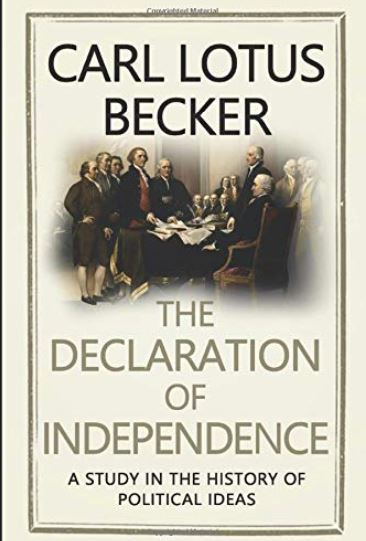
Front Page Titles (by Subject) ACKNOWLEDGMENT - The Declaration of Independence: A Study on the History of Political Ideas
Return to Title Page for The Declaration of Independence: A Study on the History of Political IdeasThe Online Library of LibertyA project of Liberty Fund, Inc.Search this Title:Also in the Library:
ACKNOWLEDGMENT - Carl Lotus Becker, The Declaration of Independence: A Study on the History of Political Ideas [1922]Edition used:The Declaration of Independence: A Study on the History of Political Ideas (New York: Harcourt, Brace and Co., 1922).
About Liberty Fund:Liberty Fund, Inc. is a private, educational foundation established to encourage the study of the ideal of a society of free and responsible individuals. Copyright information:The text is in the public domain. Fair use statement:This material is put online to further the educational goals of Liberty Fund, Inc. Unless otherwise stated in the Copyright Information section above, this material may be used freely for educational and academic purposes. It may not be used in any way for profit.
But what is nature? Why is custom not natural? I greatly fear that this nature is itself only a first custom, as custom is a second nature. Pascal, Pensées (Havet ed., 1897), I, 42. We need not feel the truth that law is but usurpation; it was introduced without reason, it has become reasonable; it is necessary to cause it to be regarded as authentic, eternal, and to conceal the beginning of it if we do not wish it to come soon to an end. Ibid., I, 39. As to the late Civil Wars, ’tis pretty well known, what Notions of Government went current in those Days. When Monarchy was to be subverted, we know what was necessary to justify the Fact; and then, because it was convenient for the purpose, it was undoubtedly true in the Nature of Things, that Government had its Original from the People, and the Prince was only their Trustee. . . . This was the Doctrine that was commonly received, and the only Doctrine that relish’d in those times. But afterwards, when Monarchy took its place again,. . . .another Notion of Government came into Fashion. Then Government had its Original entirely from God, and the Prince was accountable to none but Him. . . . And now, upon another turn of things, when people have a liberty to speak out, a new Set of Notions is advanced; now Passive Obedience is all a mistake, and instead of being a duty to suffer Oppression, ’tis a Glorious Act to resist it: and instead of leaving Injuries to be redress’d by God, we have a natural right to relieve ourselves. Th. Burnett, An Essay upon Government, p. 10. The constitution of 1795, like all of its predecessors, is made for Man. . . . I have seen, in my time, Frenchmen, Italians, Russians, etc.; I even know, thanks to Montesquieu, that one may be a Persian: but as for Man, I declare I never met him in my life; if he exists, it is without my knowledge. De Maistre, Oeuvres (ed. 1875), I, 68. ACKNOWLEDGMENTTo my colleagues, Professor Charles H. Hull and Professor Wallace Notestein, to Mr. Worthington C. Ford, and to Mr. John C. Fitzpatrick, the author is indebted for helpful suggestions in connection with this essay. The present volume was in plate proofs before I saw Mr. Fitzpatrick’s interesting article on The Declaration of Independence in the Daughters of the American Revolution Magazine for July, 1922. That article should be read in connection with chapter Ⅳ of the present work. |

Titles (by Subject)