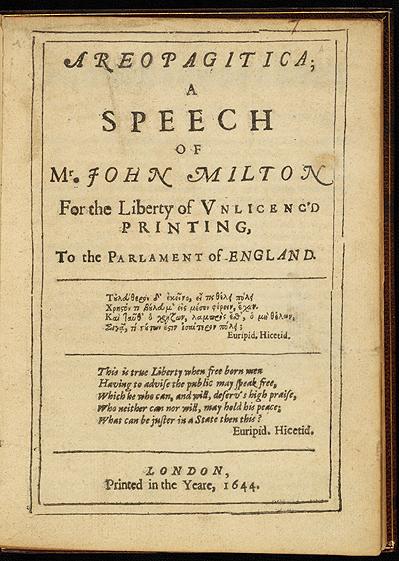
Areopagitica (1644) (Jebb ed.)
- John Milton (author)
- Sir Richard C. Jebb (editor)
This is Milton’s famous defense of freedom of speech and the press, in an edition based upon Sir Richard Jebb’s lectures at Cambridge in 1872, with extensive notes and commentaries. Mlton’s work was a protest against Parliament’s ordinance to further restrict the freedom of print. Milton issued his oration in an unlicensed form and courageously put his own name, but not that of his printer, on the cover.
Related People


Key Quotes
Freedom of Speech
What should ye do then, should ye suppress all this flowery crop of knowledge and new light sprung up and yet springing daily in this city? Should ye set an oligarchy of twenty engrossers over it, to bring a famine upon our minds again, when we shall know nothing but what is measured to us by their…
Freedom of Speech
…books are not absolutely dead things, but do contain a potency of life in them to be as active as that soul was whose progeny they are; nay, they do preserve as in a vial the purest efficacy and extraction of that living intellect that bred them. I know they are as lively, and as vigorously…
Freedom of Speech
Truth and understanding are not such wares as to be monopolized and traded in by tickets, and statutes, and standards. We must not think to make a staple commodity of all the knowledge in the land, to mark and license it like our broad-cloth and our woolpacks. What is it but a servitude like that…
Critical Responses
Article
Repressive ToleranceHerbert Marcuse
Marcuse discusses the pros and cons of tolerance in an open society. It was originally published in the larger work A Critique of Pure Tolerance co-authored with B. Moore and R.P. Wolff.
Connected Readings