Econlib

The Library

Other Sites

Front Page arrow Titles (by Subject) arrow MEMOIRS OF Cornelius de Witt and John de Witt, - The True Interest and Political Maxims, of the Republic of Holland

Return to Title Page for The True Interest and Political Maxims, of the Republic of Holland

Search this Title:

Also in the Library:

Subject Area: Economics

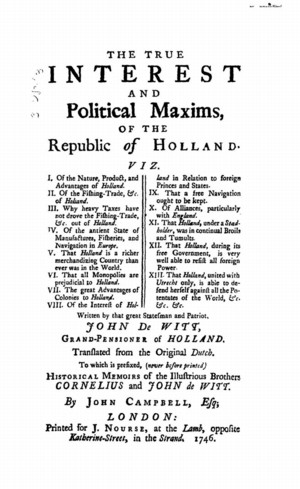
MEMOIRS OF Cornelius de Witt and John de Witt, - Pieter de la Court, The True Interest and Political Maxims, of the Republic of Holland [1662]

Edition used:

The True Interest and Political Maxims of the Republic of Holland (London: John Campbell, Esq, 1746).

About Liberty Fund:

Liberty Fund, Inc. is a private, educational foundation established to encourage the study of the ideal of a society of free and responsible individuals.


MEMOIRS OF Cornelius de Witt and John de Witt,

From their Entrance on the Administration of Public Affairs in Holland, to the Time of their Unfortunate Deaths.

IF fame be a reasonable incentive to patriotism, it may be safely averred, that there is no virtue to which it is so firmly attached. For if it ever happens, that the people are mad enough to mistake it in one age, these mistakes are amply over paid by the tribute of praise and gratitude offer’d by posterity in the next. This we see in the famous case of the Athenian patriot Phocion, in the history of the illustrious Gracchi; and in the celebrated brethren of whom I am to speak, who fell short of the Greek and Roman hero’s in nothing, and who go beyond them in this, that they lived so lately as to leave us without doubt, as to their true characters, which it shall be the business of the following pages to explain; with due respect to truth, and to the sacred memory of these martyrs in the noble cause of Libertya .

Cornelius and John De Witt were the sons of a very worthy and honest citizen of Dort, who as he had reason to glory in being their father, so he might justly think it his misfortune to outlive them as he did. His name was Jacob de Witt, and he had given incontestible proofs of his integrity and abilities both as a member of the states, and in the several embassies in which he had been employed before he was raised to the dignity of burgomaster of Dort and deputy to the states of Holland. In this capacity we find him in the year 1650, when his highness William II. prince of Orange thought fit to arrest him and five other Deputies whom he sent prisoners to the castle of Louvestein, for no other crime than that of endeavouring to free their country from the heavy burthen of taxes and impositions with which she was oppressed, under colour of public necessity, but in reality to promote and secure the interest of the stadtholderb ; and from hence the Dutch patriots were denominated, by the friends of the house of Orange, the Louvestein Faction. Their imprisonment however did not last long, a method being found to compromize matters with his highness, at least for the present, in consequence of which the prisoners were discharged upon a voluntary demission of their offices, by which their persons were delivered out of danger, and the prince of Orange freed from the apprehensions he had entertained of their influence.

c This extraordinary act of power however, with some others, of which the reader will find very clear and impartial accounts in the succeeding work would probably have been attended with consequences fatal to the very being of the republic, if the death of the prince, which happened on the 13th of November 1650d , had not given a new turn to affairs, and enabled the popular party in Holland to put the government into such hands as they thought fittest for restoring their affairs, by lessening the debts and taxes with which the people were loaded, and introducing such a spirit of liberty as is necessary to support a free commonwealth, which had been in a great measure stifled under the administration of the last princes of Orange, and which was chiefly effected by the courage, wisdom and vigilance of these two brothers, of whose tempers, capacities and other personal qualifications we will endeavour to give a short and clear account.

Cornelius de Witt was born on the 25th of June 1623. His person was very agreeable, and he had an air of majesty in his looks which very well became the employments he afterwards filled. His temper was very lively, his parts quick, his judgment penetrating, and his eloquence warm and unaffected. He discovered in his youth a great genius for academical exercises; when he grew up he applied himself to the study of the law, and amused himself with looking into martial affairs. He afterwards travelled to improve his natural talents, and give the last polish to his education, which having effectually done, he returned home in 1650, and married Mademoiselle Mary de Berkel, daughter to the receiver-general of the province of Holland. Soon after the death of prince William II. he came into the management of affairs, being advanced to the dignity of burgo-master of Dort, deputy to the assembly of the states of Holland and West-Friesland, Ruard, that is, governor and intendant of the dikes of the county of Putten, bailiff of Beyerland, intendant of the dikes of the country of Meerkerken, and curator of the university of Leydene . But of all his titles he is best known by that of Ruard Van Putten, by which he is called in most of the Dutch histories, to distinguish him from his brother the pensionary, of whose character we are next to speak.

John de Witt was born the 25th of September 1625. He had in his infancy a seriousness in his countenance and manners that was very singular. He applied himself to his studies with incredible diligence, and the quickness of his parts, joined to an indefatigable industry, rendered him, in the very beginning of his life, the wonder of all who knew him. Yet with all this steadiness and love of learning, he joined not only the accomplishments proper for a gentleman, by being perfectly versed in his exercises, but whenever he thought fit to unbend himself, had such a chearfulness in his conversation as rendered him the most agreeable companion in the world. But amongst all the great and truly amiable qualities with which the mind of this extraordinary person was adorned, his modesty and his magnanimity deserve particular notice. The first was so settled and so unfeigned, that he took more pains to conceal his abilities, than a vain man would have done to have displayed them; of which we have a remarkable instance, in his engaging Francis Schooten to publish his Elementa curvarum linearum, one of the deepest books in mathematics that had in those days appeared, and which was written by our author at twenty-three. As to his greatness of mind, I will not pretend to give any single instance of it, since every fact that will be taken notice of in these memoirs may be consider’d as a proof of it. After receiving at home the degree of doctor of laws, he travelled for some years, and on his return, in 1650, he became pensionary of Dort, and distinguished himself very early in the management of public affairsf .

The war between the English and Dutch republics commenced before John de Witt had acquired that influence which he afterwards obtained in the councils of Holland. He opposed it however as far as he was able; he shewed the ill consequences it must necessarily have which ever way fortune inclined: and when events justified his discourses to such a degree as that they seemed to be a kind of oracles or predictions, all who had the interest of the republic at heart endeavoured to promote his advancement, and to raise him to that high station in which for so many years he held the helm of the commonwealthg . An opportunity offered very early for the gratifying their desires. The Sieur Paw van Hemstede, pensionary of Holland, died in the end of the month of February 1653; and the states of Holland being assembled in order to elect a successor, the town of Dort, which is the first in the province, named the Sieur Ruyil, pensionary of Harlem, and the deputies from Harlem returned the complement, by proposing John de Witt, pensionary of Dort, though he was not then full twenty-eight years old: and he was unanimously chosen, first to officiate provisionally, and afterwards absolutely into the officeh .

Upon this occasion he consulted his friends and relations whether it was fit for him to accept this honour or not. Many of them, charmed with this mark of distinction, advised him not to hesitate a moment; but the wisest among them, without entering into long arguments, put him in mind of the fate of his predecessor Barneveldt, who lost his head for serving his country, thinking that a sufficient caution to one who was known to have the same sentiments in respect to government that Barneveldt hadi . John de Witt heard patiently all they had to say, and then delivered his own resolution, in these Words: “You all agree, that an honest and upright man may render great service to his country in this office; but you say, that this will be attended with much trouble and danger to himself. I know not how we can pass through this world without exposing ourselves to much trouble and danger, and since the thing is so, what cause so honourable as that of our country? I am resolved then to accept the office, and to serve the republic, whatever return I may meet with: this depends upon others, and that on myself alonek

The pensionary de Witt had not been long in his office before an occasion offered which sufficiently demonstrated how just a choice they had made in bringing him into that employment. King Charles II. who was then in exile at Paris, prevailed upon M. Boreel, the Dutch minister there, to inclose a letter from him to the states-general, in which he informed them, that he had reason to believe that many of the officers in the English navy were well inclined to his service; and therefore he offered to serve on board the fleet of the republic as a volunteer, till such a number of English ships should come over to him, as might enable him to assist them as an ally. When this letter was read in the assembly of the states-general, the friends of the house of Orange warmly espoused his majesty’s proposal, as a thing of the greatest consequence to the state, and most likely to weaken the English, who by this time had shewn themselves visibly an over-match for the Dutch at sea. M. de Witt opposed it, and, after having made a very handsome panegyrick on the courage and generosity of the king, he advanced two reasons against accepting his proposal, which to him, he said, appeared conclusive. The first of these was, that his near relation to the house of Orange must render his presence on board the fleet fatal to the peace of the republic, by reviving those disputes which had already been so detrimental to the interest of the state. His second, that by embracing this offer they would perpetuate the war, since, in return for such a service, it must be naturally expected that they should unite their interest with his, and make the destruction of the commonwealth of England a common cause. These reflections gave the assembly such a notion of the consequences that must, or at least, might attend this step, as induced them civilly to excuse themselves from accepting the king’s offer; and from hence we may easily judge, not only of de Witt’s maxims in government, but of his great capacity in bringing over others to his opinionl .

The continuance of the war was so visibly destructive not only to the commerce but to the very being of the republic, that the pensionary de Witt and his friends employed all their skill to set on foot a negotiation, at the same time that they omitted nothing that could be thought requisite for putting their naval force on a good footing, that they might be able to sustain the reputation of the commonwealth, so long as, in spight of all their endeavours, this war should last. With respect to the first, they found a way to get a letter from the states of Holland put into the hands of Lenthall, then speaker of the parliament; and this had in some measure the desired effect, since it brought about a negotiation, though not immediately a peacem . On the other hand, finding the people and the nobility equally inclined to declare the prince of Orange admiral, as if, under the auspice of a child of three years old, the arms of the republic were like to be more successful than when directed by the most experienced generals, they determined to satisfy the nobility, and to restrain the people. With this view they resolved to raise a nobleman to the post of lieutenant-admiral, then vacant by the death of the great Van Tromp, though none of the nobility were seamen enough to form any pretensions to it. But the English had set them an example, by conferring the highest commands in their fleet on Monk and Blake, who never were seamen, but on the contrary had always served in the army. This resolution once taken, the Seur de Witt was appointed, with some deputies of the states of Holland, to offer this command to baron Opdam, whom they persuaded with much to do to accept it, which proved of infinite consequence to the peace of the republic, and which could not well have been maintained without itn .

Yet these temporary expedients could only have served to delay the ruin of the state, without affording means to preserve it, if the pensionary and his friends, amongst whom we may reckon the ambassador sent to Cromwell, who by this time had turned out the Rump and set up a new parliament, not only authorized to sit by him and his officers, but also chosen by them. The Dutch ministers were directed to apply to them, but they quickly found them a sort of people by themselves, with whom no rational creatures could deal; for they entertained the ambassadors with long prayers, and discovered such a total ignorance of business, and withal such a spirit of pride in their discourses, that the Dutchmen plainly told the general, that it was impossible for them to deal with such folks, but that if he would assume the supreme authority, they might soon come to a right understanding. This was precisely what Cromwell wanted, and though he rejected their advice in words, declaring himself an humble creature of the parliament’s, yet he soon after found means to be rid of them, and took upon him the government under the title of Protector; and then made a peace with the Dutch, the most remarkable thing in which was, the adding a secret article for the exclusion of the house of Orange, to which the states of Holland, after great debates, and notwithstanding several towns protested against it, consented by a solemn acto .

The friends of the house of Orange, to inflame the minds of the people, insinuated, that this article of the exclusion did not flow naturally from Cromwell, but was privately suggested to him by the Sieur de Witt, by the assistance of M. Beverning; but of this the pensionary cleared himself, first by explaining the reasons why Cromwell had as much cause to be apprehensive of the power of the princes of Orange, as either himself or any of his friends; and next by the testimony of M. Beverning, who gave as full satisfaction as could be desired in this particular. Thus much however is certain, that Cromwell, by his natural sagacity, or by his conversations with the Dutch minister, came to have a clear knowledge of the strict connection there was between their interest; which made it as reasonable for them to secure him, as far as they were able, against the attempts of Charles II. as for him to protect them, as by this article it was stipulated he should, against the pretensions of the prince of Orange. This lets us into the true reason why king Charles II. always considered the de Witt administration as opposite to his interest in Holland, and why, on the other hand, the de Witts and their friends considered king Charles as an implacable enemy; and chose rather to repose a confidence in France than to enter, after the breach of the triple alliance, into any of his viewsp .

The article of the exclusion had raised such a clamour in Holland, that the de Witts and their friends had much ado to carry points that were absolutely necessary for the service of the people, such as the disbanding foreign troops, now they were no longer of use, that they might be thereby able to remit some of the heaviest taxes; and this for no better reason than that, as the opposite party gave out, the principal motive thereto was the being rid of such as were suspected to be in the interest of the house of Orange. The clergy too began to meddle with the affairs of state in their pulpits, and, instead of instructing the people how to serve God, were for directing their superiors how to govern their subjects; but the firmness of the pensionary got the better of all these difficulties, which raised his reputation to such a height, that he was chosen arbitrator of the differences that had arisen among the nobility of Friesland, and having happily composed these, he was called to the like good office in Overisselq .

Many untoward affairs, which fell out in the space of a few years after this, served only to heighten the character of the pensionary, and to shew that he wanted not the courage of the hero, with all the abilities of a consummate politician. He advised the states of Holland to make, independent of the other provinces, reprisals on the French king; and as he entered on this arduous affair with great spirit, so, notwithstanding the haughtiness of the French court, he brought his country out of it with honourr . In the great contest in the north between the crowns of Sweden and Denmark, he managed all things with such wisdom and dexterity, that, notwithstanding the eagerness and obstinacy of both parties, and the intrigues of the protector Cromwell, who, from certain secret views of his own, encouraged the Swedes to continue the war, all things were happily adjusteds . On the restoration of king Charles II. he was complimented by the pensionary de Witt in terms equally respectfull to the king, and honourable for the republic, which made such an impression, at that time, on this prince, that soon after he gave all the assistance in his power to the conclusion of a treaty between the Dutch and the Portuguze, extremely advantagious to the states, which had been in a manner solely negotiated by the pensionaryt .

Things continued for some time in this amicable situation, and king Charles II. thought himself so much obliged to the states-general, to the states of Holland, and to the pensionary De Witt, for the respect shewn him in seizing at the request of Sir George Downing, Corbet, Okey, and Barkstead, three of his father’s judges, that he found himself obliged to thank the Dutch embassadors in very strong terms, and added, at the close of his discourse, these words. “I must also, upon this occasion, inform your excellencies, that I have a very particular account of the share Mr. De Witt had in this affair, with which I am extremely well satisfied, and shall always preserve a grateful remembrance of it, and with this I desire you would acquaint him”. This seemed to be so much the intention of that monarch at this time, that soon after he concluded a treaty with the states-generalu . The affairs of the prince of Orange still gave the states of Holland a good deal of disquiet, in which however the pensionary acted with such prudence, that while he steadily pursued the interest of his master, he preserved, in a great measure the good will of the wisest persons about that prince, and so far overcame all the strong prejudices that the Orange party had formerly against him, that when his second five years were exspired, he was unanimously continued in his high office, by a resolution of the states dated September 15, 1663w .

Our statesman was now in the height of prosperity, and seem’d to have vanquished even envy herself. In all difficult cases his ministry was made use of, and when the prince of East-Friesland quarrelled with his subjects he was put at the head of that deputation which was sent by the states to terminate these disputesx . When their differences with England were risen to such a height that a war could not be avoided, and the states of Guelder and Overissel, absolutely refused to contribute their proportions towards the expence of it, the states of Holland found it necessary to send a deputation consisting of Mess. De Witt, Crommon and Kan, to explain to them the nature of the war, and the danger of their continuing in their former resolution, which they did with such effect, that those states not only agreed to furnish their quota, but did it immediately, and even borrowed money for that purpose; this was so remarkable a proof both of his zeal and his capacity, that the states general thought fit to name him one of their commissioners for the direction of the navy, in which capacity he went to Amsterdam and other places, where he made such vigorous dispositions, that the fleet was soon in much better condition and more fit to go to sea than it was judged possible by the admirals themselves, and by some of the ablest seamen in Holland, who expresed the greatest astonishment at the address with which the pensionary managed all things relating to naval affairs, though ’till called to the inspection of them on this important occasion, he had never concerned himself about them, as desiring all the servants of the state should act in their proper spheresy .

The French, who were the only gainers by a war betwen the maritime powers, pretended to manage a negociation for peace at London, which however went on very slowly, and this gave the Orange party great advantage in the states. Mr. De Witt saw clearly what was intended, and therefore advised that positive orders should be sent baron Opdam to fight; for, as the pensionary observed, a battle could not but be advantagious to the state. If they were victors it would probably put an end to the war, and if they were vanquished it would oblige the French to join them immediately. This determined the states to send such orders to Opdam, who as he was well affected to the house of Nassau obeyed them very unwillingly. On the 3d of June, 1665, he attacked the English fleet, but had the misfortune to lose the greatest battle that had hitherto been fought between the two nations, himself and his ship being blown up just as he was upon the point of boarding that of the Duke of York. This struck a great terror into the Dutch seamen, and before the states could fit out another fleet they found themselves under a necessity of appointing some of their own deputies to command it, which was a new thing, and had therefore the greater effectz .

This commission was given to Mess. Huygens, De Witt and Boreel, and among other marks of their high authority, the state assigned them guards. The friends and relations of the pensionary de Witt advised him to decline this new post as a command invidious in itself, and which must be attended with bad consequences. He answered that the safety of a private man ought not to enter into competition with that of the republic, and that he never considered his personal hazard or advantage, but only in what manner and how far he might be able to serve his countrya . When he came on board the fleet he found it shut up in the Texel, so that though it was absolutely necessary for it to put to sea, in order to secure the safe passage of the outward bound East-India fleet, yet the seamen unanimously agreed that the thing wasimpossible, as the wind then stood. The pensionary de Witt was alone of another opinion, and he made no difficulty of declaring it, though in this he oppos’d his own sentiment to the common judgment of those who ought to have been best skilled in their own professions. As this has been always esteemed one of the most remarkable actions of his life, and has in some measure contributed to render his memory immortal, I think myself obliged to give a particular account of it.

b There are at the mouth of the Texel three passages between the sands, by which vessels may go out to sea, and these are the Landsdiep, the Slenk, and the Spaniards-gat. It was the received doctrine of the seamen, that there were but ten points of the compass from which, if the wind blew, ships could go out, and that twenty-two were against them; but the pensionary de Witt, as he was a great mathematician, soon discovered the falsity of this notion, and that there were in reality no less than twenty eight points in their favour, and but four that could hinder them from going out, viz. W. NW. by W. NW. NW. by N. The pilots however perceiving that he reckoned upon all the passages, declared positively that in the Spaniards-gat there was not above ten or twelve feet water, and that therefore it was impossible to carry out large ships by that passage. Their assertion did not satisfy the pensionary, he went through it in a long-boat in person at low water, and without trusting the lead out of his hand, found it at least twenty foot deep every where, and free from those incumbrances which the pilots had hitherto talked of. The pensionary therefore engaged that himself and M. van Haaren would carry out the two greatest ships in the fleet through the Spaniards-gat with the wind at SSW, which he performed on the 16th of August 1665, and the greatest part of the fleet followed him without the least accident, since which that passage has been called, and very deservedly, Witts-diepc .

Very soon after, he came with the other deputies on board the fleet, the differences which had arisen between de Ruyter and Tromp were adjusted, and of open enemies they became in appearance sincere friends. The seamen however were still not a little discontented at this novelty of being commanded by the states deputies. However, after they had been some time at sea, and meeting with a dreadful storm on the coast of Norway, which lasted two days, M. de Witt brought them wholly over to his party, for he remained upon deck all the time, never changed his cloaths, or took any refreshment, but in common with the men, gave his orders with the greatest calmness and presence of mind, and when he saw there wanted hands, obliged his officers to work by his own example. This made him the darling of the sailors, and thenceforward they paid him more respect of their own accord than the severest orders of the states could ever have extorted, and indeed they had good reason, for he was continually suggesting regulations in their favour, and shewed as tender a concern, both for their safety and their interest, as if they had been his children; and yet he did all this without giving the least offence to the admirals, by causing those alterations to be published in their namesd . Such was the happy temper of this great man, that he was always zealous in doing good, without affecting to be popular, and had such high notions of his duty as quite excluded vanity.

All the care and pains the pensionary took on board the fleet could not hinder his enemies from spreading stories among the people, which irritated them extremely against him. Sometimes it was pretended that the misfortunes which had happened to the navy were owing to the deputies intermeddling with things they did not understand. To obviate his calum ny de Ruyter wrote a letter to the states, in which he not only vindicated the deputies in general, but M. de Witt in particular, whose assistance he acknowledged in the clearest and most honourable termse . M. de Witt himself wrote a plain and accurate relation of all that had happened during his continuance on board the fleet, and at his return, he verified every article of this account so fully to the states-general, that they not only gave him solemn thanks for his good service, but intended likewise to have made him a considerable present, which he waved by declaring that he sought the service of his country only, and not a gratification for his servicesf . Then his enemies gave out, that he had continually thwarted de Ruyter, and that their quarrels had occasioned no small detriment to the state. But this story, tho’ dress’d out with very great art, was entirely ruined by an unforeseen accident. Admiral de Ruyter had ocasion to come to the Hague, and during his stay there lodged in the house of M. de Witt, which absolutely undeceived the very mob, who would not be brought to believe that a man of de Ruyter’s temper could be induced to dissemble on any account whateverg .

King Charles II. having found means, by the help especially of very large subsidies, to engage the bishop of Munster in his interest, and that to such a degree as to engage him to declare war against Holland, the states found themselves under a necessity of raising fresh troops in order to the maintenance of a land war, which gave them no less trouble than that in which they had been engaged so long by sea. Prince John Maurice of Nassau was general of the forces employed against the bishop of Munster; but tho’ the states placed very great confidence in him, who was an old veldt marshal of their armies, yet they thought proper to send their deputies with him into the field, and amongst these they named Cornelius de Witt, who had already given high testimonies both of his courage and capacityh . He discharged his duty on this occasion in such a manner, as not only merited the applause of those who had given him this commission, but acquired him also the esteem of prince Maurice, which he testified upon all occasions; yet the people clamoured against this deputation as they had done against that which had been sent on board the fleet. But whilst Cornelius de Witt was thus employed in the army, his brother the pensionary was secretly negotiating a peace with the bishop, which when it was least expected took effect, and proved so manifestly advantageous to the republic, that for a moment the enemies of the de Witts were silenced, and the great services of the two brothers were universally confess’di .

A little after the pensionary de Witt was again appointed one of the deputies for the management of the fleet, and in fitting it to fea he used such expedition, that on his return to the Hague, he received the thanks of the statesk . On the [Editor: illegible text] of June 1666, happened the famous battle between the Dutch, under the command of de Ruyter and Tromp, and the English, under prince Rupert and the duke of Albemarle; and on this occasion the pensionary was sent by the state to take a full account of the whole affair, that they might be the better enabled to do justice to every one according to his merit. In the execution of this commission, M. de Witt drew up, from the best authorities he could obtain, an exact account of those three days fight, which is justly esteemed a master-piece in its kind, and will ever remain a proof of his being as capable of recording great exploits, as of atchieving theml . He was scarce returned to the Hague after making this enquiry, before he was called again on board the fleet on a less pleasing occasion. Another battle had been fought [Editor: illegible text] in which the Dutch had suffered severely; and which was worse, their admirals threw the blame upon each other. Tromp accused de Ruyter; de Ruyter threw all the blame upon Tromp; as if the states could see with no eyes but those of M. de Witt, he was immediately dispatched, with other commissioners, to look into this unlucky business, and to report the thing as it appeared to them, which was done accordingly; and upon this admiral Tromp was laid asidem

I shall not enter here into the prosecution of M. Buat, who was beheaded for betraying the councils of state, though this affair was discovered by M. de Witt, because it is pretty generally known; and though many reflections have been cast upon the pensionary, yet as the evidence against him was perfectly clear, and indeed in a great measure under his own hand, one cannot but be satisfied that this clamour was purely the effects of partyn . That it had very little effect on those who were the best judges, appears from his being sent immediately afterwards sole deputy to the fleet, where he commanded in chief for some time, and then returned to the Hague, where very soon afterwards he concluded the quadruple alliance between the republic on one side, the king of Denmark, the elector of Brandenburgh, and the duke of Lunenburgh on the other, whereby all the differences between those princes were absolutely adjusted, and the pensionary received thereupon, not only the thanks of the states general, but also the complements of all the foreign ministerso .

The war with England began now to be considered by all the provinces, except that of Holland, as an intolerable burden; and the pensionary finding that the storm bore heavy upon him, and that he was generally pointed out as the great enemy of peace, shewed an inclination to embrace it on reasonable termsp . But when King Charles proposed treating of the peace at the Hague, it alarmed the pensionary not a little, from an apprehension, that if the English ministers were there, they might enter into intrigues with the deputies to the states general, which might have been of dangerous consequence, and therefore it was rejected, and the town of Breda proposed; to which the ambassadors both of the king and of the states resortedq . But as they found it by experience no safe thing to rely either upon king Charles or upon king Lewis, they thought fit to equip early a stout fleet, on board which the Ruard Van Putten, with other deputies, was to command in chiefr . But as the provinces did not think fit to name their deputies, the Ruard took his post on board the fleet, and commanded it alones . All the world knows that it was at this time, and by the contrivance of Cornelius de Witt, that they executed the famous design of entering the river of Thames, and burning our ships at Chatham, which it is certain ruined the reputation of king Charles II. and raised that of the states general to a very great heightt . We need not wonder therefore that Cornelius de Witt received compliments from all quarters, that the states general should pass a vote of thanks, as they did on the 13th of Sept. 1667; or that the states of Holland should make him, in conjunction with M. de Ruyter, each a present of a gold cup; or that the town of Dort should receive him at his return thither with extraordinary, and perhaps extravagant marks of joy and satisfaction, which however did him little service in succeeding timesu .

In the meantime the peace was negociating at Breda, where it was resolved to conclude it, in order to draw the fleet of the states from the English coasts, so that this looked like forcing England into a peace; and thereupon the spirits of the states were full as much raised as those of the De Witts, for they pretended thenceforward to give laws to Europe, and to prescribe bounds to the French king’s ambitionw . This was indeed a very delicate enterprise, and required all the penetration and address of our great statesman, who finding the court of England at that time well inclined, and perfectly apprized of the danger of the French king’s over-running the Spanish Netherlands, devised, in conjunction with Sir William Temple, the means of covering these provinces before the French king should so much as suspect there was any negociation set on foot for that purpose; in which, by his prodigious dexterity and absolute command of his temper, he happily succeededx . While these schemes were carrying on the pensionary thought there could scarce happen a fitter conjuncture for his carrying into execution the great design of the warm republicans, and therefore now he brought on the establishing of that which was called the perpetual edict, whereby the office of stadtholder was for ever extinguished, and, as it was supposed, the liberty of Holland fixed on a eternal basisy . This edict is dated the 5th of August, 1667, but it was not absolutely confirmed until the December followingz .

The French king continuing his resolution of attacking the low countries, Sir William Temple was sent over in the beginning of the year 1668 to finish the negociations that had been secretly carried ona . He presented his letter of credence on the 8th of January, and he signed the triple alliance on the 13thb . This alliance between England, Sweden and Holland had the desired effect, and if it had never been dissolved Europe had remained safe, in spite of all the pernicious schemes of Lewis the fourteenthc . Though we are so much streightened for room in these memoirs, yet it seems absolutely necessary to take notice of a grand entertainment given by the pensionary de Witt on the conclusion of this treatyd . It fell out on the third of February 1668, and amongst the other guests, there were invited the prince of Orange, prince Maurice of Nassau, and Sir William Templee . There was a ball in the evening which was opened by the prince of Orange, but two things particularly surprized all who were present; the first, that the pensionary de Witt danced the best of any man theref ; the second, that so many tokens of friendship and esteem passed between him and the prince of Orange, insomuch that when the company broke up, the pensionary attended his highness to his coach, where he conversed with him near a quarter of an hour, and just before he drove away, the prince was heard to express himself in these words: “Sir, I am thoroughly persuaded of your affection towards me, and I promise you that I shall never be wanting in suitable returns of gratitude to you and to your family, upon all occasions so long as I liveg .”

In the midst of these fatigues the 15th year of M. de Witt’s ministry expired, and he thereupon testified a desire of resigning, but the states pressed him so warmly to execute the office of grand pensionary for five years longer, that he could not resist their sollicitations, though he absolutely refused a present of a large sum of money that was intended himh . On the 17th of July 1668, he entered on the last five years of his administration, his appointment being increased from three to seven thousand guilders per annum; and withal he had a present made him of fifteen thousand by the nobles of Holland in consideration of the long and faithful services he had rendered to the statei . In the beginning of 1669 the French renewed their intrigues in Holland in order to procure the breach of the triple alliance, at first indeed without success, but afterwards, when it was known that the system of affairs was changed in England, the French schemes were more successful, but this was so far from being agreeable to the pensionary, that he went into it with great reluctancy, and not ’till many of his old friends were absolutely drawn over to the interest of the house of Orangek . As a full proof of this, we need only consider the extraordinary confidence reposed in Sir William Temple, with respect to a difference which had arisen between the crown of Portugal and the republic about a debt due from the former to the latter of 2,500,000 cruzado’s, the method of paying which was referred to Sir William, who decided it so as to receive the thanks of the Portugueze ambassador, as well as of M. de Witt in the name of the statesl .

It is to be observed, that the pensionary de Witt went no farther with the French ministry than to credit the professions which they made in the name of their master, and to endeavour to adjust, by way of negotiation, the disputes which that crown had artfully started with the states. But in the mean time, the French had carried their point in England, and Charles the second made such alterations in his ministry as put public affairs entirely into the hands of men who were equally his subjects enemies and his ownm . This ministry will be infamous to all posterity by the name of the CABAL, and was composed of papists, sectaries, and atheists, pensioners to France while at the head of the British government, and conspirators against their king whilst they sat in his privycouncil. These were the men who brought about that monstrous conjunction between England and France, to the ruin of Holland, contrary to the interest of the English nation, in direct violation of treaties, and accompanied with such base and black circumstances, that even those who had the wickedness to contrive it had not the impudence to avow it, but endeavoured to conceal their designs as long as possible by the vilest prostitution of their own and their country’s honour, giving the strongest assurances to France of their resolution to destroy the state, and at the same time, protesting in Holland the sincerity of their affection for the republicn .

The pensionary de Witt, though he was not entirely blinded by the delusive representations of France and England, yet it is certain that it was a long time before he perceived in how great danger the republic stood. The regard he had for Sir William Temple; and his confidence in the declarations made by him, kept this statesman long in suspence, and the great consideration he had for the French embassador contributed not a little to the keeping him fixed in these sentiments, notwithstanding the strong appearance there was of foul dealing Besides the prince of Orange being introduced into the council of state, his party gained ground daily, and there were likewise so many who were grown jealous of the pensionary’s authority, that he found himself scarce at liberty to act, when he discerned the danger; but however he applied himself diligently to the putting both the sea and land forces of the republic into the best condition possible, in which he met not with more difficulties from the avowed opposition of his enemies than from the differences and intrigues which broke out among his friends, who could not help disputing about posts and preferment, when the very being of the state was in danger, and thereby sacrificed not only the interest of the republic to their private views, but also their own interest, as friends, to the establishment then subsisting, and the exclusion of the power of a single person, in the direction of the commonwealthp .

The state was at this time torn by three different factions. The first were for restoring the old government, and placing the prince of Orange at the head of the republic adorn’d with the same title, and invested with the same power that his ancestors had enjoyed. The second, which were at that time stiled the faction of the De Witts, were for keeping close to the perpetual edict, and extinguishing the stadtholdership, which they looked on as an office incompatible with the freedom of the state. These were generally held direct enemies to the prince of Orange, whereas they certainly meant him well, only they thought they were oblig’d to mean their country better; the two great offices of captain-general and admiral they were content his highness should possess, provided he took the usual oath for abjuring the stadtholdership, and this they judged was as much power as the commonwealth could lodge in the hands of single person safely. The third party were a kind of trimmers, who from principle favour’d the De Witts, but to gratify private resentments, or for the sake of present conveniences, could sometimes go along with the other party. These last were by far the least powerful, and yet by a well or rather ill timed shifting, they constantly turn’d the scaleq .

When the war appear’d to be inevitable, the states of Holland first, and afterwards the states-general elected the prince of Orange captain and admiral-general, in the latter end of February 1672, and in that quality he soon after took his seat in the assembly of the states, and at the same time the oath for abjuring the stadtholdership, which within a few months after he accepted. This was certainly against the pensionary’s judgment, since he would rather have given his highness that command in a time of peace. To attain this great offers were made to the king of England. He was promis’d satisfaction as to the flag, the redress of all the grievances complained of by his subjects in the East and West Indies, and as a proof of their sincerity in this respect, the states ordered all the gilding on the Royal Charles to be taken off, and as far as in them lay, to extinguish all memory of what had passed at Chatham, they offer’d to recall the medals struck on that occasion, and to melt down the two golden cups given to admiral Ruyter, and the Ruard Van Putten. But all this came too late, the French king had made the English ministry sensible of his bounty, to the full extent, and they repaid him by involving their master first in an attempt on the Smyrna fleet, and then in an open war, which was declared in the latter end of March, in conjunction with Francer .

The states in this distress appointed deputies to go to the army, and at the same time named Cornelius de Witt sole deputy on board the fleet, to which he went immediately, and was attended there with a guard, and all other marks of sovereignty, as representing the states general. He behaved bravely in the battle of Southwold-Bay, sitting on the deck of the admiral and giving orders, under his canopy surrounded by halberdeers. But this pomp did him hurt, for the people at Dort were so provoked at the sight of these unusual honours, that they not only abus’d him, when he retired thither from the fleet, on account of a fit of sickness, but also broke into the town-house, where they cut to pieces a fine picture of the expedition at Chatham, and having sever’d the head of the figure of M. De Witt from the body, they carried it out and nailed it to the gallowss . On the 11th of June the same year, the pensionary De Witt was assassinated at the Hague, by four persons, one of whom was an advocate, his name Jacob Vandergraef, who was taken and lost his head for it on the 29th of the same month. He said at the place of execution, “that he made a solemn prayer to God before he attacked the pensionary, that if he was such a one as he thought him, he might succeed, and if otherwise, that he might lose his own life.” The other three assassins fled to the prince of Orange’s army, where they were safe. After this attempt, in which the pensionary was dangerously wounded, the states, at his request, gave him a coadjutort .

Soon after this act of violence there happen’d a tumult at Dort, in which the people declared they would have the prince of Orange for stadtholder, and obliged two of their magistrates to go and invite his highness thither. The prince of Orange was then at the head of the army, where his presence was absolutely necessary, yet he had the goodness to accept of this invitation; and on his arrival the people rose again and obliged the council to declare him stadtholder, tho’ he had sworn never to accept that office. It happened that Cornelius de Witt was still at Dort, sick of the distemper on account of which he had left the fleet. To make the thing yet stronger they would needs have him sign the act for declaring the prince stadtholder, and obliged the magistrates to carry it to him for that purpose, but he rejected the proposal with a generous disdain, and when they endeavour’d to frighten him into it, by observing to how great danger his refusal must expose him, he answer’d, “In the last sea-fight I heard so many balls whistle about my ears that I am no longer afraid of them, and I had rather receive my death’s wound than play in such a manner with the oath I have taken, by setting my hand to such a writing”. Yet at last, moved by the prayers and entreaties of his wife and children, he subscribed; adding after his name, the letters V. C. i. e. Vi coactus; constrain’d by force; but this being perceived by one of the ministers who came with them, he was forc’d to put these letters out againu .

The example of Dort, was very soon follow’d by most of the other towns in the province, and every sedition arose from these pretences, that the De Witts plundered the state, and the prince of Orange was not stadtholder. On the 2d of July, the states of Zealand removed the latter of these causes, and the very next day the states of Holland repealed the perpetual edict and declared the prince their stadtholder also, which dignity he very readily receivedw . The cries of the people against the de Witts became louder and louder, and that they might not seem to clamour without cause, they gave out that the pensionary had diverted the secret service money to his own use, and had thereby defrauded the state of above 80,000 guilders a year. The pensionary upon this applied himself to the prince, and besought him, since all power was now in his hands, to suppress these insolencies, and to do him justice to the people. His highness answer’d with his usual coldness, that as to libels the pensionary must learn to bear them as he had done; and as to doing him justice, it was not in his power, since he knew nothing of the matter. This answer had, as might have been expected, a bad effect, as it seemed to give some degree of credit to the chargex . The pensionary however soon manifested his innocence by presenting a memorial to the states-general, wherein he suggested, that tho’ the disposal of the secret-service money had heretofore always belong’d to his office, yet he had never meddled with it, from a foresight of what might happen, and for the truth of this, he appeal’d to their noble mightinesses the states of Holland, who having verified this assertion, he was declared innocent of this charge.

The prince of Orange, when rais’d to the so long sought for honour of stadtholder, would willingly have gain’d the pensionary de Witt to his party, and to that end, he employed some of his best friends to break the matter to the pensionary, who answer’d, “that his highness did him a great deal of honour, but that he was sensible it was not in his power to do the prince any service. The people, said he, hate me, and their hatred must be the more violent as it is absolutely without a cause. They will therefore dislike every thing that passes through my hands, and instead of yielding any assistance to his highness, I shall be a constant dead weight on his interest. As to the compliment he is pleased to make me, that my authority under a stadtholder shall be as great as it was before, it is what I least desire. I never sought power, but as it might enable me to serve my country, and I sincerely wish that his highness may be able to render the republic greater and more successful services, and that from a heart as faithful, and as warm with zeal.” To shew however how easily he could acquiesce in whatever appeared to be the will of his sovereigns, he went on the first of August, which was the day after his first going abroad since his being assassinated, to wait upon the prince of Orange, in order to felicitate him on his being raised in the statholdership. His highness received him very dryly, and though he conversed with him an hour, yet the pensionary saw plainly, that it was impossible to gain his friendship, but at the expence of being his creaturey .

On the 4th of August Mr. John de Witt addressed himself to the states of Holland, in order to procure his dismission from the post of pensionary, which they granted, after they had thanked him for his faithful services for the space of 19 years. After this he employed his time in drawing up a state of the finances, for he was not satisfied with having clean hands, he thought that one who had exercised so long the office of first minister to so powerful a republic, ought not only to be guiltless, but exempt from all suspicion. This was the great thing he had in view, and this he lived to accomplish, for he so little affected public business, when he saw it was no longer in his power to benefit the public, that tho’ he was still a member of the great council, yet be very seldom went thither, but deplored in secret the misfortunes of his country, which from the highest prosperity, fell as it were, all at once, to the very brink of ruinz .

It is not strictly my business, and if it were I should not find it very easy to assign the causes of those mischiefs which befell Holland in 1672. It is clear that the perfidiousness of the French court, and the venality of king Charles’s ministers, ere among the chief of them, but it is no less true, that the state might have made much greater resistance than she did, if it had not been for her intestine divisions. This it was that spread that terror and confusion, which every where appear’d on the invasion of the French, and occasion’d in a few days the loss of places that might have withstood an enemy for many months; but the reader must not suppose that this at all weakens what our author suggests in the ensuing worka . Since he there takes it for granted, that men would be sensible of the blessings they possess’d, and join unanimously and heartily in supporting the government to which they owed them, and it is upon this hypothesis he affirms what would have been found true, that Holland might have defended herself even against France.

I cannot but observe upon this occasion that the prince of Orange’s party heightened these confusions in order to ruin the de Witts. The mob were encouraged to pull down a house in which the pensionary was suppos’d to lie sick, and an attempt was made to assassinate Cornelius de Witt in his house at Dort, on the very same day his brother had been attacked in the street. Peter Grotius, the son of the great Hugo, lately returned from his embassy in France, sav’d his life by flight, but his house was plunder’d, and the prince of Orange himself caused the count de Montbas, who had married the sister of the de Witts to be arrested in his camp, and if he had not escap’d, would have condemned him as a traytor, tho’ he had behav’d himself as bravely as any man could do, which increased the storm, that was but already too greatb .

While the common cry was strong against the de Witts, a barber whose name was Tichlaer, came to the prince’s camp, and in-inform’d the lord Zuylestein, natural uncle to the prince, that Cornelius de Witt, the antient burgomaster of Dort, had given him money, and promis’d him a great reward to poison the prince, because, as he said, they could not otherwise preserve their liberty, the prince being now made stadtholder, contrary to the perpetual edict; and that they might come to fall under a foreign power by a match betwixt some foreign potentate and a daughter of the prince, if he should have anyc . The barber having given this upon oath, the prince communicated the same to the court of Holland, who thereupon committed de Witt to prison, and after having examined both parties, confronted them, and enquired into the matter by torture and otherwised , considering all circumstances, with the steadfast adherence, when confronted, of the barber to his accusation, and the answers of the defendant and his defence, they condemned the latter to lose all his offices and employments, banish’d him for ever out of Holland and West-Friesland, and order’d him to depart as soon as possible, without ever returning, on pain of severer punishment, condemned him in costs of suit, and set his accusers at libertye .

The wife, brother and friends of Cornelius de Witt presented several petitions and informations to the court to vindicate the defendant; insisting upon the services he had done to the state for a great many years, and that he was but just returned home from the fleet, where his very enemies would bear witness to his courage and conduct. They alledg’d also the whole tenor of his conversation, as a sufficient defence against this calumny, and referr’d to the records of several courts, where the barber had been condemn’d for perjury, and scandalizing several persons of note, that he was under sentence at the same time for a rape, for which he was answerable to a court of the defendant’s jurisdiction, who was thereby entitled to his forfeiture, for which he ow’d the defendant a grudge; that the defendant never saw him but once, which was soon after his return from sea, when the barber, after several applications, was admitted to his bed-chamber, on pretence of having something of importance to discover to him, without any body’s being by; that Mrs. de Witt distrusting the fellow because of his ill looks, and because of the universal clamour that was rais’d against her husband and his brother, who had narrowly escaped being murdered by assassins a very little before, she ordered the chamber-door to be kept open, and her son and servant to stay in the next room, in view of the bed upon which her husband lay, because of his indisposition; that they heard all that pass’d betwixt her husband and the barber; that the latter, after some discourse about the calamities of their country, and the present posture of affairs, said, he had something to propose to him, if he would keep it secret and give him assistance. To which her husband answered, that if what he had to propose was good, he would do what he desired; but if otherwise he might get him gone. To which the barber replied, Since you will not hear me, Sir, I’ll be gone. And so bidding him farewel, he was let out of the house by her servant, after he had staid about a quarter of an hour. That de Witt, reflecting upon what had passed, sent for the town clerk, gave him an account of what the fellow had said, and desired him, since he was not able to go himself, that he would go to the present burgo-master, and get a warrant to take up and examine the barber. A warrant was accordingly taken, but the witness could not be found ’till after he had given in his accusation upon oath, to which he was encourag’d by the clamours of the people against her husbandf .

It happen’d unfortunately that the barber being at liberty, and publishing it loudly at the Hague, that the Ruard Van Putten had been convicted on his evidence, the people grew tumultuous, especially after they heard the sentence, which they said was cruel if he was innocent, and contrary to justice if he was guilty. When the barber saw them in this disposition he trump’d up another tale, that if they did not prevent it, Cornelius de Witt would be quickly rescued out of prison. Upon this the people instantly arm’d, and surrounded the place where he was confined. It fell out very unfortunately that the pensionary, who had been sent for by his brother, went to him, contrary to the advice of his friends; and as he was bringing him out of prison, in order to depart, according to his sentence, a woman cried out to the guard of burghers, who stood before the prison door, What the Devil! men, there’s the traytors going off, drive them up again, or strike them dead. Upon which, the guard order’d them both to go up again, or they would fire upon them; and tho’ the pensionary spoke to them with authority to forbear, they forc’d them both in again, and oblig’d their coach to drive off, in which their father sat, in order to have carried them to dinnerg . In mean time the the tumult increas’d, and the report being spread, that Cornelius had escap’d, the people would not be pacified ’till two of the burgo-masters and four burghers went up and satisfied them to the contrary. The pensionary prevail’d with the magistrates to dine with him and his brother. But in the mean time all the companies of burghers came in arms about the prison, drew up in good order, and would suffer no man to go in, for fear of an uproar. Three troops of horse which then lay in the Hague also mounted: one of them went to the usual place of rendezvous, and the other two endeavoured to get into the outer court of the prison, but the people kept them off with their pikes and muskets, and the armed rabble got up to the tops of the neighbouring houses, to see that neither of the de Witts should escape, and perceiving that the officers staid long in the prison, and apprehending them to be murdered, they began to throw stones and to fire their pieces at the doors and windows, ’till the officers spoke to them out of the windows, and told them, all was wellh .

A groundless report was in the mean time spread, that the mob of the neighbouring villages and towns had taken arms, and were coming to plunder the Hague. This increased the tumult, and some of the burghers cried out, We stay here to guard a couple of rogues, who will certainly be rescued before tomorrow, by force or fraud; and if they escape, the town will be next day all in blood and confusion, and our houses plunder’d. Upon which many requested, that the de Witts might be carried to the town-house, where they would be kept securely, without any trouble. Others cried out, let us tie them to the gibbet and shoot them. Upon which one of the mob bid them follow him, and he would he their leader; and then with their muskets and smith’s hammers they broke up the doors, and came to the chamber, where they found the pensionary sitting upon the foot of the bed, reading his bible, and his brother laid down in his night gown. The pensionary ask’d them what they would have, and why all that violence? one of them answer’d, You must walk down, for we will have your livesj . Cornelius rising from the bed, spoke roughly to the fellow, and bid him go down; but the pensionary seeing that no reason would do, he took his brother by the hand to go down stairs, where he was wounded by a pike over the eye; upon which he held up his hands and eyes to heaven, recommending his soul to God; and as he went out, was forc’d by the mob to the very place where he had been assassinated two months before, and barbarously murder’d, covering his face with his cloak, as Cæsar did; and his last words were, well, men! well, citizens! and soon after his brother underwent the same fate. Upon this, the companies retired under their respective colours in good order, while the barbarous mob carried their dead bodies to the gallows, where they hung the pensionary a foot higher than his brother, and afterwards mangling their corps, cut their cloaths in a thousand pieces, and sent them about the country, as if they had been trophies of a conquest; and some of them cut out large pieces of their flesh, which they broil’d and eatk . Thus fell these two great men by popular fury; Cornelius de Witt in the 49th, and the pensionary in the 47th year of his age, both equally zealous for the glory and liberty of their native country, and formerly as much belov’d, as now they were hated by the people, who look’d upon them to be the causes of all the calamities with which their country was at that time overwhelm’dl .

The Ruard van Putten left behind him a daughter who was afterwards married to her cousin Mr. John de Witt, son of the pensionary, who gave signal proofs of his extraordinary abilities, tho’ to the sorrow of his relations, and indeed of all who knew him, he died in the flower of his age, leaving behind him two sons and a daughter. The names of the sons were Cornelius and John, and they resembled in every respect their grandfather so nearly, that all the true friends of their country saw with delight these worthy representatives of a family, which had done and suffered so much for the safety and liberty of their countrym .

As very unusual pains had been taken first to excite, and then to augment that spirit of rage and fury which brought these great mento so undeserved an end, and as after their deaths it had been given out that a full discovery had been made of some traiterous correspondence carried on by the pensionary; the states of Holland thought fit to appoint a solemn deputation, who were directed to seize and seal up all the papers of the late minister, and to bring them to the chancery of the Hague, where they were examin’d by M. de Witt’s successor in the office of keeper of the seals, who declared, that he found nothing criminal in any of the pensionary’s papers, but on the contrary many fresh marks of his fidelity, and one extraordinary instance of his care, correctness and assiduity, since in the whole of his transactions for nineteen years there was not a single paper but what was in its proper place, so as that it might be immediately referred ton .

The truth is, the virtues of these great men were so resplendent, and the services they had rendered their country so many, and of such high consequence, that when death had exempted them from the pursuits of envy, even those who had persecuted them living, did justice to their memory. When king Charles II. heard of the death of the de Witts, he enter’d into a discourse of the hazard a man run in accepting the office of pensionary. “I am heartily sorry, said he, for the fate of John de Witt, but he was cloath’d with the most dangerous character in his country. That character of which Barnevelt felt the pain; Paaw experienc’d the clamours and calumnies, which are usually rais’d against him who enjoys it, and of which Cats alone enjoy’d the pleasure. This last when he threw himself on his knees before the states, to procure his dismission, could not forbear on their granting it, breaking out into tears of joy that flow’d from a just sense of his happiness in escaping safe and sound from such a posto ”.

The prince of Orange, who had only a political aversion for the de Witts, when he heard of their barbarous murder, instead of shewing the least approbation of it, or even attributing their fate to their own fault, reproved such as spoke disrespectfully of Cornelius de Witt, and then applying himself to a person of distinction who was near him; “We have lost, said he, in the pensionary a great minister and a great man. His genius was equal to his employments, and the virtues of his private life added lustre to his talents for public businessp ”. His highness had reason indeed to say this, for the pensionary de Witt was much more careful of his education than any of his own family. “I know, said that great statesman, that the prince will be one day set at the head of affairs, and therefore, out of regard for my country, I would willingly contribute, as far as in me lies, to his attaining every quality which may render him equal to those employments, to which he may be hereafter calledq .”

Mr. Samson, who wrote the life of king William, has therein drawn the following character of the pensionary “He was, sayshe, “a person of universal abilities, and the greatest genius of his age, the ablest politician in war, as well as peace, the Atlas of the commonwealth, of which, even his enemies look’d upon him as the great oracle. He was industrious, vigilant and indefatigable in business, sober, modest, always serious, but withal courteous, easy, affable and agreeable in every thing he did. As disinterested as a man could possibly be, since all he propos’d was the prosperity of his country, and the maintainance of its liberty. Tho’ he was very easy of access, and extremely civil to every body, yet he was far from courting popularity by any mean or base submissions to the people. Always equal to himself, and never shaken even amidst the greatest misfortunes: his mind retain’d its usual composure, and even to his last breath he manifested that heroic firmness as such men are only capable of, whose consciences are void of offence. To sum up his character in few words, I shall say, that in whatever could demonstrate either abilities of soul, or address of body, he excell’d. He was a great mathematician, a good philosopher, and an universal scholar. In a word, he had an exquisite judgment and an admirable memory, at the same time that he possessed, in the highest perfection, those qualities which books and study never can bestow, and which are however absolutely necessary to a minister of state, who is at the head of affairs, and who administers as he did, in a manner alone, the government of a great republicr .”

Bishop Burnet has given us a very large character of the pensionary, but it is not very exact. He says, that he was rais’d to that office by that time he was 26, whereas he was nearer 28. He observes he was defective in the knowledge of modern history, but the reader will perceive, by the ensuing pages, how much the prelate erred in that point; and he erred still farther in affirming him to have hated the house of Orange, which it is most certain he never did, but lov’d, as became him, his country’s safety better than the interest or grandeur of any princely family; and to prove this, one need do no more than cite the bishop’s character of him at large, which indeed is so particular, and contains so many curious circumstances, that notwithstanding these little slips, I shall recommend it to the reader’s perusal.

After having mentioned his family, he proceeds to tell us, “that his breeding was to the civil law, which he understood very well. He was a great mathematician; and as his Elementa Curvarum shew what a man he was that way; so perhaps no man ever applied algebra to all matters of trade so nicely as he did. He made himself so entirely master of the state of Holland, that he understood exactly all the concerns of their revenue, and what sums, and in what manner could be raised upon any emergency of state. For this he had a pocket-book full of tables, and was ever ready to shew how they could be furnished with money. He was a frank, sincere man, without fraud, or any other artifice but silence; to which he had so accustomed the world, that it was not easy to know, whether he was silent on design or custom. He had a great clearness of apprehension: and when any thing was proposed to him, how new soever, he heard all patiently, and then asked such questions as occurred to him: and by the time he had done all this, he was as much master of the proposition, as the person was that had made it. He knew nothing of modern history, nor of the state of courts, and was eminently defective in all points of form. But he had laid down this for a maxim, that all princes and states followed their own interests: so, by observing what their true interest were, he thought he could, without great intelligence, calculate what they were about. He did not enough consider how far passions, amours, humours and opinions wrought on the world, chiefly on princes. He had the notions of a commonwealth from the Greeks, and Romans. And from them he came to fancy, that an army commanded by officers of their own country, was both more in their power, and would serve them with the more zeal, since they themselves had such an interest in the success. And so he was against their hiring foreigners unless it was to be common soldiers to save their own people. But he did not enough consider the phlegm and covetousness of his countrymen; of which he felt the ill effects afterwards. This was his greatest error, and it turned totally upon him. But for the administration of justice at home, and for the management of their trade and their forces by sea, he was the ablest minister they ever had. He had an hereditary hatred to the house of Orange. He thought it was impossible to maintain their liberty, if they were still stadtholders. Therefore he did all that was possible to put an invincible bar in their way, by the perpetual edict. But at the same time, he took great care of preserving the young prince’s fortune, and look’d well to his education, and gave him, as the prince himself told me, very just notions of every thing relating to the state. For he did not know, but that at some time or other he would be set over them. Therefore he intended to render him fit to govern well.”

The famous Sir William Temple, than whom no man was better acquainted, either with the personal character of the pensionary de Witt, or with the Dutch government in general, speaks of him on various occasions, with the utmost esteem, and with the highest testimonies of praise and admiration. He observes, that when he was at the head of the government, he differed nothing in his manner of living, from an ordinary citizen. When he made visits he was attended only by a single footman, and on common occasions he was frequently seen in the streets without any servant at alls . This moderation indeed was very agreeable to the nature of that government which he laboured to support; for in an equal commonwealth there ought to be little or no distinction amongst citizens, and the posts in the administration should rather be accounted honourable burthens than employments to be sought for profit. These were absolutely the sentiments of the grand pensionary, whose office for the first ten years, brought him in little more than 300 l. and in the latter part of his life not above 700 l. per ann. When he refused a gift of 10,000 l. from the states general, it was because he thought it a bad precedent in the government, and when he accepted from the nobles of Holland 1500 l. it was with a view to the public service, which he would have been the less able to attend, but for that convenient supply, his fortune being much inferior to what, in our times, we see commonly rais’d by an under clerk in a great office. With great reason therefore, Sir William Temple speaking of his death observest ,

“He was a person that deserved another fate, and a better return from his country after eighteen years spent in their ministry, without any care of his entertainments or ease, and little of his fortune. A man of unwearied industry, inflexible constancy, sound, clear and deep understanding, and untainted integrity, so that whenever he was blinded, it was by the passion he had for that which he esteemed the good and interest of his state. This testimony is justly dueto him from all that were well acquainted with him, and is the more willingly paid, since there can be as little interest to flatter, as honour to reproach the dead.”

But why do I trouble the reader with authorities in support of his character, who in the following sheets has erected a never-fading monument to his own immortal memory. This book contains those maxims of government upon which he acted; it shews us the true and genuine principles of policy, on which alone it is possible to erect an administration, profitable at home, and which must command respect abroad. Here on the one hand are pointed out the mischiefs of tyranny, arbitrary power, authority derived from faction, monopolies, and every other species of corruption. On the other hand, here is explain’d the true method of acquiring and securing power, riches and peace, and of managing and extending trade; of supporting liberty without running into licentiousness, and of administring the commonwealth in such a manner, as that the possessors of power shall not be either envied or fear’d. Such is the work, and such was its author, a great good man, who after overcoming such domestick difficulties as were thought insuperable, and triumphing over foreign enemies, perish’d at last by popular fury, who coming to the government in distress’d and perilous times, by his skill, his probity and indefatigable industry, first rendered his country safe, then happy; who owed his destruction to the wantonness of that prosperity he had procured, and was buried in the ruins of that fabrick which none but his own incomparable genius could erect. Would you see the model of this superb edifice, behold it in his book, and know that the author of these memoirs considers it as his greatest felicity, that he has lived to pay this tribute to the memory of these martyrs, the common friends to liberty and to mankind, whose virtues have been so imperfectly known to Britons, that many look upon them as just victims to their own ambition, whereas they were absolutely sacrifices of state, which ought to teach every free people to reflect, when they are stirred up against such as have been long esteem’d patriots, since it is easy to commit such an action as was that of the murder of the de Witts, while the stain of it is scarce ever to be wiped out.

To the Memory of the Grand Pensionary.

  • HOW high, and yet how just, de Witt thy fame!
  • Who would not die like thee for such a name?
  • Yet ev’n that death could no such honour give,
  • He who would reach thy fame must like thee live.

[a ]The reader will perceive, that not only the general histories of Holland, have been consulted in this work, but also all the private memoirs and other pieces which contain any authentic account of the transactions mentioned therein.

[b ]Wiquefort, lib iii. iv. Le Clerc. Histoire des Provincies, unies lib. 13. De la Neuville lib. x.

[c ]Lion Retabli par Aitzma, p. 85.

[d ]The Reader will find passages relating to this matter in several parts of the book, but particularly in the preface, and in the 3d chapter of the third part.

[e ]Histoire de la vie et de la mort des deux illustres freres Corneille & Jean de Witt, Vol. I. p. 231

[f ]Ibid. p. 24.

[g ]The proof of this may be met with, p. 391, where our author discourses of the rise of that war, and of its detriment to the states.

[h ]Aitzma, lib. 33. p. 787. col. 1.

[i ]Le Clerc, vol. II. p. 330 Memoirs de C. and J. de Witt.

[k ]Memoires de Montbas, p. 39.

[l ]Clarendon’s history of the rebellion, book 13. Le Clerc, vol. II. p. 331.

[m ]Histoire de C. and J. de Witt, vol. I. p. 80.

[n ]Aitzma, lib. 33. p. 837. Le Clerc, de la Neuville, &c.

[o ]These particulars are chiefly collected from the secret resolutions of the states-general during the administration of de Witt, which have been likewise consulted by Aitzma, whom most of the other historians constantly copy.

[p ]These facts may be found in the memoirs of the de Witts, so often cited, together with the declaration of Van Beverning, which is very curious.

[q ]Aitzma, lib. 35. and in the history of the de Witts. Cur author himself has touched upon it, p. 225.

[r ]Histoire de C. and J. de Witt, vol. I. p. 141.

[s ]Aitzma, lib. 36, p. 1251, seq.

[t ]Histoire de C. & J. de Witt, Vol. I. p. 185. where we have the pensionary’s speech at length.

[u ]This is to be found in the same book, p. 249.

[w ]Aitzma, lib. 43.

[x ]Histoire de C. & J. de Witt, vol. I. p. 273, 281.

[y ]Aitzma lib. xliv. and d’Estrades Letters in the year 1664.

[z ]Aitzma, lib. xlv.

[a ]Le Clerc vol. iii. p. 82. col. 2.

[b ]De la Neuville, lib. xii. c. 10.

[c ]Histoire de C. & J. de Witt. p. 374. This is also taken notice of in the second Volume of the lives of the Admirals.

[d ]Histoire de C. & J. de Witt, p.383.

[e ]Aitzma lib. xliv. d’Estrade’s letters in the year 1665.

[f ]Histoire de C. & J. de Witt, p. 419.

[g ]Ibid. p. 422.

[h ]As to this alliance, the reader may consult Sir William Temple’s letters, and Le Clerc, vol. 3. p. 101.

[i ]De la Neuville, lib. 12. c. 11.

[k ]Histoire de C. & J. de Witt, vol. 1. p. 459.

[l ]This entire relation is placed at the head of the second volume of the history of the de Witts.

[m ]See count D’Estrade’s letter to the French king, dated Aug, 12, 1666, and the pensionary de Witt’s letters on that subject.

[n ]Aitzma, lib. 46. p. 839. Yet his death was steadily opposed by the province of Zealand.

[o ]Histoire de C. & J. de Witt, vol. 2. p. 71.

[p ]Basnage, Le Clerc, De la Neuville.

[q ]Kennet’s history of England, Burnet, Basnage, &c.

[r ]Histoire de Corneille & Jean de Witt, vol. II. p. 81.

[s ]He embarked on June 6, 1667, and as he represented the sovereignty of the states, extraordinary honours were paid him, which served to heighten the envy of the enemies of the de Witts.

[t ]Basnage, Le Clerc, De la Neuville.

[u ]Histoire de Corneille & Jean de Witt, where all these particulars are largely insisted upon; and we have a particular account of the poems and panegyrics composed on this occasion in Vol. II. p. 185.

[w ]De la Neuville, Lib. xii.

[x ]D’Estrade’s and Temple’s Letters, Basnage, Le Clerc. &c.

[y ]Histoire de Corneille & Jean de Witt, Vol. II. p. 202.

[z ]Basnage, Le Clerc, &c.

[a ]See Temple’s memoirs, Burnet, and the Examen.

[b ]Le Clerc. Vol. III. p. 221.

[c ]Temple’s letters, Kennet, Burnet, &c.

[d ]Of which, with great reason, he took the honour to himself, and by this step exposed himself to the hatred of the French.

[e ]To shew that this alliance had made a coalition of parties.

[f ]A proof that it was his temper to excel in every thing.

[g ]Histoire de Corneille & Jean de Witt. Vol. II. p. 256.

[h ]This present was no less a sum than 100,000 guilders, and the method taken by the pensionary to decline it was very singular; he engaged the deputies of his own town of Dort to oppose it, and thus he avoided the envy which must have attended such a present, and the vanity that would have appeared in a personal refusal of it.

[i ]Histoire de Corneille & Jean de Witt, Vol. II. p. 270.

[k ]Puffendorf. Rerum Brand. Lib. XI. Basnage, Le Clerc, &c. See also Temple’s Letters, and the first Volume of Burnet’s History of his own Times.

[l ]Histoire de Corneille & Jean de Witt, Vol. II. p. 309.

[m ]See Temple’s Memoirs, Burnet, Kennet, &c.

[n ]Temple’s Letters, Reresby’s Memoirs, and the Examen by Roger North Esq;

Temple’s Letters, Basnage, Le Clerc, &c.

[p ]Histoire de Corneille & Jean de Witt, Vol. II. p. 339.

[q ]This account of the parties in Holland is drawn from a comparison of the several general histories, particular memoirs and collections of state papers relating to those times, especially that printed at Doornick in 1674.

[r ]See Vol. III. of the compleat history of England, by bishop Kennet; bishop Parker’s memoirs of his own times, Burnet, Echard, but above all Temple’s memoirs and letters.

[s ]It is reported, that king Charles was represented at the feet of de Witt, if so, it was undoubtedly a glaring instance of folly, but of whose folly? Why of those who now pull’d it down, and who, at the time they erected it, were just as mad as when they tore it to pieces.

[t ]There was one Bornelagh another of the assassins, who was not only allowed to keep his place of post-master at the Hague, but had the reversion of it given to his son. LeClerc, Vol. III. p. 289.

[u ]Histoire de Corneille & John de Witt, Vol. II. p. 449.

[w ]LeClerc, Tom. III. p. 291.

[x ]This is the judgment of all impartial historians, who unanimously agree, that this step was taken on purpose to countenance the out cry of the people, and at the same time to mortify the De Witts.

[y ]Histoire de Corneille & Jean de Witt, Vol. II. p. 472.

[z ]See Basnage, Le Clerc, De la Newville, Brand’s life of de Ruyter, &c.

[a ]See xi and xii Chap. of part II. and compare them with xiii. xiv. and xv. Chapters.

[b ]Histoire de Corneille & Jean de Witt. See also the memoirs of the count de Mountbas, published at Cologne.

[c ]This William Tichlaer, a barber-surgeon, was a very infamous fellow. Some time before this, he had turned away Cornelia Pleunen his maid-servant, and instead of her wages gave her a bill for bleeding, tooth-drawing, &c. which he swore to, and so got off. The wench, in her passion, said he was a perjur’d villain, and had cheated her of her wages. Upon this, Tichlaer brought his action before the Ruard van Putten, for his loss of reputation. But the jury or Leen-mannen as the Dutch call them, found for the defendant, being convinced, they said, she spoke nothing more than truth.

[d ]Upon the oath of this single and most worthy witness, Cornelius de Witt, who made so great a figure in the state, and had just gained a victory over the French and English fleets, was put to the torture; and while the hangman did his office, the Ruard repeated the third ode of the third book of Horace, which so surpriz’d his judges, that they went away, and left him with the fiscal and executioners, not able to endure the sight of a man they were about to injure still farther.

[e ]This is the sentence transcrib’d, and it is very remarkable, that those who punish him do not declare him guilty, even in their own opinions.

[f ]All that Tichlaer offer’d on the other side was, that he had been injured, that the court which condemn’d him was partial, the jury perjured and himself, notwithstanding what all the world said, an honest man.

[g ]We are told in the Dutch relations of this tragedy, that a person of too great quality for the keeper to dispute with, came in the morning, and after a short interview with Cornelius de Witt, ordered the jaylor, as if it were at the prisoner’s request, to go and bring, by all means, his father and brother to see him. As soon as M. Cornelius de Witt saw his brother, he cried out, why came you here? and the pensionary, understanding he had not sent for him, foresaw his own and his brother’s fate, who lay on the bed crippled by the torture.

[h ]The magistrates applied early enough for assistance, to the prince of Orange, beseeching him to come to their aid, or at least to send them troops. The answer they received was, that his presence was necessary in the camp, and that for troops they could not be spared. All this, and the authorities on which the facts are reported, the reader may find in Le Cierc, Tom. III. p. 300—308.

[j ]It is easy to discern this was a tumult under direction, for 1. The guard was chang’d. 2. The mob were headed by Van Ban chem, then a magistrate. 3. Tho’ the ringleaders were so well known, they were never punished.

[k ]The circumstances of this inhuman butchery have been very particularly recorded. It has been especially observed, that one Henry Verhoof a gold-smith cut open their bodies like a butcher, took out both their hearts, carried them to a public house to feast the enemies of the de Witts with the fight, and afterwards kept them a long time by him.

[l ]Basnage, Le Clerc, dela Neuville, &c.

[m ]Histoire de C. & J. de Witt, Vol. II. p. 541.

[n ]Ibid. p. 547.

[o ]Ibid p. 547.

[p ]Histoire de Guillaume III Tom. II. p. 421.

[q ]Burnet’s History of his own times, Vol. I. p. 364, where the author says, that he had this from the mouth of the prince of Orange, who acknowledged, that he owed his perfect knowledge of the affairs of Holland to the discourses and instructions of John de Witt.

[r ]Histoire de Guillaume III, Tom. II. p. 413.

[s ]See Sir William Temple’s letters and memoirs.

[t ]See his Observations upon the United Provinces, p. 160