EconlibThe LibraryOther Sites |
Front Page Titles (by Subject) THE PREFACE. - The True Interest and Political Maxims, of the Republic of Holland
Return to Title Page for The True Interest and Political Maxims, of the Republic of HollandThe Online Library of LibertyA project of Liberty Fund, Inc.Search this Title:Also in the Library:
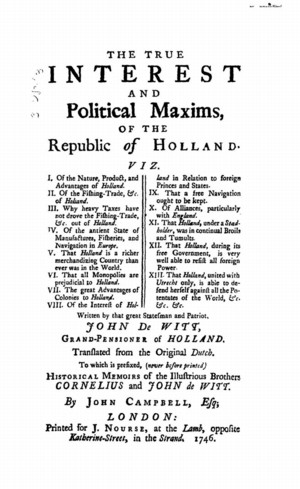
THE PREFACE. - Pieter de la Court, The True Interest and Political Maxims, of the Republic of Holland [1662]Edition used:The True Interest and Political Maxims of the Republic of Holland (London: John Campbell, Esq, 1746).
About Liberty Fund:Liberty Fund, Inc. is a private, educational foundation established to encourage the study of the ideal of a society of free and responsible individuals. Copyright information:The text is in the public domain. Fair use statement:This material is put online to further the educational goals of Liberty Fund, Inc. Unless otherwise stated in the Copyright Information section above, this material may be used freely for educational and academic purposes. It may not be used in any way for profit.
THE PREFACE.’TIS now full ten years, since the infinitely wife and good God, in the course of his over-ruling providence, was pleased to visit me with afflictions which produced such melancholy thoughts in me, that if they had continued might have proved fatal to my health. But because things past cannot be amended by sorrow or complaint, I accounted it a part of wisdom to compose the disorder of my mind, by applying my thoughts to things more agreeable. And whereas from my tender years I had been delighted with nothing more than the study of history, philosophy and political government, I soon concluded that one of these would be very much conducing to my present purpose and recreation. And whilst I was deliberating with my self about the choice, I was desired by some good friends to set down in writing such political thoughts as I had at several times communicated to them. Partly therefore for my own sake, and partly for the satisfaction of those to whom I owed the greatest deference, I undertook, among other things, to consider the fundamental maxims of the republic of Holland and West-Friesland. These thoughts drawn up in haste, and without the least ornament of language, I caused to be transcribed for the use of those friends who had prevailed with me to write them, and of some others, who having a part in the government of our native country, stand obliged to promote the publick welfare, and consequently to enquire into the means conducing to that end. And I doubted not that if any thing set down in those papers should be esteemed serviceable to my country, they would upon occasion offer’d, make use of it to advance the publick interest. But contrary to my expectation, a copy of this rough and imperfect draught, fell into the hands of those, who without my knowledge gave it to a printe, in order to be published to the world. And this I found to be done by persons of an eminent character, who not only condescended to peruse my papers, but also to strike out some things and to add divers others, in parcular the 29th and 30th chapters of that edition, treating of the reasons why the liberty enjoyed in Holland since the death of the prince of Orange hath produced no more good; and what publick advantages have already risen from the free government. And indeed the stile of these additions, as well as the subject, plainly discovers, that whatever had been altered, added or diminished, was done by persons of so great and profound knowledge of all affairs relating to the united Netherlands and government of Holland, that they seem to have transacted all those things themselves, or at least to have been the principal persons concern’d in them. But when the printer, in hopes of more profit, had surreptitiously reprinted this imperfect work, which was never designed for the press, I resolved carefully to review it, to make divers additions, and to reduce the whole into a better order; and having kept it by me about nine years (the full time prescribed by one of the most judicious among the * antients) to print and publish it to the world. And because the additions above-mentioned have been highly esteemed by many, and are accounted by me to be of great moment, I shall incorporate them without alteration in this impreffion, which I own exclusive of all other, and insert them in the fifth and sixth chapters of the third part. I shall likewise omit all such matters as were expunged, out of the singular deference I owe to the judgment of those who did me that favour. To the truth of this I think my self obliged to add, that I was never disobliged by any monarch, prince, or great lord, much less by any of the family of Orange: neither have I ever received any particular favour from the governours of any free state, or desire any. So that it would be an apparent deviation from truth to affirm, that this work was undertaken with a design either to flatter the governours of this great and powerful commonwealth, or to dishonour the memory of the princes of Orange, who were formerly captains general and stadtholders of these provinces. As if my intention had been only to shew that the monarchical administration of those princes was more prejudicial to Holland, than that of any other could have been. On the contrary, the service of my country, which I value above all human concernments, was the only thing I had in view when I wrote these papers. I am no slavish courtier, who can be unconcerned for the welfare of his country, and learns to speak or be silent, as best pleases his master. I am a true Hollander who always calls a spade a spade, and hates all indirect paths. That I might therefore be in some measure serviceable to my country and friends, and like a good citizen instruct such as perhaps have less experience, I have endeavoured to inquire into the true interest and maxims of our republick, and to follow the thread of truth to the utmost of my power. And since all men know that the preservation and prosperity of a country depends upon such a government as is consistent with itself; and reason informs us, that the welfare of Holland is founded upon manufactures, fishery, trade and navigation, I think myself obliged particularly to consider those means of subsistance and pillars of the state, with some observations upon the late government of a stadtholder and captain general, which some ignorant and mistaken Hollanders still desire. This did at first bring me under some uneasiness, because these united Netherlands, and particularly the province of Holland and West-Friesland, having had no other stadtholders and captains general, except the princes of Orange and Nassau, I doubted not that many ignorant and disaffected persons, more inclined to the increase of a prince’s power, than to the freedom and prosperity of their country and themselves, would not fail to say, that I had written this treatise with no other design than to traduce and calumniate those illustrious houses. But when I considered, that no difficulties ought to discourage a man from performing his duty, and that ill men, as well as ill things, were to be * resisted, I resolved to go on, without any regard to those who had always opposed the liberty of this country, and to write for the common good, tho’ great names should happen to be concerned. At least I may justly say, that in all that I have written either for my self, or my friends of the magistracy and others, touching these weighty matters, I have always avoided and abhorred the flatteries of some writers, which I think not only destructive to nations, but to reason itself; and could never offer violence to my judgment, or slavishly lay aside my pen. For a good man ought in due time and place to speak the truth in the cause of his country, tho’ with the hazard of his life. I conceive the publication of these papers cannot be blamed, unless by those, who maintain the monarchical power of the princes of Orange to have been so great in Holland and West-Friesland, that the shadow of it still remaining among us, ought to be sufficient to deter all men from writing any thing against the interest of that power, or to the disadvantage of any persons of that family, tho in other respects highly tending to the publick service. But if this were our case, we might confess, that no country ever fell into greater slavery than Holland lay under during the service and government of those princes. Which I conceive our greatest admirers of monarchical government will not allow, because they used to extol the said princes for assisting the states to resist the king of Spain, in order to deliver this country from oppression, and not to exalt themselves into his place; comparing them to Virginius Rufus, who having suppressed the tyranny of Vindex, desired only the following words tob engraven on his monument; Here lies Virg. Rufus, who expell’d the tyrant, not for himself, but for his country. Prince William and his son might in like manner have commanded their heirs to cause this their immortal atchievement to be engraven on their tomb, Here lies . . . . . who assisted to defend his country against our earl Philip II. king of Spain, in order to deliver us from servitude, and not to be our master; if the states general had not order’d more words to be added, tho’ to the same effect, which may be seen upon a marble monument erected at Delft 1620. But because I trust my country will not suffer herself to be brought under the like intolerable servitude, at least not in this age, I have presumed to speak of the true interest and maxims of Holland as far as I thought necessary. And this after the consideration and mature deliberation of divers years, I have delivered to be printed, not without the knowledge and allowance of my natural superiors, the states of Holland and West Friesland. I have always been, and still continue to be a lover of the princes of Orange, both as they were men, and as far as their actions might tend to the advantage of Holland and the rest of the United Provinces. I willingly acknowledge that prince William the first, with his sons Maurice and Henry, have generally been esteemed in these countries as men endued with noble and princely virtues, and blemished with few monarchical vices. La Pise. Bentivoglio. Van Rheid.For history informs us that prince William I. in the 11th year of his age, by the last will of Rene de Chaalons, became heir to all his vast possessions: that at twelve he was placed by his father in the service of the emperor Charles V. as his page, in order to secure that great inheritance to himself, by complying in the point of religion, and getting the favour of the emperor. By this means he became so acceptable to Charles, that he found no difficulty to take possession of those great revenues in due time. We are also told that he carried himself with much prudence and evenness of temper as well in adversity as prosperity; that he had a good understanding, a tenacious memory, and a magnanimous spirit; was not at all insolent, but rather modest, affable, and of easy access, by which he gained the good-will of all sorts of men. In short, we are inform’d that he was a person of few words, and knew very well how to conceal both his thoughts and his passions, tho’ he designed to pursue them with the utmost constancy. He is said to have been neither cruel nor covetous; not wasting his time in gaming or hunting, but on the contrary, free from most of those vices that reign in the courts of princes. Concerning prince Maurice the historians of that time say, that his elder brother Philip then living, and by virtue of the will of Rene de Chaalons, as well as in the right of his mother, and that of primogeniture, claiming the inheritance of his father, as necessarily devolved to him, he so acquainted himself during the troubles of the Netherlands, with all manly and princely exercises, that he became a person of great ability. And tho’ at the death of his father he exceeded not the age of 17 years, had no sums of money in stock, saw his father’s estate encumbred with many and great debts, and his own affairs as well as those of these countries in a very low condition; yet being naturally of great penetration and sagacity, prudent, frugal and laborious, he overcame all those difficulties, and was not blemished with many court vices; not delighting in musick, dancing, hunting, gluttony or drinking. As to prince Henry, his elder brothers Philip and Maurice were heirs to the paternal estate and lordships which his father left, and the latter possessed all the great offices of prince William in this country (except the stadtholdership of Friesland and Groningen, which fell to his nephew William Lodowick) so that there was little appearance during his youth, that he should ever have been advanced to those honours he attained to, and therefore it must be acknowledged, that the courtiers had little reason to corrupt him in his education. This prince was forty years of age before he was advanced from the command of colonel of the horse, to take possession of the great offices, or rather monarchical power that had been introduced by ways of violence into the government of Guelderland, Holland, Utrecht, and Overyssel; and might have learned by the conspiracy which had been formed against his brother upon those alterations, that the sovereign power of these provinces might be sooner and more certainly obtained by real or at least seeming virtues, than by opening force and avowed vices; because the legal magistrates and the inhabitants of these countries had not yet been accustomed to commend all the vices and blemishes of princes for virtues. ’Tis therefore said in praise of prince Henry, that he was affable and courteous, of a good understanding and great application to business; and used not to mispend his time in the pleasures and luxury so common in courts. And these three princes having had a better education, and a more free and useful conversation with men than other monarchs and princes usually have, they became more commendable and better monarchs and princes, than they would otherwise have been. And if, notwithstanding all this, any one will go about to asperse the lives, services and government of these deserving monarchs, as if they were common;Hoosd. Strada. Rheid. and maintain that prince William I. was much addicted to drinking after the German manner; if they should accuse him of incontinency and riot in keeping such a court as very much impaired his estate, in order to procure creatures to favour his ambitious designs; whilst pressed by ambition on one side, and want on the other, he used all kind of arts to make himself lord of these provinces, in prejudice to the king of Spain, whose right he who was his stadtholder stood obliged to maintain, or else to lay down his commission, fomenting our intestine disorders, that he might render himself sovereign of all the Netherlands, and more especially of those parts which were under his own government. And tho’ this might be excused by saying, that*illustrious ambition, accompanied with poverty, may violate laws and equity: yet his three sons Philip, Maurice, and Henry, can hardly be justified, who mutually engaged in the year 1609 to take possession of their paternal and maternal estates, and to divide them equally, with the exclusion of all their sisters and creditors, who had any just pretences upon their father’s estate. Neither can these hardships be excused or removed, by alledging that at the instance of these princes, the states of the United Provinces were moved to allow their sisters an annual pension, and the creditors of the father recommended to the same states for payment. For we cannot from hence infer any great virtues of these princes, but only the goodness, generosity, and bounty of the states general, and especially of the states of Holland and West-Friesland. But to return, if it be said that prince Maurice was not only scandalously incontinent, but withal so ambitious, that forgetting what he ow’d to the province of Holland, and to the best patriots in the Leicestrian times, who next under God was the principal cause of his safety and future greatness, he took away his life in a most unwarrantable manner, and contrary to the laws of that province. Lastly, If any man should accuse prince Henry of shameful lewdness, and affirm that when he had inherited the vast possessions of his two brothers, and been advanced to all those great and profitable offices which prince Maurice had enjoyed, he became riotously profuse and extravagant in his expences: that he manifested his insatiable ambition on many occasions, by assuming much more power than ever had been conferred on him, intruding himself into the stadtholdership of Groningen in the year 1640, and wresting the survivorship of that of Friesland from his own nephew count William;Aitzma. more especially by taking the field for so many years together with vast armies, at a prodigious expence, to make his own name famous by conquest, tho’ to the prejudice and oppression of Holland; and this in order to make himself or his son sovereign of these provinces. I say, if such things should be said, some men would return the following answer. Such accusers ought to know that the princes of Orange, who are men and not angels, should not be blamed for such faults as are common to all men, or at least to those of great birth, together with all such as are advanced to the greatest dignities. Inferior lords usually and without scruple take possession of their paternal estates without paying any debts; and all young and healthy men are violently inclined to women. Besides, ’tis not just to require moderation in the sons of princes; and indeed two of these having either never married at all, or not ’till they arrived to a considerable age, could not be guilty of so great a crime as if they had been engaged in marriage. As to the profusion and excess of drinking used in their court, to the great diminution of its revenues, ’tis a thing so universally practised, especially in the Northern parts, that none of these princes ought to be so much blamed for it, as prince Maurice deserves to be commended for the frugality and sobriety of his family. And we have no reason to wonder at the ingratitude of the said prince, but on the contrary ought rather to wonder that any wise man, after he has obliged princes in the highest manner, should expect any better recompence, since reason and experience, with all the histories of antient and modern times, do unanimously teach us, that no other rewards are to be expected from kings and princes for extraordinary services. For princes being persuaded that their inferiors are always bound to do them much more service than they perform, it would be a rare and unexampled thing to find one who should think himself obliged to any. And if by chance a prince of such understanding were found, he would hardly like such a benefactor, and for that very reason send him out of the world upon the first fair opportunity. And therefore if the words of Louise princess of Orange, may be taken for true, “That the services and good offices performed by the advocate Barnefelt to the house of Orange and Nassau, were so great, that he had acted not only like a friend but a father, and that the family was obliged to acknowledge all they had received from those of Holland to have been procured by his means;” then, according to the usual course of things of this nature, neither he nor the province of Holland ought to have expected any other reward than they received. Lastly, concerning the ambition of these princes, ’tis well known that all men spread the sails to a fair wind. Ambition in princes meets always with applause; and when they either encroach upon a free people, or advance their conquests by successful wars abroad, they are exalted to the heavens, stiled always august, enlargers of their empire, and the most glorious of monarchs. And many will be ready to say that the princes of Orange deserve as much praise for increasing their authority in the government of these countries, as industrious merchants for their ingenuity in augmenting their estates by navigation and trade. For the whole business and employment of princes consists in endeavouring to increase their power. If any man say, that as fraudulent merchants are to be abhorred with all their profits and ill-gotten goods, so deceitful and tyrannical princes ought not to be commended for their successful frauds and violences; ’tis answered, that princes are not usually esteemed for their truth, justice and integrity, like other men, but for their power, and knowledge how to exert both force and fraud upon a happy conjuncture. For an instance of this, Philip the second of Spain, by fixing his residence in that kingdom, and calling home 4000 Spaniards, who were the only military force he had in these provinces, gave a fair opportunity to William prince of Orange, who was then in the vigor of his years, and about 30, possessed of a vast estate, and by the king made stadtholder of Holland, Zealand and Utrecht, to engage the states, together with the inferior magistrates and other inhabitants in his party. On the other hand, the said prince had great opportunities to make himself master of these countries, because the states themselves, as well as the inferior magistrates and commonalty, had been for many years oppress’d under their lords of the houses of Burgundy and Austria; none had experienced the happiness enjoyed under a free state, and few understood the advantages of a republic above the government of a single person. So that he had great cause to hope he might not only withdraw himself from the obedience he ow’d to his masters, but bring the states themselves under his power, together with all the inferior governours and inhabitants of these provinces, which would certainly have happened in the year 1584, if the hand of a murderer had not put an end to his life. However the princes of Orange have understood so well how to manage their own affairs, as to obtain an increase of power to be conferred upon them from time to time under colour of necessity, or this failing, to break through all rights, privileges and laws, and yet deserved not so much blame, as the states and inferior magistrates, who were intrusted with the government of these countries, and who, by making four of those princes captains general for life, so ill maintained and preserved the free and legal government, that nothing could be denied to them, without hazarding that liberty, or rather shadow of freedom, which they seemed yet to possess. Unless perhaps one might say, and prove by former experience, as well as by latter complaints of our inhabitants, that the power of the captains-general and stadtholders has been so great, even from the beginning of our troubles, by reason of their numerous adherents, together with the common people and standing army, that men may more reasonably wonder, how the states of Holland and West-Friesland have so often adventured to shew their zeal to maintain their legal government and liberties, with the apparent hazard of their lives and estates. If these things are true, the reader may conclude, that if the states of Holland and West-Friesland, with the inhabitants, manufactures, fishery, trade and navigation, have been intolerably burdened, and yet greatly neglected and discouraged during the power of those officers; whilst Holland in the mean time was left without defence either by sea or land, tho’ necessitated to take up incredible sums of money at interest to carry on their ambitious designs: I think I have to my power declined to publish the defects of the princes of Orange, since I make no other than a general mention of their insatiable desire of dominion, which has exhausted our treasure, and weakened the frontiers as well as the inland cities of the province of Holland. Besides it is hoped a prudent reader will easily conceive what pernicious effects might be expected from a succession of such princes in the government of Holland, and at the same time consider, whether the late prince William would not have proved another monarch both in his life and government, if God, who is our deliverer, had not taken him away before the 25th year of his age; since he, being the eldest son of his father, was to inherit his vast possessions and princely dignities: and to this end in the year 1631, before he had attained the age of five years, he was placed among the governours of the United Provinces, who seemed unwillingly willing to give up the liberty of their country; and in all respects to be able, willing and necessitated to bear an universal slavery, by granting and promising to a child the future succession of all his father’s offices; and whether the said prince William the second, who was continually conversant with foreigners, and other slavish courtiers, had any better education or conversation with men than other ordinary monarchs use to have: or whether, after the reversion of the stadtholdership of Friesland had been taken from count William, in order to qualify the prince to obtain the eldest daughter of the king of Great-Britain in marriage, this prince would not of necessity have been sovereign of these United Netherlands. An understanding reader will also consider, whether our late stadtholder of Holland and West-Friesland had not spent his time in such a manner, tho’ he died before the 25th year of his age, as to furnish me with abundant matter of writing, if I were inclined to publish the blemishes of his life and short government; and whether I have not spoken of him with as much regard and temper as my design of explaining the interest of Holland would permit: and I conceive on this subject I have fully manifested my moderation. But to return from this long digression; the reader is desired impartially to read this book, which was written by me not only with a composed and sedate mind, but with a sincere affection to truth and to my country: and by weighing and considering what is here said concerning the true maxims and interest of Holland, he will be able to judge whether I have effected my design. And if he thinks otherwise, I desire him however to believe that I have used the best of my endeavours to that end; and contenting my self to have done what I could, I think I cannot but deserve thanks from my native country, for exciting by this attempt some abler hand to rectify my mistakes, and finish the work. And tho’ the matters treated in this book have been carefully weighed and considered since the year 1662, and indeed so much altered and enlarged, as to make the whole composition to seem new; yet I would not have any reader think that I believe it must of necessity please him; since in some respects I myself am not contented with it, and particularly because it fell too hastily at first from my pen: and tho’ afterwards it was maturely considered and review’d, yet many pieces were inserted, accommodated and fitted to several parts, as well as my leisure would give me leave, whilst I wanted either time or application to peruse the whole, as if it had not been composed by me, or to invent and write with more order and method. So that there is reason to believe that divers accidents may give occasion to review this subject, which concerns the prosperity of the most powerful republic at this day in the world. Which that it may be done successfully, may our gracious God grant us such happy times, as may encourage men, both in public and private, to conceive and write whatever shall tend to the service of our native country. [* ]Nonumque prematur in annum. Hor. [* ]Tu ne cede malis, sed contra audientior ito. Virg. [* ]Si violandum est jus, regnandi causa violandum est. Eurip. |

Titles (by Subject)