Econlib

The Library

Other Sites

Front Page arrow Titles (by Subject) arrow CHAPTER II.: The Right of Resistance, and the Right to have the Legality of that Resistance judged of by a Jury. - A Defence for Fugitive Slaves, against the Acts of Congress of February 12, 1793, and September 18, 1850

Return to Title Page for A Defence for Fugitive Slaves, against the Acts of Congress of February 12, 1793, and September 18, 1850

Search this Title:

Also in the Library:

Subject Area: Political Theory
Subject Area: Law

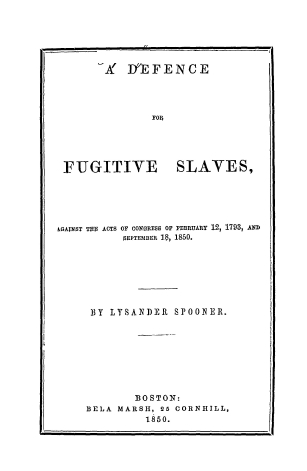
CHAPTER II.: The Right of Resistance, and the Right to have the Legality of that Resistance judged of by a Jury. - Lysander Spooner, A Defence for Fugitive Slaves, against the Acts of Congress of February 12, 1793, and September 18, 1850 [1850]

Edition used:

A Defence for Fugitive Slaves, against the Acts of Congress of February 12, 1793, and September 18, 1850 (Boston: Bela Marsh, 1850).

About Liberty Fund:

Liberty Fund, Inc. is a private, educational foundation established to encourage the study of the ideal of a society of free and responsible individuals.


CHAPTER II.

The Right of Resistance, and the Right to have the Legality of that Resistance judged of by a Jury.

If it have been shown that the acts of 1793 and of 1850, are unconstitutional, it follows that they can confer no authority upon the judges and marshals appointed to execute them; and those officers are consequently, in law, mere ruffians and kidnappers, who may be lawfully resisted, by any body and every body, like any other ruffians and kidnappers, who assail a person without any legal right.

The rescue of a person, who is assaulted, or restrained of his liberty, without authority of law, is not only morally, but legally, a meritorious act; for every body is under obligation to go to the assistance of one who is assailed by assassins, robbers, ravishers, kidnappers, or ruffians of any kind.

An officer of the government is an officer of the law only when he is proceeding according to law. The moment he steps beyond the law, he, like other men, forfeits its protection, and may be resisted like any other trespasser. An unconstitutional statute is no law, in the view of the constitution. It is void, and confers no authority on any one; and whoever attempts to execute it, does so at his peril. His holding a commission is no legal protection for him. If this doctrine were not true, and if, (as the supreme court say in the Prigg case,) a man may, if he choose, execute an authority granted by an unconstitutional law, congress may authorize whomsoever they please, to ravish women, and butcher children, at pleasure, and the people have no right to resist them.

The constitution contemplates no such submission, on the part of the people, to the usurpations of the government, or to the lawless violence of its officers. On the contrary it provides that “The right of the people to keep and bear arms shall not be infringed.” This constitutional security for “the right to keep and bear arms,” implies the right to use them,—as much as a constitutional security for the right to buy and keep food, would have implied the right to eat it. The constitution, therefore, takes it for granted that, as the people have the right, they will also have the sense, to use arms, whenever the necessity of the case justifies it. This is the only remedy suggested by the constitution, and is necessarily the only remedy that can exist, when the government becomes so corrupt as to afford no peaceable one. The people have a legal right to resort to this remedy at all times, when the government goes beyond, or contrary to, the constitution. And it is only a matter of discretion with them whether to resort to it at any particular time.

It is no answer to this argument to say, that if an unconstitutional act be passed, the mischief can be remedied by a repeal of it; and that this remedy may be brought about by discussion and the exercise of the right of suffrage; because, if an unconstitutional act be binding until invalidated by repeal, the government may, in the mean time disarm the people, suppress the freedom of speech and the press, prohibit the use of the suffrage, and thus put it beyond the power of the people to reform the government through the exercise of those rights. The government have as much constitutional authority for disarming the people, suppressing the freedom of speech and the press, prohibiting the use of the suffrage, and establishing themselves as perpetual and absolute sovereigns, as they have for any other unconstitutional act. And if the first unconstitutional act may not be resisted by force, the last act that may be necessary for the consummation of despotic authority, may not be.

To say that an unconstitutional law must be obeyed until it is repealed, is saying that an unconstitutional law is just as obligatory as a constitutional one,—for the latter is binding only until it is repealed. There would therefore be no difference at all between a constitutional and an unconstitutional law, in respect to their binding force; and that would be equivalent to abolishing the constitution, and giving to the government unlimited power.

The right of the people, therefore, to resist an unconstitutional law, is absolute and unqualified, from the moment the law is enacted.

The right of the government “to suppress insurrection,” does not conflict with this right of the people to resist the execution of an unconstitutional enactment; for an “insurrection” is a rising against the laws, and not a rising against usurpation. If the government and the people disagree, as to what are laws, in the view of the constitution, and what usurpations, they must fight the matter through, or make terms with each other as best they may.

But for this right, on the part of the people, to resist usurpation on the part of the government, the individuals constituting the government would really be, in the view of the constitution itself, absolute rulers, and the people absolute slaves. The oaths required of the rulers to adhere to the constitution, would be but empty wind, as a protection to the people against tyranny, if the constitution, at the same time that it required these oaths, committed the absurdity of protecting the rulers, when they were acting contrary to the constitution. The constitution, in thus protecting the rulers in their usurpations, would continue to act as a shield to tyrants, after they themselves had deprived it of all power to shield the people. It would thus invite its own overthrow, and the conversion of the government into a despotism, by those appointed to administer it for the liberties of the people.

This right of the people, therefore, to resist usurpation, on the part of the government, is a strictly constitutional right. And the exercise of the right is neither rebellion against the constitution, nor revolution—it is a maintenance of the constitution itself, by keeping the government within the constitution. It is also a defence of the natural rights of the people, against robbers and trespassers, who attempt to set up their own personal authority and power, in opposition to those of the constitution and people, which they were appointed to administer.

To say, as the arguments of most persons do, that the people, in their individual and natural capacities, have a right to institute government, but that they have no right, in the same capacities, to preserve that government by putting down usurpation—and that any attempt to do so is revolution, is blank absurdity.

The right and the physical power of the people to resist injustice, are really the only securities that any people ever can have for their liberties. Practically no government knows any limit to its power but the endurance of the people. And our government is no exception to the rule. But that the people are stronger than the government, our representatives would do any thing but lay down their power at the end of two years. And so of the president and senate. Nothing but the strength of the people, and a knowledge that they will forcibly resist any very gross transgression of the authority granted by them to their representatives, deters these representatives from enriching themselves, and perpetuating their power, by plundering and enslaving the people. Not because they are at heart naturally worse than other men; but because the temptations of avarice and ambition, to which they are exposed, are too great for the mere virtue of ordinary men. And nothing but the fear of popular resistance is adequate to restrain them. As it is, the great study of many of them seems to be to ascertain the utmost limit of popular acquiescence. Once in a while they mistake that limit, and go beyond it.

But, to return. As every body who shall resist an officer in the execution of these fugitive slave laws, will be liable to be tried for such resistance, and to be thus laid under the necessity of proving the unconstitutionality of the laws to the satisfaction of the tribunal by whom he is tried; and as judges are in the nearly unbroken habit of holding all legislation to be constitutional; and especially as the Supreme Court of the United States have held, (in the Prigg case, as before cited,) that the sending of men into bondage is so important an object to be accomplished, that an officer may, if he choose, exercise an authority conferred only by an unconstitutional law; it becomes those, who may be disposed to resist the execution of the laws in question, to ascertain what are their chances of escaping unharmed in running the gauntlet of such a judiciary as the nation is blessed with.

One liability, imposed by the act, (sec. 7,) is that any person, who shall in any way assist in the rescue, “shall forfeit and pay, by way of civil damages to the party injured by such illegal conduct, the sum of one thousand dollars for each fugitive so lost as aforesaid, to be recovered by action of debt,” &c.

There is one consolation, in view of this liability, and that is, that in the suit for this $1000, the claimant will be under the necessity of proving his property in the fugitive; and this, (as is shown by Senator Mason’s speech, before cited,) could be done in no case whatever.

I say the claimant will have to prove his property in the fugitive, because it is not clear that the act intends, (although at first blush such may be its apparent meaning,) that the judgment given by the court, judge, or commissioner, delivering the alleged slave to the claimant, shall be sufficient evidence, or even evidence at all, of such claimant’s property in the slave, in a civil suit for damages for the loss of the slave. And in the absence of such clear intention, I apprehend no court would dare put such a construction upon the act, or allow such use to be made of that judgment. The right of action for damages, which is given to the master, is given him, not for the purpose of punishing those who rescue the alleged fugitive, (for that punishment is provided for by fine and imprisonment,) but to enable the owner to recover payment for the loss of his property. In such an action he is of course necessitated to prove, (and Congress have no power to make any law to the contrary,) that the man he claims as his property, is really his—because, in a free state certainly, every man is prima facie the owner of himself.*

The claimant could recover payment for his slave but once, although an hundred or a thousand persons were engaged in the rescue; and these hundred or thousand persons could unite in the payment, thus making the burden a light one upon each individual.

As this action is given to the owner, to enable him to recover the value of his slave, and not as a penalty upon those who rescue him, the law is clearly unconstitutional in fixing that value at a specific sum. The value must be ascertained by a jury, if it exceed twenty dollars. Congress have as much right to say that, in case of any other injury done by one man to the property of another, the wrong-doer “shall forfeit and pay, by way of civil damages to the party injured by such illegal conduct, the sum of one thousand dollars, (and no more,) to be recovered by action of debt,” without regarding whether the injury were really $10, or $10,000, as to say the same in this case. The power of determining the amount of injury done by one man to the property of another, by violating a law of the United States, is a part of “the judicial power,” and is vested solely in the courts, and Congress have no authority whatever to decide that question.

Furthermore, the law is also unconstitutional in authorizing the owner to recover the full value of the slave. It should only authorize him to recover the damages actually sustained by the rescue. The owner does not lose his property in his slave by having him taken out of his hands on a particular occasion. His property in him remains, and the law presumes that he can take his slave again at pleasure, as he could before the rescue. Because there has been one rescue, the law does not presume that the slave is forever lost to his owner. And the defendants would be entitled to prove that the slave was still within reach of the master, where his master might at any time retake him. And it would be no answer to this fact, to say, that if the slave were retaken, he would probably be rescued again. The law presumes nothing of that kind, and could not presume it, even though the slave had been seized by the owner, and rescued by the defendants, an hundred times. The law would still presume that if the master were to take the slave again, he would be suffered to hold peaceable possession of him. Consequently the owner, in case of a rescue, is entitled to recover only the damages actually suffered by that particular rescue, and not the full value of the slave, as if he had been lost to him forever. And this suit for damages, being a “suit at common law,” within the meaning of the constitution, must be tried by a jury; and the damages must be ascertained by a jury, instead of being fixed by statute.

If this view of the law be correct, the pecuniary liability incurred in rescuing a slave, would be very slight, so far as the right of the master to recover damages was concerned.*

The only other liability incurred in rescuing an alleged fugitive, is a liability to be indicted and tried criminally for the act, and if convicted, subjected to “a fine not exceeding one thousand dollars, and imprisonment not exceeding six months.”

There are two chances of security against these punishments.

1. They can be inflicted only upon “indictment and conviction.” There is a probability that a grand jury will not indict, for it is not their duty to do so, if they think the law, that has been resisted, is unconstitutional. A grand jury have the same right to judge of the law, as a traverse jury.

2. If an indictment be found, the jury who try that indictment, are judges of the law, as well as the fact. If they think the law unconstitutional, or even have any reasonable doubt of its constitutionality, they are bound to hold the defendants justified in resisting its execution.

From this right of the jury to judge of the law in all criminal cases, it follows that in all forcible collisions between the government and individuals, (as in the case of resistance to the execution of a law,) the right of judging whether the government or the people are in the right, lies in the first instance, not with the government, or any permanent department of it, but with the people—that is, “the country,” whom the jury represent; for the jury represent “the country,” or the people, as distinguished from the government.* The people, therefore, in establishing government, with trial by jury, do not surrender their liberties into the hands of the government to be preserved or destroyed, as the government shall please. But they retain them in their own hands, by forbidding the government to injure any one in his life, liberty, or property, without having first obtained the consent of “the country”—that is, of the people themselves—who are supposed to be fairly represented by a jury, taken promiscuously from the whole people, and therefore likely to embrace persons of all the varieties of opinion that are generally prevalent among the people.

Hence it follows that, under the trial by jury, no man can be punished for resisting the execution of any law, unless the law be so clearly constitutional, as that a jury, taken promiscuously from the mass of the people, will all agree that it is constitutional. But for some principle of this kind, by which the opinions of substantially the whole people could be ascertained, men, in agreeing to a constitution, would be liable to be entrapped into giving their consent to a government that would punish them for exercising rights, which they never intended to surrender. But so long as it rests with a jury, instead of the government, to say what are the powers of the government, and what the liberties of the people—and so long as juries are fairly selected by lot from the whole population, the presumption is that all classes of opinions will be represented in the jury, and every man may therefore go forward fearlessly in the exercise of what he honestly believes to be his rights, in the confidence that, if his conduct be called in question, there will be among his judges, (the jury,) some persons at least, whose judgments will correspond with his own.

And inasmuch as a single dissentient in the jury is sufficient to prevent a conviction, it follows that if the government exercise any powers except such as substantially the whole people intended it should exercise, it is liable to be resisted, without having any power to punish that resistance. It may indeed overcome that resistance and enforce the law, constitutional or unconstitutional, unless resisted by a force that is stronger than its own. But it cannot punish that resistance afterward, unless substantially the whole people, through a jury, agree that the law was constitutional.

But this right of a jury, in all criminal prosecutions, to judge of the constitutionality of the law that has been resisted, is not the whole of a jury’s rights; they have the right to judge also of its justice. Juries are never sworn to try criminal cases “according to law.” They are only sworn to “try the issue according to the evidence.” The “issue” is guilty or not guilty. This issue is to be tried on the natural principles of justice, as those principles exist in the breasts of the jurors, and not according to any arbitrary standard which legislators may have attempted to set up. Guilt is an intrinsic quality of actions, and cannot be imparted to them by all the legislatures that ever assumed to exercise the power of converting justice into injustice, and injustice into justice. The question for a jury, in trying “the issue,” then, is not simply whether the accused has been guilty of violating a law; but whether he has been guilty in violating it? And unless they all answer this last question in the affirmative, he cannot be convicted.

The trial by jury might safely be introduced into a despotic government, if the jury were to exercise no right of judging of the law, or the justice of the law.

If juries were to find men guilty, simply because the latter had exercised their natural rights in defiance of unjust laws, juries, instead of being, as they are wont to be called, “the palladium of liberty,” would be the vilest tools of oppression—the instruments of their own enslavement—for in condemning others for resisting injustice, at the hands of the government, they authorize their own condemnation for a similar cause. No honest man could ever sit on a jury, if he were required to find a man “guilty,” and thus become accessory to his punishment, for doing an act, which was just in itself, but which the government, in violation of men’s natural rights, had arbitrarily forbidden him to do.

Furthermore, a jury, before they can convict a man, must find that he acted with a criminal intent—for it is a maxim of law that there can be no crime without a criminal intent. There can be no criminal intent in resisting injustice. To justify a conviction, therefore, the law, and the justice of the law, must both be so evident as to make its transgression satisfactory proof of an evil design on the part of the transgressor.

Such are some of the principles of the trial by jury: and the effect of them is to subject the whole operations of the government, both as to their constitutionality and their justice, to the ordeal of a tribunal fairly representing the whole people, and thus to restrain the government within such limits as substantially the whole people, whose agent it is, agree that it may occupy. But for this restraint, our government, like all others, instead of being restricted to the accomplishment of such purposes as the whole people desire, would fall, as indeed it very often has fallen, into the hands of cliques and cabals, who make it, as far as possible, an instrument of plunder and oppression, for the gratification of their own avarice and ambition.

There is, therefore, substantial truth in the saying, which, we have been recently told,* “has, in England, become traditional, and drops from the common tongue, that ‘the great object of King, Lords, and Commons, is to get twelve men into a jury box.’ ” And in this country, the great object of Presidents, Senators, and Representatives is the same. But such have been the ignorance and the frauds of legislators and judges, and such the ignorance of the people, on this point, that juries have generally been merely contemptible tribunals, looking after facts only, and not after rights, and ready to obey blindly the dictation of legislatures and courts, and enforce any thing and every thing, which the permanent branches of the government should require them to enforce. And we now see the results of their degradation and submission, in the audacity of the legislature in passing such laws as those of 1793 and 1850, and in the conduct of the courts in sanctioning, as constitutional, the former of these laws, as they undoubtedly will sanction the latter, unless deterred by the intelligence and firmness of the people.

It is this intrusting of the liberties of the people, to the hands of the people—represented by a jury taken promiscuously from the mass of the people—instead of intrusting them to the government, which represents at most but a part, and generally a small part, of the people—that makes the trial by jury “the palladium of liberty.” If governments were intrusted with authority to define the liberties of the people, they would of course say that the people had no liberties that could be exercised contrary to the will of the government. And if governments had authority to define their own powers, and to punish all who resisted their power as thus defined, all governments would declare themselves absolute of course. And the simple right to punish resistance, without getting the consent of the people in each individual case, would, of itself, make any government absolute; for the power to punish necessarily carries all other powers with it. The power to punish disobedience is the power that compels obedience. It is, in its very nature, an absolute and uncontrollable power. And if a government have this power, it is absolute of course. And oaths and parchments are things of no importance in such a case, for they are necessarily but straws in the way of a power that is otherwise unrestrained.

It is no argument to say that the constitution has provided a judicial department, with power extending to “all cases arising under the constitution and laws of the United States.” The answer is, that this constitution has made juries a part of this judicial department, and given them special jurisdiction of crimes, and made their acquittal final; and that it is only in cases of conviction that a question can be carried beyond them.

The permanent officers of this department—the judges, so called—by the very constitution of their office, are unfit to be trusted with any question arising between the government and the people, as to the powers of the former, and the liberties of the latter; for the judges receive their offices directly from those other departments of the government, and not from the people. They are also dependant upon those other departments for their salaries, and are amenable to them by impeachment. They are of course nothing but instruments in their hands, and have always proved themselves to be so. I think there is not to be found on record, either in our general or state governments, a single instance, in which the judiciary have ever held a law unconstitutional, that provided in any way for punishing the people for the exercise of their rights. The statute books of both the national and state governments have abounded, and still abound, with statutes creating odious and oppressive monopolies, infringing men’s natural rights, violating the plainest principles of justice, having no authority in the constitutions under which they purport to be enacted, and providing fines and imprisonments for those who may transgress them; and yet, (so far as I am aware), no one of this long catalogue of enactments ever encountered the veto of the judiciary. I apprehend that the whole judiciary of this country, state and national, might be safely challenged to produce a single instance, in which they have ever vindicated a single principle of either natural or constitutional liberty, against the penal encroachments of the legislatures on which they were dependent. On the contrary, they have uniformly—probably without a solitary exception—proved themselves, in all questions of this nature, to be nothing but the willing instruments of usurpation and oppression. They do not accept their offices with any other intention than that of holding all laws constitutional, which they suppose the legislature will pass—for nobody accepts an office, unless with the intention of being obedient to those, to whom they are amenable.*

The idea, so constantly asserted, that the permanent judiciary, the judges, have a right to decide all constitutional questions, authoritatively for the people, is one of those gross impostures, by which men have always been defrauded of their rights. There is not a syllable in the constitution, that makes a decision of the judiciary—of its own force, and without regard to its correctness—binding upon any body, either upon the executive, or the people. In the very nature of things, nothing but the law can be binding upon any one. If a judicial decision be according to law, it is binding; if not, not. An unconstitutional judicial decision is no more binding, than an unconstitutional legislative enactment—and a man has the same right to resist, by force, one as the other, and to be tried for such resistance by a jury, who judge of the law for themselves.

Suppose the judiciary, in a suit between two pretended mothers, for the custody of a child, should give the judgment of Solomon, that the child be cut in two, and a half given to each; does any one suppose the executive would be bound to carry the judgment into effect? or that the opinion is obligatory as an authority upon any body? Yet it would be as much binding as any other erroneous decision.

If a judicial decision contrary to the constitution, were binding simply because it were a judicial decision, the judiciary could constitutionally make themselves absolute sovereigns at once.

A judicial decision, as such, has therefore no intrinsic authority at all; its constitutional authority rests wholly upon its being in accordance with the constitution. And we can determine whether it be in accordance with the constitution, only by first determining the meaning of the constitution, independently of the decision, and then comparing the decision with it. If we take the decision as authority for the meaning of the constitution, all decisions will of necessity be constitutional, and the judges are of course, constitutionally speaking, absolute despots.

It is no argument, in answer to this view of the case, to say, that decisions may be so grossly and palpably unconstitutional as not to be binding; but that in all doubtful cases they are obligatory. The constitution knows nothing of doubtful cases. In its view decisions and laws are simply either constitutional or unconstitutional. It knows nothing of their being more or less grossly and palpably so. If they are constitutional, they are binding; if they are not constitutional, they are not binding, though their variation from the constitution be but the smallest that can be discovered.

The constitution does not assume that it needs any authoritative interpreter. It assumes that its meaning is known to the people who ordained and established it, just as all legal instruments assume that their true meaning is understood by the parties to them. The people, as parties to the constitution, would not be bound by it, unless they were presumed to understand it—for no one is bound by a contract, which he is not presumed to understand.

The constitution as much presumes that the people understand its own meaning, as it does that they understand a judicial opinion. It presumes itself to be as intelligible as the opinions of courts. It would be absurd for it to presume that courts would express its intentions more intelligibly than it has itself expressed them—for, in that case, the language of the courts would be more authoritative than the language of the constitution; they would consequently make the constitution whatever they should please to make it; and they would also make themselves whatever they should please to be. But the constitution has no such suicidal character as that. On the contrary, it presumes that the people are competent to understand both the meaning of the constitution and the meaning of the courts; and consequently that they are competent to determine whether the opinions and decisions of the courts correspond with the constitution, and whether, therefore, their decisions are to be obeyed or resisted.

What, then, it may be asked, is the use of the judiciary, if it be not to decide doubts as to the meaning of the constitution? The answer is, that it is their office to try certain “cases,” “controversies,” and “suits,” mentioned in the constitution. These cases are presumed to arise out of disagreements as to facts, or from the dishonesty of one or the other of the parties, and not from their ignorance of the law, (or constitution),—for every body is presumed to know the law, although all do not in fact know it—neither the people nor the courts. And the judiciary are to try these “cases,” “controversies,” and “suits,”—that is, they are to ascertain the facts, and determine the resulting rights of the parties—by the standard of the constitution, as a known standard; a standard that is presumed to be known to both the parties, as well as to the courts.

The judiciary are in a situation analagous to that of any other umpire, who should be agreed upon, for instance, by the parties in a controversy, to measure a certain commodity by a certain standard—as, for example, to measure certain cloth by a yard stick. The submission of this controversy to the umpire, implies that the parties, as well as the umpire, understand the length of the yard stick—but that they nevertheless disagree as to the true admeasurement of the cloth. They therefore agree to abide the decision of the umpire.

In the performance of his office, it becomes necessary for this umpire—for a guide to his own duty, and not for the information of the parties or the public,—to ascertain what is a yard stick. And if he honestly measure the cloth by a yard stick, the parties are bound by his admeasurement. But if this umpire, either from ignorance or design, measure the cloth by a stick, that is either more or less than a yard, calling such stick a yard stick, the admeasurement is not binding upon the parties—because the submission of the case to the umpire was made upon the express condition that the admeasurement should be made by a yard stick. And the party, who has been wronged by the false admeasurement, has a right to resist the execution of the umpire’s decree.

The case is the same with the judiciary. They are umpires, appointed to measure the rights of parties, by a certain standard, to wit, the constitution. This standardis presumed to be known to the parties, as well as to the umpires, (for all are presumed to know the law), although it may in fact be known to none of them. The umpires—in order to perform their own duty, and not for the information of the parties or the public,—must necessarily ascertain, if they can, what the constitution really is. But if, through ignorance or design, they put a false meaning upon the constitution—thus adopting a false standard—and then measure the rights of the parties by this false standard, the parties are not bound by their decision, because the submission was made to them only on the condition that their rights should be measured by that particular standard, the constitution—and not by any false standard which the umpires, through ignorance or design, might adopt. And the party, who is wronged by the decision, has a right to resist the execution of it, to the best of his power. And if tried criminally for such resistance, his triers (the jury) must judge whether the decision of the umpires was according to the standard agreed upon by the parties—that is, according to the constitution.

But it is thoroughly ridiculous to talk of these umpires having fixed or established the standard itself—that is, the meaning of the constitution—merely because, in a particular instance, they measured the rights of certain parties by the constitution. There would be as much reason in saying that the umpire, who measured the cloth by a yard stick, established the length of the yard stick by so doing, as to say that the judiciary establish the meaning of the constitution, whenever they pretend to measure rights by the constitution. Any thing they said or did in one instance, between certain parties, has no binding force, of itself, in any subsequent case between the same, or any other, parties. The standard, alone, or a true admeasurement by the standard alone, is binding in all cases. If the first admeasurement were correct, that admeasurement established simply the rights measured by it. It did nothing towards fixing the standard itself, by which the rights were measured. And any subsequent correct admeasurement will, in like manner, establish the rights measured by it; but will do nothing towards fixing the standard itself. The standard itself needs not to be fixed, for it was fixed before any rights at all had been measured by it. But to say because one admeasurement has been made thus, therefore all future admeasurements must be made thus, is ridiculous. The admeasurements are all bound to be made correctly, according to the standard. But if one have been made wrong, that is no reason why all future admeasurements must be made wrong, nor why the people are bound to presume that all future admeasurements will be made wrong. Whether any admeasurement be made wrong, or not, each one must judge for himself, and resist the decision of the umpires at the peril of being tried for such resistance by a jury.

[* ] In the case of Hill v. Low, the court held that under the law of 1793, the claimant, in a suit for the penalty, against a person for harboring, concealing, or rescuing a fugitive, was under the necessity of proving his property in the fugitive, and that the certificate of the magistrate was not proof. The reasons given for that opinion seem very satisfactory and conclusive, and to be as applicable to a case under the act of 1850 as under that of 1793.—4 Washington C. C. Rep. 327.

[* ] If however, it should be held that the $1000, required to be paid to the claimant, is in the nature of a penalty, in addition to the fine and imprisonment, it follows that in a suit for that penalty, the jury will have a right to judge of the constitutionality of the law, as in case of an indictment.

[* ] In all criminal cases, the jury are told that the defendant has “for trial, put himself upon the country, which country you are.”

[* ] By Hon. Horace Mann.

[* ] If judges were made amenable to the people by election, we might have more hope of their having some respect for the rights of the people.