EconlibThe LibraryOther Sites |
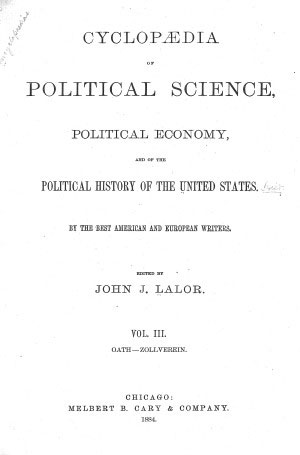
Front Page Titles (by Subject) POLITICAL ECONOMY. - Cyclopaedia of Political Science, Political Economy, and of the Political History of the United States, vol. 3 Oath - Zollverein
Return to Title Page for Cyclopaedia of Political Science, Political Economy, and of the Political History of the United States, vol. 3 Oath - ZollvereinThe Online Library of LibertyA project of Liberty Fund, Inc.Search this Title:Also in the Library:
POLITICAL ECONOMY. - John Joseph Lalor, Cyclopaedia of Political Science, Political Economy, and of the Political History of the United States, vol. 3 Oath - Zollverein [1881]Edition used:Cyclopaedia of Political Science, Political Economy, and of the Political History of the United States by the best American and European Authors, ed. John J. Lalor (New York: Maynard, Merrill, & Co., 1899). Vol 3 Oath - Zollverein
Part of: Cyclopaedia of Political Science, Political Economy, and of the Political History of the United States, 3 vols.About Liberty Fund:Liberty Fund, Inc. is a private, educational foundation established to encourage the study of the ideal of a society of free and responsible individuals. Copyright information:The text is in the public domain. Fair use statement:This material is put online to further the educational goals of Liberty Fund, Inc. Unless otherwise stated in the Copyright Information section above, this material may be used freely for educational and academic purposes. It may not be used in any way for profit.
POLITICAL ECONOMY.POLITICAL ECONOMY. I. Preliminary Considerations. In a Cyclopædia like the present it would seem that the article "Political Economy" should form one of the central points of the whole work. It would perhaps be such, if we desired to embrace under this term the various considerations which commend the study of economic science to those whom it interests, and to set forth the many advantages which may be derived from it. It would be so likewise, if in the article "Political Economy" we attempted to touch upon all the subjects which the science embraces, either for the purpose of showing their importance or their connection. We can not enter into such detail here. We wish simply to define political economy, to give it a point of departure, a formula; to determine its character and object, and to indicate, as far as possible, its extent and limits. —It would be mistaking the nature of such a task to suppose that it can be performed in a few lines. It is not as easy as one might think at first to give an exact definition of political economy, or at least a satisfactory one, one around which all adepts in the science might rally. Many authors, beginning with Adam Smith, have attempted it, but no one seems to have succeeded. Whatever may be the real merit of certain definitions hitherto given, it is certain that, up to the present time, not a single one has been accepted without dispute. It has even frequently happened (and this is a more serious matter) that the very ones who furnished them, subsequently contradicted or modified them in the course of their works. It would perhaps be more correct to say that there is not one of these definitions to which its author himself remained faithful in the manner in which be conceived and treated his subject. This has caused some of the later teachers of the science to say, that political economy has yet to be defined. "Even if we must blush for the science," says Rossi, "the economist must confess that the first question still to be examined is this: 'What is political economy? what is its object, its extent, its limits?'" There is no reason to blush, we think, for being still obliged to put such a question, when we consider the natural difficulties it presents; but we must agree, with Rossi, that it is still awaiting a solution. A Belgian writer, Arrivabene, has called attention to this truth in his introduction to a translation of Senior's "Lectures on Political Economy," in terms more emphatic than those used by Rossi, bitterly deploring the vagueness, the obscurity, the incoherence, and especially the insufficiency, of all the definitions hazarded by the masters of the science, and calling loudly for a more satisfactory and precise formula. To make this clear, we here reproduce some of the definitions furnished by economists generally considered to be of the highest authority. —Adam Smith was usually very sparing of definitions. He, however, gave a few here and there, and they characterized or defined, in the course of his work, the science which he treated. "Political economy, considered as a branch of the science of a statesman or legislator, proposes two distinct objects: first, to supply a plentiful revenue or subsistence for the people, or, more properly, to enable them to provide such a revenue or subsistence for themselves; and secondly, to supply the state or commonwealth with a revenue sufficient for the public services. It proposes to enrich both the people and the sovereign." ("Wealth of Nations," book iv., introduction.) Without discussing the relative merit of this definition, we shall simply remark that it has in view much less a science than an art, although the idea of a science is put forward in it, and although the word "science" is to be found in it. The author, in fact, appears to enunciate a series of precepts which would indeed constitute an art; but not an exposition or an explanation of certain natural phenomena, which alone can constitute a science. In substance, if not in form, Adam Smith's definition is nearly like that given by J. J. Rousseau under the term économie politique, in the Encyclopédie. We know, however, how widely Adam Smith differed from Rousseau, not only in his conclusions, but especially in his manner of treating his subject. On the other hand, his definition differs greatly, as we shall see, from that of J. B. Say, who followed in his footsteps, and looked on the science as Smith himself had done. —J. B. Say, in the beginning of his treatise, and even as title to this treatise, gave his principal definition of political economy, the one which has since been most frequently reproduced: "A Treatise on Political Economy, or a simple exposition of the manner in which wealth is produced, distributed and consumed." Whatever may be thought of this formula, it is at least very much superior to that of Adam Smith, in this especially, that it suggests the idea of a real science, and not merely of an art, since it describes an exposition or explanation of certain phenomena presented to our observation. But is this formula really satisfactory? and will it be final? Assuredly not. Men may still disagree as to the nature of the phenomena which it presents for the study of economists, as well as to the extent of the field which it opens to their exploration. And this all the more, since on this last point especially J. B. Say has not always been consistent with himself. In the formula which we have just quoted, he seems to confine the economist to a study of the material facts relating to the production and distribution of wealth; but elsewhere, notably in his Cours, he brings into its domain all facts relating to social life. "The object of political economy," he says, "seems till now to have been restricted to a knowledge of the laws which govern the production, distribution and consumption of wealth. This is how I considered it myself in my Traité d'Economie Politique." "Still," he adds, "it may be seen, even in that work, that the science touches everything in human society, and embraces the whole social system." (Cours d'économie politique, p. 4.) We might add, that in other parts of his works J. B. Say again defines political economy in a way altogether different from that in which he defined it in his Traité and his Cours. The following, for instance, taken from manuscript notes found after his death, has sometimes been quoted: "Political economy is the science of the interests of society, and like every real science is founded on experience, the results of which, grouped and arranged methodically, are principles and general truths." But it is evident that this is less a definition than a qualification, such as every author has the right to introduce in the course of his works, in order to bring out the dignity and importance of the subject he is treating. —According to Sismondi, "the physical well-being of man, so far as it can be the work of his government, is the object of political economy." This is very different from J. B. Say's first definition. In the first place, it takes us out of the realm of science into the realm of art; for, according to this formula, political economy must be merely a series of rules intended to instruct governments how to insure the physical well-being of man; it is therefore an art, a branch of the art of government. Very much limited, from a certain point of view, since governments alone can practice it, this art is, in other respects, without assignable limits; for what are the acts of a government that have not to do, more or less, with the physical well-being of man? —According to Storch, "Political economy is the science of the natural laws which determine the prosperity of nations, that is to say, their wealth and their civilization." Preferable to Sismondi's, because it suggests at least the idea of a science, this definition is still very imperfect. "The natural laws which determine the prosperity of nations," present, to our thinking, too complex an idea, and, in any case, a very vague one; and as to civilization, it certainly includes, in its general expression, things with which an economist, as such, has nothing to do. —There is nothing in Malthus or Ricardo which can be taken as a precise definition of political economy. In the case of Ricardo the reason may be, that in his "Principles of Political Economy and Taxation," being confined, as he says himself in his preface, to defining the laws regulating the distribution of revenue among the various classes of society, he did not consider the science as a whole. It may, however, be inferred from these words, that, if he had had to define science in a general manner, he would have defined it very nearly as J. B. Say had done in his Traité. —As to Rossi, after he had discussed and rejected, one after another, all the definitions given before his time, he, absolutely speaking, gave nothing in their stead. He contents himself with saying that there are phenomena of a certain order relating to wealth which are not confounded with those of any other order, and that these are just what economic science should study. Political economy is, therefore, in his eyes, as he says elsewhere, purely and simply the "science of wealth." Hence, he thinks, that, setting aside the strangeness of the words, one might call economists chrysologists, chrematisticians or divitiaries, without giving them cause of complaint. —We may here close our review of the definitions of political economy. What we have stated suffices to show how far the definition of economic science, or the general formula which covers it, is from being finally fixed. —Now, should we be ashamed of this uncertainty, as Rossi seemed to think? Must we lament it, with Arrivabene and some other writers? We do not think so. A science does not depend on the definition given of it; it is not regulated by an arbitrary formula which may be more or less happy, more or less exact; on the contrary, it is the definition which should come after, mould itself, so to speak, to the science as it exists. So much the worse for writers who cultivate a certain branch of human knowledge, if they are unable to grasp its general data and clothe these data with a fitting expression; but this does not in any way impair the stock of truth which they have to bring to light.—"A science," says J. B. Say, "makes real progress only when its masters have succeeded in determining the territory over which they may extend their researches, and what should be the object of their research." (Traité, Discours Préliminaire.) There is doubtless some truth in this statement. It is well, perhaps even necessary, that the object of a science and the field it covers should be properly determined; but it is not absolutely necessary that this determination should result from definitions hazarded by authors: it is enough if it results from the very nature of their labors. Now, it may well happen that the nature of these labors may be essentially the same for all, while the definitions are different; each author having been led by a kind of instinct to confine himself to a certain order of phenomena, without afterward being able to render an account to himself of the precise object of his researches, or to measure exactly the field he has gone over. And this is really what takes place. We have just seen how much the authors cited differ in regard to the definition of the science, and still the sum and substance of their works are always the same. Who does not know that this is the case with Adam Smith and J. B. Say? It is the case, too, with all the others, in spite of a few slight differences as to the greater or less extent of the ground they embrace. —It is one thing to feel or express, and another to conceive or define. It is sometimes very difficult to clothe a single thought in a just expression or a fitting formula; the difficulty is much greater when there is question of including a great number of ideas and facts in a single formula. It is not to be wondered at that many writers have failed in this task, in this sense, that the definitions which they give are nothing but more or less unfaithful translations of their own conceptions. J. B. Say acknowledges that this is true in his own case, since he recognizes that his Traité went everywhere beyond the limits, if the expression be allowed, marked out by his definition. And still he is, perhaps, of all economists, the one who has remained the most faithful to the formula which he had adopted. There is much more to be reprehended in Adam Smith and Sismondi in this regard. If we look, for example, at the manner in which the latter defines the science, we might think he was going to confine himself, as J. J. Rousseau had done, to laying down the rules which governments should observe in regard to the material interests of the people; and still, like all other economists since Quesnay, Turgot and Adam Smith, he has discussed the questions of exchange, division of labor, accumulation, savings, the production and distribution of wealth, the laws regulating the value of things, those determining the rate of wages, profits, etc., etc.: things in which governments have almost nothing to do. So true is it that his definition is simply an error, and an error of no consequence, an ill-chosen but empty formula, which in no way influences the real character of his labors. —It would be very desirable, however, to find for political economy a more satisfactory definition than those hitherto given, a formula at once more comprehensive and more precise, in which the whole science might, so to speak, be reflected in a few words. Will this formula be found? Perhaps. Without flattering ourselves with having found it, we shall try to point out the road to its formulation by determining, as far as possible, the real object which the science proposes to itself, and the extent of its domain. —The first question to be solved is, whether political economy belongs to the category of science, or merely to the category of art. We have already seen, from what precedes, that the question is not an idle one, especially not idle since the distinction to be made between science and art does not appear to be generally understood. —II. To what order does Political Economy belong? Is it a Science or an Art? "An art," says Destutt de Tracy, "is a collection of maxims or practical precepts, the observance of which leads to success in doing a thing, no matter what it may be; a science consists in the truths resulting from the examination of any subject whatever. Art consists, therefore, in a series of precepts or rules to be followed; science, in the knowledge of certain phenomena or certain observed and revealed relations." We are not concerned here with examining which of the two is superior to the other, art or science; both may have equal merits, each in its place; it is solely a question of showing in what they differ as to their object and methods of procedure. Art counsels, prescribes, directs; science observes, exposes, explains. When an astronomer observes and describes the course of the stars, he cultivates science; but when, his observations made, he deduces from them rules to be applied in navigation, he is engaged in art. He may be equally right in the two cases; but his object is different, as well as his method of working. Hence, observing and describing real phenomena is science; dictating precepts, laying down rules, is art. —Art and science often have close connections, in this sense especially, that the precepts of art must be derived as far as possible from the observations of science, but they are none the less different from it on that account. Notwithstanding this, they are confounded every day. A man striving to build up an art gives it emphatically the name of science, believing that by doing so he gives a high idea of the correctness of its precepts. It is notoriously the weak side of physicians to call medicine a science. They are mistaken in the use of the word. If medicine were as certain in its prescriptions as it is uncertain, it would still be no more than an art,38 the art of healing, since it consists in a collection of rules applicable to the cure of human diseases. But anatomy is a science; physiology is a science; because anatomy and physiology both have as their object a knowledge of the human body, which they study, the one in its structure, the other in the play of its organs. —Rossi grasped this distinction between science and art well, though he abused it by improperly confounding it with the distinction which is made frequently enough between theory and practice.39 "Properly speaking," he says, "science has no object. The moment we try to discover what use can be made of it, what profit may be drawn from it, we leave science and come to art. Science is in all cases nothing more or less than the possession of truth, the well-considered knowledge of relations inherent in the nature of things." Here we have, under another form, the same thought so accurately expressed by Destutt de Tracy. —This distinction being well drawn between science and art, we may now ask, to which of the two orders of ideas does political economy belong? Is it a collection of precepts, a theory of action, or only an assemblage of truths borrowed from the observation of actual phenomena? Does it show us how to do something? or does it explain what takes place? In other words, is it a science, or an art? We need not hesitate to answer that, in its present condition, political economy is both the one and the other; that is to say, in the direction of economic labors and studies a common name is still given to things which might and should be kept distinct. It is evident, in fact, that in the general treatises on political economy, composed since Adam Smith's time, a great number of really scientific observations are met with, that is to say, observations whose sole object is to tell us what takes place, or what exists. One might even say that observations of this kind predominate. But the directions, precepts, rules to be followed, are also met with in such treatises very frequently. Art is therefore constantly mixed up with science. But it is very different with a multitude of special treatises, or those particular dissertations whose object is to solve certain questions relating to industry, commerce or the economic administration of states: questions of taxation, credit, finance, foreign commerce, etc. Here it is always art that predominates. Counsels, precepts, rules to be followed, all things that pertain by their nature to the domain of art, follow each other in quick succession, while really scientific observations scarcely appear at long intervals. And still all this, without distinction, bears the name of political economy. So true is it that the name still belongs to two orders of labor, and of very different kinds. —We are far from complaining or finding it strange that from scientific truth once clearly established men should endeavor to draw rules applicable to the conduct of human affairs. It is not well that scientific truths should remain fruitless, and the only way of utilizing them is to base art upon them. There are close ties of relationship, as we have already said, between science and art. Science lends its lights to art, corrects its processes, enlightens and directs its course. Without the aid of science, art would have to feel its way, stumbling at every step. On the other hand, art gives a value to the truths which science has discovered, and science without art would be barren. Art is almost always the principal motor in the labors of science. Man rarely studies for the sole pleasure of knowledge; in general, his research and labor have generally a useful end in view, and it is through art alone that he finds that end. —In view of all this, who can fail to see how different art is from science? The distance is great between a truth discovered by observation, and a rule deduced from that truth with the intent of giving it an application; the one belongs to nature, to God; man only discovers and states it; the other is the act of man, and it always retains something of him. Everything is absolute in scientific data; they are either false or true, there is no half way; this simply means that the student of science has observed either well or ill, has seen correctly or incorrectly what he communicates. There are, it is true, incomplete data, exact on one side, inexact on the other; but, even then, the true side is true, the false side is false. On the contrary, everything is relative in the rules and the methods of art. As something human is always involved in them, they can not pretend to infallibility, they are always susceptible of more or less variation between the two extreme limits of radical vice and absolute perfection. Finally, scientific truths are immutable as the laws of nature whose revelation they are; while rules of art are changeable, either by reason of the wants they have in view or by reason of the changing views of the men who apply them. —There is so much the more reason to insist on the distinction which we have just established, viz., that if science and art have frequently many points of contact, their radii and their circumferences are far from being identical. The data furnished by a science may sometimes be utilized in many different arts. Thus, geometry, or the science of the relations of extension, enlightens and directs the work of the surveyor, the engineer, the artillery officer, the navigator, the shipbuilder, the architect, etc., etc. Chemistry comes to the aid of the druggist as well as the dyer, and to a great number of the industrial professions. Who can tell how many different arts make use of the general data of physics? And, so, an art may gain information from the data furnished by many sciences; and it is in this way, to cite but one example, that medicine, or the art of healing, simultaneously consults anatomy, physiology, chemistry, physics, botany, etc. —It is necessary, therefore, in every respect to distinguish art from science, and to indicate clearly the line separating them. This has been carefully done in certain branches of human knowledge. Mathematicians, for example, distinguish carefully pure mathematics, or science properly speaking, from its various applications. So do physicists and chemists. And the distinction exists not in books alone, it is transferred even to instruction, where the study of science and that of the arts depending on it have different chairs. It is thus that a polytechnic school is, if we be permitted to say so, the sanctuary of pure science. It is only after graduating from it that the students, each in his specialty, study the art to which they are to apply the scientific knowledge acquired. —We could wish that what has been so well done in so many other divisions of study might also be done in the order of economic studies and labors. But, it must be confessed, it has not been done up to the present. The labors of art and the studies of science continue to be, if not altogether mingled, at least embraced, under a common denomination. Sometimes it has been attempted to separate them by giving certain labors, which belong especially to art, the name of public economy, to distinguish them from others. But these attempts, ill directed, and made, in the majority of cases, without a clear view of the results to be obtained, have not succeeded thus far, so that at present, in the order of economic studies, art and science are still mingled and confounded. Whence comes this confusion? It comes, first of all, from the immaturity of the science, which has not yet had time to disengage itself from the art or arts connected with it. It results also, in a certain measure, from the pressing and ever present interest of the subjects than economic science embraces, an interest which has not allowed those who study it to devote themselves entirely to the contemplation of scientific truths, neglecting, for the moment, the artistical deductions, that is to say, the practical maxims, which they might draw from it. —Political economy was an art before it became a science, and even the etymology of its name shows this; furthermore, before it was an art, that is to say, before it was formulated in general maxims and precepts, it was blind practice in the hands of governments. Such is, however, the course of human things. In the logical order, science precedes art, which should be only a deduction from science; and art precedes practice, which should be only a more or less exact application of the general rules of art. This is the ordinary course followed in our schools, in which the logical order is followed. But in their historic sequence, things take another course: they are generally found there in an inverse order. There practice precedes art, and art science. This is true of almost all the branches of knowledge, and particularly of that which interests us most. Hurried to act, because he must act, man goes straight to action, to practice, without studying deeply that which he undertakes, and with no other guide than his instinct. It is only later, that, by rectifying and correcting the errors of this practice, with the aid of a little acquired experience, he forms rules or general maxims which he erects into an art; and it is later still that the idea comes to him of correcting the errors of this art itself, by the aid of a scientific study of the subject which he has in view. There were physicians before there was an art of healing; men acted at hazard, inspired most frequently by blind superstition, and the art of healing, based at first on a certain acquired experience, existed much earlier than anatomy, physiology, therapeutics, that is to say, earlier than a scientific knowledge of the subject on which it was desired to operate, and of the remedies employed for his cure. Huts were built before the art of building was reduced to rules, and the art of building was subjected to rules, if not written, at least transmitted from mouth to mouth, before it received the mathematical and physical sciences as a foundation. Political economy advanced in the same way. The most ancient governments, as Blanqui very justly says in his history, treated political economy after their own fashion, long before they knew what they did, or were able to give an account of the result of their measures. Later, it was attempted to give an account of these results by the aid of acquired experience, and with the data of these experiences, well or ill understood, an art was created. Sully and Colbert had reached this stage. It was only in the last resort that men undertook to study scientifically this subject, that is to say, general industry, on which they were to operate. —Now, this liberation of economic science is quite recent; it scarcely dates from the middle of the last century. It was the school of Quesnay which first endeavored to construct in this order of ideas a real science; up to his time there were merely scattered observations, and even final success in building up the science belongs only to Adam Smith. It is not very surprising, therefore, that the science of political economy has not yet been able to free itself entirely from the restrictions of the art from which it sprung. —It was our wish and duty to state, as we have done, that under the general name of political economy two things are at present understood, things very different in their nature, though tending in many respects to the same end. It has seemed to us all the more important to note this confusion of ideas, since, to our thinking, it is the real cause of the incoherence in the definitions of the science, of the deviations to which it is subject in its course, and the species of discord which reigns almost always in its beginnings. Shall we attempt, on that account, henceforth to make a clearer division between the science and the art, by giving them different names? We confine ourselves to drawing the distinction clearly, time and a better knowledge of the subject will do the rest. —III. First Idea or General Conception of Economic Science. Do the Facts of Human Industry afford Material for the formation of a real Science? It will doubtless be asked, with some astonishment, how economic science was born so late, how political economy in action could exist so long without a systematic, scientific study of the subject itself on which men had to operate. This astonishment will cease, perhaps, if we consider for a moment the internal nature of a science, and the point of view at which men place themselves on all subjects before the light of science appears. —A science does not consist merely in a knowledge of certain external facts isolated from each other, for it is an abuse of words to give the name science to a simple collection of facts. Science consists rather in the knowledge of the relations which connect these facts with one another, and of the laws which govern them. A tie, a connection, is necessary, a linking of the phenomena which it takes up and observes, and it is the knowledge of this connection which is its principal study. An incoherent collection of facts without connection may constitute the baggage of a man of erudition, but can never constitute a science. Astronomy would not merit the name if it merely limited itself to noting and naming, one by one, the stars which wander in the deserts of space; it is worthy of the name only because it renders an account of the movements of the stars and the constancy of their evolution. Similarly, in all the other branches of human knowledge, a collection of facts does not constitute a science; we must, further, be able to tell the constant relations which connect, and the general laws which govern, them. —But the first condition of the study of the laws governing certain phenomena is to suspect their existence; to believe that these phenomena are not governed by chance, and that certain constant relations exist between them. Now, on all subjects, the first impression of men who have not yet submitted facts to continuous observation or patient analysis, is to see in them merely the play of blind chance. It is only much later that they come to suspect that these facts may be subject to a certain order; and it is then only that the idea is gained of studying the laws that govern them. Let us take the ignorant and rude man of primitive ages. All the phenomena of nature are to him disordered and capricious. Wherever he looks, he sees merely accidents without cause, facts without connection or relation. If he looks at the heavens, he sees the stars scattered at hazard, as he thinks, like thistles in a field. In all things that strike him he sees nothing but the play of blind chance, unless, indeed, he supposes the mysterious influence of some occult power. Later, as he gains in knowledge, natural phenomena, at least those of a certain order, range themselves before his eyes; he sees that they are subject to certain rules, he observes the constancy of their relations; here he recognizes law. But always, even in the course of time, and ages of enlightenment, the first impression of men is the same in relation to facts which they have not yet observed. If they come, therefore, so late to study the natural laws which govern phenomena, it is because they had not previously even suspected that there were natural laws to be studied. —A remarkable example of this is to be found in the case of geological facts. Why did geology, a science so interesting and beautiful, appear so late in the world? Was it impossible to discover and study it sooner? Were the ancients less capable of pursuing that study than the moderns? They were not: geological facts are not of the nature of those which hide themselves from attentive examination, or which demand a distant search. The ancients were as well able to discover and analyze them as we, and they had, besides, almost an equal interest in doing so. This analysis supposes, it is true, certain other preliminary studies, but these studies they could either have pursued themselves or made up for without too much labor. Why did they not do so? Only, as it seems to us, because they did not even suspect that there were in the bowels of the earth which we inhabit natural laws to be studied. During many centuries men had lived in the idea that the earth, whose surface they occupied, was in its composition merely a formless and confused mass, rudis indigestaque moles, whose materials were piled up pell-mell, without order and without law. They did not suspect that there was any order there to be found, any scientific study to be made of the earth; and this is the reason they did not even think of attempting that study. The same thing has taken place with regard to industry, concerning which similar ideas were for a long time held. It was not suspected in ancient times, nor even in the middle ages, that there was any order in the industrial world, the centre of economic facts, the focus of labor, at that time relegated to so low a place. At first view, everything there seemed to be surrendered to the struggle of individual and opposing wills. Only a disordered combination of heterogeneous elements was perceived, a sort of confused conflict, a rudis indigestaque moles; and how could any one conceive the idea of searching there for rules, principles, laws, the ordinary outfit of a real science? In all subjects, we repeat, the first step toward building up a science is to gain the idea that the elements of that science exist, and this idea had not yet suggested itself. It was born only much later, when, by dint of occupation, from the governmental point of view, with industry whose importance men began to understand, they remarked, almost involuntarily, sometimes in one direction and sometimes in another, the regularity of its movements and the constancy of its relations. —And why should we be astonished that this was the case in the past, when even to-day, after the labors of Quesnay, Adam Smith and his successors, we see that many people misunderstand this industrial order, to which science has already borne witness. Not infrequently we hear at the present time men of some weight, and fairly well informed on other points, assert that industry is a prey to disorder and anarchy. Such, in general, is the rallying cry of the schools called socialistic. They all declare that the industrial world is given up to the struggle of individual wills, conflicting with and crossing each other in terrible confusion, with no trace of organization and order. All rule is absent from the circle in which industry works, and chance alone controls everything. On this account all the socialistic sects conclude, naturally enough, that the industrial world needs some organization imposed by a power above it. Thus, they vie with each other in drawing up and proposing plans of social reconstruction. —If the premises of this reasoning were correct, if it were true that industry, in its present condition, were given up to anarchy, having no trace of organization and order, political economy, considered as a science, would indeed have little to do; it would not even have a raison d'être. This would not suffice to make us adopt or even discuss seriously any one of these plans of organization proposed to us, persuaded, as we shall always be, that it is not in the power of human intelligence to regulate, even in a tolerable manner, so many interests, and labors so varied; but it would suffice to make us conclude, at least, that science, properly speaking, had no place in such a field. The rôle of the economist, if he had still a rôle to fill, would be limited, in this case, to a barren registration of disconnected facts, without his being able to deduce any principle from them. In vain would he seek to ascend from effects to causes, where chance alone governed everything. Vainly would he endeavor to establish relations between observed phenomena, and discover the laws that ruled them; for how could he find constant relations in disorder, or law in chaos? Happily, we already know our position with reference to these assertions thrown out a priori by men still unenlightened by science. We know that for them all is confusion and disorder. To the man who knows not the discoveries of geology, even from hearsay, the earth is still that confused mass which the ancients called rudis indigestaque moles. To the savage, who has never observed the course of the stars, anarchy reigns in the vault of heaven. —After all, it must be confessed that the illusion is a natural one. When we cast our eyes at hazard on the moving picture of the industrial world, it is difficult indeed to perceive, at first sight, anything but a confused struggle. A consideration, plausible enough, seems even to justify this first view; it is thus that in industry everything seems abandoned to the arbitrary and capricious impulses of individual wills, without any common principle governing and uniting these wills. And how, it is asked, can anything but disorder and chaos result from the shock of so many divergent, if not opposing, wills? When we see so many millions of stars moving in the deserts of space with perfect harmony and unchangeable constancy, nothing prevents our admitting that a single and sovereign will presides over their movements, and imposes on them its laws. But where is the principle which forces so many free beings to move in unison, each one of whom feels the motive of his action in himself? This is a strong consideration, it must be confessed; it would force economists themselves to doubt the reality of industrial order, if this order were not for them already established and demonstrated. —And still, even without the aid of science, if we look at industry with a more serious and attentive eye, it is difficult not to recognize in it at once, under the cover of apparent disorder, certain characteristics of harmony and order. Phenomena appear, whose regularity strikes and astonishes us. We gradually catch glimpses, vague at first and then more definite, of constant relations, of invariable movements. As the stars fail not to subordinate themselves to each other in their evolutions, though they seem to wander at chance, and to hasten on without order, so we see that the myriads of individuals moving in the field of industry also connect, arrange and subordinate their labors to each other, in such a way that, in spite of their apparent confusion, they all concur, each in his own way, to produce certain given results. Little by little, chaos is seen not to exist; order appears; laws are recognized. —Even if economic science had not for a long time noted the existence of certain regulating laws in the industrial world, it would seem that the appearance alone of the results offered would cause us at least to suspect their existence. An immense multitude of human beings, some scattered here and there over the surface of the earth, others grouped in irregular masses in towns, wait every day for general industry to bring them what is necessary for the infinite variety of their wants; and every day industry, active and watchful, answers without fail to all the wants which call upon it: millions of kinds of labor, all different from one another, call on every side, and at all the sources of production, for workmen, and nowhere are the hands of workmen wanting for the kind of labor which calls them; all these different kinds of labor cross each other; more than that, they are corrected and held in union; they complete each other; they form together an immense chain, not a single link of which can be broken without injury to the whole; but nowhere does the chain break or stop; it seems that a mysterious power watches unceasingly to keep in repair its invisible links. Then, by virtue of the principle of exchange, an infinite variety of products circulates continually in every direction over the surface of the earth, and all these products go direct, without loss of time, and without sensible deviation, through countless hands, to the consumers waiting for them. All this takes place under our eyes and is renewed every day, and it is in presence of such a spectacle that men are unaware of the regularity of industrial movements subject to law. In presence of this daily miracle of regularity and order, men talk about industrial anarchy and disorder! What, then, are harmony, and order? Even if certain partial disorders, the causes of which are almost always easily assigned, happen here and there to disturb this beautiful mechanism, would that be sufficient to warrant us to deny the harmony of the whole? Would it not suffice to justify us in concluding triumphantly, that, after all, industry taken as a whole accomplishes with regularity the complex task with which it is charged? —There is really little philosophy in denying, even a priori, the existence of industrial order. Remember how many surprises nature reserves for man, who is always too ready to appeal to chance. The empire of chance is narrower than is supposed; every day its boundaries become smaller in proportion as our knowledge extends; those boundaries will become still narrower in the future. But, it is asked, is there anything in industry but divergent individual wills? and what is that but confusion or chance? We answer, that individual wills, no matter how free they may appear in the domain of language, or in the domain of industry, are bound to conform to a certain order. In the work of forming languages the initiative and invention may belong to individuals; but supreme control belongs to the masses. Individuals invent words, particular forms or expressions; each one brings his contribution to the language; hence the inexhaustible wealth and the admirable variety of form which are the property of human language. But the mass controls, purifies, corrects; it rejects, with that sure instinct which controls it, everything not conformable to certain analogies or certain laws, and every one is bound to submit to its decisions under pain of not being understood. Hence, the regularity and harmony impressed on all human languages. In like manner the initiative belongs to individuals in industry, but control to the masses. Every one is at liberty to work after his own fashion, but on condition, first, of fitting the result of his labors, which is the first condition of order, to his surroundings; then, to adjust his labors to those of other men, without whose aid he can do nothing; and lastly, on condition of submitting to the whole, and yielding in all things to the decisions of the sovereign public. From the initiative of the individual and the sovereign control of the masses, arises, on the one hand, the infinity of detail, and, on the other, the harmony of the whole, which constitute the two essential characteristics of human industry. If, by supposing the impossible, confusion should be established in language, no two men would be able any longer to understand each other. An assembly of men would then be but a repetition of the confusion of the tower of Babel. If, in like manner, this anarchy should come upon industry, for merely a few days, the irregularity of production would put the very existence of men in peril. No one being able to count upon another for the satisfaction of his wants, each would work for himself and refuse to take part in the division of labor and exchange, and humanity would quickly return to the barbarism of primitive times. —But the existence of laws governing the industrial world is no longer a mystery. Industrial science has for a long time noted and verified a great number of them. We have ourselves tried to show in the article COMPETITION, the general principle from which they spring. If among those which men have tried to explain, there are some which may still be a matter of discussion or misunderstood, there are others which no one, not even those who deny in principle the regularity of industrial movements, would dare to call in question. We can therefore conclude boldly that the field of the science of political economy is open, and that the elements of that science exist. —Since, then, human industry is subject to laws; since it discloses to us constant relations, a regular movement, in a word, order, it is this order, these relations, these laws, which we must study. This is the peculiar field of political economy as a science. To explain how industry is organized in its whole and in its parts; to describe the order of its evolutions and its progress; to refer its movements to their principle, and deduce from it their immediate consequences: such is the object which economic science, carefully distinguished from art, should always propose to itself. What, in this order of ideas, should be the extent of its investigations, and what their limits? We shall examine this directly. But we must first justify the preceding definition, if it is one, in so far as it does not conform to those most frequently given of political economy. —IV. Is Wealth the Object of Economic Science, or Industry the Source of Wealth? In defining or characterizing economic science as we have above, we have spoken of industry and the general laws which govern it. It is evident that in this we have departed, if not in essence, at least in form, from the definitions generally received, and which relate, more or less, not to industry, but to the wealth which industry produces. Which of the two formulæ is the more truthful? We think that wealth is continually put forward as the subject of political economy, without reason. Wealth is merely a result; and in reality it is labor, human industry, the source of wealth, which is the true subject of investigation in political economy. It must be understood, however, that in saying this we have no idea of changing the basis of the science, which we accept as it exists. —We have already seen that J. B. Say defines political economy, even in the title of his work, as "a simple exposition of the manner in which wealth is produced, distributed and consumed." Still, he draws a distinction from the very beginning of his book, which we must note. There are, he says, two kinds of wealth: one natural, that is to say, that which man receives from nature itself, without his being obliged to produce it, and which does not appear in the market, because nature gives it to all; the other is industrial or social wealth; and he declares that this last is the only one which economic science should consider. Why this distinction, if the definition is correct? If it is really wealth with which we are concerned, what do we care from whence it comes? Is what nature gives us for nothing, and gives to all, less real, of less value, than other wealth? Why should we not take account of it too? The distinction established by J. B. Say is nevertheless correct, whatever Rossi may say of it. Why? Because it is not true that political economy studies wealth as its subject; because it has only industry in view, and consequently it should not touch upon wealth, except in so far as it is a product of industry, in so far as it is either produced or distributed by industry. All this portion of J. B. Say's work is very painful, because his starting point is not correct. Still, the author displays a wonderful sagacity in coming back, by force of attention and correctness of judgment, to the real subject from which he departed in his definition. But the subtle distinctions to which he has been obliged to have recourse could not fail to lead to controversy, as the sequel has shown. —What is true of J. B. Say is equally true of all those economists, and their number is great, who have expressly admitted with him that political economy has only to do with exchangeable value. It is different with Adam Smith, who did not commence his work, like most of his successors, by a dissertation on the nature of wealth and value. He prefers in the beginning to speak of industry, of man; in which, as it appears to us, he was very happy, although he too thinks, and says frequently, that wealth is the chief subject of his studies. In the course of his work he states nowhere, in an absolute manner, that the only wealth with which he is concerned is that which is convertible into exchangeable value; but when, at the end of chapter iv. of book i., he remarks that the word "value" has a double meaning, or that there are two kinds of values, and calls one "value in use," and the other "salable or exchangeable value," without declaring expressly that the latter is the only one which it is his mission to study, he contents himself with saying that he will examine "the principles which regulate the exchangeable values of merchandise," and as to its value in use he is silent. He has followed, in this, the same path that J. B. Say, his successor, traced out afterward in a more systematic manner. —Some economists, however, at whose head we must place Rossi, have protested loudly against this view. They contend that the utility of things, or what they call their value in use, is in itself too considerable, too important a fact, to allow an economist to omit taking account of it. Let us remark just here, that no one has said, no one can say, that the real utility of things can be despised. It is, first of all, the original basis of exchangeable value; it is, besides, the principal motive or the final object of the labors of man; for men labor only to procure what is of use to them, that is to say, what contributes to the satisfaction of their wants. It has only been said, which is true, that utility alone, when not transformed into exchangeable value, no matter how interesting it may be in other regards, is not an economic fact, and only becomes such in so far as it gives things a value, a price. But it is precisely against this conclusion that Rossi protests. The opinion of such a man has too much weight not to delay us a moment in order to examine its motives.—"There are many authors," he says, "for whom value in exchange is the only economic fact; they regard the notion of value in use as a pure generality, to which, at most, the honor of mentioning it may be given in passing without paying any attention to it afterward. For them, political economy is more the science of exchange than the science of wealth." We have underlined these last words, because they correspond exactly to what we have said above. It is very true, that, to the authors of whom Rossi speaks, as well as to us, and we shall add directly to Rossi himself, political economy is not the science of wealth, although the word "wealth" is inscribed in large letters on their banners. We have defined it, provisionally, as the science of the laws of the industrial world. One may say, however, if he wishes, shortening the expression a little, that it is the science of exchanges; for exchanges are, in the industrial system, the primordial fact which engenders all the others; but the expression which we have used seems to us at once more noble, more comprehensive, and more exact. —But to return to Rossi's argument. —First of all, it is not correct to say that the authors of whom he speaks merely mention the utility of things in passing. On the contrary, they maintain that the utility of things is the first if not the only condition of value in exchange; that things not useful in any respect would be neither asked for nor accepted by any one; and in consequence they would have no value, no price. But they add also that this utility, necessary everywhere, does not become an economic fact until, combining with other conditions, it is changed into exchangeable value. This is precisely what Rossi does not admit. "It is an error," he says, "which attacks the science in its very bases, which mutilates it, and destroys its nature." Why? This is his answer: "Value in use," he continues, "is the expression of a relation which belongs to all times and all places. Value in exchange is in its nature eventual. Not only it can not exist unless the wants of men cease, in a certain measure at least, to be satisfied, but it will disappear completely when the wants of all find unlimited means of satisfaction. No one will then have recourse to exchange." We shall soon find this last argument under another form. Rossi considers it very conclusive in his favor, and consequently reproduces it again. We shall see directly how conclusive it is against him. Now, let us continue our quotation. "I say, that in the system of those who pretend to occupy themselves only with value in exchange, science is mutilated: a great number of economic facts remain without explanation. Why are certain markets glutted with articles which never meet a demand for them? Only because the producers have not studied sufficiently what could be, in a given country, the value in use of such or such kinds of merchandise. The man who sent a cargo of skates to Brazil had forgotten that their value in use, arising from the pleasure which is felt in gliding over an icy surface, is nothing in a country where there is no ice. When publishers prepared immense shiploads of books for South America, they should have remembered that the want of books is only felt by those who know how to read. It is in the absence of value in use that these economic facts find their explanation." Without doubt, it is in the absence of value in use, or of utility, that these facts find their explanation. But how can this embarrass the authors whom Rossi is combating? What difficulty is there in accounting for such facts according to their system? None. They have said, and repeated, that the utility of things is the first condition of their exchangeable value; this condition had been omitted in the cases mentioned above, and consequently the products could not be exchanged. What more simple? The authors in question account for these facts quite as well as Rossi. Only they add that the condition of utility, though primary and essential, is not the only one which gives objects an exchangeable value; that, in addition, a certain degree of scarcity is required; that things found in profusion in nature, such as air, will have no exchangeable value, no matter how useful they may be; and that in this case economists need not busy themselves with them. —Among the arguments which Rossi heaps up at pleasure against this last conclusion, with very remarkable dialectic power, there are many which square exactly with the one which we have just noted. They merely reproduce the same thought under other forms. We may therefore omit them. But here is one which seems to differ from the others. "The study of value in use, is the study of the wants of men in their relations to economic facts." The study of value in use is the study of the wants of men; this we admit: but is the study of the wants of men the object of political economy? It is not. In the eyes of the economist every man is the judge of his own wants, which he expresses in his own way by the demand which he makes for certain products. It is the sole fact of this demand that the economist meets by following it in its consequences. He sees, on one side, men expressing their wants; on the other, workers studying to divine these wants, and to satisfy them by supplying such articles as they produce; and he studies the very extensive and complex relations arising from this demand and supply. The study of the demand, considered in itself, in its nature and principle, is perhaps the affair of the moralist; but the economist, as an economist, has nothing to do with it. —If, in the course of his laborious argument, Rossi triumphs in places, it is when he lays stress on the meaning and the use of the word "wealth." He has the advantage, we admit, when he reproaches those with whom he argues, with abusing the term. "Wealth," he rightly says, "is a generic word, which includes all objects in which this relation can be verified. If an object is capable of satisfying our desires, there is a value in it. The object itself is wealth." Rossi is certainly right here; he is right again when he adds, further on: "Ask any sensible man if, in such or such circumstances, such a man or such a country is rich or not, if it is less rich than a certain other country; ask him if the soil of the kingdom of Naples is more or less rich than the soil of Lapland; all will give you the same answer. Economists also, when they do not use the language of their particular systems, call the country rich in which natural goods abound, and in which natural agents are most active. They extend the word wealth to something more than what they call wealth when they give us their systematic definitions." All this is quite correct; but what does it all prove? Only one thing: that the word "wealth" has been very inaptly employed to designate the object of economic science. Let us say what is true, that economic science studies industry, or the relations which industry produces, and all these difficulties will disappear. —What, in fact, is wealth? A result, and nothing more. It is a fruit of the liberality of nature, or of the labor of man; a fruit which has only to be enjoyed, and which affords no aliment to observation. What is there to be studied in such a fact? Nothing. But the means that men employ to acquire that wealth, when nature does not give it in sufficient quantity, are another matter entirely. This is a great, an important fact, worthy of all the attention of the philosopher, and it is the only one the study of which political economy can dwell upon. —If a decisive proof of this is required, we shall find it in this last argument of Rossi's, of which we have already spoken. After having laid down this principle, that general wealth is increased by the low price of merchandise and all kinds of products, he adds: "If the price falls to zero, evidently the general wealth will be infinite; there will be no more exchanges; each having all that he can desire, exchange becomes impossible. How, then, could wealth be an exchangeable value, since it would be infinite, if there were no value in exchange?" This, we believe, is decisive against those economists who do not wish to consider wealth as anything else than exchangeable value.40 But does it prove in the same way that political economy should occupy itself with value in use, devoid of exchangeable value? Let us suppose Rossi's somewhat forced hypothesis realized, the prices of everything at zero, and general wealth infinite. What would happen? It is true there would be no exchangeable value, but neither would there be any political economy. Value in exchange, as Rossi correctly says, would disappear completely as soon as the wants of each one found unlimited means of satisfaction. No one would then have recourse to exchange. Nothing is truer; no one would have recourse to exchange, nor even to labor; but neither would any one think of studying political economy, because political economy itself would not have anything to study. The entire earth would present the picture of the Elysian fields described by Fenelon, in his "Adventures of Telemachus." All the wants of men would be satisfied. There would be no wants to express, and consequently no efforts to be made to provide for them. But what would the economist have to do in such an environment? Nothing, but to survey at his ease a picture of universal happiness, and thank God for his goodness. Political economy would disappear with exchangeable value and the realization of universal wealth: so true is it that it is not wealth that it studies, but exchange, with the division of labor and all the important phenomena that accompany it. —Rossi himself, as we have said, has not studied anything else. And, in reality, once out of these discussions on wealth and value, which embarrass him in the commencement of his work, he goes through the same route already passed over by his predecessors. He |

Titles (by Subject)