|
|
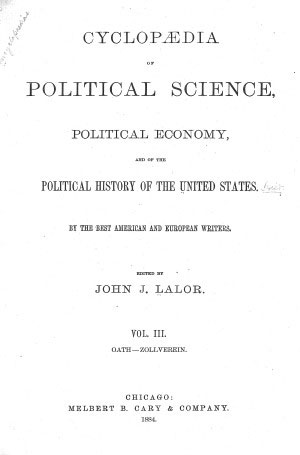
Front Page Titles (by Subject) PERSONAL UNION - Cyclopaedia of Political Science, Political Economy, and of the Political History of the United States, vol. 3 Oath - Zollverein
PERSONAL UNION - John Joseph Lalor, Cyclopaedia of Political Science, Political Economy, and of the Political History of the United States, vol. 3 Oath - Zollverein [1881]Edition used:Cyclopaedia of Political Science, Political Economy, and of the Political History of the United States by the best American and European Authors, ed. John J. Lalor (New York: Maynard, Merrill, & Co., 1899). Vol 3 Oath - Zollverein
About Liberty Fund:Liberty Fund, Inc. is a private, educational foundation established to encourage the study of the ideal of a society of free and responsible individuals. Copyright information:The text is in the public domain.
Fair use statement:
This material is put online to further the educational goals of Liberty Fund, Inc. Unless otherwise stated in the Copyright Information section above, this material may be used freely for educational and academic purposes. It may not be used in any way for profit.
- Volume III: Oath - Zollverein
- O
- Oath
- Oath of Allegiance
- Occupation
- Oceanica
- Ochlocracy.
- O'conor, Charles
- Office-holders, Danger of an Aristocracy of
- Ohio
- Oligarchy
- Olmstead Case. (see Pennsylvania.)
- Omnibus Bill. (see Parliamentary Law.)
- Opinion. (see Public Opinion.)
- Opposition
- Order of the Day. (see Parliamentary Law.)
- Orders In Council. (see Embargo, In U. S. History.)
- Orders, Religious . (see Congregations.)
- Ordinance of 1787
- Oregon
- Oriental Question
- Ostend Manifesto
- Outlawry
- Outlet
- Over-production
- P
- Pacific Railroad. (see Internal Improvements, Railroads.)
- Paper Money.
- Paraguay (republic Of).
- Parasites, Social
- Pardon.
- Paris Monetary Conference
- Parley.
- Parliament, the British
- Parliamentary Law.
- Participation In Profits.
- Parties, Political
- Party Government In the United States.
- Party Names In U. S. History. (see American Party, Anti-federal Party, Anti-masonic Party)
- Patent Office
- Patents, and the Patent System.
- Patronage
- Patrons of Husbandry. (see Grangers.)
- Pauperism
- Peace.
- Peace Congress. (see Conference, Peace.)
- Pendleton, George H.
- Penitentiary Systems. (see Prisons and Prison Discipline.)
- Pennsylvania
- Penny Banks. (see Banks, History and Management of Savings.)
- Pensions. (see United States Pension Laws, and the Pension Laws of Other Countries.)
- Persia.
- Personal Liberty Laws
- Personal Union
- Peru
- Petition
- Petition, Right of
- Philosophy of Law
- Physiocrates.
- Pickering, Timothy
- Pierce, Franklin
- Pinckney, Charles Cotesworth
- Pinckney, Thomas
- Piracy
- Plenty and Dearth.
- Poland
- Police
- Police Power of a State
- Political Arithmetic. (see Arithmetic, Political.)
- Political Assessments. (see Assessments, Political.)
- Political Economy.
- Political Economy, History of
- Political Science
- Politics, Nature and Character of
- Polk, James Knox
- Poll Tax
- Popular Sovereignty
- Population.
- Portugal.
- Postoffice
- Postoffice Department
- Postoffice Savings Banks. (see Banks, History and Management of Savings.)
- Powers of Congress. (see Congress, Powers Of.)
- President. (see Executive.)
- President Pro Tem. (see Parliamentary Law.)
- Press, the Newspaper and Periodical
- Previous Question. (see Parliamentary Law.)
- Prices
- Primary Elections.
- Priority of Debts Due to the United States and to the States
- Prisoners of War
- Prisons and Prison Discipline
- Private Bills. (see Parliamentary Law.)
- Private Calendar. (see Parliamentary Law.)
- Privateering
- Privilege. (see Parliamentary Law.)
- Prizes, Maritime
- Production of Wealth
- Products On Paper
- Profits
- Prohibition
- Promotion
- Property
- Property, Landed . (see Rent.)
- Property, Literary
- Proportional Representation
- Protection. Restrictions Upon Freedom of Exchange
- Protection In the United States.
- Protestantism. (see Churches, Protestant.)
- Prussia
- Public Debts. (see Debts, National, State and Local.)
- Public Lands of the United States
- Public Lands, Office of
- Public Opinion
- Public Policy
- Public Revenues. (see Revenues, Public.)
- Q
- Quarantine
- Quids
- R
- Races of Mankind
- Radicalism
- Railways, History and Political Economy of
- Railways, Legislation Concerning, and Management Of, In the United States
- Railway Clearing House. (see Clearing, and Clearing Houses.)
- Randolph, John
- Rebellion
- Rebellion, the (in U. S. History)
- Reciprocity
- Recognition
- Reconstruction
- Refuge, Right of . (see Asylum.)
- Refunding of the Public Debt of the United States
- Reichsrath
- Reichstag
- Removal of Deposits. (see Deposits, Removal Of.)
- Removals From Office
- Rent
- Representation
- Representative Democracy. (see Democracy, Representative.)
- Republic.
- Republican Party
- Repudiation.
- Resignation.
- Restrictive System. (see Embargo, In U. S. History.)
- Returning Boards
- Revenue
- Revolution.
- Revolution, the
- Rhode Island
- Ricardo, David
- Riders
- Right of Inheritance. (see Inheritance.)
- Right of Petition. (see Petition, Right Of.)
- Riu Kiu.
- River and Harbor Bills. (see Internal Improvements.)
- Roads. (see Transportation, Means Of.)
- Roads and Canals. (see Internal Improvements.)
- Rohmer's Doctrine of Parties. (see Parties, Political.)
- Roman Catholic Church.
- Rotation In Office. (see Civil Service Reform.)
- Rules. (see Parliamentary Law.)
- Rush, Richard
- Russia
- S
- Saint-simonism. (see Socialism.)
- Salary Grab
- San Domingo
- Sandwich Islands
- Sanitary System
- Savings
- Savings Banks. (see Banks, History and Management of Savings.)
- Saxony
- Schools. (see Education and the State)
- Schurz, Carl
- Science. (see Social Science.)
- Scotland
- Scott, Winfield
- Scratching
- Search, Right of
- Secession
- Sedition Laws. (see Alien and Sedition Laws.)
- Seminole War. (see Slavery, II.)
- Senate
- Sergeant-at-arms. (see Parliamentary Law.)
- Sergeant, John
- Servia, Principality of
- Sessions of Congress. (see Congress, Sessions Of.)
- Seward, William H.
- Seymour, Horatio
- Shay's Rebellion. (see Confederation, Articles Of.)
- Sherman, John
- Shimonoséki Indemnity
- Shinto
- Siam
- Silver
- Silver Bill. (see Hayes, R. B.)
- Sinking Fund
- Sintooism. (see Shinto)
- Slavery
- Smith, Adam
- Smuggling
- Socialism and Socialists
- Social Contract
- Social Science
- Society
- South Carolina
- Southern Confederacy. (see Confederate States.)
- Sovereignty
- Sovereignty (in U. S. History). (see Popular Sovereignty.)
- Spain
- Speaker. (see Parliamentary Law.)
- Speakers. (see Congress, Sessions Of.)
- Speculation
- Spoils System
- Squatter Sovereignty. (see Popular Sovereignty)
- Stamp Act Congress
- Standing Armies. (see Armies.)
- Standing Orders. (see Parliamentary Law.)
- Stanton, Edwin M .
- State, Department of
- State Rights. (see State Sovereignty, II.)
- State Sovereignty
- State, the
- States, Constitutional and Legal Diversities In
- Statistics
- Stephens, Alexander H.
- Stevens,thaddeus
- Stock Exchange Clearing House. (see Clearing, and Clearing Houses.)
- Stock Jobbing. (see Agiotage.)
- Story, Joseph
- Strict Construction. (see Construction.)
- Strikes and Lockouts
- Subsidies.
- Sub-treasury. (see Independent Treasury.)
- Suffrage
- Sumner, Charles
- Sumptuary Laws. (see Laws, Sumptuary.)
- Supply. (see Parliamentary Law.)
- Supreme Court. (see Judiciary.)
- Sweden.
- Switzerland
- T
- Table. (see Parliamentary Law.)
- Tammany Hall
- Taney, Roger Brooke
- Tariffs of the United States.
- Tartar, Tartary
- Ta-tsing (great Pure)
- Tauism (tao-ism, To;, Or Doctrine of Lao-tse).
- Taxation, Principles of
- Taxation, National and Local. (see Revenue, Public; Taxation.)
- Taylor, Zachary
- Telegraph
- Tellers. (see Parliamentary Law.)
- Temperance Movement In the United States. (see Prohibition, Police.)
- Ten-hour Law
- Tennessee
- Term and Tenure of Office
- Territorial Waters
- Territories
- Texas
- Third Estate
- Tie. (see Parliamentary Law.)
- Tilden, Samuel Jones
- Times-spirit, the . (see Zeitgeist.)
- Tompkins, Daniel D.
- Ton-kin. (see Tonquin.)
- Tonquin (tong-king Or Tun-kin).
- Transportation, Means of
- Treason
- Treasury Department.
- Treaties.
- Treaties, Fishery.
- Treaties of the United States
- Trent Affair
- Tungusic Races. (see Tartar.)
- Turkey.
- Tyler, John
- U
- Union, the (in U. S. History),
- Union Party. (see Republican Party.)
- United States Notes.
- United States Notes. Legal-tender Cases—Decisions of the Supreme Court of the United States.
- United States of America
- United States of Colombia. (see New Grenada.)
- United States Pension Laws and the Pension Laws of Other Countries
- United States Surplus Money
- Universal Suffrage. (see Suffrage.)
- Universities
- Usury
- Utah
- Utility
- Utopia
- V
- Value
- Van Buren, Martin
- Vermont
- Veto
- Vice-president. (see Executive, V.; Electors, Senate; Administrations.)
- Virginia
- Virginia Resolutions. (see Kentucky and Virginia Resolutions.)
- W
- Wage Fund, the
- Wages
- \"waltham System,\"
- Wants.
- War. (see Declaration of War, Belligerents, Exchange of Prisoners.)
- War, the Civil. (see Rebellion, The, In U. S. History.)
- War Department.
- Wars (in U. S. History).
- Washington City. (see Capital, National.)
- Washington, George
- Washington Territory
- Ways and Means. (see Parliamentary Law.)
- Wealth.
- Webster, Daniel
- Weights and Measures.
- West Virginia
- Wheeler, William A.
- Whig Party
- Whisky Insurrection
- Whisky Ring
- White, Hugh Lawson
- White League. (see Ku-klux Klan.)
- Wilmot Proviso
- Wilson, Henry
- Wirt, William
- Wisconsin
- Woman Suffrage. (see Suffrage.)
- Wright, Silas
- Wyoming
- Wyoming Territory
- X
- X Y Z Mission
- Y
- Yazoo Frauds
- Yeas and Nays. (see Parliamentary Law.)
- Z
- Zeitgeist.
- Zollverein.
- Lists of Writers
- The Following Is a List of the Subjects Treated By American Writers:
PERSONAL UNION
PERSONAL UNION, or dynastic union, is the combination by which two different states are governed by the same prince, while their boundaries, their laws and their interests remain distinct. Thus, in modern times, the king of England was at the same time king of Hanover; the king of Saxony, grand duke of Warsaw; the king of Denmark, duke of Schleswig-Holstein; the emperor of Austria, king of Hungary; the king of Prussia, prince of Neufchâtel; the king of Sweden, king of Norway; the king of The Netherlands, grand duke of Luxemburg; the emperor of Russia, grand duke of Finland; and the king of Prussia, duke of Lauenburg.
—Personal union scarcely ever exists except between countries the populations of which belong to different nationalities, or inhabit territories distant from each other. If the territories of the two countries were contiguous and their populations of the same race, speaking the same language, and a complete fusion did not take place between them, the mistake would be so great a one that it could not but result in serious inconveniences. It seems as if in such a case the separation could not be maintained.
—According to the letter of international law, one of the countries which is united to another by personal union may be at peace, while the other is at war. Thus, it might have happened, between 1816 and 1866, that the king of The Netherlands should have furnished for Luxemburg a military contingent to a war, which the Germanic confederation might have waged against Italy, for instance, without his minister plenipotentiary leaving Turin, or that of Italy demanding his passports at The Hague. We might even Imagine cases, improbable though not impossible, in which the grand duke of Luxemburg might have been in one camp, and the king of The Netherlands in the other. The same thing would be still more improbable in Sweden or in Norway, and entirely impossible in Finland, whose personal union with Russia is only on paper, while its real union is in the facts. Moreover there can be a personal union only between constitutional states. In absolute governments it is the sovereign who declares war; he is the state; and it is of little import that one of his territories is called Kamtschatka, and another Poland; it is still the emperor of Russia who acts, and against whom defense is made.
—We do not consider personal union a very rational combination. If two states have not enough mutual interest and sympathy to unite their destinies, let them remain separated; mutual independence does not exclude an alliance, which will not delay being formed if there is any reason for it, if it has any grounds and an aim. A personal union will almost necessarily influence the politics of one of the countries united, to the exclusive advantage of the other. It sometimes results in domestic animosities, which, as is well known, are the most bitter and inveterate.
—Personal union, it seems to us, is practicable only when the two countries form a unit vis-a-vis of foreign states. But it is not sufficient that the two countries be represented by one and the same diplomatic agent; it is also necessary that their armies should be united into one, and consequently, that the two countries should have common finances; from which it follows, that the two countries united must have, besides, their respective chambers for the special affairs of each country, a common parliament authorized to deal with international questions. The history of the United Kingdom furnishes an example which other countries should follow, and the ultimate fusion, which might be the result of the functioning of a common parliament, seems to us an advantage great enough to induce a state not to neglect the means to arrive at it. We are even surprised they have not yet thought of this in Sweden and Norway, where they ought to begin to constitute a common parliament if they indeed desire to firmly establish "Scandinavism" (which is not spoken of so much as it was in 1860-65).
|