|
|
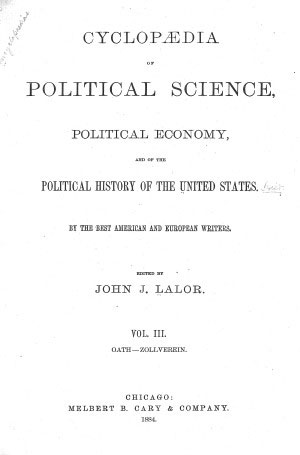
Front Page Titles (by Subject) OUTLAWRY - Cyclopaedia of Political Science, Political Economy, and of the Political History of the United States, vol. 3 Oath - Zollverein
OUTLAWRY - John Joseph Lalor, Cyclopaedia of Political Science, Political Economy, and of the Political History of the United States, vol. 3 Oath - Zollverein [1881]Edition used:Cyclopaedia of Political Science, Political Economy, and of the Political History of the United States by the best American and European Authors, ed. John J. Lalor (New York: Maynard, Merrill, & Co., 1899). Vol 3 Oath - Zollverein
About Liberty Fund:Liberty Fund, Inc. is a private, educational foundation established to encourage the study of the ideal of a society of free and responsible individuals. Copyright information:The text is in the public domain.
Fair use statement:
This material is put online to further the educational goals of Liberty Fund, Inc. Unless otherwise stated in the Copyright Information section above, this material may be used freely for educational and academic purposes. It may not be used in any way for profit.
- Volume III: Oath - Zollverein
- O
- Oath
- Oath of Allegiance
- Occupation
- Oceanica
- Ochlocracy.
- O'conor, Charles
- Office-holders, Danger of an Aristocracy of
- Ohio
- Oligarchy
- Olmstead Case. (see Pennsylvania.)
- Omnibus Bill. (see Parliamentary Law.)
- Opinion. (see Public Opinion.)
- Opposition
- Order of the Day. (see Parliamentary Law.)
- Orders In Council. (see Embargo, In U. S. History.)
- Orders, Religious . (see Congregations.)
- Ordinance of 1787
- Oregon
- Oriental Question
- Ostend Manifesto
- Outlawry
- Outlet
- Over-production
- P
- Pacific Railroad. (see Internal Improvements, Railroads.)
- Paper Money.
- Paraguay (republic Of).
- Parasites, Social
- Pardon.
- Paris Monetary Conference
- Parley.
- Parliament, the British
- Parliamentary Law.
- Participation In Profits.
- Parties, Political
- Party Government In the United States.
- Party Names In U. S. History. (see American Party, Anti-federal Party, Anti-masonic Party)
- Patent Office
- Patents, and the Patent System.
- Patronage
- Patrons of Husbandry. (see Grangers.)
- Pauperism
- Peace.
- Peace Congress. (see Conference, Peace.)
- Pendleton, George H.
- Penitentiary Systems. (see Prisons and Prison Discipline.)
- Pennsylvania
- Penny Banks. (see Banks, History and Management of Savings.)
- Pensions. (see United States Pension Laws, and the Pension Laws of Other Countries.)
- Persia.
- Personal Liberty Laws
- Personal Union
- Peru
- Petition
- Petition, Right of
- Philosophy of Law
- Physiocrates.
- Pickering, Timothy
- Pierce, Franklin
- Pinckney, Charles Cotesworth
- Pinckney, Thomas
- Piracy
- Plenty and Dearth.
- Poland
- Police
- Police Power of a State
- Political Arithmetic. (see Arithmetic, Political.)
- Political Assessments. (see Assessments, Political.)
- Political Economy.
- Political Economy, History of
- Political Science
- Politics, Nature and Character of
- Polk, James Knox
- Poll Tax
- Popular Sovereignty
- Population.
- Portugal.
- Postoffice
- Postoffice Department
- Postoffice Savings Banks. (see Banks, History and Management of Savings.)
- Powers of Congress. (see Congress, Powers Of.)
- President. (see Executive.)
- President Pro Tem. (see Parliamentary Law.)
- Press, the Newspaper and Periodical
- Previous Question. (see Parliamentary Law.)
- Prices
- Primary Elections.
- Priority of Debts Due to the United States and to the States
- Prisoners of War
- Prisons and Prison Discipline
- Private Bills. (see Parliamentary Law.)
- Private Calendar. (see Parliamentary Law.)
- Privateering
- Privilege. (see Parliamentary Law.)
- Prizes, Maritime
- Production of Wealth
- Products On Paper
- Profits
- Prohibition
- Promotion
- Property
- Property, Landed . (see Rent.)
- Property, Literary
- Proportional Representation
- Protection. Restrictions Upon Freedom of Exchange
- Protection In the United States.
- Protestantism. (see Churches, Protestant.)
- Prussia
- Public Debts. (see Debts, National, State and Local.)
- Public Lands of the United States
- Public Lands, Office of
- Public Opinion
- Public Policy
- Public Revenues. (see Revenues, Public.)
- Q
- Quarantine
- Quids
- R
- Races of Mankind
- Radicalism
- Railways, History and Political Economy of
- Railways, Legislation Concerning, and Management Of, In the United States
- Railway Clearing House. (see Clearing, and Clearing Houses.)
- Randolph, John
- Rebellion
- Rebellion, the (in U. S. History)
- Reciprocity
- Recognition
- Reconstruction
- Refuge, Right of . (see Asylum.)
- Refunding of the Public Debt of the United States
- Reichsrath
- Reichstag
- Removal of Deposits. (see Deposits, Removal Of.)
- Removals From Office
- Rent
- Representation
- Representative Democracy. (see Democracy, Representative.)
- Republic.
- Republican Party
- Repudiation.
- Resignation.
- Restrictive System. (see Embargo, In U. S. History.)
- Returning Boards
- Revenue
- Revolution.
- Revolution, the
- Rhode Island
- Ricardo, David
- Riders
- Right of Inheritance. (see Inheritance.)
- Right of Petition. (see Petition, Right Of.)
- Riu Kiu.
- River and Harbor Bills. (see Internal Improvements.)
- Roads. (see Transportation, Means Of.)
- Roads and Canals. (see Internal Improvements.)
- Rohmer's Doctrine of Parties. (see Parties, Political.)
- Roman Catholic Church.
- Rotation In Office. (see Civil Service Reform.)
- Rules. (see Parliamentary Law.)
- Rush, Richard
- Russia
- S
- Saint-simonism. (see Socialism.)
- Salary Grab
- San Domingo
- Sandwich Islands
- Sanitary System
- Savings
- Savings Banks. (see Banks, History and Management of Savings.)
- Saxony
- Schools. (see Education and the State)
- Schurz, Carl
- Science. (see Social Science.)
- Scotland
- Scott, Winfield
- Scratching
- Search, Right of
- Secession
- Sedition Laws. (see Alien and Sedition Laws.)
- Seminole War. (see Slavery, II.)
- Senate
- Sergeant-at-arms. (see Parliamentary Law.)
- Sergeant, John
- Servia, Principality of
- Sessions of Congress. (see Congress, Sessions Of.)
- Seward, William H.
- Seymour, Horatio
- Shay's Rebellion. (see Confederation, Articles Of.)
- Sherman, John
- Shimonoséki Indemnity
- Shinto
- Siam
- Silver
- Silver Bill. (see Hayes, R. B.)
- Sinking Fund
- Sintooism. (see Shinto)
- Slavery
- Smith, Adam
- Smuggling
- Socialism and Socialists
- Social Contract
- Social Science
- Society
- South Carolina
- Southern Confederacy. (see Confederate States.)
- Sovereignty
- Sovereignty (in U. S. History). (see Popular Sovereignty.)
- Spain
- Speaker. (see Parliamentary Law.)
- Speakers. (see Congress, Sessions Of.)
- Speculation
- Spoils System
- Squatter Sovereignty. (see Popular Sovereignty)
- Stamp Act Congress
- Standing Armies. (see Armies.)
- Standing Orders. (see Parliamentary Law.)
- Stanton, Edwin M .
- State, Department of
- State Rights. (see State Sovereignty, II.)
- State Sovereignty
- State, the
- States, Constitutional and Legal Diversities In
- Statistics
- Stephens, Alexander H.
- Stevens,thaddeus
- Stock Exchange Clearing House. (see Clearing, and Clearing Houses.)
- Stock Jobbing. (see Agiotage.)
- Story, Joseph
- Strict Construction. (see Construction.)
- Strikes and Lockouts
- Subsidies.
- Sub-treasury. (see Independent Treasury.)
- Suffrage
- Sumner, Charles
- Sumptuary Laws. (see Laws, Sumptuary.)
- Supply. (see Parliamentary Law.)
- Supreme Court. (see Judiciary.)
- Sweden.
- Switzerland
- T
- Table. (see Parliamentary Law.)
- Tammany Hall
- Taney, Roger Brooke
- Tariffs of the United States.
- Tartar, Tartary
- Ta-tsing (great Pure)
- Tauism (tao-ism, To;, Or Doctrine of Lao-tse).
- Taxation, Principles of
- Taxation, National and Local. (see Revenue, Public; Taxation.)
- Taylor, Zachary
- Telegraph
- Tellers. (see Parliamentary Law.)
- Temperance Movement In the United States. (see Prohibition, Police.)
- Ten-hour Law
- Tennessee
- Term and Tenure of Office
- Territorial Waters
- Territories
- Texas
- Third Estate
- Tie. (see Parliamentary Law.)
- Tilden, Samuel Jones
- Times-spirit, the . (see Zeitgeist.)
- Tompkins, Daniel D.
- Ton-kin. (see Tonquin.)
- Tonquin (tong-king Or Tun-kin).
- Transportation, Means of
- Treason
- Treasury Department.
- Treaties.
- Treaties, Fishery.
- Treaties of the United States
- Trent Affair
- Tungusic Races. (see Tartar.)
- Turkey.
- Tyler, John
- U
- Union, the (in U. S. History),
- Union Party. (see Republican Party.)
- United States Notes.
- United States Notes. Legal-tender Cases—Decisions of the Supreme Court of the United States.
- United States of America
- United States of Colombia. (see New Grenada.)
- United States Pension Laws and the Pension Laws of Other Countries
- United States Surplus Money
- Universal Suffrage. (see Suffrage.)
- Universities
- Usury
- Utah
- Utility
- Utopia
- V
- Value
- Van Buren, Martin
- Vermont
- Veto
- Vice-president. (see Executive, V.; Electors, Senate; Administrations.)
- Virginia
- Virginia Resolutions. (see Kentucky and Virginia Resolutions.)
- W
- Wage Fund, the
- Wages
- \"waltham System,\"
- Wants.
- War. (see Declaration of War, Belligerents, Exchange of Prisoners.)
- War, the Civil. (see Rebellion, The, In U. S. History.)
- War Department.
- Wars (in U. S. History).
- Washington City. (see Capital, National.)
- Washington, George
- Washington Territory
- Ways and Means. (see Parliamentary Law.)
- Wealth.
- Webster, Daniel
- Weights and Measures.
- West Virginia
- Wheeler, William A.
- Whig Party
- Whisky Insurrection
- Whisky Ring
- White, Hugh Lawson
- White League. (see Ku-klux Klan.)
- Wilmot Proviso
- Wilson, Henry
- Wirt, William
- Wisconsin
- Woman Suffrage. (see Suffrage.)
- Wright, Silas
- Wyoming
- Wyoming Territory
- X
- X Y Z Mission
- Y
- Yazoo Frauds
- Yeas and Nays. (see Parliamentary Law.)
- Z
- Zeitgeist.
- Zollverein.
- Lists of Writers
- The Following Is a List of the Subjects Treated By American Writers:
OUTLAWRY
OUTLAWRY. The declaring one by superior authority outside of the protection of all law, was a proceeding not unknown to the Greeks and Romans, but was inflicted by them when offenses had been committed against the national religion, and was more in the nature of ecclesiastical excommunications and interdicts such as are found in some Christian countries.
—At common law process of outlawry originally lay only in cases of treason, but was at later periods extended to minor offenses and even to civil actions. The consequences, however, of a judgment in outlawry, and the legal steps to obtain it, were very different in the last mentioned cases.
—In Bacon's Abridgment outlawry is defined as a punishment inflicted on a person for contempt and contumacy, in refusing to be amenable to and abide by the justice of that court which has lawful authority to call him before it. And as this is a crime of the highest nature, being an act of rebellion against the state or community of which he is a member, so does it subject the party to divers forfeitures and disabilities, for hereby he loses liberam legem, is out of the king's protection. It is further said in the same place, that in outlawry in treason and felony the law interprets the party's absence as a sufficient evidence of his guilt, and, without requiring further proof, accounts him guilty of the fact, on which ensues corruption of blood and forfeiture of his whole estate, real and personal, which he holds in his own right.
—One of the most memorable proceedings in outlawry was directed against the well-known agitator and member of parliament, Wilkes Booth, in consequence of his withdrawing to France, while an information for libel was pending against him (1770). On technical grounds (Lord Mansfield presiding) the proceeding was quashed. The process of outlawry was so beset with technical difficulties that it could hardly ever be successfully maintained. In the United States it never was generally recognized either in criminal or civil cases. This process of outlawry, as found in the common law, as applicable to minor offenses and even to civil cases, if it ever prevailed on the continent of Europe, was soon superseded by process and judgment in contumaciam, taken from the Roman and canon law even in criminal cases. Parties sued or indicted may, under that process, be summoned by publication and be condemned in their absence, but not without evidence being heard, which condemnation, however, upon appearance within certain prescribed periods, may be set aside on terms.
—Outlawry in the English sense was there confined to high and capital crimes, and was frequently applied by the secret courts, held by certain tribunals in some parts of Germany, under imperial sanction (Vehm Gerichte) in the middle ages. Those convicted, when within the power of the tribunal, were at once executed by the subordinate officials, and those who escaped were outlawed, and liable to be executed wherever found by officers or members of the brotherhood. In Rome and Greece everybody could kill an outlaw, and it is a somewhat disputed point whether at earlier times this was not also allowable at common law before it was expressly prohibited by statute. In the holy German empire outlawry, called Reichs-Acht (Bann), played a great part, but it was more of a political than strictly legal process. It was adopted in cases of felony, committed by the great vassals against the emperor, their liege lord; also in cases of great crimes and misdemeanors not strictly breaches of fealty. The imperial great bann had to proceed from the diet; the lower bann could be pronounced by local courts, and had but a local application. Upon complaint, sustained by the estates of the empire assembled in diet, the accused was summoned, usually three times, and upon default conviction followed and declaration of outlawry. With the great vassals the decrees could only be enforced by a real war. The outlawry of Henry the Lion (the head of the Guelph faction), duke of Saxony and Bavaria, was perhaps the most noted instance of this process. Having failed to heed the summons to answer the impeachment at three different sessions of the diet, outlawry (the Ober- or Aber-Acht) was pronounced against him at the diet held at Wurzburg (1180) by the emperor Frederick I. (Barbarossa, chief of the Ghibelins). It was a political act more than a legal one, as it also declared a forfeiture of his estates held as benefices, and not in his own right, which was not usual either at common law or at the German law. Henry took up arms, but being unsuccessful, fled to his father-in-law, the king of England. Later, amnestied, he was reinstated into Brunswick and Luneburg, his allodial possessions.
—The outlawry of the elector John Frederick of Saxony, and of Philip, landgrave of Hesse, the Protestant leaders in the reformation, was wholly irregular, being declared by a mere edict of the emperor Charles V., without sanction of the diet (Reichstag) 1547. Equally irregular had been the outlawry of Martin Luther, by a mere minority of the diet of Worms in 1521, when the session, by the departure of most of the members, had been virtually closed. Some of the most powerful princes of the empire at once protested against it, and the emperor never took steps to execute it. All formalities had been neglected. The only resolution that was legally passed against Luther was one binding the estates of the empire not to obstruct the papal bulls against Luther, which had only a clerical effect by excommunicating him. Other imperial outlawries sanctioned by the diet were those against the elector palatine Frederick, king of Bohemia, and his allies, in 1619, and against the electoral princes of Bavaria and Cologne in the war of the Spanish succession, on account of their alliance with France in 1702. An attempt to outlaw Frederick the Great of Prussia, at the commencement of the seven years war (1758) failed in its initial steps. Purely political acts, without any legal proceedings, were the outlawry of the Baron de Stein, ex-minister of Prussia, by Napoleon I., in 1809, and that of Napoleon himself by the princes assembled at the Vienna congress in 1815, as also that of Gen. B. F. Butler by the confederate states.
|