Econlib

The Library

Other Sites

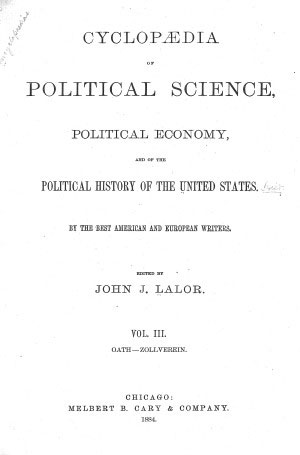
Front Page arrow Titles (by Subject) arrow O - Cyclopaedia of Political Science, Political Economy, and of the Political History of the United States, vol. 3 Oath - Zollverein

Return to Title Page for Cyclopaedia of Political Science, Political Economy, and of the Political History of the United States, vol. 3 Oath - Zollverein

Search this Title:

Also in the Library:

Subject Area: Economics
Subject Area: Political Theory
Subject Area: History
Topic: Property

O - John Joseph Lalor, Cyclopaedia of Political Science, Political Economy, and of the Political History of the United States, vol. 3 Oath - Zollverein [1881]

Edition used:

Cyclopaedia of Political Science, Political Economy, and of the Political History of the United States by the best American and European Authors, ed. John J. Lalor (New York: Maynard, Merrill, & Co., 1899). Vol 3 Oath - Zollverein

Part of: Cyclopaedia of Political Science, Political Economy, and of the Political History of the United States, 3 vols.

About Liberty Fund:

Liberty Fund, Inc. is a private, educational foundation established to encourage the study of the ideal of a society of free and responsible individuals.


O

OATH

OATH. Oaths have been in use in all countries of which we have any exact information, and it is probable that there is no nation which has any clear notion of a Supreme Being, or of superior beings, that does not make use of oaths on certain solemn occasions. An oath may be described generally as an appeal or address to a superior being, by which the person making it engages to declare the truth on the occasion on which he takes the oath, or by which he promises to do something hereafter. The person who imposes or receives the oath, imposes or receives it on the supposition that the person making it apprehends some evil consequences to himself from the superior being, if he should violate the oath. The person taking the oath may or may not fear such consequences, but the value of the oath in the eyes of him who receives or imposes it consists in the opinion which he has of its influence over the person who takes it. An oath may be taken voluntarily, or it may be imposed on a person under certain circumstances by a political superior; or it may be the only condition on which the assertion or declaration of a person shall be admitted as evidence of any fact.

—The form of taking the oath has varied greatly in different countries. Among the Greeks a person sometimes placed his hand on the altar of the deity by whom he swore; but the forms of oaths were almost as various as the occasions. Oaths were often used in judicial proceedings among the Greeks. The Dicastæ, who were judges and jurymen, gave their verdict upon oath. The Heliastic oath is stated at length in the speech of Demosthenes against Timocrates (c. 36). It does not appear that the oath was always imposed on witnesses in judicial proceedings; and yet it appears that sometimes witnesses gave their evidence on oath: perhaps the oath on the part of witnesses was generally voluntary. (Demosth., c. 16;, c. 10; and Meier and Schömann, Att. Process., p. 675.)

lf0216_figure_228
lf0216_figure_229
lf0216_figure_230

—In the Roman jurisprudence an oath was required in some cases from the plaintiff, or the defendant, or both. Thus the oath of calumny was required from the plaintiff, which was a solemn declaration that he did not prosecute his suit for any fraudulent or malicious purpose. The offense of false swearing was perjurium, perjury; but it was considered a less offense in a party to a suit when the oath was imposed by a judex than when it was voluntary. It does not appear that in civil proceedings witnesses were necessarily examined on oath; but witnesses appear to have been examined on oath in the judicia publica, which were criminal proceedings. The title in the Digest, "De Testibus" (22, tit. 5), makes no mention of the oath, though it speaks of punishment being inflicted on witnesses who bore false testimony.

—The law in America and England, as a rule, requires evidence or testimony for judicial purposes to be given on oath. A Jew, a Mohammedan and a Hindoo may be sworn as witnesses, but they must severally take the oath in that form which is sanctioned by the usage of their country or nation, and which they severally consider to be binding. The offense of declaring what is false when a witness is examined upon oath, constitutes perjury.

—Declarations made by a person under the apprehension of immediate death are generally admitted as evidence in judicial proceedings, when properly verified; for it is considered that the circumstances in which the person is placed at the time of making the declaration furnish as strong motives for veracity as the obligation of an oath. Quakers also, in all civil cases, were allowed by the statute 7 8 8 Wm. III., c. 34, to give their evidence on affirmation; and now the affirmation of Quakers and Moravians is admissible in all judicial proceedings, both civil and criminal.

—As oaths may be either voluntary or may be imposed by a political superior, so they may be imposed either on extrajudicial or on judicial occasions. Oaths which are imposed on occasion of judicial proceedings are the most frequent, and the occasions are the most important to the interests of society. The principle on which an oath is administered on judicial occasions is this it is supposed that an additional security is thereby acquired for the veracity of him who takes the oath. Bentham, in his "Rationale of Evidence," on the contrary, affirms that, "whether principle or experience be regarded, the oath will be found, in the hands of justice, an altogether useless instrument; in the hands of injustice, a deplorably serviceable one," "that it is inefficacious to all good purposes," and "that it is by no means inefficacious to bad ones."

—The three great sanctions or securities for veracity in a witness, or, to speak perhaps more correctly, the three great sanctions against mendacity in a witness, are, the punishment legally imposed on a person who is convicted of false swearing, the punishment inflicted by public opinion or the positive morality of society, and the fear of punishment from the Deity, in this world or the next, or in both. The common opinion is, that all the three sanctions operate on a witness, though they operate on different witnesses in very different degrees. A man who does not believe that the Deity will punish false swearing can only be under the influence of the first two sanctions; and if his character is such that it can not be made worse than it is, he may be under the influence of the first sanction only. Bentham affirms that the third sanction only appears to exercise an influence in any case, because it acts in conjunction with "the two real and efficient sanctions," "the political sanction and the moral or popular sanction;" and that if it is stripped of those accompaniments, its impotence will appear immediately.

—Bentham's chief argument is as follows. "that the supposition of the efficiency of an oath is absurd in principle. It ascribes to man a power over his Maker. It supposes the Almighty to stand engaged, no matter how, but absolutely engaged, to inflict on every individual by whom the ceremony, after having been performed, has been profaned, a punishment (no matter what) which, but for the ceremony and the profanation, he would not have inflicted. It supposes him thus prepared to inflict, at command, and at all times, a punishment, which, being at all times the same, at no time bears any proportion to the offense." Again: "either the ceremony causes punishment to be inflicted by the Deity in cases where otherwise it would not have been inflicted; or it does not. In the former case the same sort of authority is exercised by man over the Deity, as that which, in English law, is exercised over the judge by the legislator, or over the sheriff by the judge. In the latter case the ceremony is a mere form without any useful effect whatever."

—The absurdity of this argument hardly needs to be exposed. He who administers the oath, by virtue of the power which he has to administer it and the political superior who imposes the oath, may either believe or not believe that the Deity will punish false swearing, and it is quite immaterial to the question which of the two opinions they entertain. That which gives the oath a value in the eyes of him who administers it, or of that political superior who imposes it, is the opinion of the person who takes the oath; and if the individual who takes the oath believes that the Deity, in case it is profaned, will inflict a punishment which otherwise he would not inflict, the object of him who enforces the oath is accomplished, and an additional sanction against mendacity is secured. It matters not whether the Deity will punish or not, or whether he who enforces the oath believes that he will punish or not, if he who takes the oath believes that the Deity will punish false swearing, that is sufficient to show that the oath is of itself a sanction.

—The fear of legal punishment is admitted by Bentham to be a sanction against mendacity. But the legal punishment may or may not overtake the offender. Legal punishment may follow detection, but the perjury may not be detected, and therefore not punished. Is the oath, or would a declaration without oath be, "a mere form without any useful effect whatever," because the legal punishment may not, and frequently does not, overtake the offender? When a Greek or a Roman swore by his gods, in whose existence he believed, and who, being mere imaginations, could not punish him for his perjury, was not his belief in their existence and their power and willingness to punish perjury a sanction against mendacity? All antiquity at least thought so.

—There are occasions on which oaths are treated lightly, on which he who imposes the oath, he who takes it, and the community who are witnesses to it, treat the violation of it as a trivial matter. Such occasions as these furnish Bentham with arguments against the efficacy of oaths on all occasions. Suppose we admit, with Bentham, as we do merely for the sake of the argument, that "on some occasions oaths go with the English clergy for nothing;" and this, notwithstanding the fact, which nobody can doubt, "that among the English clergy believers are more abundant than unbelievers." The kind of oaths "which go for nothing" are not mentioned by Bentham, but they may be conjectured. Now, if all oaths went for nothing with the clergy, or with any other body of men, the dispute would be settled. But this is not the fact. If in any way it has become the positive morality of any body of men that a certain kind of oath should go for nothing, each individual of that body, with respect to that kind of oath, has the opinion of his body. He does not believe that such oath, if broken, will bring on him divine punishment, and therefore such oath is an idle ceremony. But if there is any oath the violation of which he thinks will bring on him divine punishment, his opinion as to that kind of oath is not at all affected by his opinion as to the other kind of oath. Now, oaths taken on judicial occasions are by the mass of mankind considered to be oaths the violation of which will bring some punishment some time, and therefore they have an influence on the great majority of those who take them. Whether society will in time so far improve as to render it safe to dispense with this ceremony in judicial proceedings, can not be affirmed or denied; but a legislator who knows what man now is, will require better reasons for the abolition of judicial oaths than Bentham has given.

—How far the requisition of an oath may be injurious in excluding testimony in certain cases, and how far oaths on solemn and important occasions may be made most efficacious, and in what cases it may be advisable to substitute declarations in lieu of oaths, are not matters of consideration here. It is enough here to show that an oath is a sanction or security to some extent, if the person who takes it fears divine punishment in case he should violate it; and that this, and no other, is the ground on which the oath is imposed.

—There is some difficulty in stating accurately how far oaths were required from witnesses in Roman procedure under the republic and the earlier emperors. In addition to what has been stated, the reader may refer to Cicero, Pro Q. Rose. Comœd., c. 15, etc.; and Noodt, Op. Omn., ii., 479, "De Testibus." By a constitution of Constantine, all witnesses were required to give their testimony on oath; and this was again declared by a constitution of Justinian. (Cod. 4, tit. 20, s. 9, 16, 19.)

—Many persons conscientiously object to the taking of an oath on religious grounds, and particularly with reference to the prohibition in Matthew v., 33. On the subject of oaths in general the reader may consult Grotius, De Jure, B. 8 P., lib. ii., c. 13; Paley's Moral Philosophy; Tyler's Origin and History of Oaths; the Law Magazine, vol. xii.; and the work of Bentham already referred to.1 .

BOHN

OATH OF ALLEGIANCE

OATH OF ALLEGIANCE, The. (IN ENGLISH HISTORY). The natural history and antiquity of oaths in general were discussed some time ago by Mr E.B. Tylor. (Macmillan's Magazine, "ordeals and Oaths," May, 1876.) Mr. Tylor has, among other interesting points, made it all but certain that our formula, "So help me God!" is of Scandinavian or pre-Christian origin; a discovery which throws an unexpected light on the much abused dictum that Christianity is parcel of the common law of England, and the proposition, confidently advanced at a later time, that the oath of allegiance taken by members of parliament is in some way (notwithstanding the removal of Jewish disabilities) a bulwark of the Christian religion in England. This statement, however, errs only in generality and in being out of date. It is perfectly true that the oath of allegiance was, down to the Catholic emancipation, one of the chief statutory defenses of the Protestant religion, though in a political rather than a theological sense; and for many years later it contained a promise to maintain and support the Protestant succession to the crown as limited by the act of settlement. The history of the oaths of allegiance and supremacy and of the various transformations they have undergone, is a varied and complex one.

—Before we go back to the beginning, it may be as well to look at the end. As late as 1868 the English oath of allegiance was reduced by the promissory oaths act to its present simple, not to say meagre, form, which stands thus: "I,—do swear that I will be faithful and bear true allegiance to her majesty Queen Victoria, her heirs and successors, according to law. So help me God."

—What the substance of the oath as thus reduced may amount to would not be a very profitable question to discuss at large. It certainly does not promise anything beyond what is at common law the duty of every subject, and it seems to follow that it could not be broken except by some act which was otherwise an offense at common law, for example, treason or sedition, or perhaps also the vaguely defined offense of disparaging the dignity of the crown. And it seems at least a tenable view that the words "according to law" not only express the limit within which the crown is entitled to obedience, but cover the possibility (a possibility, fortunately, of the most remote kind) of the course of succession being legally varied.2 Such is the bare residue of the formidable and elaborate fabric of oaths and declarations raised up by parliaments of former generations against the pope and the pretender. We say against the pope and the pretender; for our modern oaths of allegiance are of statutory devising, and date from Henry VIII.'s assertion of the crown's ecclesiastical supremacy as against the see of Rome. The earliest point of history we have to observe is of a distinguishing kind, namely, that the modern oath of allegiance is a thing apart from the older oath of fealty, though formed on its analogy. Side by side with the fealty due from a man to his lord in respect to tenure, there was recognized in England, it would seem as early as the tenth century, an obligation of fealty to the crown as due from every free man without regard to tenure.3

—Sometimes we find mixed or transitional forms. Thus, there is preserved among the so-called statutes temporis incerti an oath taken by bishops, which, translated, is as follows: "I will be faithful and true, and faith and loyalty will bear to the king and to his heirs kings of England, of life and of member and of earthly honour, against all people who may live and die: and truly will acknowledge, and freely will do, the services which belong to the temporalty of the bishoprick of N., which I claim to hold of you, and which you render to me. So help me God and the Saints."4

—This bears considerable generic resemblance to the modern oath. But it is not simply an oath of allegiance in the modern sense: it includes an oath of fealty in respect of a specific tenure, namely, for the temporalities of the see holden of the crown. This is made more evident by comparison of the common forms of a free man's homage and fealty: "I become your man from this day forth, for life, for member and for worldly honour, and shall bear you faith for the lands that I claim to hold of you; saving the faith that I owe unto our lord the king * * I shall be to you faithful and true, and shall bear you faith of the tenements I claim to hold of you, and loyally will acknowledge and will do the services I owe you at the times assigned. So help me God and the Saints."

—Moreover, the ceremonies of homage and fealty have in no way been abrogated or superseded by any of the statutes imposing political oaths. In England an oath of homage is to this day taken by archbishops and bishops, in a somewhat fuller form than the old one above cited. An oath of fealty is stated in our law books of the thirteenth century to be required from every one attending the sheriff's tourn, and Coke speaks of it in Calvin's case, as if it had been still in use in his time.5 There appears no reason why this oath of fealty should not in theory still be due from every subject at common law, though it would be doubtful who had authority to administer it, and what would be the legal consequence, if any, of a refusal to take it.

—Shortness of time and space, however, forbid the further discussion of the doctrine or history of allegiance at common law. We must pass on to the additional obligations imposed by a series of statutes, from which the oath of allegiance in its existing form and application is lineally derived.

—In the spring of 1534, when the last hopes of a reconciliation with Rome were exhausted, there was passed "An act for the establishment of the king's succession," (25 H. VIII., c. 22), the objects of which were to declare valid the king's marriage with Anne Boleyn, and to limit the succession of the crown to his issue by her. It also enacted that all subjects of full age should make a corporal oath that they would "truly, firmly and constantly, without fraud or guile, observe, fulfill, maintain, defend and keep to their cunning wit and uttermost of their powers, the whole effect and contents of this present act." The oath was not further specified in the act itself, but a form was at once prepared and used, and was expressly authorized by statute in the next session. (26 H. VIII., c. 2.) This, as the earliest specimen of its kind, deserves the honor of being given in full, with the original spelling: "Ye shall swere to beare faith, truth and obedyence alonely to the Kynges Majestye and to his heires of his body of his moost dere and entirely belovyd laufull wyfe Quene Anne, begotten or to be begotten. And further to the heires of oure said Soveraign Lorde accordyng to the lymytacion in the Statute made for suretie of his succession in the crowne of this Realme mencioned and conteyned, and not to any other within this Realme nor foreyn auctorite or Potentate; And in case any othe be made or hathe be made by you to any persone or persones, that then ye do repute the same as vayne and adnyehillate; And that to your connynge wytte and utter moste of your power, without gyle, fraude or other undue meane, you shall observe, kepe, mayntene 8 defende the saide acte of successyon, and all the hole effectes 8 contentes therof, and all other actes and statutes made yn confirmacion or for execucion of the same or of any thynge therin conteyned; and this ye shall do ayenst all maner of persones of what estate, dignyte, degree or condicion so ever they be; And in no wyse do or attempte, nor to your power suffre to be done or attemptid, directly or indirectly, any thinge or thinges prively or appartlye to the lette, hindrannce, damage or derogacion therof or of any parte of the same by any maner of meaner or for any maner of pretence; So helpe you God, all Sayntes and the Holye Evangelystes."

—Within two years the calamitous end of the marriage with Anne Boleyn brought about a new "Act for the establishment of the succession of the imperial crown of this realm," (28 H. VIII., c. 7), which, after repealing the former acts and making minute provision for the descent of the crown, appointed a new oath of allegiance, and declared that refusal to take it should be deemed and adjudged high treason. There is no variation worth noticing in the form of the words, save that Queen Jane is substituted for Queen Anne. In the same session (c. 10) there followed an "Act extinguishing the authority of the bishop of Rome," which introduced a special oath of abjuration. The preamble is a notable specimen of the inflated parliamentary style of the time. It sets forth how "the pretended power and usurped authority of the bishop of Rome, by some called the pope, * * did obfuscate and wrest God's holy word and testament a long season from the spiritual and true meaning thereof to his worldly and carnal affections, as pomp, glory, avarice, ambition and tyranny, covering and shadowing the same with his human and politic devices, traditions and inventions, set forth to promote and stablish his only dominion, both upon the souls and also the bodies and goods of all Christian people": how the pope not only robbed the king's majesty of his due rights and pre-eminence, "but spoiled this his realm yearly of innumerable treasure"; and how the king and the estates of the realm, "being overwearied and fatigated with the experience of the infinite abominations and mischiefs preceding of his impostures," were forced of necessity to provide new remedies. The oath of abjuration was to be taken by all officers, ecclesiastical and temporal, and contained an undertaking to "utterly renounce, refuse, relinquish or forsake the bishop of Rome and his authority, power and jurisdiction."

—In 1544, however, it had been discovered that in these oaths of allegiance and supremacy, though they seem to a modern reader pretty stringent and comprehensive, "there lacketh full and sufficient words"; and in the act further regulating the succession to the crown (35 H. VIII., c. 1) occasion was taken to provide a new consolidated form to replace the two previously appointed oaths. This is very full and elaborate; some of its language survived down to our own times, as will be seen by the following extract: "I, A B, having now the veil of darkness of the usurped power, authority and jurisdiction of the see and bishop of Rome clearly taken away from mine eyes, do utterly testify and declare in my conscience that neither the see nor the bishop of Rome nor any foreign potentate hath, nor ought to have, any jurisdiction, power or authority within this realm, neither by God's law nor by any other just law or means, * * and that I shall never consent nor agree that the foresaid see or bishop of Rome, or any of their successors, shall practice, exercise or have any manner of authority, jurisdiction or power within this realm or any other the king's realms or dominions, nor any foreign potentate, of what estate, degree or condition soever he be, but that I shall resist the same at all times to the uttermost of my power, and that I shall bear faith, truth and true allegiance to the king's majesty and to his heirs and successors, * * and that I shall accept, repute and take the king's majesty, his heirs and successors, when they or any of them shall enjoy his place, to be the only supreme head in earth under God of the church of England and Ireland, and of all other his highness dominions * *."

—Refusal to take the oath is, as before, to subject the recusant to the penalties of high treason. Apparently this act remained in force till Mary's accession, in 1553. One of the first proceedings of her reign was to abolish all statutory treasons not within the statute of Edward III, by which the offense of high treason was and still is defined. (1 Mar., st. 1, c. 1.) Thus, the penalty for not taking the oath of allegiance and supremacy was abrogated, and the oath of course became a dead letter, though not dealt with in express terms. Nor was it revived in the same form when the reformation again got the upper hand with the accession of Elizabeth. The first act of parliament of her reign 6 —which, in repealing the reactionary legislation of Philip and Mary, names "Queen Mary, your highness' sister," with a significant absence of honorable additions—created a new and much more concise oath of supremacy and allegiance, to be made by all ecclesiastical officers and ministers, and all temporal officers of the crown, and also by all persons taking orders or university degrees. It is short enough to be cited in full: "I, A B, do utterly testify and declare in my conscience that the queen's highness is the only supreme governor of this realm and of all other her highness' dominions and countries, as well in all spiritual or ecclesiastical things or causes as temporal, and that no foreign prince, person, prelate, state or potentate hath or ought to have any jurisdiction, power, superiority, pre-eminence or authority, ecclesiastical or spiritual, within this realm, and therefore I do utterly renounce and forsake all foreign jurisdictions, powers, superiorities and authorities, and do promise that from henceforth I shall bear faith and true allegiance to the queen's highness, her heirs and lawful successors, and to my power shall assist and defend all jurisdictions, pre-eminences, privileges and authorities granted or belonging to the queen's highness, her heirs and successors, or united or annexed to the imperial crown of this realm. So help me God and by [sic] the contents of this Book."

—The oath was not imposed on all subjects, and the only penalty for refusing it was forfeiture of the office in respect of which it ought to be taken. So far this presents a very favorable contrast to the violent legislation of Henry VIII. Under the act of Elizabeth the sanction is the mildest one compatible with the law being effectual; indeed, it is not properly a penalty, but a condition. The law no longer says to all sorts of men, "You must take this oath or be punished as a traitor," but only to men receiving office or promotion, "You must take this oath to qualify yourself for holding the place." But troubles were not long in gathering, and they bore their natural fruit in a return to disused severities. A new and more stringent anti-papal act was passed in 1563 (5 Eliz., c. 1), and it seems that even sharper measures had been first proposed. The obligation to take the oath of supremacy was extended to all persons taking orders and degrees, schoolmasters, barristers, attorneys, and officers of all courts. A first refusal to take the oath was to entail the penalties of premunire; a second, those of high treason. Temporal peers were specially exempted, "forasmuch as the queen's majesty is otherwise sufficiently assured of the faith and loyalty of the temporal lords of her highness' court of parliament." So matters stood till, early in the reign of James I., yet a new outbreak of indignation and panic was produced by the gunpowder plot. The Protestant majority was convinced by "that more than barbarous and horrible attempt to have blownen up with gunpowder the king, queen, prince, lords and commons, in the house of parliament assembled, tending to the utter subversion of the whole state," that popish recusants and occasionally conforming papists should be more sharply looked after. Hence the "Act for the better discovering and repressing of popish recusants" (3 Jas. I., c. 4), which established, among other precautions, a wordy oath of allegiance, supremacy and abjuration, which might be tendered by justices of assize or of the peace to any commoner above the age of eighteen; persons refusing it were to incur the penalties of premunire. This oath contains an explicit denial of the pope's authority to depose the king or discharge subjects of their allegiance, a promise to bear allegiance to the crown notwithstanding any papal sentence of excommunication or deprivation, and a disclaimer of all equivocation or mental evasion or reservation. About the middle of it occurs for the first time the "damnable doctrine and position" clause, as we may call it, which was long afterward continued in the interests of the Protestant succession against James II. and the pretender. The words are these: "And I do further swear that I do from my heart abhor, detest and abjure, as impious and heretical, this damnable doctrine and position, that princes which be excommunicated or deprived by the pope may be deposed or murdered by their subjects or any other whosoever." Here also we find the words, afterward discussed in relation to the admission of Jews to parliament, "upon the true faith of a Christian." They can not have been particularly intended to exclude Jews from office, as Jews were at that time excluded from the realm altogether. It has been plausibly conjectured that their real intention was to clinch the proviso against mental reservation or equivocation "by conclusively fixing a sense to that oath which by no evasion or mental reservation should be got rid of without (even in the opinion of the Jesuit doctors themselves) incurring the penalty of mortal sin." For in a certain treatise on Equivocation, of which a copy corrected in Garnet's handwriting was found in the chamber of Francis Tresham, one of the conspirators named in the act, and was much used on the trial, this point of mental reservation is fully discussed; and it is laid down that equivocation and reservation may be used without danger to the soul even if they are expressly disclaimed in the form of the oath itself. But there is this exception, that "no person is allowed to equivocate or mentally reserve, without danger, if he does so, of incurring mortal sin, where his doing so brings apparently his true faith toward God into doubt or dispute." It was probably conceived by the advisers of the crown that the words, "upon the true faith of a Christian," brought the statutory form of oath within this exception. (Judgment of Baron Alderson in Miller vs. Salomons, 7 Ex. 536, 537.) A few years later, in the session of 1610, a sort of confirming act was passed (7 James I., c. 6), which made minute provision as to the places where, and the officers by whom, the oath should be administered to various classes of persons.

—Shortly after the restoration an oath declaring it unlawful upon any pretense whatever to take arms against the king, was imposed on all soldiers and persons holding military offices (14 Car. II., c. 3, as, 17, 18): and the act of uniformity (14 Car. II., c. 4, s. 6) contained a declaration to the like effect, and also against the solemn league and covenant. A similar provision in the corporation act was overlooked at the revolution, and escaped repeal till the reign of George I. In 1672 a revival of the anti-Catholic agitation followed upon Charles II.'s attempts to dispense with the existing statutes, nominally in favor of Romanists and Dissenters equally by a declaration of liberty of conscience. The result was, that a declaration against transubstantiation was added to the oaths of allegiance and supremacy, by a new penal statute entitled "An act for preventing dangers which may happen from popish recusants," (25 Car. II., c. 2). After the revolution of 1688, however, a new start was taken. By the combined effect of two of the earliest acts of the convention parliament (1 Will. 8 Mar., c. 1 and c. 8), all the previous forms of the oaths of allegiance and supremacy, expressly including the declaration as to taking arms against the king, were abrogated, and a concise form substituted, which stood as follows: "I, A B, do sincerely promise and swear that I will be faithful and bear true allegiance to their majesties King William and Queen Mary. So help me God, etc.7 I, A B, do swear that I do from my heart abhor, detest and abjure, as impious and heretical, that damnable doctrine and position that princes excommunicated or deposed by the pope or any authority of the see of Rome may be deposed or murthered by their subjects or any other whatsoever. And I do declare that no foreign prince, person, prelate, states or potentate hath or ought to have any jurisdiction, power, superiority, pre-eminence or authority, ecclesiastical or spiritual, within this realm. So help me God, etc."

—In 1701 came the death of James II. at St. Germains, and the ostentatious recognition of the pretender as king of England by Louis XIV. Fuller and more stringent precautions were again thought needful, and in the very last days of William III.'s life an act was passed (13 8 14 Wm. III., c. 6), imposing on specified classes of persons, including peers, members of the house of commons, and all holding office under the crown, an oath of special and particular abjuration of the pretender's title. The declaration of 1672 against transubstantiation (which had been spared from the general abrogation of other existing tests at the beginning of the reign) was at the same time expressly continued. As the form settled by this act remained substantially unchanged down to our own time, it is here set out: "I, A B, do truly and sincerely acknowledge, profess, testify and declare in my conscience before God and the world, that our sovereign lord King William is lawful and rightful king of this realm and of all other his majesty's dominions and countries thereunto belonging. And I do solemnly and sincerely declare that I do believe in my conscience that the person pretended to be the prince of Wales during the life of the late King James and since his decease pretending to be and taking upon himself the stile and title of king of England by the name of James the Third, hath not any right or title whatsoever to the crown of this realm or any other the dominions thereto belonging. And I do renounce, refuse and abjure any allegiance or obedience to him. And I do swear that I will bear faith and true allegiance to his majesty King William, and him will defend to the utmost of my power against all traitorous conspiracies and attempts whatsoever which shall be made against his person, crown or dignity. And I will do my best endeavours to disclose and make known to his majesty and his successors all treasons and traitorous conspiracies which I shall know to be against him or any of them. And I do faithfully promise to the utmost of my power to support, maintain and defend the limitation and succession of the crown against him the said James and all other persons whatsoever as the same is and stands limited (by an act instituted an act declaring the rights and liberties of the subject and settling the succession of the crown) to his majesty during his majesty's life, and, after his majesty's decease, to the Princess Ann of Denmark and the heirs of her body being Protestants, and for default of issue of the said princess and of his majesty respectively, to the Princess Sophia, electoress and duchess dowager of Hanover, and the heirs of her body being Protestants. And all these things I do plainly and sincerely acknowledge and swear according to these express words by me spoken, and according to the plain and common sense understanding of the same words, without any equivocation, mental evasion or secret reservation whatsoever. And I do make this recognition, acknowledgment, abjuration, renunciation and promise, heartily, willingly and truly, upon the true faith of a Christian. So help me God."

—This oath was in addition to the oaths of allegiance and supremacy prescribed by the acts already mentioned of the first session of William and Mary's reign, not by way of substitution for them. It will be observed that the words "upon the true faith of a Christian" now reappear. In Queen Anne's reign the only alterations made were, first to put Anne's name for William's, and then to leave a blank to be filled in with the name of the sovereign for the time being.8 The accession of George I., in 1714, gave occasion for a full re-enactment of the oaths of allegiance, supremacy and abjuration, in what would now be called a consolidating act. (1 Geo. I., st. 2, c. 13.) All persons holding civil or military office, members of foundations at the universities, schoolmasters, "preachers and teachers of separate congregations," and legal practitioners, were required to take the oaths; besides which, they might be tendered by two justices of the peace to any one suspected of disaffection. Members of both houses of parliament are, as before, specially forbidden to vote without taking the oaths. The form was settled by inserting the name of George in the blank left by the last statute of Anne, but no provision was made in terms for substituting from time to time the name of the reigning sovereign. In 1766, upon the pretender's death, the oath of abjuration was made appropriate to the new state of things by inserting the words "not any of the descendants of the person who pretended to be the prince of Wales," etc.

—In this form the oaths remained for nearly a century, affected only by a certain number of special exemptions. The most important of these was made by the Catholic emancipation of 1829. The act which effected this (10 Geo. IV., c. 7) allowed Roman Catholics to sit in parliament, taking, instead of the oaths of allegiance, supremacy and abjuration, a single modified oath containing the substance of them expressed in a milder form. The Catholic member was required, instead of detesting and abhorring the "damnable doctrine and position," to "renounce, reject and abjure the opinion" that excommunicated princes might be deposed or murdered; and to disclaim the belief that the pope of Rome or any other foreign prince had or ought to have any temporal or civil jurisdiction, etc., within this realm. The words "upon the true faith of a Christian" were for some reason omitted, and the oath concluded thus; "And I do solemnly, in the presence of God, profess, testify and declare, that I do make this declaration, and every part thereof, in the plain and ordinary sense of the words of this oath, without any evasion, equivocation or mental reservation whatsoever." This act contains, for the first time, a standing direction to substitute in the form of the oath, as may be required, the name of the sovereign for the time being.

—All this time the penalties of the statute of 1714 against a member of parliament who voted without having taking the oaths (or, in the case of a Catholic, the special oath provided by the Catholic relief act), continued in force, and very alarming they were. In addition to the pecuniary forfeiture of £500, they included disability to sue in any court, to take a legacy, to hold any office, and to vote at parliamentary elections. Disability to be an executor, which is also in the list, would at this day be regarded by many persons as rather a benefit than otherwise.

—The next step was in consequence of the persistent endeavors made through several years to procure the removal of Jewish disabilities. It would be too long to trace the history of this movement through its various stages; and the episode of Mr. Salomons' gallant attempt to take the position by a coup de main has now lost its interest for most people except lawyers who have a taste for ingenious argument on the construction and effect of statutes.9 In 1857 Mr. Salomons, being duly elected for Greenwich, took the oath on the Old Testament, omitting the words "upon the true faith of a Christian"; he was sued for the statutory penalty, as having sat without taking the oath; and it was decided (with one dissenting voice, but a weighty one)10 that these words were a material part of the oath, and could not be dispensed with otherwise than by legislation. At last, in 1858, a very odd and peculiarly English compromise was arrived at after the house of lords had rejected bills sent up from the commons. By one act (21 8 22 Viet., c. 48) a simplified form of oath, but still containing the words "upon the true faith of a Christian," was substituted for the oaths of allegiance, supremacy and abjuration in all cases where they were required to be taken. The application of this enactment to clerical subscriptions was afterward more especially regulated by the clerical subscription act, 1865 (28 8 29 Vict., c. 122).11 Then, by a separate act (21 8 22 Vict., c. 49), either house of parliament was empowered to permit by resolution "a person professing the Jewish religion, otherwise entitled to sit and vote in such house," to take the oath, with the omission of the words, "and I make this declaration upon the true faith of a Christian." It was also provided, that in all other cases where the oath of allegiance was required to be taken by a Jew, these words might be omitted. Such an exemption had once already been given by parliament in the eighteenth century, but, after the fashion of legislation in those days, only on a special occasion and for a limited purpose; and more recently to enable Jews to hold municipal offices. The act of 1858, being general in its terms, is a full statutory recognition of the civil equality of Jews with other British subjects, which, though long allowed in practice, had never yet been expressly declared.

—At length, in 1866, we come out into the daylight of modern systematic legislation. The parliamentary oaths act of that year (29 Viet., c. 19) swept away the former legislation relating to the oaths of members of parliament, and prescribed the following shortened form: "I, A B, do swear that I will be faithful and bear true allegiance to her majesty Queen Victoria; and I do faithfully promise to maintain and support the succession to the crown, as the same stands limited and settled by virtue of the act passed in the reign of King William the Third, instituted 'An act for the further limitation12 of the crown, and better securing the rights and liberties of the subject,' and of the subsequent acts of union with Scotland and Ireland. So help me God."

—For not taking the oaths only the pecuniary penalty of £500 was retained out of the terrible list enacted by earlier statutes. This act was excellent as far as it went, but it applied only to members of parliament. It is the fate of English legislation to be carried on as best it can, piecemeal, and at odd times. Measures which excite opposition pass through a struggle in which they are lucky if they escape without maim or grave disfigurement. As to those which do not excite opposition, it is for that very reason of no apparent political importance to push them on, and, as it is worth nobody's while to be much interested in them, they have to take their chance. In this case an act of the following year (the office and oath act, 1867, 30 8 31 Vict., c. 75) authorized the new parliamentary form of oath to be taken in all cases where the oath of allegiance was required as a qualification for office. Finally, the promissory oaths act of 1868 (31 8 32 Vict., c. 72) cut down the oath of allegiance in all cases to the form already given at the beginning of this paper, and substituted a declaration for an oath in the great majority of cases where an oath was formerly required. Still the work of simplification was not formally complete. A repealing act was passed in 1871 (34 8 35 Vict., c. 48), which struck off the statute book a long list of enactments imposing oaths for various purposes on various persons, and others partially amending or repealing them, from the middle of the fourteenth century downward. And so the story ends for the present; England no longer stands in fear of pope or pretender, and the modern oath of allegiance, devised for the protection of the realm against foemen and conspirators, and swollen with strange imprecations and scoldings, is brought back to the more plain and seemly fashion of the ancient oath of fealty. Yet our English ancestors were not capricious in the elaborate safeguards which they built up again and again round a ceremony originally of the simplest. Every clause and almost every word in the statutory oaths of allegiance, supremacy and abjuration was directed against a distinct and specific political danger. It is unhappily true that examples of repressive legislation against mere speculative opinions, though less common in England than elsewhere, are by no means wanting. But the political test oaths do not belong to this class. They were framed to discover and bring to punishment, or to disable and exclude from privileges, not the holders of theological opinions as such, but persons holding opinions, of which, rightly or wrongly, disloyal and seditious behavior was supposed to be the necessary or highly probable result. The attempt lately made, and for the present made with success, to use the parliamentary oath as a religious test, and thereby exclude a person obnoxious to a majority of the house of commons, partly for theological but much more for political and social reasons, has nothing to justify it in English history, or in the traditions of English politics. It is an unhappy example of the ignorance and confusion of mind concerning the institutions of their own country which are still too common among English legislators. (See ALLEGIANCE, and the note to the preceding article.)

FREDERICK POLLOCK.

OCCUPATION

OCCUPATION. I. Of the different meanings of this word, that which has the longest exercised the ingenuity of publicists relates to the manner of acquiring lands which up to the time of acquisition had no owner. The occupation of such lands, that is, the taking of effective possession of them, is one of the means of obtaining the right of property in them. The individual who discovers an uninhabited island, which constitutes no part of an established state, may appropriate it, cultivate it and dispose of it, and the more labor he expends upon it the less contestable is his title thereto. If the island forms part of a state, he can not acquire the ownership of it, unless the laws recognize the rights of the first occupant, or he can acquire these rights only on the conditions provided by the laws of the country. Thus, in the United States, the land which belongs to no one in particular forms part of the domain of the Union; it is not, strictly speaking, without an owner; and hence the first occupant has only a limited right, the right of pre-emption of such land. But to proceed with the hypothesis of a desert island. A European, let us suppose, discovers such an island in the Pacific ocean, and takes effective possession of it. It does not suffice for this purpose to erect a post, and nail a board to it, with a notice of the taking of possession, and do nothing further; the occupation and exploitation of the land are absolutely necessary. Our European is assuredly the proprietor of this island by private title, or from the standpoint of the civil law, but is he also its political lord? He can only be so in one case; if he has previously freed himself from the bonds which attach him to his own country. As long as he remains a Frenchman, a German or an Englishman, his status follows him, his country retains its rights over him, he nationalizes or naturalizes the objects which become his property, for, in many respects, property, at least movable property, is an accessory of the man. The power of a citizen, however, to cause an accession of land in favor of his country is not unlimited, for the power of his country is not unlimited. Just as his personal status follows him wherever he goes, while his real status (immovable property) necessarily remains subject to the territorial laws of his country; so his right of extending the boundaries of the nation to which he belongs may be contested. In other words, the right of an individual to take possession of land in the name of his government may be questioned. The law on this point is not well settled, for the reason that the facts in cases of this kind have not greatly varied. An individual might live on an island, lost in the ocean, and enjoy sovereignty, because no one cares to disturb him. He might also feel the need of protection, and ask it of his native country; but the latter is the judge of what he may with propriety do. It can grant or refuse its protection. It will never grant that an individual can bind it without a commission to do so, and it is free not to ratify the taking of possession; but if it wishes to accord its protection, if it consents to cover with its flag the domain which has come to it by accession, it must do so by a formal or express act; it is for the government to take possession. The official occupation of land without an owner, by the agents of a government, constitutes a mode of acquisition fully recognized by international law. This mode of acquisition has been used and abused, but in proportion as the earth becomes peopled, there is less occasion to have recourse to it.

—II. Up to this point there has only been in question the occupation of a territory without an owner, but there is also such a thing as the occupation of an inhabited country. A victorious army, which invades a country, occupies it in part or in whole, and sometimes during a long period. We shall not stop to discuss an occupation which lasts days or weeks, and the near end of which may be foreseen. The invader should be humane, should demand only those things which he needs for his support, and should destroy nothing, except to defend himself or as an act of war. He should not destroy simply for the sake of destruction. If the occupation is a lengthy one, matters become complicated, and a great number of questions arise. In such case evidently the power which occupies a country has become its master; it exercises there the rights of sovereignty, levies taxes, makes the necessary laws, and, if need be, administers justice; but it possesses only sovereignty de facto, and not sovereignty de jure. Thus, the inhabitants do not lose their nationality, the civil relations between the citizens of the country occupied remain intact, and the laws continue in force, save those which the conqueror has expressly repealed, modified or suspended. A crime committed during the occupation is punishable by the tribunals of the country, even after the conclusion of peace. An alien, even if he belongs to the nationality of the conqueror, but is not a part of the army, remains subject to the laws of the invaded country, and he may, if the statutes of limitation do not prevent it, be arrested after the declaration of peace, for the crimes he may have committed at a time when the courts perhaps were not in a condition strictly to enforce the law.

—Unless the commander of the invading army decides to the contrary, the administrative authorities may remain at their posts, and maintain their governmental order. The courts may continue to administer justice, and it is even their duty to do so as long as there are no serious moral or material obstacles in the way. They administer justice in the name of their sovereign. In the Franco-German war a very peculiar difficulty arose. During the war, the revolution of the 4th of September having changed the form of the French government, and the Germans not having yet recognized the republic, they thought that they could not permit justice to be administered in their presence, in the name of the republic, without seeming to recognize it; they therefore requested that the court of Nancy and several other courts should sit in the name of the "occupying governments," which these courts rightly refused to do. The Germans were doubly mistaken: first, in asking that justice should be administered in their name; and secondly, in supposing that the administration of justice in the name of the republic implied on their part a recognition of its government. They were supposed, or might have been supposed, to ignore the proceedings of the courts, as long as the magistrates had nothing to do with the war, and their judgments and decrees affected only private interests.

—III. We have again the occupation of a country by way of pledge, as for instance, for the payment of a war indemnity. In cases of this kind the details of the mode of occupation are generally regulated by treaty. However, as a state of peace has here succeeded that of war, all public services are resumed and directed by the national government, and the commander of the army of occupation has no power but such as is necessary for the security of his troops. He can not levy taxes, nor demand any contributions except those stipulated for in the treaty; but if the local authorities are unable to preserve his safety, he has the right to protect himself. The inhabitants of the occupied country should have the patriotism to avoid giving him any serious ground of complaint. A calm dignity is always more noble than daring but ill-judged annoyance. Occupation may also be a mode of coercion, of compelling the fulfillment of a contract. For example, if one of the German countries did not submit to some one of the provisions of the federal constitution, the emperor might send troops of occupation into such country, which would act as a sort of bailiff at the expense of the country occupied. But the state of peace would not necessarily be interrupted, and the civil authorities would continue to discharge their functions as usual. These two kinds of occupation may be considered as legal measures, but history has also recorded, and much too frequently, occupations more or less well (we should say illy) justified by policy. These occupations being made outside of the provisions of international law, publicists can scarcely think of laying down rules for them.

MAURICE BLOCK.

OCEANICA

OCEANICA. Under this head, although contrary to the custom of geographers, we propose to treat of both Oceanica and Australia.

—I. OCEANICA. By the name Oceanica are designated all the islands scattered in the Pacific ocean, from the coasts of Asia and the, Indian ocean to the coasts of America. The most northerly of the islands belonging to Oceanica is the rock of Crespa, latitude 32° 46' north; the most southerly are the islands of Bishop and his Clerk, latitude 55° 15' south; the most westerly point is the island of Boh, longitude 129° 12' east; while the rock of Salary Gomez, longitude 254° 40' east of Greenwich, forms the eastern boundary. The islands are divided into high and low. The former are, in almost every case, of volcanic origin and mountainous; they are the largest and most important in all the groups, and have a fertile soil; the low islands, on the contrary, are mostly but ring-like rocks of coral rag, encircling a body of water. The waves of the ocean often carry seeds from great distances to these barren coral reefs and deposit them there. These seeds develop into graminous plants or trees; aquatic birds visit the yet destitute strip of land, and shortly afterward there appear insects and amphibia, carried thither by the waves on living trees.

—The area of Oceanica, by far the greater part of which is situated between the tropics, may, according to an approximate estimate, the only one possible, be 1,156,000 square kilometres. All the islands and groups of islands of Oceanica may be divided into three great principal divisions, based upon differences in the physical conformation, and in the institutions and manners as well as in the languages of the natives. Melanesia (or West Polynesia) comprises the islands, extending from west to cast, thence southeast, which encircle the Australian continent like a wreath. To these islands belong the extensive island of New Guinea with the neighboring groups, the Luisiad archipelago, the archipelago of New Britain and the Admiralty islands, the Salomon islands, the Queen Charlotte islands, the New Hebrides, New Caledonia and the Loyalty islands. The islands of Melanesia are inhabited by the Papuas, a dark skinned people, who are also called Negritos or Australian negroes, on account of there being some similarity between them and the natives of Africa. To Polynesia belong the following islands and groups of islands: New Zealand, the Fiji islands, Tonga, Samoa, the Hervey islands, the Society group of islands, the Australian islands, the Tuamotu, the Marquesas, and the Sandwich or Hawaiian islands. In New Zealand the European population prevails at present. The Fiji islands are accounted as belonging to Polynesia, because the inhabitants of these islands, although. Melanesians as far as their language and physical conformation are concerned, possess the same degree of civilization as the Polynesians. The islands of Polynesia are inhabited by a light brown, well formed race of men, accessible to civilization, good seamen, and somewhat resembling the Malays. By the term Micronesia is designated the group of islands situated in the north-western part of the Pacific ocean, and extending north and west near the coasts of Japan and the Philippine islands; this group of islands is inhabited by that part of the Polynesian race which differs from the Polynesians proper in peculiarities of character, mode of living, and chiefly by the difference in languages. These (mostly low) islands are divided into three groups: the Ladrones, the Bonin islands north of them, and the Caroline islands, the Marshall and the Gilbert islands.

—Throughout nearly the whole of Melanesia oppressive heat prevails, which, combined with the humidity of the densely wooded islands, is as prostrating as it is injurious to health; the climate of the other islands is warm, but not disagreeable, because of the sea breezes, and is as agreeable as it is healthy. While on the low islands vegetation can not be called rich and luxuriant, on the high islands it is of a tropical abundance. The mountains are for the most part wooded to the top; the trees are high, and serviceable for building. Among the food plants the following are to be found on all the larger islands: the cocoanut tree, the banana tree, different kinds of taro or arum, the bread-fruit tree, the pandang, yam-root, and the sweet potato; besides these, there are the sugar cane, the pineapple, the coffee tree, the lemon and orange trees: in short, nearly all the useful plants of warmer climates. While New Guinea vies with the Moluceas in the abundance and peculiar character of its plants and the magnificence and grandeur of its forests, its vegetation, without losing its luxuriance, shows a decline in so far as the