Econlib

The Library

Other Sites

Front Page arrow Titles (by Subject) arrow a. Hoarding. - Capital: A Critique of Political Economy. Volume I: The Process of Capitalist Production

Return to Title Page for Capital: A Critique of Political Economy. Volume I: The Process of Capitalist Production

Search this Title:

a. Hoarding. - Karl Marx, Capital: A Critique of Political Economy. Volume I: The Process of Capitalist Production [1867]

Edition used:

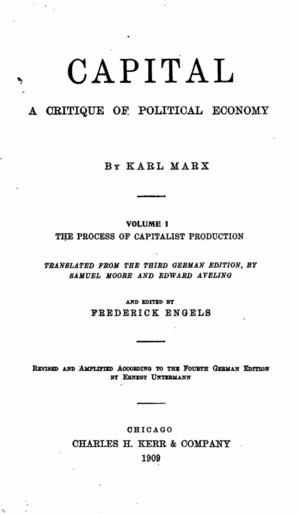
Capital: A Critique of Political Economy. Volume I: The Process of Capitalist Production, by Karl Marx. Trans. from the 3rd German edition, by Samuel Moore and Edward Aveling, ed. Federick Engels. Revised and amplified according to the 4th German ed. by Ernest Untermann (Chicago: Charles H. Kerr and Co., 1909).

About Liberty Fund:

Liberty Fund, Inc. is a private, educational foundation established to encourage the study of the ideal of a society of free and responsible individuals.


a. Hoarding.

The continual movement in circuits of the two antithetical metamorphoses of commodities, or the never ceasing alternation of sale and purchase, is reflected in the restless currency of money, or in the function that money performs of a perpetuum mobile of circulation. But so soon as the series of metamorphoses is interrupted, so soon as sales are not supplemented by subsequent purchases, money ceases to be mobilised; it is transformed, as Boisguillebert says, from "meuble" into "immeuble," from movable into immovable, from coin into money.

With the very earliest development of the circulation of commodities, there is also developed the necessity, and the passionate desire, to hold fast the product of the first metamorphosis. This product is the transformed shape of the commodity, or its gold-chrysalis.95 Commodities are thus sold not for the purpose of buying others, but in order to replace their commodity-form by their money-form. From being the mere means of effecting the circulation of commodities, this change of form becomes the end and aim. The changed form of the commodity is thus prevented from functioning as its unconditionally alienable form, or as its merely transient money-form. The money becomes petrified into a hoard, and the seller becomes a hoarder of money.

In the early stages of the circulation of commodities, it is the surplus use-values alone that are converted into money. Gold and silver thus become of themselves social expressions for superfluity or wealth. This naïve form of hoarding becomes perpetuated in those communities in which the traditional mode of production is carried on for the supply of a fixed and limited circle of home wants. It is thus with the people of Asia, and particularly of the East Indies. Vanderlint, who fancies that the prices of commodities in a country are determined by the quantity of gold and silver to be found in it, asks himself why Indian commodities are so cheap. Answer: Because the Hindoos bury their money. From 1602 to 1734, he remarks, they buried 150 millions of pounds sterling of silver, which originally came from America of Europe.96 In the 10 years from 1856 to 1866, England exported to India and China £120,000,000 in silver, which had been received in exchange for Australian gold. Most of the silver exported to China makes its way to India.

As the production of commodities further develops, every producer of commodities is compelled to make sure of the nexus rerum of the social pledge.97 His wants are constantly making themselves felt, and necessitate the continual purchase of other people's commodities, while the production and sale of his own goods require time, and depend upon circumstances. In order then to be able to buy without selling, he must have sold previously without buying. This operation, conducted on a general scale, appears to imply a contradiction. But the precious metals at the sources of their production are directly exchanged for other commodities. And here we have sales (by the owners of commodities) without purchases (by the owners of gold or silver.)98 And subsequent sales, by other producers, unfollowed by purchases, merely bring about the distribution of the newly produced precious metals among all the owners of commodities. In this way, all along the line of exchange, hoards of gold and silver of varied extent are accumulated. With the possibility of holding and storing up exchange value in the shape of a particular commodity, arises also the greed for gold. Along with the extension of circulation, increases the power of money, that absolutely social form of wealth ever ready for use. "Gold is a wonderful thing! Whoever possesses it is lord of all he wants. By means of gold one can even get souls into Paradise." (Columbus in his letter from Jamaica, 1503.) Since gold does not disclose what has been transformed into it, everything, commodity or not, is convertible into gold. Everything becomes saleable and buyable. The circulation becomes the great social retort into which everything is thrown, to come out again as a gold crystal. Not even are the bones of saints, and still less are more delicate res sacrosanctæ extra commercium hominum able to withstand this alchemy.99 Just as every qualitative difference between commodities is extinguished in money, so money, on its side, like the radical leveller that it is, does away with all distinctions.100 But money itself is a commodity, an external object, capable of becoming the private property of any individual. Thus social power becomes the private power of private persons. The ancients therefore denounced money as subversive of the economical and moral order of things.101 Modern society, which soon after its birth, pulled Plutus by the hair of his head from the bowels of the earth,102 greets gold as its Holy Grail, as the glittering incarnation of the very principle of its own life.

A commodity, in its capacity of a use-value, satisfies a particular want, and is a particular element of material wealth. But the value of a commodity measures the degree of its attraction for all other elements of material wealth, and therefore measures the social wealth of its owner. To a barbarian owner of commodities, and even to a West-European peasant, value is the same as value-form, and therefore, to him the increase in his hoard of gold and silver is an increase in value. It is true that the value of money varies, at one time in consequence of a variation in its own value, at another, in consequence of a change in the value of commodities. But this, on the one hand, does not prevent 200 ounces of gold from still containing more value than 100 ounces, nor, on the other hand, does it hinder the actual metallic form of this article from continuing to be the universal equivalent form of all other commodities, and the immediate social incarnation of all human labour. The desire after hoarding is in its very nature unsatiable. In its qualitative aspect, or formally considered, money has no bounds to its efficacy, i.e., it is the universal representative of material wealth, because it is directly convertible into any other commodity. But, at the same time, every actual sum of money is limited in amount, and therefore, as a means of purchasing, has only a limited efficacy. This antagonism between the quantitive limits of money and its qualitative boundlessness, continually acts as a spur to the hoarder in his Sisyphus-like labour of accumulating. It is with him as it is with a conqueror who sees in every new country annexed, only a new boundary.

In order that gold may be held as money, and made to form a hoard, it must be prevented from circulating, or from transforming itself into a means of enjoyment. The hoarder, therefore, makes a sacrifice of the lusts of the flesh to his gold fetish. He acts in earnest up to the Gospel of abstention. On the other hand, he can withdraw from circulation no more than what he has thrown into it in the shape of commodities. The more he produces, the more he is able to sell. Hard work, saving and avarice, are, therefore, his three cardinal virtues, and to sell much and buy little the sum of his political economy.103

By the side of the gross form of a hoard, we find also its æsthetic form in the possession of gold and silver articles. This grows with the wealth of civil society. "Soyons riches ou paraissons riches " (Diderot). In this way there is created, on the one hand, a constantly extending market for gold and silver, unconnected with their functions as money, and, on the other hand, a latent source of supply, to which recourse is had principally in times of crisis and social disturbance.

Hoarding serves various purposes in the economy of the metallic circulation. It first function arises out of the conditions to which the currency of gold and silver coins is subject. We have seen how, along with the continual fluctuations in the extent and rapidity of the circulation of commodities and in their prices, the quantity of money current unceasingly ebbs and flows. This mass must, therefore, be capable of expansion and contraction. At one time money must be attached in order to act as circulating coin, at another, circulating coin must be repelled in order to act again as more or less stagnant money, In order that the mass of money, actually current, may constantly saturate the absorbing power of the circulation, it is necessary that the quantity of gold and silver in a country be greater than the quantity required to function as coin. This condition is fulfilled by money taking the form of hoards. These reserves serve as conduits for the supply or withdrawal of money to or from the circulation, which in this way never overflows its banks.104

[95.][95] "Une richesse en argent n'est que...richesse en productions, converties en argent." (Mercier de la Riviére, 1. c.) "Une valeur en productions n'a fait que change de forme." (Id., p. 486.)

[96.][96] "'Tis by this practice they keep all their goods and manufactures at such low rates." (Vanderlint, 1. c., p. 96.)

[97.][97] Money...is a pledge." (John Bellers: "Essays about the Poor, Manufacturers, Trade, Plantations, and Immorality," Lond., 1699, p. 13.)

[98.][98] A purchase, in a "categorical" sense, implies that gold and silver are already the converted form of commodities, or the product of a sale.

[99.][99] Henry III., most Christian king of France, robbed cloisters of their relics, and turned them into money. It is well known what part the despoiling of the Delphic Temple, by the Phocians, played in the history of Greece. Temples with the ancients served as the dwellings of the gods of commodities. They were "sacred banks." With the Phœnicians, a trading people par excellence, money was the transmuted shape of everything. It was, therefore, quite in order that the virgins, who, at the feast of the Goddess of Love, gave themselves up to strangers, should offer to the goddess the piece of money they received.

[100.][100] "Gold, yellow, glittering, precious gold! Thus much of this, will make black white; foul, fair; Wrong right; base, noble; old, young; coward, valiant. ...What this, you gods? Why, this Will lug your priests and servants from your sides; Pluck stout men's pillows from below their heads; This yellow slave Will knit and break religions; bless the accura'd; Make the hoar leprosy ador'd; place thieves, And give them title, knee and approbation, With senators on the bench; this is it, That makes the wappen'd widow wed again: ...Come damned earth, Thou common whore of mankind." (Shakespeare: Timon of Athens.)

[101.][101]

(Sophocles, Antigone.)

[102.][102]

(Athen.Delpnos.)

[103.][103] "Accrescere quanto più si può il numero de' venditori d'ogni merce, diminuere quanto più il numero dei compratori, questi sono i cardini sui quali si raggirano tutto be operazioni di economia politica." (Verri, 1. c. p. 52.)

[104.][104] "There is required for carrying on the trade of the nation a determinate sum of specifick money, which varies, and is sometimes more, sometimes less, as the circumstances we are in require....This ebbing and flowing of money supplies and accommodates itself, without any aid of Politicians....The buckets work alternately; when money is scarce, bullion is coined; when bullion is scarce, money is melted." (Sir D. North, 1. c., Postscript, p. 3.) John Stuart Mill, who for a long time was an official of the East India Company, confirms the fact that in India silver ornaments still continue to perform directly the functions of a hoard. The silver ornaments are brought out and coined when there is a high rate of interest, and go back again when the rate of interest falls. (J. S. Mill's Evidence. "Reports on Bank Acts," 1857, 2084.) According to a Parliamentary document of 1864, on the gold and silver import and export of India, the import of gold and silver in 1863 exceeded the export by £19,367,764. During the 8 years immediately preceding 1864, the excess of imports over exports of the precious metals amounted to £109,652,917. During this century far more than £200,000,000 has been coined in India.