Econlib

The Library

Other Sites

Front Page arrow Titles (by Subject) arrow SECTION 3.—MONEY. - Capital: A Critique of Political Economy. Volume I: The Process of Capitalist Production

Return to Title Page for Capital: A Critique of Political Economy. Volume I: The Process of Capitalist Production

Search this Title:

SECTION 3.—MONEY. - Karl Marx, Capital: A Critique of Political Economy. Volume I: The Process of Capitalist Production [1867]

Edition used:

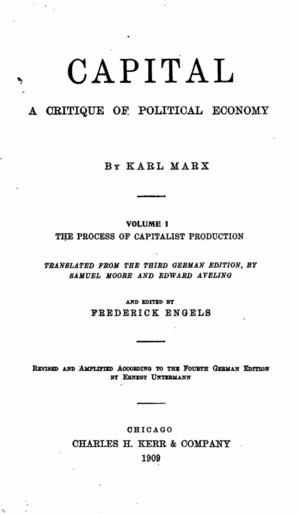
Capital: A Critique of Political Economy. Volume I: The Process of Capitalist Production, by Karl Marx. Trans. from the 3rd German edition, by Samuel Moore and Edward Aveling, ed. Federick Engels. Revised and amplified according to the 4th German ed. by Ernest Untermann (Chicago: Charles H. Kerr and Co., 1909).

About Liberty Fund:

Liberty Fund, Inc. is a private, educational foundation established to encourage the study of the ideal of a society of free and responsible individuals.


SECTION 3.—MONEY.

The commodity that functions as a measure of value, and, either in its own person or by a representative, as the medium of circulation, is money. Gold (or silver) is therefore money. It functions as money, on the one hand, when it has to be present in its own golden person. It is then the money-commodity, neither merely ideal, as in its function of a measure of value, nor capable of being represented, as in its function of circulating medium. On the other hand, it also functions as money, when by virtue of its function, whether that function be performed in person or by representative, it congeals into the sole form of value, the only adequate form of existence of exchange-value, in opposition to use-value, represented by all other commodities.

a. Hoarding.

The continual movement in circuits of the two antithetical metamorphoses of commodities, or the never ceasing alternation of sale and purchase, is reflected in the restless currency of money, or in the function that money performs of a perpetuum mobile of circulation. But so soon as the series of metamorphoses is interrupted, so soon as sales are not supplemented by subsequent purchases, money ceases to be mobilised; it is transformed, as Boisguillebert says, from "meuble" into "immeuble," from movable into immovable, from coin into money.

With the very earliest development of the circulation of commodities, there is also developed the necessity, and the passionate desire, to hold fast the product of the first metamorphosis. This product is the transformed shape of the commodity, or its gold-chrysalis.95 Commodities are thus sold not for the purpose of buying others, but in order to replace their commodity-form by their money-form. From being the mere means of effecting the circulation of commodities, this change of form becomes the end and aim. The changed form of the commodity is thus prevented from functioning as its unconditionally alienable form, or as its merely transient money-form. The money becomes petrified into a hoard, and the seller becomes a hoarder of money.

In the early stages of the circulation of commodities, it is the surplus use-values alone that are converted into money. Gold and silver thus become of themselves social expressions for superfluity or wealth. This naïve form of hoarding becomes perpetuated in those communities in which the traditional mode of production is carried on for the supply of a fixed and limited circle of home wants. It is thus with the people of Asia, and particularly of the East Indies. Vanderlint, who fancies that the prices of commodities in a country are determined by the quantity of gold and silver to be found in it, asks himself why Indian commodities are so cheap. Answer: Because the Hindoos bury their money. From 1602 to 1734, he remarks, they buried 150 millions of pounds sterling of silver, which originally came from America of Europe.96 In the 10 years from 1856 to 1866, England exported to India and China £120,000,000 in silver, which had been received in exchange for Australian gold. Most of the silver exported to China makes its way to India.

As the production of commodities further develops, every producer of commodities is compelled to make sure of the nexus rerum of the social pledge.97 His wants are constantly making themselves felt, and necessitate the continual purchase of other people's commodities, while the production and sale of his own goods require time, and depend upon circumstances. In order then to be able to buy without selling, he must have sold previously without buying. This operation, conducted on a general scale, appears to imply a contradiction. But the precious metals at the sources of their production are directly exchanged for other commodities. And here we have sales (by the owners of commodities) without purchases (by the owners of gold or silver.)98 And subsequent sales, by other producers, unfollowed by purchases, merely bring about the distribution of the newly produced precious metals among all the owners of commodities. In this way, all along the line of exchange, hoards of gold and silver of varied extent are accumulated. With the possibility of holding and storing up exchange value in the shape of a particular commodity, arises also the greed for gold. Along with the extension of circulation, increases the power of money, that absolutely social form of wealth ever ready for use. "Gold is a wonderful thing! Whoever possesses it is lord of all he wants. By means of gold one can even get souls into Paradise." (Columbus in his letter from Jamaica, 1503.) Since gold does not disclose what has been transformed into it, everything, commodity or not, is convertible into gold. Everything becomes saleable and buyable. The circulation becomes the great social retort into which everything is thrown, to come out again as a gold crystal. Not even are the bones of saints, and still less are more delicate res sacrosanctæ extra commercium hominum able to withstand this alchemy.99 Just as every qualitative difference between commodities is extinguished in money, so money, on its side, like the radical leveller that it is, does away with all distinctions.100 But money itself is a commodity, an external object, capable of becoming the private property of any individual. Thus social power becomes the private power of private persons. The ancients therefore denounced money as subversive of the economical and moral order of things.101 Modern society, which soon after its birth, pulled Plutus by the hair of his head from the bowels of the earth,102 greets gold as its Holy Grail, as the glittering incarnation of the very principle of its own life.

A commodity, in its capacity of a use-value, satisfies a particular want, and is a particular element of material wealth. But the value of a commodity measures the degree of its attraction for all other elements of material wealth, and therefore measures the social wealth of its owner. To a barbarian owner of commodities, and even to a West-European peasant, value is the same as value-form, and therefore, to him the increase in his hoard of gold and silver is an increase in value. It is true that the value of money varies, at one time in consequence of a variation in its own value, at another, in consequence of a change in the value of commodities. But this, on the one hand, does not prevent 200 ounces of gold from still containing more value than 100 ounces, nor, on the other hand, does it hinder the actual metallic form of this article from continuing to be the universal equivalent form of all other commodities, and the immediate social incarnation of all human labour. The desire after hoarding is in its very nature unsatiable. In its qualitative aspect, or formally considered, money has no bounds to its efficacy, i.e., it is the universal representative of material wealth, because it is directly convertible into any other commodity. But, at the same time, every actual sum of money is limited in amount, and therefore, as a means of purchasing, has only a limited efficacy. This antagonism between the quantitive limits of money and its qualitative boundlessness, continually acts as a spur to the hoarder in his Sisyphus-like labour of accumulating. It is with him as it is with a conqueror who sees in every new country annexed, only a new boundary.

In order that gold may be held as money, and made to form a hoard, it must be prevented from circulating, or from transforming itself into a means of enjoyment. The hoarder, therefore, makes a sacrifice of the lusts of the flesh to his gold fetish. He acts in earnest up to the Gospel of abstention. On the other hand, he can withdraw from circulation no more than what he has thrown into it in the shape of commodities. The more he produces, the more he is able to sell. Hard work, saving and avarice, are, therefore, his three cardinal virtues, and to sell much and buy little the sum of his political economy.103

By the side of the gross form of a hoard, we find also its æsthetic form in the possession of gold and silver articles. This grows with the wealth of civil society. "Soyons riches ou paraissons riches " (Diderot). In this way there is created, on the one hand, a constantly extending market for gold and silver, unconnected with their functions as money, and, on the other hand, a latent source of supply, to which recourse is had principally in times of crisis and social disturbance.

Hoarding serves various purposes in the economy of the metallic circulation. It first function arises out of the conditions to which the currency of gold and silver coins is subject. We have seen how, along with the continual fluctuations in the extent and rapidity of the circulation of commodities and in their prices, the quantity of money current unceasingly ebbs and flows. This mass must, therefore, be capable of expansion and contraction. At one time money must be attached in order to act as circulating coin, at another, circulating coin must be repelled in order to act again as more or less stagnant money, In order that the mass of money, actually current, may constantly saturate the absorbing power of the circulation, it is necessary that the quantity of gold and silver in a country be greater than the quantity required to function as coin. This condition is fulfilled by money taking the form of hoards. These reserves serve as conduits for the supply or withdrawal of money to or from the circulation, which in this way never overflows its banks.104

b. Means of Payment.

In the simple form of the circulation of commodities hitherto considered, we found a given value always presented to us in a double shape, as a commodity at one pole, as money at the opposite pole. The owners of commodities came therefore into contact as the respective representatives of what were already equivalents. But with the development of circulation, conditions arise under which the alienation of commodities becomes separated, by an interval of time, from the realisation of their prices. It will be sufficient to indicate the most simple of these conditions. One sort of article requires a longer, another a shorter time for its production. Again, the production of different commodities depends on different seasons of the year. One sort of commodity may be born on its own market place, another has to make a long journey to market. Commodity-owner No. 1, may therefore be ready to sell, before No. 2 is ready to buy. When the same transactions are continually repeated between the same persons, the conditions of sale are regulated in accordance with the conditions of production. On the other hand, the use of a given commodity, of a house, for instance, is sold (in common parlance; let) for a definite period. Hence, it is only at the end of the term that the buyer has actually received the use-value of the commodity. He therefore buys it before he pays for it. The vendor sells an existing commodity, the purchaser buys as the mere representative of money, or rather of future money. The vendor becomes a creditor, the purchaser becomes a debtor. Since the metamorphosis of commodities, or the development of their value-form, appears here under a new aspect, money also acquires a fresh function; it becomes the means of payment.

The character of creditor, or of debtor, results here from the simple circulation. The change in the form of that circulation stamps buyer and seller with this new die. At first, therefore, these new parts are just as transient and alternating as those of seller and buyer, and are in turns played by the same actors. But the opposition is not nearly so pleasant, and is far more capable of crystallization.105 The same characters can, however, be assumed independently of the circulation of commodities. The class-struggles of the ancient world took the form chiefly of a contest between debtors and creditors, which in Rome ended in the ruin of the plebeian debtors. They were displaced by slaves. In the middle-ages the contest ended with the ruin of the feudal debtors, who lost their political power together with the economical basis on which it was established. Nevertheless, the money relation of debtor and creditor that existed at these two periods reflected only the deeper-lying antagonism between the general economical conditions of existence of the classes in question.

Let us return to the circulation of commodities. The appearance of the two equivalents, commodities and money, at the two poles of the process of sale, has ceased to be simultaneous. The money functions now, first as a measure of value in the determination of the price of the commodity sold; the price fixed by the contract measures the obligation of the debtor, or the sum of money that he has to pay at a fixed date. Secondly, it serves as an ideal means of purchase. Although existing only in the promise of the buyer to pay, it causes the commodity to change hands. It is not before the day fixed for payment that the means of payment actually steps into circulation, leaves the hand of the buyer for that of the seller. The circulating medium was transformed into a hoard, because the process stopped short after the first phase, because the converted shape of the commodity, viz., the money, was withdrawn from circulation. The means of payment enters the circulation, but only after the commodity has left it. The money is no longer the means that brings about the process. It only brings it to a close, by stepping in as the absolute form of existence of exchange value, or as the universal commodity. The seller turned his commodity into money, in order thereby to satisfy some want; the hoarder did the same in order to keep his commodity in its money-shape, and the debtor in order to be able to pay; if he do not pay, his goods will be sold by the sheriff. The value-form of commodities, money, is therefore now the end and aim of a sale, and that owing to a social necessity springing out of the process of circulation itself.

The buyer converts money back into commodities before he has turned commodities into money: in other words, he achieves the second metamorphosis of commodities before the first. The seller's commodity circulates, and realises its price, but only in the shape of a legal claim upon money. It is converted into a use-value before it has been converted into money. The completion of its first metamorphosis follows only at a later period.106

The obligations falling due within a given period, represent the sum of the prices of the commodities, the sale of which gave rise to those obligations. The quantity of gold necessary to realise this sum, depends, in the first instance, on the rapidity of currency of the means of payment. That quantity is conditioned by two circumstances: first the relations between debtors and creditors form a sort of chain, in such a way that A, when he receives money from his debtor B, straightway hands it over to C his creditor, and so on; the second circumstance is the length of the intervals between the different due-days of the obligations. The continuous chain of payments, or retarded first metamorphoses, is essentially different from that interlacing of the series of metamorphoses which we considered on a former page. By the currency of the circulating medium, the connexion between buyers and sellers, is not merely expressed. This connexion is originated by, and exists in, the circulation alone. Contrariwise, the movement of the means of payment expresses a social relation that was in existence long before.

The fact that a number of sales take place simultaneously, and side be side, limits the extent to which coin can be replaced by the rapidity of currency. On the other hand, this fact is a new lever in economising the means of payment. In proportion as payments are concentrated at one spot, special institutions and methods are developed for their liquidation. Such in the middle ages were the virements at Lyons. The debts due to A from B, to B from C, to C from A, and so on, have only to be confronted with each other, in order to annul each other to a certain extent like positive and negative quantities. There thus remains only a single balance to pay. The greater the amount of the payments concentrated, the less is this balance relatively to that amount, and the less is the mass of the means of payment in circulation.

The function of money as the means of payment implies a contradiction without a terminus medius. In so far as the payments balance one another, money functions only ideally as money of account, as a measure of value. In so far as actual payments have to be made, money does not serve as a circulating medium, as a mere transient agent in the interchange of products, but as the individual incarnation of social labour, as the independent form of existence of exchange value, as the universal commodity. This contradiction comes to a head in those phases of industrial and commercial crises which are known as monetary crises.107 Such a crisis occurs only where the ever-lengthening chain of payments, and an artificial system of settling them, has been fully developed. Whenever there is a general and extensive disturbance of this mechanism, no matter what its cause, money becomes suddenly and immediately transformed, from its merely ideal shape of money of account, into hard cash. Profane commodities can no longer replace it. The use-value of commodities becomes value-less, and their value vanishes in the presence of its own independent form. On the eve of crisis, the bourgeois, with the self-sufficiency that springs from intoxicating prosperity, declares money to be a vain imagination. Commodities alone are money. But now the cry is everywhere: money alone is a commodity! As the hart pants after fresh water, so pants his soul after money, the only wealth.108 In a crisis, the antithesis between commodities and their value-form, money, becomes heightened into an absolute contradiction. Hence, in such events, the form under which money appears is of no importance. The money famine continues, whether payments have to be made in gold or in credit money such as bank notes.109

If we now consider the sum total of the money current during a given period, we shall find that, given the rapidity of currency of the circulating medium and of the means of payment, it is equal to the sum of the prices to be realised, plus the sum of the payments falling due, minus the payments that balance each other, minus finally the number of circuits in which the same piece of coin serves in turn as means of circulation and of payment. Hence, even when prices, rapidity of currency, and the extent of the economy in payments, are given, the quantity of money current and the mass of commodities circulating during a given period, such as a day, no longer correspond. Money that represents commodities long withdrawn from circulation, continues to be current. Commodities circulate, whose equivalent in money will not appear on the scene till some future day. Moreover, the debts contracted each day, and the payments falling due on the same day, are quite incommensurable quantities.110

Credit-money springs directly out of the function of money as a means of payment. Certificates of the debts owing for the purchased commodities circulate for the purpose of transferring those debts to others. On the other hand, to the same extent as the system of credit is extended, so is the function of money as a means of payment. In that character it takes various forms peculiar to itself under which it makes itself at home in the sphere of great commercial transactions. Gold and silver coin, on the other hand, are mostly relegated to the sphere of retail trade.111

When the production of commodities has sufficiently extended itself, money begins to serve as the means of payment beyond the sphere of the circulation of commodities. It becomes the commodity that is the universal subject-matter of all contracts.112 Rents, taxes, and such like payments are transformed from payments in kind into money payments. To what extent this transformation depends upon the general conditions of production, is shown, to take one example, by the fact that the Roman Empire twice failed in its attempt to levy all contributions in money. The unspeakable misery of the French agricultural population under Louis XIV., a misery so eloquently denounced by Biosguillebert, Marshal, Vauban, and others, was due not only to the weight of the taxes, but also to the conversion of taxes in kind into money taxes.113 In Asia, on the other hand, the fact that state taxes are chiefly composed of rents payable in kind, depends on conditions of production that are reproduced with the regularity of natural phenomena. And this mode of payment tends in its turn to maintain the ancient form of production. It is one of the secrets of the conservation of the Ottoman Empire. If the foreign trade, forced upon Japan by Europeans, should lead to the substitution of money rents for rents in kind, it will be all up with the exemplary agriculture of that country. The narrow economical conditions under which that agriculture is carried on, will be swept away.

In every country, certain days of the year become by habit recognised settling days for various large and recurrent payments. These dates depend, apart from other revolutions in the wheel of reproduction, on conditions closely connected with the seasons. They also regulate the dates for payments that have no direct connexion with the circulation of commodities such as taxes, rents, and so on. The quantity of money requisite to make the payments, falling due on those dates all over the country, causes periodical, though merely superficial, perturbations in the economy of the medium of payment.114

From the law of the rapidity of currency of the means of payment, it follows that the quantity of the means of payment required for all periodical payments, whatever their source, is in inverse proportion to the length of their periods.115

The development of money into a medium of payment makes it necessary to accumulate money against the dates fixed for the payment of the sums owing. While hoarding, as a distinct mode of acquiring riches, vanishes with the progress of civil society, the formation of reserves of the means of payment grows with that progress.

c. Universal Money.

When money leaves the home sphere of circulation, it strips off the local garbs which it there assumes, of a standard of prices, of coin, of tokens, and of a symbol of value, and returns to its original form of bullion. In the trade between the markets of the world, the value of commodities is expressed so as to be universally recognised. Hence their independent value-form also, in these cases, confronts them under the shape of universal money. It is only in the markets of the world that money acquires to the full extent the character of the commodity whose bodily form is also the immediate social incarnation of human labour in the abstract. Its real mode of existence in this sphere adequately corresponds to its ideal concept.

Within the sphere of home circulation, there can be but one commodity which, by serving as a measure of value, becomes money. In the markets of the world a double measure of value holds sway, gold and silver.116

Money of the world serves as the universal medium of payment, as the universal means of purchasing, and as the universally recognised embodiment of all wealth. Its function as a means of payment in the settling of international balances is its chief one. Hence the watchword of the mercantilists, balance of trade.117 Gold and silver serve as international means of purchasing chiefly and necessarily in those periods when the customary equilibrium in the interchange of products between different nations is suddenly disturbed. And lastly, it serves as the universally recognised embodiment of social wealth, whenever the question is not of buying or paying, but of transferring wealth from one country to another, and whenever this transference in the form of commodities is rendered impossible, either by special conjunctures in the markets, or by the purpose itself that is intended.118

Just as every country needs a reserve of money for its home circulation, so, too, it requires one for external circulation in the markets of the world. The functions of hoards, therefore, arise in part out of the function of money, as the medium of the home circulation and home payments, and in part out of its function of money of the world.119 For this latter function, the genuine money-commodity, actual gold and silver, is necessary. On that account, Sir James Steuart, in order to distinguish them from their purely local substitutes, calls gold and silver "money of the world."

The current of the stream of gold and silver is a double one. On the one hand, it spreads itself from its sources over all the markets of the world, in order to become absorbed, to various extents, into the different national spheres of circulation, to fill the conduits of currency, to replace abraded gold and silver coins, to supply the material of articles of luxury, and to petrify into hoards.120 This first current is started by the countries that exchange their labour, realise in commodities, for the labour embodied in the precious metals by gold and silver-producing countries. On the other hand, there is a continual flowing backwards and forwards of gold and silver between the different national spheres of circulation, a current whose motion depends on the ceaseless fluctuations in the course of exchange.121

Countries in which the bourgeois form of production is developed to a certain extent, limit the hoards concentrated in the strong rooms of the banks to the minimum required for the proper performance of their peculiar functions.122 Whenever these hoards are strikingly above their average level, it is, with some exceptions, an indication of stagnation in the circulation of commodities, of an interruption in the even flow of their metamorphoses.123

PART II.
THE TRANSFORMATION OF MONEY INTO CAPITAL.

Part II, Chapter IV
THE GENERAL FORMULA FOR CAPITAL.

THE circulation of commodities is the starting point of capital. The production of commodities, their circulation, and that more developed form of their circulation called commerce, these form the historical groundwork from which it rises. The modern history of capital dates from the creation in the 16th century of a world-embracing commerce and a world-embracing market.

If we abstract from the material substance of the circulation of commodities, that is, from the exchange of the various use-values, and consider only the economic forms produced by this process of circulation, we find its final result to be money: this final product of the circulation of commodities is the first form in which capital appears.

As a matter of history, capital, as opposed to landed property, invariably takes the form at first of money; it appears as moneyed wealth, as the capital of the merchant and of the usurer.1 But we have no need to refer to the origin of capital in order to discover that the first form of appearance of capital is money. We can see it daily under out very eyes. All new capital, to commence with, comes on the stage, that is, on the market, whether of commodities, labour, or money, even in our days, in the shape of money that by a definite process has to be transformed into capital.

The first distinction we notice between money that is money only, and money that is capital, is nothing more than a difference in their form of circulation.

The simplest form of the circulation of commodities is C—M—C, the transformation of commodities into money, and the changé of the money back again into commodities; or selling in order to buy. But alongside of this form we find another specifically different form: M—C—M, the transformation of money into commodities, and the change of commodities back again into money; or buying in order to sell. Money that circulates in the latter manner is thereby transformed into, becomes capital, and is already potentially capital.

Now let us examine the circuit M—C—M a little closer. It consists, like the other, of two antithetical phases. In the first phase, M—C, or the purchase, the money is changed into a commodity. In the second phase, C—M, or the sale, the commodity is changed back into money. The combination of these two phases constitutes the single movement whereby money is exchanged for a commodity and the same commodity is again exchanged for money; whereby a commodity is bought in order to be sold, or, neglecting the distinction in form between buying and selling, whereby a commodity is bought with money, and then money is bought with a commodity.2 The result, in which the phases of the process vanish, is the exchange of money for money, M—M. If I purchase 2000 lbs. of cotton for £100, and resell the 2000 lbs. of cotton for £110, I have, in fact, exchanged £100 for £110, money for money.

Now it is evident that the circuit M—C—M would be absurd and without meaning if the intention were to exchange by this means two equal sums of money, £100 for £100. The miser's plan would be far simpler and surer; he sticks to his £100 instead of exposing it to the dangers of circulation. And yet, whether the merchant who has paid £100 for his cotton sells it for £110, or lets it go for £100, or even £50, his money has, at all events, gone through a characteristic and original movement, quite different in kind from that which it goes through in the hands of the peasant who sells corn, and with the money thus set free buys clothes. We have therefore to examine first the distinguishing characteristics of the forms of the circuits M—C—M and C—M—C, and in doing this the real difference that underlies the mere difference of form will reveal itself.

Let us see, in the first place, what the two forms have in common.

Both circuits are resolvable into the same two antithetical phases, C—M, a sale, and M—C, a purchase. In each of these phases the same material elements—a commodity, and money, and the same economical dramatis personæ, a buyer and a seller—confront one another. Each circuit is the unity of the same two antithetical phases, and in each case this unity is brought about by the intervention of three contracting parties, of whom one only sells, another only buys, while the third both buys and sells.

What, however, first and foremost distinguishes the circuit C—M—C from the circuit M—C—M, is the inverted order of succession of the two phases. The simple circulation of commodities begins with a sale and ends with a purchase, while the circulation of money as capital begins with a purchase and ends with a sale. In the one case both the starting point and the goal are commodities, in the other they are money. In the first form the movement is brought about by the intervention of money, in the second by that of a commodity.

In the circulation C—M—C, the money is in the end converted into a commodity, that serves as a use-value; it is spent once for all. In the inverted form, M—C—M, on the contrary, the buyer lays out money in order that, as a seller, he may recover money. By the purchase of his commodity he throws money into circulation, in order to withdraw it again by the sale of the same commodity. He lets the money go, but only with the sly intention of getting it back again. The money, therefore, is not spent, it is merely advanced.3

In the circuit C—M—C, the same piece of money changes its place twice. The seller gets it from the buyer and pays it away to another seller. The complete circulation, which begins with the receipt, concludes with the payment, of money for commodities. It is the very contrary in the circuit M—C—M. Here it is not the piece of money that changes its place twice, but the commodity. The buyer takes it from the hands of the seller and passes it into the hands of another buyer. Just as in the simple circulation of commodities the double change of place of the same piece of money effects its passage from one hand into another, so here the double change of place of the same commodity brings about the reflux of the money to its point of departure.

Such reflux is not dependent on the commodity being sold for more than was paid for it. This circumstance influences only the amount of the money that comes back. The reflux itself takes place, so soon as the purchased commodity is resold, in other words, so soon as the circuit M—C—M is completed. We have here, therefore, a palpable difference between the circulation of money as capital, and its circulation as mere money.

The circuit C—M—C comes completely to an end, so soon as the money brought in by the sale of one commodity is abstracted again by the purchase of another.

If, nevertheless, there follows a reflux of money to its starting point, this can only happen through a renewal or repetition of the operation. If I sell a quarter of corn for £3, and with this £3 buy clothes, the money, so far as I am concerned, is spent and done with. It belongs to the clothes merchant. If I now sell a second quarter of corn, money indeed flows back to me, not however as a sequel to the first transaction, but in consequence of its repetition. The money again leaves me, so soon as I complete this second transaction by a fresh purchase. Therefore, in the circuit C—M—C, the expenditure of money has nothing to do with its reflux. On the other hand, in M—C—M, the reflux of the money is conditioned by the very mode of its expenditure. Without this reflux, the operation fails, or the process is interrupted and incomplete, owing to the absence of its complementary and final phase, the sale.

The circuit C—M—C starts with one commodity, and finishes with another, which falls out of circulation and into consumption. Consumption, the satisfaction of wants, in one word, use-value, is its end and aim. The circuit M—C—M, on the contrary, commences with money and ends with money. Its leading motive, and the goal that attracts it, is therefore mere exchange value.

In the simple circulation of commodities, the two extremes of the circuit have the same economic form. They are both commodities, and commodities of equal value. But they are also use-values differing in their qualities, as, for example, corn and clothes. The exchange of products, of the different materials in which the labour of society is embodied, forms here the basis of the movement. It is otherwise in the circulation M—C—M, which at first sight appears purposeless, because tautological. Both extremes have the same economic form. They are both money, and therefore are not qualitatively different use-values; for money is but the converted form of commodities, in which their particular use-values vanish. To exchange £100 for cotton, and then this same cotton again for £100, is merely a roundabout way of exchanging money for money, the same for the same, and appears to be an operation just as purposeless as it is absurd.4 One sum of money is distinguishable from another only by its amount. The character and tendency of the process M—C—M, is therefore not due to any qualitative difference between its extremes, both being money, but solely to their quantitative difference. More money is withdrawn from circulation at the finish than was thrown into it at the start. The cotton that was bought for £100 is perhaps resold for £100+£10 or £110. The exact form of this process is therefore M—C—M', where M'=M+8Delta;M=the original sum advanced, plus an increment. This increment or excess over the original value I call "surplus-value." The value originally advanced, therefore, not only remains intact while in circulation, but adds to itself a surplus-value or expands itself. It is this movement that converts it into capital.

Of course it is also possible, that in C—M—C, the two extremes C—C, say corn and clothes, may represent different quantities of value. The farmer may sell his corn above its value, or may buy the clothes at less than their value. He may, on the other hand, "be done" by the clothes merchant. Yet, in the form of circulation now under consideration, such differences in value are purely accidental. The fact that the corn and the clothes are equivalents, does not deprive the process of all meanings, as it does in M—C—M. The equivalence of their values is rather a necessary condition to its normal course.

The repetition or renewal of the act of selling in order to buy, is kept within bounds by the very object it aims at, namely, consumption or the satisfaction of definite wants, an aim that lies altogether outside the sphere of circulation. But when we buy in order to sell, we, on the contrary, begin and end with the same thing, money, exchange-value; and thereby the movement becomes interminable. No doubt, M becomes M+8Delta;M, £100 become £110. But when viewed in their qualitative aspect alone, £110 are the same as £100, namely money; and considered quantitatively, £110 is, like £100, a sum of definite and limited value. If now, the £110 be spent as money, they cease to play their part. They are no longer capital. Withdrawn from circulation, they become petrified into a hoard, and though they remained in that state till doomsday, not a single farthing would accrue to them. If, then, the expansion of value is once aimed at, there is just the same inducement to augment the value of the £110 as that of the £100; for both are but limited expressions for exchange-value, and therefore both have the same vocation to approach, by quantitative increase, as near as possible to absolute wealth. Momentarily, indeed, the value originally advanced, the £100 is distinguishable from the surplus value of £10 that is annexed to it during circulation; but the distinction vanishes immediately. At the end of the process we do not receive with one hand the original £100, and with the other, the surplus-value of £10. We simply get a value of £110, which is in exactly the same condition and fitness for commencing the expanding process, as the original £100 was. Money ends the movement only to begin it again.5 Therefore, the final result of every separate circuit, in which a purchase and consequent sale are completed, forms of itself the starting point of a new circuit. The simple circulation of commodities—selling in order to buy—is a means for carrying out a purpose unconnected with circulation, namely, the appropriation of use-values, the satisfaction of wants. The circulation of money as capital is, on the contrary, an end in itself, for the expansion of value takes place only within this constantly renewed movement. The circulation of capital has therefore no limits.6 Thus the conscious representative of this movement, the possessor of money becomes a capitalist. His person, or rather his pocket, is the point from which the money starts and to which it returns. The expansion of value, which is the objective basis or main-spring of the circulation M—C—M, becomes his subjective aim, and it is only in so far as the appropriation of ever more and more wealth is the abstract becomes the sole motive of his operations, that he functions as a capitalist, that is, as capital personified and endowed with consciousness and a will. Use-values must therefore never be looked upon as the real aim of the capitalist;7 neither must the profit on any single transaction. The restless never-ending process of profit-making alone is what he aims at.8 This boundless greed after riches, this passionate chase after exchange-value,9 is common to the capitalist and the miser; but while the miser is merely a capitalist gone mad, the capitalist is a rational miser. The never-ending augmentation of exchange-value, which the miser strives after, by seeking to save10 his money from circulation, is attained by the more acute capitalist, by constantly throwing it afresh into circulation.11

The independent form, i.e., the money-form, which the value of commodities assumes in the case of simple circulation, serves only one purpose, namely, their exchange, and vanishes in the final result of the movement. On the other hand, in the circulation M—C—M, both the money and the commodity represent only different modes of existence of value itself, the money its general mode, and the commodity its particular, or, so to say, disguised mode.12 It is constantly changing from one form to the other without thereby becoming lost, and thus assumes an automatically active character. If now we take in turn each of the two different forms which self-expanding value successively assumes in the course of its life, we then arrive at these two propositions: Capital is money: Capital is commodities.13 In truth, however, value is here the active factor in a process, in which, while, constantly assuming the form in turn of money and commodities, it at the same time changes in magnitude, differentiates itself by throwing off surplus-value from itself; the original value, in other words, expands spontaneously. For the movement, in the course of which it adds surplus value, is its own movement, its expansion, therefore, is automatic expansion. Because it is value, it has acquired the occult quality of being able to add value to itself. It brings forth living offspring, or, at the least, lays golden eggs.

Value, therefore, being the active factor in such a process, and assuming at one time the form of money, at another that of commodities, but through all these changes preserving itself and expanding, it requires some independent form, by means of which its identity may at any time be established. And this form it possesses only in the shape of money. It is under the form of money that value begins and ends, and begins again, every act of its own spontaneous generation. It began by being £100, it is now £110, and so on. But the money itself is only one of the two forms of value. Unless it takes the form of some commodity, it does not become capital. There is here no antagonism, as in the case of hoardings, between the money and commodities. The capitalist knows that all commodities, however scurvy they may look, or however badly they may smell, are in faith and in truth money, inwardly circumcised Jews, and what is more, a wonderful means whereby out of money to make more money.

In simple circulation, C—M—C, the value of commodities attained at the most a form independent of their use-values, i.e., the form of money; but that same value now in the circulation M—C—M, or the circulation of capital, suddenly presents itself as an independent substance, endowed with a motion of its own, passing through a life-process of its own, in which money and commodities are mere forms which it assumes and casts off in turn. Nay, more: instead of simply representing the relations of commodities, it enters now, so to say, into private relations with itself. It differentiates itself as original value from itself as surplus-value; as the father differentiates himself from himself quâ the son, yet both are one and of one age: for only by the surplus value of £10 does the £100 originally advanced become capital, and so soon as this takes place, so soon as the son, and by the son, the father, is begotten, so soon does their difference vanish, and they again become one, £110.

Value therefore now becomes value in process, money in process, and, as such, capital. It comes out of circulation, enters into it again, preserves and multiplies itself within its circuit, comes back out of it with expanded bulk, and begins the same round ever afresh.14 M—M', money which begets money, such is the description of Capital from the mouths of its first interpreters, the Mercantilists.

Buying in order to sell, or, more accurately, buying in order to sell dearer, M—C—M', appears certainly to be a form peculiar to one kind of capital alone, namely, merchants' capital. But industrial capital too is money, that is changed into commodities, and by the sale of these commodities, is reconverted into more money. The events that take place outside the sphere of circulation, in the interval between the buying and selling, do not affect the form of this movement. Lastly, in the case of interest-bearing capital, the circulation M—C—M' appears abridged. We have its result without the intermediate stage, in the form M—M', "en style lapidaire" so to say, money that is worth more money, value that is greater than itself.

M—C—M' is therefore in reality the general formula of capital as it appears prima facie within the sphere of circulation.

Part II, Chapter V
CONTRADICTIONS IN THE GENERAL FORMULA OF CAPITAL.

THE form which circulation taken when money becomes capital, is opposed to all the laws we have hitherto investigated bearing on the nature of commodities, value and money, and even of circulation itself. What distinguishes this form from that of the simple circulation of commodities, is the inverted order of succession of the two antithetical processes, sale and purchase. How can this purely formal distinction between these processes change their character as it were by magic?

But that is not all. This inversion has no existence for two out of the three persons who transact business together. As capitalist, I buy commodities from A and sell them again to B, but as a simple owner of commodities, I sell them to B and then purchase fresh ones from A. A and B see no difference between the two sets of transactions. They are merely buyers or sellers. And I on each occasion meet them as a mere owner of either money or commodities, as a buyer or a seller, and, what is more, in both sets of transactions, I am opposed to A only as a buyer and to B only as a seller, to the one only as money, to the other only as commodities, and to either of them as capital or a capitalist, or as representative of anything that is more than money or commodities, or that can produce any effect beyond what money and commodities can. For me the purchase from A and the sale to B are part of a series. But the connexion between the two acts exists for me alone. A does not trouble himself about my transaction with B, nor does B about my business with A. And if I offered to explain to them the meritorious nature of my action in inverting the order of succession, they would probably point out to me that I was mistaken as to that order of succession, and that the whole transaction, instead of beginning with a purchase and ending with a sale, began, on the contrary, with a sale and was concluded with a purchase. In truth, my first act, the purchase, was from the standpoint of A, a sale, and my second act, the sale, was from the standpoint of B, a purchase. Not content with that, A and B would declare that the whole series was superfluous and nothing but Hokus Pokus; that for the future A would buy direct from B, and B sell direct to A. Thus the whole transaction would be reduced to a single act forming an isolated, non-complemented phase in the ordinary circulation of commodities, a mere sale from A's point of view, and from B's, a mere purchase. The inversion, therefore, of the order of succession, does not take us outside the sphere of the simple circulation of commodities, and we must rather look, whether there is in this simple circulation anything permitting an expansion of the value that enters into circulation, and, consequently, a creation of surplus-value.

Let us take the process of circulation in a form under which it presents itself as a simple and direct exchange of commodities. This is always the case when two owners of commodities buy from each other, and on the settling day the amounts mutually owing are equal and cancel each other. The money in this case is money of account and serves to express the value of the commodities by their prices, but is not, itself, in the shape of hard cash, confronted with them. So far as regards use-values, it is clear that both parties may gain some advantage. Both part with goods that, as use-values, are of no service to them, and receive others that they can make use of. And there may also be a further gain. A, who sells wine and buys corn, possibly produces more wine, with given labour time, than farmer B could, and B, on the other hand, more corn than wine-grower A could. A, therefore, may get, for the same exchange value, more corn, and B more wine, than each would respectively get without any exchange by producing his own corn and wine. With reference, therefore, to use-value, there is good ground for saying that "exchange is a transaction by which both sides gain."15 It is otherwise with exchange value. "A man who has plenty of wine and no corn treats with a man who has plenty of corn and no wine; an exchange takes place between them of corn to the value of 50, for wine of the same value. This act produces no increase of exchange value either for the one or the other; for each of them already possessed, before the exchange, a value equal to that which he acquired by means of that operation."16 The result is not altered by introducing money, as a medium of circulation, between the commodities, and making the sale and the purchase two distinct acts.17 The value of a commodity is expressed in its price before it goes into circulation, and is therefore a precedent condition of circulation, not its result.18

Abstractedly considered, that is, apart from circumstances not immediately flowing from the laws of the simple circulation of commodities, there is in an exchange nothing (if we except the replacing of one use-value by another) but a metamorphosis, a mere change in the form of the commodity. The same exchange value, i.e., the same quantity of incorporated social labour, remains throughout in the hands of the owner of the commodity first in the shape of his own commodity, then in the form of the money for which he exchanged it, and lastly, in the shape of the commodity he buys with that money. This change of form does not imply a change in the magnitude of the value. But the change, which the value of the commodity undergoes in this process, is limited to a change in its money form. This form exists first as the price of the commodity offered for sale, then as an actual sum of money, which, however, was already expressed in the price, and lastly, as the price of an equivalent commodity. This change of form no more implies, taken alone, a change in the quantity of value, than does the change of a £5 note into sovereigns, half sovereigns and shillings. So far therefore as the circulation of commodities effects a change in the form alone of their values, and is free from disturbing influences, it must be the exchange of equivalents. Little as Vulgar-Economy knows about the nature of value, yet whenever it wishes to consider the phenomena of circulation in their purity, it assumes that supply and demand are equal, which amounts to this, that their effect is nil. If therefore, as regards the use-values exchanged, both buyer and seller may possibly gain something, this is not the case as regards the exchange values. Here we must rather say, "Where equality exists there can be no gain."19 It is true, commodities may be sold at prices deviating from their values, but these deviations are to be considered as infractions of the laws of the exchange of commodities,20 which in its normal state is an exchange of equivalents, consequently, no method for increasing value.21

Hence, we see that behind all atempts to represent the circulation of commodities as a source of surplus-value, there lurks a quid pro quo, a mixing up of use-value and exchange value. For instance, Condillac says: "It is not true that on an exchange of commodities we give value for value. On the contrary, each of the two contracting parties in every case, gives a less for a greater value....if we really exchanged equal values, neither party could make a profit. And yet, they both gain, or ought to gain. Why? The value of a thing consists solely in its relation to our wants. what is more to the one is less to the other, and vice versâ....It is not to be assumed that we offer for sale articles required for our own consumption....We wish to part with a useless thing, in order to get one that we need; we want to give less for more....It was natural to think that, in an exchange, value was given for value, whenever each of the articles exchanged was of equal value with the same quantity of gold....But there is another point to be considered in our calculation. The question is, whether we both exchange something superfluous for something necessary."22 We see in this passage, how Condillac not only confuses use-value with exchange value, but in a really childish manner assumes, that in a society, in which the production of commodities is well developed, each producer produces his own means of subsistence, and throws into circulation only the excess over his own requirements.23 Still, Condillac's argument is frequently used by modern economists, more especially when the point is to show, that the exchange of commodities in its developed form, commerce, is productive of surplus-value. For instance, "Commerce...adds value to products, for the same products in the hands of consumers, are worth more than in the hands of producers, and it may strictly be considered an act of production."24 But commodities are not paid for twice over, once on account of their use-value, and again on account of their value. And though the use-value of a commodity is more servicable to the buyer than to the seller, its money form is more serviceable to the seller. Would he otherwise sell it? We might therefore just as well say that the buyer performs "strictly an act of production," by converting stockings, for example, into money.

If commodities, or commodities and money, of equal exchange-value, and consequently equivalents, are exchanged, it is plain that no one abstracts more value from, than he throws into, circulation. There is no creation of surplus-value. And, in its normal form, the circulation of commodities demands the exchange of equivalents. But in actual practice, the process does not retain its normal form. Let us, therefore, assume an exchange of non-equivalents.

In any case the market for commodities is only frequented by owners of commodities, and the power which these persons exercise over each other, is no other than the power of their commodities. The material variety of these commodities is the material incentive to the act of exchange, and makes buyers and sellers mutually dependent, because none of them possesses the object of his own wants, and each holds in his hand the object of another's wants. Besides these material differences of their use-values, there is only one other difference between commodities, namely, that between their bodily form and the form into which they are converted by sale, the difference between commodities and money. And consequently the owners of commodities are distinguishable only as sellers, those who own commodities, and buyers, those who own money.

Suppose then, that by some inexplicable privilege, the seller is enabled to sell his commodities above their value, what is worth 100 for 110, in which case the price is nominally raised 10%. The seller therefore pockets a surplus value of 10. But after he has sold he becomes a buyer. A third owner of commodities comes to him now as seller, who in this capacity also enjoys the privilege of selling his commodities 10% too dear. Our friend gained 10 as a seller only to lose it again as a buyer.25 The nett result is, that all owners of commodities sell their goods to one another at 10% above their value, which comes precisely to the same as if they sold them at their true value. Such a general and nominal rise of prices has the same effect as if the values had been expressed in weight of silver instead of in weight of gold. The nominal prices of commodities would rise, but the real relation between their values would remain unchanged.

Let us make the opposite assumption, that the buyer has the privilege of purchasing commodities under their value. In the case it is no longer necessary to bear in mind that he in his turn will become a seller. He was so before he became buyer; he had already lost 10% in selling before he gained 10% as buyer.26 Everything is just as it was.

The creation of surplus-value, and therefore the conversion of money into capital, can consequently be explained neither on the assumption that commodities are sold above their value, nor that they are bought below their value.27

The problem is in no way simplified by introducing irrelevant matters after the manner of Col. Torrens: "Effectual demand consists in the power and inclination (!), on the part of consumers, to give for commodities, either by immediate or circuitous barter, some greater portion of...capital than their production costs."28 In relation to circulation, producers and consumers meet only as buyers and sellers. To assert that the surplus-value acquired by the producer has its origin in the fact that consumers pay for commodities more than their value, is only to say in other words: The owner of commodities possesses, as a seller, the privilege of selling too dear. The seller has himself produced the commodities or represents their producer, but the buyer has to no less extent produced the commodities represented by his money, or represents their producer. The distinction between them is, that one buys and the other sells. The fact that the owner of the commodities, under the designation of consumer, pays too much for them, does not carry us a single step further.29

To be consistent therefore, the upholders of the delusion that surplus-value has its origin in a nominal rise of prices or in the privilege which the seller has of selling too dear, must assume the existence of a class that only buys and does not sell, i.e., only consumes and does not produce. The existence of such a class is inexplicable from the standpoint we have so far reached, viz., that of simple circulation. But let us anticipate. The money with which such a class is constantly making purchases, must constantly flow into their pockets, without any exchange, gratis, by might or right, from the pockets of commodity-owners themselves. To sell commodities above their value to such a class, is only to crib back again a part of the money previously given to it.30 The towns of Asia Minor thus paid a yearly money tribute to ancient Rome. With this money Rome purchased from them commodities, and purchased them too dear. The provincials cheated the Romans, and thus got back from their conquerors, in the course of trade, a portion of the tribute. yet, for all that, the conquered were the really cheated. Their goods were still paid for with their own money. That is not the way to get rich or to create surplus-value.

Let us therefore keep within the bounds of exchange where sellers are also buyers, sellers. Our difficulty may perhaps have arisen from treating the actors as personifications instead of as individuals.

A may be clever enough to get the advantage of B or C without their being able to retaliate. A sells wine worth £40 to B, and obtains from his in exchange corn to the value of £50. A has converted his £0 into £50, has made more money out of less, and has converted his commodities into capital. Let us examine this a little more closely. Before the exchange we had £40 worth of wine in the hands of A, and £50 worth of corn in those of B, a total value of £90. After the exchange we have still the same total value of £90. The value in circulation has not increased by one iota, it is only distributed differently between A and B. What is a loss of value to B is a surplus-value to A; what is "minus" to one is "plus" to the other. The same change would have taken place, if A, without the formality of an exchange, had directly stolen the £10 from B. The sum of the values in circulation can clearly not be augmented by any change in their distribution, any more than the quantity of the precious metals in a country by a Jew selling a Queen Ann's farthing for a guinea. The capitalist class, as a whole, in any country, cannot over-reach themselves.31

Turn and twist then as we may, the fact remains unaltered. If equivalents are exchanged, no surplus-value results and if non-equivalents are exchanged, still no surplus-value.32 Circulation, or the exchange of commodities, begets no value.33

The reason is now therefore plain why, in analysing the standard form of capital, the form under which it determines the economical organisation of modern society, we entirely left out of consideration its most popular, and, so to say, ante-diluvian forms, merchants' capital and money-lenders' capital.

The circuit M—C—M', buying in order to sell dearer, is seen most clearly in genuine merchants' capital. But the movement takes place entirely within the sphere of circulation. Since, however, it is impossible, by circulation alone, to account for the conversion of money into capital, for the formation of surplus-value, it would appear, that merchants' capital is an impossibility, so long as equivalents are exchanged;34 that, therefore, it can only have its origin in the two fold advantage gained, over both the selling and buying producers, by the merchant who parasitically shoves himself in between them. It is in this sense that Franklin says, "war is robbery, commerce is generally cheating."35 If the transformation of merchants' money into capital is to be explained otherwise than by the producers being simply cheated, a long series of intermediate steps would be necessary, which, at present, when the simple circulation of commodities forms our only assumption, are entirely wanting.

What we have said with reference to merchants' capital, applies still more to money-lenders' capital. In merchants' capital, the two extremes, the money that is thrown upon the market, and the augmented money that is withdrawn from the market, are at least connected by a purchase and a sale, in other words by the movements of the circulation. In money-lenders' capital the form M—C—M' is reduced to the two extremes without a mean, M—M', money exchanged for more money, a form that is incompatible with the nature of money and therefore remains inexplicable from the standpoint of the circulation of commodities. Hence Aristotle: "since chrematistic is a double science, one part belonging to commerce, the other to economic, the latter being necessary and praiseworthy, the formed based on circulation and with justice disapproved (for it is not based on Nature, but on mutual cheating), therefore the usurer is most rightly hated, because money itself is the source of his gain, and is not used for the purposes for which it was invented. For it originated for the exchange of commodities, but interest makes out of money, more money. Hence its name ( interest and offspring). For the begotten are like those who beget them. But interest is money of money, so that of all modes of making a living, this is the most contrary to nature."36

In the course of our investigation, we shall find that both merchants' capital and interest-bearing capital are derivative forms, and at the same time it will become clear, why these two forms appear in the course of history before the modern standard form of capital.

We have shown that surplus-value cannot be created by circulation, and, therefore, that in its formation, something must take place in the background, which is not apparent in the circulation itself.37 But can surplus-value possibly originate anywhere else than in circulation, which is the sum total of all the mutual relations of commodity-owners, as far as they are determined by their commodities? Apart from circulation, the commodity-owner is in relation only with his own commodity. So far as regards value, that relation is limited to this, that the commodity contains a quantity of his labour, that quantity being measured by a definite social standard. This quantity is expressed by the value of the commodity, and since the value is reckoned in money of account, this quantity is also expressed by the price, which we will suppose to be £10. But his labour is not represented both by the value of the commodity, and by a surplus over that value, not by a price of 10 that is also a price of 11, not by a value that is greater than itself. The commodity owner can, by his labour, create value, but not self-expanding value. He can increase the value of his commodity, by adding fresh labour, and therefore more value to the value in hand, by making, for instance, leather into boots. The same material has now more value, because it contains a greater quantity of labour. The boots have therefore more value than the leather, but the value of the leather remains what it was; it has not expanded itself, has not, during the making of the boots, annexed surplus value. It is therefore impossible that outside the sphere of circulation, a producer of commodities can, without coming into contact with other commodity owners, expand value, and consequently convert money or commodities into capital.

It is therefore impossible for capital to be produced by circulation, and it is equally impossible for it to originate apart from circulation. It must have its origin both in circulation and yet not in circulation.

We have, therefore, got a double result.

The conversion of money into capital has to be explained on the basis of the laws that regulate the exchange of commodities, in such a way that the starting point is the exchange of equivalents.38 Our friend, Moneybags, who as yet is only an embryo capitalist, must buy his commodities at their value, must sell them at their value, and yet at the end of the process must withdraw more value from circulation than he threw into it at starting. His development into a full-grown capitalist must take place, both within the sphere of circulation and without it. These are the conditions of the problem. Hic Rhodus, hic salta!

Part II, Chapter VI
THE BUYING AND SELLING OF LABOUR-POWER.

THE change of value that occurs in the case of money intended to be converted into capital, cannot take place in the money itself, since in its function of means of purchase and of payment, it does no more than realise the price of the commodity it buys or pays for; and, as hard cash, it is value petrified, never varying.39 Just as little can it originate in the second act of circulation, the re-sale of the commodity, which does no more than transform the article from its bodily form back again into its money-form. The change must, therefore, take place in the commodity bought by the first act, M—C, but not in its value, for equivalents are exchanged, and the commodity is paid for at its full value. We are, therefore, forced to the conclusion that the change originates in the use-value, as such of the commodity, i.e., in its consumption. In order to be able to extract value from the consumption of a commodity, our friend, Moneybags, must be so lucky as to find, within the sphere of circulation, in the market, a commodity, whose use-value possesses the peculiar property of being a source of value, whose actual consumption, therefore, is itself an embodiment of labour, and, consequently, a creation of value. The possessor of money does find on the market such a special commodity in capacity for labour or labour-power.

By labour-power or capacity for labour is to be understood the aggregate of these mental and physical capabilities existing in a human being, which he exercises whenever he produces a use-value of any description.

But in order that our owner of money may be able to find labour-power offered for sale as a commodity, various conditions must first be fulfilled. The exchange of commodities of itself implies no other relations of dependence than those wh