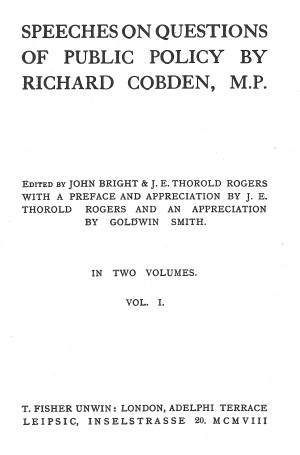
- Preface
- An Appreciation By Goldwin Smith
- An Appreciation By J. E. Thorold Rogers
- Free Trade. I. Her Majesty's Speech.—amendment On the Address. House of Commons, August 25, 1841.
- Free Trade. II. Corn-laws.—mr. Villiers' Annual Motion. House of Commons, February 24, 1842.
- Free Trade. III. Distress of the Country. House of Commons, February 17, 1843.
- Free Trade. IV. Corn-laws. House of Commons, May 15, 1843.
- Free Trade. V. London, September 28, 1843.
- Free Trade. VI. London, October 13, 1843.
- Free Trade. VII. Manchester, October 19, 1843.
- Free Trade. VIII. London, February 8, 1844.
- Free Trade. IX. Effect of Protective Duties. House of Commons, March 12, 1844.
- Free Trade. X. London, May 8, 1844.
- Free Trade. XI. London, July 3, 1844.
- Free Trade. XII. Manchester, October 24, 1844.
- Free Trade. XIII. London, December 11, 1844.
- Free Trade. XIV. London, January 15, 1845
- Free Trade. XV. Agricultural Distress. House of Commons, March 13, 1845.
- Free Trade. XVI. London, June 18, 1845.
- Free Trade. XVII. Manchester, October 28, 1845.
- Free Trade. XVIII. Birmingham, November 13, 1845.
- Free Trade. XIX. London, December 17, 1845.
- Free Trade. XX. Manchester, January 15, 1846.
- Free Trade. XXI. Corn-laws. House of Commons, February 27, 1846.
- Free Trade. XXII. Manchester, July 4, 1846.
- Free Trade. XXIII. House of Commons, March 8, 1849.
- Free Trade. XXIV. Leeds, December 18, 1849.
- Free Trade. XXV. Aylesbury, January 9, 1853.
- Letter From Mr. Cobden to the Tenant Farmers of England.
- Finance. I. Manchester, January 27, 1848.
- Finance. II. Manchester, January 10, 1849.
- Finance. III. House of Commons, March 8, 1850.
- Finance. IV. International Reduction of Armaments. House of Commons, June 17, 1851.
- Finance. V. House of Commons, December 13, 1852.
- Finance. VI. House of Commons, April 28, 1853.
- Finance. VII. House of Commons, July 22, 1864.
FREE TRADE.
I.
HER MAJESTY'S SPEECH.—AMENDMENT ON THE ADDRESS.
HOUSE OF COMMONS, AUGUST 25, 1841.
[Mr. Cobden was returned to Parliament for the first time in August, 1841, as Member for Stockport. He had previously, in 1837, contested this borough. In the debate on Mr. Baring's Budget, who was Chancellor of the Exchequer in Lord Melbourne's Government, Lord John Russell avowed that it was the intention of the Government to propose a moderate fixed duty on corn, in lieu of the sliding-scale. These duties were announced on the 7th of May, to be 8s. on wheat, 5s. on rye, 4s. 6d. on barley, and 3s. 6d. on oats. On May 27th, Sir Robert Peel moved a resolution of want of confidence. This resolution was carried by a majority of 1 (312 to 311). On this, Lord Melbourne appealed to the country. When the new Parliament met, Mr. Wortley moved and Lord Bruce seconded an amendment to the Address, to the effect that the Administration did not enjoy the confidence of the country. The amendment was carried by a majority of 91 (360 to 269), and Sir Robert Peel came into office. This statesman continued in office till he repealed those Corn-laws which he took office to maintain.]
I feel some difficulty in attempting to treat the question before the House, as there does not seem to be a good understanding of the position in which the House stands with regard to it. Different opinions have been expressed as to the object for which hon. Members have been sent here, and as to the nature of the late general election. It has been said that the elections were not a test of public opinion in reference to the monopolies, but merely in reference to the question of confidence in her Majesty's Ministers. That opinion has been expressed by the right hon. Gentleman the Member for Tamworth (Sir R. Peel), and a disposition has been evinced by his followers to take it as his dictum. But we are not then sent here to represent monopoly, and strange would it be did the majority of this House authentically announce that they have been sent here for such a purpose by what is called the ‘people of England.’
A recommendation has been made by the Executive to this House, advising us to set about the immediate reduction of taxation; and it is accompanied by an assurance that not only will that reduction not impair the revenue, but increase the resources of the national Exchequer. That, after all, is the nature of the message upon which the late Parliament was dissolved. But how can Gentlemen opposite, notwithstanding what has been said for them, come to this House to maintain taxation in all its inordinate vigour and mischievousness, because they wish for taxation in order to protect monopoly, as well as for the purposes of the State? It is really well that all people have not become enamoured of monopoly.
There is another difficulty in addressing the House on the present occasion. We are told that the question is not whether the Corn-laws shall be repealed or monopoly abated, but whether the amendment upon the Address shall be agreed to; and hon. Gentlemen opposite, in discussing that question, talked of the wars in Syria and China, and of the affairs of Canada and New York, but never once touched upon those questions which had been recommended to their consideration, and with a view to a diminution of the burdens of the people. But while I give hon. Gentlemen opposite credit for their discretion in excluding those important topics from the discussion, I see no reason why hon. Gentlemen on my side of the House, who feel that such questions as the Corn-laws are of greater interest to the people than the Chinese or Syrian wars, or any other remote subject of the kind, should not declare their views upon those questions; or why, if the speeches from my side of the House are to meet with no response on the other, we should not discharge our duty towards the people, and pay that respect and deference to her Majesty to which she is entitled, by calmly considering those questions and stating our opinions upon them. I believe it was customary, under the old régime, particularly with the Conservative party in this House, to treat the Speech from the Throne as something very nearly appertaining to monarchical dignity. I do not think it was customary, unless with very great reason, to drag in the Ministers of the day, but rather to respond to the Speech from the Throne as something connected with royal dignity, and entitled to that calm discussion which hon. Gentlemen opposite are not willing to accord to the most gracious and, since the time of Alfred, the most popular monarch of these realms.
It has been said that the people of England are not sincere in seeking for a total repeal of the food tax. With all sincerity, I declare that I am for the total repeal of those taxes which affect the price of bread and provisions of every description, and I will not allow it to be said without denying it, that the three millions of people who have petitioned the House for the total repeal of those taxes are not sincere in their prayer. What are those taxes upon food? They are taxes levied upon the great body of the people, and hon. Gentlemen opposite, who show such sympathy for the working classes after they have made them paupers, cannot deny my right to claim on their behalf that those taxes should be a primary consideration. I have heard them called protections; but taxes they are, and taxes they shall be in my mouth, as long as I have the honour of a seat in this House. The bread-tax is a tax primarily levied upon the poorer classes; it is a tax, at the lowest estimate, of 40 per cent. above the price we should pay if there were a free trade in corn. The report upon the handloom weavers puts down 10s. as the estimated weekly earnings of a family, and states that in all parts of the United Kingdom that will be found to be not an unfair estimate of the earnings of every labourer's family. It moreover states, that out of 10s. each family expends 5s. on bread. The tax of 40 per cent. is, therefore, a tax of 2s. upon every labouring man's family earning 10s. a week, or 20 per cent. upon their earnings. How does it operate as we proceed upwards in society? The man with 40s. a week pays an income-tax of 5 per cent.; the man of 250l. a year pays but 1 per cent.; and the nobleman, or millionaire, with an income of 200,000l. a year, and whose family consumes no more bread than that of the agricultural labourer, pays less than one halfpenny in every 100l. [Laughter.] I know not whether the laugh is at the monstrous character of the case, or the humble individual who states it; but I repeat that the tax upon the nobleman is less than one half-penny per cent., while upon the poor man's family it was 20l. per cent. I am sure there is not an hon. Member in the House who would dare to bring in a bill to levy an income-tax on all grades of society upon a scale similar to this, and yet I maintain that the bread-tax is such a tax, and is levied not for the purposes of the State, but for the benefit of the richest portion of the community. That is a fair statement of the tax upon bread. I can sympathise with the incredulity of hon. Gentlemen opposite, but if they knew the case as it really is, and felt it as they would if they did know it, they would also feel that they could not lie down to rest in comfort or safety if they voted for such a tax. With the exception of England and of Holland, in no country has any Government, however distressed, ever yet resorted to the monstrous injustice of levying a tax upon bread. Gentlemen will point to the laws affecting the importation of corn in France, Spain, and the United States of America; but in those countries they export corn upon an average, one year with another, and therefore no import duty could operate with them as with us.
But it is said that the working classes have some compensation—some protection extended to them by this law. Hon. Gentlemen on the other side have talked largely at the hustings of their determination to protect the poor; and the noble Lord (Stanley) opposite, at the election for North Lancashire, eagerly propounded this doctrine of protection. I have heard the noble Lord with my own ears; his case of protection to the labourer was that which I will now unfold. The noble Lord said that the manufacturers wanted to repeal the Corn-laws because they wanted to reduce the rate of wages; that, unless by the repeal of the bread-tax they reduced wages, they could not be better able to compete with foreigners; and that if they did, it could be no benefit to the working man. Let me remind the House, that the parties who have so patiently struggled for three years past for a hearing at your bar, have never been allowed to state their case; that the hon. Member for Wolverhampton (Mr. Charles Villiers)—for whose great and incessant services I, in common with millions of my fellow-countrymen, feel grateful—when he proposed that the case of those millions should be heard at the bar, had the proposition scouted and spurned; and that, when they had denied them a hearing, they proceeded to misrepresent their motives. I will state the case as given by the noble Lord himself. If he can be in error in appreciating the merits of the question, with all his brilliant talents, other hon. Gentlemen opposite will excuse me if I believe that they also are in error. The case was stated by the noble Lord thus:—Those who advocate a repeal of the Corn-laws have again and again announced that their object is to exchange the produce of their industry for the productions of all other countries, and that all duties for protection (so called) levied upon articles in the manufacture of which they are engaged, should be likewise removed, and a free and unfettered intercourse established between all the countries of the earth, as was clearly the design of nature. But we were told by the noble lord the Member for North Lancashire that this means the reduction of wages. If I know anything, it means increased trade, and the claim of a right, besides, to exchange our manufactures for the corn of all other countries, by which we should very much increase the extent of our trade. How can this be done, unless by an increased amount of labour? How can we call into requisition an increased demand for labour without also increasing the rate of wages?
Another prevailing fallacy was mixed up with the noble Lord's statement. The object, he said, was to reduce wages, so as to enable our manufacturers to compete with foreigners. I maintain that we do now compete with them; that we now sell our manufactures in neutral markets in competition with other countries; that we now sell them, in New York, for instance, in competition with all the other countries of the earth. You talk of protection to the home producer, but it should ever be remembered that it is the foreign market which fixes the price of the home market. Would any man think of sending to a distance of 3,000 miles articles for which he could find a better market at home? I see in this fallacy of wages that which is at the bottom of all the opposition to the repeal of the Corn-laws. There are many conscientious upholders of the present system who support them in the supposition that they maintain the rate of wages. I see no relation between the price of food, or of any other article of consumption, and the price of labour, in its wholesome, natural state. In Cuba, or in the slave-holding states of America, I can imagine the price of labour to be affected by the price of food. I can imagine the slave-holder sitting down and estimating the value of herrings and rice. In his case, the price of labour at his command is affected clearly by the price of provisions.
There is another stage in the labour market—I refer to labourers in the agricultural districts—where the amount of wages has reached the very minimum, according to their habits of life. These unfortunate men are told that their wages will rise as the price of provisions advances. Why? Is it because the high price of provisions increases the demand for labour, or is it done from pure charity? But I come to that state of the labour market under which—and God knows how long it will continue under such legislation—the various products of our manufacturing industry are called into existence, and there, I assert, without fear of contradiction, that the rate of wages has no more connection with the price of food than with the moon's changes. There it depends entirely on the demand for labour; there the price of food never becomes an ingredient in testing the value of labour. There the labour market is, happily, elastic, and will become more so, if you leave it unfettered. But if you continue to legislate in the spirit by which you have so long been animated, you will succeed at last in bringing our commercial and manufacturing population down to the same pitch to which you have reduced our agriculturists, and then these merchants and manufacturers may come forward and give alms to the wretched men in their employment; then it will perhaps be said that ‘with the increase in the price of food arises an increase in the rate of wages.’ It will be doled out as an alms, as a mere act of charity, and not because the working man, as a free agent, is entitled, in return for his labour, to a decent subsistence.
I will now dismiss the question of wages, though it is one which I must say should be again and again mooted in this House. I now come to the consideration of that all-important subject—the existing state of our manufacturing and agricultural labourers—which has already called forth your sympathy, and to which I must again direct your attention. I have lately had an opportunity of obtaining, by peculiar means, access to a report about the state of the labouring population in all parts of the country. A highly important Convocation was held in Manchester a week ago, consisting entirely of the ministers of religion. [Ironical cheers.] I understand those cheers. I will not pause in my statement of facts, but will say a word upon that subject when I have done. I have seen at Manchester a body of ministers of all religious persuasions—not 620, as has been stated, but 650 in number—assembled together from all parts of the country, at an expense of from 3,000l. to 4,000l., which was borne by their respective congregations. Those clergymen gathered, not from Yorkshire or Lancashire only—not from Derby or Cheshire only—but from every county of Great Britain—from Caithness to Cornwall,—and stated the most important facts relating to the labouring population in their various districts. I have had an opportunity of examining those statements. I will not trespass on the time and attention of the House by going into those statements in detail; but I will state generally, that, from both the manufacturing and agricultural districts, there was the most unimpeachable testimony that the condition of the great body of her Majesty's labouring subjects had deteriorated wofully within the last ten years, and more especially so within the three years last past; and furthermore, that in proportion as the price of the food of the people had increased, just so had their comforts been diminished. I have seen statements derived from the reports of infirmaries and workhouses, from savings' banks and prisons; and all alike bore testimony, clear and indubitable, that the condition of the great mass of her Majesty's subjects in the lower ranks of life is rapidly deteriorating; that they are now in a worse condition, and receiving less wages; and that their distress and misery result in a greater amount of disease, destitution, and crime than has ever been witnessed at any former period of the history of this country.
One word in reference to the jeers with which the mention of this Convocation has been received. I do not come here to vindicate the conduct of those Christian men in having assembled to take this momentous subject into their consideration. The parties who will more fitly judge them are their own congregations. At that Convocation we had members of the Established Church and of the Church of Rome, Independents, Baptists, members of the Church of Scotland, Seceders, Methodists, and every other denomination with which I am acquainted. If hon. Gentlemen are disposed to impugn the character of those reverend individuals, they will be at the same time casting a reproach and a stigma on the great body of dissenting Christians in this country.
It may be thought that these reverend persons were travelling out of their province. But when I heard these worthy men telling their tales of saddening misery—when I heard them state that members of their congregations would keep away from their places of worship in the morning, and steal out to the house of God at night, wrapped up in a cloak or an outside coat, when a shade was thrown over their misery—when I heard that others were unfitted to receive spiritual consolation because of their being so plunged in physical destitution; that the Sunday-schools were falling off, because their congregations could not attend—when I heard these things, and was further assured that the provisions monopoly is at the bottom of all the misery under which these poor people labour, I cannot conscientiously say that those ministers were out of their place. When they who sit in high places are oppressive and unjust to the poor, I am glad to see that there are men amongst us who, like Nathan of old, can be found to come forward and exclaim, ‘Thou art the man!’ The religious people of the country have revolted against the infamous injustice of that bread-tax, which is condemned by the immutable morality of the Scriptures. They have prepared and signed a petition to this House, in which they declare that these laws are a violation of the will of the Supreme Being, whose providence watches over His famishing children. You may rely upon it that the time abounds with momentous signs. It is not those 650 ministers only, but 1,500 ministers of the Gospel, whose letters have been read at the Manchester meeting, and who send up their prayers to Heaven daily and hourly that it may be the will of Him who rules both princes and potentates to turn their hearts to justice and mercy.
And now, having told you what has been done by these men, and in what spirit they have proceeded, we cannot for a moment doubt that these men were in earnest; neither can we doubt that these are men to make very efficient emissaries in this great cause. Remember what has been done in the Anti-Slavery question. Where is the difference between stealing a man and making him labour, on the one hand, or robbing voluntary labourers, on the other, of the fruits of their labour? The noble Lord opposite (Lord Stanley) knows something of the ability of these men to give efficacy to their strong convictions. When the noble Lord proposed his Emancipation Bill in 1833, he broadly stated, that from the moment that the religious community took up the question, from that moment it was settled. I believe that the result will be the same here.
Let me remind hon. Members of the qualities which pervade the minds of their countrymen. They have great deference for power and rank, and respect for wealth—perhaps too much; they have a most profound attachment to the laws and institutions of the country. But it must be remembered that there is another attribute peculiar to the minds of Englishmen—a veneration for sacred things, far beyond their deference to human authority. Once infringe upon that, and their respect for you and yours will vanish like chaff in the whirl-wind. What must be the feeling of the country when they find upon this occasion that the most kind, and benevolent, and generous recommendation of her Majesty, that you should take the Cornlaws into your wise consideration, with a view to relieving the heavy burdens under which her poor people suffer, of diminishing labour and insufficient food—what will be said by the country at large when they find this gracious recommendation from the Crown scouted and scorned by the majority of this House? What will be their feelings of indignation when they find a question of this magnitude treated as of secondary importance to the question whether a gentleman with a white hat, on that side, or a gentleman with a black hat, on this side of the House, shall hold the patronage of office? The people of this country will regard the transaction—if Parliamentary language will permit me to say so—as the most factious proceeding which has ever characterised the conduct of this House.
If I turn to a declaration made elsewhere—in a place which, in conformity with the rules of the House, I will not particularise—when I find an illustrious Duke stating that the condition of the labouring population in this country is enviable compared with that of any other population in Europe, and that every labouring man in this country, who has industry and sobriety to recommend him, can attain to a competence—what, I ask, will be the feelings of the country at large upon hearing such a declaration? Are hon. Gentlemen disposed to respond to that sentiment, and accept it as their own? Let them remember that about ten years since the same illustrious individual stated that the old borough-mongering Parliament, under which we then suffered, was the perfection of human wisdom. Yes; and I shall not be surprised if this doctrine of yesterday, meeting a similar and still more remarkable fate, may be the forerunner of a far greater change than that contemplated by her Majesty's Ministers.
Let me, before I sit down, say one word to the right hon. Baronet (Sir R. Peel) opposite. I have heard some allusions made here to the opinions of Mr. Huskisson. The right hon. Baronet the Member for Tamworth is fond of appearing under the sanction of that distinguished statesman. I am most anxious that he should not fall into the error of appearing in his cast-off garments, and fancying himself arrayed in his mantle—that when he gives us the last will and testament of that distinguished statesman, he should know that an important codicil was added to that will, which I will now present him. I heard Mr. Huskisson's opinion in 1828 quoted. It is deeply to be lamented that after that period he sanctioned, by joining the Duke of Wellington's Administration, a line of policy to which he had strongly objected. But when he spoke last in the House on the subject of the Corn-laws, on the 25th of March, 1830, upon the occasion of Mr. Poulett Thomson's motion on the subject, Mr. Huskisson gave his opinion in these terms—'It is my distinct conviction that we cannot maintain the present Corn-laws, and at the same time maintain the permanent prosperity and prevalent contentment of the country. That these laws may be repealed without injury to our landed interests is my firm belief.' Here is the last codicil to the will of Huskisson. I protest in his name, in many respects illustrious, though not of uniform brightness, against the misrepresentation of his opinion. When Mr. Huskisson spoke in 1830—and I would strongly recommend the whole of that speech to hon. Members' attentive perusal—there was by no means the same amount of distress prevalent as that from which the country is now suffering, nor was there anything like the same gloom in her prospects. But if Mr. Huskisson spoke so despondingly then, what would he have said had he lived in 1841, and seen the accumulated difficulties under which the country now labours,—if, instead of the Bank of England, with 10,000,000l. or 12,000,000l. of treasure, and money in abundance at 3 per cent., he saw scarcely half that amount of treasure, and the interest raised to 5 per cent.? What would have been his opinion of the Corn-laws, had he lived to see all these things accomplished? I am earnestly impressed by a desire to record his solemn conviction on this subject.
The right hon. Baronet opposite possesses at this moment the power to do immense service to his country. Let the right hon. Baronet refer back to 1830, and consider what were then the circumstances of the country, compared with what they are now. What is the cause of our elevation from that prostration to which the country had fallen in 1830? It was clearly not a natural or legitimate trade which then sprung up. From 1831 to 1836 the increase of our exports, compared with our imports, amounted to 20,000,000l. official value. But all these goods were sent to America, where they were neither sold nor consumed, but despatched in exchange for bank and railway shares, and State bonds. That is not legitimate trade; it is over-speculation; the goods are not paid for.
It should be borne in mind, too, that from the period of 1831 to 1836 there was an extension of the banking system in this country, increasing the number of banks by nearly 100, and extending their capital by nearly 60,000,000l. The increase of the export and home trade thus factitiously created, accompanied with a fortuitous series of unexampled harvests, created a state of prosperity which enabled the Government of the day to move tranquilly on in carrying the Reform Bill and amending the Poor-law; but it was a fictitious prosperity.
Has the right hon. Baronet, then, any plan—I will not ask him to divulge it at present—but has he any plan by which, in 1841, he can raise up a real prosperity in the country? If not, can he hope even to raise up a factitious prosperity? If so, it will only lead to a recoil which will be infinitely more disastrous than that under which we are now suffering.
Thank God, Ministers in this country require money, and glad I am that they cannot get it but through the prosperity of the trading and manufacturing interests. The landholder who spends his money in Paris or Naples cannot find revenue for the Minister. The revenue flourishes when the trading and commercial community are prosperous, and when the farmers are crying out under excessive distress; and, on the other hand, just in proportion as the land-owner feels prosperous on account of the starvation of the millions, the revenue of the State falls off.
Having made these few remarks, though not, I must be allowed to say, in a party spirit (for I call myself neither Whig nor Tory; I am a free-trader, and such I shall always be ready to avow myself), I have only, in conclusion, to observe, that while I am proud to acknowledge the virtue of the Whig Ministry in coming out from the ranks of the monopolists, and advancing three parts out of four towards my own position, yet, if the right hon. Baronet opposite advances one step farther, I will be the first to meet half way and shake hands with him.
FREE TRADE.
II.
CORN-LAWS.—MR. VILLIERS' ANNUAL MOTION.
HOUSE OF COMMONS, FEBRUARY 24, 1842.
[On Feb. 18, 1842, Mr. Villiers proposed his annual motion, to the effect, ‘that all duties payable on the importation of corn, grain, meal, and flour, do now cease and determine.’ After five days' debate, the motion was negatived by a majority of 303 (393 to 90), on Feb. 24. Mr. Cobden was one of the tellers. The majority of the Conservative party voted or paired; but 108 of the Opposition were absent. On the last day of the debate, Mr Ferrand, Member for Knaresborough, made a violent personal attack on Mr. Cobden. In explanation, Mr. Cobden stated, once for all, that he intended never to be driven into personal altercation with any Member of the House. He was advised by Mr. Byng, then the senior Member of the House, to be utterly indifferent to Mr. Ferrand's personalities. Shortly after the rejection of Mr. Villiers' motion, Sir R. Peel made certain alterations in the sliding-scale, the maximum duties on wheat, barley, rye, oats, peas, and beans, from foreign countries, being 20s., 11s., 11s. 6d., 8s., and 11s. 6d. the quarter, and from British colonies, 5s., 2s. 6d., 3s., 2s., and 3s.; a shilling duty being payable when wheat rose to 73s., barley to 37s., oats to 27s., rye, peas, and beans, to 42s., if the corn was of foreign origin, while, if colonial corn were imported, the shilling duty commenced on wheat at 58s., and a 6d. duty on barley at 31s., oats at 33s., rye, peas, and beans at 34s. Similar duties were to be levied on meal and flour.]
If the hon. Gentleman (Sir Howard Douglas) who has just sat down will give the House another promise, that when he speaks he will always speak to the subject, the House will have a more satisfactory prospect of his future addresses. I have sat here seven nights, listening to the discussion on what should have been the question of the Corn-laws, and I must say that I think my hon. Friend the Member for Wolverhampton (Mr. C. Villiers) has just grounds for complaint, that in all those seven nights scarcely two hours have been given to the subject of the bread-tax. Our trade with China, the war in Syria, the bandying of compliments between parties and partisans, have occupied our attention much and often, but very little has been said on the question really before the House. I may venture to say that not one speaker on the other side of the House has yet grappled with the question so ably propounded by my hon. Friend, which is—How far, how just, how honest, and how expedient it was to have any tax whatever laid upon the food of the people? That is the question to be decided; and when I heard the right hon. Baronet (Sir R. Peel) so openly express his sympathy for the working classes of this country, I expected that the right hon. Baronet would not have finished his last speech on this question without at least giving some little consideration to the claims of the working man in connection with the Corn-laws.
To this view of the subject I will therefore proceed to call the attention of the Committee; and I call upon hon. Gentlemen to meet me upon neutral ground in discussing the question in connection with the interests of those working classes, who have no representatives in this House. While I hear herein strong expressions of sympathy for those who have become paupers, I will ask hon. Gentlemen to give some attention to the case of the hard-working man before he reaches that state of abject pauperism in which he can only receive sympathy. In reading the debates upon the passing of the first stringent Corn-law of 1814, I am much struck to find that all parties who took part in that discussion were agreed upon one point,—it was that the price of food regulated the rate of wages. That principle was laid down, not by one side of the House, but by men of no mean eminence on each side, and of course of opposite opinions in other respects. Mr. Horner and Mr. Baring, Mr. F. Lewis, the present Lord Western, Mr. (now Sir) G. Philips, were all agreed on that head, though some advocated and others opposed the measure. One of the speakers, indeed, went so far as to make a laboured computation to show the exact proportion which the price of food would bear to the rate of wages. The same delusion existed out of doors too. A petition was presented to the House in 1815, signed by the most intelligent of the manufacturing and working classes, praying that the Corn Bill might not be passed, because it would so raise the rate of wages, that the manufacturers of this country would not be able to compete with the manufacturers abroad. In reading the debates of that date, I have been filled with the deepest sorrow to find how those who passed that measure were deluded. But I believe that they were labouring under an honest delusion. I firmly believe, that if they had been cognisant of the facts now before the House, they would never have passed that Corn Bill. Every party in the House was then deluded: but there was one party, that most interested, the working classes, who were not deluded. The great multitude of the nation, without the aid of learning, said—with that intuitive and instructive sagacity which had given rise to the adage, ‘The voice of the people is the voice of God'’—what the effect of the measure would be upon wages, and therefore it was, that when that law was passed this House was surrounded by the multitudes of London, whom you were compelled to keep from your doors by the point of the bayonet. Yes, and no sooner was the law passed than there arose disturbances and tumults everywhere, and in London bloodshed and murder ensued; for a coroner's jury returned a verdict of wilful murder against the soldiers who were called out and fired upon the people. The same hostility to the measure spread throughout the whole of the north of England; so that then, from the year 1815 down to 1819, when the memorable meeting was held at Peter's-field in Manchester, there never was a great public meeting at which there were not borne banners inscribed with the words ‘No Corn-laws.’
There was no mistake in the minds of the multitude then, and let not hon. Gentlemen suppose that there is any now. The people may not be crying out exclusively for the repeal of the Corn-laws, because they have looked beyond that question, and have seen greater evils even than this, which they wish to have remedied at the same time; and, now that the cries for ‘Universal Suffrage’ and ‘The Charter’ are heard, let not hon. Gentlemen deceive themselves by supposing that, because the members of the Anti-Corn-law League have sometimes found themselves getting into collision with the Chartists, that therefore the Chartists, or the working men generally, were favourable to the Corn-laws. If one thing is more surprising than others in the facts which I have mentioned, it is to find in this House, where lecturers of all things in the world are so much decried, the ignorance which prevails upon this question amongst hon. Members on the other side of the House. [Oh! oh!] Yes, I have never seen their ignorance equalled amongst any equal number of working men in the North of England. Do you think that the fallacy of 1815, which I heard put forth so boldly last week, that wages rose and fell with the price of bread, can now prevail in the minds of working men, after the experience of the last three years? Has not the price of bread been higher during that time than for any three consecutive years for the last twenty years? And yet trade has suffered a greater decline in every branch of industry than in any preceding three years. Still there are hon. Gentlemen on the other side of the House, with the Reports of Committees in existence and before them proving all this, prepared to support a bill, which, in their ignorance—for I cannot call it anything else—they believe will keep up the price of labour.
I am told that the price of labour in other countries is so low that we must keep up the price of bread here, to prevent wages going down to the same level. But I am prepared to prove, from documents emanating from this House, that labour is cheaper here than in other countries. I hear a sound of dissent; but I would ask those who dissent, do they consider the quality of the labour? By this test, which is the only fair one, it will be proved that the labour of England is the cheapest labour in the world. The Committee on machinery, last session but one, demonstrated that fact beyond all dispute. They reported that labour on the continent was actually dearer than in England in every branch of industry. Spinners, manufacturers, machine-makers, all agreed that one Englishman on the Continent was worth three native workmen, whether in Germany, France, or Belgium. If they are not, would Englishmen be found in every large town on the Continent? Let us go to any populous place, from Calais to Vienna, and we should not visit any city with 10,000 inhabitants without finding Englishmen who are earning thrice the wages the natives earn, and yet their employers declare that they are the cheapest labourers. Yet we are told that the object of the repeal of the Corn-laws is to lower wages here to the level of continental wages.
Have low wages ever proved the prosperity of our manufactures? In every period when wages have dropped, it has been found that the manufacturing interest dropped also; and I hope that the manufacturers will have credit for taking a rather more enlightened view of their own interest than to conclude that the impoverishment of the multitude, who are the great consumers of all that they produce, could ever tend to promote the prosperity of our manufacturers. I will tell the House, that by deteriorating that population, of which they ought to be so proud, they will run the risk of spoiling not merely the animal but the intellectual creature, and that it is not a potato-fed race that will ever lead the way in arts, arms, or commerce. To have a useful and a prosperous people, we must take care that they are well fed.
But to come to the assumption that the manufacturers do want to reduce the rate of wages, and that the Corn-law will keep them up, we are still going to pass a law which will tax the food of our industrious and hard-working people; and what must be the result? The right hon. Baronet, in answer to a fallacy so often uttered on the other side of the House, said, ‘We do now compete with the foreigner: we export to the extent of 40,000,000l. or 50,000,000l. a year.’ That is true; but how? By taxing the bones and muscles of the people to double the amount of good supposed to be done to them by the Corn-laws. A double weight being put upon them, they are told to run a race with the labourers of Germany and France. We exult in a people who can labour so; but I would ask, with Mr. Deacon Hume, Whose are the energies which belonged to the British people, their own property or that of others? Think you, that for giving them an opportunity merely to strive and struggle for an existence, you may take one-half of what they earn? Is that doing justice to the high-mettled racer? You do not treat your horses so; you give them food, at all events, in proportion to their strength and their toil. But Englishmen, actually, are worse treated; tens of thousands of them were last winter worse off than your dogs and your horses.
Well, what is the pretence upon which you propose to tax them? We have been told by the right hon. Gentleman that his object is to fix a certain price for corn: and hearing that proposition from a Prime Minister, and listening to the debates, I have been almost led to believe that we are gone back to the times of the Edwards, when Parliament was engaged in fixing the price of a table-cloth, or a napkin, or a pair of shoes. But is this House a corn-market? Is not your present occupation better fitted for the merchant and the exchange? We do not act in this way with respect to cotton, or iron, or copper, or tin. But how are we to fix the price of corn? The right hon. Baronet, taking the average of ten years at 56s. 10d., proposes to keep the price of wheat at from 54s. to 58s. Now Lord Willoughby D'Eresby will not be content with less than 58s. Some hon. Members opposite are for the same price at the lowest; and I see by the newspapers that the Duke of Buckingham, at a meeting of farmers held at Aylesbury on the preceding day, said the price ought to be 60s. But there is one hon. Gentleman, whom I hope I shall have the pleasure to hear by-and-by go more into detail as to the market price which he intends to secure for his commodity in the market. I see in that little but very useful book, the Parliamentary Companion, which contains most accurate information, and in which some of the Members of this House give very nice descriptions of themselves, under the head of Mr. Cayley, M.P. for North Yorkshire (p. 134), the following entry:—'Is an advocate for such a course of legislation, with regard to agriculture, as will keep wheat at 64s. per quarter, new milk cheese at from 52s. to 60s. per cwt., wool and butter at 1s. per lb. each, and other produce in proportion.'
Now it is all very amusing, exceedingly amusing, to find still that there are gentlemen, at large, too, who will argue that Parliament should interpose and fix the price at which they should sell their own goods. That is very amusing indeed; but when we find the Prime Minister of this great country coming down to parliament and avowing such a principle, it becomes anything but amusing. I will ask the right hon. Baronet, is he prepared to carry out this principle in respect to cotton and wool? I pause for a reply.
[Sir R. Peel: ‘I have said that it was impossible to fix the price of food by any legislative enactment.'’]
Then upon what are we now legislating? I thank the right hon. Baronet for that avowal. Will he oblige me still further by not trying to do it? But supposing he will try, all I ask of him is—and again I shall pause for a reply—will he try to legislate to keep up the price of cottons, woollens, silks, and such like goods? There is no reply. Then we have come to this, that we are not legislating for the universal people. Here is the simple, open avowal, that we are met here to legislate for a class against the people. I do not marvel, therefore, though I have seen it with the deepest regret and indignation, that the House has been surrounded during this debate by an immense body of the police force. (A laugh.) I cannot let this subject drop with a laugh. It is no laughing business to those who have no wheat to sell, and no money to purchase food to sustain life.
I will refer the House to the great fall in the price of cotton. At this day, in Manchester, the price of that article is 30 per cent. less than it was ten years back. It is the same with respect to ironmongery. During the average of the last ten years it has also fallen 30 per cent., and yet with this great reduction of price the man engaged as an iron-monger is to take his goods and to exchange them with the agriculturist for the produce of the land at the present high price of corn. Is this fair and reasonable? Can it be called legislation at all? Sure I am that it is not honest legislation. It is no answer to this argument, if the Prime Minister of this country comes forward and declares that he has not the power to obviate this evil; yet it is not too much to assert that the man placed in that high and responsible situation should step forward to stay the progress of such unjust and partial legislation.
I have only yet touched the skirts of the question. I would remind the House that it will not be a laughing question before it is settled. I would ask the right hon. Baronet whether, whilst fixing the scale of prices for wheat, he intends to introduce to the House a sliding scale for wages as well? I know only one class of the community whose wages are secured by the sliding scale, and those are the clergy of this country. I would ask what is to be done with the artisan; I know that I shall be told that a resolution has been passed declaring that the scale of wages cannot be kept up. I am well acquainted with the answer which the poor distressed hand-loom weavers got when they addressed the House and claimed its protection. They were told that the House had been studying political economy, and that the weavers had entirely mistaken their position, and that their wages could not be maintained up to a certain price. That was the answer which those poor men received. Why, I will ask, should a law be passed to keep up the price of wheat, whilst you admit that wages cannot be also sustained at a certain price? It is not complicated statistics, learned references to authorities, or figures nicely dovetailed, that will satisfy the starving people of this country, and convince them that a band of dishonest confederates had not been leagued together for the purpose of upholding the interests of one body against the general good of the country.
We have been told that the land of this country is subjected to peculiarly heavy burdens? But what is the nature of those burdens? A facetious gentleman near me has attempted an explanation of this matter, and has declared that ‘the heavy burdens’ meant only heavy mortgages. The country has a right to expect that the right hon. Baronet will inform the House what those burdens are to which the landed interest is exposed. When questioned on this point, the right hon. Baronet states that there exist a variety of opinions on the subject; and that is the only explanation that can be obtained. I boldly declare that for every one burden imposed on the land I am able to show ten exemptions.
I will refer to the speech of the hon. Member for Renfrewshire (Mr. Stewart). He complained of the delay which had occurred in obtaining a return moved for some time back with reference to the land-tax to which the land abroad was subjected. I should like to know why our Consuls abroad have not made some official return on the subject. They surely might have forwarded the Government the desired information. Being without any official intelligence on this point, it will not be in my power to give the House any explicit information on the subject. With reference to the land-tax in France, it has been stated by M. Humann, in the Chamber of Deputies, that the land-tax paid in France was 25 per cent. upon the value of the soil, and equal to 40 per cent. of the whole revenue of the country. In this country the land-tax amounts to 1,900,000l., and the value of the landed property, as stated by one of your own men, Mr. Macqueen, was about 230,000,000l. This tax is but a mere fraction compared to the duty levied in this country on the poor man's tobacco. I think that if the right hon. Baronet does not soon propound his views on this subject to the House, he will be treating them with great disrespect.
I look back to the past debate with feelings not altogether devoid of satisfaction. Many important admissions have been made. I never heard it admitted, until the right hon. Baronet made the admission, that the tax upon food actually contributes to the revenue of the proprietors of the land. What are the peculiar burdens imposed on land which led to the introduction of the present tax on corn? I have a right to demand an answer on this point. The only plea for levying such a tax is to benefit one class of society.
It has been admitted by the head of the Government that this country never can be entirely independent of the foreign grower of corn; that our state was a kind of supplementary dependence; that in some years we must look abroad for a supply of food, and that this is when we want it. I perfectly agree with the right hon. Baronet, that corn ought only to be admitted free of all restrictions when it is ‘wanted.’ That is, the particular moment or crisis when it is desirable to open our ports for the admission of foreign corn. But I would ask the House and the Government of the country, who are to decide when the corn is wanted? Is it those who need food and are starving, or those who fare sumptuously every day and roll in all the luxuries of life? What right has the right hon. Baronet to attempt to gauge the appetite of the people? It is an inordinate assumption of power to do so. Such a thing cannot be tolerated under the most monstrous system of despotism which the imagination of man has ever conceived. Do we sit here for the purpose of deciding when the people of this country want food? What do the Members of this House know of want? It is not for them to say when the starving people of this country ought to have food doled out to them. The people are the best judges upon that point.
The right hon. Baronet has been guilty of having made contradictory statements with reference to the condition of the hand-loom weavers. What is the state of the poor in Ireland? I refer to the work of Mr. Inglis. That gentleman declared, at the conclusion of his publication, that one-third of the people of Ireland are perishing for want of the common necessaries of life.
I have heard other admissions during the debate, some of a very startling character, with reference to which I will make an observation. It has been affirmed by the right hon. Baronet the Paymaster of the Forces (Sir E. Knatchbull), that a tax upon corn is necessary in order to enable the landed interest to maintain their rank in society. I do not think that the noble Lord (Stanley) who sits near the right hon. Baronet the Paymaster of the Forces, is dealing fairly by the people of England. It was very justly observed some years ago by the Times newspaper, that the Corn-laws were nothing but an extension of the Pension List; but it might have been added that it was also an extension of a system of pauperism to the whole of the landed aristocracy. If this country is to be ground down by an oligarchy, we had better at once adopt the system pursued in ancient Venice, where the nobles entered their names in the Golden Book, and took the money directly out of the people's pockets. It would be more honest to imitate those nobles openly, than do so in a covert manner. But one class will not submit to be heavily taxed, whilst the other lives in opulence and splendour.
The right hon. Baronet is not ignorant of the state of the commercial and manufacturing interests of the country. He is not legislating in the dark. I will tell the right hon. Baronet, that bad as trade is now, it will soon be much worse. The Government must be aware that the measure proposed for the settlement of the Corn-law question will not extend the commerce of the country. The House has been told that the measure must be pushed forward without any delay, and this is the result of a communication which the right hon. Baronet has received from the corn-dealers. But I would ask, why there should not be corn-merchants as well as tea-merchants? Why should not the corn-merchants be able to bring back, in exchange for other commodities, a cargo of corn, as well as a cargo of sugar or of tea? If something is not done, we shall see our large capitalists struggling against bankruptcy. In the last speech which the right hon. Baronet addressed to the House, he adopted an apologetic tone of reasoning. An excuse might be offered for the right hon. Baronet if he had been placed in his present position by the people, or by the Queen; but he has placed himself in his present situation.
With reference to the proposition of the noble Lord (J. Russell) the Member for the City of London, I must say that although it is not good, it is infinitely better than the measure submitted to the House by the hon. Gentleman opposite. The right hon. Baronet has been reconstructing his party ever since the carrying of the Reform Bill. He must know that his party is composed of monopolists in corn, tea, sugar, timber, coffee, and the franchise. Out of that band of monopolists the right hon. Baronet has formed the party which supported him, and which formed his Government. They bribed, they intimidated, until they got possession of office.
I will say a word to the noble Lord and his right hon. associates on this (the Opposition) side of the House, who, whilst advocating generally Free-trade principles, have manifested a squeamishness in supporting the motion for a total and immediate repeal of the Corn-laws. With all deference to them, that shows too great sympathy with the few, and too little with the many who are suffering. I would ask them, if they had had the power of rescinding the Corn-law Bill by their votes in 1815, would they then have talked of compensation, or of a nine or ten years' diminishing duty? No, they would not. Why then, I would ask, do they now think that twenty-seven years' unjust enjoyment entitles them to an increased benefit in the shape of compensation? I have frequently known the difficulty met before. I give hon. Gentlemen and noble Lords on my side of the House full credit for sincerity, but, for their benefit, I will state the answer I once heard given to the difficulty on the hustings, an answer which was most satisfactory to my mind. On the hustings, there was a great difficulty amongst Whiggish gentlemen. They were arguing on the danger and hardship which might follow the immediate repeal of the Corn-law, when a poor man in a fustian jacket said, ‘Why, mon, they put in on all of a ruck ’ I may explain, for the benefit of those unacquainted with the Lancashire dialect, that the meaning was, all at once; and so the Corn-laws were. They were put on in 1815 at once, and against the remonstrances of the people. Let them, then, abolish the law with as little ceremony.
I will not further detain the House. The question resolves itself into a very narrow compass. If you find that there are exclusive burdens on the land, do not put a tax upon the bread of the people, but remove the burdens. If you are not prepared to ameliorate the condition of the people, beware of your own position—nay, you must take care that even this House may not fall under the heap of obloquy which the injustice you are perpetuating will thrust upon you.
FREE TRADE.
III.
DISTRESS OF THE COUNTRY.
HOUSE OF COMMONS, FEBRUARY 17, 1843.
[The Queen's Speech, read Feb. 2, 1843, ‘regretted the diminished receipt from some of the ordinary sources of revenue, and feared that it must be in part attributed to the reduced consumption of many articles, caused by the depression of the manufacturing industry of the country which has so long prevailed.’ On this statement Lord Howick moved, on Feb. 13, that the House be resolved into a Committee of the whole House, to consider this part of the Speech. Lord Howick's motion was rejected by 115 votes (306 to 191). The peculiarity of the debate, however, was, that Sir Robert Peel imagined that Mr. Cobden had charged him with being personally responsible for the distress of the country. Sir Robert Peel had been greatly affected by the murder of his private secretary in the preceding month (Jan. 24), who was shot by one Macnaghten. It was believed that the secretary was shot by mistake for the Minister. Mr. Cobden disclaimed using the term ‘individually or personally responsible’ in any other sense than that of Ministerial responsibility. It should be added that the allusion to ‘an eminent and learned Lord,’ is to Lord Brougham, who insinuated that the attempt of Macnaghten was stimulated by the language of the League. His words were ‘that ministers of religion did not scruple to utter words—calculated to produce fatal effects (he would not say had produced them), but calculated to produce the taking away of innocent life.'’]
We have heard much objection made to the form of this motion. We have heard it charged as being a party motion. Now, Sir, I can, at all events, say it is not a party motion as far as I am concerned. I was absent from town when it was put on the books. I am no party man in this matter in any degree; and if I have any objection to the motion it is this, that whereas it is a motion to inquire into the manufacturing distress of the country, it should have been a motion to inquire into manufacturing and agricultural distress. If the motion had been so framed, we should not have had the words ‘manufactures’ and ‘agriculture’ bandied between the two sides of the House, but we should have had the Gentlemen on the other side of the House put in their proper position as defendants, to justify the operation of the law as it affects their own immediate interests.
I ask you, are the agricultural districts of the country in such a state now, that you are entitled to say that this law—for this has been made a Corn-law debate—that this law, which injures the manufacturers, has benefited the agriculturists? There is the hon. Member for Dorsetshire (Mr. Bankes), one of the most clamorous assailants of the Anti-Corn-law League, he will probably speak on this question—there is plenty of time, the debate may be adjourned, if necessary—and when he speaks he can answer me, and correct me if I am wrong. Take the district of Dorsetshire which the hon. Gentleman represents. Take his own property. I ask him, are the labourers on his estates receiving more than the miserable pittance of 8s. a week at this moment? I ask him to contradict me, if he can, when I state that the labourers in his neighbourhood are the worst paid, the worst clad, and the most illiterate portion of the population of this country. I tell him that the peasantry on his own estates, earning these 8s. a week, if their families average the usual number of five, that then the head of each of these families is sustained at less cost than the cost of the maintenance of each person in the county gaol of Dorsetshire, and I ask you—you with your peasantry at your own doors, living worse than paupers and felons—I ask you, are you entitled to assert, and will you maintain, that the present state of things is for the benefit of the agriculturists? I put you on your defence—I call on you to prove the benefit which this law confers on the agriculturists. Mind, I do not call you agriculturists. The landlords are not agriculturists; that is an abuse of terms which has been too long tolerated. The agriculturists are they who cultivate the land, who work at it either with their hands or their heads, and employ their capital on it; you are the owners of the land, who may be living at London or Paris: to call yourselves agriculturists is just as absurd as if shipowners were to call themselves sailors. I deal with the agriculturists, and not with the landowners—not with the rent-owners; and I tell you that you cannot show me that the labouring classes on farms are as well off as the much-deplored manufacturing population.
I myself employ a number of men; my concern is in the country, like your own. I have a number of labourers like yours; unskilled labourers, as unskilled as your own. I employ them in washing, cleansing, wheeling, and preparing materials, and I pay them 12s. a week; but I have no protection. Take Devonshire, Sussex, Wiltshire, Oxfordshire, and other agricultural counties, which send up their squires to this House to support this odious system, and any of these counties will show you a larger ratio of paupers than the manufacturing districts. Take Dorset; there has just been laid on the table of the House a Return of the population and revenue, and here we find, that in the year 1840, the very year in which we were blessed with wheat at 66s. a quarter, one out of every seven of the population in Dorsetshire was a pauper. And if we go to Sussex and the rest of the counties which send representatives to support this system for the benefit of the agriculturists, there we shall invariably find the largest amount of pauperism.
I will turn to the farmers. The hon. Gentleman, and other hon. Gentlemen, are pleased to designate me as the archenemy of the farmers. Sir, I have as good a right as any hon. Gentleman in this House to identify myself with the order of farmers. I am a farmer's son. The hon. Member for Sussex has been speaking to you as the farmers' friend; I am the son of a Sussex farmer; my ancestors were all yeomen of the class who have been suffering under this system; my family suffered under it, and I have therefore as good or a better right than any of you to stand up as the farmer's friend, and to represent his wrongs in this House. Now, I ask you, what benefits have the farmers had from this protection of which you speak so much? I put you on your defence, and I again call on you to show how the farmers can possibly derive higher profits from your law to enhance the price of the produce of the soil of this land? You must answer this question; this has not been shown yet at any of your agricultural meetings, where you tell the farmers that you must sink or swim together, and that you both row in the same boat. But the time is coming, and on the next quarter-day you will be called upon to show the farmer—upon whom some little enlightenment is now creeping—to show how he hitherto has gained, or can gain, any benefit from this legislation. You will have to answer this question from the intelligent farmer:—
'If there be more farmers than farms, then will not the competition amongst us for your farms raise the rent of land? and will there not be a proportionate value of the produce to whatever value you may give it in your Acts of Parliament?'
The same intelligent farmer may tell you:—
'If there were more farms than farmers, and if you raised the value of your produce, you would be bidding against each other for farmers, and then I could understand how the farmers could get some benefit in the shape of extra profit, for you would be compelled to pay them better for cultivating your farms.'
Now all this has been made as clear as noon-day.
The hon. Member for Dorsetshire has maligned the Anti-Corn-law League, as an association for dissseminating, not useful, but disagreeable knowledge. Every farmer in Dorsetshire has had a packet; every county voter of Dorsetshire has received a packet, containing about a dozen little tracts. This has not been left to casual distribution; it has not even been entrusted to the Post-office; but special agents have gone from door to door, climbing the mountains and penetrating the valleys. There is not a freeholder in the country who does not know as much about the matter as we ourselves. Do you think we shall hear next year, at the agricultural meeting at Blandford, the hon. Member for Dorsetshire telling his hearers that ‘the Corn-law is the sun of our social system; that it gilds the spire of the church, the dome of the palace, and the thatch of the cottage’? There will be some black sheep, who will shout out, ‘and the chimney of the landlord.’ We have had during this debate a great deal of criminating language cast at this body. Far be it from me to enter into such extraneous matter as the objects and proceedings of that body. I shall not think it necessary to answer the very amusing gossip in a stage coach which has been related to us. But attacks have been made upon this body at other times. The right hon. Baronet (Sir R. Peel) made a dark insinuation against it at the close of last session, when there was no one to answer it; and we have had the cry raised since, ‘that the Anti-Corn-law League is an incendiary and revolutionary body.’ We took no pains to refute that charge. How have the public treated your accusations? The shrewd and sagacious people of England and Scotland have given bail for the morality and good conduct of the maligned body to the amount of 50,000l.; and let the same slander go forth another year, and I am sure that the people will then enter into recognizances for the same body to the extent of 100,000l. No, it is not necessary that I should enter into the defence of such a body.
There has been an attempt, an alleged attempt, made to identify the members of this body with a most odious—a most horrible—I might say, a most maniacal transaction which has lately occurred. An attempt has been made in another place—reported to have been made—to suggest that the proceedings of the League were to be connected with that horrible transaction. I do not—I cannot—believe that this report is a correct one; I cannot believe that either the language or the spirit of the remarks attributed to an eminent and a learned Lord (Brougham) are founded on anything that really took place. If they were uttered, I can only attribute them to the ebullition of an ill-regulated intellect, not to a malicious spirit. This trick of charging the consequence of injustice upon the victims of injustice is as old as injustice itself. Who does not remember that, when this infamous law was enacted in 1815, Mr. Baring, now Lord Ashburton, was charged, in this House, by one of the Ministers of the day, with having caused all the riots, murders, and bloodshed which ensued in the metropolis, merely because he had been one of the most pertinacious opponents of the law, denounced it in the House as a mere scheme to raise rents at the expense of the commercial classes, and the welfare of the community. Sir, if there be anything which can add to the gratification I feel at having taken an active part in this body, it is the high character of those with whom I have been associated. Yes, tested by their utility, tested by their public character and private worth, they might justly be compared to the Members of this House, or of another more illustrious assembly. But enough of this subject.
I will now turn my attention to the question before the House. Last session the Anti-Corn-law party put the question, What was to be done for the country? That is the question I now put. I say to the Government—I say to the right hon. Gentleman opposite—What do you now think of the condition of our trade, and the condition of the country? I gather from what has fallen from hon. Members on the other side, that this motion is to be resisted. The motion is to be resisted; but what are the reasons for resisting it? How is the question met by the Government? It is alleged that there is a great discrepancy of opinion on this side of the House. I admit it. There is such a discrepancy between some Gentlemen on this side and myself, between the noble Lord (Worsley), the Member for North Lincolnshire, and myself; there is as great a difference of opinion as between me and the Gentlemen on the other side. The party on our side is as the hon. Gentleman opposite described it—it is broken into atoms, and may never be reunited. But does that diminish the responsibility of the Government, which is strong in proportion as the Opposition, is weak? Are we never to escape from this mode of evading responsibility—this bandying of accusations about Whigs, Tories, and Radicals, and their differences of opinion? Is that cry always to be repeated and relied on? How long, I ask, is this course to be continued? How long is the argument to be used? If it be continued, what defence will it be for the Government? There always have been differences of opinion on both sides of the House, but that can be no excuse for the right hon. Baronet at the head of the Government, who took the reins of power into his hands on the avowed responsibility of bringing forward measures to meet the exigencies of the moment. But there is not one measure of importance adopted by the Government which has not been taken out of the school of the Free-traders. The colleagues of the right hon. Baronet who have spoken on this occasion have introduced the Corn-laws into this debate, and have discussed that subject in connection with the present distress. But what says the right hon. Member the Vice-President of the Board of Trade (Mr. Gladstone)? Why, he says that there are not two opinions on the subject of free-trade. What says the right hon. Baronet (Sir R. Peel) at the head of the Government? Why, he says that on this point we are all agreed. And the right hon. Baronet the Secretary of the Home Department (Sir J. Graham) says that the principles of free-trade are the principles of common sense. And last night, to my amazement, the Chancellor of the Exchequer (Mr. Goulburn) said, there are not two opinions on the subject, and there never was any dispute about it. The noble Lord the Member for North Lancashire (Stanley), who has not yet spoken, will, I believe, justify by his vote the same principles. Again, the right hon. Gentleman the Paymaster of the Forces (Sir E. Knatchbull) must adopt the same course. That right hon. Gentleman, and that noble Lord, may not have avowed free-trade principles; but they must, as men of morality, carry those principles into effect, for both of them have averred that the Corn-laws raise rent. The right hon. Gentleman the Paymaster of the Forces has expressly declared in this House that the Corn-laws were passed to maintain country gentlemen in their station in the country. The noble Lord the Member for North Lancashire has said that the Corn-laws raise the price of food, and that they do not raise wages; the noble Lord, therefore, says that the landed gentlemen increase their rents at the expense of the profits of the middle classes. They must carry their principle into their conduct. Now, taking the four Members of the Cabinet who have avowed free-trade principles, and assuming that the two others by their addresses must be favourable to them, I ask, why do they not carry their principles into effect? How am I met? The right hon. Gentleman the Vice-President of the Board of Trade admits the justice of the principles of Free Trade. He says that he does not want monopoly; but then he applies these just principles only in the abstract. Now, I do not want abstractions. Every moment that we pass here, which is not devoted to providing for the welfare of the community, is lost time. I tell the hon. Member that I am a practical man. I am not an abstract Member, and I ask what we have here to do with abstractions? The right hon. Gentleman is a free-trader only in the abstract. We have nothing, I repeat, to do with abstractions here. The right hon. Gentleman used another plea. He said that the system has been continued for centuries, and cannot now be abandoned. If the Attorney-General be in the House (and I hope he is), what would he say to such a plea in an action of trover? Would he admit the plea? Would he say, ‘I know that you have right and justice on your side in the abstract, but then the unjust possession has been for so long a time continued that it cannot be at once abandoned?’ What would be the verdict in such a case? The verdict would not be an abstract verdict, but one of restitution, of total and immediate restitution. The right hon. Gentleman has made the admission that these principles must be carried out, and he says that the Corn-laws are temporary. I ask why the Corn-laws are temporary? Just laws are not temporary. It is the essence of just laws to be eternal. You have laws on your statute-book against murder and robbery, and no man says they should not be continued. Why, then, are the Corn-laws to be temporary? Because the Corn-laws are unjust; because they are neither right nor expedient. They were passed to give a benefit to the country gentlemen, and raise them in society at the expense of the rest of the community.
The hon. Member for Bridport (Mr. Baillie-Cochrane) made last night a declaration against the Anti-Corn-law League, but he pronounced it with such gentle accents, he put so much sweetness into his denunciation, that he deprived it of its effect. That hon. Member is a young man, and perhaps is not aware of the force of what he said. But that hon. Gentleman, too, made an admission which will not sustain your system. The hon. Member said, that if the Corn-laws were repealed, the aristocracy would be forced to reduce their rents, and could not live as an aristocracy. The Gentlemen who make those admissions are the real incendiaries, the real revolutionists, and the real destroyers of the aristocracy. I must put the honest part of the aristocracy on their guard against them, and must tell them not to allow themselves to be included with those who fear destruction from the repeal of the Corn-laws. They must know that an aristocracy cannot maintain its station on wealth moistened with the orphans' and the widows' tears, and taken from the crust of the peasant. The question has been brought before the country, and the decision must be adverse to them. The people are well aware of their conduct. They may talk about an increase of one or two mills, or of the increase of joint-stock banks, but I call attention to the condition of the country, and I ask you if it is not worse now than it was six months ago? It has been going on from bad to worse. And what is the remedy you propose? what are the proceedings by which you propose to give relief to the country? Is it an abstraction? You cannot say that we are at the close of the session, or that you are overloaded with public and private busi ness. Never before were there so few measures of importance under the consideration of Parliament at such a period. Have you devised some plan, then, of giving relief to the country? If you have not, I tell you emphatically that you are violating your duty to your country; you are neglecting your duty to your Sovereign if you continue to hold office one moment after you can find no remedy for the national distress. The right hon. Gentleman, however, proposes nothing. The measures which he has brought forward since he has held office have not remedied the distress of the country. It may be said of me, that I am a prophet who fulfils his own prophecy; but I tell you your proceedings will lead from bad to worse; that more confusion will come; there are germs of it sown in the north of England. Yes, not in the cotton district. The danger which menaces you will come from the agricultural districts, for the next time there is any outbreak, the destitute hands of the agricultural districts will be added to the destitute hands of the manufacturing districts.
Does the right hon. Gentleman, who must know the state of the country, doubt whether this be the fact? I receive correspondence from every part of the country—but what is my correspondence to his?—and he must know that what I say is the fact. It is time, then, to give up bandying the terms ‘Whig’ and ‘Tory’ about from one side of the House to the other, and to engage in a serious inquiry into the present condition of the country. The right hon. Baronet cannot conceal from himself what is that condition: capital is melting away, pauperism is increasing, trade and manufactures are not reviving. What worse description can be given of our condition? and what can be expected, if such a state of things continues, but the disruption and dissolution of the State? When the agitation was begun for the repeal of the Corn-laws, four years ago, the right hon. Baronet met our complaints by entering into many details, showing that our commerce was increasing, that the savings' banks were prospering, that the revenue was improving, and that consumption was augmenting. When a deputation of manufacturers waited upon him to represent the hopeless state of trade, he refused to listen to their representations, or he met them with details of an extraordinary increase in the consumption of the people and in the revenue, and with many official statements full of hope. I ask the right hon. Baronet, can he take the same ground now? Can he tell the country and his Sovereign when this state of things is likely to terminate; or what other remedy has he for this than that we propose? Can he find a better?
If you (Sir Robert Peel) try any other remedy than ours, what chance have you for mitigating the condition of the country? You took the Corn-laws into your own hands after a fashion of your own, and amended them according to your own views. You said that you were uninfluenced in what you did by any pressure from without on your judgment. You acted on your own judgment, and would follow no other, and you are responsible for the consequences of your act. You said that your object was to find more employment for the increasing population. Who so likely, however, to tell you what markets could be extended as those who are engaged in carrying on the trade and manufactures of the country? I will not say that the mercantile and manufacturing body, as a whole, agree with me in my views of the Corn-laws; but the right hon. Baronet must know that all parties in the manufacturing and commercial districts disapprove of his laws. I do not speak of the League—I speak of the great body of commercial men; and I ask, where will you find on any exchange in England, Scotland, or Ireland, where ‘merchants do congregate,’ and manufacturers meet, twelve men favourable to the Corn-law which you forced on the community, in obedience to your own judgment, and contrary to ours? You passed the law, you refused to listen to the manufacturers, and I throw on you all the responsibility of your own measure. The law has not given the promised extension to our trade: it has ruined the Corn-law speculators. (A laugh.) You may laugh; but is it a triumph to ruin the corn-dealers, or cause a loss of 2,000,000l. of money? When you have ruined the corn speculators, who will supply you with foreign wheat? The Corn-law is in such a state that no regular merchant will engage in the corn trade. Ask any merchant, and you will find that no man, let his trade be what it will, sends abroad orders for corn as he sends abroad orders for sugar and coffee. No merchant dares to engage in the corn trade. I was offered, or rather the Anti-Corn-law League was offered, a contribution of wheat from one of the Western States of America, on condition that we should pay the expense of transport down the Mississippi. On calculating the cost of transport, we found it would not pay the expense of carriage. On taking the 20s. duty into consideration and the expense of carriage, we found that when it was sold here there would not be one farthing for the League! When such is the case, how can such merchants as the Barings, or the Browns of Liverpool, send out orders for corn, when there is no certainty whether they shall have to pay 20s. duty, or any less sum, when it arrives? Such a law defies calculation, and puts an end to trade.
Take, again, the article sugar. The right hon. Gentleman by his tariff reduced the duties on 700 articles, and he carefully omitted those two articles which are supplied by North and South America, the only two countries the trade of which can resuscitate our present declining manufactures. Yes, the right hon. Baronet altered the duties on 700 articles. He took the duty off caviare and cassava powder, but he left corn and sugar oppressed with heavy monopoly duties. The right hon. Baronet reduced the charges on drugs, which was not unimportant, but he excluded those two vital commodities which the merchants of the country know can alone supply any extension to our trade. I will not say that this was done with a design of injuring our trade, but it was done. The right hon. Baronet acted on his own judgment, and he retained the duty on the two articles on which a reduction of duty was desired, and he reduced the duties on those on which there was not a possibility of the change being of much service to the country. It was folly or ignorance. (Oh! oh!) Yes, it was folly or ignorance to amend our system of duties, and leave out of consideration sugar and corn. The reduction of the duties on drugs and such things was a proper task for some under-Secretary of State, dealing with the sweepings of office; but it was unworthy of any Minister, and was devoid of any plan. It was one of the least useful changes that ever was proposed by any Government. There is also the case of timber. I admit that the reduction of the duty on timber is a good thing; but you reduced the duty when there are 10,000 houses standing empty within a radius of twenty miles of Manchester, and when there are crowds of ships rotting in our ports. At the same time, you denied our merchants the means of traffic, by refusing to reduce the duties on the two most bulky articles which our ships carry. You reduced your timber duties when there were no factories to build, and when there was no employment for ships. That is the scheme of the right hon. Baronet—the only plan which he has to propose for the benefit of the country. Can he not try some other plan? Does he repudidiate that which has been suggested by the hon. Member for Whitehaven (Mr. Attwood)? and will he have nothing to do with altering the currency, to which he is invited by the hon. Member for Birmingham (Mr. Muntz)? The hon. Member for Shrewsbury (Mr. Disraeli), too, and the organs of his party in the press, have plans, but he will adopt none of them. It is his duty, he says, to judge independently, and act without reference to any pressure; and I must tell the right hon. Baronet that it is the duty of every honest and independent Member to hold him individually responsible for the present position of the country.
I am not a party man. Hon. Members know that I am not. But this I will tell the right hon. Baronet, that let who will be in office, whether Whigs or Tories, I will not sit in the House a day longer than I can, in what I believe to be the interest of my constituents, not vote for or against Whigs or Tories, as I may think right. I tell the right hon. Gentleman that I, for one, care nothing for Whigs or Tories. I have said that I never will help to bring back the Whigs: but I tell him that the whole responsibility of the lamentable and dangerous state of the country rests with him. It ill becomes him to throw that responsibility on any one at this side. I say there never has been violence, tumult, or confusion, except at periods when there has been an excessive want of employment, and a scarcity of the necessaries of life. The right hon. Baronet has the power in his hands to do as he pleases. If he will not, he has the privilege, which he told the noble Lord (Palmerston), the late Secretary for Foreign Affairs, he had, namely, that of resigning the office which gives him the power. I say that this is his duty. It is his duty to resign office the moment he finds he has not power to carry out to the fullest extent those measures which he believes to be for the benefit of the country. But whether he does so or not, I have faith in the electoral body—I have faith in the middle classes, backed by the more intelligent of the working classes, and led by the more honest section of the aristocracy—I have faith in the great body of the community that they will force the Government, whether of the right hon. Gentleman or of any other party, to the practical adoption of those principles which are now generally believed to be essential to the welfare of this country. The right hon. Gentleman has admitted the justice, the policy, and expediency of our principles. He has admitted, then, that they must in the end be triumphant. I repeat, I trust in the middle classes, in the electoral body, in the better portion of the working classes, and in the honester part of the aristocracy, to force the right hon. Baronet, or his successors, to put in practice those principles, the justice, policy, and reasonableness of which he has himself admitted.
FREE TRADE.
IV.
CORN-LAWS.
HOUSE OF COMMONS, MAY 15, 1843.
[Spoken during the debate on Mr. Villiers' annual motion. After the discussion had been carried on for five nights, the motion was negatived by a majority of 256 votes (381 to 125).]
I think we may fairly consider the speech of the hon. Member for Birmingham (Mr. Muntz) as an episode in this debate. I was going to remark, that by hon. Gentlemen opposite, and by many upon this side of the House, although we have had five nights' debate, the question proposed by the hon. Member for Wolverhampton (Mr. Villiers) has been scarcely touched: that is, How far you are justified in maintaining a law which restricts the supply of food to be obtained by the people of this country.
In supporting the present Corn-law, you support a law which inflicts scarcity on the people. You do that, or you do nothing. You cannot operate in any way by this law, but by inflicting scarcity on the people. Entertain that proposition. In fact, you cannot escape it. And if it is true, how many of you will dare to vote for the continuance of the present law? You cannot enhance the price of corn, or of any other article, but by restricting the supply. Are you justified in doing this, for the purpose of raising your prices?
Without attributing motives to hon. Gentlemen opposite, I tell them (and they may rely upon it as being true) that they are in a false position when they have to deprecate the imputation of motives. We never hear of a just judge on the Bench fearing the imputation of motives. But I will not impute motives, although they have been imputed by hon. and right hon. Gentlemen opposite. Dowries, settlements, mortgages, have all been avowed as motives from the benches opposite; but I will take things as I find them. Upon what ground do you raise the price of corn? For the benefit of the agricultural interest. You have not, in the whole course of the debate, touched upon the farmers' or agricultural labourers' interest in this question. No; hon. Gentlemen opposite, who represent counties, instead of taking up the old theme, and showing the benefit of this law to farmers and to farmers' labourers, have been smitten with a new light. They have taken the statistics of commerce and the cotton trade to argue from. Will the hon. Member for Shoreham, who took the statistics which the right hon. Baronet (Sir R. Peel) four years ago cast aside, tell the House how it is you do not take the agricultural view of the question, and show the farmers' interest in it? There is something ominous in your course. Shall I tell you the reason? Because the present condition of the farmers and labourers of this country is the severest condemnation of the Corn-laws that can possibly be uttered. During the whole operation of this law, or during that time when prices were highest under this law, the condition of the agricultural labourers was at the worst. An hon. Gentleman opposite says ‘No.’ Has he looked at the state of pauperism of this country in the last Return which was laid before the House? There he will find that up to Lady-day, 1840, the proportion of paupers in the different counties in this country, showed that the ten which stood highest in the list were ten of the purely agricultural counties, and that after your law had for three years maintained corn at 67s. per quarter. If anything could have benefited the labourer, it should have been three years of high prices, and after trade had suffered the greatest depression in consequence of your law. If the agricultural labourer had not prospered up to the year 1840, what has been his condition since? The returns of pauperism show an increase in the number of the poor; and what is the present condition of the labourer in the agricultural districts? Is not crime increasing in the same proportion as pauperism has increased? I heard it stated that the actual returns of your petty sessions and your assizes furnish no criterion as to the state of demoralisation in your districts; nay, I heard that such was the extent of petty pilfering and crime, that you were obliged to wink at it, or you would not be able to carry out the business of your criminal courts. I hear that both in Somersetshire and in Wiltshire. Hon. Gentlemen may cry ‘No, no,’ but there is an intelligent audience outside which knows that I am stating the truth. And what are the crimes these poor people are brought up for? Why, one old woman for stealing sticks of the value of 1½d. was sentenced to a fine of 15s. Another case was a charge for stealing turmptops; and at Chichester an individual has been convicted of stealing mould from the Duke of Richmond. Such is the state of poverty and distress, that they are glad to steal the very earth. Again, what was the fact urged by the hon. Member for Dorsetshire (Mr. Bankes), in extenuation of the condition of his labouring poor, but this: that he allowed them to gather up the sticks that were blown from the trees in his park? It was brought forward as a proof of the hon. Member's benevolence, that he allowed his labourers to gather the crows' nests which were blown from the trees. And what does all this argue? Why, it argues that which you cannot deny, namely, that the agricultural peasantry of this country are in a state of the deepest suffering at this moment, and that, if there has been any benefit from the Corn-laws, they, at least, have not derived one particle of a share of it.
I now come to the farmer; and I ask how it is that you, who support this law, have not adduced the case of the farmer? Are there no farmer's friends present who will state his condition? You know that his capital is wasting away—that he cannot employ his labourers—and why? Because that money which should go to pay them is absorbed in your rents. Hon. Gentlemen opposite cry ‘No, no;’ but the farmers of this country will corroborate me, and that you well know. Does the hon. and gallant Member for Sussex (Col. Wyndham) say ‘No’? If so, I leave the farmers of Sussex to say whether I am uttering the truth or not. The hon. and gallant Member tells me to go to Sussex. I mean to do so, and perhaps the hon. and gallant Member will meet me there. Now, I want to ask what benefit the farmer ever derived from the Corn-laws? I have asked the question of hundreds, nay, thousands of farmers; and, as I am now in the presence of landlords, I ask it of you. I ask you to go back to the Corn-law of 1815. What was the object of the Corn-law of 1815? Why, to keep up the price of wheat at 80s. per quarter. Did it ever produce that effect? No; for in 1822, seven years afterwards, wheat was sold as low as 42s.; and yet your agents and valuers valued to your tenants upon the calculation that they would get 80s. per quarter for their wheat. You cannot deny that. And what was the consequence? Why, in 1822, the farmers were ruined by hundreds and thousands. One newspaper in Norwich contained 120 advertisements of the sale of stock in one day. The farmers then came to ask you for another law. You appointed Committees, you went through the farce of inquiring into agricultural distress, and you passed another law, that of the year 1828, giving the sliding-scale protection, to secure them 64s. per quarter for their wheat; and then, again, the red-tape men went about to value your farms, on the calculation that the price obtained would be 64s. Another seven years elapsed, and then wheat was selling at 36s. Then came general distress, again, and an application for a fresh Committee. You gave them another Act; and I now come to the Act passed in 1842 by the right hon. Baronet at the head of the Government; and now the farmers are again distressed, and blame the right hon. Baronet for deceiving them. They do blame, and they are justified in blaming, the right hon. Baronet, and I will tell you why. The right hon. Baronet, in the speech in which he proposed that law, said that he intended it to give to the farmer, as for as legislation could give it, 56s. per quarter for his corn. Now, the right hon. Baronet will remember that I called his attention at the time to that point. I saw the importance of it then, and I see it now, and I wish the House to see clearly how the matter stands. The right hon. Baronet said, that on taking a comprehensive view of the cost of production and the then state of the country, he thought, if he could secure the farmer a price not rising higher than 58s., nor going lower than 54s., that these were about the prices the farmer ought to obtain. It is true that afterwards, in the course of the same speech, the right hon. Baronet said that no legislation could secure that price.
Now I do not charge the right hon. Baronet with intending to deceive the farmers; I do not attribute motives to the right hon. Baronet; but this I do say, that in dealing with plain and simple men—men accustomed to straightforward and intelligible language, this was certain, however intended, to mislead the farmers in their calculations. But it was a most convenient thing for the landlords to go to the tenant with a promise to secure him 56s. per quarter for his wheat, and it was very convenient for the right hon. Baronet to say, at the same time, that though the law purports to give you 56s. per quarter, still I have not the power to secure it to you. And now, what is the price? 45s. or 46s. instead of 56s. The right hon. Baronet distinctly says now he never intended to maintain the price, and that he could not maintain it. Now, then, I ask, what is this legislation for? I ask what it means?—what it has meant from 1815 downwards? I will not say what the motives of its promoters have been; but the effect has been one continued juggle played off upon the farmers, in order to enable the landlords to obtain artificial rents. These being paid out of the farmer's capital, loss falls on him, while the landlords are enabled to profit by it, owing to the competition among tenants for farms.
We will not separate this night until we have a perfect understanding of what you do purpose to do for the farmer. I ask the right hon. Baronet opposite, when he talks of the prices which the farmers should obtain, whether he can prevent wheat from falling as low as 36s.?—whether he can ensure it from falling as low as 30s.? As the right hon. Gentleman says nothing, I will assume that this House cannot secure to the farmer a price of even 30s. per quarter. Let this go forth; let there be, if you please, no ambiguity on the point—no more deception; let the farmer perfectly understand that his prosperity depends upon that of his customers—that the insane policy of this House has been to ruin his customers, and that Acts of Parliament to keep up prices are mere frauds to put rents into the landlord's pockets, and enable him to juggle his tenants. Now we shall soon be able to dispose of some other sophistries upon the Corn-laws. We are told that the Corn-laws are intended to compensate certain parties for excessive burthens; that is to say, that the landowners, who have had the absolute command of the legislature of the country, and who, to a late period, did not permit a man to vote in this House unless he swore he was a landowner, have been such disinterested angels (for no human beings would do as much) as to lay excessive burthens upon their own shoulders; and when they find it necessary to re-adjust taxation and relieve themselves, they do it by passing a Corn-law, and then come forward and confess that the law is inoperative. Now, in the first place, I say that the disinterestedness of the landlords on this presumption surpasses all human perfection; it is perfectly angelical.
But, unfortunately, the contrary to the proposition of excessive burthens falling on land is so notorious, that to say a word upon the subject would be a work of supererogation. Let a copy of the statutes be sent, if it were possible, to another planet, without one word of comment, and the inhabitants of that sphere would at once say, ‘These laws were passed by landlords.’ The partiality of your legislation is notorious; but, if you had been really so disinterested, is it not likely, when you found out your real condition, that you would have put taxation fairly upon the shoulders of the people, instead of substituting a clumsy law, which you admit does not reimburse you at all?
Now we come to another view of this question. We have the confessions of the right hon. Baronet the Paymaster of the Forces (Sir E. Knatchbull), and of the hon. Member for Wiltshire (Mr. Bennett); the one to the effect that the Corn-law goes to pay marriage settlements, and the other that it goes to pay mortgages. Now, if it goes to pay these, how can it pay the farmer? And if you cannot insure the operation of the law, if, after you have passed it, you are obliged to confess that you cannot insure its operation, who then pays the dowries and the settlements? Surely, in that case, they must be paid out of the pockets of the farmers. You have confessed that a law cannot secure prices, but as mortgages and settlements are paid, then I say that you have confessed that the money comes from the farmers; and surely this is sufficient to account for their distress. I contend, then, that if this law creates a profit at all, that profit passes into rent. And this proposition rests on more than the admission of the Paymaster of the Forces, or of the hon. Member for Wiltshire. We have other acknowledgments of the fact coming from still higher authority. See a transaction of Mr. Gladstone, of Fasque, in Kincardineshire, of which I have an account in a paper in my pocket. Mr. Gladstone was applied to to reduce his rents, and he writes a letter to his agent telling him—and his confession is worth something, as coming from a prudent and sagacious merchant—telling him that he does not look at the alteration in the Corn-law as calculated to reduce prices, and that consequently he does not feel himself bound to reduce his rents. Now this is a clear admission that the benefit from the law goes into the shape of rent. But this is not all. There is his Grace the Duke of Richmond. The other day he was visiting his tenants in Scotland, dining with them, and looking over his estates, and in one of his speeches he told them, whilst speaking of the alteration in the Corn-law, that he was not the man to hold his tenants to any bargain they had made under circumstances which had been altered, and that if they wished it he was willing that they should throw up their leases and return their farms into his hands. Now what does that amount to? Why, merely that the Corn-law influences the rent. It means that or nothing; although I must say such a speech shows very little care for the farmer, who perhaps a dozen years ago purchased stock and went into his farm, and is now told, when probably the price of his stock has fallen 40 per cent., that if he pleases lie may sell off, leave his farm, retire from his connection with the noble Duke, and get another landlord where he may. All this shows, then, that if the Corn-law operates to cause a profit at all, it also operates to put that profit into the pockets of the landlord.
Now do not suppose that I wish to deprive you of your rents; I wish you to have your rents; but what I say is, don't come here to raise them by legislative enactments. I think you may have as good rents without a Corn-law as with it; but what I say is this, that when you come here to raise the price of corn under the pretence of helping the farmer and the farm-labourer, whilst in reality you are only going to help yourselves, then, I say, you are neither dealing fairly by the farmer, nor yet by the country at large; and, mind me, this is just the position in which you stand with the country. You have deceived the farmers, and, feeling that you have deceived them, they have a right to ask, how you intend to benefit them? Nay, more, they have a right to inquire into your rentals, and find out how you have benefited yourselves. Yes, I say they have a right to inquire into your rentals. The hon. Member for Sussex (Colonel Wyndham) laughs, and truly it would be laughable enough were he to come to me to inquire into the profits of my business; but, then, he should remember that I do not ask for a law to enhance the profits of my business. He, on the contrary, is the strenuous supporter of a law, which, in its effect—whatever may be its intention—benefits his own class and no other class whatever. This language, I dare say, is new to the House. I dare say it is strange and unexpected in this place; but it is the language I am accustomed to use on this subject out of doors, and I do not wish to say anything behind your backs that I am not prepared to say before your faces.
And here let me ask what progress has been made in rents? Since 1793, rents in this country have doubled. I have returns in my pocket sent in by the clergy of Scotland, from which it appears that the rental of that country has increased in the same time threefold. In England, rents have not increased to that extent; but I can say with safety that they have more than doubled; and there is something beyond even this. You have had a considerable advance in rents since 1828. There has been a great rise since that year. I hold in my hand a return of the rents of the corporation lands of the city of Lincoln since 1828. I see the hon. Member for Lincoln (Colonel Sibthorp) in his place. Now I have a return of the property of the city corporation; it is nearly all agricultural property, and I find that that rental has increased 50 per cent. since the year 1829. Now I do not say that the whole rental of the kingdom has increased in the same proportion, but I do say that we have a right to inquire what is the increase in that rental. The hon. Member for Lincoln says he won't tell me; but I will tell him that nothing is so easy to learn as the history of rents in this country, for there is scarcely a village in England in which there is not some old man who can tell what was the price of land in his parish through many succeeding years. I say it is the business of the farmer and the poor labourer to know the progress which rents have made since the Corn-law passed, and if they find that whilst in the one case they are losing all their capital, and in the other their condition is deteriorating, and they are obliged to put up with a potato diet—if they find, I say, that whilst this has been going on, rents have increased and are increasing, then, I contend, they will have a proof that this law was passed for the landlords, and that it operates for their benefit, and their benefit only. I know that this is a sore subject; but I am bound to make it known that this is not the only way in which you have profited by political delusions.
I will now show you another view of the question. You have made the Cornlaw the subject of political outcry in the counties. You have made it a Church and State question, and at the same time you have made the farmers your stepping-stones to political power. And for what has this been done? I will take the last general election. At the last election the ‘farmers’ friends' were running through the country, and, with the purest and most disinterested intentions, no doubt, were making all sorts of promises to the agriculturists. Well, here are some of them, sitting in this House. Here they are, some of them sitting on the Treasury Bench. The right hon. Baronet at the head of the Government (Sir R. Peel) made a speech at Tamworth as the ‘farmers’ friend.' The hon. Member for Essex (Sir John Tyrell) says he quoted it repeatedly, but I don't think he quotes it now. As for the right hon. Baronet, however, with all his ability, and with his thirty years' Parliamentary experience, he might probably have obtained the situation he now holds whatever might have been the circumstances of the time. The post was due to him, perhaps, for his talents; so of him I shall say no more just now. But there is another right hon. Baronet very near him—I mean the Paymaster of the Forces (Sir E. Knatchbull). There is no disturbing force in him. The right hon. Member is the ‘farmers’ friend.' There he sits. O, I was struck, the other night, at the fervour with which the hon. Member for Wallingford (Mr. Blackstone) apostrophised this ‘farmers’ friend,' when, with clasped hands and uplifted eyes, he said, ‘O if the Paymaster of the Forces were himself again! A few years back, he would not have treated the farmer so.’ [Question!] Ay, it is not a very pleasant one, certainly; but it is the question. I do not complain of the Paymaster of the Forces; I have no reason. He has made a speech which is more to the point, which is better calculated to serve the cause which I uphold than anything that has occurred in this debate, excepting, perhaps, his own explanation. I don't complain of him; I pass on. There is a noble Duke (Newcastle) who is a ‘farmers’ friend,' and he has a son (Lord Lincoln) in the Woods and Forests. The noble Lord, I dare say, performs his duty efficiently; but I want to show the farmers of England—of whom there is not one genuine specimen in this House—who they are who profit by this law. Well, then, there is a noble Duke (Buckingham) who is the ‘farmers’ friend' par excellence. He has reached the summit of rank already. He has no son re