Econlib

The Library

Other Sites

Front Page arrow Titles (by Subject) arrow 1: The Law as Individual Claim - Freedom and the Law (LF ed.)

Return to Title Page for Freedom and the Law (LF ed.)

Search this Title:

1: The Law as Individual Claim - Bruno Leoni, Freedom and the Law (LF ed.) [1961]

Edition used:

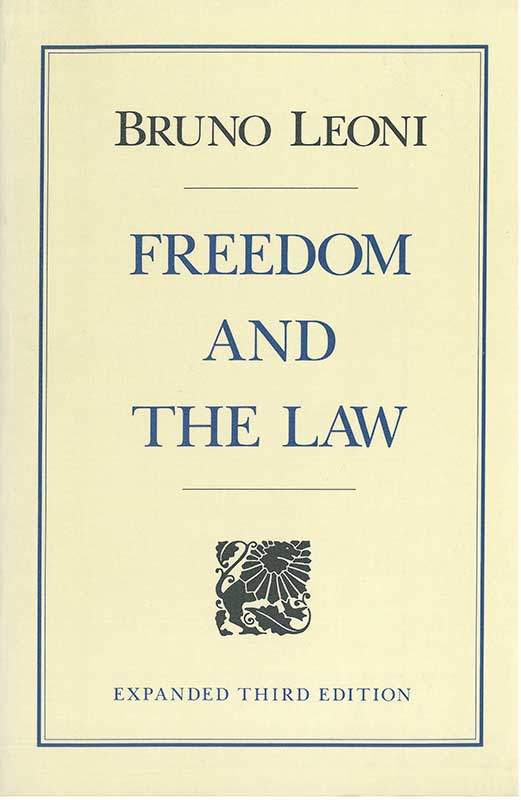
Freedom and the Law, expanded 3rd edition, foreword by Arthur Kemp (Indianapolis: Liberty Fund 1991).

About Liberty Fund:

Liberty Fund, Inc. is a private, educational foundation established to encourage the study of the ideal of a society of free and responsible individuals.


1

The Law as Individual Claim

Contemporary philosophical schools that focus on the analysis of language have probably taught us less than they pretend. Nonetheless, they have reminded us of something that we know well but easily forget. Words are “words,” and it isn’t possible to deal with them as if they were “things” or, to put it another way, as if they were objects of sensorial experience the definitions of which make sense insofar as they refer more or less directly to said experience. The word “law” in particular cannot be dealt with more than others as a “thing”; the less so as it doesn’t have a meaning directly or uniquely referrable to a sensorial experience as such.

Any analysis of the “law” presents itself first as a linguistic analysis, that is, as an attempt to overcome the above-mentioned difficulty in finding out the actual meaning of that word in the language. This is not easy because people may use the word law from many points of view and with meanings which not only change according to the various kinds of people who use that word, but may also change within the language used by the same kind of people. Even among professors of “law” you may notice that the meaning of the word is not always the same. Long-lasting disputes among international lawyers or constitutional lawyers on the one side and civil lawyers on the other may be quoted in this respect.

This difficulty tends to be tiring and discouraging, the result being that people who start a linguistic analysis about the “law” may be tempted to discontinue it sooner or later in order to adopt one of the following three statements: a) law is what my colleagues X, Y, and Z and I know is “law” and we don’t care about other opinions; b) law is what I suggest or I “stipulate” to call in that way without caring very much about other “stipulations” relating to the same word; c) law is everything everybody wants to call in that way whatever that may mean, and it isn’t worthwhile carrying on a research that has no end.

While the third statement leads to skepticism, the former two actually generate the most part of the so-called general theories of law. To be honest, tiredness is not, however, the only source of the two former statements. There is also a practical reason for them. Lawyers or teachers of law are not primarily concerned with a theoretical analysis about the meaning of the word “law.” They directly or indirectly tend, as any legal operator, to practical results such as convincing a judge and winning a case. Any conventional definition that may lead to their goal is welcome.

Supposing, however, that we have no practical goals and try to avoid skepticism at the same time, I think there is only one escape from the arbitrariness of the two former statements: to take into consideration as far as possible all discourses in which the word “law” is involved, in order to see whether we happen to find out a minimal common meaning of the word “law.” This kind of research is not to be confused with that of the lexicographer who limits himself to register one or more meanings of the same word without necessarily worrying about the connections between all the meanings of the same word. This kind of research is only possible if we accept a postulate: that a minimal common meaning does exist. In other words, we must assume that the language of the man in the street, as well as that of the experts on the technicalities of courts, statutes, and precedents, are homogeneous enough to justify the research.1

I daresay that this research of the minimal common meaning of the word “law” is, in the end, the hard destiny of the so-called legal philosopher.

The lack of a preliminary theory of definitions and a satisfactory linguistic approach to the problem of defining the “law” is accountable for the fact that the language adopted in most general theories of law is simply borrowed from the lawyers—or from some kinds of lawyers. It is, therefore, transplanted from a field in which people are only seeking in a more or less direct way for practical results into a quite different field in which people do not care in the least to reach practical results, but try to work out theoretical conclusions.

One of the usual meanings of the word “law” as borrowed in the general theories from the professional lawyers is that of “legal norm” or generally that of a “system” or “ordering” of norms. Actually this “system” or ordering of norms is the conceptual limit not only of the discourses of professional lawyers but also of legal operators in general; that is, of people who tend to solve some practical problems such as of having a debtor pay his creditor or dissolving a marriage and so on. For these purposes, it is sufficient for them to assume that the law is simply the ordering of those norms the “application” of which enables them to reach the above-mentioned ends. Similarly, for economic operators, economy is simply the market or, to put it better, “the market” where they can buy and sell at given prices economic goods or services. People who want to dissolve a marriage or be paid by a debtor need simply to know first the norms concerned, just as people who want to buy or sell any commodities on the market need first to know what their prices are. The reasons why each country has certain norms (possibly different from others of other countries, or of the same country in other times) relating to the dissolving of marriages or paying debts are not usually a matter of concern for legal operators unless they are also personally interested in comparative law or in the history of law. In a precisely similar way, the (often remote) reasons why prices are as they are in a certain market at a given moment are not a matter of interest for sellers or buyers, unless they are historians of economy or economists themselves.

Legal operators on the one side or economic operators on the other side are even less concerned with the reasons why there are norms in general in the legal field and prices in general in the market. Professional lawyers, as well as economic advisors, do not need to know those reasons either, in order to assist their clients. The result is that they all treat norms and, respectively, prices as ultimate data from which they move in order to reach their own ends.

It is, however, the task of the economist to reveal the connections between the actions of the economic operators and the prices of the goods they buy or sell. The task of the legal philosopher is to reconstruct the connections between legal operators and the corresponding norms that they may invoke for their purposes. This means that norms are not the ultimate data of the legal process for the legal philosopher, just as prices are not the ultimate data of the economic process for the economist.

Economists have traced back prices as a social phenomenon ultimately to individual choices between scarce goods. It is my suggestion that legal philosophers as well should trace back legal norms as social phenomena to some individual acts or attitudes. These acts reflect themselves in some way in the norms under a legal system, as individual choices among scarce goods reflect themselves in prices on the market under a monetary system.

I suggest also that those individual acts and attitudes be called demands or claims. Dictionaries define a claim as “a demand for something as due.” I assume in this connection that only individuals can make claims, just as only individuals can make choices. Individuals do make claims as well as choices. But while they do not necessarily need to refer to other individuals to make choices, they need to refer to other individuals to make claims.

I know perfectly well that reducing legal norms to individual claims may seem paradoxical. It may even shock people who move from commonplace assumptions that are at the basis of most contemporary theories of law. Isn’t a norm the expression of a duty? Isn’t a “legal” norm first of all the expression of a legal duty? Are not the legal “rights” (when they exist) the reflection of corresponding duties as fixed in the legal norms? Isn’t a norm, logically considered, a prescriptive sentence? Isn’t the nature of legal duty as expressed in the norm evidenced by sanctions and coercions contemplated in the legal norms themselves? These are some of the “obvious” objections that may be raised against my suggestion. My humble reply is that, just as the norms are not the ultimate data of the legal process, the so-called prescriptive or duty nature of the legal norm is not its ultimate nature for the legal philosopher.

At first sight, the analogy between a so-called legal duty and a moral duty may be tempting indeed. Moral duties are considered as ultimate data of morals in the Kantian tradition. Why shouldn’t we consider legal duties as ultimate data of law as well? Unfortunately, if we do that we get immediately into trouble, as we must first distinguish moral duties from legal ones, in order to locate conceptually the latter. I don’t know of any successful attempt to do that thus far. It is rather common to maintain that legal duties differ from moral ones because the former, at variance with the latter, are presented in connection with some kind of “coercion” or at least with the contemplation of a possible coercion in the formula in which those duties are expressed. I am not very happy with that theory. How can we ignore the fact that many norms which are usually considered as legal (and specifically those which are considered as basic for any legal ordering), lack any coercion, as well as the mention of coercion in the formula in which they are expressed?

Of course, there is a good reason for that, although this reason seems to have escaped many theorists. If abiding with legal norms actually depended in the main on coercion, or even on the mere fear of it, the whole process would be so full of frictions and so difficult that it wouldn’t work. It is curious to note how many people are so highly impressed by the peculiar nature of coercion as a purportedly typical ingredient of legal norms that they tend to overlook completely the very marginal significance of coercion in any actual legal order as a whole.

Sanctions and coercions do not make the law; they just assist it in a limited number of cases, and besides, as I have already pointed out, they may apply only to some kinds of norms that we would consider as subordinate to others. The main norms often do not even mention sanctions or coercions, for the simple reason that no sanction or coercion could assist them in any effective way: such as constitutional norms, in each single nation, or international norms, concerning relationships between nations.

Attempts to distinguish between moral norms and legal norms on other bases are no more convincing than attempts to distinguish sanctions and coercions as purportedly typical ingredients of the legal norms. At least I don’t know of any attempt that has been successful thus far.

In its turn, the often tempting analogy between legal rules on the one hand and technical rules on the other hasn’t succeeded either. Legal rules and technical rules seem to present a similarity because they are both formulated in a “prescriptive” way, and usually move from some hypothesis. The general formula of both kinds of rules is approximately reducible to the following: if you want A you have to do B. But once again, what is difficult here is to locate the area of the so-called legal rules, as distinguishable from technical rules in general. Any attempt to take into consideration at the same time the purported duty nature of the legal norms, together with their purported technical nature, simply complicates the problem even more. Syncretistic theories of the legal norm are little more than metaphors, and do not explain too much. This applies to the theories of the late Professor Alesandro Levi, according to which the legal norm should be a kind of hinge connecting economic and moral rules, as well as those of the late Professor Gurvitch, according to which legal norms would always present a “dramatic tension” by being an inextricable mixture of logic, morals, economy, and so on.

No normative theory of the law has succeeded, thus far, in explaining what a legal norm is, or, to put it another way, what is accountable for the fact that a norm is “legal,” and not, say, “moral” or “technical” or “social.” Nor has the concept of “authority” proved more useful to enable us to distinguish legal norms from others. People are considered as “legal” authorities just because there are some “legal” norms that define or prescribe who is to be considered an “authority” in the legal field. Significantly enough, the top concept of the most celebrated “normative” theories of the law is not that of authority, but that of “norm”: No real authority in the legal sense creates the fundamental norm of a legal system, according to that theory.

The difficulty of centering a general theory of law on the concept of legal norms, and ultimately on the concept of legal duty, as expressed in the legal norm, is all but concealed by the undiscriminating usage of the famous German word Sollen, meaning at the same time the noun “duty” and the verb “to be obliged” or “to have a duty.” It isn’t sufficient at all to use that verb in the infinitive to make us understand what a legal duty is. When I say, “I ought to,” it may mean any one of these three things: a) I have the moral duty of . . .; b) I am forced to . . . if I want to reach the result I wish; c) somebody wants me “legally” to do. . . .

It may well happen that more than one or even all the three meanings mentioned above are present in the expression, “I ought to.” But nonetheless, they are three different meanings that should not be confused with each other. Only the third one appears to be the legal meaning of the expression. But the difference between this legal meaning and the meanings mentioned above under a) or under b) lies just in the fact that in the former legal meaning I refer to the will of somebody who wants me to do what I ought to do. The meaning under a) refers just to my moral feeling, which may be considered as an ultimate datum in the Kantian way; the meaning of b) refers to the hypothesis that I wish something, which is an effect of a cause I may determine through my action. At variance with both the meanings of a) and b), the meaning of c) refers, ultimately, to a claim on the part of other people relating to myself. If nobody wanted me legally to do something, there would actually be no legal duty on my part, and the expression “I ought to” would have no legal meaning at all. Briefly, the expression “I ought to,” taken in the legal sense, is not explainable without reducing it to the (legal) claim of somebody else.

Of course, now we should define what a claim is and what a legal claim is. This means that we have to lift our attention from people who say “I ought to” to people who say, “I have a claim,” or “I demand,” or “I intend,” or “I request.” Without those people there is no “law,” even if other people are left who do not feel the corresponding way—even if these people who are left feel moral duties or adopt technical rules. This doesn’t mean, of course, that claims are satisfied if people whose behavior is the object of a claim do not feel the corresponding moral duty of satisfying that claim, or if they do not realize that it is “technically” expedient for them to satisfy said claims. But while the central concept in the meaning under a) is that of duty, and the central concept in the meaning under b) is that of expediency, the central concept in the meaning under c) turns out to be, in the end, that of a claim on the part of other people.

What does “claiming” mean? Psychologically, claiming is a complex act. First of all, it is obvious that not all demands are legal claims, according to the discourses we can take into consideration in this respect. The robber who waits for me in a dark and lonely place “demands” my money. On the other hand, a lender demands my money if I have to give him back a sum. But while the former demand would usually be considered “illegal” in all countries of the world, the latter is usually considered everywhere “legal.” It seems to me that the most obvious difference between the two demands is that everybody (including robbers) usually intends not to be robbed by anyone else. Everybody usually intends to get back the money he has lent, including those scoundrels who try to avoid giving back the money they have borrowed from their creditors. The robber or the scoundrel makes a special demand, which is in contradiction with the common demand, the latter being a demand that they would make themselves towards all other possible robbers or debtors in bad faith.

The supporters of the “normative” theory of the law may object that what enables us to speak of a contradiction between “common” demands and “special” ones is actually the existence of a “norm,” and namely, of a legal norm. I wish to counter, however, that it isn’t necessary at all to think of a norm of the legal type as a criterion to discover the above-mentioned contradiction. The classic notion of “id quod plerumque accidit” (what usually happens) in a given society would be fairly sufficient to enable us to tell “legal” from “illegal” demands. Statistically, the probability that a passer-by transforms himself into a robber when he meets another passer-by in a lonely place is comparatively low, and lower, at any rate, than the contrary at any given time. The same applies to one who borrows money, and the probability that he does not intend to give it back at all. The popular Russian saying “where everybody robs, nobody is a robber” is true. That is, where everybody robs, the very premises are lacking to define the robber, since there is no actually organized community. The demand we have qualified as special is statistically not probable in the community. It is, so to say, an exception to the rule, and I mean by rule, in general, not necessarily a legal norm, but a description of actual events according to a scheme.

What is implied in the demand of a creditor when he wants to be paid by his debtor is the prevision that his debtor will pay. What is implied in the demand of a passer-by not to be disturbed or robbed by anybody is in its turn a prevision that nobody will disturb him. Probability judgments are at the basis of their respective claims.

On the other hand, what is implied in the attitude of a robber or of a debtor of bad faith when he wants to reach his own ends is the prevision that his demand would simply not be satisfied by his victims under normal circumstances. This is the reason why such a person tries to put himself and/or the victim in a very special situation, in order to increase the usually low probabilities of being satisfied in his special demands.

I suggest calling “legal” exactly those demands or claims that have a good probability of being satisfied by corresponding people in a given society at any given time, the reasons why they may be satisfied in each single case being variable and based alternatively or jointly on moral or technical rules.

“Illegal demands or claims” on the contrary, are those that have little or no probability of being satisfied by the corresponding people under normal circumstances.” (As when a robber would demand money on a busy street in broad daylight.)

Clearly “legal” demands on one hand, and clearly “illegal” demands on the other are located at the opposite ends of a spectrum comprising all demands that people may make in any given society at any given time. One should not forget, however, the huge intermediate sector of less definable “quasi-legal” or “quasi-illegal” demands whose probabilities of being satisfied are lower than those of clearly “legal” demands, but still higher than those of clearly “illegal” ones.

The position of many, if not all, demands in the spectrum may change and is actually changing in any society at any given time. This process, to use Justinian’s famous words, “semper in infinitum decurrit” (is always continuing), and we could not grasp it without introducing the time dimension. New demands may appear while old ones fade away, and present demands may change their position in the spectrum. The whole process may be therefore described as a continuous change of the respective probabilities that all demands have to be satisfied in a given society at any given time.

Demands or claims, as we saw, are based on previsions. They are not, however, reducible to mere previsions. The position of the legal operator is not simply that of an astronomer who foresees an eclipse. It resembles the position of said astronomer if the latter not only foresaw but also wanted the eclipse to take place for some reason of his own and could influence that event through his own action. No demand is possible without an element of will, on the basis of which there is an interest of the person concerned. On the other hand, no will of the latter is possible without being based on the above-mentioned prevision. Of course, we must distinguish between several kinds of previsions, relating to the ultimate goal we want to reach when we make a demand. One can foresee, as creditor, that his debtor will pay him, but the creditor also wants his debtor to pay him, and is determined to use some means at his disposal to have the latter pay his debt. This doesn’t necessarily mean that he wants or needs to resort to “coercion” of any kind. Maybe the debtor will pay willingly, maybe he will pay just when the creditor reminds him of it, or after a little argument, reproach, and so on. Even while the creditor resorts to the so-called coercion (or the threat of it), this concept is not so relevant in the whole process as it may appear at first sight, for coercion applied to the debtor needs the cooperation of the people who have to apply said coercion. These people may, once again, apply coercion willingly or, once again, after a personal intervention of the creditor, without necessarily implying the need for the creditor to resort to other kinds of coercion on the latter people to provoke coercion on his debtor. The relevant concept here is, as before, not coercion but the will of the creditor to obtain behavior that he foresees as statistically probable, on the part of other people.2

Claims intermingle and may even conflict against each other, “legal” against “illegal,” and also “legal” against “legal,” and “illegal” against “illegal,” their respective success depending on their respective probabilities of being satisfied by the people concerned.

It is interesting to compare the results of the analysis outlined above with some of the main concepts of lawyers and, I might add, of all legal operators. I have already stated that they usually move from the concept of legal norm instead of that of “legal claim.” Even those lawyers who tried to theorize the concept of legal claim as a basic concept of the legal language got involved in contradictions whenever they clung to the concept of legal norm as the ultimate one from which to move to develop their theories.

I must now underline some other differences that we can notice in the language and, respectively, in the frame of mind of lawyers and legal operators in general, as compared with the language that I have suggested as typical of the legal philosopher. Not only do lawyers “deduce” legal claims from legal norms, but they also conceive of their deductions as the only possible ones. Claims are legal for lawyers if they are “derivable” from a legal norm, and illegal if they are not. In turn, norms are legal or illegal according to their being or not being accepted by said lawyers and legal operators in general, in order to reach their own practical ends. Tertium non datum. The picture of the norms and, respectively, of the claims by legal operators, is always, so to say, black and white. Besides, no time dimension is implied in the picture; the legal operators care for the legal norm of today and not for that of yesterday or tomorrow. Finally, they only care for the legal norm they have accepted, as such, in view of their own practical ends, and ignore all others. They have an exclusive view of the legal society. In fact, they only care for their own legal society. They may refer as well to other societies, but only insofar as the latter are acceptable or rejectable to them, on the basis of the only norms they have accepted. What legal operators actually need is to make some claims, and their frame of mind as well as their language is adapted to this end. On the contrary, the legal operator doesn’t want to make or to support any claim of his own, but just to use existing claims in order to reconstruct their basic connections with each other, and with the legal norms in any given society at any given time.

The legal philosopher not only moves from the concept of claims, but also realizes that claims may be conflicting. Even more, he realizes that claims may be conflicting while all are considered “legal” by different people at the same time. The legal philosopher’s picture of the law is, therefore, never black and white, because he has to take into account in his picture a whole sector of claims that the lawyers do not care about. He knows that it is exactly in that sector that things happen which may change the whole picture of the legal operator at any given time. The legal philosopher knows also that there is not one legal society, namely, that accepted by each legal operator, for practical reasons, but also other “legal” societies that may be conflicting with the former, and that other people have accepted in their turn for their own practical reasons. The resulting picture, as given by the legal philosopher, is nuanced and multilateral and unfolding through time, like those Japanese paintings that you can inspect only by unrolling the long roll of paper in which they are contained. In the philosopher’s view, the legal norm has not only a different place than in the picture of the legal operator, but it has a different meaning. A legal norm is a rule in a statistical sense, while a legal norm in the view of the legal operator is just the description of the claims that he considers as legal, regardless of all other possibly contradictory claims.

The difference between the two points of view is not always so easy to discern. Both the legal operator and the legal philosopher consider in the end as legal claims whose satisfaction they consider as probable. While the legal operator is engaged in the process of influencing that probable event, the legal philosopher is not; he waits to see. Both the legal philosopher and the legal operator consider the legal norm as a sentence expressing claims. While the legal operator invokes the sentence to support his own claims, the legal philosopher studies said sentences as a reflection of claims that are not necessarily his own. As a result, the legal operator does not put in doubt the validity of the sentence just because he doesn’t put in doubt the validity of his (corresponding) claims. The legal philosopher is always ready to scrutinize the sentence in order to find out whether it describes accurately “legal” claims in the statistical sense.

From these two different points of view descend two different views of legal norms and of their significance in the whole legal process. The legal operator intends that fixing legal norms, say, by legislation, is the origin of the whole legal process. The legal philosopher, on the other hand, has to consider it as only one of the factors of said process, and not even the decisive one. As a matter of fact, legislation does not necessarily describe the statistically legal claims, although, of course, it may influence the probabilities of their being satisfied at any given time, and in any given society. Indeed, only a few people (the representatives of the people) participate directly in the process of making legislation, and what they do is just describe the claims they make or support, without having them necessarily coincide with claims actually, or going actually to be, satisfied, as a rule, in that society. It is typical that there has been a strong tendency in all times (and this applies especially to our contemporary age) to overrate, if not the accuracy of the description of statistically “legal” claims on the part of legislators, at least the power of the latter to influence the probabilities of the already existing legal claims through legislation.

I would suggest that this tendency is the practical counterpart of the theoretical assumption which puts the “norms” at the beginning of the whole legal process and considers claims only as a logical consequence of normative “prescriptions.” I suggest that the task of the legal philosopher, besides that of reconstructing the real connections between statistically legal claims and legal norms, is that of reminding all legal operators that fixing legal norms has a limited scope in any legal process.

We may consider legislation as a more or less successful attempt to describe the statistically legal claims, besides “prescribing” them. What legislators describe may be: a) what they think the actual statistically legal norms to be in their own society, or b) what they think the actual statistically legal norms will be in that society as a result of their legislation and of the employment of the means they think they have at their disposal (namely, psychological or physical coercion) to produce that result. But once again we must go back at this point to what I noticed before, relating to coercion and its significance in the legal process as a whole. Legislation, in describing a situation that the legislators want in the future, is confronted with the difficulties arising from the marginal significance of coercion in the legal process. Of course, legislation may also describe simply what the present legal situation is, without tending to change it, or even with the very purpose of maintaining it. Legal codes such as those enacted in the last century in Europe are an example in point. Acts and statutes as they are enacted in this century all over the world are mostly an example of legislation that tends to change the already existing situation. In all cases, legislation is both the presentation of claims supported by the legislators themselves and a description of claims that are to be considered as statistically legal in their own society by said legislators. The degree in which each of these two aspects is present in any legislation may vary considerably.

Similar remarks apply to other ways of fixing legal norms besides legislation, such as those performed by judges. The decisions of a judge or the responses of a juris-consult (as in Roman times) are always both presentations of claims that are considered as statistically legal on the one hand, and presentations of claims that are also supported personally, on the other hand, to a certain degree, by their authors. Lawyers and judges, however, are even more conditioned than legislators in their attempt to support their own claims, while describing, at the same time, the statistically legal claims in their own societies at a given time. While the work of the legislator is intended to be, at least by definition, unconditioned, the work of a judge or a juris-consult is by its very definition conditioned by precedents, statutes, and the very claims of the parties concerned. Even more than in the legislator’s case, judges and juris-consults are confronted with the marginal significance of coercion and other means to influence the probabilities of existing claims being satisfied by the people concerned.

The legal process always traces back in the end to individual claim. Individuals make the law, insofar as they make successful claims. They not only make previsions and predictions, but try to have these predictions succeed by their own intervention in the process. Judges, juris-consults, and, above all, legislators are just individuals who find themselves in a particular position to influence the whole process through their own intervention. As I have stated, the possibilities of this intervention are limited and should not be overrated. May I add that we should not overrate, on the other hand, the distortions that the intervention of those particular individuals and, above all, of the legislators, may provoke in the whole process.

Legal norms, whatever be their origin, decisions of judges, responses of juris-consults, or statutes, almost always influence that process to a point. Even when they simply describe the already existing situation of the legal claims, they tend, at least, to perpetuate that situation by presenting to people a clear-cut picture of what is going on in the already existing legal process. On the other hand, when legal norms describe a future situation that their authors wish to attain by influencing the existing legal process, they may well succeed in preventing people from succeeding in their own claims, even if the authors don’t succeed in imposing the satisfaction of other (contrary) claims. To be sure, there is a negative result of legal norms that is more effective than any positive one, since it is easier to prevent people from doing something they want than to force them actually to do something they do not want. Individuals who are in a special position in the legal process may take advantage of it, but not so much as they want or possibly think. Unless I am wrong, this is a teaching that has been more or less obscurely imparted to us by old natural law doctrines; that is, by the doctrine of the rights of man. This teaching should serve those doctrines, although it lacks, or just because it lacks, practical emphasis. It is not so much a claim by a legal operator as a theoretical conclusion of the legal philosopher.

[1 ] I have no need to explain at length why I call that a postulate. Indeed, no demonstration of said assumption could be supplied until the research is finished and it is obvious that the latter is practically inexhaustible owing to the great number of languages and meanings which should be taken into consideration.

[2 ] I suggest, in this condition, calling power our possibility of being satisfied in our demands regardless of the reasons why they are satisfied, and legal power our possibility of being satisfied in our legal demands, regardless, once again, of the reasons that induce other people to satisfy them, or to have them satisfied some way or other by the people concerned.