EconlibThe LibraryOther Sites |
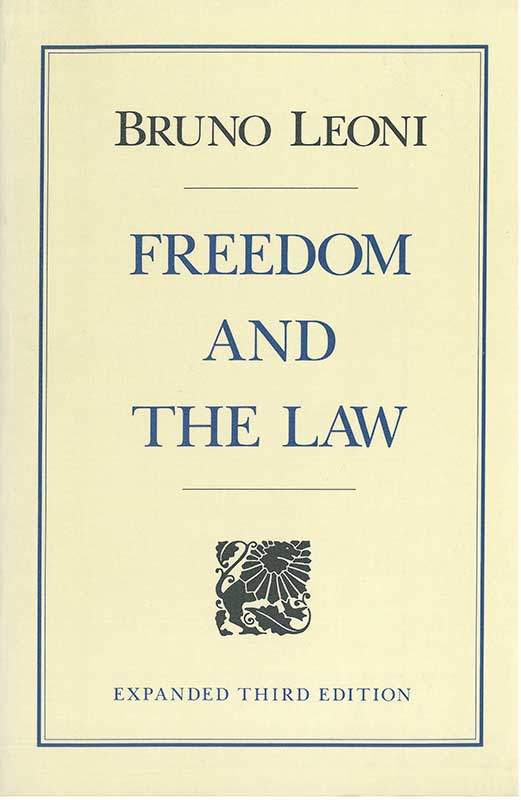
Front Page Titles (by Subject) THE LAW AND POLITICS - Freedom and the Law (LF ed.)
Return to Title Page for Freedom and the Law (LF ed.)The Online Library of LibertyA project of Liberty Fund, Inc.Search this Title:Also in the Library:
THE LAW AND POLITICS - Bruno Leoni, Freedom and the Law (LF ed.) [1961]Edition used:Freedom and the Law, expanded 3rd edition, foreword by Arthur Kemp (Indianapolis: Liberty Fund 1991).
About Liberty Fund:Liberty Fund, Inc. is a private, educational foundation established to encourage the study of the ideal of a society of free and responsible individuals. Copyright information:This work is copyrighted by the Institute for Humane Studies, George Mason University, Fairfax, Virginia, and is put online with their permission. Fair use statement:This material is put online to further the educational goals of Liberty Fund, Inc. Unless otherwise stated in the Copyright Information section above, this material may be used freely for educational and academic purposes. It may not be used in any way for profit.
THE LAW AND POLITICSThis series of lectures under the general heading “The Law as Individual Claim” was given at the Freedom School Phrontistery in Colorado Springs, Colorado, December 2-6, 1963. The Phrontistery (after the Greek word for “a place for thinking”) was an experimental six-month program that ran from November 1963 through April 1964. It offered eighteen selected students the opportunity for intensive individual study on questions of human liberty. It was intended to develop material for a curriculum for a proposed Ramparts College liberal arts program. Eleven distinguished scholars gave lectures at various times throughout the period. In addition to Dr. Leoni, the lecturers included: Drs. G. Warren Nutter, Roger J. Williams, Arthur A. Ekirch, Milton Friedman, Sylvester Petro, Ludwig von Mises, Oscar W. Cooley, James J. Martin, F. A. Harper, and Gordon Tullock. A version of the first chapter appeared in 1964 in a slightly different form in Archives for Philosophy of Law and Social Philosophy, Hermann Luchterhand Verlag, Berlin, Germany. Chapter 3 was based largely on two earlier articles: “The Economic Approach to Politics,” Il Politico, Vol. 26, No. 3, 1961, pp. 491-502; and “The Meaning of “Political” in Political Decisions,” Political Studies, Vol. 5, No. 3, October 1957, pp. 225-239. Chapter 4 was based on “Political Decisions and Majority Rule,” Il Politico, Vol. 25, No. 4, 1960, pp. 724-733. These lectures were not originally footnoted. Notes have been added for this edition. 1The Law as Individual ClaimContemporary philosophical schools that focus on the analysis of language have probably taught us less than they pretend. Nonetheless, they have reminded us of something that we know well but easily forget. Words are “words,” and it isn’t possible to deal with them as if they were “things” or, to put it another way, as if they were objects of sensorial experience the definitions of which make sense insofar as they refer more or less directly to said experience. The word “law” in particular cannot be dealt with more than others as a “thing”; the less so as it doesn’t have a meaning directly or uniquely referrable to a sensorial experience as such. Any analysis of the “law” presents itself first as a linguistic analysis, that is, as an attempt to overcome the above-mentioned difficulty in finding out the actual meaning of that word in the language. This is not easy because people may use the word law from many points of view and with meanings which not only change according to the various kinds of people who use that word, but may also change within the language used by the same kind of people. Even among professors of “law” you may notice that the meaning of the word is not always the same. Long-lasting disputes among international lawyers or constitutional lawyers on the one side and civil lawyers on the other may be quoted in this respect. This difficulty tends to be tiring and discouraging, the result being that people who start a linguistic analysis about the “law” may be tempted to discontinue it sooner or later in order to adopt one of the following three statements: a) law is what my colleagues X, Y, and Z and I know is “law” and we don’t care about other opinions; b) law is what I suggest or I “stipulate” to call in that way without caring very much about other “stipulations” relating to the same word; c) law is everything everybody wants to call in that way whatever that may mean, and it isn’t worthwhile carrying on a research that has no end. While the third statement leads to skepticism, the former two actually generate the most part of the so-called general theories of law. To be honest, tiredness is not, however, the only source of the two former statements. There is also a practical reason for them. Lawyers or teachers of law are not primarily concerned with a theoretical analysis about the meaning of the word “law.” They directly or indirectly tend, as any legal operator, to practical results such as convincing a judge and winning a case. Any conventional definition that may lead to their goal is welcome. Supposing, however, that we have no practical goals and try to avoid skepticism at the same time, I think there is only one escape from the arbitrariness of the two former statements: to take into consideration as far as possible all discourses in which the word “law” is involved, in order to see whether we happen to find out a minimal common meaning of the word “law.” This kind of research is not to be confused with that of the lexicographer who limits himself to register one or more meanings of the same word without necessarily worrying about the connections between all the meanings of the same word. This kind of research is only possible if we accept a postulate: that a minimal common meaning does exist. In other words, we must assume that the language of the man in the street, as well as that of the experts on the technicalities of courts, statutes, and precedents, are homogeneous enough to justify the research.1 I daresay that this research of the minimal common meaning of the word “law” is, in the end, the hard destiny of the so-called legal philosopher. The lack of a preliminary theory of definitions and a satisfactory linguistic approach to the problem of defining the “law” is accountable for the fact that the language adopted in most general theories of law is simply borrowed from the lawyers—or from some kinds of lawyers. It is, therefore, transplanted from a field in which people are only seeking in a more or less direct way for practical results into a quite different field in which people do not care in the least to reach practical results, but try to work out theoretical conclusions. One of the usual meanings of the word “law” as borrowed in the general theories from the professional lawyers is that of “legal norm” or generally that of a “system” or “ordering” of norms. Actually this “system” or ordering of norms is the conceptual limit not only of the discourses of professional lawyers but also of legal operators in general; that is, of people who tend to solve some practical problems such as of having a debtor pay his creditor or dissolving a marriage and so on. For these purposes, it is sufficient for them to assume that the law is simply the ordering of those norms the “application” of which enables them to reach the above-mentioned ends. Similarly, for economic operators, economy is simply the market or, to put it better, “the market” where they can buy and sell at given prices economic goods or services. People who want to dissolve a marriage or be paid by a debtor need simply to know first the norms concerned, just as people who want to buy or sell any commodities on the market need first to know what their prices are. The reasons why each country has certain norms (possibly different from others of other countries, or of the same country in other times) relating to the dissolving of marriages or paying debts are not usually a matter of concern for legal operators unless they are also personally interested in comparative law or in the history of law. In a precisely similar way, the (often remote) reasons why prices are as they are in a certain market at a given moment are not a matter of interest for sellers or buyers, unless they are historians of economy or economists themselves. Legal operators on the one side or economic operators on the other side are even less concerned with the reasons why there are norms in general in the legal field and prices in general in the market. Professional lawyers, as well as economic advisors, do not need to know those reasons either, in order to assist their clients. The result is that they all treat norms and, respectively, prices as ultimate data from which they move in order to reach their own ends. It is, however, the task of the economist to reveal the connections between the actions of the economic operators and the prices of the goods they buy or sell. The task of the legal philosopher is to reconstruct the connections between legal operators and the corresponding norms that they may invoke for their purposes. This means that norms are not the ultimate data of the legal process for the legal philosopher, just as prices are not the ultimate data of the economic process for the economist. Economists have traced back prices as a social phenomenon ultimately to individual choices between scarce goods. It is my suggestion that legal philosophers as well should trace back legal norms as social phenomena to some individual acts or attitudes. These acts reflect themselves in some way in the norms under a legal system, as individual choices among scarce goods reflect themselves in prices on the market under a monetary system. I suggest also that those individual acts and attitudes be called demands or claims. Dictionaries define a claim as “a demand for something as due.” I assume in this connection that only individuals can make claims, just as only individuals can make choices. Individuals do make claims as well as choices. But while they do not necessarily need to refer to other individuals to make choices, they need to refer to other individuals to make claims. I know perfectly well that reducing legal norms to individual claims may seem paradoxical. It may even shock people who move from commonplace assumptions that are at the basis of most contemporary theories of law. Isn’t a norm the expression of a duty? Isn’t a “legal” norm first of all the expression of a legal duty? Are not the legal “rights” (when they exist) the reflection of corresponding duties as fixed in the legal norms? Isn’t a norm, logically considered, a prescriptive sentence? Isn’t the nature of legal duty as expressed in the norm evidenced by sanctions and coercions contemplated in the legal norms themselves? These are some of the “obvious” objections that may be raised against my suggestion. My humble reply is that, just as the norms are not the ultimate data of the legal process, the so-called prescriptive or duty nature of the legal norm is not its ultimate nature for the legal philosopher. At first sight, the analogy between a so-called legal duty and a moral duty may be tempting indeed. Moral duties are considered as ultimate data of morals in the Kantian tradition. Why shouldn’t we consider legal duties as ultimate data of law as well? Unfortunately, if we do that we get immediately into trouble, as we must first distinguish moral duties from legal ones, in order to locate conceptually the latter. I don’t know of any successful attempt to do that thus far. It is rather common to maintain that legal duties differ from moral ones because the former, at variance with the latter, are presented in connection with some kind of “coercion” or at least with the contemplation of a possible coercion in the formula in which those duties are expressed. I am not very happy with that theory. How can we ignore the fact that many norms which are usually considered as legal (and specifically those which are considered as basic for any legal ordering), lack any coercion, as well as the mention of coercion in the formula in which they are expressed? Of course, there is a good reason for that, although this reason seems to have escaped many theorists. If abiding with legal norms actually depended in the main on coercion, or even on the mere fear of it, the whole process would be so full of frictions and so difficult that it wouldn’t work. It is curious to note how many people are so highly impressed by the peculiar nature of coercion as a purportedly typical ingredient of legal norms that they tend to overlook completely the very marginal significance of coercion in any actual legal order as a whole. Sanctions and coercions do not make the law; they just assist it in a limited number of cases, and besides, as I have already pointed out, they may apply only to some kinds of norms that we would consider as subordinate to others. The main norms often do not even mention sanctions or coercions, for the simple reason that no sanction or coercion could assist them in any effective way: such as constitutional norms, in each single nation, or international norms, concerning relationships between nations. Attempts to distinguish between moral norms and legal norms on other bases are no more convincing than attempts to distinguish sanctions and coercions as purportedly typical ingredients of the legal norms. At least I don’t know of any attempt that has been successful thus far. In its turn, the often tempting analogy between legal rules on the one hand and technical rules on the other hasn’t succeeded either. Legal rules and technical rules seem to present a similarity because they are both formulated in a “prescriptive” way, and usually move from some hypothesis. The general formula of both kinds of rules is approximately reducible to the following: if you want A you have to do B. But once again, what is difficult here is to locate the area of the so-called legal rules, as distinguishable from technical rules in general. Any attempt to take into consideration at the same time the purported duty nature of the legal norms, together with their purported technical nature, simply complicates the problem even more. Syncretistic theories of the legal norm are little more than metaphors, and do not explain too much. This applies to the theories of the late Professor Alesandro Levi, according to which the legal norm should be a kind of hinge connecting economic and moral rules, as well as those of the late Professor Gurvitch, according to which legal norms would always present a “dramatic tension” by being an inextricable mixture of logic, morals, economy, and so on. No normative theory of the law has succeeded, thus far, in explaining what a legal norm is, or, to put it another way, what is accountable for the fact that a norm is “legal,” and not, say, “moral” or “technical” or “social.” Nor has the concept of “authority” proved more useful to enable us to distinguish legal norms from others. People are considered as “legal” authorities just because there are some “legal” norms that define or prescribe who is to be considered an “authority” in the legal field. Significantly enough, the top concept of the most celebrated “normative” theories of the law is not that of authority, but that of “norm”: No real authority in the legal sense creates the fundamental norm of a legal system, according to that theory. The difficulty of centering a general theory of law on the concept of legal norms, and ultimately on the concept of legal duty, as expressed in the legal norm, is all but concealed by the undiscriminating usage of the famous German word Sollen, meaning at the same time the noun “duty” and the verb “to be obliged” or “to have a duty.” It isn’t sufficient at all to use that verb in the infinitive to make us understand what a legal duty is. When I say, “I ought to,” it may mean any one of these three things: a) I have the moral duty of . . .; b) I am forced to . . . if I want to reach the result I wish; c) somebody wants me “legally” to do. . . . It may well happen that more than one or even all the three meanings mentioned above are present in the expression, “I ought to.” But nonetheless, they are three different meanings that should not be confused with each other. Only the third one appears to be the legal meaning of the expression. But the difference between this legal meaning and the meanings mentioned above under a) or under b) lies just in the fact that in the former legal meaning I refer to the will of somebody who wants me to do what I ought to do. The meaning under a) refers just to my moral feeling, which may be considered as an ultimate datum in the Kantian way; the meaning of b) refers to the hypothesis that I wish something, which is an effect of a cause I may determine through my action. At variance with both the meanings of a) and b), the meaning of c) refers, ultimately, to a claim on the part of other people relating to myself. If nobody wanted me legally to do something, there would actually be no legal duty on my part, and the expression “I ought to” would have no legal meaning at all. Briefly, the expression “I ought to,” taken in the legal sense, is not explainable without reducing it to the (legal) claim of somebody else. Of course, now we should define what a claim is and what a legal claim is. This means that we have to lift our attention from people who say “I ought to” to people who say, “I have a claim,” or “I demand,” or “I intend,” or “I request.” Without those people there is no “law,” even if other people are left who do not feel the corresponding way—even if these people who are left feel moral duties or adopt technical rules. This doesn’t mean, of course, that claims are satisfied if people whose behavior is the object of a claim do not feel the corresponding moral duty of satisfying that claim, or if they do not realize that it is “technically” expedient for them to satisfy said claims. But while the central concept in the meaning under a) is that of duty, and the central concept in the meaning under b) is that of expediency, the central concept in the meaning under c) turns out to be, in the end, that of a claim on the part of other people. What does “claiming” mean? Psychologically, claiming is a complex act. First of all, it is obvious that not all demands are legal claims, according to the discourses we can take into consideration in this respect. The robber who waits for me in a dark and lonely place “demands” my money. On the other hand, a lender demands my money if I have to give him back a sum. But while the former demand would usually be considered “illegal” in all countries of the world, the latter is usually considered everywhere “legal.” It seems to me that the most obvious difference between the two demands is that everybody (including robbers) usually intends not to be robbed by anyone else. Everybody usually intends to get back the money he has lent, including those scoundrels who try to avoid giving back the money they have borrowed from their creditors. The robber or the scoundrel makes a special demand, which is in contradiction with the common demand, the latter being a demand that they would make themselves towards all other possible robbers or debtors in bad faith. The supporters of the “normative” theory of the law may object that what enables us to speak of a contradiction between “common” demands and “special” ones is actually the existence of a “norm,” and namely, of a legal norm. I wish to counter, however, that it isn’t necessary at all to think of a norm of the legal type as a criterion to discover the above-mentioned contradiction. The classic notion of “id quod plerumque accidit” (what usually happens) in a given society would be fairly sufficient to enable us to tell “legal” from “illegal” demands. Statistically, the probability that a passer-by transforms himself into a robber when he meets another passer-by in a lonely place is comparatively low, and lower, at any rate, than the contrary at any given time. The same applies to one who borrows money, and the probability that he does not intend to give it back at all. The popular Russian saying “where everybody robs, nobody is a robber” is true. That is, where everybody robs, the very premises are lacking to define the robber, since there is no actually organized community. The demand we have qualified as special is statistically not probable in the community. It is, so to say, an exception to the rule, and I mean by rule, in general, not necessarily a legal norm, but a description of actual events according to a scheme. What is implied in the demand of a creditor when he wants to be paid by his debtor is the prevision that his debtor will pay. What is implied in the demand of a passer-by not to be disturbed or robbed by anybody is in its turn a prevision that nobody will disturb him. Probability judgments are at the basis of their respective claims. On the other hand, what is implied in the attitude of a robber or of a debtor of bad faith when he wants to reach his own ends is the prevision that his demand would simply not be satisfied by his victims under normal circumstances. This is the reason why such a person tries to put himself and/or the victim in a very special situation, in order to increase the usually low probabilities of being satisfied in his special demands. I suggest calling “legal” exactly those demands or claims that have a good probability of being satisfied by corresponding people in a given society at any given time, the reasons why they may be satisfied in each single case being variable and based alternatively or jointly on moral or technical rules. “Illegal demands or claims” on the contrary, are those that have little or no probability of being satisfied by the corresponding people under normal circumstances.” (As when a robber would demand money on a busy street in broad daylight.) Clearly “legal” demands on one hand, and clearly “illegal” demands on the other are located at the opposite ends of a spectrum comprising all demands that people may make in any given society at any given time. One should not forget, however, the huge intermediate sector of less definable “quasi-legal” or “quasi-illegal” demands whose probabilities of being satisfied are lower than those of clearly “legal” demands, but still higher than those of clearly “illegal” ones. The position of many, if not all, demands in the spectrum may change and is actually changing in any society at any given time. This process, to use Justinian’s famous words, “semper in infinitum decurrit” (is always continuing), and we could not grasp it without introducing the time dimension. New demands may appear while old ones fade away, and present demands may change their position in the spectrum. The whole process may be therefore described as a continuous change of the respective probabilities that all demands have to be satisfied in a given society at any given time. Demands or claims, as we saw, are based on previsions. They are not, however, reducible to mere previsions. The position of the legal operator is not simply that of an astronomer who foresees an eclipse. It resembles the position of said astronomer if the latter not only foresaw but also wanted the eclipse to take place for some reason of his own and could influence that event through his own action. No demand is possible without an element of will, on the basis of which there is an interest of the person concerned. On the other hand, no will of the latter is possible without being based on the above-mentioned prevision. Of course, we must distinguish between several kinds of previsions, relating to the ultimate goal we want to reach when we make a demand. One can foresee, as creditor, that his debtor will pay him, but the creditor also wants his debtor to pay him, and is determined to use some means at his disposal to have the latter pay his debt. This doesn’t necessarily mean that he wants or needs to resort to “coercion” of any kind. Maybe the debtor will pay willingly, maybe he will pay just when the creditor reminds him of it, or after a little argument, reproach, and so on. Even while the creditor resorts to the so-called coercion (or the threat of it), this concept is not so relevant in the whole process as it may appear at first sight, for coercion applied to the debtor needs the cooperation of the people who have to apply said coercion. These people may, once again, apply coercion willingly or, once again, after a personal intervention of the creditor, without necessarily implying the need for the creditor to resort to other kinds of coercion on the latter people to provoke coercion on his debtor. The relevant concept here is, as before, not coercion but the will of the creditor to obtain behavior that he foresees as statistically probable, on the part of other people.2 Claims intermingle and may even conflict against each other, “legal” against “illegal,” and also “legal” against “legal,” and “illegal” against “illegal,” their respective success depending on their respective probabilities of being satisfied by the people concerned. It is interesting to compare the results of the analysis outlined above with some of the main concepts of lawyers and, I might add, of all legal operators. I have already stated that they usually move from the concept of legal norm instead of that of “legal claim.” Even those lawyers who tried to theorize the concept of legal claim as a basic concept of the legal language got involved in contradictions whenever they clung to the concept of legal norm as the ultimate one from which to move to develop their theories. I must now underline some other differences that we can notice in the language and, respectively, in the frame of mind of lawyers and legal operators in general, as compared with the language that I have suggested as typical of the legal philosopher. Not only do lawyers “deduce” legal claims from legal norms, but they also conceive of their deductions as the only possible ones. Claims are legal for lawyers if they are “derivable” from a legal norm, and illegal if they are not. In turn, norms are legal or illegal according to their being or not being accepted by said lawyers and legal operators in general, in order to reach their own practical ends. Tertium non datum. The picture of the norms and, respectively, of the claims by legal operators, is always, so to say, black and white. Besides, no time dimension is implied in the picture; the legal operators care for the legal norm of today and not for that of yesterday or tomorrow. Finally, they only care for the legal norm they have accepted, as such, in view of their own practical ends, and ignore all others. They have an exclusive view of the legal society. In fact, they only care for their own legal society. They may refer as well to other societies, but only insofar as the latter are acceptable or rejectable to them, on the basis of the only norms they have accepted. What legal operators actually need is to make some claims, and their frame of mind as well as their language is adapted to this end. On the contrary, the legal operator doesn’t want to make or to support any claim of his own, but just to use existing claims in order to reconstruct their basic connections with each other, and with the legal norms in any given society at any given time. The legal philosopher not only moves from the concept of claims, but also realizes that claims may be conflicting. Even more, he realizes that claims may be conflicting while all are considered “legal” by different people at the same time. The legal philosopher’s picture of the law is, therefore, never black and white, because he has to take into account in his picture a whole sector of claims that the lawyers do not care about. He knows that it is exactly in that sector that things happen which may change the whole picture of the legal operator at any given time. The legal philosopher knows also that there is not one legal society, namely, that accepted by each legal operator, for practical reasons, but also other “legal” societies that may be conflicting with the former, and that other people have accepted in their turn for their own practical reasons. The resulting picture, as given by the legal philosopher, is nuanced and multilateral and unfolding through time, like those Japanese paintings that you can inspect only by unrolling the long roll of paper in which they are contained. In the philosopher’s view, the legal norm has not only a different place than in the picture of the legal operator, but it has a different meaning. A legal norm is a rule in a statistical sense, while a legal norm in the view of the legal operator is just the description of the claims that he considers as legal, regardless of all other possibly contradictory claims. The difference between the two points of view is not always so easy to discern. Both the legal operator and the legal philosopher consider in the end as legal claims whose satisfaction they consider as probable. While the legal operator is engaged in the process of influencing that probable event, the legal philosopher is not; he waits to see. Both the legal philosopher and the legal operator consider the legal norm as a sentence expressing claims. While the legal operator invokes the sentence to support his own claims, the legal philosopher studies said sentences as a reflection of claims that are not necessarily his own. As a result, the legal operator does not put in doubt the validity of the sentence just because he doesn’t put in doubt the validity of his (corresponding) claims. The legal philosopher is always ready to scrutinize the sentence in order to find out whether it describes accurately “legal” claims in the statistical sense. From these two different points of view descend two different views of legal norms and of their significance in the whole legal process. The legal operator intends that fixing legal norms, say, by legislation, is the origin of the whole legal process. The legal philosopher, on the other hand, has to consider it as only one of the factors of said process, and not even the decisive one. As a matter of fact, legislation does not necessarily describe the statistically legal claims, although, of course, it may influence the probabilities of their being satisfied at any given time, and in any given society. Indeed, only a few people (the representatives of the people) participate directly in the process of making legislation, and what they do is just describe the claims they make or support, without having them necessarily coincide with claims actually, or going actually to be, satisfied, as a rule, in that society. It is typical that there has been a strong tendency in all times (and this applies especially to our contemporary age) to overrate, if not the accuracy of the description of statistically “legal” claims on the part of legislators, at least the power of the latter to influence the probabilities of the already existing legal claims through legislation. I would suggest that this tendency is the practical counterpart of the theoretical assumption which puts the “norms” at the beginning of the whole legal process and considers claims only as a logical consequence of normative “prescriptions.” I suggest that the task of the legal philosopher, besides that of reconstructing the real connections between statistically legal claims and legal norms, is that of reminding all legal operators that fixing legal norms has a limited scope in any legal process. We may consider legislation as a more or less successful attempt to describe the statistically legal claims, besides “prescribing” them. What legislators describe may be: a) what they think the actual statistically legal norms to be in their own society, or b) what they think the actual statistically legal norms will be in that society as a result of their legislation and of the employment of the means they think they have at their disposal (namely, psychological or physical coercion) to produce that result. But once again we must go back at this point to what I noticed before, relating to coercion and its significance in the legal process as a whole. Legislation, in describing a situation that the legislators want in the future, is confronted with the difficulties arising from the marginal significance of coercion in the legal process. Of course, legislation may also describe simply what the present legal situation is, without tending to change it, or even with the very purpose of maintaining it. Legal codes such as those enacted in the last century in Europe are an example in point. Acts and statutes as they are enacted in this century all over the world are mostly an example of legislation that tends to change the already existing situation. In all cases, legislation is both the presentation of claims supported by the legislators themselves and a description of claims that are to be considered as statistically legal in their own society by said legislators. The degree in which each of these two aspects is present in any legislation may vary considerably. Similar remarks apply to other ways of fixing legal norms besides legislation, such as those performed by judges. The decisions of a judge or the responses of a juris-consult (as in Roman times) are always both presentations of claims that are considered as statistically legal on the one hand, and presentations of claims that are also supported personally, on the other hand, to a certain degree, by their authors. Lawyers and judges, however, are even more conditioned than legislators in their attempt to support their own claims, while describing, at the same time, the statistically legal claims in their own societies at a given time. While the work of the legislator is intended to be, at least by definition, unconditioned, the work of a judge or a juris-consult is by its very definition conditioned by precedents, statutes, and the very claims of the parties concerned. Even more than in the legislator’s case, judges and juris-consults are confronted with the marginal significance of coercion and other means to influence the probabilities of existing claims being satisfied by the people concerned. The legal process always traces back in the end to individual claim. Individuals make the law, insofar as they make successful claims. They not only make previsions and predictions, but try to have these predictions succeed by their own intervention in the process. Judges, juris-consults, and, above all, legislators are just individuals who find themselves in a particular position to influence the whole process through their own intervention. As I have stated, the possibilities of this intervention are limited and should not be overrated. May I add that we should not overrate, on the other hand, the distortions that the intervention of those particular individuals and, above all, of the legislators, may provoke in the whole process. Legal norms, whatever be their origin, decisions of judges, responses of juris-consults, or statutes, almost always influence that process to a point. Even when they simply describe the already existing situation of the legal claims, they tend, at least, to perpetuate that situation by presenting to people a clear-cut picture of what is going on in the already existing legal process. On the other hand, when legal norms describe a future situation that their authors wish to attain by influencing the existing legal process, they may well succeed in preventing people from succeeding in their own claims, even if the authors don’t succeed in imposing the satisfaction of other (contrary) claims. To be sure, there is a negative result of legal norms that is more effective than any positive one, since it is easier to prevent people from doing something they want than to force them actually to do something they do not want. Individuals who are in a special position in the legal process may take advantage of it, but not so much as they want or possibly think. Unless I am wrong, this is a teaching that has been more or less obscurely imparted to us by old natural law doctrines; that is, by the doctrine of the rights of man. This teaching should serve those doctrines, although it lacks, or just because it lacks, practical emphasis. It is not so much a claim by a legal operator as a theoretical conclusion of the legal philosopher. 2Law and Economy in the MakingGeneral studies on the nature of economic science are rather rare. The same can be said, by and large, of general studies of legal science. This is probably a good reason why we lack studies worth mentioning comparing the nature of the law-making process with the nature of the economic process and, specifically, with the nature of the market process. But this is certainly not the only reason for that shortage. In our era of specialization, few economists are also lawyers, and few lawyers are also economists. We do have a few outstanding examples of economists who are trained in law, for example, Professor Mises and Professor Hayek. Some economic or legal advisers of great industries or federations of industries are lawyers trained in economics. (I could mention, in this respect, my good friend Arthur Shenfield, who is both a lawyer and an economist and serves presently as the Chief Economic Adviser for the Federation of British Industries.) People who are both willing and able to delve into the comparative study of both processes are extremely rare. I do not pretend to be one of those persons. Still, being a lawyer by profession, and also being keenly interested in the theory and practice of economics, I have always considered it very important for lawyers and economists to have a clear idea of what these processes are, of what their main aspects are as compared with each other, and, finally, of what the theoretical and practical relationships are between these two processes. The importance of an inquiry of this kind is not merely theoretical. Whether politicians feel entitled or not to adopt some policies in view of some ends they try to reach in the economic field depends to a large extent on the ideas they have concerning the respective aspects of each process, and of their reciprocal relationships. Whether the man in the street demands or approves or simply tolerates those policies depends to a great extent on those ideas. I do not think that politicians and the man in the street are necessarily conditioned by their own political ideologies in their ideas about the relationships between the law-making process and the economic process. On the contrary, I suspect that, in many cases, their own political ideologies may be conditioned by their own more or less clear ideas about the nature and relationships of the law-making process and, respectively, of the economic process. I shall start from an attempt to describe the main kinds of law-making processes as we know them, at least in the history of the West. We shall see later that all of these kinds of processes may be traced back to a more general, though less apparent way, of producing law, of which I shall speak in the end. I wish to summarize my argument by saying that there are three main ways or methods of making law, which emerge with independent features, though not each independently and to the exclusion of others, all through the history of the West, from the ancient Greeks to the present day. They are: 1) the production of the law through the opinions of a special class of experts called juris-consults in Rome, Turisten in Germany in the Middle Ages, and lawyers in Anglo-Saxon countries. These people produced a kind of law that is called from its origin “lawyers”-law,” or as the Germans say, turistenrecht. 2) The production of law on the part of another special class of experts called judges. The English expression “judge-made-law” implies exactly what I have in mind concerning this kind of law. 3) The production of the law through the legislative process. This is a process that has become so frequent in present days that in many countries the man in the street cannot even imagine another kind of production of what we call the law. Legislation is conceived as the product of the will of some people called legislators, the underlying idea being that what the legislators will is ultimately to be considered as the law of the country. Legislation differs profoundly from the two preceding ways of “producing law.” Lawyers and judges produce law by working on some materials that are considered to be given to them in order to condition their own production. To adopt a happy metaphor of a great contemporary scholar, Sir Carleton Kemp Allen, they “make” law in the same sense that a man who chops a tree into logs has “made” the logs.1 On the contrary, the ambition of the legislators is to make the law without being conditioned that way. They not only “produce” law, but they also want to produce it by a kind of fiat, regardless of materials and even of contrary wills and opinions of other people. What they mean is not sheer production but, as one of the most famous contemporary theorists and defenders of this process would say, creation of the law.2 The peculiar nature of these features of legislation has been realized for centuries and expressed by the scholars through the contrast between words like jus and lex, law and will, law and king, law and sovereign, etc. This contrast has been frequently tinged through the ages with metaphysical or religious meanings and implications. Nonetheless, the contrast is also quite understandable on simply human and worldly terms. If one assumes that the law is a creation of a legislator, one must also assume, at least implicitly, that the law is the result of the unconditioned will of some people like kings or sovereigns or so on. Therefore, legislation is traced back, more or less implicitly, to the unconditioned will of a sovereign, whoever he may be. The very idea of legislation encourages the hopes of all those who imagine that legislation, as a result of the unconditioned will of some people, will be able to reach ends that could never be reached by ordinary procedures adopted by ordinary men; that is, by judges and lawyers. The usual phrase by the man in the street today, “There ought to be a law” for this or for that, is the naive expression of that faith in legislation. While the processes conducive to lawyers’-law and judge-made-law appear as conditioned ways of producing law, the legislative process appears, or tends to appear, to be unconditioned and a pure matter of will. The very idea that there could be an unconditioned way of producing law has been denied in all times by many eminent scholars. For instance, in Roman times one of the most eminent Roman statesmen, Cato the Censor, the champion of the traditional way of life against the foreign (that is, Greek), used to boast that the superiority of the Roman legal system as compared with the Greek system was due to the fact that the Roman system had been produced piece by piece through a long series of centuries and generations by a great number of people, each of whom had to base his work on experience and on precedents and was always conditioned by the existing situation. Later on, in the Middle Ages, and using a completely different language, owing to his different philosophical and religious background, the celebrated English lawyer Bracton used to say that the King himself was subject to the law, for the law makes the King. “Let the King then attribute to the law what the law attributes to him, namely, domination and power, for there is no King where the will and not the law has dominion.” If we translate Bracton’s language into more modern words, it boils down to this: Not even the King with all his power can create law; he can only enforce it. There is no unconditioned way of making law at will, not even if we have a great power over other people. In the eighteenth century another lawyer said the same thing in other words. I am referring to Blackstone, who used to say that the sovereign is not the fountain but simply the reservoir of the law, from which, through a thousand channels, justice and law are derived for the individual. The same criticism of the purported possibility of creating the law from nothing on the part of a legislator has been shared by the most famous lawyers in the West. For instance, the greatest German lawyer of the nineteenth century, Savigny, the so-called founder of the Historical School in law, wrote at the beginning of that century that what binds the rules of our behavior (including legal behavior) into one whole “is the common conviction of the people, the kindred consciousness of an inward necessity, excluding all notion of an accidental and arbitrary origin.” And another great lawyer, Eugen Ehrlich, whose influence in the United States has become more and more important in recent times through lawyers such as Pound, Timasheff, Cairns, and Julius Stone, stated flatly in our century that, “At the present as well as at any other time, the centre of gravity of legal development lies not in legislation . . . but in society itself.” To these critics of the idea of the legislative process as an unconditioned way of producing the law at will, we should add many of the economists, both of the classical and of the neoclassical school. (We shall go back later to legislation and to the idea that underlies all the attempts to substitute legislation for any other kind of law-making process.) Let us now examine the other two ways of producing law mentioned above. The first one is the way adopted by the lawyers. Probably excepting only ancient Greece, all countries in the West had lawyers as a special class of experts after a certain point in the development of their civilizations. The country in which lawyers seem to have had their highest status, however, is ancient Rome. The ancient Roman lawyers “produced” the law through the centuries in a professional, openly recognized, and almost official way. It is true that they themselves were not in general eager to recognize this fact. While working out legal rules they frequently used to refer to old legendary statutes like that of the Twelve Tablets; however, they actually worked out those rules and their fellow citizens accepted them quite willingly, while their government usually did not interfere in that process. Of course, the Romans enacted many statutes during their history, but those statutes related mainly to the functioning of their own government, and extremely rarely to private relationships between individuals. We have records of only about 50 statutes enacted by the Roman legislative powers relating to private relationships among citizens throughout their history—embracing more than 1000 years. An almost similar status was enjoyed by Italian, French, and German lawyers, both in the Middle Ages and in modern times until the beginning of the last century and, as far as German countries are concerned, until the end of it. The peculiar way of producing law by these lawyers was rather different from the old Roman way. But still they “produced” law of their own in a way that was openly and even officially recognized although submitted to several strictures from time to time until the introduction of the codes on the European continent towards the end of the eighteenth century and at the beginning of the nineteenth. I have already tried to define briefly the nature of the process adopted by Roman lawyers in Freedom and the Law. In that attempt, I took advantage of the fascinating studies of some contemporary scholars like the Italians Rotendi and Vincenzo Arangio Ruiz, the Englishman Buckland, and the German Schulz. In this respect I stated: The Roman jurist was a sort of scientist: the objects of his research were the solutions to cases that citizens submitted to him for study, just as industrialists might today submit to a physicist or an engineer a technical problem concerning their plants or their production. Hence, private Roman law was something to be described or to be discovered, not something to be enacted—a world of things that were there, forming part of the common heritage of all Roman citizens. Nobody enacted that law; nobody could change it by any exercise of his personal will. This did not mean absence of change, but it certainly meant that nobody went to bed at night making his plans on the basis of a present rule only to get up the next morning and find that the rule had been overturned by a legislative innovation. The Romans accepted and applied a concept of the certainty of the law that could be described as meaning that the law was never to be subjected to sudden and unpredictable changes. Moreover, the law was never to be submitted, as a rule, to the arbitrary will or to the arbitrary power of any legislative assembly or of any one person, including senators or other prominent magistrates of the state. This is the long-run concept, or, if you prefer, the Roman concept, of the certainty of the law.3 I have already pointed out that this concept of law was certainly essential to the freedom that Roman citizens usually enjoyed in business and in all private life. It is very important to note in this connection that the process of making law adopted by Roman lawyers resulted in putting juridical relations among citizens on a plane very similar to that on which a free market put their economic relations. Law as a whole was no less free from constraint than the market itself. Or to adopt the words of Professor Schulz, the private law in Rome was developed “on a basis of Freedom and Individualism.”4 I shall take this opportunity to answer one of the reviews devoted to Freedom and the Law5 in which I was accused of being too enthusiastic about the Roman system. I feel I was not. I never said that Roman law provided a “paradise of liberty” and even less that Roman law provided that “paradise” under the rule of the Emperors. Still, I think that there is much to say in favor of the legal system of the Romans, even under the rule of the Emperors, when we compare that system with many others prevailing today. It is true that those Roman rulers who were omnipotent sometimes disposed of the life and property of some citizens at will. But this was always done and considered as an exception and also as an undue exception to the general rule, according to which life and property of the citizens could not be disposed of by the state. Compare that general rule with those prevailing in almost all contemporary states, in which confiscatory practices or other limitations to the free choice of the individuals in the market relate actually, or at least in principle, to all citizens. The comparison between the present legal systems and the old Roman is very flattering for the latter. A Roman tyrant in the times of the old Republic, like Sulla, could take vengeance against his enemies by trying to put them to death or by confiscating their property. A Roman Emperor in later times could send a murderer to kill some dangerous rival or pretender and issue a decree to confiscate his property. But contemporary rules, even in free countries like this one, have the power in principle, only provided that they abide by some legal formalities, to deprive all citizens of practically all of their property if not their lives. If we consider the Roman taxation system as compared with many contemporary ones we arrive at similar conclusions. The above-mentioned review of my book has mentioned the purported “crushing taxation” operated by the Romans. We do not know well, unfortunately, the real way in which the fiscal system was operated by the Romans, as there are still several unknown points about it. But it is certain that Roman citizens were not submitted in principle to any real taxation, at least in the classic period. All that their government did was to resort to compulsory borrowing when it was necessary to wage a war. When the war was won, which frequently happened, the money borrowed by the government was given back to the citizens. In their turn, the conquered countries were usually submitted to a taxation (the so-called vectigal) that was conceived as a kind of ransom to be paid to the Roman conquerers for the use of the land on the part of the conquered people. But even this taxation never went, as a rule, over 10 percent of the income of the people who had to pay it. If we consider that the taxing power of our contemporary governments, even in free countries such as this one, is practically unlimited and can absorb the quasi-totality of the income of some taxpayers belonging to the so-called high brackets, the comparison with the Roman taxing system is likely to leave us breathless because of its generosity. Contemporary governments in the so-called free countries behave towards their citizens in a way that no Roman government would have behaved, at least as far as fiscal policy is concerned, not only towards its own citizens, but also towards the citizens of conquered countries. To complete this comparison before reverting to our main argument, I must finally refer to the so-called repressive network of controls and welfare measures purportedly adopted by the Romans, according to my reviewer. Even here, we should sharply distinguish between the classical Roman period and the post-classical period of what we call the decay of the Roman Empire. Controls and welfare measures were practically unknown during the former period. They were occasionally introduced in the later period by some Emperors and reached their peak at the time of Diocletian in the fourth century after Christ, that is, towards the end of the history of the Roman Western Empire. But even if we were to compare the welfare state and planning introduced by Diocletian with the welfare state, nationalization, and planning introduced by our contemporary governments, the comparison would result in favor of the Romans. As a rule, privately owned land was never confiscated in Rome, and the government never imposed itself in the operation of private enterprises. We can make similar considerations about inflation and currency debasement. All that the Roman government could do in this respect was relatively little as compared to the unlimited power of contemporary governments to promote inflation through legal tender laws and similar practices. But let’s go back to our main argument, that is, the “production” of law by lawyers. We shall now try to investigate a little more closely how and from where the Roman lawyers derived their legal rules. Recent studies allow us to conclude that they were probably never clear about their own way of working. However, we can conclude that the ultimate data with which they worked were always the feelings and behavior of their citizens. This was revealed by their habits and customs in making agreements with each other, and in their expectations of other persons” behavior on the basis of those agreements, or even without any explicit agreements. The Roman lawyers included these data within the concept of the “nature of things” and within the other no less important concept of “what most frequently happens.” Their own attitude towards those data was that of trying to interpret them in order to let their implicit rules emerge. Of course, it wasn’t an easy task in many cases, especially when old habits and customs were obviously tapering off, and new and comparatively unprecedented ones were developing. The task of the lawyers was that of working out a rule that could be considered, as far as possible, as an extension or as an analogue of an already revealed rule, or at least a new rule corresponding to the preceding ones and fitting in with them in a consistent manner. That kind of interpretation of the data, according to those lawyers, was not only possible but also susceptible to a more or less rigorous procedure. In fact, it was always possible, according to them, to make a kind of calculus in order to find out the reasons for the behavior of people in their mutual relationships, and in order to discover their implicit logic. This was what Roman lawyers called, in fact, the ratio of these relationships and of their implicit rules. This ratio they used to call natural, as it didn’t depend on the arbitrary will of anybody concerned, and least of all on the arbitrary will of the lawyers who tried to discover it. It was only when a Roman lawyer was almost completely at a loss, if not in working out a legal rule, at least in giving the reasons for his conclusions on it, that he invoked the authority of another lawyer who had preceded him, and who had come to similar results in similar respects. Sometimes, in a rather paradoxical way, he resorted to invoking his own authority, although this was rather rare. What is worth noting, relating to this Roman concept of authority, is that resorting to it did not imply, on the part of the lawyers, any mystical implications. Roman lawyers certainly did not refer to any kind of divine revelation for the correct solution of a legal question. What they very probably implied was a kind of hypothesis that their own solution was right, even if they could not prove it for the time being. Even in the history of mathematics you can notice a similar attitude on the part of some great representatives of mathematical thought. There are theorems, like that of Fermat, of which we do not know whether the alleged demonstration actually existed, or whether any demonstration can be discovered in the future. In a similar way, concepts of fundamental importance in modern mathematics, like that of function, contrived by the Italian Lagrange, or that of infinitesimal calculus, contrived by the German Leibnitz, or the Englishman Newton, were employed at first as provisional results of reasonings that could not be completely justified, because the demonstrations concerned were still to be made. In other words, what Roman lawyers thought about their own work was that they could always, or almost always, reconstruct completely both the logic of the behavior of their own citizens and the logic of the relationships in that behavior. In a similar way, modern economists who study the so-called economic action of man imply the possibility of reconstructing both the rationale of these actions and that of their relationships with other actions of other operators. Let’s now examine briefly what the work and the attitude of lawyers was in less ancient times. Lawyers on the Continent in the Middle Ages tried to work out legal rules as had their Roman predecessors. Both they and their contemporaries considered that work as preferable in a logical way, on the basis of a fundamental logic implicit in the data of that work. There was, however, a main difference between the work of the latter lawyers and that of the former. Lawyers in the Middle Ages and in modern times on the Continent, before the introduction of codes, worked out their legal rules by deriving them from a different kind of data. Instead of considering directly as their data the behavior of the people, they studied behavior in an indirect way by looking at them through the screen of a set of rules already worked out before them by the Romans themselves, and continued in that great legal Bible of the Western people on the Continent, which was the so-called Corpus Juris, enacted by Emperor Justinian in the first half of the sixth century. Thus, the lawyers in that new era were not interpreting the behavior of their fellow citizens. Instead they were applying the words used by the Roman lawyers to interpret the behavior of their own citizens, and to work out legal rules for them. This was indeed, on the part of the new lawyers, a rather paradoxical and anachronistic way of working out legal rules for their contemporaries, but it worked; and this seems to prove that the rationale of human behavior in what is usually called the legal field is not so contingent and accidental as to be humanly bound to a certain historical period or to a certain country of the world. It isn’t my task here to try to explain the reasons for that paradoxical procedure on the part of the lawyers of the Middle Ages and of more modern times in the European countries. I only want to point out once again that what those lawyers did was not exactly what they pretended to do. What they actually did was much more interpreting of the behavior of their contemporaries and its rationale than of the words of their Roman predecessors and their meaning. We have stated, on the other hand, that their Roman predecessors had, in their turn, pretended to do something different than they were doing; that is, interpreting words instead of facts—the clauses of a purported written law (that of the Twelve Tablets) instead of the actual behavior of living people. Fundamentally, medieval and modern lawyers on the one hand, and Roman lawyers on the other hand, have all done the same thing. They interpret their own fellow citizens” behavior and reconstruct its own rationale and its implicit rules. Let’s now have a look at the category of the law producers I mentioned in the beginning: the judges. The law-making process through judges is probably as old as our Western civilization. When Homer wants to illustrate in the Odyssey the barbarous condition of the Cyclops, he says that they even lacked two things: assemblies to make collective decisions on the one hand, and judicial decisions on the other. The Cyclops, as Homer adds, simply lived at home with their families, without having any kind of political or legal system, as we would say now. Judicial decisions have probably been, in fact, the main way of finding out and rendering explicit many legal rules prevailing in ancient Rome before the era of legislation. Once again, judicial decisions were a usual way of finding out legal rules in ancient Rome through the so-called Jus honorarium; that is, through the decisions of the main judicial authority of the Romans, the Praetor. This process of finding out the law through the lawyers and that of finding out the law through the judges co-existed successfully for several centuries in Rome. They were not incompatible; they were even complimentary whenever new legal rules were adopted or required by the citizens. The Praetor pretended not to enter the core of the questions possibly raised by the new rules as far as consistency with the old ones was concerned. He simply pretended to pronounce himself on procedural technicalities, while taking care to reach in this way the goal of accepting and enforcing the new rules. This was a kind of trick, indeed, to which the Praetor was probably induced by his respect both for old customs and for the professional work of the lawyers. Just as the Roman judges had produced law by pretending to deal only with procedural technicalities, the Roman lawyers had produced law in a disguised way by pretending to interpret old words instead of new facts. Greek judges had produced laws more openly, as did English judges in medieval and modern times, although we know that at least the English judges were fond of several kinds of tricks throughout their history. But once again, what judges had in mind in Greece, as in Rome and in England, was the behavior of their own citizens, their rationale, and the rationale of their relationships. They all could and actually did resort to concepts similar to those of the Roman lawyers, like the “nature of things” whose general meaning was that the problems confronting them did not allow solutions to be contrived at their own will, or in an unconditioned way. The Greek judges and orators meant this when they said they were simply following the advice of the Goddess Themis, or that of the Oracle of Delphus. This was implied by the Roman Praetor who pretended to deal only with procedural technicalities, and not with the substance of the law itself. This was meant by English judges who used to speak of the law of the land as something superior to their own arbitrary choice. We have pointed out thus far a basic similarity between both ways of producing law: that of the lawyers and that of the judges. Let’s examine a little more profoundly what the relationships are between the data of their work and their work itself. These relationships are not easy to scrutinize, and it is not surprising that the opinions of the scholars about them diverge widely in some respects. Two main conceptions of these relationships have been stated and championed by the theorists. According to one of these concepts, mainly represented by the above-mentioned Savigny, the interpreters of the law perform a mostly passive and receptive task: They reflect the habits and customs of the people by describing them in their own language, just as a physicist would describe in his own language the relationships between physical forces. According to this theory, there would not be any special reaction on the habits and customs of the people themselves as a result of the work of the professional interpreters. In other words, the latter would not influence, in their turn, customs and habits by their own work. They would just be conduit pipes for a liquid that they did not change. Of course conduit pipes, to be efficient, must be made of good material and built in a proper way. Similarly, the professional interpreters of the law would be learned, clever, and trained, but according to this theory they produce law mainly in the sense that they scrutinize it. The contrary theory is that customs and habits would just derive from the work of the lawyers and judges. Some scholars like Maine in his famous book, Ancient Law, have maintained, for instance, that this happened with the ancient Greeks, whose customs would have been created by the decisions of the judges. Another scholar, the Frenchman Lambert, has insisted on the so-called creative force of jurisprudence, i.e., of judicial decisions, which would be an essential element and one of the most productive agencies in law. An intermediate theory, worked out by Erlich, maintains that we should distinguish clearly between legal rules applied by the courts on the one hand, and legal arrangements existing in society on the other. Accordingly, the function of the interpreter should be considered as two-fold: On the one hand he should discover the existing legal convictions of the community in order to describe them, and on the other hand he should frame uniform generalizations reflecting those convictions in order to apply them to all cases. This latter operation implies technical aspects that should be considered as different from convictions and consciousness of the people. Just for this latter operation, we should distinguish between lawyers’-law and people’s-law, and we should recognize that, although lawyers’-law comes out of the people’s-law, it may react on the latter. But all theories, regardless of their emphasis on customs and habits on the one hand and techniques and generalizations of the lawyers on the other hand, recognize in general that there wouldn’t be any lawyers’-law or any judge-made-law without the common ground of the people’s customs, habits, and convictions. Even Lambert, who was one of the most convinced supporters of the theory that lawyers’-law reacts powerfully on people’s habits and customs, admitted that lawyers’-law is, after all, a kind of crystallization in rules of what the Romans and the Canonists of the Roman Catholic Church would have called the common consent of the people concerned (communis consensus utentium). Both of these opposite theories can resort to several historical instances to support their own conclusions. If it is not true that custom is something resulting from a long series of judgments in ancient Greece, as Maine maintained, it is true that judgments very probably influenced the custom in the historical period of the Greek civilization before the appearance of the written law. If it is not true that people living in countries based on customary and judge-made-law, as in England, are not simply adapting their own conduct to decisions of the judges by obligatory resignation, as Lambert maintained, it is true that the history of common law in England reveals the decisive influence exercised on it by the outstanding personalities of some lawyers and judges, and even by Acts of Parliament not now to be found on record. History is never simple and never adapts itself entirely to consistent theories of it. But there is one good reason why we should, I think, take into very serious consideration Savigny’s opinion that it is not the lawyers who make the law of the people, but the people who make the lawyers. As a distinguished contemporary scholar remarked in this connection, whatever the importance and the influence of the interpreters may be, not only is there a native law of the community, but the greatest conceivable interpreter can work only with material “which its environment vouchsafes to it, and can express itself only in language and only about things, which are intelligible to contemporary minds.” We should also remember in this respect one of the most fascinating comparisons made by Savigny in his famous essay on the vocation of our time for legislation and jurisprudence: the comparison between law and language. Law, he said, like language, is a spontaneous expression of the minds of the people concerned. Grammarians, we should add, may have a great influence on the language, and the rules they work out may well react on the linguistic usage of their country, but grammarians cannot create a language—they are simply given it. People who create languages are usually unsuccessful. Ready-made languages do not work, regardless of their purported utility as simple and possibly universal ways of communication between different people. Only half-learned people can trust the attempts made to introduce Esperanto or similar languages as ready-made universal means of communication. What these purported languages lack is people behind them. In the same way, one could not create a universal or even a particular law if no people were behind it, with their convictions, habits, and feelings. Law, like language, is not a gadget that a man can contrive at will. Of course one can try. But according to the whole experience we have, he can only succeed within very narrow limits or he doesn’t succeed at all. 3The Economic Approach to the PoliticalI have already stated at the beginning of these lectures that we still lack studies worth mentioning on the nature of the law-making process as compared with the nature of the market process. This statement, however, needs qualification. During recent years, some studies have appeared with the intent of comparing market choice on the one hand and political choice through voting on the other. The law itself may be conceived as an object of choice, i.e., of political choice. To the extent that we identify law with legislation, we can take advantage of the recent studies of political choice as compared with market choice in order to draw a comparison between the market and the law conceived as legislation. The usual perspective of decision-making or choice-making theories is an individualistic one. It is usually admitted, at least implicitly, that every decision must be someone’s decision. But the theorists are also aware of the fact that the decisions of individuals are not only competitive (as when individuals are out for themselves) but also cooperative (as when individuals try to reach a single decision for a whole group). Some authors call these cooperative decisions “group decisions” and try to work out special systems in order to enable different individuals (by applying independently the standard procedures of the system to a given set of data) to come out with essentially the same inferences and possibly with essentially the same decisions. The same authors recognize, however, that the value of their system is still unproved, at least for group decisions outside the scientific world. This is a pity (as one of them says) because very few and only questionable mechanisms for other group decisions have so far been invented, for instance, voting procedures (such as majority rule) and verbal bargaining. In fact it is admitted that the ballot box “works (only) when decisions are relatively non-technical, and when the group loyalty is strong enough so that minority voters are willing to stay with the group and accept the majority decision.”1 On the other hand, verbal bargaining, which may of course operate in conjunction with voting procedures, is subject to serious limitations. However, I think that group decision, as the cooperative decision of a number of individuals in accordance with some procedure, is both a useful and an understandable idea for the political scientist—not that we should equate group decision and political decision. We probably cannot exclude some individual agents, whose decisions Max Weber would call “monocratic.” Nor can we say that all group decisions are political. Boards of directors in trade corporations make group decisions that we should not call political in the ordinary sense. Thus we should be cautious about agreeing with Professor Duncan Black when he thinks of his theory of committee decisions as a political tout court.2 But it is clear that a great many decisions which are usually called “political,” such as decisions of constituencies, of administrative or executive agencies, of legislatures, etc., are really group decisions, or cooperative decisions in the sense indicated by Bross of single decisions reached by several individuals for a whole group. We must note at this point that the individualistic perspective seems to be altered somewhat when we speak of group decisions. The decision of a “whole group” may or may not be the same decision that each individual in the group would make if he were in a position to decide for the whole group. I wonder whether this would be so in the scientific world mentioned by Bross. But it is the case wherever there is no unanimity among the decisions of the several members of a group, and such lack of unanimity in groups is the rule rather than the exception. Group decisions are not usually identical with each single individual decision inside the group. This fact goes some way toward explaining the appeal of those semi-mystical or semi-philosophical constructions in which the collectivities, such as the state, are conceived as independent entities making decisions as if they were individuals.3 But there is no need, I think, to cling to any such notion of an “unmeetable person” with whom “one can never converse” (as the late Miss MacDonald would have said) in order to analyze the consequences of lack of unanimity in groups.4 But when political decisions are group decisions, then we must take such lack of unanimity into account. And the usual procedure for doing this is voting according to majority principle. A great many political decisions are in fact made this way. They are thus different from individual choices in the market, where voting procedures are not needed in order to buy commodities. Nonetheless, the fact that voting also involves individual choice has led some scholars to compare individual choice in political voting and in the market. It has been said, indeed, that “a substantial part of the analysis will be intuitively familiar to all social scientists, since it serves as a basis for a large part of political theory on the one hand and economic theory on the other hand.”5 All the features of the process of choosing seem to be present both in the group and in individual decisions—orderings of values, assessments of probabilities, calculations of expectations, choices of strategies, etc. Voting is held to resemble market choice, and the market itself is thought of (not very consistently) as a big decision group where everyone votes by buying or selling commodities, services, etc. On these analogies Duncan Black has been led to consider his theory of committees a “general theory of economic and political choice.” Conceived as theories of committee decisions, both sciences “really form two branches of the same subject.” “Each relates to choosing of some kind,” makes “use of the same language, the same mode of abstraction, the same instruments of thought, and the same methods of reasoning.” In other words, in both sciences the individual is represented by his scale of preferences, and both properly leave technological facts outside. Although there is a difference in the degree of knowledge of the outcome of the various lines of action that might be chosen, this knowledge often being greater in economics than in politics, there would be no difference in principle “between the economic and political estimates which people can make.” Moreover, (according to Black) the same instrument is common to both sciences— the concept of equilibrium.6 According to Black, in economics “although the conception has been differently treated by different authors” the underlying idea has always been that equilibrium results from equality of supply and demand. “In political science, the motions before a committee stand in some definite order on the scales of preferences of the members. Equilibrium will be reached through one motion being selected as the decision of the committee by means of voting. The impelling force towards having one particular motion selected will be the degree to which the members” schedules, taken as a group, rank it higher than the others. . . .” Black recognizes that there are obstacles in the way of this process and that one of them is the particular form of committee procedure in use because it can be shown that with a given group of schedules, “one procedure will select one motion, while another procedure will select another.” This fact does not prevent Black from concluding that although each science uses a different definition of equilibrium, “the underlying conceptions are the same in kind.” If the definition of equilibrium relates to equality of demand and supply, the phenomena will be economic in nature; if it relates to equilibrium being attained by means of voting, they will be political, and in both sciences the most general type of theory of equilibrium “would be formulated in terms of mathematics.” The pure theory would enable us to work out the effects of any given change in political circumstances. The initial state of equilibrium, before the change was introduced, would be examined; and when the data had altered so as to incorporate the given change, the new state of equilibrium would give the effects of the assumed political change. “The method by which the effects of such political change would be traced is that familiar in economics as the method of comparative statics.” I dealt with Black’s theories in my lectures on the “Theory of the State” at Pavia in 1953-1954, and I was later surprised and pleased to see that several criticisms I had made had been worked out independently by Buchanan in his article published in 1954 on “Individual Choices in Voting and the Market.” Buchanan was concerned at that time with the general problem of comparing market choices and political voting, not in the usual terms of the relative efficiency of centralized and decentralized decision-making, but in terms of a more complete understanding of the individual behavior involved in the two processes. Although he did not quote Black’s theory, and may not have been acquainted with it at that time, Buchanan managed to prove that very important differences exist between market choice and voting choice, and that the analogy of the popular saying “one dollar, one vote” is only partially appropriate. In the market choice the individual is the choosing entity as well as the entity for which the choices are made; whereas in voting (at least in what we usually call political voting) while the individual is the acting or choosing entity, the collectivity of all the other individuals is the entity for which the choices are made. Moreover, the act of choosing in the market and the consequences of choosing stand in one-to-one correspondence. On the other hand, the voter can never predict with certainty which of the alternatives present will be chosen. Buchanan indicated other fundamental differences between the two processes. The individual choosing in the market “tends to act as if all the social variables were determined outside of his behavior, while the individual in the polling place, by contrast, recognizes that his vote is influential in determining the final collective choice.” On the other hand, “since voting implies collective choice, the responsibility for making any social or collective decision is necessarily divided, and there is no tangible benefit or cost directly imputable to the chooser in the polling place in connection with his personal choice.” The result is probably a less precise and less objective consideration of alternative costs than takes place in the minds of individuals choosing in the market. A further and most important distinction has been emphasized by Buchanan in much the same way as it was emphasized by me in the lectures I mentioned before: “Alternatives of market choice normally conflict only in the sense that the law of diminishing returns is operative. . . . If an individual desires more of a particular commodity or service, the market normally requires only that he take less of another.” By contrast, “alternatives of voting choice are more exclusive,” that is, the selection of one precludes the selection of another. Group choices, so far as the individuals belonging to the group are concerned, tend to be “mutually exclusive by the very nature of the alternatives” which are regularly (as Buchanan admitted in 1954) of the “all or none variety.” This feature arises not only because of the poverty of the schemes usually adopted and adoptable for the distribution of voting strength, but also because (as both Buchanan and I maintained in 1954) many alternatives that we usually call political do not allow these combinations or composite solutions which render market choices so articulate in comparison with political choices. An important consequence is that in the market the dollar vote is never overruled. As illustrated by Mises, the individual is never placed in the position of a dissenting minority: “ . . . on the market no vote is cast in vain,”7 at least so far as the existing or potential alternatives of the market are concerned. To put the point the other way around, there is a possible coercion in voting that does not occur in the market. The voter chooses only between potential alternatives: “He may lose his vote and be compelled to accept [to quote Buchanan again] a result contrary to his expressed preference.” We can see that between the choices of individual voters and resulting group decisions there is no consistency (in the sense previously assumed) whenever voters are on the losing side. The voter who loses initially makes one choice but eventually has to accept another that he has previously rejected. His individual decision-making process has been overthrown. It is true that on the winning side consistency may be discerned between individual choices and group decisions; but we can scarcely speak of a consistency of the whole process of group decisions in the same way we can speak of consistency in an individual process of decision making. And perhaps we can go further and doubt whether there is any sense whatever in speaking of a rationality in this voting process, unless we refer simply to conformity with the rules set for decision procedures. In other words, we had probably better speak here not of process but of procedure. A consistent procedure may well be the second best when a consistent process of choice cannot be traced. A real comparison between these two kinds of consistency has appeared to some scholars as just as devoid of sense as trying to find out “whether a pig is fatter than a giraffe is tall.”8 Another conclusion to be drawn from what we have said before is that the concept of equilibrium can be used only in different ways in economics and in politics. In economics equilibrium is defined as equality of supply and demand, an equality understandable when the individual chooser can so articulate his choice as to let each single dollar vote successfully. But what kind of equality between supply and demand for laws and orders can be assumed in politics—where the individual may lose his vote; where he can ask for bread and be given a stone? There is still, however, the possibility of using the term “equilibrium” in politics whenever you can imagine that all the individuals belonging to a group are unanimous in taking some decision. As Rousseau once said, a community is to be conceived as “unanimous” at least as far as its members agree to submit to majority rule. This means that whenever a group decision takes place, the individual members of the group are unanimously convinced that a bad decision is better than none, or, to put it more properly, that a collective decision which a member of the group considers bad is better than none. Unanimous agreement does not require any special procedure in order to make the decision that has been considered as adoptable by the members of the group. A group decision, when unanimously agreed upon, may be considered as consistent as any other taken by the individual chooser in the market. Thus it seems that we are here confronted with the same kind of pig as in economics, and it makes sense to ask whether this “political” pig is fatter than the “economic” one. The latter considerations may lead, and in fact did lead, independently in the article I quoted above, in lectures I delivered in Claremont, California, in 1958 (which became Freedom and the Law), and in Professor Buchanan’s recent work (published in collaboration with Gordon Tullock) The Calculus of Consent,9 to emphasize again rather strongly some possible similarities between the economic and the political decisions. If a community is to be considered as “unanimous,” at least as far as its members agree to submit to some kind of majority or, to say that more generally, to some kind of less than unanimous rule, the similarity between those unanimous political decisions and economic decisions re-emerges at a higher level. People do not yet decide any particular political issue, but first decide what rules they are to adopt for all kinds of political decisions’that is, for the political game. In fact, the choice of the rules for the political game may be due to a process as rational and as free as that resulting in any other choice in the market. At this higher level, people may compare costs and benefits relating to any rule to be chosen for making political decisions. They may decide, for instance, that in some cases some rules will be more adoptable than others, and specifically that unanimity rules or qualified majority rules will be more suitable than others to protect potentially dissenting individuals from possibly harmful effects of the coercive action of deciding majorities. The comparison between the political and the economic action in this respect is not limited, however, to the level of the choice of the general rules for making decisions. It is an undoubted merit of Tullock and Buchanan to have recently extended the analysis to ordinary political decisions, also under the assumption that the latter are taken in accordance with procedural rules (they call them “constitutional” rules) unanimously agreed upon by the members of the political group concerned. A typical trait of this analysis is the recognition of the fact that vote trading (or logrolling) takes place very frequently in the actual political process, and the corresponding recognition that vote trading, under certain conditions, should be considered beneficial to all the members of the political group, just as trade of ordinary goods and services has been considered beneficial, by the founders of economics, to all the members of the community in which the market system has been adopted. Moreover, the conditions under which the vote trading may be beneficial to all the members of the political community are similar to the conditions under which the usual trading of commodities and services is beneficial, that is, to the conditions under which no monopoly and no conspiracy can be established by one or more members of the community in order to exploit the others. By “trading” their votes through a long-run and continuous process of bargaining until a unanimous agreement is reached among them, all the members of a political group are confronted with many possible alternatives and are able to prevent any coalition of members of the group from making decisions that may be harmful to the others. The resulting situation should be a general agreement similar to that which renders a competitive market possible and efficient. This theory is presented as descriptive as well as normative, according to the usual type of modern theories of choice. One must ask, however, how far such an analysis can go in assimilating political decisions to economic decisions from this point of view. I propose to examine here the limits of a conception which admits vote trading in politics by assuming simply that voting means merely a way of securing some utilities for the individual concerned, according to some privately accepted set of values. To begin with, I wish to suggest a reconsideration of a probable weak point in this otherwise clever and interesting analysis of the possible similarities between political and economic decisions. It seems to me that this analysis, in the form adopted by the authors at the present stage of their work, reveals some lack of preliminary and precise definitions relating to some basic concepts of the analysis itself. “Political” or “collective” choice on the one hand is distinguished from “private” or “voluntary” choice on the other. According to the theory, private choices may be individualistic as well as cooperative. In their turn, cooperative choices on the one hand and collective choices on the other are always, quite correctly, considered as different in kind, even when they seem to be similar. But unless I am wrong, a “collective” action is never defined satisfactorily or explicitly in this theory. The reason for this weakness in an otherwise accurate and penetrating analysis is probably a psychological one. The whole theory is based on an individualistic point of view on which I agree quite cordially. But the more the authors try to emphasize the role that voluntary consent has in a political community both at the “constitutional” and at the ordinary level, the less they seem to be inclined to recognize openly, although they admit it implicitly, that what makes a “collective” decision “collective” and not simply “cooperative” at the individualistic level is the fact that the former is always, in the last analysis, susceptible to being enforced upon all the members of the group—regardless of the particular individual attitude towards that decision at any given time. Decisions that can be enforced are, in the last analysis, coercive decisions. While coercion is something that economists never need to take into consideration when they are concerned with goods and services being voluntarily supplied or demanded in the market, it is also something that one cannot help taking into consideration when one moves from the market to the political scene. In connection with their hesitancy to openly recognize the importance of the concept of “coercion” (whatever this may mean) in their own analysis of politics, the authors of the theory explicitly reject any power-approach to the problems they are confronted with in dealing with political decisions. They assume that that approach is irremediably contradictory to the economic one. They adopt the argument that while you can simultaneously maximize, through the economic exchange, the utilities of the seller and the buyer in the market, the result being a net gain for both, you cannot do the same if you try to maximize individual power. You cannot have at the same time maximized powers both for the man who wins and the man who loses in a struggle for power. I have already suggested on another occasion that this comparison, although accepted as a matter of course by several economists, is not presented in a proper way. I would not compare power with utility. Power, like the commodities or services taken into consideration by the economists, has its own utility for the individual concerned. But this is not the only similarity between power and commodities or services. There is a sense in which you can exchange power as well as you can exchange commodities or services. And the exchange of power may also result in maximizing utilities for the individuals who participate in the exchange. If I grant you the power to prevent me from hurting you, provided that you grant me a similar power to prevent you from hurting me, we are both better off after this exchange, and we are precisely better off in terms of utilities. In other words, we have both maximized the utility of our respective power. (A similar maximization obviously occurs when two or more individuals agree to join their powers in order to prevent other people from doing something harmful to them.) May I suggest that a political community starts precisely when this exchange of powers takes place—an exchange that is preliminary to any other, of commodities or of services. As a matter of fact, the power approach is not a recent device of political scientists. You find it in the classic political literature and the whole Aristotelian theory of politics may be considered as based to a great extent on that approach, since Aristotle recognized at the very beginning of his treatise on politics that there are men who are destined by nature to have power over others (arkoi) and men who are destined by nature to be subject to the power of others (arkomenoi). There is in the Aristotelian theory an explicit recognition of the profit that both arkoi and arkomenoi derive from cooperating, although Aristotle fails to see clearly that any collaboration between the arkoi and the arkomenoi always implies the existence of some minimum powers (at least of some negative ones) guaranteed to the arkomenoi as a kind of consideration for the more obvious and positive powers granted to the arkoi. This way of considering the question would not at all exclude the economic approach. It would reconcile it with an approach (i.e., the power approach) that seems to be increasingly adopted by political scientists today. But unless I am wrong there are several limits for a conception which admits vote trading in politics by explicitly assuming that voting simply means a way of securing some utilities for the individuals concerned, and implies that those utilities are similar in kind to those dealt with by individuals in the market. 1) We have seen that the authors of this theory do not assume that vote trading would be beneficial in all cases. They insist on the conditions, according to Pareto’s rules under which such trading could be really beneficial to all members of the community concerned, that is the conditions under which no monopoly and no conspiracy can be established by one or more members of the community concerned in order to satisfy their “sinister interests” at the expense of some or all of the other members. These limiting conditions are, however, not the only ones that we should take into account. To begin with, there is a stage in which no vote trading would make any sense, i.e., the constitutional stage. According to the authors of the theory, this is the point for deciding what kind of rules are the most suitable in order to successfully make any sort of decisions including those to be reached through some bargaining of the kind that results in vote trading. The reason vote trading would not make any sense at this stage is not only because we do not yet have any procedural rule according to which we may vote. There is a still more important reason. The process of finding out the rules is a theoretical one. There are, of course, useful ways of finding such rules, but you cannot exchange their utilities, as if they were yours only, with the utilities of other ways of finding the same rules, as if the latter utilities belonged only to other people. There is no sense in bargaining when it is a question of knowing what is the sum of 2 + 2 or what is the square of the hypotenuse of a right triangle in Euclidian geometry. To put it in more general terms, there is no rationality in bargaining or in trading whenever it is a question of omitting a truth judgment relating to any subject whatsoever. The arguments leading to a correct conclusion are not for sale. While the authors of the theory assume, at least implicitly, that no vote trading could reasonably take place at the constitutional stage, they seem to neglect the possibility that, at a lower stage than the constitutional, voting could be a process through which the members of a political community are supposed to emit truth judgments regardless of their personal interest in the matter concerned. If this is the case, bargaining and vote trading would be as irrational as they were at the constitutional stage. We can conceive of several issues on which the voters may be requested to emit truth judgments regardless of their own personal interests in the issue. If we assume, for instance, that a jury is a political institution, and that consequently its members emit, by voting, a political decision, nobody would maintain that they would act rationally if they traded their votes with other members of the jury, according to some consideration of their personal utilities. Of course we can conceive of corrupted members of a jury who might be bribed by people interested in their decision. We could call their vote trading “rational” though very objectionable from an ethical point of view. But this is not the case as long as we assume that members of a jury are not going to be bribed by anybody. Vote trading in the latter case would appear simply irrational from all points of view. Similar considerations apply to any other kind of truth judgments to be emitted by the members of a political community through the process of voting. Indeed, the authors of the theory may counter by saying, quite correctly, that voting is not the right procedure to follow in order to reach sound conclusions relating to some objective truth, and that therefore the attempts to do that on the political scene risk being sheer illusion. Still, there are cases in which truth judgments on the part of the voters are useful in order to know their opinions—if any—concerning a given political issue. In those cases the voting procedure may be the most appropriate way of finding out precisely what those opinions are regardless of the fact that these opinions may be true or false according to some scientific tests. It is obvious that there would be no vote trading in the latter cases. 2) It is probably reasonable to suspect that the applicability of the vote-trading model is limited whenever differences emerge between the individual choice in the polling place and in the competitive market—which are conspicuous enough to force us to neglect the existing similarities. For instance, a) the fact, already stated above, that there is more uncertainty and in general less knowledge of the costs and the benefits involved in the process of choosing through voting than in the process of buying or of selling in the market renders it much more difficult to trade votes than to trade commodities and services in the market. Moreover, b) vote trading seems to be irremediably less beneficial than regular trading in the market because the voter takes much less responsibility for his choice than any operator in the market. While unsuccessful operators are pushed out of the market and better ones step in, nothing of that kind happens on the political stage where unsuccessful voters never go out, and new possibly successful voters are not allowed to step in as successful operators do in the market. It may be countered that in the political process unsuccessful voters may be forced to abandon the political scene qua voters whenever they allow a tyrant to end the democracy. This fact, however, far from being acceptable evidence in favor of the similarities between unsuccessful voters on the one hand and unsuccessful operators in the market on the other, forces us to recognize important differences between the former and the latter. In the case of unsuccessful voters taken over by a tyrant, each and all of the voters must go out of the political scene qua voters, including the potentially successful ones—the resulting situation being not a selection of the best voters but the final ruin of a political community based on the voting system. c) A similar limitation to the applicability of the vote-trading model seems to emerge where alternative issues in politics are more exclusive than those offered to the individuals in the market. Vote trading in the presence of two mutually exclusive issues will be comparable to the trading of commodities and services in a situation in which oligopoly or oligopsony dominates the market, that is, in a situation in which market prices are less likely to emerge than in a situation in which a more regular competition takes place. Finally, d) it should be noticed that while the inconveniences we have underlined take place under any minority or majority rule, the relationship between collective action taken under the rule of unanimity on the one hand, and purely voluntary action, such as occurs in the market, on the other hand is not as close as it probably appears to the authors of the theory. Under unanimity, a voter whose consent is necessary to all the other voters to make a group decision is only to a certain extent comparable to an individual whose consent is necessary to other people who wish to buy from him or to sell to him services or commodities in the market. Neither the former nor the latter is forced to accept other people’s decisions without his own consent. This consent, however, is certainly a necessary although not a sufficient condition for the existence of a competitive market. In fact, the voter under unanimity rule is in a position which may be closely related to that of a discriminating monopolist who can realize the whole benefit of the exchange of the commodities or of the services he is able to sell, and can therefore acquire the whole, or almost the whole, of the so-called consumer’s surplus. This fact, which has been sometimes rather improperly termed as a possible “blackmail” on the part of a dissenting voter under unanimity rule, should not be neglected in a theory that tries to secure in politics the conditions of a competitive market. Whenever out of a group of 100 voters, 99 are in favor of a given decision and 1 opposes it, the attempt of the latter to not only be compensated for giving up his opposition, but more than compensated by his 99 fellow voters with a net gain for himself is perfectly rational from the point of view of the very theory we are discussing. If this happens, the Pareto rule may be respected, but we cannot compare the position of the voters to that of the individuals in a competitive market. It may be countered that any voter under unanimity rule may be interested in giving his consent to the other 99 for a small benefit, rather than risking the loss of that benefit if the other 99 voters think that the price requested by the last one for his consent is too high. But this fact does not prevent the dissenting voter from bargaining in a much better condition than the other 99 voters—a condition comparable to that of a discriminating monopolist. Of course, discriminating monopolies may occur in the market as well as in political decisions. But while they tend to be reduced in the market at least in the long run, until costs are equalizing prices, there is no hope of a similar result for group decisions under unanimity rule. The authors themselves admit that their theory may supply only a partial explanation of the actual process of voting in politics. The corresponding normative value of the theory is limited accordingly. Unless we are wrong, more accurate inquiry about the limits of the applicability of this interesting economic approach to politics would probably be useful both to economists and political scientists in order to reach a deeper understanding of their respective subjects. 4Voting Versus the MarketWe have seen in the preceding lecture that notwithstanding many similarities that may exist between voters on the one hand and market operators on the other, the actions of the two are far from actually being similar. No procedural rule seems able to allow voters to act in the same flexible, independent, consistent, and efficient way as operators employing individual choice in the market. While it is true that both voting and operating in the market are individual actions, we are compelled, however, to conclude that voting is a kind of individual action that almost inevitably undergoes a kind of distortion in its use. Legislation considered as a result of a collective decision by a group—even if consisting of all citizens concerned as in the direct democracies of ancient times or in some small democratic communities in medieval and modern times—appears to be a law-making process that is far from being identifiable with the market process. Only |

Titles (by Subject)