Econlib

The Library

Other Sites

Front Page arrow Titles (by Subject) arrow 6: Freedom and Representation - Freedom and the Law (LF ed.)

Return to Title Page for Freedom and the Law (LF ed.)

Search this Title:

6: Freedom and Representation - Bruno Leoni, Freedom and the Law (LF ed.) [1961]

Edition used:

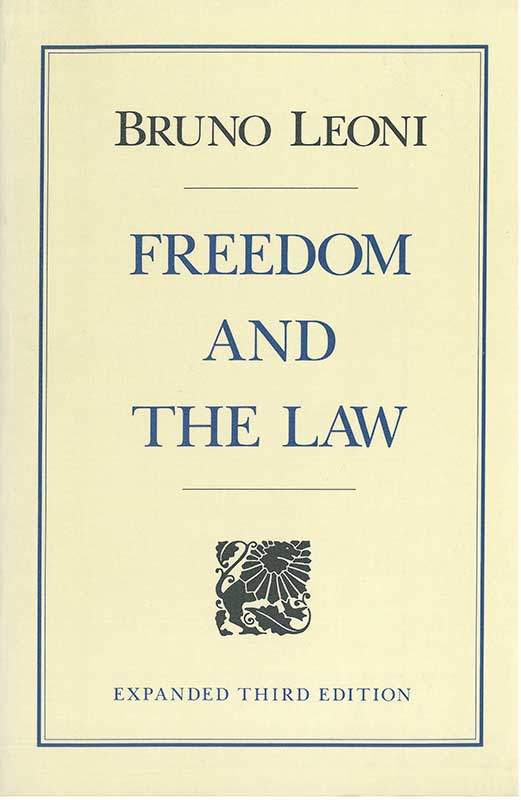
Freedom and the Law, expanded 3rd edition, foreword by Arthur Kemp (Indianapolis: Liberty Fund 1991).

About Liberty Fund:

Liberty Fund, Inc. is a private, educational foundation established to encourage the study of the ideal of a society of free and responsible individuals.


6

Freedom and Representation

It is frequently asserted that there is, or to put it more accurately, there once was, a classical concept of the democratic process that bears little resemblance to what is happening on the political scene at present either in Britain, where that process had its origin in the Middle Ages, or in other countries that have more or less imitated the “democratic” system of England. All economists, at least, will remember what Schumpeter clearly stated in this respect in Capitalism, Socialism, and Democracy. According to the classical concept of “democracy,” as it was formulated towards the end of the eighteenth century in England, the democratic process was assumed to permit the people to decide issues for themselves through elected representatives in the parliament. This offered a supposedly efficient substitute for direct decision on general issues on the part of the people, such as the decisions that had taken place in the ancient Greek cities or in Rome or in the medieval Italian comuni or in the Swiss Landsgemeinde. Representatives had to decide for the people all the issues that the people could not decide themselves for certain technical reasons, as, for instance, the impossibility of meeting all together in a square to discuss policies and make decisions. Representatives were conceived of as mandataries of the people, whose task was to formulate and to carry out the people’s will. In their turn, the people were not conceived of as a mythical entity, but rather as the ensemble of the individuals in their capacity as citizens, and the representatives of the people as persons were themselves citizens and therefore in a position to express what all their fellow citizens felt about the general issues of the community.

According to Burke’s interpretation,

the House of Commons was supposed originally to be no part of the standing government of England. It was considered as a control issued immediately from the people, and speedily to be resolved in the mass from whence it arose. In this respect, it was in the higher part of government what juries are in the lower. The capacity of a magistrate being transitory and that of a citizen permanent, the latter capacity, it was hoped, would of course preponderate in all discussions, not only between the people and the standing authority of the Crown, but between the people and the fleeting authority of the House of Commons itself. . . .1

According to this interpretation, and aside from the so-called standing authority of the Crown, it is rather apparent that the deputies are to “discuss” and to decide more in their capacity as citizens than as magistrates, and moreover that the citizens as such are something permanent, from whom magistrates are to be chosen to effect their immediate and transitory expression.

Burke himself was not a man to be considered as a sort of gramophone record sent to the Parliament by his electors. He also took care to point out that

to deliver an opinion is the right of all men; that of constituents is a weighty and respectable opinion, which a representative ought always to rejoice to hear and which he ought always most seriously to consider. But authoritative instructions, mandates issued, which the member is bound blindly and implicitly to obey, to vote and argue for, though contrary to the clearest conviction of his judgment and conscience, these are things utterly unknown to the laws of the land and which arise from a fundamental mistake of the whole order and tenor of our constitution.2

Generally speaking, it would be a mistake to think that towards the end of the eighteenth century the members of the Parliament heeded carefully the will of their fellow citizens. The second English revolution in the late seventeenth century was not a democratic one. As a recent student of the development of the people’s influence in the British government, Cecil S. Emden, has pointed out, “if a plebiscite had been taken in 1688 on the question of the substitution of William for James, the majority would have voted against the deposition of the latter.”3 The new regime of 1688 resembled an oligarchy of the Venetian type rather than a democracy. Notwithstanding the abolition of censorship of the press in 1695, the members of the House of Commons and the ministries proved many times indisposed to suffer free criticism by their fellow citizens. On some occasions—for instance, in 1712—they were so exasperated at the publication of certain pamphlets reflecting on the proceedings of the House that they decided to impose heavy duties on all newspapers and pamphlets in order to affect their sale adversely. Moreover, very little encouragement was given to the exercise of public opinion. The official publication of the determinations reached in proceedings in Parliament was not a regular procedure, and the objection to publishing information on the ground that it might imply an “appeal to the people” was frequent in the early eighteenth century in order to avoid the publication of the debates and the votes in Parliament. The same attitude influenced the House and the ministries in regard to matters of vital interest for the country in order to prevent opposition on the part of public opinion against the policy adopted by the government and by the House. In the eighteenth century, statesmen like Charles Fox, when a young man, could consider the House of Commons as the only revealer of the national mind, and Fox himself proclaimed once in the House:

I pay no regard whatever to the voice of the people: it is our duty to do what is proper, without considering what may be agreeable; their business is to choose us; it is ours to act constitutionally and to maintain the independence of the Parliament.4

Nevertheless, it is generally admitted that, according to the classical theory of democracy, the Parliament was conceived of as a committee whose functions “would be to voice, reflect, or represent the will of the electorate.”5 Incidentally, it was much easier to put this theory into effect at the end of the eighteenth century and before the Reform Act of 1832 than later on. Although representatives were as numerous as they are now, constituents were few. In 1830 the British Commons represented an electorate of about 220,000 out of a total population of approximately 14 million, or about 3 percent of the adult population. Members represented on the average 330 voters each. Now they represent in England an average of 56,000 electors each, on the basis of a universal adult suffrage of some 35,000,000 people. But at the beginning of this century, Dicey, while objecting to the alleged “legal” theory of Austin that the members of the House of Commons are merely “trustees for the body by which they were elected and appointed,” and maintaining that no English judge could concede that Parliament is in any legal sense a “trustee” for the electors, had no difficulty in admitting that “in a political sense the electors are the more important part, or, we may even say, are actually the sovereign power, since their will is under the present constitution sure to obtain ultimate obedience.” Dicey recognized that the language of Austin was therefore as correct in regard to “political” sovereignty as it was erroneous in regard to what he termed “legal” sovereignty and stated that “the electors are a part of and the predominant part of the politically sovereign power.”6

As things now stand, the will of the electorate, and certainly of the electorate in combination with the Lords and the Crown, is sure ultimately to prevail on all subjects to be determined by the British government. The matter indeed may be carried a little further, and we may assert that the arrangements of the constitution are now such as to ensure that the will of the electors shall by regular and constitutional means always in the end assert itself as the predominant influence in the country.7

All this was possible, according to Dicey, because of the representative character of the English government, and he explained that “the aim and effect of such government is to produce a coincidence or at any rate diminish the divergence between the internal and the external limitations of the exercise of sovereign power,”8 that is, between the wishes of the sovereign (and Parliament is in England legally a sovereign) and “the permanent wishes of the nation.”9 Dicey concluded on this subject that

the difference between the will of the sovereign and the will of the nation was terminated by the foundation of a system of real representative government. Where a Parliament truly represents the people, the divergence between the external and the internal limit to the exercise of sovereign power can hardly arise, or if it arises, must soon disappear. Speaking roughly, the permanent wishes of the representative portion of Parliament can hardly in the long run differ from the wishes of the English people or at any rate of the electors: that which the majority of the House of Commons command, the majority of the English people usually desire.10

Of course, “representation” is rather a generic term. We could adopt only a “legal” concept of it, to conclude, as several lawyers do in regard to political representation in other countries, that this term means nothing more nor less than what it is supposed to mean in terms of constitutional law or, as in England, the constitutional conventions prevailing at a given time. But, as Dicey quite rightly pointed out, there is obviously also a “political” meaning of “representation,” and it is this political meaning that political scientists emphasize in accordance with actual facts.

The verb “to represent,”11 coming from the Latin repraesentare, that is, making present again, was given several meanings in early English, but its first political use in the sense of acting as an authorized agent or deputy of someone is traceable to a 1651 pamphlet of Isaac Pennington and later on, in 1655, to a speech by Oliver Cromwell on January 22 in Parliament, when he said: “I have been careful of your safety and the safety of those you represented.” But as early as 1624, “representation” had come to mean “substitution of one thing or person for another,” especially with a right or authority to act on the other’s account. A few years later, in 1649, we find the word “representative” applied to the Parliamentary assembly in the act abolishing the office of king after the execution of Charles I. The act mentions the “representatives” of the “nation” as those by whom the people are governed and whom the people choose and entrust for that purpose according to their “just and ancient rights.”

The thing itself was certainly older than the word. For instance, the famous principle, “no taxation without representation,” the importance of which for the destiny of the United States it is unnecessary to underline, had been established in England as early as 1297 by the declaration De tallagio non concedendo, to be confirmed later by the Petition of Right in 1628. Even earlier, in 1295, Edward I’s famous writ to the sheriff of Northamptonshire to summon to Parliament in Westminster elected representatives of the counties and boroughs applied for the first time to political practice (if we disregard a preceding similar writ of Henry III and a preceding Parliament of nonelected representatives in 1275) a device praised in more recent times as the most brilliant novelty in the field of politics since the days of the Greeks and the Romans.12 Edward’s writ to the sheriff read clearly that people had to be elected (elegi facias)—burgesses for boroughs, knights for counties, and citizens for cities —and pointed out that they must have “full and sufficient power for themselves and for the communities . . . for doing what shall then be ordained according to the Common Council in the premises, so that the aforesaid business [that is, doing what was necessary to avoid some grave dangers threatening the kingdom] shall not remain unfinished in any way for defect of this power.” Hence it is clear that people summoned by the king to Westminster were conceived of as proper attorneys and mandataries of their communities.

Very interesting from our point of view is the fact that “representation in Common Council” did not imply necessarily that decisions had to be taken according to the majority rule. As has been pointed out by some scholars (for instance, by McKechnie in his Commentary in Magna Charta [1914]), an early medieval version of the principle, “no taxation without representation,” was intended as “no taxation without the consent of the individual taxed,” and we are told that in 1221, the Bishop of Winchester, “summoned to consent to a scutage tax, refused to pay, after the council had made the grant, on the ground that he dissented, and the Exchequer upheld his plea.”13 We know also from the German scholar, Gierke, that in the more or less “representative” assemblies held among German tribes according to Germanic law, “unanimity was requisite” although a minority could be compelled to give way, and that the idea of a connection between representation and majority rule made its way into the political sphere through the church councils that adopted it from the law of corporations, although even in the Church the canonists held that minorities had certain irrefragable rights and that matters of faith could not be decided by mere majorities.14

Thus, it appears that the formation of decision groups and of group decisions according to a coercive procedure based on the idea of majority rule, whether the groups were only “presentative” or “representative” of other people, seemed at first to be unnatural, at least for a time, to our ancestors, both in religious and in political councils, and probably only expediency could have paved the way for its progress in more recent times. As a matter of fact, this procedure is somewhat unnatural, as it overrules some choices only because the people adopting them are less numerous than others, while this method of making decisions is never adopted in other circumstances, and, if adopted, would lead to patently unsuitable results. We shall go back to this point later on. Here it is sufficient to point out that political representation was closely connected in its origin with the idea that the representatives act as agents of other people and according to the latter’s will.

When, in modern times, the principle of representation, in England as well as in other countries, was extended practically to all the individuals in a political community, at least to all the adults belonging to it, three great problems arose which needed to be solved if the representative principle was actually to work: (1) that of making the number of citizens entitled to choose representatives correspond to the real structure of the nation; (2) that of getting candidates to stand for the office of representatives who were adequate exponents of the will of the people represented; and (3) that of adopting a system of choosing representatives that would result in their adequately reflecting the opinions of the people represented.15

It can hardly be said that these problems have so far received a satisfactory solution. None has thus far been solved in any country; no nation has been able to preserve the spirit of representation as an activity performed according to the will of the people represented. Let us set aside such important questions as those raised in the famous essay of John Stuart Mill on Representative Government (1861) relating to what people are entitled to be represented and to the different weight to be possibly given to the people represented according to their abilities or to their contribution to the expenses of the community, and so on. Let us also for the moment set aside another question that is undoubtedly very important and difficult to solve, viz., whether or not a representation of the will of people could be consistent in regard to a great many issues, or, in other words, whether it is actually possible to speak of a “common will” on the part of the people in a number of instances where choices are of alternative nature and where there is no probability of discovering a way of allowing people to agree about any choice whatever. Schumpeter has pointed out this difficulty in his essay on Capitalism, Socialism, and Democracy and concluded that the “common will” is an expression whose content must be inevitably contradictory when referred to individual members of a community that is said to have a “common will.” If political matters are precisely those that do not allow of more than one choice, and if, moreover, there is no way of discovering by some objective method which is the most suitable choice for a political community, we ought to conclude that political decisions always imply an element that is not compatible with individual freedom, and therefore not compatible with a true representation of the will of those people whose choice has possibly been rejected in the decision adopted. Finally, let us set aside, as not important for our purposes, certain special questions relating to different systems of choosing. We must notice that voting is not the only system of choosing representatives. We have other historically important systems, such as the ballots cast in some cases by the ancient Greek cities or by the aristocratic republic of Venice in medieval and in modern times, and therefore relating to different systems of voting, if voting is the way adopted for making the choice.

These questions may be considered to some extent as technicalities that lie beyond the field of our inquiry. We have to deal now with other difficulties.

True, the extension of the principle of representation through the extension of the franchise to all citizens seems to correspond perfectly to an individualistic conception of representation, according to which every individual must be represented in some way in the decisions to be taken on the general issues of the nation. Every individual must exercise his right of choosing, entrusting, and instructing representatives in order to make political decisions through a free manifestation of his will. Of course, as Disraeli would say, the will of some people may be perfectly represented in some cases by other people who guess the wishes of the former without having been instructed by them, as, according to Schumpeter, Napoleon did when he terminated all religious struggles in his country at the time of his consulate. We can also imagine that the real interests of some people (that is, at least the interests some people later recognize as their own true interests, notwithstanding any contrary opinion they may have held before) may be better represented by some competent and incorruptible exponents of their will who never would have been entrusted or instructed by them. This is the case, for instance, with parents who act in the capacity of representatives of their children in private life and in business. But it seems to be obvious, from an individualistic point of view, that nobody is more competent to know what one’s own will is than one is oneself. Therefore, the true representation of that will must be the result of a choice on the part of the individual who is to be represented. The extension of representation in modern times seems to correspond to this consideration. So far, so good.

But very serious difficulties arise when the principle of representation through individual choice of representatives is applied in political life. In private life, as a rule, these difficulties do not exist. Anybody may contact anybody else whom he trusts and engage him as an agent to negotiate a contract, for example, according to instructions that can be clearly stated, clearly understood, and clearly carried out.

In political life nothing of the kind takes place, and this seems to be also a consequence of the very extension of representation to as many individuals as possible in a political community. It seems to be a great misfortune of this principle that, the more one tries to extend it, the more one defeats its purpose. It must be observed that political life is not the only field in which these inconveniences have emerged in recent times. Economists and sociologists have already drawn our attention to the fact that representation in big private corporations works badly. Shareholders are said to have little influence on the policy of the managers, and the discretionary power of the latter, being a result as well as a cause of the “managerial revolution” in our times, is the greater, the more numerous are the shareholders that the managers “represent” in a business.16 The story of representation in political as well as in economic life teaches us a lesson that people have not yet learned. There is in my country a saying, chi vuole vada, which means that if you really want something, you must go and see for yourself what is to be done instead of sending a messenger. Of course, your action cannot have good results if you are not wise, skilled, or sufficiently well-informed to achieve the result you desire. And this is what managers and representatives in politics as well as in business would say if only they bothered to explain to the people they represent how things are actually being done.

John Stuart Mill pointed out the fact that representation cannot work unless the people represented participate in some way in the activity of their representatives.

Representative institutions are of little value, and may be a mere instrument of tyranny or intrigue, when the generality of electors are not sufficiently interested in their own government to give their vote, or, if they vote at all, do not bestow their suffrages on public grounds, but sell them for money, or vote at the beck of someone who has control over them or whom for private reasons they desire to propitiate. Popular election, as thus practised, instead of a security against misgovernment, is but an additional wheel in its machinery.17

But in political representation many difficulties arise that are very probably not due to lack of wisdom or to the ill will or the apathy of the people represented. It is a truism that issues at stake in political life are too many and too complicated and that very many of them are actually unknown both to the representatives and to the people represented. Under these conditions, no instructions could be given in most cases. This happens at any moment in the political life of a community when the self-styled representatives are not in a position to represent the actual will of the alleged “people represented” or when there are reasons for thinking that the representatives and the people represented do not agree about the issues at stake.

In pointing out this fact, I am not referring only to the usual way of choosing representatives at the present time, that is, by voting. All the difficulties I have pointed out before remain whether or not voting is the method of choosing representatives.

But voting itself seems to increase the difficulties relating both to the meaning of “representation” and to the “freedom” of the individuals in making their choice. All the difficulties relating to decision groups and group decisions remain when we consider the process of voting in present-day political systems. Election is the result of a group decision where all the electors are to be considered as the members of a group, for instance, of their constituencies or of the electorate as a whole. We have seen that group decisions imply procedures like majority rule which are not compatible with individual freedom of choice of the type that any individual buyer or seller in the market enjoys as well as in any other choice he makes in his private life. The effects of coercion in the machinery of voting have been repeatedly pointed out by politicians, by sociologists, by political scientists, and especially by mathematicians. Certain paradoxical aspects of this coercion have been especially emphasized by the critics of such classical methods of representation as the so-called single-member system which still is in effect in the English-speaking countries. I wish to draw your attention to the fact that these criticisms are chiefly based on the alleged fact that the system is not in accordance with the principle of “representation,” namely, when, as John Stuart Mill said, political issues are decided “by a majority of the majority who may be, and often are, but a minority of the whole.” Let me quote the passage of Mill’s essay on this subject:

Suppose then that, in a country governed by equal and universal suffrage, there is a contested election in every constituency, and every election is carried by a small majority. The parliament thus brought together represents little more than a bare majority of the people. This parliament proceeds to legislate and adopts important measures by a bare majority of itself. What guarantee is there that these measures accord with the wishes of a majority of the people” Nearly half the electors, having been outvoted at the hustings, have had no influence at all in the decision, and the whole of these may be—a majority of them probably are—hostile to the measures; having voted against those by whom they have been carried. Of the remaining electors nearly half have chosen representatives who, by supposition, have voted against the measures. It is possible, therefore, and not at all improbable, that the opinion which has prevailed was agreeable only to a minority of the nation.18

This argument is not completely convincing, as the case cited by Mill is probably theoretical only, but there is some truth in the argument, and we all know the devices that have been invented, such as proportional representation, of which there are no less than three hundred varieties, in order to render elections more “representative” of the supposed will of the electors. But it is also known that no other electoral system avoids these unsurmountable difficulties, as is proved by the very existence of such devices as referenda, initiatives, and so on, that have been introduced, not in order to improve on representation, but rather to replace representation by some other system, based on a different principle, namely, that of direct democracy.

In fact, no representative system based on elections can work properly while elections are held with the object of reaching group decisions by way of majority rule or any other rule of which the effect is to coerce the individual on the losing side of the electorate.

Thus, “representative” systems as usually conceived of, in which election and representation are connected, are incompatible with individual freedom, in the sense of freedom to choose, empower, and instruct a representative.

Nevertheless, “representation” has been retained to the present day as one of the alleged characteristic features of our political system by simply emptying the word of its historical meaning and using it as a catchword or, as the contemporary English analytic philosophers would say, a “persuasive” word. In fact, the word “representation” in politics still has a favorable connotation, as people inevitably understand it to mean a sort of relation between “cestui qui trust” and a trustee, just like that in private life and in business and like what Austin supposed it to be under the constitutional law of England. As one of the most recent students of present-day political parties, R. T. McKenzie, has pointed out,

Lip service is still paid to the classical conception of democracy even by many who are aware of the extent to which it has proved unworkable. . . . It has also become increasingly evident that the classical theory attributed to the electorate an altogether unrealistic degree of initiative; it came near to ignoring completely the importance of leadership in the political process.19

Meanwhile a process of monocratization (to use Weber’s word) is continually going on within groups like political parties, at least in Europe, in fulfillment of the prophecy made by my fellow citizen, Roberto Michels, who, in his famous essay published in 1927 in the American Political Science Review on the sociological character of political parties, formulated the so-called iron law of oligarchy as the chief rule of the internal evolution of all present-day parties.

All this affects the fate not only of democracy, but also of individual freedom in so far as the individual is involved in the so-called democratic process and in so far as the ideas of democracy are compatible with that of individual freedom.

The tendency is to accept things as they are, not only because people cannot see anything better, but also because they are frequently not aware of what is really going on. People justify present-day “democracy” because it seems to secure at least a loose participation of individuals in the process of legislation and in the administration of their country—a participation that, loose as it may be, is considered to be the best obtainable under the circumstances. In a similar vein, R. T. McKenzie writes: “It is . . . realistic to argue that the essence of the democratic process is that it should provide a free competition for political leadership.” He adds that “the essential role of the electorate is not to reach decisions on specific issues of policy but to decide which of two or more competing teams of potential leaders shall make the decisions.”20 However, this is not very much for a political theory that still uses terms like “democracy” or “representation.” It is not very much either if we consider that “representation” is something other than what these new theories imply, or at least it has been conceived of as something else until recent times in politics and it is still conceived of as something else in private life and business.

Valid objections can be raised against the arguments of those who accept this emasculated version of the individualistic point of view and think that the “representative system” as it works at present is better than any other system enabling people to participate in some way in the formation of policies and especially in the formation of the law in accordance with the individual’s freedom of choice.

People may be said to have a share in these processes only by way of group decisions like, for instance, those of a constituency or of a council of representatives such as Parliament. But to say this is to take a strictly legal point of view, i.e., one based on the present legal regulations, without taking into consideration all that is or is not behind the official rules. This legal point of view becomes untenable as soon as we discover that legislation and constitutions, on the basis of which we ought to decide whether something is “legal,” are themselves frequently rooted in something that is not “legal” at all. The American Constitution, that great achievement of so many first-rate statesmen in the late eighteenth century, was the result of an illegal action taken at the Philadelphia Convention in 1787 by the Founding Fathers, who had not had conferred upon them any power of the kind by the legal authority on which they were dependent, namely, the Continental Congress. The latter, in its turn, had an illegal origin, since it had been set up as a result of a rebellion on the part of the American colonies against the legal power of the British Crown.

The origin of the recent constitution of my country can scarcely be said to be any more legal than that of its American counterpart, although many people in my country are not even aware of this.

In fact, the present constitution of Italy was drawn up by a constituent assembly whose creation was, in its turn, due to a decree of June 25, 1944, issued by the hereditary prince of Italy, Humbert, who had been appointed “lieutenant general” of the Kingdom of Italy, without any limits of competence, by his father, King Victor Emmanuel III, in a royal decree of June 5, 1944. But neither the lieutenant general of the Kingdom of Italy nor the king himself had any legal power to change the constitution or to summon an assembly to do so. Moreover, the promulgation of the above-mentioned decree stemmed from the so-called Salerno Agreement, which took place, under the auspices of the Allied powers, between King Victor Emmanuel III and the “representatives” of Italian parties whom nobody had chosen in our country through the usual way of election. The constituent assembly was, therefore, to be considered illegal from the point of view of the existing law of the kingdom, for the act that had originated the assembly was itself illegal, since its author, the “lieutenant general,” had promulgated it ultra vires. On the other hand, it would have been very difficult to avoid “illegal” acts in a situation like that. None of the institutions foreseen by the constitutional laws of the kingdom survived until June, 1944. The Crown had changed its character after the nomination of the lieutenant general; one of the branches of the parliament, the Chamber of Fasces and Corporations, had been suppressed without being replaced by any other, and the other branch, the Senate, was not in condition to function at that time. Such is the lesson for those who speak of what is legal and what is not on the basis of alleged “legal” constitutions and do not bother about what lies behind them.

Leslie Stephen pointed out rather well the limits of the legal point of view:

Lawyers are apt to speak as though the legislature were omnipotent, as they do not require to go beyond its decisions. It is, of course, omnipotent in the sense that it can make whatever law it pleases, inasmuch as a law means any rule which has been made by the legislature. But from the scientific point of view, the power of legislation is, of course, strictly limited. It is limited, so to speak, both from within and from without: from within, because the legislature is the product of a certain social condition, and determined by whatever determines the society; and from without, because the power of imposing laws is dependent upon the instinct of subordination, which is itself limited. If a legislature decided that all blue-eyed babies should be murdered, the preservation of blue-eyed babies would be illegal; but legislators must go mad before they could pass such a law, and subjects be idiotic before they could submit to it.21

While agreeing with Leslie Stephen, I wonder, incidentally, whether idiocy begins only at this point on the part of the “subjects” and whether contemporary “subjects” are not likely to accept decisions like this in the future if the ideals of “representation” and “democracy” are still to be seriously identified for a long time with the power of simply deciding (as R. T. McKenzie would say) “which of two or more competing teams of potential leaders shall make the decisions” for every kind of action and behavior on the part of their fellow citizens.

Of course, choosing between potential competitors is the proper activity of a free individual in the market. But there is a great difference. Market competitors, if they are to keep their position, are necessarily working for their voters (that is, for their customers), even when both they and their voters are not completely aware of it. Political competitors, on the other hand, are not necessarily working for their voters, since the latter cannot actually choose in the same way the peculiar “products” of the politicians. Political producers (if I may use this word) are at the same time the sellers and the buyers of their products, both in the name of their fellow citizens. The latter are not expected to say, “I do not want that statute, I do not want that decree,” since, according to the theory of representation, they have already delegated this power of choice to their representatives.

To be sure, this is a legal point of view, which does not coincide necessarily with the actual attitude of the people concerned. In my country citizens frequently distinguish between the legal point of view and other points of view. I have always admired countries in which the legal point of view coincides as much as possible with any other and I have become convinced that their great achievements in politics have been chiefly owing to this coincidence. I still remain convinced of this, but I wonder whether this virtue cannot become a vice whenever the legal point of view results in the blind acceptance of inadequate decisions. A saying in my country may explain why our political theorists, from Machiavelli to Pareto, Mosca, and Roberto Michels, were little concerned with the legal point of view, but always tried to go beyond it and see what was going on behind it. I do not think that the German- or English-speaking peoples have a similar saying: Chi comanda fa la legge, that is, “Whoever has the power makes the law.” This sounds like a Hobbesian sentence, but it lacks the Hobbesian emphasis on the necessity of a supreme power. It is rather, unless I am wrong, a cynical sentence, or, if you prefer, a realistic one. The Greeks, of course, had a similar doctrine, although I do not know whether they had a similar saying.

Please do not think that I am recommending such political cynicism. I am merely pointing out the scientific implications of this cynicism, if we may indeed qualify the doctrines as cynical. He who has the power makes the law. True, but what about people who do not have the power? The saying is apparently silent about this, but I suppose that a rather critical view of the limits of the law as centered on political power is the natural conclusion to be drawn from the doctrine. This is probably the reason why my fellow countrymen do not know by heart their written constitution as many Americans do. My fellow countrymen are convinced, I would say instinctively, that written laws and constitutions are not the end of the political story. Not only do they change and may change rather frequently, but also they do not always correspond to the law written in living tables, as Lord Bacon would have said. I dare say that there is a sort of cynical common-law system which underlies the written-law system of my country and which differs from the English common-law system in so far as the former is not only unwritten but also officially unrecognized.

Moreover, I am inclined to think that something similar is happening and will happen perhaps to an even greater extent in the future in other countries where the coincidence between the legal point of view and other views has been so perfect until recent times. Blind acceptance of the contemporary legal point of view will lead to the gradual destruction of individual freedom of choice in politics as well as in the market and in private life, for the contemporary legal point of view means the increasing substitution of group decisions for individual choices and the progressive elimination of spontaneous adjustments between not only individual demands for and supplies of goods and services, but all kinds of behavior, by such rigid and coercive procedures as that of the majority rule.

To sum up my views on this subject: There is far more legislation, there are far more group decisions, far more rigid choices, and far fewer “laws written in living tables,” far fewer individual decisions, far fewer free choices in all contemporary political systems than would be necessary in order to preserve individual freedom of choice.

I do not say that we ought to do entirely without legislation and give up group decisions and majority rules altogether in order to recover individual freedom of choice in all the fields in which we have lost it. I quite agree that in some cases the issues involved concern everybody and cannot be dealt with by the spontaneous adjustments and mutually compatible choices of individuals. There is no historical evidence that there ever existed an anarchistic state of affairs of the kind that would result if legislation, group decisions, and the coercion of individual choices were to be altogether eliminated.

But I am convinced that the more we manage to reduce the large area occupied at present by group decisions in politics and in the law, with all their paraphernalia of elections, legislation, and so on, the more we shall succeed in establishing a state of affairs similar to that which prevails in the domain of language, of common law, of the free market, of fashion, of customs, etc., where all individual choices adjust themselves to one another and no individual choice is ever overruled. I would suggest that at the present time the extent of the area in which group decisions are deemed necessary or even suitable has been grossly overestimated and the area in which spontaneous individual adjustments have been deemed necessary or suitable has been far more severely circumscribed than it is advisable to do if we wish to preserve the traditional meanings of most of the great ideals of the West.

I suggest that the maps of the above-mentioned areas have to be redrawn, as many lands and seas appear now to be indicated on them in places where in the old classical maps nothing was marked. I also suspect, if I may continue to use this metaphor, that there are signs and marks on the present-day maps that actually correspond to no newly discovered land at all and that some lands are not to be located where they have been placed at present by inaccurate geographers of the political world. In fact, some of the marks appearing on the present-day political maps are only little spots with nothing real behind them, and our behavior toward them is like that of the skipper who mistook for an island on his map what a fly had left on it several days before and kept on searching for that presumed “island” in the ocean.

In redrawing these maps of the areas occupied respectively by group decisions and by individual decisions, we ought to take into account the fact that the former include decisions of the all-or-none variety, as Professor Buchanan would say, while the latter include articulate decisions which are compatible—nay, complementary—with other people’s decisions.

A golden rule in this reform—unless I am wrong—ought to be that all individual decisions that have proved to be not incompatible with one another ought to be substituted for corresponding group decisions in regard to alternatives among which incompatibilities have been wrongly assumed to exist. It would be silly, for instance, to submit individuals to a group decision in regard to such questions as whether they should go to the movies or take a walk whenever there is no incompatibility between these two forms of individual behavior.

Supporters of group decisions (for instance, of legislation) are always inclined to think that in such or such a case individual choices are mutually incompatible, that the issues concerned are necessarily of the all-or-none variety, and that the only way to make a final choice is to adopt a coercive procedure like majority rule. These people pretend to champion democracy. But we ought always to remember that whenever majority rule is unnecessarily substituted for individual choice, democracy is in conflict with individual freedom. It is this particular kind of democracy that ought to be kept to a minimum in order to preserve a maximum of democracy compatible with individual freedom.

Of course, it would be necessary to avoid misunderstandings at the very outset of the reform I am proposing. Freedom could not be conceived of indifferently as “freedom from want” and “freedom from men,” just as constraint ought not to be understood as “constraint” exercised by people who have done absolutely nothing to constrain anybody else.

The assessment of various forms of behavior and decisions in order to ascertain the area to which they properly belong and to locate them in that area, if consistently performed, would obviously involve a great revolution in the field of present-day constitutions and of legislative and administrative law. This revolution would for the most part consist in the displacement of rules from the area of the written to the area of the unwritten law. In this process of displacement great attention should be paid to the concept of the certainty of the law, understood as a long-run certainty, in order to render it possible for individuals to make free choices in view not only of the present, but also of the future. In the process judicature ought to be separated as much as possible from other powers, as it was in Roman times and in the Middle Ages, when jurisdictio was separated as much as possible from the imperium. Judicature should address itself much more to discovering what the law is than to imposing on the parties to the dispute what the judges want the law to be.

The law-making process ought to be reformed by making it mainly, if not only, a spontaneous process, like that of trading or of speaking or of keeping other compatible and complementary relations on the part of individuals with other individuals.

It may be objected that such a reform would be equivalent to the creation of a utopian world. But such a world was, taken all in all, certainly not utopian in several countries and at several historical times, some of which have not yet vanished altogether from the memory of living generations. On the other hand, it is probably much more utopian to continue addressing appeals to a world where old ideals are perishing and only old words remain, as empty shells, that everybody can fill up with his favorite meanings, regardless of the final results.

[1 ] Edmund Burke, Works (1808 ed.), II, 287 ff.

[2 ] Edmund Burke, “Speech to the Electors of Bristol,” December 3, 1774, in Works (Boston: Little, Brown & Co., 1894), II, 96.

[3 ] Cecil S. Emden, The People and the Constitution (2nd ed.; Oxford: at the Clarendon Press, 1956), p. 34.

[4 ] Ibid., p. 53. The historians tell us that “as a result of this speech Fox himself was attacked by a mob as he drove down to the House and was rolled in the mud.”

[5 ] R. T. McKenzie, British Political Parties (London: Heineman, 1955), p. 588.

[6 ] Dicey, Introduction to the Study of the Law of the Constitution (9th ed.; London: Macmillan, 1939), p. 76.

[7 ] Ibid., p. 73.

[8 ] Ibid., p. 82.

[9 ] Ibid., p. 83.

[10 ] Loc. cit.

[11 ] On this and other points mentioned in this chapter, cf. the clear and informative article on “Representation” by H. Chisholm in the Encyclopaedia Britannica (14th ed.).

[12 ] However, the political theory of representation in the Middle Ages seems to have been influenced by a similar theory of the Roman jurist Pomponius, contained in a fragment of the Digest (“deinde quia difficile plebs convenire coepit, populus certe multo difficilius in tanta turba hominum, necessitas ipsa curam reipublicae ad senatum deduxit,” i.e., the senate was led to assume the responsibility of legislation because of the difficulties involved in assembling the plebeians and the even greater difficulty of holding an assembly of the vast multitude constituting the entire electorate). Cf. Otto Gierke, Political Theories of the Middle Age, tr. by Maitland (Cambridge University Press, 1922), pp. 168 ff.

[13 ] H. Chisholm, loc. cit.

[14 ] Gierke, op. cit., p. 64.

[15 ] For a recent discussion of the problems of representation in connection with the majority rule, see Burnham, The Congress and the American Tradition (Chicago: Regnery, 1959), particularly the chapter entitled “What Is a Majority” pp. 311 ff.

[16 ] This is true in spite of the fact, noted by Professor Milton Friedman, that shareholders may ultimately get rid of the stock of those firms whose policy they are not sufficiently allowed to control, whereas the citizenry cannot so easily do the same with their citizenship.

[17 ] John Stuart Mill, Considerations on Representative Government (New York: Henry Holt & Co., 1882).

[18 ] Ibid., p. 147.

[19 ] R. T. McKenzie, op. cit., p. 588.

[20 ] Ibid., p. 589.

[21 ] Leslie Stephen, The Science of Ethics, quoted by Dicey, op. cit., p. 81.