Econlib

The Library

Other Sites

Front Page arrow Titles (by Subject) arrow FREEDOM AND THE LAW - Freedom and the Law (LF ed.)

Return to Title Page for Freedom and the Law (LF ed.)

Search this Title:

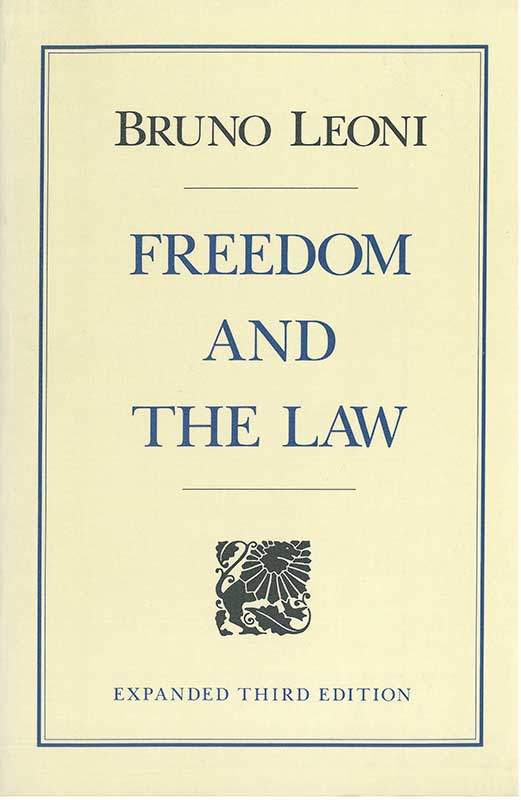
FREEDOM AND THE LAW - Bruno Leoni, Freedom and the Law (LF ed.) [1961]

Edition used:

Freedom and the Law, expanded 3rd edition, foreword by Arthur Kemp (Indianapolis: Liberty Fund 1991).

About Liberty Fund:

Liberty Fund, Inc. is a private, educational foundation established to encourage the study of the ideal of a society of free and responsible individuals.


FREEDOM AND THE LAW

Introduction

It seems to be the destiny of individual freedom at the present time to be defended mainly by economists rather than by lawyers or political scientists.

As far as lawyers are concerned, perhaps the reason is that they are in some way forced to speak on the basis of their professional knowledge and therefore in terms of contemporary systems of law. As Lord Bacon would have said, “They speak as if they were bound.” The contemporary legal systems to which they are bound seem to leave an ever-shrinking area to individual freedom.

Political scientists, on the other hand, often appear to be inclined to think of politics as a sort of technique, comparable, say, to engineering, which involves the idea that people should be dealt with by political scientists approximately in the same way as machines or factories are dealt with by engineers. The engineering idea of political science has, in fact, little, if anything, in common with the cause of individual freedom.

Of course, this is not the only way to conceive of political science as a technique. Political science can also be considered (although this happens less and less frequently today) as a means of enabling people to behave as much as possible as they like, instead of behaving in the ways deemed suitable by certain technocrats.

Knowledge of the law, in its turn, may be viewed in a perspective other than that of the lawyer who must speak as if he were bound whenever he has to defend a case in court. If he is sufficiently well versed in the law, a lawyer knows very well how the legal system of his country works (and also sometimes how it does not work). Moreover, if he has some historical knowledge, he may easily compare different ways in which successive legal systems have worked within the same country. Finally, if he has some knowledge of the way in which other legal systems work or have worked in other countries, he can make many valuable comparisons that usually lie beyond the horizon of both the economist and the political scientist.

In fact, freedom is not only an economic or a political concept, but also, and probably above all, a legal concept, as it necessarily involves a whole complex of legal consequences.

While the political approach, in the sense I have tried to outline above, is complementary to the economic one in any attempt to redefine freedom, the legal approach is complementary to both.

However, there is still something lacking if this attempt is to succeed. During the course of the centuries many definitions of freedom have been given, some of which could be considered incompatible with others. The result is that a univocal sense could be given to the word only with some reservation and after previous enquiries of a linguistic nature.

Everyone can define what he thinks freedom to be, but as soon as he wants us to accept his formulation as our own, he has to produce some truly convincing argument. However, this problem is not peculiar to statements about freedom; it is one that is connected with every kind of definition, and it is, I think, an undoubted merit of the contemporary analytical school of philosophy to have pointed out the importance of the problem. A philosophical approach must therefore be combined with the economic, the political, and the legal approaches in order to analyze freedom.

This is not in itself an easy combination to achieve. Further difficulties are connected with the peculiar nature of the social sciences and with the fact that their data are not so univocally ascertainable as those of the so-called natural sciences.

In spite of this, in analyzing freedom, I have tried, as far as possible, to consider it first as a datum, namely, a psychological attitude. I have done the same with constraint, which is, in a sense, the opposite of freedom, but which is also a psychological attitude on the part of both those who try to do the constraining and those who feel that they are being constrained.

One could hardly deny that the study of psychological attitudes reveals differences and variations among them, so that a univocal theory of freedom, and consequently also of constraint, with reference to the ascertainable facts is difficult to formulate.

This means that people belonging to a political system in which freedom is defended and preserved for each and all against constraint cannot help being constrained at least to the extent that their own interpretation of freedom, and consequently also of constraint, does not coincide with the interpretation prevailing in that system.

However, it seems reasonable to think that these interpretations on the part of people generally do not differ so much as to foredoom to failure any attempt to arrive at a theory of political freedom. It is permissible to assume that at least within the same society the people who try to constrain others and those who try to avoid being constrained by others have approximately the same idea of what constraint is. It can therefore be inferred that they have approximately the same idea of what the absence of constraint is, and this is a very important assumption for a theory of freedom envisaged as the absence of constraint, such as is suggested in this book.

To avoid misunderstandings, it must be added that a theory of freedom as the absence of constraint, paradoxical as it may appear, does not preach absence of constraint in all cases. There are cases in which people have to be constrained if one wants to preserve the freedom of other people. This is only too obvious when people have to be protected against murderers or robbers, although it is not so obvious when this protection relates to constraints and, concomitantly, freedoms that are not so easy to define.

However, a dispassionate study of what is going on in contemporary society not only reveals that constraint is inextricably intertwined with freedom in the very attempt to protect the latter, but also, unfortunately, that according to several doctrines, the more one increases constraint, the more one increases freedom. Unless I am wrong this is not only an evident misunderstanding, but also an ominous circumstance for the fate of individual freedom in our time.

People often mean by “freedom” (or “liberty”) both the absence of constraint and something else as well—for instance, as a distinguished American judge would have said, “enough economic security to allow its possessor the enjoyment of a satisfactory life.” The same people very often fail to realize the possible contradictions between these two different meanings of freedom and the unpleasant fact that you cannot adopt the latter without sacrificing to a certain extent the former, and vice versa. Their syncretistic view of freedom is simply based on a semantic confusion.

Other people, while contending that constraint is to be increased in their society in order to increase “freedom,” merely pass over in silence the fact that the “freedom” they mean is only their own, while the constraint they want to increase is to be applied exclusively to other people. The final result is that the “freedom” they preach is only the freedom to constrain other people to do what they would never do if they were free to choose for themselves.

Today freedom and constraint pivot more and more on legislation. People generally realize fully the extraordinary importance of technology in the changes that are taking place in contemporary society. On the other hand, they do not seem to realize to the same extent the parallel changes brought about by legislation, often without any necessary connection with technology. What they appear to realize even less is that the importance of the latter changes in contemporary society depends in its turn on a silent revolution in present-day ideas about the actual function of legislation. In fact, the increasing significance of legislation in almost all the legal systems of the world is probably the most striking feature of our era, besides technological and scientific progress. While in the Anglo-Saxon countries common law and ordinary courts of judicature are constantly losing ground to statutory law and administrative authorities, in the Continental countries civil law is undergoing a parallel process of submersion as a result of the thousands of laws that fill the statute books each year. Only sixty years after the introduction of the German Civil Code and a little more than a century and a half after the introduction of the Code Napoléon the very idea that the law might not be identical with legislation seems odd both to students of law and to laymen.

Legislation appears today to be a quick, rational, and far-reaching remedy against every kind of evil or inconvenience, as compared with, say, judicial decisions, the settlement of disputes by private arbiters, conventions, customs, and similar kinds of spontaneous adjustments on the part of individuals. A fact that almost always goes unnoticed is that a remedy by way of legislation may be too quick to be efficacious, too unpredictably far-reaching to be wholly beneficial, and too directly connected with the contingent views and interests of a handful of people (the legislators), whoever they may be, to be, in fact, a remedy for all concerned. Even when all this is noticed, the criticism is usually directed against particular statutes rather than against legislation as such, and a new remedy is always looked for in “better” statutes instead of in something altogether different from legislation.

The advocates of legislation—or rather, of the notion of legislation as a panacea—justify this way of fully identifying it with law in contemporary society by pointing to the changes continually being brought about by technology. Industrial development, so we are told, brings with it a great many problems that older societies were not equipped to solve with their ideas of law.

I submit that we still lack proof that the many new problems referred to by these advocates of inflated legislation are really brought about by technology1 or that contemporary society, with its notion of legislation as a panacea, is better equipped to solve them than older societies that never so blatantly identified law with legislation.

The attention of all the advocates of inflated legislation as an allegedly necessary counterpart of scientific and technological progress in contemporary society needs to be drawn to the fact that the development of science and technology, on the one hand, and that of legislation, on the other, are based respectively on two completely different and even contradictory ideas. In fact, the development of science and technology at the beginning of our modern era was made possible precisely because procedures had been adopted that were in full contrast to those that usually result in legislation. Scientific and technical research needed and still needs individual initiative and individual freedom to allow the conclusions and results reached by individuals, possibly against contrary authority, to prevail. Legislation, on the other hand, is the terminal point of a process in which authority always prevails, possibly against individual initiative and freedom. Whereas scientific and technological results are always due to relatively small minorities or particular individuals, often, if not always, in opposition to ignorant or indifferent majorities, legislation, especially today, always reflects the will of a contingent majority within a committee of legislators who are not necessarily more learned or enlightened than the dissenters. Where authorities and majorities prevail, as in legislation, individuals must yield, regardless of whether they are right or wrong.

Another characteristic feature of legislation in contemporary society (apart from a few instances of direct democracy in small political communities like the Swiss Landsgemeinde) is that the legislators are assumed to represent their citizens in the legislative process. Whatever this may mean—and this is what we shall try to discover in the following pages—it is obvious that representation, like legislation, is something altogether extraneous to the procedures adopted for scientific and technological progress. The very idea that a scientist or a technician should be “represented” by other people in the carrying on of scientific or technical research appears as ridiculous as the idea that scientific research should be entrusted, not to particular individuals acting as such even when they collaborate in a team, but to some kind of legislative committee empowered to reach a decision by majority vote.

Nonetheless, a way of reaching decisions that would be rejected out of hand in scientific and technological fields is coming to be adopted more and more as far as law is concerned.

The resulting situation in contemporary society is a kind of schizophrenia, which, far from being denounced, has been hardly noticed so far.

People behave as if their need for individual initiative and individual decision were almost completely satisfied by the fact of their personal access to the benefits of scientific and technological achievements. Strangely enough, their corresponding needs for individual initiative and individual decision in the political and legal spheres seem to be met by ceremonial and almost magical procedures such as elections of “representatives” who are supposed to know by some mysterious inspiration what their constituents really want and to be able to decide accordingly. True, individuals still have, at least in the Western world, the possibility of deciding and acting as individuals in many respects: in trading (at least to a great extent), in speaking, in personal relations, and in many other kinds of social intercourse. However, they seem also to have accepted in principle once and for all a system whereby a handful of people whom they rarely know personally are able to decide what everybody must do, and this within very vaguely defined limits or practically without limits at all.

That the legislators, at least in the West, still refrain from interfering in such fields of individual activity as speaking or choosing one’s marriage partner or wearing a particular style of clothing or traveling usually conceals the raw fact that they actually do have the power to interfere in every one of these fields. But other countries, while already offering a completely different kind of picture, reveal at the same time how much farther the legislators can go in this respect. On the other hand, fewer and fewer people now seem to realize that just as language and fashion are the products of the convergence of spontaneous actions and decisions on the part of a vast number of individuals, so the law too can, in theory, just as well be a product of a similar convergence in other fields.

Today the fact that we do not need to entrust to other people the task of deciding, for instance, how we have to speak or how we should spend our leisure time fails to make us realize that the same should be true of a great many other actions and decisions that we take in the sphere of law. Our present notion of the law is definitely affected by the overwhelming importance that we attach to the function of legislation, that is, to the will of other people (whoever they may be) relating to our daily behavior. I try to make clear in the following pages one of the chief consequences of our ideas in this respect. We are actually far from attaining through legislation the ideal certainty of the law, in the practical sense that this ideal should have for anybody who must plan for the future and who has to know, therefore, what the legal consequences of his decisions will be. While legislation is almost always certain, that is, precise and recognizable, as long as it is “in force,” people can never be certain that the legislation in force today will be in force tomorrow or even tomorrow morning. The legal system centered on legislation, while involving the possibility that other people (the legislators) may interfere with our actions every day, also involves the possibility that they may change their way of interfering every day. As a result, people are prevented not only from freely deciding what to do, but from foreseeing the legal effects of their daily behavior.

It is undeniable that today this result is due both to inflated legislation and to the enormous increase of a quasi-legislative or pseudo-legislative activity on the part of the government, and one cannot help agreeing with writers and scholars like James Burnham in the United States, Professor G. W. Keeton in England, and Professor F. A. Hayek, who, in recent years, have bitterly complained about the weakening of the traditional legislative powers of Congress in the United States or the “passing” of the British Parliament as a consequence of a corresponding enlargement of the quasi-legislative activities of the executive. However, one cannot lose sight of the fact that the ever-growing power of governmental officials may always be referred to some statutory enactment enabling them to behave, in their turn, as legislators and to interfere in that way, almost at will, with every kind of private interest and activity. The paradoxical situation of our times is that we are governed by men, not, as the classical Aristotelian theory would contend, because we are not governed by laws, but because we are. In this situation it would be of very little use to invoke the law against such men. Machiavelli himself would not have been able to contrive a more ingenious device to dignify the will of a tyrant who pretends to be a simple official acting within the framework of a perfectly legal system.

If one values individual freedom of action and decision, one cannot avoid the conclusion that there must be something wrong with the whole system.

I do not maintain that legislation should be entirely discarded. Probably this has never happened in any country at any time. I do maintain, however, that legislation is actually incompatible with individual initiative and decision when it reaches a limit that contemporary society seems already to have gone far beyond.

My earnest suggestion is that those who value individual freedom should reassess the place of the individual within the legal system as a whole. It is no longer a question of defending this or that particular freedom—to trade, to speak, to associate with other people, etc.; nor is it a question of deciding what special “good” kind of legislation we should adopt instead of a “bad” one. It is a question of deciding whether individual freedom is compatible in principle with the present system centered on and almost completely identified with legislation. This may seem like a radical view. I do not deny that it is. But radical views are sometimes more fruitful than syncretistic theories that serve to conceal the problems more than they solve them.

Fortunately we do not need to take refuge in Utopia in order to find legal systems different from the present ones. Both Roman and English history teach us, for instance, a completely different lesson from that of the advocates of inflated legislation in the present age. Everybody today pays lip service to the Romans no less than to the English for their legal wisdom. Very few realize, however, what this wisdom consisted in, that is, how independent of legislation those systems were in so far as the ordinary life of the people was concerned, and consequently how great the sphere of individual freedom was both in Rome and in England during the very centuries when their respective legal systems were most flourishing and successful. One even wonders why anyone still studies the history of Roman or of English law if this essential fact about both is to remain largely forgotten or simply ignored.

Both the Romans and the English shared the idea that the law is something to be discovered more than to be enacted and that nobody is so powerful in his society as to be in a position to identify his own will with the law of the land. The task of “discovering” the law was entrusted in their countries to the jurisconsults and to the judges, respectively—two categories of people who are comparable, at least to a certain extent, to the scientific experts of today. This fact appears the more striking when we consider that Roman magistrates, on the one hand, and the British Parliament, on the other, had, and the latter still has, in principle, almost despotic powers over the citizens.

For centuries, even on the Continent, legal tradition was far from gravitating around legislation. The adoption of Justinian’s Corpus Juris in the Continental countries resulted in a peculiar activity on the part of the jurists, whose task it was once again to find out what the law was, and this, to a great extent, independently of the will of the rulers of each country. Thus, Continental law was called, quite appropriately, “lawyers’ law” (Juristenrecht) and never lost this character, not even under the absolutist regimes preceding the French Revolution. Even the new era of legislation at the beginning of the nineteenth century began with the very modest idea of reassessing and restating lawyers’ law by rewriting it afresh in the codes, but not in the least by subverting it through them. Legislation was intended chiefly as a compilation of past rulings, and its advocates used to stress precisely its advantages as an unequivocal and clear-cut abridgment as compared with the rather chaotic mass of individual legal works on the part of the lawyers. As a parallel phenomenon, written constitutions were adopted on the Continent primarily as a way of putting into black and white the series of principles already laid down piece-meal by English judges as far as the English constitution had been concerned. In the nineteenth-century Continental countries both codes and constitutions were conceived as means of expressing the law as something that was by no means identical with the contingent will of the people who were enacting these codes and constitutions.

In the meanwhile, the increasing importance of legislation in the Anglo-Saxon countries had chiefly the same function and corresponded to the same idea, namely, that of restating and epitomizing the existing law as it had been elaborated by the courts down through the centuries.

Today, both in the Anglo-Saxon and in the Continental countries, the picture has almost completely changed. Ordinary legislation and even constitutions and codes are more and more presented as the direct expression of the contingent will of the people who enact them, while often the underlying idea is that their function is to state, not what the law is as a result of a secular process, but what the law should be as a result of a completely new approach and of unprecedented decisions.

While the man on the street is becoming accustomed to this new meaning of legislation, he is adapting himself more and more to the notion of it as corresponding, not to a “common” will, that is, a will that may be presumed as existent in all citizens, but to the expression of the particular will of certain individuals and groups who were lucky enough to have a contingent majority of legislators on their side at a given moment.

In this way, legislation has undergone a very peculiar development. It has come to resemble more and more a sort of diktat that the winning majorities in the legislative assemblies impose upon the minorities, often with the result of overturning long-established individual expectations and creating completely unprecedented ones. The succumbing minorities, in their turn, adjust themselves to their defeat only because they hope to become sooner or later a winning majority and be in the position of treating in a similar way the people belonging to the contingent majority of today. In fact, majorities may be built and pulled down within legislatures according to a regular procedure that is now being methodically analyzed by certain American scholars—a procedure that American politicians call “log-rolling” and that we should call “vote-trading.” Whenever groups are insufficiently represented in the legislature to impose their own will on some other dissenting group, they resort to vote-trading with as many neutral groups as possible within the legislature in order to place their intended “victim” in a minority position. Each of the “neutral” groups bribed today is in its turn prepared to bribe other groups in order to impose its own will on other intended “victims” tomorrow. In this way, majorities change within the legislature, but there are always “victims,” as there are always beneficiaries of the sacrifice of these “victims.”

Unfortunately, this is not the only grave disadvantage of the inflation of the legislative process today. Legislation always involves a kind of coercion and unavoidable constraint of the individuals who are subject to it. The attempt made in recent times by some scholars to consider the choices made by individuals in their capacity as members of a decision-making group (such as a constituency or a legislature) as equivalent to choices made in other fields of human action (e.g., in the market) fail to observe a fundamental difference between these two types of choice.

True enough, both the individual choice in the market and the choices made by individuals as members of a group are dependent for their success on the behavior of other people. For instance, nobody can buy if there is nobody to sell. Individuals making choices in the market, however, are always free to repudiate their choice, in part or as a whole, whenever they do not like the possible results of it. Poor as it may seem, even this possibility is denied to individuals trying to make their choices as members of a group, whether a constituency or a legislature or other. What the winning part of the group decides is deemed to be decided by the group itself; and unless they leave the group, the losing members are not even free to reject the result of a choice when they do not like it.

It may be held by the advocates of inflated legislation that this is an unavoidable evil if groups are to decide at all and their decisions are to be effective. The alternative would be to split the groups into an increasing number of smaller factions and finally into individuals. In that event the groups could no longer work as units. Thus, loss of individual freedom is the price paid for the alleged benefits received from the groups’ working as units.

I do not deny that group decisions may often be reached only at the cost of the loss of the individual’s freedom to choose and, concomitantly, to refuse to make a choice. What I wish to point out is that group decisions actually are worth that cost much less frequently than it would appear to a superficial observer.

Substituting legislation for the spontaneous application of nonlegislated rules of behavior is indefensible unless it is proved that the latter are uncertain or insufficient or that they generate some evil that legislation could avoid while maintaining the advantages of the previous system. This preliminary assessment is simply unthought of by contemporary legislators. On the contrary, they seem to think that legislation is always good in itself and that the burden of the proof is upon the people who do not agree. My humble suggestion is that their implication that a law (even a bad law) is better than nothing should be much more supported by evidence than it is.

On the other hand, only if we fully realize how much constraint is implied by the very process of legislation are we in a position to decide how far we should go in introducing any legislative process whatsoever while trying at the same time to preserve individual freedom.

It seems to be unquestionable that we should, on this basis, reject the resort to legislation whenever it is used merely as a means of subjecting minorities in order to treat them as losers in the field. It seems also unquestionable that we should reject the legislative process whenever it is possible for the individuals involved to attain their objectives without depending upon the decision of a group and without actually constraining any other people to do what they would never do without constraint. Finally, it seems simply obvious that whenever any doubt arises about the advisability of the legislative process as compared with some other kind of process having for its object the determination of the rules of our behavior, the adoption of the legislative process ought to be the result of a very accurate assessment.

If we were to submit existing legislation to the kind of trial I am here proposing, I wonder how much of it would survive.

A completely different question is to ascertain how such a trial could be carried out. I do not contend that it could be easily accomplished. Too many vested interests and too many prejudices are obviously ready to defend the inflation of the legislative process in contemporary society. However, unless I am wrong, everybody will be confronted sooner or later with the problem of a resulting situation that seems to promise nothing but perpetual unrest and general oppression.

A very old principle appears to have been violated in contemporary society—a principle already enunciated in the Gospel and, much earlier, in the Confucian philosophy: “Do not do unto others what you would not wish others to do unto you.” I do not know of any other statement in the modern philosophy of freedom that sounds so strikingly concise as this. It may seem dull in comparison with the sophisticated formulae sometimes clothed in obscure mathematical symbols that people seem to like so much today in economics as well as in political science. Nevertheless, the Confucian principle would appear to be still applicable for the restoration and the preservation of individual freedom at the present time.

To be sure, the task of finding out what people would not want others to do to them is not easy. However, it seems to be comparatively easier than the task of determining what people would like to do by themselves or in collaboration with others. The common will, conceived as the will common to each and every member of a society, is much more easily ascertainable, as far as its content is concerned, in the “negative” way already evidenced by the Confucian principle than in any other “positive” way. Nobody would contest the fact that an inquiry among any group whatsoever conducted with the object of ascertaining what its members do not want to suffer as a result of the direct action of other people on them would give clearer and more precise results than any inquiry relating to their wishes in other respects. Indeed, the celebrated rule of “self-protection” propounded by John Stuart Mill not only can be reduced to the Confucian principle but becomes actually applicable only if so reduced, for nobody could effectively decide what is and what is not harmful to any particular individual in a given society without relying in the end upon the judgment of each member of that society. It is for all of them to define what is harmful, and this is, in fact, what any one of them would not want others to do to him.

Now experience shows that, in a sense, there are no minorities in any group relating to a whole series of things that “should not be done.” Even people who are possibly ready to do these things to others admit that they do not want others to do these same things to them.

Pointing out this simple truth is not the same as saying that there is no difference between one group or one society and another in this respect, still less that any group or society always retains the same feelings and convictions throughout its history. But no historism and no relativism could prevent us from recognizing that in any society feelings and convictions relating to actions that should not be done are much more homogeneous and easily identifiable than any other kind of feelings and convictions. Legislation protecting people against what they do not want other people to do to them is likely to be more easily determinable and more generally successful than any kind of legislation based on other “positive” desires of the same individuals. In fact, such desires are not only usually much less homogeneous and compatible with one another than the “negative” ones, but are also often very difficult to ascertain.

To be sure, as some theorists emphasize, “there is always some interrelation between the state machinery which produces legislative changes and the social opinion of the community in which they are intended to operate.”2 The only trouble is that this interrelation may mean very little in disclosing the “social opinion of the community” (whatever this may mean) and even less in expressing the actual opinions of the people concerned. There is no such thing as “social opinion” in many cases, nor is there any convincing reason to dignify as “social opinion” the private opinions of groups and individuals who happen to be in a position to enact the law in those cases, often at the expense of other groups and individuals.

To contend that legislation is “necessary” whenever other means fail to “discover” the opinion of the people concerned would only be another way of evading the solution of the problem. If other means fail, this is no reason to infer that legislation does not. Either we assume that a “social opinion” on the matter concerned does not exist or that it exists but is very difficult to discover. In the first case, introducing legislation implies that this is a good alternative to the lack of a “social opinion”; in the latter case, introducing legislation implies that the legislators know how to discover the otherwise undiscoverable “social opinion.” In either case one or the other of these assumptions should be carefully proved before legislation is introduced, but it is only too obvious that nobody attempts to do so, least of all the legislators. The suitability or even the necessity of the alternative (i.e., legislation) appears to be simply taken for granted even by theorists who should know better. They like to state that “what could once be regarded as more or less technical lawyers” law may today be a matter of urgent economic and social policies,” that is, of statutory regulations.3 However, both the way of ascertaining what is “urgent” and the criteria required to decide its urgency, including the reference to “social opinion” in this respect, remain in the dark, while the possibility of reaching a satisfactory conclusion by way of a statute is simply taken for granted. It seems to be only a question of enacting a statute—and that is all.

The advocates of inflated legislation at the present time have drawn from the reasonable assumption that no society is centered on exactly the same convictions as other societies and that, moreover, many convictions and feelings are not easily identifiable within the same society the very peculiar conclusion that therefore what real people decide or do not decide within a society should be neglected altogether and replaced by what any handful of legislators may happen to decide for them at any time.

In this way, legislation is conceived as an assured means of introducing homogeneity where there was none and rules where there were none. Thus, legislation appears to be “rational,” or, as Max Weber would have said, “one of the characteristic components of a process of rationalization . . . penetrating into all spheres of communal action.” But, as Weber himself took care to emphasize, only a limited measure of success can be attained through the extension of legislation and the threat of coercion that supports it. This is due not only to the fact that, as Weber again pointed out, “the most drastic means of coercion and punishment are bound to fail where the subjects remain recalcitrant” and that “the power of law over economic conduct has in many respects grown weaker rather than stronger as compared with earlier conditions.” Legislation may have and actually has in many cases today a negative effect on the very efficacy of the rules and on the homogeneity of the feelings and convictions already prevailing in a given society. For legislation may also deliberately or accidentally disrupt homogeneity by destroying established rules and by nullifying existing conventions and agreements that have hitherto been voluntarily accepted and kept. Even more disruptive is the fact that the very possibility of nullifying agreements and conventions through supervening legislation tends in the long run to induce people to fail to rely on any existing conventions or to keep any accepted agreements. On the other hand, the continual change of rules brought about by inflated legislation prevents it from replacing successfully and enduringly the set of nonlegislative rules (usages, conventions, agreements) that happen to be destroyed in the process. What could have been deemed a “rational” process then proves in the end to be self-defeating.

This fact cannot be ignored simply by saying that the idea of a “limited” sphere of state norms “has now lost its validity and meaning in the increasingly industrialized and articulated society of our time.”4

One may well say that von Savigny’s deprecation, at the beginning of the last century, of the trend toward codification and written legislation in general seems to have faded among the clouds of history. One may also observe that at the beginning of the present century a similar fate appears to have befallen the reliance placed by Eugen Ehrlich on the “living law of the people” as against legislation enacted by the “representatives” of the people. However, not only do Savigny’s and Ehrlich’s criticisms of legislation remain unrefuted today, but the serious problems they raised in their own times, far from having been eliminated, are proving more and more difficult to solve or even to ignore in the present age.

This is certainly due, among other things, to the conventional faith of our time in the virtues of “representative” democracy, notwithstanding the fact that “representation” appears to be a very dubious process even to those experts on politics who would not go so far as to say with Schumpeter that representative democracy today is a “sham.” This faith may prevent one from recognizing that the more numerous the people are whom one tries to “represent” through the legislative process and the more numerous the matters in which one tries to represent them, the less the word “representation” has a meaning referable to the actual will of actual people other than that of the persons named as their “representatives.”

The demonstration—already adduced in the early twenties by economists like Max Weber, B. Brutzkus, and, more completely, Professor Ludwig von Mises—that a centralized economy run by a committee of directors suppressing market prices and proceeding without them does not work because the directors cannot know, without the continuous revelation of the market, what the demand or the supply would be has remained so far unchallenged by any acceptable argument advanced by its adversaries, such as Oskar Lange, Fred M. Taylor, H. D. Dickinson, and other supporters of a pseudo-competitive solution of the problem. Indeed, this demonstration may be deemed the most important and lasting contribution made by the economists to the cause of individual freedom in our time. However, its conclusions may be considered only as a special case of a more general realization that no legislator would be able to establish by himself, without some kind of continuous collaboration on the part of all the people concerned, the rules governing the actual behavior of everybody in the endless relationships that each has with everybody else. No public opinion polls, no referenda, no consultations would really put the legislators in a position to determine these rules, any more than a similar procedure could put the directors of a planned economy in a position to discover the total demand and supply of all commodities and services. The actual behavior of people is continuously adapting itself to changing conditions. Moreover, actual behavior is not to be confused with the expression of opinions like those emerging from public opinion polls and similar enquiries, any more than the verbal expression of wishes and desires is to be confused with “effective” demand in the market.

The inescapable conclusion is that in order to restore to the word “representation” its original, reasonable meaning, there should be a drastic reduction either in the number of those “represented” or in the number of matters in regard to which they are allegedly represented, or in both.

It is difficult to admit, however, that a reduction in the number of those represented would be compatible with individual freedom if we assume that they are entitled to express their own will at least as electors. On the other hand, a reduction in the number of matters in regard to which people are to be represented does definitely result in a corresponding increase in the number of matters in regard to which people can make free decisions as individuals without being “represented” at all. The latter reduction thus seems to be the only path left for individual freedom to take at the present time. I do not deny that those who are accustomed to taking advantage of the process of representation, either as representatives or as members of represented groups, have something to lose by such a reduction. However, it is obvious that they also have much to gain from it in all those cases in which they would have been the intended “victims” of an unrestricted legislative process. The result should be, in the end, as favorable for the cause of individual freedom as, according to Hobbes, it is for all human beings to be ultimately restrained from interfering with one another’s lives and property so that they may emerge from the pitiful stage which he describes as “the war of all against all.”

In fact, what we are often confronted with today is nothing less than a potential legal war of all against all, carried on by way of legislation and representation. The alternative can only be a state of affairs in which such a legal war cannot any longer take place, or at least not so widely or so dangerously as it now threatens to do.

Of course, a mere reduction in the area covered by legislation today could not completely solve the problem of the legal organization of our society for the preservation of individual freedom, any more than legislation now solves that problem by actually suppressing that freedom step by step.

Usages, tacit rules, the implications of conventions, general criteria relating to the suitable solutions of particular legal problems also with reference to possible changes in the opinions of people at any given time and in the material background of those opinions—all these are yet to be discovered. One may well say that this is an undeniably difficult, sometimes painful, and very often long process. It always was. According to the experience of our ancestors, the usual way of meeting this difficulty—as we have already pointed out—not only in Anglo-Saxon countries but everywhere in the West, was to entrust the process to specially trained persons like lawyers or judges. The very nature of the activity of such people and the extent of their personal initiative in finding legal solutions are still open questions. It cannot be denied that lawyers and judges are men like any others and that their resources are limited; neither can it be denied that they may be subject to the temptation to substitute their own personal will for the impartial attitude of a scientist whenever the case is obscure and their own deeply rooted convictions are concerned. Moreover, one could contend that the activity of such types of honoratiores in contemporary society seems to be as devoid of real sanction as that of the legislators, as far as a true interpretation of the people’s will is concerned.

However, the position of lawyers and judges in the countries of the West as well as that of other honoratiores in similar societies in the past is fundamentally different from that of legislators, at least in three very important respects. First, judges or lawyers or others in a similar position are to intervene only when they are asked to do so by the people concerned, and their decision is to be reached and become effective, at least in civil matters, only through a continuous collaboration of the parties themselves and within its limits. Second, the decision of judges is to be effective mainly in regard to the parties to the dispute, only occasionally in regard to third persons, and practically never in regard to people who have no connection with the parties concerned. Third, such decisions on the part of judges and lawyers are very rarely to be reached without reference to the decisions of other judges and lawyers in similar cases and are therefore to be in indirect collaboration with all other parties concerned, both past and present.

All this means that the authors of these decisions have no real power over other citizens beyond what those citizens themselves are prepared to give them by virtue of requesting a decision in a particular case.

It means also that this very power is further limited by the unavoidable reference of every decision to decisions issued in similar cases by other judges.5 Finally, it means that the whole process can be described as a sort of vast, continuous, and chiefly spontaneous collaboration between the judges and the judged in order to discover what the people’s will is in a series of definite instances—a collaboration that in many respects may be compared to that existing among all the participants in a free market.

If we contrast the position of judges and lawyers with the position of legislators in contemporary society, we can easily realize how much more power the latter have over the citizens and how much less accurate, impartial, and reliable is their attempt, if any, to “interpret” the people’s will.

In these respects a legal system centered on legislation resembles in its turn—as we have already noticed—a centralized economy in which all the relevant decisions are made by a handful of directors, whose knowledge of the whole situation is fatally limited and whose respect, if any, for the people’s wishes is subject to that limitation.

No solemn titles, no pompous ceremonies, no enthusiasm on the part of applauding masses can conceal the crude fact that both the legislators and the directors of a centralized economy are only particular individuals like you and me, ignorant of 99 percent of what is going on around them as far as the real transactions, agreements, attitudes, feelings, and convictions of people are concerned. One of the paradoxes of our era is the continual retreat of traditional religious faith before the advance of science and technology, under the implied exigency of a cool and matter-of-fact attitude and dispassionate reasoning, accompanied by a no less continual retreat from the same attitude and reasoning in regard to legal and political questions. The mythology of our age is not religious, but political, and its chief myths seem to be “representation” of the people, on the one hand, and the charismatic pretension of political leaders to be in possession of the truth and to act accordingly, on the other.

It is also paradoxical that the very economists who support the free market at the present time do not seem to care to consider whether a free market could really last within a legal system centered on legislation. The fact is that economists are very rarely lawyers, and vice versa, and this probably explains why economic systems, on the one hand, and legal systems, on the other, are usually analyzed separately and seldom put into relation to each other. This is probably the reason why the strict relationship between the market economy and a legal system centered on judges and/or lawyers instead of on legislation is much less clearly realized than it should be, although the equally strict relationship between a planned economy and legislation is too obvious to be ignored in its turn by scholars and people at large.

Unless I am wrong, there is more than an analogy between the market economy and a judiciary or lawyers” law, just as there is much more than an analogy between a planned economy and legislation. If one considers that the market economy was most successful both in Rome and in the Anglo-Saxon countries within the framework of, respectively, a lawyers” and a judiciary law, the conclusion seems to be reasonable that this was not a mere coincidence.

All this does not mean, of course, that legislation is not useful—besides those instances in which it is a question of determining what “should not be done” according to the commonly shared feelings and convictions of people—in cases where there may be widespread interest in having some definite rules of behavior even when the people concerned have not yet come to any conclusions about what the content of such rules should be. It is well known that people sometimes prefer to have any rule whatsoever rather than none at all. This may happen in several contingent cases. The very need of some definite rule was probably the reason why, as Karl Hildebrand said of the archaic Roman legal rules, or as Eugen Ehrlich said of Justinian’s Corpus Juris in the Middle Ages, people seem inclined to accept sometimes a rather rigid or obsolete or otherwise unsatisfactory rule before they find a more suitable one.

The problem of our time, however, seems to be just the contrary: not that of being content with unsuitable rules because of a fundamental scarcity and “hunger for rules,” but that of getting rid of a host of harmful or at least useless rules because of a tremendous glut and, so to say, an indigestible surfeit of them.

On the other hand, it cannot be denied that the lawyers” law or the judiciary law may tend to acquire the characteristics of legislation, including its undesirable ones, whenever jurists or judges are entitled to decide ultimately on a case. Something of this kind seems to have occurred during the postclassical period of the Roman law when the emperors conferred on certain jurisconsults the power to issue legal opinions (jus respondendi) which became ultimately binding on judges in given circumstances. In our time the mechanism of the judiciary in certain countries where “supreme courts” are established results in the imposition of the personal views of the members of these courts, or of a majority of them, on all the other people concerned whenever there is a great deal of disagreement between the opinion of the former and the convictions of the latter. But, as I try to stress in Chapter 8 of this book, this possibility, far from being necessarily implied in the nature of lawyers

” law or of judiciary law, is rather a deviation from it and a somewhat contradictory introduction of the legislative process under the deceptive label of lawyers” or judiciary law at its highest stage. But this deviation can be avoided and is therefore not an insurmountable obstacle to the satisfactory performance of the judicial function of determining what the will of the people is. After all, checks and balances may well be applied within the sphere assigned to the exercise of the judiciary function, namely, in the highest stages of it, just as they are applied among the various functions and powers of our political society.

One final remark needs to be made. What I am dealing with here are mainly general principles. I do not offer particular solutions for particular problems. I am convinced, however, that such solutions can be found much more easily in accordance with the general principles I have proposed than by applying others.

On the other hand, no abstract principle will work effectively by itself; people must always do something to make it work. This applies to the principles that I have advanced in this book no less than it does to any others. I do not seek to change the world, but merely to submit some modest ideas that should be, unless I am wrong, carefully and fairly considered before concluding, as do the advocates of inflated legislation, that things are unchangeable and, although not the best, are the inevitable response to our needs in contemporary society.

1

Which Freedom?

Abraham Lincoln, in a speech at Baltimore in 1864, recognized both the difficulty of defining “freedom” and the fact that the Civil War between the North and the South was based, in a way, on a misunderstanding related to that word. “The world,” he said, “has never had a good definition of the word “liberty.” . . . In using the same word, we do not mean the same thing.”1

In fact, it is not easy to define “freedom” or to be aware completely of what we are doing when we define it. If we want to define “freedom,” we must first decide the purpose of our definition. A “realistic” approach removes the preliminary problem: “freedom” is something that is simply “there,” and the only question is to find the proper words to describe it.

An example of a “realistic” definition of freedom is that given by Lord Acton at the beginning of his History of Freedom: “By liberty I mean assurance that every man shall be protected in doing what he believes to be his duty against the influence of authority and majorities, custom and opinion.” Many critics would say that there is no reason to call “freedom” only the assurance that every man shall be protected in doing what he believes to be his duty, and not, for example, his right or his pleasure; nor is there any reason to say that this protection ought to be assured only against majorities or authority, and not against minorities and individual citizens.

As a matter of fact, when Lord Acton, at Bridgenorth in 1877, delivered his famous lectures on the history of freedom, the respect accorded to religious minorities by the English authorities and the English majority was still one of the big issues of the political life of the Victorian age in the United Kingdom. With the abrogation of such discriminatory laws as the Corporation Act of 1661 and the Test Act of 1673, and with the admission, in 1870, of the Protestant Dissenters and of the Catholics (the Papists, as they were called) to the universities of Oxford and Cambridge, the so-called Free Churches had just won a battle that had lasted two centuries. Previously these universities had been open only to students belonging to the Reformed Church of England. Lord Acton, as is known, was himself a Catholic and for this reason had been prevented, much against his will, from attending Cambridge. The “freedom” he had in mind was the freedom that Franklin Delano Roosevelt, in the most famous of his slogans, called “freedom of religion.” Lord Acton, as a Catholic, belonged to a religious minority at a time when respect for religious minorities in England was beginning to prevail against the hostility of the Anglican majorities and against such acts of the legal authority as, say, the Corporation Act. Thus, what he meant by “freedom” was religious freedom. Most probably this was also what the members of the Free Churches in the United Kingdom and many other people in the Victorian age meant by “freedom”“a term that was then obviously connected, among other things, with legal technicalities like the Corporation Act or the Test Act. But what Lord Acton did in his lectures was to present his idea of “freedom” as freedom tout court.

This happens quite frequently. The history of political ideas evinces a series of definitions such as the one given by Lord Acton.

A more careful approach to the problem of defining “freedom” would involve a preliminary inquiry. “Freedom” is first of all a word. I would not go so far as to say that it is only a word, as several representatives of the contemporary analytical school, in their self-styled philosophical revolution, might maintain. Thinkers who begin by asserting that something is simply a word and conclude that it is nothing but a word remind me of the saying that one must not throw the baby out with the bath water.

But the very fact that “freedom” is first of all a word calls, I think, for some preliminary linguistic remarks.

Linguistic analysis has received increasing attention in certain quarters, especially after the Second World War, but it is not yet very popular. Many people do not like it or do not bother about it. Learned men not devoted to philosophical or philological matters are more or less inclined to think of it as an idle occupation. Neither can we receive much encouragement from the example of the contemporary analytical school of philosophers. After having focused their attention on linguistic problems and made the latter the center of their research, they seem more inclined, instead of analyzing, to destroy altogether the very meaning of the words belonging to the vocabulary of politics. Moreover, linguistic analysis is not easy. But I would suggest that it is particularly necessary in these times of semantic confusion.

When we try to define or simply to name what is generally called a “material” thing, we find it rather easy to be understood by our listeners. Should uncertainty arise about the meaning of our words, it would be sufficient, in order to eliminate the misunderstanding, simply to point to the thing we are naming or defining. Thus, two different words referring to the same thing and used respectively by us and by our listener would prove equivalent. We could substitute one word for the other, whether we speak the same language as our listener (as we do in the case of synonyms) or different languages (as we do in the case of translations).

This simple method of pointing out material things is the basis of all conversation among people who speak different languages or among people who speak a language and those who do not yet speak it” e.g., children. It was this that made it possible for early European explorers to make themselves understood by the inhabitants of other parts of the world and that still makes it possible for thousands of contemporary American tourists to spend their holidays, say, in Italy without knowing a word of Italian. In spite of this ignorance on their part they are understood perfectly for many practical purposes by Italian waiters, taxi drivers, and porters. The common factor in conversation is the possibility of pointing to material things like food, luggage, and so on. Of course, it is not always possible to point out the material things we refer to by our words. But whenever two different words refer to material things, they prove easily interchangeable. Natural scientists agree quite easily about the use of words designating newly discovered phenomena. Usually they choose Greek or Latin words, and their method is successful, since uncertainty can be avoided by pointing out which phenomena are designated by these words.

This calls to mind the wisdom of the reply made by an old Confucian pedagogue to his heavenly disciple, a very young Chinese emperor who had been asked by his teacher the name of some animals they met while taking a walk through the countryside. The young emperor replied, “They are sheep.”

“The Son of Heaven is perfectly right,” the pedagogue said politely. “I must add only that these kinds of sheep are usually called pigs.”

Unfortunately, much greater difficulty arises if we try to define things that are not material and if our listener does not know the meaning of the word we are using. In such a case we cannot point out to him any material object. Our way of understanding each other is completely different and it is necessary to resort to altogether different ways of discovering a common factor, if any, between our language and his. Banal and self-evident as it appears, this fact is probably not noticed, or at least it is not emphasized sufficiently, when we consider the use of our language. We are so accustomed to our vocabularies that we forget the importance we attached to pointing out things at the beginning of our learning process. We are inclined to think of our linguistic achievements mainly in terms of definitions simply read in a book. On the other hand, as many of these definitions refer to material things, we often behave as if nonmaterial things were simply “there” and as if it were only a question of attaching to them a verbal definition.

This explains certain metaphysical trends among those ancient Greek philosophers who treated nonmaterial things—justice, for example—as if they were similar to visible, material things. It also explains more recent attempts to define the “law” or the “state” as if they were entities like the sun or the moon. As Professor Glanville Williams points out in his recent essay (1945) on the controversy concerning the word “law,” the English jurist John Austin, the celebrated founder of jurisprudence, maintained that his definition of “law” corresponded to “law properly defined,” without having the least doubt that there exists such a thing as “the law properly defined.” In our day a view rather similar to that of Austin has been advanced by the well-known Professor Hans Kelsen, who boasted in his General Theory of Law and the State (1947) and still boasts of discovering that what is “properly called” the “State” is nothing but the legal order.

The naive belief that nonmaterial things can easily be defined comes to an abrupt end as soon as we try to translate, for instance into Italian or French, legal terms like “trust,” “equity,” or “common law.” In all these cases not only are we unable to point to any material thing that would permit an Italian or a Frenchman or a German to understand what we mean, but we can find no Italian, French, or German dictionary that will give us the corresponding words in these languages. Thus, we feel that something has been lost in passing from one language to the other. As a matter of fact, nothing has been lost. The problem is that neither the French nor the Italians nor the Germans have exactly such concepts as those denoted by the English words “trust,” “equity,” and “common law.” In a certain sense, “trust,” “equity,” and “common law” are entities, but as neither the Americans nor the English can simply point them out to the French or to the Italians, it is difficult for the former to be understood by the latter in this respect.

It is this fact that still renders it practically impossible to translate an English or American legal book into German or Italian. Many words could not be translated into corresponding words because the latter are simply nonexistent. Instead of a translation, it would be necessary to supply a long, cumbrous, and complicated explanation of the historical origin of many institutions, their present way of working in Anglo-Saxon countries, and the analogous working of similar institutions, if any, in Continental Europe. In turn, the Europeans could not point out to the Americans or to the English anything material to indicate a conseil d’état, a préfecture, a cour de cassation, a corte costituzionale, or the like.

These words are often so firmly rooted in one definite historical environment that we cannot find corresponding words in the language of other environments.

Of course, students of comparative law have attempted on several occasions to bridge the gap between the European and the Anglo-Saxon legal traditions. For instance, there is the very recent essay included in the Bibliographical Guide to the Law of the United Kingdom, published by the London Institute of Advanced Legal Studies and devoted mainly to foreign scholars, that is, to the students of “civil law.” But an essay is not a dictionary, and this is precisely the point I am making.

Thus, reciprocal ignorance is the result of different institutions in different countries, and historical ignorance is the result of changing institutions within the same country. As Sir Carleton Kemp Allen reminds us in his recent book, Aspects of Justice (1958), most English reports of medieval cases are now simply unreadable, not only because they are written—as he so wittily puts it—in “dog Latin” and “bitch French,” but also because the English (and everybody else) lack the corresponding institutions.

Unfortunately, this is not the only difficulty of being unable to point to material things in the definition of legal concepts. Words that have apparently the same sound may have completely different meanings relating to different times and places.

This is often the case with nontechnical words or with words originally having a technical use, but which were introduced into everyday language rather carelessly without paying heed to their technical sense or without even recognizing it. If it is unfortunate that strictly technical words, such as those belonging, for instance, to legal language, cannot be translated at all into corresponding words in other languages, it is even more unfortunate that nontechnical or half-technical words can be translated only too easily into other words in the same language or into cognate words of other languages that have a similar sound. In the first case a confusion is created between words that actually are not synonyms, while in the latter case people speaking a different language think that the meaning they attach to a word in their language corresponds to the different meaning you attach to an apparently similar word in yours.

Many terms belonging both to the language of economics and to the language of politics are typical in this respect. The German philosopher Hegel once said that anyone can determine the suitability of a legal institution without being a lawyer, just as anyone, without being a shoemaker, can decide whether a pair of shoes is suitable for his feet or not. This does not seem to apply to all legal institutions. Few people actually are suspicious and inquisitive about the framework of such legal institutions as contracts, evidence, etc. But many people think that political and economic institutions are just their business. They suggest, for instance, that governments must adopt or reject this or that policy in order to redress, say, the economic situation of a country or to modify the terms of international trade or both.

All these people use what we call “ordinary language,” which includes many words that belonged originally to such technical vocabularies as the language of law or of economics. These languages use terms in a definite and unambiguous way. But as soon as such technical words are introduced into ordinary language, they quickly become nontechnical or half-technical words (I use the word “half” as in the expression “half-baked”), because no one bothers to recognize their original meaning in the technical languages or to fix upon a new meaning for them in ordinary language.

When, for instance, people speak of “inflation” in America, they usually mean an increase in prices. Yet until quite recently people usually meant by “inflation” (and they still mean this in Italy) an increase in the quantity of money circulating in a country. Thus, the semantic confusion that can arise from the ambiguous use of this originally technical word is bitterly regretted by those economists who, like Professor Ludwig von Mises, hold that the increase in prices is the consequence of the increase in the quantity of money circulating in the country. The use of the same word, “inflation,” to mean different things is considered by these economists as an inducement to confuse a cause with its effects and to adopt an incorrect remedy.

Another striking instance of a similar confusion is offered by the contemporary use of the word “democracy” in several countries and by different people. This word belongs to the language of politics and of the history of political institutions. Now it belongs also to ordinary language, and this is the reason why a great deal of misunderstanding arises at present among people using the same word with completely different meanings—say, the man in the street in America and the political rulers in Russia.

I would suggest that a special reason why the meanings of half-technical words tend to be confused is that within technical languages (such as that of politics) the meaning of these words was originally connected with other technical words that often have not been introduced into ordinary language for the simple reason that they could not be translated easily or at all. Thus, applications that gave an unequivocal meaning to the original use of a word have been lost.

“Democracy,” for instance, was a term belonging to the language of politics in Greece at the time of Pericles. We cannot understand its meaning without referring to such technical terms as polis, demos, ecclesia, isonomia, and so on, just as we cannot understand the meaning of contemporary Swiss “democracy” without referring to such technical terms as Landsgemeinde, referendum, etc. We notice that words like ecclesia, polis, Landsgemeinde, and referendum are usually quoted in other languages without being translated because there are no satisfactory words for that purpose.

Lacking their original connection with technical words, half-technical or nontechnical terms often go adrift in ordinary language. Their meaning can change according to the people using them, although their sound is always the same. To make matters worse, several meanings of the same word may prove mutually incompatible in some respects, and this is a continual source not only of misunderstandings, but also of verbal disputes or worse.

Political and economic affairs are the main victims of this semantic confusion, when, for instance, several types of behavior implied by different meanings of the same word prove to be mutually incompatible and attempts are made to grant them all a place in the same legal and political system.

I do not say that this confusion, which is one of the most obvious characteristics of the history of the countries of the West at the present time, is semantic only, but it is also semantic. Men such as Ludwig von Mises and F. A. Hayek have pointed out on several occasions the necessity of removing semantic confusions, not only for economists but for political scientists as well. It is a very important task for learned people to collaborate in the elimination of semantic confusion in the language of politics no less than in that of economics. Of course, this confusion, as Professor Mises frankly recognizes, is not always fortuitous, but corresponds in several instances to certain mischievous plans on the part of those who try to exploit the familiar sound of favorite words like “democracy” in order to convince others to adopt new forms of behavior.2 But this is probably not the only explanation of a complex phenomenon that manifests itself all over the world.

I am reminded of what Leibniz once said about the way our civilization is threatened by the fact that after the invention of the printing press too many books might be written and diffused and too few would be actually read by each individual, with the probable result that the world could be plunged into a new era of barbarism.

As a matter of fact, many writers, chiefly philosophers, have contributed much to semantic confusion. Some of them have used words taken from ordinary language and given them odd meanings. In many cases they never bothered to state what they actually meant by using a word, or they gave rather arbitrary definitions that were at variance with those in the dictionaries, but that were accepted by readers and disciples. This practice has contributed, at least to some extent, to the confusion of the meanings accepted in ordinary language.

In many cases these definitions, purportedly more accurate and profound than the usual ones, were simply presented as the result of an inquiry about the nature of the mysterious “thing” that the writers wanted to define. Because of the connections between ethical and political subjects, on the one hand, and between economic and ethical subjects, on the other, some philosophers contributed, consciously or not, to an increase in the huge stock of semantic confusion and to the contradictions between the meanings of words in the ordinary language of today.

All that I have said on this topic applies as well to the word “freedom” and to its Latin synonym “liberty,” and to certain derivative terms such as “liberal” and “liberalism.”

It is not possible to point to a material “thing” when we refer to “freedom” in ordinary language or in the technical languages of economics and of politics to which this word belongs. Moreover, this word has different meanings according to the historical environments in which it has been used in both ordinary language and the technical languages of politics and of economics. We cannot understand, for example, the meaning of the Latin term libertas without making reference to such technical terms of the Roman language of politics as res publica or jus civitatis or to some other technical terms like manus (which designated the power of the patres familias over their wives, children, slaves, land, chattels, and so on) or manumissio, which designated the legal act—or rather the legal ceremony—by which a slave changed his status and became libertus. On the other hand, we cannot understand the meaning of “freedom” in the language of politics of modern England without referring to such other technical terms as habeas corpus or the rule of law, which have never been translated, so far as I know, into exactly corresponding words in other languages.

Regardless of its technical implications, the word “freedom” entered very early into the ordinary languages of Western countries. This implied sooner or later a disconnection of the word itself from several technical terms belonging to the legal or to the political language of these countries. Finally, in the past hundred years the word “freedom” seems to have begun to float unanchored (as a contemporary author might say). Semantic changes have been introduced at will by a number of different people in different places. Many new meanings have been proposed by philosophers that are at variance with the meanings already accepted in the ordinary languages of the West. Shrewd people have tried to exploit the favorable connotations of this word in order to persuade others to change their corresponding ways of behaving into new and even contrary ones. Confusions arose whose number and gravity have increased as the various uses of the word “freedom” in philosophy, economics, politics, morality, and so on, have become more numerous and serious.

The very word free, to take a trivial example, in its use in ordinary English, may or may not correspond to the French word libre or to the Italian libero. Of course, the Italians and the French attach to this word several meanings that correspond to the English and the American ones, such as when it is said that the American Negro became “free”—that is, was no longer in bondage—after the Civil War. However, neither the French nor the Italians ever use libre or libero in the same way as the English and the Americans use “free” to mean, for instance, that something is gratuitous.

It has become usual, especially in modern times, to speak of freedom as one of the basic principles of good political systems. The meaning of “freedom” as it is used to define or simply to name that principle is not at all the same in the ordinary language of each country. When, for instance, Colonel Nasser or the Algerian fellagha speak today of their “freedoms” or of the “freedom” of their countries, they are referring only, or also, to something that is completely different from what the Founding Fathers meant in the Declaration of Independence and in the first ten amendments to the American Constitution. Not all Americans are inclined to recognize this fact. I cannot agree with writers like Chester Bowles, who apparently maintains in his recent book, New Dimensions of Peace (London, 1956), that there is little or no difference in this respect between the political attitude of the English settlers in the American colonies of the British Crown and that of such people as the Africans, the Indians, or the Chinese, who are now praising “freedom” in their respective countries.

The English and American political systems have been imitated to a certain extent, and are imitated still in many respects, by all the peoples of the world. European nations have contrived some very good-looking imitations of these systems, and this is also due to the fact that their history and their civilization were somewhat similar to those of the English-speaking peoples. Many European countries, imitated now in their turn by their former colonies all over the world, have introduced into their political systems something similar to the English Parliament or to the American Constitution and thus flatter themselves that they have political “freedom” of the kind presently enjoyed by the English or the Americans or which these countries once enjoyed in the past. Unfortunately, even in countries which have, as Italy does, for example, the oldest European civilization, “freedom” as a political principle means something different from what it would mean if it were actually connected, as it is in both England and the United States, with the institution of habeas corpus or with the first ten amendments to the American Constitution. The rules may seem to be almost the same, but they do not work in the same way. Neither the citizens nor the officials interpret them as the English or the Americans do, the resulting practice being rather different in many respects.

I can find no better example of what I mean here than the fact that in England and the United States criminal cases must be settled—and are actually settled—by “a speedy and public trial” (as called for in the Sixth Amendment to the American Constitution). In other countries, including Italy, notwithstanding laws such as certain special articles (e.g., 272) of the Italian Codice di Procedura Penale that contain several provisions relating to persons suspected of a crime and kept in prison awaiting trial, a man who has been held to answer for a crime may stay in prison for as much as one or two years. When at last he is found guilty and condemned, he perhaps must be set free immediately since he has already spent in prison all the time of his sentence. Of course, if he is proved not guilty, no one can restore to him the years lost in jail. One is sometimes told that in Italy the judges are not sufficiently numerous and that the organization of the trials probably is not so efficient as it could be, but public opinion is obviously not alert or active enough to denounce these defects of the judiciary system, which do not appear so clearly incompatible with the principle of political freedom as they would to public opinion in England or the United States.

“Freedom,” then, as a term designating a general political principle, may have only apparently similar meanings for different political systems. It must be pointed out also that this word may have different meanings and different implications at different times in the history of the same legal system, and, what is even more striking, it may have different meanings at the same time in the same system under different circumstances and for different people.

An example of the first case is provided by the history of military conscription in the Anglo-Saxon countries. Until comparatively recent times, military conscription, at least in time of peace, was considered both by the English and by the American people as incompatible with political freedom. On the other hand, Continental Europeans such as the French or the Germans (or the Italians since the second half of the nineteenth century) considered it almost self-evident that they had to accept military conscription as a necessary feature of their political systems without even wondering whether the latter could still therefore be called “free.” My father—who was Italian—used to tell me that when he went to England for the first time in 1912, he asked his English friends why they had no military conscription, confronted as they were with the fact that Germany had become a redoubtable military power. He always received the same proud reply: “Because we are a free people.” If my father could visit the English or the Americans again, the man in the street would not say to him that because there is military conscription these countries are no longer “free.” The meaning of political freedom in these nations has simply changed in the meantime. Because of these changes, connections which were taken for granted before are now lost, and contradictions appear which are strange enough to the technicians, but which other people accept unconsciously or even willingly as natural ingredients of their political or economic system.

Unprecedented legal powers conferred upon trade unions both in the United States and in the United Kingdom today are a good example of what I mean by “contradictions” in this respect. In the language employed by the Chief Justice of Northern Ireland, Lord MacDermott, in his recent Hamlin Lectures (1957), the Trade Disputes Act of 1906 “put trade unionism in the same privileged position which the British Crown enjoyed until ten years ago in respect to wrongful acts committed in its behalf.” This law accorded protection to a series of acts committed in pursuance of an agreement or combination by two or more people in contemplation or furtherance of a trade dispute which had been always actionable before—for example, acts inducing the breach of a contract of service or interfering with the trade, business, or employment of some other person or with the right of some other person to dispose of his capital or of his labor as he wishes. As Lord MacDermott points out, this is a broad provision and can be used to cover acts which are done outside the trade or employment involved and which must inevitably cause loss or hardship to interests having no part in the dispute. Another statute, the Trade Union Act of 1913, repealed by another Trade Disputes and Trade Union Act in 1927, but fully restored by the Trade Disputes and Trade Union Act of 1946 when the Labour Party had returned to office, gave British trade unions an enormous political power over their members and also over the whole political life of that country by authorizing the unions to spend the money of their members for purposes not directly related to trade and without even consulting the members themselves about what they actually wanted done with their money.

Before the passage of these Trade Union Acts there was no doubt that the meaning of political “freedom” in England was connected with the equal protection of the law, accorded, against the constraint of anyone, to everyone to dispose of his capital or of his labor as he pleased. Since the enactment of these statutes in Great Britain there is no longer protection against everyone in this respect, and there is no doubt that this fact has introduced a striking contradiction in the system so far as freedom and its meaning are concerned. If you are now a citizen of the British Isles, you are “free” to dispose of your capital and of your labor in dealing with individuals, but you are no longer free to do so in dealing with people who belong to trade unions or who act in behalf of trade unions.

In the United States, by virtue of the Adamson Act of 1916, as Orval Watts writes in his brilliant study of Union Monopoly, the Federal government for the first time used its police power to do what the unions probably “could not have accomplished without a long and costly struggle.” The subsequent Norris-LaGuardia Act of 1932, in a certain sense the American counterpart of the English Trade Union Act of 1906, restricted federal judges in their use of injunctions in labor disputes. Injunctions in American and English law are court orders that certain people shall not do certain things which would cause a loss that could not be remedied later by a damage suit. As Watts pointed out, “injunctions do not make the law. They merely apply principles of laws already on the statute books, and labor unions often use them for this purpose against employers and against rival unions.” Originally, injunctions were usually issued by federal judges in favor of employers whenever a large number of people with small means could cause damage with an unlawful purpose and by unlawful acts, such as the destruction of property. American courts used to behave in a way similar to that of the English courts before 1906. The English Act of 1906 was conceived as a “remedy” on behalf of labor unions against the decisions of the English courts, just as the Norris-LaGuardia Act of 1932 was intended to defend the unions from the orders of American courts. At first sight one might think that both the American and the English courts were prejudiced against the unions. Many people said so both in the United States and in England. As a matter of fact, the courts adopted against the unions only the same principles that they still apply against all other people who conspire, for instance, to damage property. Judges could not admit that the same principles that worked to protect people from constraint by others could be disregarded when those others were union officials or union members. The term “freedom from constraint,” for the judges, had an obvious technical meaning that explained the issuing of injunctions to protect employers as well as everyone else from other people’s constraint.

Nevertheless, after the passage of the Norris-La Guardia Act everyone became “free” in this country from the constraint of everyone else except in cases where union officials or union members wanted to constrain employers to accept their demands by threatening or actually causing damages to the employers themselves. Thus, the expression “freedom from constraint” in the particular case of injunctions has changed its meaning in America not less than in England since the passage of the American Norris-LaGuardia Act of 1932 and the English Trade Disputes Act of 1906. The American Wagner Labor Relations Act made things even worse in 1935, not only by limiting further the meaning of “freedom” on the part of the citizens who were employers, but also by openly changing the meaning of the word “interference” and therefore introducing a semantic confusion that deserves to be quoted in a linguistic survey of “freedom.” As Watts has pointed out, “No one should interfere with the legitimate activities of anyone else if to interfere means the use of coercion, fraud, intimidation, restraint, or verbal abuse.” Thus, a wage earner does not interfere with the owners of General Motors when he goes to work for Chrysler. But, as Watts points out in his essay, we could not say that he does not interfere if we had to apply to his behavior the criteria used by the Wagner Act to establish when an employer “interferes” with the union activities of the employees whenever he hires, for instance, nonunion employees in preference to union members. Thus, of this use of the word “interference,” the extraordinary semantic result is that while union people do not interfere when they constrain employers to accept their demands by unlawful acts, employers do interfere when they do not constrain anyone else to do anything whatever.3

We are reminded of some strange definitions, such as the one given by Proudhon (“Property is theft”), or of the story of Akaki Akakievitch in Gogol’s famous tale The Overcoat, in which a robber deprives a poor man of his overcoat, saying, “You have stolen my overcoat!” If we consider the connections that the word “freedom” has in ordinary language with the word “interference,” we can have a fair idea of the extent to which a change such as the one we have seen may now affect the very meaning of “freedom.”

If we ask what is actually the meaning of “freedom from constraint” in such present-day political and legal systems as the American or the English, we are confronted with tremendous difficulties. We must say, to be honest, that there is more than one legal meaning of “freedom from constraint,” depending on the people who are constrained.

Most probably this situation is connected with a semantic change that huge pressure and propaganda groups have promoted in recent times and are still promoting all over the world in the sense given to the word “freedom” in ordinary language. Professor Mises is accurate when he says that the advocates of contemporary totalitarianism have tried to reverse the meaning of the word “freedom” (as it was previously more or less commonly accepted in Western civilization) by applying the word “liberty” to the condition of individuals under a system in which they have no right other than that of obeying orders.

This semantic revolution is probably connected in its turn with the speculations of certain philosophers who enjoy defining “freedom,” in opposition to all the usual meanings of the word in ordinary language, as something that implies coercion. Thus, Bosanquet, the English disciple of Hegel, could state in his Philosophical Theory of the State that “we can speak, without a contradiction, of being forced to be free.” I agree with Maurice Cranston when he suggests, in his recent essay on this subject, that such definitions of freedom are based mainly on a theory of the “bifurcated man,” that is, of man as a “mind-body unit” that is at the same time rational and “irrational.” Freedom thus would imply a sort of coercion by the rational part of man over the irrational part. But these theories often are strictly connected with the notion of a coercion that can be physically applied by self-styled “rational” people on behalf of, but also eventually against the will of, allegedly “irrational” people. Plato’s theories seem to me the most notorious example in this respect. His philosophical notion of a bifurcated man is strictly connected with his political notion of a society in which rational men ought to rule the others, if necessary without regard to the latter’s consent—like surgeons, he says, that cut and burn without bothering about the cries of their patients.

All the difficulties to which I have referred warn us that we cannot use the word “freedom” and be rightly understood without first defining clearly the meaning we attach to that word. The realistic approach to defining “freedom” cannot be successful. There is no such thing as “freedom” independent of the people who speak of it. In other words, we cannot define “freedom” in the same manner as we define a material object that everyone can point to.

2

“Freedom” and “Constraint”

A more careful approach to the problem of defining “freedom” than the realistic one that we have here rejected would involve a preliminary inquiry concerning the nature and purpose of such a definition. It is customary to distinguish “stipulative” from “lexicographic” definitions. Both are descriptive of the meaning attached to a word; but the former refers to a meaning that the author of the definition proposes to adopt for the word in question, whereas the latter refers to the meaning that ordinary people give to the word in common usage.

Since the Second World War a new trend in linguistic philosophy has emerged. It recognizes the existence of languages whose purpose is not only descriptive or even not descriptive at all—languages that the school of the so-called Vienna Circle would have condemned as altogether wrong or useless. The adherents of this new movement grant recognition also to nondescriptive (sometimes called “persuasive”) languages. The aim of persuasive definitions is not to describe things, but to modify the traditional meaning of words with favorable connotations in order to induce people to adopt certain beliefs or certain forms of behavior. It is obvious that several definitions of “freedom” may be and have been contrived in this way with the object of inducing people, for instance, to obey the orders of some ruler. The formulation of such persuasive definitions would not be a proper task for the scholar. On the other hand, the scholar is entitled to make stipulative definitions of “freedom.” By doing so, a student may at the same time escape the charge of using equivocal definitions for purposes of deception and relieve himself of the necessity of elaborating a lexicographic definition, the difficulties of which are obvious because of the already mentioned multiplicity of meanings actually given to the word “freedom.”

Stipulative definitions may appear to be, on the surface, a solution to the problem. Stipulating seems to depend entirely on us or at most also on a partner who agrees with us about what we want to define. When the adherents of the linguistic school speak of stipulative definitions, they emphasize the arbitrariness of such formulations. This is evidenced, for instance, by the enthusiasm with which the advocates of stipulative definitions quote an authority who is not properly a philosopher—at least not an official one. This oft-quoted gentleman is Lewis Carroll, the brilliant author of Alice in Wonderland and Through the Looking-Glass, who describes the impossible and sophisticated characters met by Alice during her travels. One of these, Humpty Dumpty, made words say what he wanted them to say and also paid them a sort of salary for their service.

“When I use a word,” Humpty Dumpty said in a rather scornful tone, “it means just what I choose it to mean—neither more nor less.”

“The question is,” said Alice, “whether you can make words mean so many different things.”

“The question is,” said Humpty Dumpty, “which is to be master—that’s all.”1

When they speak of stipulative definitions, the analytical philosophers have in mind chiefly those of logic or of mathematics, where everybody seems to be free to start when and where he wants provided that he defines precisely the terms he employs in his reasoning. Without entering into the complicated questions relating to the nature of mathematical or logical procedures, we feel obliged nonetheless to sound a note of warning against confusing these procedures with those of people who speak of matters like “freedom.” A triangle is certainly a concept, whether or not this concept is also something else—for instance, an object of experience, of intuition, or the like. “Freedom,” while presenting itself as a concept, is also what many people believe in as a reason for living, something they say they are ready to fight for, something they say they cannot live without. I do not think that people would fight for triangles. Perhaps a few mathematicians would do so. But many people say that they are prepared to fight for freedom just as they are prepared to fight for a piece of land or to protect the lives of their loved ones.

This is not intended to be a panegyric on behalf of freedom. The facts referred to here can easily be verified in the historical records of many countries or observed in everyday life. The fact that people are prepared to fight for what they call their “freedom” is related to the fact that they also say they have “maintained” or “lost” or “restored” their “freedom,” although they never say that they have “maintained” or “lost” or “restored” triangles or other similar geometrical concepts. On the other hand, “freedom” cannot be actually pointed to; it is not a material thing. Even if considered as a material thing, “freedom” could not be the same for everybody, since there are different meanings of “freedom.” Nevertheless, we probably can say that “freedom” is, at least for each person who speaks of it, a reality, a definite thing. “Freedom” may be a situation deemed suitable to those who praise it; it may be an object of nonsensorial experience inducing an awareness of nonmaterial things like values, beliefs, and so on. “Freedom” seems to be an object of psychological experience. This means that it is not conceived of by ordinary people simply as a word, as a nominal entity the meaning of which it is only necessary to agree on by means of a stipulation similar to those of mathematics or logic.

Under these circumstances, I wonder whether or not we can define “freedom” stipulatively. Of course, every definition is to some extent stipulative, since it implies a certain agreement about how a word is to be used. Even lexicographic definitions do not exclude stipulations concerning the way of describing, say, what people mean by a certain word of ordinary usage in France or in England or in both countries or all over the world. For instance, we can make stipulations about the languages to be taken into consideration in elaborating a lexicographic definition or about the choice to be made among the meanings of the same word when dictionaries give several. But in all such cases we never forget that there are some uses which are revealed by common dictionaries and which cannot be changed by stipulation without disregarding the meanings of the words as other people actually use them.

Stipulations are simply instrumental devices to convey to others something we want them to know. In other words, they are a means of communicating or transmitting information, but the information itself cannot be stipulated. We can stipulate that black shall be called “white,” and white, “black,” but we cannot make stipulations about the actual sensorial experiences which we communicate and to which we arbitrarily give the name “black” or “white.” A stipulation is possible and also useful in so far as there is a common factor that makes its communication successful. This common factor may be an intuition in mathematics or a sensorial experience in physics, but it is never itself a subject of stipulation in its turn. Whenever a stipulation seems to be based on another stipulation, the problem of finding a common factor that permits the stipulation to function is simply postponed; it cannot be eliminated. This would be the limit of Humpty Dumpty’s power if Humpty Dumpty were not a fictitious character in a children’s tale, but a real person making stipulations with other persons about the use of a word.

It would be of little use, therefore, to make a stipulative definition of “freedom” that would not convey to other people some kind of information included in the very meaning of that word as already understood, and it may be questioned if the theorists, in speaking of stipulative definitions, had such a thing as “freedom” actually in mind.

Thus, if a stipulative definition of “freedom” is to have significance, it must transmit some information. It is doubtful whether information knowable only by the author of the definition would be of any interest whatever to other people who have no share in the content of that information. Being completely personal, it would be of little concern to others. Indeed, it would be impossible to reveal it to other people. An exclusively stipulative definition of “freedom” could not avoid this deficiency. Whenever political philosophers have proposed a stipulative definition of “freedom,” they have not only wanted to transmit information about their personal feelings and beliefs, but also to remind others of feelings and beliefs that they considered as common to those whom they addressed. In this sense also the stipulative definitions of “freedom” proposed from time to time by political philosophers are more or less clearly concerned with some lexical use of the word “freedom” and therefore with some lexicographic research about it.

Thus, a really effective definition of “freedom” must be, in the last analysis, a lexicographic one, regardless of the fact that this will involve the difficulties of lexicographic research.

To sum up: “Freedom” is a word used by people in their ordinary language to mean special kinds of psychological experiences. These experiences are different at different times and in different places and are also connected with abstract concepts and technical words, but they cannot merely be identified with abstract concepts or reduced to a mere word. Finally, it is possible, and probably also useful or even necessary, to formulate a stipulative definition of “freedom,” but stipulations cannot avoid lexicographic research because only the latter can reveal the meanings people actually attach to the word in ordinary usage.

“Freedom,” by the way, is a word with favorable connotations. Perhaps it may be useful to add that the word “freedom” sounds good because people use it to point to their positive attitude toward what they call “being free.” As Maurice Cranston has observed in his essay on Freedom (London, 1953) quoted above, people never use expressions such as “I am free” to mean that they are without something they consider to be good for them. No one says, at least in speaking of day-to-day affairs, “I am free from money” or “I am free from good health.” Other words are used to express the attitude of people toward the absence of good things: they say that they lack something; and this applies, so far as I know, to all the European languages at present as well as in the past. In other words, to be “free” from something means “to be without something that is not good for us,” while, on the other hand, to lack something means to be without something that is good.

Of course, freedom has little meaning when it is complemented only by the expression “from something,” and we expect people to tell us also what it is that they are free to do. But the presence of a negative implication in the word “freedom” and in certain related words like “free” seems unquestionable. This negative implication is also present in derivative words connected with the term “liberty,” which is simply the Latin counterpart of “freedom” and not a word with a different meaning.2 For instance, “liberal” is a word that designates both in Europe and in America a negative attitude toward “constraint,” regardless of the nature of the “constraint” itself, which in its turn is conceived of very differently by American and by European “liberals.”

Thus, “freedom” and “constraint” in ordinary language are antithetical terms. Of course, one can like “constraint” or some kind of “constraint,” like the Russian army officers of whom Tolstoy said that they liked military life because it turned out to be a sort of “commanded idleness.” Many more people in the world like “constraint” than we probably imagine. Aristotle made a penetrating remark when he said at the beginning of his treatise on politics that people are divided into two broad categories, those who were born to rule and those who were born to obey rulers. But even if one likes “constraint,” it would be an abuse of words to say that “constraint” is freedom. Nevertheless, the idea that “constraint” is something very closely connected with freedom is at least as old as the history of political theories in the Western world.

I think that the main reason for this is that no one can be said to be “free from” other people if the latter are “free” to constrain him in some way. In other words, everyone is “free” if he can constrain in some way other people to refrain from constraining him in some respect. In this sense, “freedom” and “constraint” are inevitably linked, and this is probably too often forgotten when people speak of “freedom.” But “freedom” itself in ordinary language is never constraint, and the constraint that is linked inevitably with freedom is only a negative constraint; that is, a constraint imposed solely in order to make other people renounce constraining in their turn. All this is not merely a play on words. It is a very abridged description of the meaning of words in the ordinary language of political societies whenever individuals have any power whatever to be respected or, as one might say, whenever they have any power of a negative kind entitling them to be called “free.”

In this sense, we can say that the “free market” also inevitably implies the idea of a “constraint” in that all the members of a market society have the power to exercise restraint against people like robbers or thieves. There is no such thing as a “free market” with some constraining power superadded. A free market is rooted in a situation in which those engaged in market transactions have some power to constrain the enemies of a free market. This point probably is not emphasized sufficiently by those authors who, in focusing their attention on the “free market,” end by treating it as the very antithesis of governmental constraint.

Thus, for instance, Pro