Econlib

The Library

Other Sites

Front Page arrow Titles (by Subject) arrow SECTION 12.: PROTECTING DUTIES AND BOUNTIES. - Construction Construed and Constitutions Vindicated

Return to Title Page for Construction Construed and Constitutions Vindicated

Search this Title:

Also in the Library:

Subject Area: Economics
Topic: Money and Banking
Subject Area: Political Theory

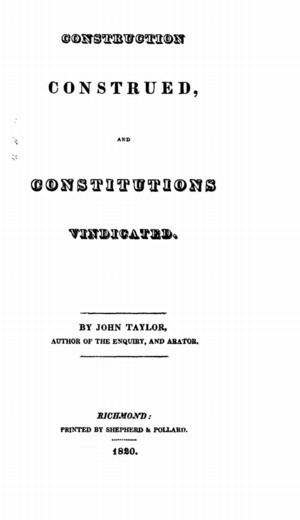
SECTION 12.: PROTECTING DUTIES AND BOUNTIES. - John Taylor, Construction Construed and Constitutions Vindicated [1820]

Edition used:

Construction Construed and Constitutions Vindicated (Richmond: Shepherd and Pollard, 1820).

About Liberty Fund:

Liberty Fund, Inc. is a private, educational foundation established to encourage the study of the ideal of a society of free and responsible individuals.


SECTION 12.

PROTECTING DUTIES AND BOUNTIES.

The points presenting themselves in considering this important subject, are, first, whether either the federal or state governments possess a right to distribute wealth and poverty, gain and loss between occupations and individuals. Secondly, whether the federal government possesses this right. And thirdly, supposing both or either to possess such a right, weather it is wise, or honest, or beneficial to the United States, to exercise it.

To understand the rights of mankind, the powers of government, and the meaning of constitutions, we ought to ascertain the design of civil society. Man, by nature, had two rights; to his conscience, and to his labour; and it was the design of civil society, to secure these rights. In the case of religious freedom, we have seen one right; in that of the freedom of property, our vision is not so clear; yet both, as natural rights, stand on the same foundation.

By suppressing the distinction between occupations, and covering all by the inclusive term, labour, we at once discern the natural equality of the right. The occupations of men are the men themselves; and every free government supposes, that it is only distinguishable from a tyrannical one by equal laws, and equal rights in its citizens. Our societies grew up from this principle, and we find nothing in our constitutions by which it is abolished. Our governments received man, animated by the creator, with a free will over his mind and his labour; and were instituted to protect the divine bounty. The freedom of conscience was made complete, because no contributions from that natural right were necessary for the support of civil government; but the freedom of labour was incomplete, from the necessity of such contributions. For ages, governments used the division of mankind into religious sects, as a means for making some men subservient to the avarice of others. We have detected this fraud; but its principle is vindicated by our governments having used the division of mankind into different occupations, as a means for making some men subservient to the avarice of others. The natural rights of labour, in subjecting themselves to contributions for the support of civil government, never meant to acknowledge themselves to be the slaves of a despotick power. These contributions were agreed to, for the purchase of protection, and not to establish a power for transferring the fruits of labour from one man to another. When paid, the freedom of property, as a natural right, occupies in relation to the remainder, the same ground which is occupied by the freedom of conscience. There is no reason to make any deduction from the latter right, for the sake of civil government; the reason for doing so, as to the former, extends only to publick contributions, and when these are paid, the rights of property are the same as the rights of conscience. Had it been proposed in forming our constitutions, to invest government with a power (over and above the power of exacting contributions for public use) of taking away the property of some and giving it others, it would have been rejected with indignation; yet this power is as much exercised by bestowing gratuities or exclusive privileges, as if the individuals, impoverished and enriched, had been named. This evasion of the freedom of property is particularly fraudulent, when a new society is constituted of men previously divided into distinct sects or occupations. Then the names of these sects or occupations are exactly the same as the names bestowed on infancy, as a medium for transferring property from one to another, and more difficult to exchange, in order to elude the imposition. Suppose, that at the period when the Highlands of Scotland were inhabited by a very few cognominal families, these families had united in a civil government by the names of tribes, either in the terms of the state or federal constitutions. In the first case, an assumption of power by their government to tax one family or tribe to enrich another, would have been exactly equivalent to state exclusive privileges in favour of some occupations, and injurious to others. In the second, an assumption of the same power would also have had this effect, and would moreover have resembled partialities on the part of congress for and against particular states. The endowment of one class of men by the names of their occupations, at the expense of another, is evidently the same in substance, as to tax the McGregors to enrich the McDonalds. All these cases, however modified, are an actual subjection of labour and free will for self good, to the use of avarice; and if this be not tyranny, I know not what is so.

Had beasts established a government among themselves, to protect each individual in the exertion of his own skill and industry, in gathering the fruits of the forest, and this government should have passed laws to prevent the majority of beasts form eating clover and cherries, and confining them to broom straw and blackberries, that a few might indulge in the most delicious fruits; would it not have been an arbitrary restriction of the desires and comforts bestowed on beasts by divine bounty, and a tyrannical abridgment of their natural power and liberty to provide for themselves? The case in much stronger, when the fruits are produced, not spontaneously, but by labour. Can it be less humiliating to reason than to instinct, to suffer this deprivation; or is the latter most capable of feeling it? Yet sophistry, or at least self-interest, has deluded several states into an opinion, that it is a blessing. But Doctor Rezio of Barataria could never persuade honest Sancho, that he would be made healthier or happier, by having good victuals or drink conjured away by the wand of power. Nations, excluded by prohibitory duties upon industry and free will, form enjoying the good things produced by different climates and different degrees in the arts, are placed in the situation of the beguiled and half starved Sancho. This is not surprising, when they are obliged to submit to doctors; but what shall we say to nations who boast of doctoring themselves? Are our comforts so numerous that they ought to be diminished? Yes, says the doctor, it will make you richer. When we reflect, however, upon the existence of an ocean for the diffusion of these comforts, and that man has been taught to walk all over the world upon the water, it ought to induce us to doubt, whether this worldly wisdom, even if it were not a fraud, of bartering comforts for deprivations, was preferable to the wisdom which has provided the means of bartering comforts for comforts.

The capacities of reasoning and labouring beget among men a relation founded in desires and wants, which designates them as constituted by nature, for society. Whether society be tacit or conventional, its end and design is to protect each individual of which it is composed, in the enjoyment and exercise of his primitive and natural faculties of labour and free will. Restraints upon these, so far and no father, than to protect the same natural rights of other individuals, constitute social liberty; and restraints imposed, not for the end of this social liberty; and restraints imposed, not for the end of this social protection, constitute tyranny. If the society has crept tacitly into existence, these two natural rights are the strongest of all limitations upon the powers of its government, because they are imposed by God; if it be conventional, the same limitations also remain, unless the compact should expressly surrender them. It would even be a doubt, if an existing generation should improvidently do so, whether future generations would be bound by the surrender; and the soundest opinion is, that they would not. Suppose the compact should say, that the government should have the power of taking away the life of one man for the private benefit of another; would this be a free government? But if it be silent upon the point, could the government exercise the power because it was not prohibited? And what prohibits it, but the natural paramount human right to the enjoyment of life? It is this paramount right, which has made it unnecessary to stipulate in our constitutions against the killing of one man for the benefit of another. The right of each man to his own labour, by which only his life can be preserved, is as much a natural right, as a right to life itself; nor was there any more need to stipulate in actual social compacts for its safety, than for the safety of life. It is an evasion of the right to live, to take away the products of labour by which men live, and to give them to other men. If a government can take some, it may take all; and bad governments, by this species of tyranny, do often starve men to death. But there is no difference in the principle, whether men are partially starved, or quite starved, to enrich other men. If the reader will recollect, and apply to this point what has been before said in relation to a bill of rights, he will discern that there was no reason to vindicate natural rights in that mode, because they remain, if not surrendered; and as the rights to our lives and our labour are not surrendered by our state constitutions, their design being on the contrary, to protect and preserve both, it follows, that these paramount rights are limitations upon the power of state governments to invade, either by exclusive privileges or otherwise, to enrich private individuals.

I might rest the argument here, and leave it to the reader to determine whether the interest, liberty or happiness of any state in the union can be possibly advanced by overturning these principles; but as the freedom of property is the object intended to be vindicated by this treatise, I hope he will have patience with me in bringing it into view in as many shapes as I may happen to recollect.

All, or most intellectual improvements, are referable to the free exercise of each man’s will, in procuring his own happiness. It unfolds his understanding, increases his knowledge, and animates his virtue. By multiplying the relations between the individuals of the human family, the blessings of society are also multiplied; and an abridgment of these relations is a retrograde movement towards that savage state, in which they are few. These relations are called commerce; and all obstacles thrown in its way are diminutions of an intercourse, from which men have derived their accomplishments, and a capacity for happiness.

Though a power of interfering in the intercourse between individuals by bestowing exclusive privileges on particular sects or interests, civil or religious, is contrary to the rights of nature and the end of society, and has produced oppression, when exercise in all other modes; it is contended, that one mode remains, by which a bad principle may be changed into a good one, and fraud white-washed into justice. By baptizing this bad principle with the goodly name of “an encouragement of manufactures,” avarice is supposed to be turned into patriotism, as Jefferies was made an upright judge, by clothing him in ermine; or, as it was once endeavoured to be purified by the still better name “religion.” It behooves us, therefore, to consider this new nominal modification of the same old tyrannical principle, with great attention.

If men were classed by the colour of their hair, yet the generick term “man” would include them all. Classed by their occupations, all are also included by the generick term “labour.” They all have the same rights, whatever may be the outlines of their physical or moral qualities, and to stretch or contract their moral qualities by force, in order to pamper the passions of a particular sect, or their physical qualities to gratify those of a Procrustes, is one and the same act. It is the same thing for a government to grant exclusive privileges to a particular occupation at the expense of the others, as to the class of black-haired men, at the expense of those having hair of other colours, because the effect of both would be, to confiscate a portion of the faculties of some men to provide for their own subsistence and comfort, and to bestow the amount of the confiscation upon other men; and it exceeds in atrocity the contributions imposed by generals on conquered towns, because it cannot be defended by the right of conquest. We have been led into this error by the abundance and vagueness of words. The words “agriculture, manufacture, commerce, profession and science” have produced artificial distinctions, which have obscured the reach of the inclusive word “labour,” and caused us to forget, that it is a natural faculty, like that of seeing, given to all men, that each might provide for his own individual happiness. I cannot see any difference between taking away form a man one of his eyes, if it could be done, and giving it to another; or taking away and giving to another fifty per centum of his labour. But this has been effected by making the plenty of words change the nature of things, although labour is in fact the only manufacturer. Workers upon the land, or upon the ocean, who give to things new forms or new places, are all manufacturers; and being comprised in one essential character, are entitled to the same freedom in free societies. It is this equality of rights, and nothing else, which constitutes a free, fair and mild government.

The power of a strong man to extort from am weak one, more labour than he gave in exchange, identifies the character of a government, which personifies the strong man, in depriving some occupations of free will in making exchanges of labour. It assumes that very practice of the strong man, which caused mankind to form themselves into societies, for the purpose of resistance. An exertion of this power first defrauded the sufferers of all the labour they had lost during the revolutionary war, by the circulation of certificates whilst they were depreciating; and secondly, of as much more by taxes imposed on the sufferers themselves, to raise an enormous bounty for the last holders. A certificate sect, strong in influence, used the power of government to transfer to itself a great mass of the labour of more useful occupations, like the strong unassociated man. The banking sect, also, has been able to convert the legitimate power of government to protect the freedom and fairness of exchanges, into an illegitimate power of destroying both, by enabling that sect to rob all useful occupations of a great portion of their labour, by means of false or depreciating tokens of value, drawing an interest paid by these occupations, in addition to their losses from depreciation and bankruptcy. But, the manufacturing sect do not propose to divert the power of government form the protection to the invasion of property in the same atrocious degree, and only asks it to compel all other occupations to exchange labours with it, not by the mutual valuations of free will, but by a compulsory, inadequate valuation; and like a liberal, unassociated strong man, it is willing, for the present, to receive annually from all other occupations, two measures only for one. In exchanges of labour, that which a freedom of intercourse can obtain, constitutes the only true measure.

the effects of this annual exchange of labour to a great amount, by a false, and of course, a fraudulent measure, are too extensive to be explained in this short treatise, and too intricate to be completely developed; but some of its consequences are necessary to clarify the argument.

As all the other occupations, by being compelled to give two measures of labour for one, will sustain a great diminution of their means for procuring subsistence, competency or affluence, every individual belonging to them will immediately exert his ingenuity to evade the imposition, and to reimburse himself for his losses, at the expense of other individuals. He will endeavour to enhance the price of his own manufactures, whether agriculture, mechanical, commercial scientifick or professional, in order to bring back exchanges from the false measure of legal compulsion, to the true measure of free will. If these other occupations could succeed in this attempt against the occupation obtaining the bounty by means of the false measure, the bounty or privilege would become abortive, and exchanges would be honestly made, measure for measure, as they were previously to the compulsion. In this event, the experiment would only have the effect of disordering for a time the only fair principle of social intercourse, and of exciting new arts for mutual imposition. If these other occupations cannot succeed in reinstating the golden rule of free will in the exchanges of labour, they will endeavour, like starving men, to prey upon each other; and the oppression of the bounty will fall heavily upon them a second time, by producing fraud and extortion among themselves. Those occupations, which cannot find at home objects on which to operate, to indemnify themselves for the extortions of the occupation which is privileged to mete in a smaller measure, than they are willing to receive by, cannot be reimbursed. The agricultural and commercial occupations are in this situation. Neither of these can for many years find objects at home for exchanges, sufficient to reinstate the freedom of intercourse; and neither can indemnify itself for the coerced contributions to the domestic privileged sect, at the expense of foreign nations, because all exchanges between them and these nations must still be made and measured by free will and mutual computation, whilst the extortions they will suffer from the false legal mode of exchanges at home will remain. The agricultural class may indeed retain and employ its capital, subject to the contribution, but a considerable portion of the mercantile capital will be thrown out of employment; and its owners must suffer miseries and losses from leaving a business in which they are skilful, for one of which they are ignorant. They will be emigrants from a highly cultivated to an unexplored country. Though the scientifick classes may make a few reprisals from the endowed class, and many inroads for indemnification upon the mercantile and agricultural classes, yet it will be incomplete, because they must participate of the loss sustained by their best customers. The valuable classes of ship builders, owners and navigators, subsisting entirely upon the capital of the mercantile and agricultural classes, must inevitably lose a portion of employment equivalent to the losses of their patrons or customers, without the smallest chance of reimbursement. These classes sell neither bread, meat, physick nor law, and their wages will be diminished by a diminution of employment. Such will be the effect until a sufficient number of these maritime manufacturers are starved, or thrown out of employment, to create a demand for the labour of the remnant.

The great argument, in favour of compelling all other occupations to pay double prices to that which is very incorrectly called, exclusively, the manufacturing occupation, is, that the imposition will be temporary; for that when it has coerced an emigration from other occupations into this, to stock the market sufficiently with manufactures, the fraudulent measure or compulsory price will disappear, and the fair measure, or free will in computation, will be re-instated; and an anticipation of a recovery of the principle for which I am contending, is said to be better than its actual enjoyment. No proverb has said, that a bird in the bush is worth as much, as one in the hand. This argument, containing the essential and solitary promise, by which a protecting-duty policy is defended, is infinitely more fallacious than any I have ever met with, by which privileged sects have heretofore dazzled reason, and defrauded ignorance. These fungi have usually asserted, that their monopolies and exclusive privileges were good, and proper for endurance. But this admits, that the privilege and monopoly it is striving to obtain bad; by asserting that it ought to be granted, because it will in time cease to operate partially and unjustly upon the other occupations of society. Let us, says its great argument, relinquish the good principle of exchanging labour by the measure of free will, and undertake a journey, long or short, upon the bad principle of forcing all other occupations to give two measures for one, to a certain detachment of manufacturers, that we may get back to the same good principle from which we set out. What should we think of the general of a vast army, encamped on firm ground, who should march for many years over bogs and marshes, in order to get back to the same ground? If he should even accomplish a project so profound, would his getting back resuscitate or cure the soldiers who had died or been crippled by the way? A journey through exclusive privileges, in order to get back to the principles of social liberty, is even more hopeless than the march of an army round the world, in order to get back to a safe station; for this latter journey might possibly have an end. But where is the end of the world of exclusive privileges? What man can hope to live to the end of a journey through its protecting-duty region only? If he should survive the hardships and privations of this long and perilous journey, could he be so infatuated as to expect, that no new exclusive privileges will be invented by the way? Will avarice be glutted and put to sleep by its success in this instance; or will that success beget a new progeny, and cause the hopes of our traveller from good principles, to get back to the same good principles, by the road of bad principles, to be more extravagant than those of a turnspit dog, which expects that every step will be his last, and that then he will eat the meat he is roasting? But why do I argue this point, when he who gave to man the capacities of free will and labouring, hath said, “with what measure you mete, it shall be measured to you again?”

Let us, therefore, proceed to the second point, namely, whether the federal government has a right to regulate the wealth and poverty of individuals, or of corporations, by protecting duties and bounties. And if it has, mark the consequence! Protecting duties for the encouragement or coercion of manufacturers are within the sphere of action of congress; the supremacy of congress over subordinate governments entitles it to remove all obstacles to its measures within that sphere; therefore, the state governments cannot tax internal manufacturers, because it would obstruct the intention of congress to encourage them by bounties. Here is a new case, displaying the extent of the principles asserted in the bank decision, and evincing that their power to enable congress gradually to strip the states of the right of taxation is not ascertained, if according to that decision, it admits of any limitation. I hope the reader, in considering this important point, will endeavour to recollect the observations previously made, in relation to sovereignty, supremacy, and our distinction between local and external powers, which caused us to go to war with England, and dictated much of our former and existing confederation. He is not to determine, weather congress could create a bank, or grant protecting-duty bounties, or gratuitously bestow the property of the people upon revolutionary soldiers, as if these were special and particular cases; but whether it has an unlimited right to establish monopolies, grant exclusive privileges to persons, exempt capital or wealth from state taxation, and give away the property of the people in any amount to whomsoever it pleases. Such are the general conclusions arising from these special cases, which seem to me to deserve the national attention.

The truth of the following proposition, depends upon the intention of the federal constitution. Congress is only invested with limited powers over persons and things, for the purpose of executing the defined powers delegated to it. The 8th section of the first article of the constitution contains a list of these defined powers, amounting to seventeen; and the eighteenth clause of the section empowers congress to make all laws necessary and proper for executing the seventeen defined powers delegated. Thus, a correlative power of acting upon persons and things is attached to each defined power delegated, as a necessary and proper means for the execution of the power; and not a means of obtaining power not delegated, or of destroying or diminishing any power reserved to the states.

The first power given to congress is that of taxation, to provide for the common defence and general welfare of the United States. Under this power, congress can act upon persons and things, so far as is necessary and proper to collect these taxes. It has however been often asserted, that the power given to congress to lay taxes is amplified by the words “to provide for the common defence and general welfare of the United States.” This construction is obviously erroneous. These words refer to the destination of the taxes, and are only a reason for the power of taxation. If they convey and power over persons and things, internally or externally, they convey all power over all objects; and under a construction of the latitude contended for the power of taxation, and all the subsequent powers bestowed in the same section, would have been quite superfluous. For, if these words comprise a grant of power to congress, the power is unlimited, and includes both all the specified powers, and also every other power, which in their opinion may be necessary and proper to provide for the common defence and general welfare. They would suffice to swallow up the treaty-making power, as well as the other; specifications of the constitution; but, if they do not suffice to swallow up all the specifications and restrictions of the constitution, they are not sufficient to swallow up any one. Of course, they cannot absorb any portion of the local or internal powers, especially reserved to the states, among which that of making roads is undoubtedly one.

But, suppose we detach the phrase “to provide for the common defence and general welfare of the United States“ from the power of taxation, and consider it as an isolated and distinct grant of power; it will then be necessary to ascertain whose defence and welfare was to be provided for; the defence and welfare of the individuals composing the states, or of the political individuals called states. I think the letter and tenour of the constitution correspond upon this point with perfect perspicuity. “The United States” are specified as the objects or individuals, whose common defence and general welfare was to be provided for. In the first clause of the constitution the same phrase is used: “The people of the United States to provide for the common defence and promote the general welfare establish this constitution for the United States of America.” It was not, therefore, a constitution for the government of persons or things generally existing in these United States, but for the government of the states themselves, and in order to promote their common defence and general welfare. The words common and general refer to the objects or political beings, whose defence and welfare was to be provided for, as being in a state of union. And as no state of union or any species of social compact existed among the persons composing the states, inclusively, these words cannot be made to refer to them. They therefore restrain the power of congress to the defence and welfare of the states themselves, instead of enlarging it to include the defence and welfare of private persons.

The whole tenour of the constitution corresponds with this literal construction. All the powers given to congress point to the defence and welfare of United States, and those necessary for the defence and welfare of private individuals are reserved to the states themselves. If this construction be correct, it clearly follows, that congress can only impose taxes, constitutionally, for the defence and welfare of the states, and that an imposition of taxes for the purpose of enriching one state, one interest, or one individual, at the expense of another state, another interest, or another individual, is as unconstitutional, as it is adverse to the freedom and fairness of exchanges. In fact, this declaratory end is a complete key to the intention of the constitution, and locks out congress, in conjunction with the reservation to the states, from all constructive powers over persons and things, if a local and personal nature, especially the power of taxing either to foster fungi, or to grant bounties or exclusive privileges.

Let us, however, look farther into the constitution, to see if it affords other proofs of the correctness of the construction for which I contend. It terms, in creating the departments of the federal government, are the same with those used to define its design. “The house of representatives shall consist of members chosen by the people of the several states. Representatives and direct taxes shall be apportioned among the several states. Until the enumeration, the state of New Hampshire shall be entitled to choose three representatives. When vacancies happen in the representation from any state. President of the United States. Senate of the United States. House of representatives of the United States. And the congress of the United States.” Now, can any fair reasoner contend, that the states are not here repeatedly recognized, as the authors of the federal government, and the federal government as a government of the states, and not of the people? Those who made it are its constituents, and over these constituents its powers are delegated. The states are expressly characterized as individual political beings, and every department of the federal government, even the house of representatives, is positively asserted to be the representative, agent or trustee of the states, and none are even insinuated to be the representative, agent or trustee of the people, except as comprised by the term “states.” Congress is therefore a representation of those interests only common to its constituents, the states. But the framers of the constitution, lest this representation should usurp powers over private persons and internal concerns, carefully defined such common interests of these constituents, as were intended to be entrusted to their representative; and the question is, whether the doctrine of means to effect ends, can bring under the power of a representation of states, persons and things, neither its constituents, nor subjected to its power.

Let us look at a sample of this question.

Powers bestowed by the constitution.Powers claimed as means.
Taxation,Incorporating banks,
War,Making roads,
Appropriating money,Giving it away,
Regulating trade,Granting monopolies,
Admitting new states.Prescribing state constitutions.

In one column, we find objects of general concern to the states; in the other, said to be their legitimate progeny, objects merely personal or local. Now I contend, that the progeny of the parent powers ought to be sui generis; and that a progeny of means, which violate the powers reserved to the states, under the influence of a different species of lust, from that which excited the heathen gods, is no less spurious, than the fruit of their amours.

Let us deduce a few arguments from the following position. No powers, delegated to congress, are represented in the state governments; and no powers reserved to the states, are represented in congress. If this be true, it evidently follows, that the design of the federal constitution was to establish two communities, assigning to each a distinct representation, and entrusting each with distinct powers and duties, so modelled as to preserve the common interest, fellow feeling and sympathy, which constitute the essence of a true representation. Congress was entrusted with powers concerning the common defence and general welfare of the community of states, which it represents; and the state governments, with the common defence and general welfare of the communities of individuals represented by them. If the latter should exercise powers within the sphere of the former, under the pretexts that it would advance the welfare of the community of states constituting the union, and were means which might be inferred from the reserved powers, they would be acting for a community which they do not represent; and if congress should exercise any powers within the state spheres, under the same pretexts, it would in like manner be acting for a community which it does not represent. Now, as it is not pretended that either congress or the state governments can violate the principles of representation, by directly assuming powers assigned to the other, the only question is, whether either can do it directly, by the instrumentality of means. It seems to me, that both these governments must as well be the representative of means, as of powers, and this consideration is as much a restriction upon the former, as upon the latter. Means ought to be emblematical of the powers they commemorate, and the converting of them into powers which penetrate into the territories, either of rights delegated or rights reserved, is a species of political transubstantiation, transgressing the essential principles of representation. They are emanations from the powers delegated to congress or reserved to the states; but these emanations must surely be limited and restricted by the same principles which limit and restrict the powers themselves. The primary and obvious intention of the federal constitution was, to invest congress with such powers only, as equally affected the members of the community called the union; and to leave to the state governments, all those powers affecting the members of the community called the states. In both cases, this was necessary to sustain the principles of representation, and in neither can this primary an obvious intention be evaded by any means, without destroying both the positive division of powers, and the moral principle of representation. A legislation of either of these communities within the territory assigned to the other, is equivalent to a legislation by one independent nation over another. I now ask the reader, if monopolies, exclusive privileges, or bounties to persons; or local improvements, such as roads or canals, and an encouragement of agriculture or manufactures, are represented in congress; and if congress in legislating upon such subjects, can possibly be invigorated by the community of interests, which ought to pervade that body in the discharge of its federal functions? Are not the recited functions plainly local and personal, and would they not be exercised in congress by feelings and motives, entirely different from the common interest, fellow feeling and sympathy, essential to representation?

In the Federalist, pages 173, 176 and 177, Mr. Hamilton, who was neither disposed to diminish the powers of congress, nor to extend those of the states, has delivered the following contemporary constructions of the constitution. “The encouragement of agriculture and manufactures is an appendage of the domestick police of the states. Exorbitant duties on imported articles tend to render other classes of the community, tributary, in an improper degree, to the manufacturing classes. They would be attended with inequality, between the manufacturing and non-manufacturing states.” What a whimsical thing is party politicks! This gentleman assisted in framing the federal constitution. He knew that the agricultural and manufacturing interests were not represented in congress, and that a patronage of either by the body, would therefore be an usurpation; and having stated that they appertained to the states, he suggests the tyrannical effect of high duties, in making one state tributary to another. Mr. Hamilton had a clear view of the subject. As the states and not individuals were the constituents of congress, he saw that it could not legislate concerning the property, the persons, or the rights of individuals, of a local or internal nature; because in such cases the relation necessary to bestow a right of legislation, between constituent and representative, did not exist. He saw that the absence of this relationship would, as it always does, make some people tributary to others. He saw that the care of agriculture and manufactures equally appertained to the states. And he knew that a right to encourage one involved a right to discourage the other; and that, however modest and unassuming the first word might appear, it contained as much internal tyrannical power, as any degree of ambition could wish for.

But, may not the power of encouraging and discouraging both agriculture and manufactures, be common to congress and the state governments? This is a doubt which deserves great attention, and will reflect much light upon the subject. We have not forgotten the assertion in the decision of the bank question, “that congress being elected by and representing all” may be trusted with internal powers, and therefore it behooves us to look into the constitution itself, to discover how far this is the case. When we do so, we at one discern that the elective and representative qualities of congress are not considered in the least degree as vehicles of powers; but that defined and limited powers are delegated, adapted to the nature of its representative character, and of its constituents. The powers delegated are such, as would act upon the common interest of its constituents, and not such as would foster local partialities. And there is no concurrency of powers between the federal and state governments, except in the case of taxation; from whence it is fair to infer that none other was intended to exist. It will not be denied, that a right to encourage agriculture and manufactures, and to make roads, was possessed by the states previously to the union; and that, as it is reserved by the constitution, it still remains. The concurrent power established from necessity in the case of taxation seems to exclude the idea of tacit concurrent powers. At least, these cannot be inferred from the representative nature of congress, without endowing that body with a concurrent power as to all other powers reserved to the states; nor without exploding the reasoning which goes to prove that congress is the representative of federal, and not of personal or local interests. The meaning of the word “reserved” must also be overlooked. A has no right to participate in that which is reserved to B, and if congress be excluded from the exercise of the powers reserved to the states, and those encouraging agriculture and manufactures are among the powers reserved, its right to exercise either power cannot be established.

But, these powers have been claimed as an appendage of that to “regulate commerce,” and as the power of taxation has been made to beget a power of creating corporations and granting exclusive privileges to persons and property, so this power to regulate commerce is supposed to contain both the latter power, and also that of inflicting a tax upon all other interests to enrich one. This art of making external and federal powers beget local and internal powers, resembles I suppose the ingenious process by which pigeon-breeders are said to be able to furnish birds of any colour; but it is not yet pushed quite as far in this instance as in the bank case. In the latter, taxation has begotten banks, and those banks have begotten a restriction of the right of taxation reserved to the states; a very anomalous progeny indeed; the right of transmitting taxes has taken away the right of imposing them. Thus, as two persons re-peopled a deluged world by throwing stones over their heads, the tossing about of words is made to revive all the powers prohibited to a federal congress by a federal constitution, and to resuscitate legions of those principles of despotism, which were intended to be suffocated by division and limitations of powers. It is not uncommon far a skilful verbalist, to engraft upon an old root new scions bearing very different fruit; but we might as justly contend that an apple engrafted on a pear, would produce pears, as that a power to tax all other occupations to enrich one, engrafted on the power to regulate commerce, would be an imposition of duties “to pay the debts and provide for the common defence and general welfare” of the United States.

During the pressure for money towards the conclusion of the revolutionary war, an ingenious member of congress, by way of amusement, informed a very rich friend of his, that congress had resolved to engraft, upon the words “general welfare”, in the old confederation, an absolute power over private property; and that coerced by necessity, it had resolved, that the estates of one hundred of the richest individuals in the United States should be sold, and applied to the “common defence and general welfare” for which it was the duty of congress to provide. Being a gentleman of great ingenuity, he alarmed his friend by many plausible arguments to prove the existence of the power and a necessity for its exercise; and drew from him a serious and laboured answer. This case is evidently much stronger, than that under consideration, and afforded a wider scope for the verbalizing science. The words “to provide for the common defence and general welfare” are of larger compass, than the words “to regulate commerce.” The application of the money, to be raised by this violation of private property, to the use of the nation, was more conformable to the constitution, than a transfer of private property to private people. And it was more equitable that the rights of one hundred men should be sacrificed to defend the nation, than that the rights of all other occupations should be sacrificed to enrich the manufacturing class.

Let us place before our eyes the root, and the scion proposed to be engrafted on it. The root is, “congress shall have power to regulate commerce;” the scion, “congress shall have power by protecting duties to tax all other occupations for the purpose of enriching the manufacturing class.” But the power to lay duties had been defined and limited by the first clause of the section, and their application limited to national use. The power to regulate commerce could not be intended to convey to congress an indefinite power of taxation, because a definite power of taxation had been previously expressed. Specification precludes inference; at least, if the inference contradicts the specification. As the subject of taxation had been expressly disposed of, it cannot be fairly supposed that it was tacitly resumed; and as the specification appropriates duties to the use of the United States, this tacit resumption cannot also contain a hidden power, to lay duties for the benefit of a particular occupation. The recondite powers contained in the words “to regulate commerce” may find objects for their operation, as they are multifarious, without adding to the catalogue, a power expressly given in another clause; but, if they are allowed to be a root, capable of endowing congress with all powers having relating to commerce, they will convey many powers inconsistent with the tenour of the constitution.

They would invest congress with an internal power over persons and things, not represented in that body; and both prohibited to it, and reserved to legislatures in which they are represented. The whole property and wealth of the country are more nearly connected with commerce, than roads are with war; and the mode of reasoning in that case will embrace agriculture, and invest congress with a power of regulating that also, as is attempted by making it tributary to manufactures. The constitution has laboured to prevent this illicit intercourse between construction and a lust of power. “No capitation or other direct tax shall be laid, unless in proportion to an enumeration. No tax shall be laid on articles exported. No preference shall be given, by any regulation of commerce or revenue, to ports of one state over those of another.” The intention of these restrictions was, to deprive congress of the power of exercising local or personal partialities. Protecting duties operate in fact as a direct or capitation tax, for the benefit of one occupation, imposed upon all others by legal necessity; and such taxes ought to be apportioned by the census, unless it be said that this rule is only required when the tax is imposed for public service, and may therefore be disregarded when it is imposed for the benefit of a pecuniary aristocracy. “No taxes shall be laid on articles exported.” The value of agricultural staples must long depend upon exchanges with foreign nations. They are consumers of our breadstuff, cotton, tobacco, fish, and many other articles. Consumers neither exist, nor can be speedily created at home. These foreigners are utterly unable to pay us in specie for the products we can spare, and if they could, this specie would depreciate like paper money, unless we could export it, not to buy more specie, but articles of consumption. A prohibition, therefore, complete or partial, of the importation of the articles of consumption in which agriculturists must receive payment, is in substance a double tax upon exports. It lessens their value, and enhances the price of the few articles of consumption they can procure at home. It will have an effect similar to a diminution of circulating currency by banks, because it diminishes the currency, (the soundest imaginable,) circulated by the freedom of exchanges. It is an illusion to suppose, that this banishment of currency from the agricultural market of our country will not cause it to decline, because specie may still be brought in payment. The currency brought to this market consists of specie and articles of consumption; by banishing both, the market would be starved; by banishing one, it will be half starved. It is surprising that gentlemen who despise and deride a miser abounding in wealth, and yet denying to himself the comforts and delights of life, should recommend an example which they reprobate, for the imitation of their country.

“No preference shall be given, by any regulation of commerce or revenue, to ports of one state, over those of another.” In all these prohibitions, we find the great principle of interdicting to congress a power of regulating the wealth or prosperity of particular states or occupations, carefully enforced. Ports is here put for people. Inanimate things have no rights, and can enjoy no preferences. A tax paid by agricultural to manufacturing states, if the bounty be sufficiently high to enable the manufacturing class to meet foreign competition, will operate as a favour to particular ports in the state where the manufacturers reside. The bounty, bestowed by the British parliament upon Irish line exported, was a preference to the ports from which the exportations were made, of the same kind. And all such bounties, direct or indirect, have been considered universally as highly valuable local preferences. The weight of the restrictive clauses of the constitution, as an exposition of the intention to exclude congress from an exercise of power, internally, over persons or things, by which partialities or pecuniary inequalities among states or individuals might be cultivated, would be sufficient to over-balance a long list of verbal subterfuges, by which this principle, so anxiously enforced, is endeavoured to be eluded; even if literal prohibitions, exactly fitting every deviation from it, could not be found. Man’s foresight cannot anticipate all the artifices of ambition and avarice; but the restrictive clauses of the constitution, compared with the limited powers bestowed, demonstrate an abhorrence of the idea, that the federal government should have a power of bestowing preferences of any kind upon states, districts or occupations. The restrictive clauses are precedents by anticipation, and the reason which suggested them, extends to similar cases. This was the division of powers between the federal and state governments, and therefore a construction so ingenious, as to elude the letter of the restrictive clauses, will still be incorrect, if it violates the reason which suggested them. Have protecting duties been imposed by congress under the expressed power in the first clause of the eighth section “to lay duties,” or under the clause “to regulate commerce?” If under the power expressed, their purpose must be “to pay the debts and provide for the common defence and general welfare of the United States;” if under a power inferred from that to regulate commerce, can the constitutional appropriation or purpose be thereby evaded or repealed? To lay them for the purpose of paying the debts, enriching or advancing the welfare of particular persons or occupations, seems to accord as little with the words of the constitution, as with its spirit in creating a division of powers; assigning to congress those exclusively relating to the defence, welfare and debts of the members constituting the union, called states; and to the state governments, exclusively also, those relating to the defence, welfare and debts of individuals and occupations.

But the following argument seems to be conclusive. A government, which exercises a power of distributing welfare among occupations and individuals, must be sovereign and absolute over persons and occupations, to enable it to do justice by bestowing countervailing favours, because it must of necessity otherwise commit great injustice. Even the British government acknowledges the right to such equivalents, and accordingly endeavours to compensate the agricultural occupation by particular favours and a considerable monopoly, for the favours and monopoly it has granted to the manufacturing class. It is unnecessary to enlarge upon the intricate system of equivalents extended to a variety of interests in England; and it is enough to know that this system must exist as an appendage of exclusive privileges, necessary to give them even an appearance of justice and equity. By this game of government, though played with professed fairness, the great body of the people do not appear to have been gainers. What then would be the effect of a power in congress to grant exclusive privileges to two occupations only, those of bankers and manufacturers, without any power to grant to other occupations or the persons engaged in them, the countervailing equivalents? We must therefore conclude, either the congress have no power to grant exclusive privileges to the individuals engaged in these occupations, or that the constitution has invested it with an absolute internal power over persons and property; because it can never be imagined, that its wise framers intended to invest congress with a power of granting exclusive privileges to two occupations, one of no value, and the other of inferior value, and to prohibit it from advancing the welfare of the agricultural, commercial, maritime, and scientifick occupations, of so much more importance. We must either embrace an absurdity so flagrant, or discern that our decision upon this point is reduced to a plain alternative; and that we are forced to conclude, either that congress may constitutionally incorporate, or grant exclusive privileges to every species of human occupation, or to none. By the first decision, congress will acquire an unlimited internal power over persons and things; by the second, the powers reserved to the states will be retained. The third opinion, that congress may grant favours to particular states or districts, by granting exclusive privileges to occupations locally prevalent, is inconsistent with a possibility of dispensing equal justice or general welfare among the parties to the union, not less forcibly impressed by the tenour of the constitution, than by common sense and sound policy. All places and all states are not susceptible of the same exclusive privileges, and these cannot therefore be equalized, except the power of granting them shall embrace the means by which only it can be effected. Each reader will select that of these opinions, which may correspond with the true intention of the federal constitution.

But, if all our legislatures have an absolute power over persons and property, and the freedom of exchanges is an imaginary notion; and if the federal constitution does empower congress to incorporate or grant exclusive privileges to all occupations, or to two only, it still remains to be considered, whether its exercise is wise, honest, or beneficial to the United States.

It is said, that protecting duties by their derangement of fair exchanges will be a bounty to starving and destitute manufacturers. I shall not stop to enquire into the power of congress to provide for the poor of all occupations; nor to display the iniquity of taxing the poor of all other occupations to raise bounties for the poor of one; nor to enforce a parallel between such a law, and one for taxing the dissenters, as they are called, to raise bounties for the poor of the church of England; nor to press to existing similitude of these dissenters being taxed in England to raise bounties for the episcopal clergy, who more nearly resemble those who will get the protecting-duty bounties; but passing over these fruitful arguments, come at once to facts.

It will hardly be imagined, that the workmen in manufactories wrote the multitude of pamphlets and petitions, which have appeared in favour of the protecting-duty mode of bestowing bounties upon the occupation of manufacturing; and if the phenomenon does not arise from the concert and avarice by which exclusive privileges have been hitherto moved, it may have been produced by a pure and disinterested benevolence in their employers, of intending to enhance the wages which they are themselves to pay. Allowing a motive so gratuitous and disinterested for the expenditure of talents and waste of vehemence brought forth by the occasion, it will be useful to these gentlemen to enquire, whether their charitable purpose is attainable by the mode they have recommended; because if it be not, as they have no mercenary design, it will be doing them a service to cool a consuming zeal, and save them from the shock of a sore disappointment. It will undoubtedly dismay them to be told, that all the bounties arising from the protecting-duty project, must inevitably settle in their own pockets; and that the wages of their poor workmen (the objects of their solicitude) will ultimately be diminished by it. Yet such will certainly be the consequences.

As consumers must pay these bounties, and as a majority of consumers are poor, it follows, that if additional wages could have been bestowed upon the workmen in manufactories, by an impost on consumptions, it would have still diminished the comforts of more poor men than it would have relieved; and this observation derives additional force from the fact, that whilst our manufactories are young, and their fabricks coarse, they will be chiefly consumed by the poorest classes in society. Our capitalists so well skilled in figures may therefore very easily discover, that their project is on the debit side in he account of benevolence.

Their poor workmen, like all other poor people, are consumers themselves, and a tariff to bestow bounties by a general monopoly will reach and tax them, with the exception of the solitary article manufactured by each. Thus each workman will pay two measures of labour for one, on a multitude of articles, even if he should receive two measures for one, on a single article. What a number of these double prices, for instance, will be paid by the poor grinder of snuff, for that portion of the double price which may get into his pocket! Such is the theoretical benefit to the poor workmen; practically, even this poor benefit does not exist.

The theory supposes, that the workmen are to get the whole excess of price arising from protecting duties, but as they have a violent tendency to aggravate taxation and provoke a taste for expense in the government; and as the system can only be enforced by a great increase of publick officers, the share of these burdens, which would fall on the workmen, would probably balance or certainly diminish the bounties very considerably.

But the system must encounter a still more formidable fact. It must meet and destroy a principle much sounder than itself, before it can fulfil its promise to enhance the wages of the workmen. The wages of labour are not settled by law, but by circumstances over which law can possess but a very feeble and transient influence. As the level of wages among labouring occupations had been settled previously to protecting-duty laws, the circumstances by which it had been effected were too stubborn to be suddenly subverted; otherwise, when fifty or an hundred per centum had been added to the price of a manufacture by law, the same addition would have been uniformly made by employers to the wages of their workmen. We know that this is never the case. Even a struggle for the bounty seldom ensues between the employers and their workmen, and it was never seen that the workmen have gotten it all. Now, all could not possibly be more than sufficient, to reimburse the workmen, for the loss they sustain by the increased expense of government, and by the additional price they must pay for the articles they consume, but do not fabricate; and if the employers get any part of the bounty, the labour of the workmen will not go so far in providing them with subsistence, as it would have gone, had not the price of consumptions been enhanced by protecting duties; and although the wages of manufacturing labour should be somewhat raised, above the level of those paid to the workmen in other occupations, the retrenchments would exceed the accession, and leave the workmen less to subsist upon, than when their wages, expenses and taxes were all lower.

Suppose however, that the whole tax collected by a multitude of monopolies from the community should go to the workmen, without their employers being able to intercept any portion of it, and suddenly create a great inequality between the wages of manufacturing workmen, and the workmen in other occupations; yet the circumstance of abundance, which so absolutely diminishes the price of labour, would tread upon the heels of the acquisition, and very soon defeat it. An enhanced price suddenly removes scarcity, begets plenty, and terminates in cheapness. Therefore, when merchants design to obtain an article at a low rate, they wisely begin with giving a high price. The bait fills the market, and they avail themselves of the abundance to buy cheap. So in this case, if the wages of the workmen should be raised far above the level of the wages of labour in other occupations, the bait would suddenly draw an abundance of workmen to the manufacturing occupation, and this abundance would immediately reduce the wages to the rate dictated by the necessity for subsistence, or by a comparison with the wages of labour in other occupations, leaving to the employers the whole of the bounty. The most favourable operation of the protecting-duty system, as to the workmen, is, that the whole body of consumers in the community, including themselves, will be taxed to raise a great annual bounty; that this will augment the expenses of government of which they must bear a share; that this bounty may draw an abundance of workmen to the market; that this abundance will certainly reduce their wages lower, comparatively with the expense of subsistence, than when there was a scarcity of workmen; and that the bounty will infallibly settle in the pockets of their employers. Thus the system eventuates as all other exclusive-privilege projects, in an absolute conspiracy against the interest of labour, by inflicting on it an additional burden, precisely of the same character and effect, as if the sum paid to employers had been added to the salaries of the officers of government, or given as a bounty to any two or three hundred men by name.

A few facts will be the strongest arguments in support of this reasoning. Society may be divided into the classes of rich and poor; both are consumers; but as the poor class is by far the most numerous, it is of course the greatest consumer; and therefore, it must pay the greatest portion of the tax imposed by the protecting-duty system, especially as that tax falls chiefly upon coarse fabricks. In iron foundries for instance, as in all other manufactories, the workmen belong to the poor class, and consume more of the taxed articles of home manufacture, then their employers; upon all of which they pay the tax. As to the tax upon iron itself, it is chiefly paid by the poor of the whole community, because they consume more of it than the rich. This instance is adduced to establish the fact, that the poor class, including the workmen in all the manufactories, instead of receiving, actually pay the largest portion of the protecting-duty tax.

The manufacturing workmen in England are among the poorest of the poor class, although the prohibition against the importation of their fabrications is complete. Why has not this prohibition enriched the workmen? Because it has established a monopoly which operates only in favour of their employers, increases the expenses of government, and feeds unproductive capital by sacrificing productive labour. It keeps down the price of labour both by a concert among employers, and also by a comparison with its price employed in other occupations; and subverts the pretence, that the same system will produce opposite effects in this country. It is evidently a system in favour of the rich, and against the poor class, because the first class possess the capital which the system nourishes, and the second perform the labour, which supplies the nourishment.

Employers are called capitalists with great propriety, because more capital is necessary to establish a manufactory, than to employ ourselves in individual occupations. Few or none, therefore, of the manufacturing capitalists can belong to the poor class of society. The mercantile occupation requires capital in the next degree, and of course furnishes the next fewest number of individuals belonging to the poor class. The scientifick and professional occupations include the next fewest number of persons assignable to the poor class. And the agricultural occupation contains a much greater number of individuals belonging to the poor class, than either of these, because no capital, except bodily labour, is necessary to go to work; and a very small sum suffices to procure means sufficient to employ ourselves in that occupation, to the utmost extent of bodily capacity. Of the variety of other occupations, highly useful, but yet containing a still greater number of individuals belonging to the poor class, I shall specify two, for the sake of an observation suggested by such. The seafaring occupation is chiefly composed of people having very little capital except their bodily labour. If a bounty should be given to this occupation, by taxing all other occupations, these other occupations would presently exclaim, that the law of plenty or scarcity, which governs the price of labour, would certainly enable its employer, the rich mercantile occupation, to appropriate this bounty to itself, by diminishing wages from an estimate of the bounty, and of other wages; and that, under pretence of favouring poor sailors, the poor of all other occupations would be taxed, for the benefit of the richest merchants. I see no difference between capitalist merchants and their sailors, and capitalist manufacturers and their workmen. The carpenter occupation, like the agricultural, contains a large proportion of the poor class. A law laying a heavy duty upon the importation of houses, as a recompense for the tax these poor people pay through their consumptions to the manufacturing capitalists, would be equivalent to laws laying duties upon the importation of bread-stuff, tobacco and cotton, to reimburse the poor agriculturists for the same tax.

The wealth of the owners of manufactories, having conferred upon them with great propriety, the title of capitalists, I cannot see the policy, wisdom or justice, of taxing the whole class even of the rich in all other occupations, to make them wealthier; but when the tax producing this effect, is extended to the poor of all other occupations, it is something worse than a fraud, and becomes a grinding oppression. Morality may calmly disapprove of the rich plundering the rich, but humanity shrinks with no little impression of abhorrence, from the idea of the rich plundering the poor. If avarice should endeavour to conceal this appalling spectre from herself, by the flimsy pretence, that the manufacturing poor and not the manufacturing rich, will get the protecting-duty tax, it only proves that a very small matter of reasoning, attended by a great sum of money, will satisfy her. Where is the justice or policy of taxing the great body of the poor class, included in all other occupations, for the benefit of the small number of poor, included by the manufacturing occupation? Suppose two capitalists, having each a million of dollars, and a law should pass for taking from the one and giving to the other only half a million. How would he feel, though he would have more than enough left? Bodily labour is all a poor man’s capital. In taking away a moiety of this, though for the purpose of giving it to another poor man, a more cruel injury is committed, because he has not enough left. It is not an excision from a superfluity, but from the necessary natural capacity to labour, and strongly resembles the Abyssinian morality of feeding upon an animal which is still living. To tax one poor man for the benefit of another, each having no other capital, but his natural ability to labour, in its degree of oppression, is the same to the sufferer, as if the tax had been appropriated to the rich; but the distinction is of no consequence, because the fact upon which it is surmised does not exist. The whole community, poor and rich, is taxed by the protecting-duty system. Had the small body of poor comprised in the manufacturing occupation received this tax, they would have ceased to be poor. If such be the case, there is no further occasion for the tax; but if their poverty continues, we can no longer reason upon a supposition, that the protecting-duty tax is received by the poor manufacturers; and we are force to conclude, that it is a tax upon the poor and rich of the whole community, all being consumers, for the exclusive benefit of the rich of one occupation. This is aristocracy in its worst character.

To corrupt our political system by the principles of aristocracy is, of itself, sufficiently immoral and unwise. The struggle for wealth between individuals is chastened by laws and restrained by punishments; but a struggle for wealth by combinations is fostered by laws, and encouraged by rewards. The first is incapable of begetting civil wars or political revolutions; the second acts with a concert, an influence and a force, able to corrupt principles, subvert governments, and dispense general oppression. As combinations multiply, they become chafferers among themselves for a division of national spoil, and measure out their own privileges and emoluments by their own will. In legislative bodies, they exactly resemble religious sects, invested with a power to regulate the rights of conscience; and by the same corrupt devotion to their own exclusive interest, regulate the rights of property. All their compromises are dictated by this design. Civil combinations indeed invariably promise to invest nations with the riches of earth, as religious promise to endow them with the kingdom of Heaven; but all history informs us, that one promise terminates in adding to the mass of wickedness, and the other in adding to the mass of poverty.

Let us enquire whether the peculiar situation of the United States holds out to them this historical experience as an admonition, or a policy worthy of imitation. We know that combinations, by the force of concert acting against disunion, have been able in all ages to delude or purchase allies enough, to enable them to pillage and oppress majorities. If they can in this country enlist whole states under their banner, they will become infinitely stronger here, than in countries where no such allies are to be obtained; but, as other organized states, intended to be the victims of their avarice, will act in concert in opposition to the design, the resistance will also be stronger than in countries where no such organized interest exists. Hence would arise collisions between the general interest and the exclusive interest, infinitely more violent, than the collisions between these combatants in countries, where the general interest it unaided by organization and concert; and yet such collisions with weaker weapons have been sufficiently baleful to human happiness.

Combinations have hitherto succeeded by deluding particular states into an opinion, that they would be benefitted by serving under the banners of mercenary self-interest. The certificate peculators succeeded in establishing a system for liquidating the expenses of the revolutionary war, exuberantly partial to themselves, and atrociously unjust to a vast majority of the community; by urging the locality of their exclusive interest, as combined with the general interest of the states in which they resided. Banking combinations have by the same artifice cajoled towns, districts and states, to become partizans in favour of their selfish speculations, pernicious to the common interest. The acquisitions of all these projects have been paid by the labour, and the mischiefs they have caused, have been suffered by the people of the deluded states, together with the people of the other states; and the question simply is, whether it would be beneficial to the people of any one state, to create an order of bishops, or of useless officers, because these bishops or officers happened chiefly to reside in it. If I have proved that this pretence is a snare in the case of manufacturing workmen, it must be a deception still more notorious, when addressed to the people of a whole state. These workmen are placed much nearer to the benedictions supposed to emanate from a sect of privileged capitalists, then the great body of the people in any state; and if to them the dew of monopoly will be as little refreshing as the benedictions of the pope himself, I cannot conceive how the people of any state can imagine, that they will be reimbursed by this visionary manna, for the solid contributions they must annually pay to enrich a monopolizing sect.

But suppose, that the locality of the monopoly may be a pecuniary benefit, fully equal, in the case of a particular state, to the pecuniary contributions it will exact; it will then behoove the state, which may be so wonderfully fortunate as to balance its account of profit and loss with the monopoly, to consider, whether a pecuniary reimbursement will also comprise a compensation, for the political calamities the policy is calculated to produce.

The policy of fostering combinations by federal laws, has undoubtedly transferred, and continues to transfer, a considerable portion of the profits of labour, from one portion of the union to another; not to enrich the people generally of the receiving states, but to amass great capitals for a few individuals residing in them; towards which all the states contribute and by which is artificially reared a monied interest at the expense of the whole community, which is gradually obtaining an influence over the federal government, of the same kind with that possessed by a similar sect over the British parliament. The operations of this sect, being already sorely felt, have already produced awful calculations in reference to a dissolution of the union. These arise from its new efforts to gratify an insatiable avarice, and its fears of the resentment it excites. It therefore craftily works upon the passions of the states it has been able to delude, by computations of their physical strength and their naval superiority; and by boasting of an ability to use the weakening circumstance of negro slavery, to coerce the defrauded and discontented states into submission. The indignation, excited by these threats, has suggested on the other hand estimates of resources and means of defence. The value of their exports; an ability to procure foreign cooperation for the protection of commerce; and an exclusion of the rapacious monied sect from a farther participation of their wealth; are suggestions natural to the occasion. Whence has arisen this ugly account, replete with other exasperating items; from the interest of the people of any one state in the union, or from the interest of a monied sect, embracing only an inconsiderable portion of these people? For what are the states talking about disunion, and for what are they going to war among themselves? To create or establish a monied sect, composed of privileged combinations, as an aristocratical oppressor of them all. I appeal to every disinterested man of common sense to say, whether the least cause for discontent or dislike between the states exists or has appeared, founded in any interest of which the people in any one state of the union generally participate? It is notorious, that all discontents between the states have been produced and fostered by pecuniary projects of a monied interest, the success of which, however beneficial to the individuals composing that interest, must be highly injurious to the majority of every state in the union. An intercourse upon fair and equal terms, between the sections of the union, founded in an exchange of agricultural labour, for naval, commercial and manufactural, is the basis of mutual prosperity, and utterly distinct from the speculations of a monied interest, whose prosperity is founded in principles, always hostile to the interest of labour. Shall honest labour and fair industry go to war with themselves to bestow a sovereignty over both, upon their greatest enemy? Charles the first lost his life and his kingdom by his infatuation for episcopacy, and suffering himself to become the tool of his bishops. If the United States should be plunged into a civil war, and lose the union by a devotion to capitalists, and by suffering themselves to become the tools of a monied interest, I will venture to predict, that future historians will degrade Charles from the summit of folly, which he has so long occupied without a rival.

I freely admit, that capitalists, whether agricultural, commercial or manufactural, constitute useful and productive classes in society; and by no means design, in the use of the term, to insinuate that it contains an odious allusion. It may even be applied to the man, whose bodily labour is his sole capital. But I also contend, that capital is only useful and re-productive, when it is obtained by fair and honest industry; and that whenever it is created by legal coercions, the productiveness of the common stock of capital is diminished, just as it is diminished by the excessive expenses of a civil government. Every species of capital thus accumulated, by whatever name it is called, belongs to the same genus, diminishes the efficacy of the common stock of capital, enriches individuals, impoverishes a nation, and all operating in the same mode deserve to be equally odious.

I will endeavour to exhibit an old idea in a new form, for the purpose of explaining how it has happened, that the policy of creating a monied interest has become so lamentably interwoven with the continuance of the union.

The federal is not a national government; it is a league between nations. By this league, a limited power only over persons and property was given to the representatives of the united nations. This power cannot be further extended, under the pretext of national good, because the league does not create a national government. Either this word “national” can or cannot enlarge the limited powers bestowed by the constitution over persons and property, upon the federal government. If it can, it expunges all its limitations and restrictions, and leaves to the constitution only the simple office of organizing a government, invested with an absolute power of providing for the national good, equivalent to the power of the British government, organized by events, without being subjected to constitutional laws. If it cannot, the term can never be fairly used in any discussion whatsoever, for defining the powers of congress. If the federal league creates a government for exercising specified powers, as to those cases only, wherein the united nations have a common interest; and contains no clause for investing it with the great power of acting upon persons and property, or of transferring property from man to man, or from state to state, or from the states to individuals, by donations, or by exclusive privileges; it can never be imagined, that a power so enormous and tyrannical could have been given without using a single word expressive of such an intention. The exercise of these powers, even by a government really national, and absolutely sovereign, has uniformly resulted in oppression, although the persons thus legislated out of natural rights, are actually represented; but under the federal government, in which local and personal interests are not, and cannot be represented, an exercise of these powers, utterly unnecessary to a fair and free government, must produce mischiefs of ten-fold magnitude. These local and personal interests were therefore left a politically and geographically arranged, into distinct compartments; and a federal was preferred to a national government, because that commixture of local interests, and inextricable sympathetick cohesion, which infuse into election and representation their substantial value, was stopt by nature at the state governments, and could not be extended to a national government, by melting up the states into one vast empire. A federal government was therefore adopted to provide for the interests of states as separate nations, as to those cases, and those cases only, in which a similar commixture would produce a mutual sympathy, and federal cohesion would infuse into election and representation their substantial value. It was intended by this federal policy to prevent a geographical majority from dispensing injustice, oppression or ruin, to geographical interests; but if a geographical majority in congress, under cover of misconstrued or interpolated words, such as sovereign, supreme, national, paramount, necessary and convenient, may still exercise a power so enormous, the precaution is defeated, and the essence of a federal government is already lost. Even the members of congress and the president of the United States do not take an oath to protect local or personal interests; and that frivolous security does not exist in their favour, however little its absence is to be deplored, after the loss of a genuine representation. If these ideas, though badly expressed, are sound, they furnish a very plain rule, by which to determine the extent of federal legislative power. It was never intended to become an instrument of geographical partialities, or personal privileges, or an illegitimate offspring of the principle of representation.

We felt with great resentment the usurpations of internal powers over this country by Great Britain. We hear with indignation of the interferences of one European state with the internal affairs of another. We viewed with disapprobation, the interferences of other states with the internal affairs of France, under the pretence that a European nation existed; and that therefore some of these states had a right to meddle with the internal affairs of others, for the general good of Europe. Even an emperor has protested against this doctrine, and we applaud his opinion. And at this very time, judging disinterestedly, and guided by the principles of justice, we deprecate any interference by other states, with the internal affairs of Spain. Is there any difference between these cases, and an interference by congress with the internal affairs of the states? A majority of states in congress are as much a foreign power, as to the internal affairs of each state, as was a majority of European states to France. If such a majority can transfer to themselves by their own laws the property of any one state, they are not less inimical to the injured state, because they do not effect their purpose by armies; and may as justly be resisted, as Poland resisted the impositions of monarchs legislating for their own benefit.

Let these observations be a telescope, through which to view the continuance of the union. Something has suggested to the members of congress the policy of acquiring geographical majorities. This is a very direct step towards disunion, and must foster those geographical enmities by which alone it can be effected. This something must undoubtedly be, a contemplation of particular advantages to be derived from such majorities. If we can discover what these are, and can also remove the temptation, we shall destroy the most dangerous enemy to the best system of government, which ever existed. And is it not notorious, that they can consist of nothing else but usurpations of internal powers over persons and property, by which they can regulate the internal wealth and prosperity of states and individuals? This was the sole cause, which has rendered the possession of a geographical preponderance in congress of so much importance, as to have suggested sundry pernicious artifices to obtain it, and to have produced sundry battles with pens, the precursors of battles with swords. To this motive the Missouri controversy itself is ascribable. It was really at the bottom of all the ingenuity and zeal lavished upon that subject. The true case may be shortly stated thus. Congress has no power to bestow exclusive privileges, or to arrange property between states or individuals; therefore, no motive exists for obtaining a geographical majority in congress. Congress has a power to bestow exclusive privileges and to arrange property between states and individuals; therefore, a powerful motive exists for obtaining a geographical majority in Congress. Had the motive for the pernicious Missouri discussion never existed, the discussion itself would never have existed; but if the same cause continues, more fatal controversies may be expected. It is therefore evident, that if the people in any state should be deluded into an opinion, that they will be enriched by an exclusive privilege for enriching a few capitalists, they ought very seriously to consider the risque to which the union will be exposed, by a power in congress to regulate wealth and poverty internally, so well calculated to generate the most exasperated geographical parties. If the neighbours to a courtier should wish him to receive extravagant douceurs, from a hope of admiring the palace he might build, or of tasting occasionally the luxuries of his table, yet, should these partialities be likely to excite a civil war, they would hardly be so infatuated by these frivolous considerations, as to bring upon themselves the worst of evils, by becoming advocates for the partiality by which it may be caused.

The weighty authority of congress has affirmed the truth of this reasoning, by changing the sales of publick lands from credit to cash, because the creation of a considerable pecuniary interest by credit sales might produce a combination of a pernicious political tendency. If a pecuniary combination, which feeds upon a wilderness, would endanger our form of government, what may be expected from such combinations, which feed upon the profits of labour? If a combination of a small band of land-speculators, united in one interest by a small capital, might shake the union; what may be done by the mighty combination of banking and manufacturing capitalists, stronger in number, in influence, and united by an enormous annual income? And if a policy which must have vanished, when the uncultivated lands were exhausted, was yet an object of apprehension, ought not the same policy, which may last as long as land is cultivated and labour is exerted, to suggest some degree of foresight?

But suppose, that all these objections to the protecting-duty system are unfounded; and that, surrendering the freedom of labour, the federalism of the constitution, and the safety of the union, its policy should be settled by a maxim, canonized by capitalists: “Get money; fairly if you can, but get money.” The only difficulty is to ascertain those to whom this maxim is addressed by the protecting-duty system; to the capitalists or to the community. If to the capitalists, they may avail themselves of its whole doctrine; if to the community, it can only avail itself of the two first words. The scope and design of this treatise, is to maintain the right of every body to get money, and I only differ with the capitalists, by proceeding to assert, that every one has a further right to use it for his own benefit, because he has earned it. This every body composes the community, and if it shall consider the two first words of the protecting-duty maxim, as applicable to itself, the question only is, whether it will be made richer by each of its members employing his own capital for his own benefit, or by yielding up annually a portion of it to rich capitalists. There is nothing which excites and ardour for getting money, more than a right to use it; and nothing which damps that ardour more, than its being annually taken from us. To effect the object of getting money, the policy of transferring the ardour to a few capitalists, and applying the refrigerator to the community, is as if a nation having ten millions of hands should diminish the industry of nine millions nine hundred and ninety-nine thousand, to excite a money-getting temper in one thousand. The pecuniary loss to the community will therefore not be limited by what the one thousand may gain, but will be incomputably aggravated by a general discouragement of industry.

A dislocation of capital by laws has no other object but to effect its accumulation in a few hands, by diminishing it in those of all others; an effect, comprising the essence of oppression, in every form hitherto experienced. The real question, therefore, is, whether nations are richer, unexposed to the essential instrument of tyranny, than when suffering under it. If free nations are more prosperous than enslaved, free capital will be more productive, than capital deprived of its liberty. It would be a strange anomaly, if the freedom of other human rights advance the wealth and happiness of nations, that the freedom of labour or capital should produce poverty and misery. And it would be an evident contradiction in economists to assert, that cultivation by personal slavery is unthrifty, but that the subjection of capital to legislative dislocation, will make it more productive. I perceive no consistency in patronizing the rights of slaves, and anathematizing the rights of capital. The freedom of labour must supply the arguments in both cases, since there is no difference between constraints imposed upon the body, and constraints imposed upon the acquisitions of the body.

After capital is dislocated by law, is the law still to pursue it in its accumulated state, and to prescribe its future destination; or are the receivers to hold and use it, according to their own free will and judgment? The law it is said transfers it, that it may be employed in a mode more productive, than if it had remained with its owners; but if these new occupants are left at liberty to use it as they please, its productiveness must continue to depend, not upon the law, but upon the freedom of individual will. If the principle of free will in the use of capital be a good one, applied to the acquirers of capital by law, it cannot be a bad one, applied to the acquirers of capital by labour; nor can it cause capital to be productive in one case, and unproductive in the other.

Let us consider some other established facts, and apply them to the point of national wealth. No fact is better established, than that commerce is a source of wealth. Such is its effect from its powerful capacity to excite industry. The examples of Venice and Holland are modern; that of Carthage is less explicit from its antiquity. In the former cases, and probably in the latter also, the national wealth obtained by commerce did not arise from prohibitory duties imposed upon the importations of foreign manufactures, but from the freedom of importations and exchanges, combined with the skill and industry, produced by this freedom. Holland long flourished in the midst of Europe, under very unfavourable circumstances, tottering on the brink of some political precipice, by importing the manufactures of all countries within her reach.

The case of Britain differs from these in the protecting-duty item; but her commercial system, considered in its essential characters, is substantially the same. She imports whatever she wants or can advantageously exchange, and does not import what she does not want can exchange with other nations; taking care that her ships shall return with valuable cargoes. How far these cargoes are composed of articles ready for consumption, or requiring labour to be prepared for it, is a point, difficult and not material to decide. Her importations from the east are chiefly of the former description; those from the west remain doubtful, as to their comparative value. Among the articles ready for consumption are bread-stuff, fish, rice, indigo, and others; even tobacco may be considered as belonging to this description of her importations, as she re-exports the most of it, in the state received, and as it employs an inconsiderable portion of manufacturing labour. These are manufactured articles of the United States, imported by Britain and her dependencies to a great amount, to be consumed or exchanged; and probably equal in value to the raw materials she also imports to manufacture; but taking her whole commerce into contemplation, there can be no doubt that her importations of manufactures to be consumed or exchanged, greatly exceed in value her importations of raw materials to be manufactured. Such is the general character of her commerce; she has prohibited the importation of those particular kinds of manufactures only, which she does not want, and cannot advantageously exchange, because she is overstocked with them; but this is a particular exception suggested by a particular circumstance, and not extending to the general character of her commercial system. And yet, by adverting to the recent suspicions in Britain itself, as to its wisdom, and combining with its policy her debt and taxes, far exceeding the debt and taxes of any other European nation, a doubt of its effect, and a fear of its adoption, ought to be inspired.

Instead of teasing ourselves in a perplexing endeavour to disentangle the convolutions of a tissue, made of shavings from these facts, let us apply the plain facts themselves to the United States. Venice and Holland became rich, by importing manufactures; and had they prohibited this importation, their commerce must have dwindled and perished. Will not the commerce of the United States be more flourishing, by following, than by rejecting these brilliant examples? England imports a great variety of manufactures, which she either consumes or exchanges; may not the commerce of the United States be nourished by the same means? England only prohibits the importation of those manufactures in which she abounds, and begins to doubt whether even this prohibition is a wise one; does this example recommend here a prohibition of the manufactures which we want, whilst England encourages the importation of such as she wants? The prohibition of those manufactures in which England overflows, causes no monopoly, and inflicts no tax upon consumers for the benefit the capitalists; but the prohibition of the importation of those wanted here, causes a tax and bestows a bounty, locally and individually partial.

In all these cases the soul of commerce shews itself at its eyes, to be compounded of full freights, rich cargoes, and free exchanges. The facility and freedom of exchanges is as essential to commercial prosperity, as to civilization and happiness. Abolish it entirely, commerce is destroyed, and savageness and misery restored. Domestick, as well as foreign commerce all over Europe is restrained of its freedom, and avarice has erected toll gates for cities, just as it purposes to do it here for whole states, by the protecting-duty project; not for the sake of increasing the comforts of those within, but merely to get money for itself. The English protecting-duty system does not impair the facility and freedom of exchanges, as to internal or domestick commerce, in any degree; ours destroys it; nor does the English system impair this freedom and facility in relation to foreign commerce, beyond what we should do by duties to prohibit the importation of cotton, flour and tobacco, as articles are chiefly prohibited, which could not be imported to any advantage if they were not prohibited. The domestick commerce of England is left quite free; the foreign nearly so. And to procure the commercial prosperity she is supposed to have obtained by this policy, we are rapidly subjecting both domestick and foreign commerce, to strangling restrictions.

We are blinded to the rights of domestick commerce, by clouds of dust brushed from foreign practices, of which we cannot form a judgment by the help of those honest intelligencers, the senses; but surely we may be permitted to take a glance at it, through this dusky medium.

Suppose the nations, composing what is very incorrectly called the non-manufacturing district of the United States, (for they are probably as great manufacturers as their sisters.) should believe the arguments and adopt the policy recommended by the protecting-duty system. If the policy be wise and good between the United States and England, it must also be wise and good between the nations composing our union. If it be injurious to the United states, to admit the importation and use of foreign manufactures, subject to competition, it must be more injurious to the southern states, to suffer the use of northern manufactures, enhanced by a monopoly. It cannot be proved, that a policy, chastened by competition and a freedom of exchanges, is bad, but that it may be made good by poisoning it with monopoly. It cannot be proved, that foreign nations draw wealth from the United States, unjustly, by selling them manufactures cheap; and that one state may draw wealth from another, justly, by selling to it manufactures, dear. Nor is it possible, that so enlightened a body of men as congress should be able to discern any species of injustice or loss in one case, which is not aggravated in the other. Therefore, if the capitalists can prove that a prohibiting policy is wise and just for the United States in reference to other nations, they have also proved that it would be wise and just for particular states in relation to themselves. Its wisdom and justice in relation to the southern states, called non-manufacturing, being proved by the capitalists, it only remains to consider whether they have a right to do that which is necessary for the preservation of their internal wealth and prosperity. Have congress a right to inflict upon some nations composing the union, local and internal evils of impoverishing severity? This question has been discussed in a former section. But it may be added, that if congress can effect this, by a circuitous mode of internal taxation, the complete concurrency of that power between the states and congress, in every case, invests, or rather leaves to the states, a constitutional right of resistance. The states may tax every species of internal property; and by internal prohibitory excises, prevent the use of any manufactures of pernicious internal consequences. This idea will again be adverted to; now I shall only observe, that every state in the union has exercised the right in a multitude of instances. If then congress assumes a power of dealing out the same partialities, in an aggravated form, between states and manufacturing capitalists; said to be ruinous between the United States and the English manufacturing capitalists, though of a milder type; the old contest arises (so common among mankind) between a power to oppress and a right to resist; and it would not be very important to decide, whether the right was both natural and constitutional, or natural only. But this contest between power and power, or power and right, or injury and resistance, will never occur, provided the principle of the freedom and fairness of exchanges between the individuals composing the several states, is adhered to, as principle of the union, uncontaminated by a capitalist monopoly.

This principle, internally just, has universally been also considered as wise, by all commercial nations. This principle, and not prohibition, was the basis of Carthaginian, Venetian and Dutch commercial prosperity; and is in fact the basis also of the British. It brings home merchandise and not ballast, either for consumption or re-exportation. Both descriptions of merchandise constitute the sustenance of commerce; and of course commerce will languish, if its sustenance be diminished. I am no merchant, but it seems to me, that by diminishing the business of commerce in any way, we must unavoidably diminish its wealth, and also the naval power of the United States. I have endeavoured to prove, that the distinction between raw materials and manufactures is verbal and unsubstantial, as labour is the source of both. Whenever ships bring home the products of labour, they bring home solid wealth, and by bringing home wealth, they add to the wealth both of the mercantile class and of the community. This truth is universally assented to, except when it is contested by the design of enriching some home monopoly or exclusive privilege. Thus we import the manufacture called tea, both to supply our own wants and to re-export, because a manufacture brought from a foreign country is an acquisition of so much wealth; and we prohibit the importation of other manufactures, only because the nourishment of a monopoly is preferred to the nourishment of commerce, and the acquisition of national wealth. Had no such combination as manufacturing capitalists existed, the policy of encouraging commerce by leaving its importations free would never have been doubted; and the cause of the doubt affords no argument in favour of its confirmation.

What are importations? Money. They are something better; they are a universal currency. They are the substance, of which money is only a representative; and are of more universal value, than money itself. And they inspire more skill and industry than money, because they give employment to more labour. Commerce is supposed to flourish, and a nation to be rich, when they abound in money or currency; but this is only a sign of probability, and not a positive truth, as Spain has proved by a metallick, and the United States by a paper currency. On the other hand it is a positive truth, that nations abounding in things represented by currency or money, whether imported for use or exchanges, or fabricated by itself, is wealthy; and that commerce abounding in the same things, is prosperous and flourishing. This abundance can never be effected except by importations, and no nation nor commerce can therefore be rich and prosperous, if these are excluded. A total exclusion is death to commerce; a partial, sickening. I do not believe that either nations or commerce are benefitted by confining their importations to things in their least valuable form, or what are commonly called raw materials; on the contrary, it seems to me, that the richer the cargoes, the greater will be the prosperity both of the nation and its commerce. Would it be better for us to import from Mexico the ore, than the manufactured dollar? This might possibly be answered in the affirmative, if our country was so overflowed with people, that the loss in freight and labour occasioned by importing only as much wealth in fifty or an hundred ships, as could be brought in one, would be compensated by the employment of manufacturing the ore into money; but under our circumstances, it would enrich us more to receive one cargo of dollars, as valuable as an hundred of ore, because it would be a great saving of capital and labour, capable of being beneficially employed otherwise. For the same reason, it is better for us to import English cloth than English wool.

The Dutch were extremely wealthy, whilst their warehouses groaned with the most valuable manufactures of all nations. They preferred rich cargoes to those of little value, because fine manufactures were a currency of gold, and raw materials, like the iron money of Sparta. An abundance of universal currency brought wealth to the Dutch through the instrumentality of exchanges; but it will bring wealth to us through an additional and important channel. The Dutch had few or no domestick articles for sale and exportation; the United States abound in them. An abundance of currency enhances prices. Manufactures are a substantial and universal currency, and of course the more of this currency is brought to us by commerce, the better will be the price of every article we have for sale. By a diminution of this currency, the prices of all articles we have for sale must be correspondently diminished. Such is the effect of embargoes and restrictions upon commerce, because they expel from the market a portion of the currency, foreign manufactures, by which the prices of our own are upheld. If barter was practiced without the intervention of money, the more manufactures were brought to us by foreign nations, to exchange for ours, the more we should get for ours; and the fewer they brought, the less we should receive. Thus it is better, that a foreign merchant should come to us full than empty-handed, because we shall get more for our commodities in the first than in the latter case; and though we receive payment in a currency called manufactures, yet as it is universal, and we live in the commercial world, it is real wealth to us. Indeed it often happens, that the enhanced price for our commodities, arising from an abundance of manufacturing currency, will enable us to rival or undersell in other countries the fabricators themselves. Accordingly, those who have observed the fluctuations of prices since our revolution, must have seen, that they have been distinctly influenced by the plenty or scarcity of imported universal currency, and that the wealth and prosperity of the United States has been visibly increased by its abundance, and diminished by its expulsion. In fact, it is exactly the case of a plenty scarcity of money.

The protecting-duty system advocates a scarcity of currency, and gravely informs agriculture, commerce, the fisheries and all other occupations, except one, that by expelling the abundance of imported currency, and substituting one about twenty fold less in amount, these occupations will get as good or better prices than ever. But do we not know, that as currency becomes scarce, its value increases; and must it not of course follow, if ninety-five per centum of it is driven away, that the holder of the remaining five would be made very rich? The policy of this project therefore is, to deprive commerce of that branch of her business, consisting of importations, re-exportations, and free exchanges by which the Dutch grew rich, and English commerce is now flourishing; and moreover to deprive agriculture and all other occupations except one, of good prices for their labours, by expelling a great portion of the currency by which these prices are enhanced, and granting to a few individuals an exclusive privilege to coin the very same kind of currency proposed to be expelled. They do not pretend that they can coin as much as they propose to expel, but they propose by way of some compensation for the deficiency, to make each half dollar, pass for a whole one.

Neal, in his history of the puritans, vol. 2. p. 223, speaking of the government of Charles the first, remarks, that “he levied the duties of tonnage and poundage, and laid what other duties he thought proper upon merchandise, which he let out to farm to private persons; the number of monopolies was incredible; there was no part of the subjects’ property that ministry could dispose of, but was bought and sold. They raised above a million a year by taxes on soap, salt, candles, wine, cards, pins, leather, coals, &c. even to the sole gathering of rags. Grants were given out for weighing hay and straw, for gauging red herring barrels and butter casks; for marking iron and sealing lace; and a great many others; which being purchased of the crown, must be paid for by the subject. His majesty claimed a right, in cases of necessity, (of which necessity himself was the sole judge) to raise money by ship-writs for the maintenance of the royal navy. The like was demanded for the royal army, by the name of coat and conduct money; the men were billeted upon private houses. Large sums of money were raised by the fines of the star-chamber and high commission court, and the extraordinary projects of loans, benevolences and free gifts.”

We have imposed duties, not for the exclusive purpose of defraying the expenses of government, but also the enrich private persons. The number of monopolies thus created is incredible. They extend to clothes of all kinds, iron, furniture, carriages, and a multitude of manufactures, and even to the conversion of rages into money. The profit reaped from all these monopolies must be paid by the citizen. Every citizen’s property is reached by them to a great extent, and as far as it is reached, transferred to other citizens. Thus it is bought and sold by a traffick between laws and courtiers and speculators. Charters to collect money of the people are openly sold, under the pretexts of necessity or convenience, and in virtue of the power of sovereignty, according to the maxims and policy of Charles. Much larger sums of money are annually taken from free citizens by charter-bounties and monopolies, than were taken from Charles’s subjects by the star-chamber and high commission courts. Charles extorted money from the people, and then squandered it among his favourites; we squander it, and then extort it from the people; as in the cases of the grants to certificate-holders and revolutionary soldiers. Charles sometimes, by granting monopolies, enabled his favourites to collect great sums of money from the people themselves; we follow his example by banking and protecting duty monopolies.

I shall not attempt to try either the conduct of Stuart, or our own by the principles of civil liberty, in order to discern the preference. The most material differences between them are, that our banking and protecting-duty monopolies cover every thing; whereas by selecting particular articles, acute as he was in the science of monopoly, Charles might have overlooked a few. His monopolies were always sold; ours are sometimes given away. Publick revenue was the pretext of his; private emolument the design of ours. He pleaded necessity; we plead speculation. He used force; we delusion.

“Tax luxuries,” is sometimes the cry. “Tax necessaries,” at others. But “tax both” is at all times the creed of fraud and avarice. What are these luxuries and necessaries? Are the products of agriculture assignable to the former class, and those of manufacturing to the latter? Is food a luxury, and clothing a necessary? Is iron a luxury? Are wine, rum, whiskey, sugar, coffee, tea, spices, salt and physick, all luxuries? God saw that all his works were good, and avarice impiously prohibits the divine benevolence. It taxes comforts, by calling them luxuries, and it taxes necessaries, by pretending that they are politically pernicious, with the design of introducing those very abuses, to which the term luxury is most correctly applied. A legislative distribution of wealth begets the luxury which is pernicious, and the poverty which is miserable; but the freedom of industry diffuses the pleasures which the creator has provided for man, and softens the evils by which they are attended.

But avarice pursues industry in all her recesses, and computes her earnings with the eye of a master. Self-interest is capable of any estimates, however false, for its own gratification. Thus we have seen the wages of labour in the agricultural occupation, enhanced beyond those in the mechanical, merely because it was necessary to make the only accessible victim of a pecuniary combination, rich and the soldiers by whom they were to conquer, poor; although it is notorious that mechanicks, white or black, freemen or slaves, earn much higher daily wages than agricultural labourers can gain; and that slaves, having a good trade, sell for double the price they would do i