EconlibThe LibraryOther Sites |
Front Page Titles (by Subject) SECTION 8.: THE BANK DECISION.—SOVEREIGNTY OF SPHERES. - Construction Construed and Constitutions Vindicated
Return to Title Page for Construction Construed and Constitutions VindicatedThe Online Library of LibertyA project of Liberty Fund, Inc.Search this Title:Also in the Library:
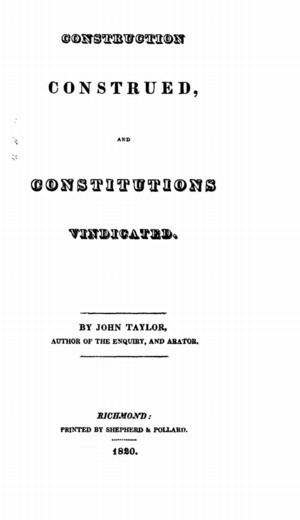
SECTION 8.: THE BANK DECISION.—SOVEREIGNTY OF SPHERES. - John Taylor, Construction Construed and Constitutions Vindicated [1820]Edition used:Construction Construed and Constitutions Vindicated (Richmond: Shepherd and Pollard, 1820).
About Liberty Fund:Liberty Fund, Inc. is a private, educational foundation established to encourage the study of the ideal of a society of free and responsible individuals. Copyright information:The text is in the public domain. Fair use statement:This material is put online to further the educational goals of Liberty Fund, Inc. Unless otherwise stated in the Copyright Information section above, this material may be used freely for educational and academic purposes. It may not be used in any way for profit.
SECTION 8.THE BANK DECISION.—SOVEREIGNTY OF SPHERES.“If any one proposition could command the universal assent of mankind, we might expect it would be this; that the government of the union, though limited in its powers, is supreme in its sphere of action. This would seem necessarily to result from its sphere of action. It is the government of all; its powers are delegated by all, it represents all, and it acts for all.“ “The powers of sovereignty are divided between the government of the union and those of the states. They are each sovereign with respect to the objects committed to it, and neither sovereign, with respect to the objects committed to the other.“ The word “sphere” conveys an idea of something limited, in which sense it is correctly applied to our governments by the Federalist, and may be easily undersood; but I confess myself extremely puzzled to discern, how this word, being a substantive circumscribed, can be converted into a substantive uncircumscribed, by the help of the adjective “sovereign.” And I think it almost as difficult to see what is meant by the sovereignty of the spheres, as it is to hear the musick of the spheres. But, as some change of the nature of a sphere must be effected by an incongruous epithet, to sustain the opinion of the court, the experiment deserves a very serious and respectful consideration. The word “sphere” was very happily used in the Federalist, and conveyed an idea of our system of government, both just and beautiful. It refers to the structure of the universe, as the model of our political system; and in the allusion, tacitly suggests, and forcibly illustrates the sovereignty of the people over the spheres they have created. The beauty of the similitude consists in the regularity produced by a strict confinement of these spheres within their respective orbits; and it contains a fine admonition, in extending our ideas to the consequences which would ensue to the universe, should one of its spheres leave its own and travel into other orbits; to forewarn us of the consequences which would ensue to our political system from a similar aberration. But the similitude is utterly spoilt, by the idea that one of our spheres may annex to itself a long tail of means, reaching into the orbits of other spheres, so as to defeat the sublime allusion, and leave us only a regret for having neglected its admonition. If the sovereignty of the spheres means any sovereignty at all, it supersedes the sovereignty of the people, since they can no longer possess that, which they have divided among spheres. But, if these spherical sovereignties are restrained by their orbits, called “spheres of action,” then this new phrase means nothing at all, because a change in the description, does not alter the nature of the thing described; and if our divisions of power will still remain the same, whether they are called spherical sovereignties, spheres of action, limited powers, balances, checks or trusts (as the moon did under the several names of Phœbe, Cynthia, Diana, Dictynna, Hecate and Luna,) no sound argument can be deduced from using one appellation in preference to another. “The limited monarchy of spheres” would have been more appropriate to the apparent meaning of the court in this extract, as clearly conveying the idea of spherical limitation, and clearly excluding that of a spherical extension of power lurking in the word sovereignty. We see a sovereignty of spheres in England, to justify the language adopted by the court, and we know that the sphere of action of each is limited and restrained by the spheres of action of the other two. By calling each “sovereign with respect to the objects committed to it, and neither sovereign with respect to the objects committed to the other,” I cannot see that the powers of the king, of the lords, or of the commons, would be enlarged in the least degree; or that a choice of means would be bestowed upon either, by which it could encroach upon the others. To our imitation of this model in the arrangement of legislative and executive power, we have, besides others, subjoined two improvements, by a judicial sphere possessing a great political power; and by the important spheres called state and federal governments. Now, if a spherical sovereignty exists here as it does in England, it would be as certainly destroyed, as it has often been there, if either sphere possessed an exclusive or an uncontrouled choice of means, in the exercise of a species of sovereignty separately from the rest. Encroachments of sphere upon sphere can only be made by means; and it is yielding nothing to admit that the spheres are circumscribed, but to insist, that their choice of means, by which encroachments are made, is unlimited; because a political sphere of action, cannot possibly be created in any other way, than that of withholding from it many means for effecting the ends, even the legitimate ends it may have in view. Even in bringing a murderer to justice, the means, as well as the sphere of action in the court, are all limited. If it was otherwise, confusions, usurpations, and oppressions would ensue on all sides; because power never finds any difficulty in choosing means calculated for its own enlargement. In fact, we know that the English political history is only a compilation of insidious and specious means, occasionally resorted to by each of the spheres, for the purposes of deluding the people, and encroaching upon the others. At length these spheres having harrassed each other for many centuries, by each having chosen means for encroaching on the others, came to a compromise; and compounded among themselves a sovereignty of spheres; and this precedent justifies the court, however puzzled I may be to understand it upon American ground, in using that phrase. But in quoting it, especially if I do not dispute its authority, I hope I may be allowed to contend, that it cannot prove the same thing to be wrong in England and right here. It proves that political spheres, by uniting, may acquire, not an individual but a collective sovereignty. It thence follows, if the sovereignty has passed in the United States from the people to political spheres, either by delegation, or by the usurpation of those spheres, that it can only be executed legitimately by the collective or united consent of all these spheres; unless it can be shewn, that a sort of interregnum or suspension of this spherical sovereignty, like those which often happened in England, has already happened here. The same precedent proves, that neither sphere ought to have any choice of means in the exercise of its own spherical powers, by which it may encroach upon its collateral spheres; for, though they were not co-ordinate, nor circumscribed to preserve the liberty of the people, yet they became balanced by mutual fear for, mutual safety; and accordingly each sphere has been obliged, as the only chance for self-preservation, to be excessively jealous of the means resorted to by each to increase its own power. Now what does this English precedent teach us? That a spherical sovereignty can only be exercised by the mutual consent of the spheres: That one sphere can only be prevented by the watchfulness and resistance of the others, from using means to make itself the master of these others. That its success has always been considered as a usurpation, and has always introduced a tyranny: And that it was necessary to preserve the independence of the spheres of each other, to maintain even the semblance of a free government. If then we are to adopt the English spherical sovereignty, we ought not to make it worse than it is, by subjoining to it vices, which it rejects, as utterly inconsistent with the spherical system, and certainly destructive of all the good it can produce. In that country, each sphere is a judge, independently of the others, of its own sphere of action, and of its own means; but both this sphere of action, and these means, are checked and restrained by the sphere of action and the choice of means, possessed by the other spheres. The same equivalency is necessary here to preserve a sovereignty of spheres, and prevent one from becoming the master of the others. The English system has made no specified provision to settle the collisions which will naturally arise, and have arisen in England from this equivalency of powers, “because power controuled or abridged is almost always the rival and enemy of that power by which it is controuled or abridged,” as Mr. Hamilton justly observes in the Federalist, page 81; and this important office is loosely left to publick opinion, without establishing an orderly mode in which it might be expressed. Our system, foreseeing the probability of such collisions, both from the temper of human nature, and also from the occurrences in England, has provided a constitutional and orderly mode, by which publick opinion may exercise this supervising office. It would be a radical violation of the English policy of checks and balances, considered in that country, as the only safeguard of liberty, even without a specifick provision for reconciling collisions, were we to surrender the same safeguard, with specifick provisions for its exercise. By that, the sovereignty of the people is denied, and sovereignty is possessed by the three spheres, king, lords and commons; this is the reason, why it contains no orderly mode by which a direct reference can be made to the people, for the settlement of collisions among these spheres; yet the English system does not relinquish the essential principle of the co-ordinacy, independency and equality of the political spheres themselves, from an apprehension of their collisions. If we should relinquish this essential principle from the same apprehension, we should adopt the English spherical sovereignty, renounce the English security of a co-ordinacy or balance of spheres, and lose the sovereignty of the people. According to the English system, no sphere possesses the least degree of supremacy in the exercise of sovereign power, over the others, by the instrumentality of means, because it would enable the supreme sphere to swallow up these others; and therefore to admit of such a supremacy in one of our spheres, would be contrary to the most valuable principle of theirs; and by adopting the sovereignty of the spheres, and also rejecting the only security against its abuse, namely the check and controul of these spheres upon each other, we should introduce here a worse government than the English, in an essential circumstance. There is but one mode of getting over this reasoning, and to that mode the court has resorted. It asserts that “the government of the union is delegated by all, represents all, and acts for all.” Do these assertions (the truth of which I shall presently examine) squint at consolidation, and ingeniously undermine the state spherical sovereignty admitted by the court? Do they design to recognize the English spherical sovereignty of kings, lords and commons, as existing here in the president, senate and house of representatives? Do they mean to insinuate that our system of government will be safe under the guardianship of these three departments, as the English system is safe under the guardianship of the king, lords and commons? If these inferences were not intended, I cannot discern what was meant by these assertions; but admitting them to be true, I deny their sufficiency to justify such inferences. The people certainly had a right to create the union sphere to restrict the state spheres; and to retain the state spheres, to restrict the union sphere. The court admit that they have exercised this right; therefore no inference from these assertions can be correct, by which this co-ordinacy of restriction would be abolished. Had the people of England created their co-ordinate spheres, they might have varied their form and their number from what they are; and surely the people of the United States might vary the form and the number of theirs from those of England, without defeating the principle of a co-ordinacy of spheres, and still retaining its application to whatever spheres they chose to create. The establishment of the union and state spheres, was not only a happy circumstance for extending the compass and capacity of republican government, but wisely comprised an advantage to which the English spherical system cannot pretend. Each of these spheres is invested with an independent legislative and judicial power within their respective orbits, so that collisions may be conducted and reconciled orderly and argumentatively, whilst those of the English spheres can only appeal to mobs or factions. Why therefore should these spheres, so much better supplied with the means of self-preservation and for mutual restriction, be considered as less estimable than those established in England by civil war, and the intrigues of faction? The ordinances of the people approved of by the best talents of the country ought at least to be as venerable, as the compromises of ambitious self-created orders. Let us now calmly consider whether the prodigiously inclusive assertions, “That the government of the union is the government of all; its powers are delegated by all, it represents all, and acts for all,” are really true. Another assertion to confront it brings it to a fair test. The government of the union, in respect to the powers reserved to the states, is the government of none, is delegated by none, represents none, and can only act for all, by assuming a power, neither delegated nor representative. If one of these assertions be true and the other false, the reader will not hesitate in deciding to which a deficiency, in veracity, appertains. I admit, that the first may be made true by a restrictive qualification, similar to the qualification which makes the second assertion true, by adding to it the words, “in respect to the powers delegated to the general government.” Both governments represent all in exercising the powers committed to them respectively, and neither represent any, with respect to the powers committed to the other. Both may act for all, within their respective delegated spheres; but neither can act for all within the spheres delegated to the other. “If any propositions could command the universal consent of mankind, we might expect they would be these.” And if these propositions are true, it follows, that neither government can, under cover of a sovereignty of spheres, or by the use of inferences, exceed its limitations, without violating the essential principles of delegation and representation. If we were to admit the assertion of the court in all its latitude, it would amount to the following position:—“A government representing all, may act for all.” This position, unqualified, applies more forcibly, (as I shall attempt to shew,) to the end of unfettering the state governments, than to the end of unfettering the government of the union, because they actually represent all, which the latter government does not. The principle of personal representation was violated to a considerable extent, for the sake of compromise and accommodation, and because a spherical representation was necessary to a union of states. The house of representatives only, of the federal government, is elected with a view to the first principle, whilst it is throughout applied to the state governments. The senate of the United States is a representation of state sovereignties, not of numbers; and this fact circumscribes very materially, the generality of the assertion made by the court, or transfers its application to the state governments. It was instituted to preserve that which it represents, and not as the guardian of individuals whom it does not represent. The union was established for the management of the general concerns of the states united, and not for the management of local or individual concerns; to which intention the construction of the senate has a distinct relation. The present senate is exactly analogous to the old congress, in which each state had one vote, as each has two in the present senate; and the present senate is no farther a representative of individuals, than was that congress. Both were chosen by the state legislatures. Hence it appears that the government of the union does not represent all, as the court assert, and of course, that it has no right to act for all. The house of representatives is elected by states; but that house is not the government of the union; and the mode of its election may be easily accounted for, exclusively of an intention by that mode, to extend the powers of the federal government. The want of a power in the old confederation to act upon individuals by taxation, had destroyed its efficacy, and this defect was the chief object to be removed in the formation of “a more perfect union.” The concomitancy of representation and taxation, dictated the form of the house of representatives, and not an intention of extending the powers of the federal government, by the mode of representation established in that single branch. For, the president is also elected, in the first instance, upon indirect federal principles, and directly by states, in case of no election by electors. As two branches of the federal government are federally constructed, as only one participates of individual representation, and as the construction of this one was dictated by the limited power over persons bestowed for effecting federal, and not personal or local ends, the assertion of the court is exploded by fact and the inferences from it subverted by a genuine construction of the federal constitution. It never intended to inflict upon state legislatures, elected by all, a responsibility to the federal senate, not elected by the people, and only the representatives of state sovereignties. Nor did it intend, by bestowing a limited power of taxation upon the federal government, for the special purpose of effecting federal ends, and by subjecting this power to the check of personal representation, to make this partial representation a pretext for assuming local or personal powers, and for exercising the unlimited power of “acting for all.” If this reasoning be true, it applies conclusively to banks, corporations, roads, canals, and congressional patronage. To sustain the assertions I have been combating, the court says, “There is no phrase in the constitution which excludes incidental or implied powers.“ “Its nature requires that only its great out-lines should be marked.” “We find in it the great powers to lay and collect taxes, to borrow money, to regulate commerce, to declare and conduct a war, and to raise and support armies and navies. Can we adopt that construction, unless the words imperiously require it, which would impute to the framers of the instrument, when granting these powers for the publick good, the intention of impeding their exercise by withholding a choice of means? The instrument does not profess to enumerate the means by which the powers it confers may be executed, nor does it prohibit the creation of a corporation, if the existence of such a thing be essential to the beneficial exercise of those powers.” If the assertions we have just examined are true, they do not need the various auxiliaries summoned to their assistance in this extract; if they are false, these auxiliaries cannot make them true; and as the assertions comprise the principles to be vindicated, the auxiliaries brought forward in their defence are of no use or weight, if the principles themselves should have been exploded. The great weight of the authority of the court, however, will justify their examination. When the adoption of the federal constitution was under discussion, its enemies expressed an alarm, on account of the magnitude of the powers conferred on the federal government, and its friends an apprehension of its feebleness, compared with the powers reserved to the states; but neither party contended, that an amplification of the greater division of power, and of course a diminution of the lesser, could constitutionally be made by equipping the giant in all the panoply of means, implication and inference, and compelling the dwarf to appear naked in a combat with his antagonist. On the contrary, it was successfully urged by the warmest friends to the constitution, and in particular by the authors of the Federalist, that the supposed inequality of power between the state and federal spheres did not exist; and that either division, especially the state, was able to balance and controul the other. In this computation, the comparison was made between the federal sphere, and the state sphere, comprising all the state governments; and the equilibrium of power was deduced from the expectation, that if the rights of one state were assailed by the federal government, the rest would not suffer their copartner to be overwhelmed by the weight of power, and their own rights to be destroyed by a victory, in a contest so unequal. To estimate the magnitude of their relative powers, the state governments ought to be considered as constituting one sphere, and the federal government another. Perhaps a cool philosopher may consider the security of private property, the protection of personal rights, the suppression of crimes, the care of good manners and the catalogue of municipal regulations, as embracing a sphere of action, of greater moral extent, than the powers delegated to congress; and if the two spheres are to be geographically compared, the map demonstrates their equality. If these spheres are equal as to magnitude, one magnitude attracts undefined appurtenances as strongly as the other; and if the framers of the constitution designed to balance magnitude by magnitude, they could not also have designed to destroy the balance, by annexing to either an exclusive privilege of attracting undefined powers. Be this as it may, I contend, that the federal constitution, so far from intending to make its political spheres morally unequal in powers, or to invest the greatest with any species of sovereignty over the least, intended the very reverse; and that the court have recognised the latter intention by avowing its right to declare an unconstitutional law, void. As the powers of congress must be confessed to transcend those of the court, much farther than they do those of the states, it follows, that if they cannot be constitutionally used to contract the powers of the court, they cannot be constitutionally used to contract the powers of the states. The reason why great spheres derive no authority from magnitude to transgress upon small spheres, is, that both are donations from the same source; and that the donor did not intend, that one donation should pilfer another, because it was smaller. “Can we adopt that construction, unless the words imperiously require it, which would impute to the framers of the instrument, when granting these powers for publick good, the intention of impeding their exercise by withholding a choice of means?” This question might be answered by another. Can we adopt that construction, unless the words imperiously require it, which would impute to the framers of the constitution, when granting powers for publick good, the intention of allowing one sphere by an unlimited choice of means, to impede the exercise of powers conferred upon others? It admits also of so many other answers, quite satisfactory, that a few only need be urged. There is no imperious, or rather positive power, requiring the judicial sphere to declare a law void; yet it claims this right, by which it may limit the means of legislative power, and impede its exercise. This can only be justified by co-ordinacy and restrictions imperiously established, in the positive division of power, into limited political spheres. This division was intended to effect the precise end, for the publick good, here objected to; the end of controuling power by power. And if this controul does not extend to means, as power cannot be exercised nor usurpation become successful, except by means; all our divisions, restrictions and limitations of power, designed to prevent, for the publick good, the profligacy it has invariably displayed, when uncontrouled, must become nugatory and ineffectual. The words of the constitution are literally imperious in reserving to the states, for the publick good also, a right of taxation subject only to a positive limitation. The means by which the states may provide for raising a revenue, being expressly bestowed by the people, are surely as sacred, and as constitutional, and as likely to advance the publick good, as any conjectural conflicting means, which can be imagined by congress. “There is no phrase in the constitution, which excludes incidental or implied powers. Its nature requires that only its great outlines should be marked.” A contrast between positions often elicits light. There is no phrase in the constitution which even insinuates, that the actual divisions of power should be altered or impaired by incidental or implied powers. A revolution in our system of government would be no longer anticipated, after supplanting the position “that actual powers controul implied powers,” and planting in its place the dogma “that implied powers controul actual powers.” A great one would be effected, if it could be established, that “incidental or implied powers not excluded” were not prohibited. Let it be remembered, that the great outlines of state governments are more slightly referred to by the constitution, than the outlines of the federal government; that the means for executing the powers delegated to the latter are frequently marked, whilst those for executing the powers reserved to the former, are left chiefly unlimited. And then let it be computed, which sphere may make the greatest use of the strange position “that means, or incidental, or implied powers not excluded, are not prohibited,” however they may be at discord with the positive divisions of power. If this reasoning of the court be incorrect, the conclusion it is used to establish “that the creation of a corporation, if the existence of such a thing be essential to the beneficial exercise of the powers of congress, is constitutional, because not prohibited“—is incorrect also, if however beneficial considered alone, it disorders or impairs actual powers bestowed upon political spheres, as in the case of limiting the power of state taxation, farther than it is limited by the constitution. The idea, that one limited sphere has an exclusive privilege of doing whatever it may conceive to “be essential to the beneficial exercise of its own powers” is still more extravagant, more subversive of co-ordinate spheres, and utterly inconsistent, in every view, with our system of checking power by power; as well as with the English theory of balances. Another argument urged by the court is, I think, less ingenious than any of those we have previously considered. It says “The power of taxation by the states is not abridged by the grant of a similar power to the government of the union; it is to be concurrently exercised by the two governments. The states are forbidden to lay duties on exports or imports. If the obligation of this prohibition must be conceded; if it may restrain a state from the exercise of its taxing powers on imports and exports, the same paramount power would seem to restrain, as it certainly may restrain, a state from such other exercise of this power as is in its nature incompatible with and repugnant to the constitutional laws of the union.” The artifice of acknowledging a constitutional principle, and distinctly admitting the powers actually bestowed on the federal and state spheres of our government; and then of immediately defeating these actual powers on one side, and extending them on the other, is repeatedly resorted to in the opinion of the court. But, this bold mode of reasoning is in every instance completely overthrown by the principle, if it be a true one, “that expressed powers and rights contract and limit implied powers and rights, and that implied powers and rights do not controul and limit expressed powers and rights.” The assertion “that the same paramount power” (by which I understand the constitution) “which restrained the states from taxing imports and exports, may restrain a state from such other exercise of their taxing power as is in its nature incompatible with and repugnant to the constitutional laws of the union,” by blending a sequitur and a non sequitur together and confounding our ideas, endeavours to delude them into an erroneous conclusion. Stript of this ambiguity the argument stands thus: “The constitution might have further restrained, and therefore, it has further restrained the taxing power of the states.” Thus fairly stated, the conclusion does not follow. To use the prospective terms employed by the court, the argument would be this: “A constitution may, and therefore has further restrained this power.” This mode of anticipating innovation, renders the mode prescribed for amending the constitution quite superfluous. It unfolds to legislatures the entire cargo of powers not prohibited, but not given; they are told that they may exercise any powers, which the constitution might have given them, and are very courteously invited to pick and choose. As a complete spherical sovereignty is conceded both to the federal and state governments, and as the constitution does not forbid to either this mode of extending their respective powers, it is open to both; and the laws of neither, under this novel constitutional power, can be unconstitutional, because state laws made in virtue of its spherical sovereignty comprising a right of construction, will be equally constitutional with federal laws, when both may defend themselves by a common principle. The clashings likely to arise between specified powers and rights will be nothing to those, which would be produced by a mutual power to assume implied rights and powers not prohibited. But I believe that I have misunderstood the court in supposing, that it meant “constitutional power” by the phrase “paramount character.” It seems by the expression “constitutional laws of the union” as if it meant, not that the constitution, but that congress was the paramount power. The consideration of this idea is postponed to the next section; at present I shallonly observe that the laws both of the federal or state governments may be either conformable or repugnant to the constitution; that one government is equally restrained with the other from passing laws repugnant to the constitution; and that neither can be absolved by a claim of one to the title “paramount” bestowed upon neither, to defeat the laws of its co-ordinate sphere. The paramount power of the people, by prohibiting the states from taxing imports and exports, did not create a paramount power in congress, to extend the prohibition to internal objects of taxation. It is therefore obvious, that the restrictive expression “constitutional laws of the union” has no relation to the subject under discussion, as that relates entirely to unconstitutional laws; and that it is used merely to conceal, under the position “that the states have no right to pass unconstitutional laws,” which is true, the conclusion “that the federal government possess a paramount and exclusive power of deciding upon the constitutionality and unconstitutionality of all laws, both state and federal,” which is denied to be true. Let us illustrate this reasoning by the fact. Congress have, by one corporation, subtracted from the fund made liable by the constitution to state taxation, thirty millions of specified right, by the instrumentality of power implied or not prohibited. The same species of instrumentality, not being prohibited, may also be implied in behalf of the states. And to place the federal and state governments in the constitutional relation existing between them previously to its exercise, the states ought to subtract thirty millions also from the specified fund exposed to federal taxation; a precedent by which one fund is diminished to the extent of thirty millions, and by the capacity of an incorporating power to diminish it without limitation, decides the fate of either of these sovereign spheres, which should be deprived both of resistance, and every countervailing expedient. Revenue is the sustenance of power. The old congress dwindled into imbecility, because the states could subtract from its funds without limitation; and the old states will ultimately suffer the same fate, if the new congress may by corporations subtract from their power to raise a revenue, without limitation. The position between these two spherical sovereignties would be exactly reversed, and however it may be justified upon the principles of retaliation and revenge, the reciprocity of defeat would, by the humiliation of the state governments, inflict greater evils upon the people, than they suffered from the humiliation of the old congress from a similar cause. Our experience had taught us the necessity of an independent revenue for the support of power; and the constitution under the conviction of experience, invested each sphere, sovereign say the court, with this paramount necessity, in terms the most distinct; but, if another paramount necessity for creating corporations, shall be able to subtract what it pleases from the paramount necessity for revenue, these spherical sovereignties will occupy the stations of England and Ireland, whilst the former took away revenue from the latter, by quartering a substantial, though not a nominal, corporation of pensioners upon the Irish funds. Had it been proposed in the convention, still further to reduce the fund for revenue left with the states, by investing congress with a power of subtracting any portion or the whole of internal state funds for raising revenue; or had such a construction been put upon the constitution whilst under the consideration of the people, it is impossible to hesitate in our opinions as to the results; and this unavoidable retrospective impression is no slight proof of its real intention. Sometimes the court reject a restriction imposed upon particular words by the general tenour of the constitution, and at others endeavour to destroy the most liberal rights, though according with the general tenour. An exception excludes that which it does not contain. A delegation of power does the same. The prohibition to tax exports and imports leaves untouched every other species of taxation. The delegated power of taxation to congress, contains no new prohibition upon the states. The intention in both cases is literally expressed. The reservation of all powers not delegated to the United States, nor prohibited to the states, is a third literal restriction of the prohibition to tax imports and exports, to the things actually prohibited. Add to the positive letter the consideration, that sovereign states were delegating limited powers; and the idea, that both the specifick prohibition upon the states, and the restricted delegation to congress, may be defeated by an implication, hostile to both, and contrary to the rules of construction, seems entirely inadmissible. Had the framers of the constitution conceived, that the state taxing power, originally unlimited, could be limited by implication, a far more specious foundation for this doctrine was furnished by the power given to congress to regulate commerce; as the taxation of exports and imports by the states might have been “incompatible with and repugnant to” this constitutional power; and by not confiding in this implied species of prohibition, they positively reprobate it. The implication in this case would have been specially confined to imports and exports, had the constitution failed to prohibit the states from taxing them; but as it does contain this limited prohibition, I cannot conceive by what train of ratiocination, the limited prohibition expressed, can be made to beget an unlimited power in congress further to restrict the original state right of taxation. It has been proved, that the English spherical sovereignty rejects any claim of sovereignty by one sphere over another, and limits the means of each, by the sphere of each. Admitting a sovereignty composed of spheres to be still one and indivisible, then a spherical sovereignty of spheres here would also be one and indivisible. Unity is an innate quality of sovereign power, as it is of legislative, though it may be compounded of individuals. Thus the moral or political beings called a sovereignty or a legislature are units, of whatever individuals composed. Such is the case with the sovereignty of the people. As this is composed of natural individuals, a sovereignty of spheres is composed of individual spheres. Neither of these can possess a better right to assume by any means a superiority over cospheres composing a sovereignty, than one citizen under the pretext that he also is a component part of the sovereignty of the people can assume a superiority over other citizens. In both cases, however, a love of power has suggested a multitude of means, by which both the individuals composing the sovereignty of the people, and the individuals composing a sovereignty of the spheres, have violated their allegiance. Sovereignty here resides in the people, or in our individual political spheres. If in the people, these spheres are limited departments only, not having more power individually, than if they participated as is contended of sovereign power. If we even enlarge this power, by endowing our political spheres with sovereignty, then one sphere, being only an individual of the sovereignty, has no controuling authority over the others; such an authority, however disguised, would destroy a sovereignty of spheres and establish a sovereignty of one sphere; and this sphere would be a despot over the others, just as one citizen, who obtains a controuling authority over the rest, is also a despot. The case is precisely the same if one sphere of action can by any means obtain a controuling authority over the other spheres of action; the rights of the controuled spheres, derived from the sovereignty of the people, would be made dependent upon another sphere of action, created by the same authority. Thus a citizen having social rights loses them, if another citizen has by any means obtained an authority of controuling them. It follows from both aspects of the case, one of which must be admitted, that political spheres, constituting a spherical sovereignty, must controul and restrain each other; that political departments, circumscribed by the sovereign power of the people, must still more clearly controul each other; that is, spheres of action must controul each other; and that the means of each of these individual moral beings, must also be controuled and restrained by the means of the others; because an authority capable of controuling the rest, obtained by one, destroys the end and design of either political system. The argument in reply to this reasoning is, that unless a supreme authority is allowed to the federal legislature and federal courts, to controul the legislatures and courts of the states, subordination will not exist, and sundry inconveniences would result from its absence. This argument would be sufficiently answered by asking for the words in the constitution, by which one sphere of action is made subordinate to another; or by which one is invested with the exclusive authority to restrain the rest within their proper spheres. But it overthrows itself by its own force, and by proving too much, proves nothing. It implies, that every division, balance, restriction or check of power by power, which has been or can be invented, must be wrong; and that subordination is preferable to them all: that Mr. Hamilton is wrong in observing that “power controuled or abridged is almost always the rival and enemy of that power by which it is controuled and abridged,” and ought to have pleaded in favour of removing all restrictions by supremacy, for the sake of establishing subordination; and that he was still more wrong in supposing, that power could only be controuled by power. It is not uncommon to destroy the highest attainable temporal blessings, by selecting and displaying the imperfections of which all human institutions participate. Thus the inconveniences of co-ordinate and balanced departments, and the conveniences of subordination are both magnified. Individual spheres or departments are easily persuaded, like kings, that a subordination to themselves would be better for a nation, than the occasional collisions produced by a division and limitation of power. The federal and state governments might both be induced to believe, that its own supervising supremacy over the other would produce more good to the people, than the plan adopted by the people themselves. And thus an object of the first necessity or convenience, that of a free, moderate and limited form of government, might be sacrificed for such pitiful objects, called objects of necessity or convenience, as transmitting the publick money by banks, staying judgments and executions, making a road or a canal, creating fraudulent corporations, and absolving their great wealth from taxation, whilst very poor people are contributing to the support of government. Usurpation begins with weaving a shroud for free principles by the woof and warp of little conveniences and pretended necessities, and ends by inflicting the slavish quietism of a perfect subordination. The court has cautiously forborne to define the origin, or the extent of spherical sovereignty. By denying the argument of the counsel, “That the people had bestowed sovereignty on the state governments, and therefore had none left to bestow on the federal government,” it clearly asserts, that the people do not lose their sovereignty by creating a government. By contending that the federal government, created in virtue of their retained and inherent sovereignty, has acquired any species of sovereignty, it as clearly asserts, that they do lose it. By asserting, that our political spheres are limited by their constitutional spheres of action, it admits, that they are not invested with sovereignty. By investing them with the right of creating corporations, as resulting from the power appertaining to sovereignty, it declares that they are. This sample of its appurtenances, and the general position that it may employ any means which it chooses, or may think necessary or convenient, leaves the capacity of the new political structure called spherical sovereignty, quite indefinite. I have heard of a lady desirous of having a new house, and unable to prevail on her husband to build it, who persuaded him at length to suffer her to repair the old one. With the help of an ingenious carpenter, under her own influence and direction, she went to work; and proceeding by cautious degrees, not to awaken her husband’s attention, so altered and enclosed the old one, that when he at last discovered the artifice, he found himself obliged to pull it down and throw it piece by piece out of the windows. Thus the indefinite attributes of a sovereignty of spheres, will gradually usurp and supplant the attributes of the sovereignty of the people. The old principle of limited ends will be thrown out of the window by the new principle of unlimited means; and the right of the old sovereignty to create bodies politick, will be swallowed up by a new spherical sovereignty. Of this sophistical spherical sovereignty, the instances abound; and we find it in every case to be the identical machine, by which all free and limited governments have been overthrown. The conventions of France (elected to form a constitution) upon the ground of representing the people, assumed a spherical sovereignty with its attributes as settled by themselves; and exercised unlimited power, under a nominal acknowledgment of the sovereignty of the people. Bonaparte, both in his sphere of consul and emperor, took their votes, and thus owned the sovereignty of the people. But what was the value of the allegiance professed in either case, united with a choice of means, necessities, and conveniences, by these spherical sovereignties? The same as that of the divine right of sovereignty in kings, nobles and political spheres, from the beginning of history to this day. The reader is reminded, that although I have adopted the phrase “spherical sovereignty” and supposed its existence, with a hope of proving that even this concession does not warrant the judgment of the court; yet I do not thereby design to admit of its application, under any definition, to our system of government; because its meaning is so utterly equivocal, as to be innately incongruous with the idea of limited powers, of which this system is composed. I contend that the idea of one or many spherical sovereignties is an adulteration of the sovereignty of the people; that a limitation of spheres of action, is a limitation of means of action; that no sphere can do any thing, because it may be convenient or necessary, unless it be constitutional; that no sphere can invade another by means however beneficial, because it would be unconstitutional; that no sphere has a power of doing what is good or bad, generally, but constitutionally only; and that if these principles can be overturned by an ingenious management of words, all our checks, balances, limitations and divisions of power, are good for nothing. |

Titles (by Subject)