EconlibThe LibraryOther Sites |
Front Page Titles (by Subject) SECTION 7.: THE BANK DECISION.—CORPORATION. - Construction Construed and Constitutions Vindicated
Return to Title Page for Construction Construed and Constitutions VindicatedThe Online Library of LibertyA project of Liberty Fund, Inc.Search this Title:Also in the Library:
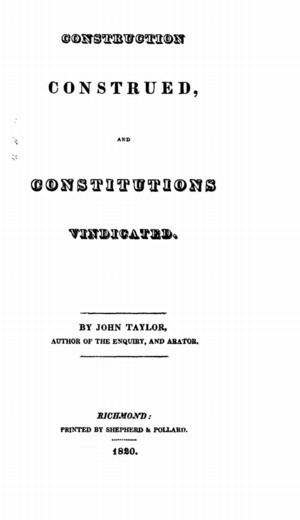
SECTION 7.: THE BANK DECISION.—CORPORATION. - John Taylor, Construction Construed and Constitutions Vindicated [1820]Edition used:Construction Construed and Constitutions Vindicated (Richmond: Shepherd and Pollard, 1820).
About Liberty Fund:Liberty Fund, Inc. is a private, educational foundation established to encourage the study of the ideal of a society of free and responsible individuals. Copyright information:The text is in the public domain. Fair use statement:This material is put online to further the educational goals of Liberty Fund, Inc. Unless otherwise stated in the Copyright Information section above, this material may be used freely for educational and academic purposes. It may not be used in any way for profit.
SECTION 7.THE BANK DECISION.—CORPORATION.The previous pages have been devoted to the establishment of several important principles, from an opinion, that they are better expounders of our constitutions, and sounder arbiters of construction, than dictionaries. The philosopher, who is led astray from things by signs, resembles a botanist whose taste leads him to wander in a wilderness of flowers, and to contemplate their hues, without caring whether their fruit is noxious or wholesome. Principles are the fruit of words; and as no man in his senses would swallow poison, because it grew from the beautiful flower of the poppy; so bad principles ought not to be recommended nor good ones defeated, by a verbal Mosaick, however ingenious. By the standard of principles, I shall therefore proceed to examine several measures and opinions; and beginning with the most recent, select a few others, without regard to chronological order, as opposite to such as I believe to be constitutional. An examination of the opinion of the court of appeals, against the right of the state governments to tax the bank of the United States, not with arrogance, but with humility; not with confidence, but with distrust; will I hope be pardonable. Against the talents and integrity of that respectable body of men, I have no counterpoise but my creed; against the acute argument by which their decision is defended, I have no offset, but an artless course of reasoning. An unknown writer is but a feather, weighed against acknowledged uprightness, erudition, and well merited publick confidence; yet under all these disadvantages, as wisdom and virtue are sometimes liable to error; as the battle is not always to the strong, nor the race to the swift; and as enquiry is the road to truth; I shall endeavour to reconcile my respect for the court, with my right, perhaps my duty, as a citizen of our happy commonwealth. Before I proceed, as some defence of this presumption, I quote a judicial precedent. The decision of a bad or a corrupt judge would not apply; but one rendered by the great, the good, the wise Sir Matthew Hale, so late too as the seventeenth century, is quite in point. This judge, of superior talents and spotless integrity, condemned and put to death two poor old women as witches; and the correctness of his judgment was not questioned. Behold in this case, confidence yoked to fallibility. Perhaps the time may arrive, when it would be as absurd to contend for the witchcraft said to be lurking under the words sovereignty, supremacy, necessary and convenient, as it would be to prove now, that it does not lurk under a wrinkled visage; and when it would be thought as superfluous to prove, that our constitutions ought not to be destroyed by one species of witchcraft, as that old women ought not to be burnt out of compliment to the respectable Judge Hale’s decision establishing the other. The following quotation from the opinion of the court is copious, from an apprehension of omitting any thing material towards a thorough knowledge of the question. “Banking was introduced at a very early period of our history, has been recognized by many successive legislatures, and has been acted upon by the judicial department in cases of peculiar delicacy, as a law of undoubted obligation.” “It has been said, that the people had already surrendered all their powers to the state sovereignties, and had nothing more to give.” “If any proposition could command the universal assent of mankind, we might expect it would be this; that the government of the union, though limited in its powers, is supreme in its sphere of action. This would seem to result necessarily from its sphere of action. It is the government of all; its powers are delegated by all, it represents all, and acts for all. The people have said ‘This constitution and the laws of the United States, which shall be made in pursuance thereof shall be the supreme law of the land, any thing in the constitution or laws of any state notwithstanding.” “There is no phrase in the constitution which excludes incidental or implied powers.” “Its nature requires that only its great outlines should be marked.” “We find in it the great powers to lay and collect taxes, to borrow money, to regulate commerce, to declare and conduct war, and to raise and support armies and navies. Can we adopt that construction, unless the words imperiously require it, which would impute to the framers of the instrument, when granting these powers for the publick good, the intention of impeding their exercise by withholding a choice of means? The instrument does not profess to enumerate the means by which the powers it confers may be executed, nor does it prohibit the creation of a corporation, if the existence of such a thing be essential to the beneficial exercise of those powers. The creation of a corporation appertains to sovereignty.” “The powers of sovereignty are divided between the government of the union and those of the states. They are each sovereign with respect to the objects committed to it, and neither sovereign with respect to the objects committed to the other.” “Congress shall have power to make all laws necessary and proper to carry into execution the powers of the government.” “Let the end be legitimate, let it be within the scope of the constitution, and all means which are appropriate, which are plainly adapted to that end, which are not prohibited, but consist with the letter and spirit of the constitution, are constitutional.” “That banking is a convenient, a useful, and essential instrument in the prosecution of fiscal operations, is not now a subject of controversy.” “The power of taxation by the states is not abridged by the grant of a similar power to the government of the union; it is to be concurrently exercised by the two governments. The states are forbidden to lay duties on exports or imports. If the obligation of this prohibition must be conceded; if it may restrain a state from the exercise of its taxing power on imports and exports, the same paramount character would seem to restrain as it certainly may restrain, a state from such other exercise of this power, as is in its nature incompatible with and repugnant to the constitutional laws of the union.” “All subjects over which the sovereign power of the state extends, are objects of taxation; but those over which it does not extend, are upon the soundest principles exempt from taxation. The sovereignty of a state extends to every thing which exists by its own authority, or is introduced by its permission, but does not extend to the means employed by congress to carry into execution, powers conferred on that body by the people of the United States.” “Such is the character of human language, that no word conveys to the mind, in all situations, one single definite idea. It is essential to just construction, that many words which imply something excessive, should be understood in a more mitigated sense.” “We find, on just theory, a total failure of the original right to tax the means employed by the general government of the union for the execution of its powers.” “That the power to tax involves the power to destroy; that the power to destroy may defeat and render useless the power to create; that there is a plain repugnance in conferring on one government a power to controul the constitutional measures of another, which other, with respect to those very measures, is declared to be supreme over that which exerts the controul, are propositions not to be denied.” “The legislature of the union can be trusted by the people with the power of controuling measures which concern all, with the confidence that it will not be abused.” “The principle, for which the state of Maryland contends, is capable of arresting all the measures of the general government, and of prostrating it at the foot of the states.” “It is a question of supremacy.” “It is of the very essence of supremacy to remove all obstacles to its action within its own sphere, and so to modify every power vested in subordinate governments, as to exempt its own operations from their influence.” “The result is a conviction, that the states have no power by taxation or otherwise to retard, impede, burden, or in any manner controul the operation of the constitutional laws enacted by congress to carry into execution the powers vested in congress. This we think the unavoidable consequence of the supremacy, which the constitution has declared.” The essential conclusion of this opinion is, that an absolute sovereignty as to means does exist, where there is no sovereignty at all as to ends. This doctrine seems to me, to be evidently inconsistent with the principle of dividing, limiting, balancing and restraining political powers, to which all our constitutions have unequivocally resorted, as the only resource for the preservation of a free form of government. If the means to which the government of the union may resort for executing the powers confided to it, are unlimited, it may easily select such as will impair or destroy the powers confided to the state governments. If a delegation of powers implies a delegation of an unrestrained choice of means for the execution of those powers, then this unrestrained choice of means was bestowed by the people on the state governments, by the double act of delegation and reservation, and is attached to their powers; and the same principle, by which it is contended that the government of the union may impair or destroy the powers of the state governments, entitles the state governments to impair or destroy those of the government of the union. It will be admitted, that the powers delegated and reserved to the state governments, are positive limitations of the powers delegated to the government of the union; and that the powers delegated to the union, are limitations of those delegated and reserved to the state governments; and from this assignment of powers, made by the same authority, it arises, that both are limited governments. The ends with which these governments are respectively entrusted, are allowed to have been exclusively bestowed, and neither could constitutionally use its legitimate ends, to defeat or absorb the legitimate ends assigned to the other. So far the array of ends against ends appears to have been placed by the constitution on equal ground, and this equality justifies the inference, that a mutual check upon the exercise of political power by each government was intended. In dividing these ends, the constitution of the union is positive and explicit; but, it is quite silent as to the means to be employed by the state governments for effecting the ends committed to them by the people; and also as to the means to be employed by the government of the union, in some degree. And this silence is attempted to be exclusively appropriated to the government of the union, so that by the instrumentality of a monopoly of means, it may supplant and destroy the equality of ends plainly established by the constitution, subdue the state ends by the appendages of the union ends, though neither catalogue of these ends would be allowed openly to batter down the other; and thus effectually overturn by implied means, our whole positive division of ends, made for the purpose of limiting, checking and moderating power. As ends may be made to beget means, so means may be made to beget ends, until the co-habitation shall rear a progeny of unconstitutional bastards, which were not begotten by the people; and their rights being no longer secured by fixed principles, will be hazarded upon a game at shuttlecock with ends and means, between the general and state governments. To prevent this, means as well as ends are subjected by our constitutions to a double restraint. The first is special. In many instances, the means for executing the powers bestowed, are defined, and by that definition, limited. The other is general, and arises necessarily from the division of powers; as it was never intended that powers given to one department, or one government, should be impaired or destroyed, by the means used for the execution of powers given to another. Otherwise, the indefinite word “means” might defeat all the labour expended upon definition by our constitutions. Numberless illustrations might be adduced in support of this reasoning, but those which have appeared, are preferable to such as are conjectural. The constitution of the United States contains many positive restrictions of the means for executing the powers bestowed. It bestows on congress the power of declaring war. But it restricts the means of executing this power, by limiting the right of taxation; by withholding the right of ordering the militia without the United States: by withholding the right of impressing seamen or landmen; by confining appropriations for an army to two years, and by excluding the government of the union from the appointment of militia officers. This last power, positively reserved to the state governments, is evidently intended as a check upon the power of the sword, by dividing it between the two governments; and a volunteer militia, officered by the president, or a general, is a mean, both convenient for the end of war, and also for impairing or defeating the end designed to be accomplished by the constitution. Is this inferred convenience, a fair abrogation of the specified end? Again; a sudden inroad under the authority of the president into a country at peace with us, might be a beneficial and convenient mode of beginning a war, and a mean towards ultimate success; but the right of involving us in war, is exclusively limited to congress for ends infinitely more beneficial to the nation. Ought these more valuable ends to be sacrificed, for the sake of one less valuable? So congress is empowered to borrow, and to coin money; and as one mean for the execution of this power, to provide for the punishment of counterfeiting the securities and current coin of the United States. Ought this restraint of a power to create or punish crimes, to be extended by construction, to a power of punishing counterfeiters of corporation or individual paper? Such a power was not given, because a paper currency was not recognized. To secure a fair exercise of the legislative power of congress, two means are resorted to. One, that no legislator shall receive an office created, or the emoluments of which shall have been increased, during the time for which he was elected; the other, that no person holding an office under the United States, shall be a legislator. If corporations are used to enable members of congress to be both legislators, officeholders, and emolument-receivers under their own laws, the means for effecting this triple violation of the constitution ought surely to be compared, if the word “beneficial” is to decide the preference, with the means for preventing it. The judicial power is invested with the right of deciding controversies between private persons, and between individuals and our governments, and even between states, to prevent the mischiefs of legislative patronage and adjudication. A legislative judicature is both excessively imperfect and expensive, and also defeats one of the most beneficial means, for attaining the great social ends of fair trials and impartial decisions. A specification of some means for the attainment of ends, is a proof that means were not intended to be unlimited; but as it was impossible to specify all which might be constitutionally used, for the execution of the powers delegated to the government of the union, or reserved to the states, those not specified were unavoidably left to be controuled by the division of powers and rights, which was specified. This controul is indispensably necessary for giving the intended effect, to all the minor divisions of power in the state constitutions, and also to the major division of power, between the state governments and the government of the union, as well as to the inferior divisions of the latter. By rejecting this controul, our whole system of social policy would be rent to pieces from top to bottom. If the unspecified means of the states for executing the powers reserved to them, were not limited by the powers delegated to congress, the state governments might defeat the latter powers, by the instrumentality of means. But, if the unspecified means which the states may use to effect the ends committed to their care, are limited by the powers delegated to the government of the union, it follows, as being the same principle, that the unspecified means which congress may use to effect the ends committed to the care of the government of the union, are also limited by the powers delegated and reserved to the states. Neither government can, under cover of such words as “sovereign, convenient, necessary and supreme,” legitimately resort to means which would impair their co-ordinacy of origin, or the distribution of ends made by the people for their own security; and both or neither must be restrained by a principle, exactly common to both. Otherwise, the words “sovereign, convenient, necessary and supreme” will enable the same parties, factions and exclusive interests, which have been changing and modelling the English form of government from time immemorial, gradually to work up ours into a similar compound of exclusive privileges and emoluments, legislative corruption and venality, excessive taxation, and stock aristocracy. Our civil revolution will then have eventuated, precisely like the religious revolution in England under Henry the 8th. The pope was gotten rid of, but the tithes and the episcopal aristocracy remained. But, the wise men who framed our form of government never intended, that its great principles and great ends should be altered and modelled from time to time, by the means and ends of factions, parties or individuals; to render it quite unsteady, liable to important innovations without any real reference to the people, or to the right of self-government; and to carry it back to the same unfixed principle or no principle of the English form of government; in which, change has been so constant, and constitution so changeable, that it is said in a late Edinburgh Review, that the old English reporters do not contain a single precedent which is now law; and in England, law is constitution. On the contrary, they intended to erect a political fabrick, with separate compartments, each watered by distinct streams of power; and not, whilst apparently perfecting a work so glorious, to invent covertly a machine, then nameless but now called the “supremacy of means,” for diverting the streams assigned to some departments into others, so as to famish some occupiers and poison others by a plethora. Though the outside walls of the fabrick may still stand after the operations of this machine, like those of an old Gothick castle, and occasionally attract the admiration of future connoisseurs; yet they will no longer be capable of sheltering liberty against the blasts of ambition or the reptiles of venality, after the apartments cease to be habitable. Having thus opened the way for a more particular consideration of the opinion of the court, I shall proceed to exhibit to the reader extracts from the quotation, arranged with a view to the perspicuity of the argument. “The creation of a corporation appertains to sovereignty.” This position, the fountain from whence the court draws all its arguments, is assented to; but I shall endeavour to prove, that if their proposition be true, their inferences are false. There are some words innately despotick, and others innately liberal. Among those of the former character, corporation and hierarchy bear the most exact analogy to each other, the first being used to destroy civil, and the second to destroy religious liberty. Both are appurtenances of sovereignty, and sovereignty being despotick because it is indefinite, both are appurtenances of despotism. The fruit uniformly produces a tree like that on which it grew. The English sovereignty has availed itself of these two appurtenances to a great extent. Kings and towns conspired in the use of corporations; Kings to purchase partisans, reduce the barons, and increase their own power; towns to obtain more liberty than the rest of the people. Kings soon discovered, that the sovereign right of granting exclusive privileges was much better adapted for getting money, corrupting factions, and gratifying minions, than for diffusing liberty; and they substituted this new appurtenance of sovereignty for its old prerogatives, with the advantage which a plausible novelty possesses over a detected oppression. Commercial monopolies, commercial companies, local immunities and personal privileges, fully compensated their ambition and avarice for the loss of prerogatives, and the word “corporation” has furnished history with a list of grievances, often resisted, occasionally redressed, again revived in new forms, and terminating in taxation and pauperism, both so excessive, that England is as ripe for reformation, as it was under royal prerogative in its most aggravated form. The word was adopted into English jurisprudence, and endowed with a character both sacred and indefinite, by regal “during pleasure” judges, to enlarge regal power, to obtain regal favour, and to avoid regal displeasure. It was thrust into the English law books by sheep, clothed in ermine by lions, and sanctified by precedents bottomed upon fear, hope and flattery. From these receptacles, wherein it hides the heart of a prostitute under the habiliments of a virgin, it has found its way into the heads of lawyers, seduced by the habits of intercourse, or deceived by a primness of feature, adjusted to conceal imposture, and to impose upon credulity. But it did not get into our constitutions, and the question is, whether its congeniality with their principles is sufficiently apparent, to justify our judges in supplying the oversight of the people. Regal sovereignty was its father, and regal prerogative (a respectable matron in England, though not much beloved here,) its mother. The English dictionaries, in accordance with their intention and effects, define corporations to be “bodies politick.” Sovereignty alone could create bodies politick, and therefore it exclusively granted the charters or enacted the laws by which they were created in England. The English law books themselves do not recognize a right in some bodies politick to create other bodies politick. Whether our governments are sovereigns, or only bodies politick created by the charters of the only sovereignty we acknowledge, is a question, involving in my view the existence of our form of government. If they are sovereigns, it must be admitted, that according to the English precedents, they have a right to prop and secure themselves by all bodies politick, capable of defending an absolute, unquestionable, and indefinite power, the attribute of sovereignty; but if they are not sovereigns, they can only be bodies politick, created by the charters, called constitutions, and as such, according to the incorporating principles of the English law books, they have no right to create other bodies politick. If we are to be bound by the laws of England, those laws ought surely to be correctly construed. Do these allow bodies politick created by the sovereignty of that country, to create other bodies politick, without the assent of its sovereign power? Is it less necessary for the safety of the sovereignty of the people, to attain its appurtenant power of creating bodies politick, than for the sovereignty of a king or a government? It is undoubtedly a power, which cannot be surrendered by any species of sovereignty, without ultimately losing the sovereignty; because, after its attributes are gone, an empty shell only remains. If therefore it be true, as the English anthorities assert, that the opinion of the court admits “that the creation of corporations appertains to sovereignty,” and if sovereignty among us appertains to the people, it follows that the creation of corporations does not appertain to either of our governments, or to either of their departments. There is no political influence capable of producing greater impressions upon the sovereignty of the people, or their forms of government, than a system of legislative patronage, or of shedding wealth upon corporations, and lustre upon ambition. By incorporations, great bodies politick, whole parties, and entire states, may be degraded into clientage, and bribed to obedience; and legislators themselves may participate in every bonus they bestow. Among these, an exemption from taxation extended to a great mass of incorporated wealth, is an exclusive privilege, of a value sufficient to purchase the most abject submission to political projects, the expense of which is imposed upon other classes of society. This mode of purchasing the adherence of priests and nobles was universally resorted to by European kings, and is still practised by all European governments. And although our system of election and representation, is often urged as a complete security against this palpable injustice to the rest of society, yet it must be admitted, that the additional securities we have provided against an evil so general, by divisions and restrictions of power; that the experience of the whole world; that the example of England in particular; that the concurrence of all political writers; unite in concluding, that election, alone, is insufficient, and requires many auxiliaries. Why should these auxiliaries be renounced, if the consequence is acknowledged, under the pretext, that election, unaided by divisions and limitations of power, has universally failed to prevent the evil? Congress is prohibited from legislating respecting the establishment of religion. But, if it possesses a sovereign power to create corporations, it may nevertheless incorporate a sect, without establishing a religion, invest that sect with a right to acquire wealth; and protect that wealth against taxation, under the doctrine contended for in the case of banking corporations. The states might exercise the same power. And thus, a positive principle of our constitutions might be evaded by the sovereign incorporating privilege, which has every where sufficed to beget the most enormous oppression. But supposing that this species of incorporation is prohibited by our constitutions; yet, allowing that it would have sufficed to destroy religious liberty, had it not been prohibited, it follows, that a sovereign power to create civil corporations would also suffice to destroy civil liberty. The wise men who prepared the constitution of the United States, conceived, that as no power was delegated to congress to create religious corporations, its exercise was sufficiently prohibited; and such was the construction of the instrument before its adoption. Hence it follows, that this patriotick convention was of opinion, that the same absence of any power to create civil corporations, also prohibited its exercise. And though the object of adopting the constitution suggested the amendment referred to, for quieting unfounded apprehensions, yet the weight of this respectable contemporaneous opinion remains unshaken. If the convention was mistaken, and really conferred upon congress an unlimited incorporating power, though it intended to do no such thing, then congress may create an East India corporation, settle it upon the Pacifick ocean, and under the power to dispose of the lands of the United States, endow it with a western territory; or it may create commercial corporations; or it may incorporate towns; and shield all against taxation. I need not remind the reader of the political consequences which would flow from such measures. A power of excusing either personal or real property from taxation, is so far from being found in the constitution of the United States, that it contains positive prohibitions against it, in the modes prescribed for taxing both. Congress is prohibited from exempting the whole personal or real property of a state from taxation by these prescribed modes, and not invested with a power of granting partial exemptions to any portion of either, even in the imposition of taxes for the benefit of the union; but, if it may assume the latter power, it may in detail defeat the actual prohibition. If however it cannot exercise this partiality even in taxing for the benefit of the union, the construction, which supposes that it may partially exempt real or personal property in particular states from state taxation, as still more violent, cannot be admitted. A power to exempt, is equivalent to a power of imposing; since the deficit it creates, must produce a relative accumulation upon property not exempted. The whole field of taxation not delegated to congress, is reserved to the states. A construction which imposes a restriction upon the states, where there is none; and destroys the restrictions to prevent partialities actually imposed upon congress, is doubly at war with a construction, drawn from positive rules. There is no distinction in the right of taxation reserved to the states, between real and personal property. Their original right to tax both is reserved to them as it stood, and a right to tax both in specified modes only is delegated to congress. If congress can exempt personal property from taxation by the instrumentality of corporations, it may exempt real, as the stock of banks as well as of other corporations, may as easily be composed of lands as of money; and thus accumulate direct taxation upon lands not exempted. But it may be said, that though congress possess a dispensing power of exempting both real and personal property from state taxation, by first inferring from a gratuitous sovereignty, never created, a right to create corporations, and then inferring from this inference, a right to exempt the property of these corporations from taxation; and though these same inferences from the gratuitous sovereignty allowed also to the state governments, are rejected; yet, that congress may tax the property of these corporations, and observe in so doing, some degree of uniformity. But suppose their stock is made to consist of land. Is this land to be taxed by the rule of population? If so, a thousand acres of landed corporate stock, in a state having fifty thousand people, will only pay one-twentieth of the amount to be paid by a thousand acres in a state having half a million; and states having no land stock, would pay no part of this direct tax. The same inequalities would ensue from the taxation of personal stock by congress. This power of exemption claimed on behalf of congress, (for congress has never claimed it for itself, and I believe never will,) must have the effects of rendering state taxation unequal and unjust, by shielding masses of state property, real or personal, from contribution; and also of rendering union taxation unequal and unjust, or of placing corporation property beyond its reach: thus it is in fact already exempted from taxation, great as it is, and greater as it may become; and exactly occupies the privilege of the clergy and nobility of France, which caused the revolution of that country. By taxing state banks, congress has acknowledged the injustice of exempting corporate property from taxation. There is no idea expressed in the constitution, of any object of internal taxation, or any species of internal property, within the reach of congress, and without the reach of the state governments. Their power, as to all such objects, is evidently considered as concurrent, except where the taxing power of the state governments extends farther than the taxing power of congress. Whatever internal property congress may tax, the state governments may tax, and therefore corporation property must be exposed to state taxation, or it must be entitled to an absolute exemption from paying taxes, both to the state governments, and the government of the union. Thus, the power of exemption claimed will defeat the concurrent power of taxation, bestowed for the mutual security of both governments; and also introduce either an inequality of taxation, or a complete exemption from it, both of which are inconsistent with a fair and free government, and neither of which was intended to be introduced by the general or state constitutions. Both partial exemptions and partial douceurs have the same effect, as if congress should tax in accordance with the formalities prescribed by the constitution, and then restore their proportional contributions to states or individuals, instead of applying them to publick use. A shield against unequal taxation, which can be pierced by any of these contrivances, is no shield at all. Let us suppose, that the state governments could diminish the objects of the concurrent right of taxation, on the part of congress. The gratuitous sovereignty conceded to both, carries with it the mutual right, it is supposed, of establishing corporations. So far the doctrine of the court, though erroneous, is consistent. But at this point it becomes eccentrick. Having created mutual sovereignties, and having endowed them with a mutual right of creating corporations, it becomes suddenly disloyal to the sovereignty bestowed upon the states, and denies to it the same appurtenance, claimed for the sovereignty bestowed upon congress; although these sovereignties must be co-ordinate, whether they are bestowed by the people or the judges. But, consistency required an acknowledgment, that if the state governments cannot controul or defeat the sovereignty of congress, so neither can congress controul or defeat the sovereignty of the state governments, as to incorporations; these being included within the spheres of both governments. Now, if the state governments could diminish by corporations, the concurrent objects of taxation on the part of congress, it is very evident that by multiplying them they might weaken and endanger the government of the union. This danger both congress and the court have distinctly discovered. Congress have warily resisted it, by the precedent of a slight tax on state banks; and the judges have wisely sacrificed consistency to prevent it. But then this foresight, both of congress and the court, as to the danger to the government of the union, from a power in the state governments to diminish the objects of a concurrent right of taxation on the part of congress, ought not to make the governments and courts of the states blind, as to their danger from a power in congress, to diminish the objects of the concurrent right of taxation on the part of the states. There is no view, in which a power to create bodies politick with pecuniary privileges and exemptions, is more manifestly unconstitutional, than in its capacity to subvert the distinct division of powers between the general and state governments. It has been remarked, that the opinion of a state right to local and internal regulation, was derived from the principles of our revolution; and that the idea of a union was derived from general relations, and not from local considerations. To these sources, both the special powers given to congress, and the residuary powers reserved to the states, must be referred. The creation of bodies politick by the states or by congress, endowed with privileges inconsistent in any degree, with the ends and duties expected from either, is substantially unconstitutional; and substance is the best lexicographer for ascertaining both political rights and wrongs. There are two principles pre-eminently unfavourable to a free government; an absence of checks and balances, and a partiality in taxation. The judgment of the court subverts our best counterpoise of power by power, and admits of an exemption from taxation in favour of wealth. The admission, that our primary divisions of power were co-ordinate, was liberal, if the general government was created by a union between states politically existing; because a claim of superiority rather appertains to the creator, than to the created; and because this co-ordinacy is the highest ground, upon which the created power can be placed, and is precisely its guardian angel; since a superiority in one and a subordination in the other, would certainly cause the destruction of both. Usurpation may be an appendage of spherical sovereignty, unnoticed by the court, and revolution is its sequel. These consequences can only be prevented, by considering our governments as the creatures of the people, invested with expressed, and prohibited from implied powers, derived from the idea that they are sovereigns. An indiscriminate use of the term “corporation” has introduced a loose idea of its meaning, which appears to me to be incorrect; but if correct, as militating against the opinion of the court. It is applied to towns, counties, and other sectional divisions, necessary for civil government, for the administration of justice, the prevention or punishment of crimes, the care of the poor, the removal of nuisances, and the preservation of roads, streets and bridges; all objects of a social rather than a political nature; meaning by the first term, modes of civil government, and by the second, modes of changing that civil government. There is an evident distinction, between provisions for executing a government, and means for changing its first principles; between municipal and political ends. And, if there is, it is incorrect to infer from the application of the word “corporation” to a constitutional class of ends, an extension of the power of government to an unconstitutional class of ends, from the mere accident of both being called by one name, arising from the want of different words to express every different thing; just as it would be incorrect to suppose, that two men had the same rights and qualities, because they were called by one name. Though the same word may have been applied to sectional divisions for sustaining civil government, and also to “bodies politick” for altering civil government, it does not confound things so different in their nature, and only proves that our language, participating in some degree of the hieroglyphical defects of the Chinese, has often but one word to convey ideas, extremely distinct. Besides, it will appear from a careful perusal, that the state constitutions, literally, virtually or impliedly, recognize the class of municipal sections for executing civil government, never recognize the class of corporate exclusive privileges or bodies politick for altering its principles, and sometimes express an abhorrence of them. But, if the term “corporation” is to be so loosely construed as to convey these distinct powers, the claim of congress to its instrumentality must become still more remote, unless it can be proved, that this body can incorporate towns, divide counties, and create the whole genus, comprehending both the municipal and political species. To exclude congress from the former class, although it is a legitimate appurtenance of a limited government, and to invest it with the latter, although it is an illegitimate attribute of a limited government, would be a strange perversion of the science of construction. As therefore the state governments are either invested with, or not prohibited from, the power of creating municipal sections for local state governments; and as congress is not invested with, but prohibited from, the power of creating municipal local sections for internal government, this word must be considered as exclusively appertaining to the state vocabulary. It is neither literally nor virtually applied by the constitution of the United States, to “the common defence and general welfare.” On the contrary, this common defence and general welfare had for its chief object the common security of the state governments. And the union, far from intending to defeat, was entered into, for the purpose of attaining this object. The use of the word “corporation” must either be disallowed to the government of the union, or the union must be considered as intended to absorb and abolish the powers reserved to the states, and to create an absolute general sovereignty, which it was instituted to prevent. If however this word may be used by the state governments, to contaminate their own principles, (which I deny,) some consolation exists in the consideration, that a weapon so dangerous will be local; and that they are prevented by the federal constitution from extending its malignancy to the government of the United States. Political words of all others are the most indefinite, on account of the constant struggle of power to enlarge itself, by selecting terms not likely to alarm, but yet capable of being tortured by construction to produce effects generally execrated. In the catalogue of examples testifying to the truth of this observation, the words “sovereignty and corporation” occupy the most prominent place. If “despotism” were substituted for “sovereignty,” the mask would be torn from the latter, and its deformity would be exposed to the weakest minds; and if “exclusive privileges” were substituted for “corporation,” the position “that exclusive privileges are general grievances” so generally assented to, would detect that. An unlimited right of taxation was possessed by the states, previous to the union. The solitary exception to this right is contained in the prohibition to tax imports and exports. A concurrent right of taxation under some limitations, is given to congress; but one concurrent right is no restriction upon the other, and both reach every object of taxation to which either extends. Therefore, congress in virtue of this concurrent right, can inflict no tax, to which the same right in the states does not extend. Hence it irresistibly follows, either that the states can tax corporate wealth under their original power of taxation, not prohibited, but reserved by the constitution; or that congress cannot tax the corporate wealth of their own creation, because no such exclusive right of taxation is given to them, and therefore it must either be a concurrent right or no right at all; and in the concurrent right of taxation, the states participate. Can congress exempt any species of wealth from taxation, and how would the consequences of a power so fatal to civil liberty terminate? I shall conclude this section with a few quotations, still leaving to the reader their application. Fed. p. 163. H. “I affirm that (with the sole exception of duties on imports and exports) the individual states retain an independent and uncontroulable authority to raise their own revenue, in the most absolute and unqualified sense, and that an attempt on the part of the national government to abridge them in the exercise of it, would be a violent assumption of power, unwarranted by any article or clause of the constitution.“ Fed. p. 168. H. “Suppose that the federal legislature, by some forced construction of its authority (which indeed cannot easily be imagined) upon the pretence of an interference with its revenues, should undertake to abrogate a land tax, imposed by the authority of a state, would it not be evident that it was an invasion of that concurrent jurisdiction in respect to this species of tax, which the constitution plainly supposes to exist in the state governments.” Fed. p. 169. H. “Though a law, therefore, laying a tax for the use of the United States would be supreme in its nature, and could not legally be opposed or controuled, yet a law abrogating or preventing the collection of a tax laid by the authority of a state (unless upon imports or exports) would not be the supreme law of the land, but an usurpation of power not granted by the constitution.“ “The inference from the whole is, that the individual states would, under the proposed constitution, retain an independent and uncontroulable authority to raise revenue to any extent of which they may stand in need, by every kind of taxation, except duties on imports and exports.” Fed. p. 175. H. “The convention thought the concurrent jurisdiction in the case of taxation, preferable to subordination.“ We shall meet with many other disagreements in construction, between avarice and great statesmen. |

Titles (by Subject)