Econlib

The Library

Other Sites

Front Page arrow Titles (by Subject) arrow §39. - Of the Nature and Qualification of Religion, in Reference to Civil Society

Return to Title Page for Of the Nature and Qualification of Religion, in Reference to Civil Society

Search this Title:

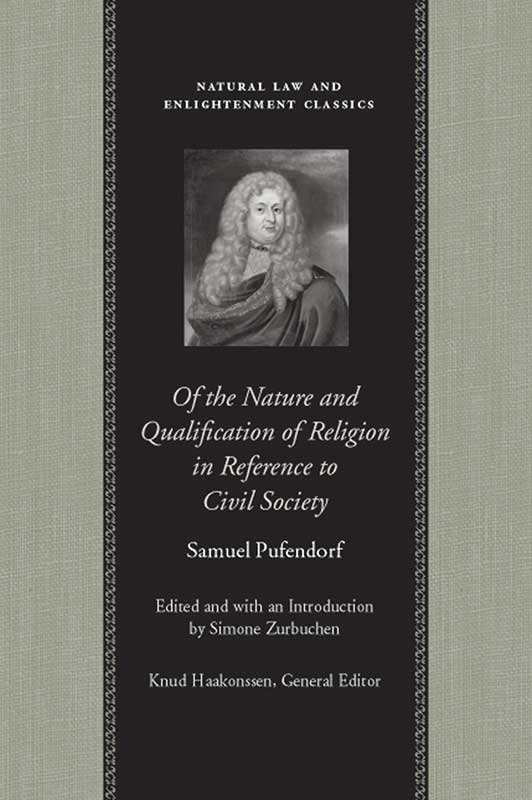
§39. - Samuel von Pufendorf, Of the Nature and Qualification of Religion, in Reference to Civil Society [1687]

Edition used:

Of the Nature and Qualification of Religion, in Reference to Civil Society, trans. Jodocus Crull, ed. and with an introduction by Simone Zurbuchen (Indianapolis: Liberty Fund, 2002).

About Liberty Fund:

Liberty Fund, Inc. is a private, educational foundation established to encourage the study of the ideal of a society of free and responsible individuals.


§39.

In what condition the Churches were under the Pagan Emperours. It having been hitherto demonstrated at large, that the Church is no State, we must consider in the next place, unto what kind of moral Bodies the Churches have the nearest relation, as they were in primitive Times under the Pagan Princes. It is evident enough, That they were of the nature of Colledges, or such Societies, where a great many are joined for the carrying on a certain Business, under this limitation nevertheless, as not to be independent from the Civil Jurisdiction. Concerning the nature of the Colledges and Corporations, Jacobus Cujachus may be consulted before all others, 7 Observ. 30, and 16; and Observ. 3, and 5.186 And it is here very well worth our most particular Observation, that such Societies as were erected for the exercise of Religion were by Publick Authority allowed of in the antient Roman Empire. This is attested among a great many others, by Athanagoras, in the beginning of his Apology for the Christians, when he says: It is by your Command, you greatest of Princes, that several Nations live according to their own Customs and Laws, and every one, without being controuled by any Penal Statutes, freely exercise the same Religion in which he was educated. And thus he proceeds immediately after: All Mankind offer their Sacrifices, and use other Religious Ceremonies, according to the Custom of their Native Country.187 This Liberty of Conscience was, among others, the true cause, why the Christian Religion in so short a time did spread it self all over so vast an Empire, and why in the beginning, very few opposed its Progress, the Magistrates not thinking it belonging to their Province to intermeddle with it. And this is one Reason, why we never read of the Apostles having desired leave from the Civil Magistrates to preach the Gospel, or to plant a Church. Tho’ another Reason may be given, why the Apostles were not obliged to ask leave from the Civil Magistrates for the Constituting of Christian Churches; because the Apostles had received their immediate Authority of Preaching the Gospel from him, who is the King of kings, and by whose Command all Mankind were then called to repentance.188 From what has been said, this rational Conclusion may be drawn; That the Apostles had not only a Power to plant Churches in all places, where they found their Auditors inclined to receive the Doctrine of the Gospel, but that, also in all other places, whither this Doctrine was transplanted, the Believers might enter into such a Society, or plant a Church upon their own accord, without any Commission or Permission for so doing, from the Apostles; but, that, pursuant to our Saviour’s Expression, it was sufficient, if two or three were inclined to meet in his Name. If we trace the true nature of these Societies, which are constituted by a free Choice and Consent of certain Men, we may easily find to contain, all of them, something resembling a Democracy, where such Matters as concern the whole Body of the Society are to be dispatched by common Consent, and where no particular Person can claim any further Power over the rest, than what he has received by their joint Consent. From whence it may be rationally concluded, that at the first beginning, the Power of Constituting Teachers, and other Ministers of the Church, was originally lodged in the whole Church, or, the whole Congregation of the Believers. And, tho’ it is unquestionable, that in the first primitive Church, Teachers were constituted by the Apostles in a great many places; nevertheless the Greek word χειροτονει̑ν, (which implies something of a Democracy, and is often used in the Scriptures in this Case) argues sufficiently, that this was not done without the Approbation of the Church. It would be a hard Task to prove, that the Apostles did constitute Teachers themselves in all lesser Towns, or that they preached the Gospel in all lesser Places and Villages. It seems rather probable, that the Gospel was published by the Apostles in great Cities, and other places of note; from whence it was communicated unto other Places; and, that such Churches, as were not provided with Teachers, Bishops, or Presbyters by the Apostles themselves, or their special Authority, used either to chuse those very Persons to that Function, who were the first Preachers of the Gospel among them, or any others, whom they esteemed to be endowed, before others, with the Gift of Teaching. If we consult the Epistle of St. Paul to the Romans, it seems that the Gospel had been taught at Rome, before ever Peter and Paul came thither;189 And the High Treasurer of the Queen Candaces, who is generally believed to have first carried the Doctrine of the Gospel to Aethiopia, and to have been the first Founder of the Christian Churches in those Parts, received no Ordination as a Bishop or Presbyter from Philip, after his Baptism.190 Neither did Christ or his Apostles prescribe any certain Form, to be used in the Ordination of Bishops, as he did in the use of the Sacraments; which seems to prove that for the obtaining of this Function, there is nothing more required, than for the Person to be called by the Church, and to have the Gift of Teaching. It is not to be denied, but that the Ordination of Ministers, and Imposition of Hands by the Bishops and Presbyters191 is a very laudable and useful Ceremony, and ought to be received as such, with this restriction nevertheless, that the same need not to be deemed so absolutely necessary, as if without it no Person ought to be taken for a true Minister of the Church; especially since these miraculous Gifts which accompanied that Ceremony in the Infancy of the Primitive Church are many Ages past, become useless. The Church, like all other Colledges, have power to collect Stipends for their Ministers, and to make Collections for the Use of the Poor; but in a different degree from that which belongs to Civil Magistrates or Sovereigns, who levy Taxes, and have a Power to force their Subjects to a compliance with their Commands; But, in the Church this Power is founded upon the meer Liberality and free Consent of all the Believers in general, who being made sensible of their Duty of paying a Workman his Stipend, and relieving those in Distress, ought not to refuse such Acts of Justice and Humanity.192 It properly belongs to all Colledges as well as Churches, to have a Power to make, with joint Consent of their Members, such Statutes, as may conduce towards the obtaining the Ends of their Society, provided they do not interfere with the legal Rights of their Sovereigns. Of this kind are these Statutes, which St. Paul recommends to the Corinthians in his first Epistle, in the 7 Chaps. If any one acted contrary to these Rules, he deservedly was to receive Correction, or to undergo such a Penalty as was dictated by the Statute, and which was to be laid upon him not by Vertue of an Inherent Power in the Colledge, but pursuant to their Contract. And, tho’ Colledges have not any Power or Jurisdiction over their Members, unless what is absolutely requisite for the obtaining the true end of each Society, or else has been granted to them by their Sovereigns; Nevertheless, it is often practised in these Societies, and may be done without prejudice to the Rights of their Sovereigns, that, if any Differences arise betwixt the Members of one and the same Colledge, these are composed by the Interposition and Arbitration of the rest of the Members of that Colledge or Society, to the End, that a mutual good Correspondency may be cultivated among them. In which sense is to be taken the Admonition which St. Paul gives to the Corinthians concerning this point in the 1 Epistle, in the 6 Chapter, in the first and following Verses. Lastly, because many Vices were at the time of the first publishing of the Gospel in vogue among the Heathens, which were not punishable by the Pagan Laws, they being more encouraged to the observance of Moral Duty by the prospect of Honours than by any civil Commands; And, the Christians believing it more peculiarly belonging to themselves to recommend and adorn their Profession by a holy Life, and, by an innocent Conversation, to excel the Heathens, some Statutes were, at the very beginning, introduced into the Primitive Church, which were thought most convenient to correct all manner of Licentiousness, according to St. Paul’s Direction: If any one that is called a Brother be a Fornicator, or Covetous, or an Idolater, or a Railer, or a Drunkard, or an Extortioner, with such a one do not eat.193 From whence it appears, that in the primitive Times, Church Censure was used in the Churches, all which may easily be supposed to have been done without the least prejudice to the Sovereign Power, it being always for the Interest of the State, that Subjects should lead an innocent Life. It is worth our Observation, that the Punishments inflicted by vertue of these Statutes, were of such a nature, as might be put in execution without the least prejudice to the Civil Government; such were private Admonitions, publick Reprimands, and Church Penances, the extream Remedy was Excommunication, by vertue of which, a Member of the Church was either for a time deprived from enjoying the benefit of the Publick Worship, or entirely excluded from being a Member of the Church. This being the utmost, unto which any Colledge can pretend, viz. entirely to exclude a Member of their Society. This Exclusion, tho’ in it self considered, of the greatest moment, (since thereby a Christian was deprived of the whole Communion with the Church) Nevertheles did not alter the Civil State or Condition of a Subject; But those that were thus excommunicated suffered no loss in their Dignities, Honour, Rights, or Fortunes. For, that the Church Censures should extend to the real Prejudice of the civil Condition of any Subject, is not any ways requisite for the obtaining the Ends for which the Church is Established; Neither can it be supposed, that without defrauding Sovereigns of their Right, such a Power can be exercised over Subjects, unless with their own Consent, and by vertue of a publick Civil Authority.

[186.]Jacobus Cujachus, i.e., Jacques Cujas, Observationum Libri XVIII, 1618, book 7, chap. 30: “De collegiis” (On Colleges). [SZu]

[187.]Athenagoras, A Plea for the Christians (Presbeia peri Christianon; Apologia pro Christianis, c. a.d. 177), chap. 1. See note 51, above. [SZu]

[188.]Acts 17:30. [Puf.]

[189.]Rom. 16.

[190.]Acts 8:27ff.

[191.]1 Tim. 4:14.

[192.]2 Cor. 8:2, 3; 9:5, 6, 7.

[193.]1 Cor. 6:9, 10; 1 Tim. 5:20. [Puf.]