Econlib

The Library

Other Sites

Front Page arrow Titles (by Subject) arrow §33. - Of the Nature and Qualification of Religion, in Reference to Civil Society

Return to Title Page for Of the Nature and Qualification of Religion, in Reference to Civil Society

Search this Title:

§33. - Samuel von Pufendorf, Of the Nature and Qualification of Religion, in Reference to Civil Society [1687]

Edition used:

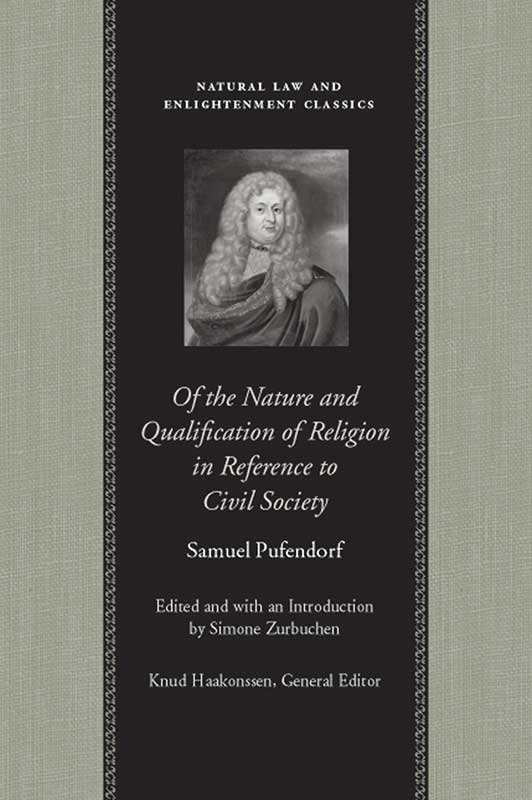
Of the Nature and Qualification of Religion, in Reference to Civil Society, trans. Jodocus Crull, ed. and with an introduction by Simone Zurbuchen (Indianapolis: Liberty Fund, 2002).

About Liberty Fund:

Liberty Fund, Inc. is a private, educational foundation established to encourage the study of the ideal of a society of free and responsible individuals.


§33.

There is a great difference betwixt Teachers in a Church, and the Governours of a State. Besides all this, the Teachers in a Church, do not only differ from Temporal Governours in a State, in that these are constituted for different Ends: But the main Difference is the very nature of their Constitution. We will not insist here upon the Point of Succession, by which a great many Sovereigns obtain their Sovereign Power, which is quite otherwise in the Church: But we will only treat in this place concerning the different Constitution betwixt Teachers, and such Sovereigns, as exercise the Supream Civil Power, by Vertue of Election. When therefore the Sovereign Power is lodged in any Persons by Election, the rest who have thus chosen them their Supream Governour, do thereby submit themselves to the Disposal of those their Sovereigns, in such a manner as to oblige themselves, that whatsoever they think conducing for the publick Welfare, shall be taken as such by the whole Body; and that they will always be ready to execute their Commands: Wherefore Sovereigns are always invested with a full Power to force their Subjects to a compliance with their Commands, by inflicting Punishments upon them. But how is it possible to imagine that any Church or Congregation of the Believers should ever, or ought to submit themselves so entirely to the Pleasure and Disposal of their Teachers; as to oblige themselves to acquiesce barely in, and to follow blindly, whatever shall be proposed by them, as conducing and leading to the way of Salvation; it being certain without contradiction, that none of the Believers do entirely submit themselves and their Faith to any Body but to God Almighty, whose Will and Commands ought to be interpreted by the Teachers of the Church, and their Auditors to be exhorted to a due Compliance with them. For, whoever it be, that proposes any Doctrine surpassing human Reason, if he pretends to gain credit by his Auditors, must either claim it by Virtue of his own Authority, or by Compulsion, or by Virtue of a more Superiour Power. But any Man that offers Matters not agreeable to Reason, does thereby expose himself, and so looses his Authority, except he can by other more powerful means maintain his Doctrine, and gain credit with his Auditors. It was for this Reason, that, to the Greeks, who were Men that sought after Wisdom and Reason, the Preaching of the Apostles was Foolishness.161 And S. Paul was for the same Reason nick-named a Babler by the Athenian Philosophers.162 Neither is any human Power capable of enforcing the Mysteries of Faith and the Christian Doctrine upon People; for which reason Christ told his Apostles, Go and Teach, and Believe, and that with all your hearts; to obtain which, all human means which imply any Temporal Advantages, or are forcible in their own nature, are to be taken for Trifles and insufficient. There is then no other Way left, but that such Doctrines must be verified by a Superiour Being or Principle, viz. the Grace of God, which always accompanies the Gospel, and those Miracles wherewith the Apostles antiently authorized their Doctrine;163 Tho’ it is at the same time undeniable, that since the Gospel is sufficiently spread abroad in the World, we do not now any more stand in need of such Miracles: In the same manner as the Thunder and Lightning which were heard at the Publishing of the Ten Commandments, were never repeated afterwards among the Jews. The Christians therefore have submitted their Faith and Reason only to Christ, whose Authority is unquestionable, as being God himself, and was testified by his Father’s Voice from Heaven, when he said, This is my beloved Son, in whom I am well pleased.164 And, as the People of Israel willingly submitted their Faith to Moses, as soon as he had given them plain Demonstrations of his Divine Commission;165 so were they obliged to submit their Faith to the Apostles, after they had once verified their Divine Commission by their Miracles: Tho’ it cannot be denied, but that their Doctrine did sometimes produce good Effects without Miracles. It is therefore very observable, that when they preached and taught their Doctrine to such as were well versed in the Old Testament, they did not take it amiss, if their Auditors examined their Words, whether they were consonant with the Prophesies contained therein.166 From whence it is sufficently apparent, that no body ought to engage himself unto a blind Obedience of such Teachers, as cannot verifie their immediate Divine Commission by Miracles, so as to make his Faith absolutely dependant from their Doctrine without Exception, but only so far, as their Doctrine is found agreeable to the Doctrine of those who had given manifest demonstrations of their divine Authority. And for this Reason it is, that it is not sufficient for a Teacher in the Church to say, so it is, and so it shall and must be: But he lies under an indispensible Obligation of making it plain and apparent, that, what he offers to his Auditors, is absolutely consonant to the Doctrine published by Christ and his Apostles. Neither ought the Auditors pin their Faith upon the Authority of their Teachers, but to refer themselves to the Authority of God and his Word, which is the Touchstone by which the Teachers Doctrine is to be examined and approved. The Schools of Philosophers used to take their Names from their Chief Teachers or Founders, as we may observe in the Schools of Plato, Aristoteles and Zeno: But the Church ought to have no other Name, but that she is the Church of God or Christ. It was upon that score when S. Paul rebuked the Corinthians, because some of them said, they were of Paul, some of Apollo, some of Cephas, and some of Christ.167 So that since the holy Scripture is now established among us, Christians ought not to be like the Disciples of Pythagoras, who used for their Motto, that old Saying ἀυτὸς ἔφα, He himself has spoken it:168 But they have sufficient Authority to look themselves into the Holy Scripture, and to examine whether the Doctrine of their Teachers be agreeable to the Doctrine of our Saviour. For, Christ, when he said, search the Scriptures, did not only speak to his Disciples, but to his Auditors in general. And S. Paul bid us to prove all things, and to hold fast that which is good.169 S. John says, that we shall try the Spirits, whether they are of God.170 Neither can I conceive how the Examination of our selves, which S. Paul so highly recommends to all that intend to be Partakers of the Lords Supper, can be duely performed without meditating the Scriptures.171 For, in this case, I take the condition of a Teacher and of a Physician, to be quite different; it being only required in the latter to understand the Art of Physick, and to apply the same to his Patients, which may be done with good Success, tho’ they be never so ignorant. But it is not sufficient for a Teacher of a Church to be alone versed in the Articles of the Christian Religion; that Church being to be deemed most excellent, where the Auditors are not inferiour to their Teachers in the Cognition of the Mysteries of the Faith. For the Apostles did not shun to declare unto Mankind all the Counsel of God,172 having not committed the Christian Doctrine to the care and custody of one particular Person, who was to be the only Interpreter of it, as the Sibyllin Oracles were antiently at Rome in the Custody of the Decemviri.173 And because Christians do not build their Faith upon any Human Authority, but upon the Word of God alone, they are said to be taught of God.174 For which Reason S. Paul utterly denied that they had any Dominion over the Faith of the Corinthians; or, which is the same in effect, that they could exercise any Dominion over them under the Pretence of Faith.175 For the rest, as Christians which are well versed in the Scriptures, may, without great difficulty, try their Teacher’s Doctrine by the Touchstone of the Holy Scripture: So the Catechism and other compendious Instructions relating to the chiefest Articles of the Christian Faith may be sufficient for those of a meaner Capacity, wherein all Christians ought to be well instructed in their younger Years, both by their Parents and Teachers of the Church, this being likely to prove more useful to those of an indifferent Capacity than all the other Subtilities and Controversies, which in themselves are not absolutely necessary, or requisite to be understood by every Christian in particular. And if we duely consider what is required by the Apostle for the obtaining of Salvation, we shall find that this Knowledge may be attained to without much Difficulty; because the Confession that Jesus was Christ, the Son of God, is the Foundation Stone, and, as it was, the Center of the Christian Religion,176 and that this Article was chiefly opposed by the Gates of Hell in the time of the Primitive Christians, the Apostle S. John prescribes this as a general Rule to be particularly taken notice of by such as are of a mean Capacity: Hereby know you (said he) the Spirit of God: Every Spirit that confesseth, that Jesus Christ is come in the Flesh, is of God; and every Spirit that confesseth not, that Jesus Christ is come in the Flesh, is not of God.177 Though from hence no Inference ought to be made, as if Christians may neglect, or ought not also to be well instructed concerning all the other Articles of Faith, or that it is indifferent for any Christian to believe, what he pleases, concerning the rest of the Articles of the Christian Doctrine.

[161.]1 Cor. 1:23.

[162.]Acts 17:18.

[163.]Mark 16:20; Acts 14:3; Hebr. 2:4.

[164.]Matt. 3:17; Luke 3:22.

[165.]Exod. 20:19.

[166.]Acts 17:11.

[167.]1 Cor. 1:12.

[168.]In the middle of the fifth century b.c., the order of the Pythagoreans split into two parties. Whereas one group (that used the motto quoted by Pufendorf) did not wish to depart from Pythagoras’s own words, the other one deemed it more appropriate to develop his teachings by reflection. [SZu]

[169.]John 5:39; 1 Thess. 5:21.

[170.]1 John 4:1.

[171.]1 Cor. 11:28.

[172.]Acts 20:27.

[173.]See note 78, above. [SZu]

[174.]John 6:45; 1 Thess. 4:9.

[175.]2 Cor. 1:24.

[176.]Rom. 10:9, 10; 1 Tim. 1:5; 2 Tim. 2:22; John 20:31.

[177.]1 John 4:2, 3.