EconlibThe LibraryOther Sites |
Front Page Titles (by Subject) §27. - Of the Nature and Qualification of Religion, in Reference to Civil Society
Return to Title Page for Of the Nature and Qualification of Religion, in Reference to Civil SocietyThe Online Library of LibertyA project of Liberty Fund, Inc.Search this Title:Also in the Library:
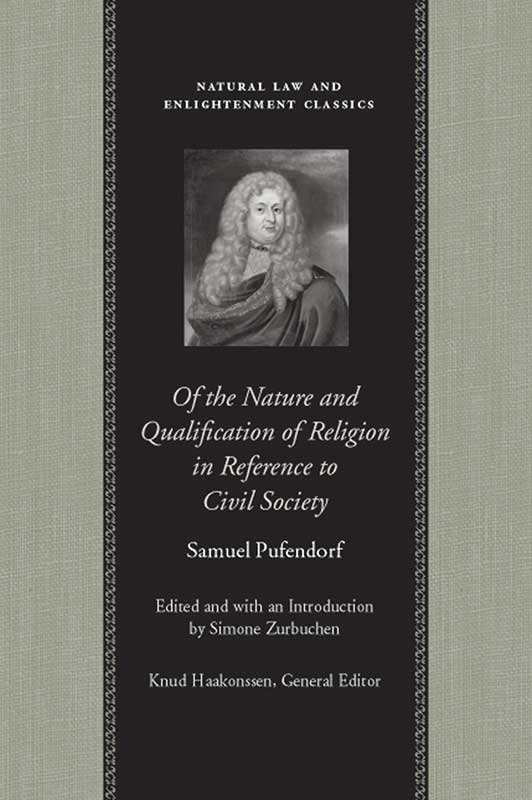
§27. - Samuel von Pufendorf, Of the Nature and Qualification of Religion, in Reference to Civil Society [1687]Edition used:Of the Nature and Qualification of Religion, in Reference to Civil Society, trans. Jodocus Crull, ed. and with an introduction by Simone Zurbuchen (Indianapolis: Liberty Fund, 2002).
About Liberty Fund:Liberty Fund, Inc. is a private, educational foundation established to encourage the study of the ideal of a society of free and responsible individuals. Copyright information:The copyright to this edition, in both print and electronic forms, is held by Liberty Fund, Inc. Fair use statement:This material is put online to further the educational goals of Liberty Fund, Inc. Unless otherwise stated in the Copyright Information section above, this material may be used freely for educational and academic purposes. It may not be used in any way for profit.
§27.Whether the Power of Excommunication implies any Sovereign Right or Jurisdiction. It also is worth our Consideration, whether the Power of Excommunication, which was used by the Apostles, and in the Primitive Church, implies any Sovereign Authority, such as ought to be exercised in a State? Unto this we answer in the Negative; provided the same be taken according to the proper Use and End of its genuine and primitive Institution. For, that this Power may with conveniency enough, be made use of, (if misapplied) to serve an ambitious Design, and to keep the poor People in awe, is sufficiently proved by Experience. It seems to me, that there was a remarkable Difference betwixt the Excommunication of the Jews, by virtue of which they were excluded from their Synagogues, and the Excommunication used among the Primitive Christians. For, among the Jews, where the Sovereigns and the People professed one and the same Religion (which also was entirely united with the State) it might easily happen, that the Exclusion from the Synagogue, did carry along with it several Inconveniencies in Civil Affairs, and might therefore not unjustly be considered at the same time, as a Civil Punishment; which, rendered the Offenders infamous in the Commonwealth; Especially, since, according to the Fundamental Constitution of that Government, there were several things belonging to Religion punishable by their civil Constitutions. But, it being already put beyond Question, that neither our Saviour, nor his Apostles, did ever pretend to any Civil Power; and that besides this, the Primitive Christians lived under the Jurisdiction of other Princes, how could their Excommunication, Ban, or what other sort of Ecclesiastical Censure was used among them, be supposed to have any influence upon the Civil State and Condition of the Christians; or to have been of the same nature and force (properly speaking) as Civil Punishments are? This will more plainly appear, if we examine those Passages, where this Matter is compleatly treated of in the New Testament: It is said in Matthew 18:15, 16, 17. If thy Brother shall trespass against thee, go, and tell him his Fault, between thee and him alone; If he shall hear thee, thou hast gained thy Brother. But, if he will not hear thee, then take with thee One or Two more, that in the mouth of two or three Witnesses every Word may be established. And if he shall neglect to hear them, tell it unto the Church, but if he neglect to hear the Church, let him be unto thee as a Heathen Man and a Publican. Certainly out of this passage, nothing can be inferr’d that has any relation to a Temporal Jurisdiction or Sovereignty; but barely shews us, how differences ought to be composed among Christians. So St. Paul ordains, that we shall rather leave Differences to the Arbitration of a Brother, or rather take wrong, than to go to Law with a Brother before the Unbelievers, to the great shame of the Christian Name.107 So, that, tho’ it is else required from the Offender to beg the Pardon of, and offer Satisfaction to the Person offended; nevertheless, if he neglect his Duty in this Point, Christ commanded, that the offended Party shall first offer a Reconciliation,108 and try before he brings his Action against the Offender, whether Satisfaction for the Injury received, and a Reconciliation may not be obtained by a private Arbitration. If this prove fruitless, he says, he ought to take along with him two or three Witnesses, to try whether they can prevail with his Adversary to bring him to a more pliable Temper; and at the same time, may testifie, That the offended Party, did offer every thing which might tend towards a Reconciliation betwixt them; But, if after all this, he remain obstinate, the Difference ought to be referr’d to the whole Congregation of the Believers, residing in that Place; (for I see no reason why by the word Ecclesia or Church, the Presbyters only should be understood.) But, if they also cannot prevail with their Authority over his Stubborness, let him then be unto thee like a Heathen man and Publican, unto whom his Trespasses will not be remitted, because he refuses to acknowledge his Offence, or to give Satisfaction for it; which is as much as to say, fly his Conversation, like that of a vile Person; which every one may freely do, without being thereunto compelled by any Superior Power. For, that the Jews did not converse with the Heathens and Publicans, except in Civil Affairs, is of no great force against us, it being certain, that the Heathens and Publicans were not so infamous in themselves by any Civil Constitution, the Jews being at that time subject to the Heathens, who matter’d not their Conversation. Besides this, it is left to every ones free Choice, whom he will admit into his familiar Conversation; and always was a certain Rule among the wiser Sort, not to be familiar with People of a perversed Humour, and an ill Life, whose Conversation every body may avoid, as he finds it most convenient. So, the Apostle bids us, to reject a Man that is a Heretick, after the first and second Admonition,109 lest we should be infected with his false Doctrine, for which he is to expect due Punishment from God Almighty.110 Neither does that passage, in the 1 Epistle to the Corinthians, 5:1. and following Verses, and in the 2 Epistle to the Corinthians, 13:2, 10. where St. Paul declares, that according to the Power given him, he intends to deliver the incestuous Person to Satan, (take it in what sense you please) involve any Civil Jurisdiction or Command; no more, than those in the 1 Epistle to the Corinthians, 6:9. seq. in the 1 Timothy, 1:20. in the 2 Epist. of John, 5:10. All which passages signifie no more, than that every body may freely decline the Conversation of such People, as he thinks may be reproach, or hurtful to him, without implying a prejudice to their Reputation in Civil Affairs. So, that, by avoiding the Conversation of ill Livers, we are not obliged to retire from the World; that is, we need not be so scrupulous in avoiding such Conversation, as to neglect our Duty, or other necessary Business appertaining to Civil Society. And in this sense it is appliable as well to Christians, as to Pagans, of an ill Conversation. [107.]1 Cor. 6:1, 2. See also Matt. 5:40. [108.]Mark 11:25; Luke 6:27; Acts 7:60. [Puf.] [109.]Tit. 3:10; 2 Thess. 2:14. [110.]2 Pet. 2:1, 2; Gal. 1:8, 9. |

Titles (by Subject)