Econlib

The Library

Other Sites

Front Page arrow Titles (by Subject) arrow §26. - Of the Nature and Qualification of Religion, in Reference to Civil Society

Return to Title Page for Of the Nature and Qualification of Religion, in Reference to Civil Society

Search this Title:

§26. - Samuel von Pufendorf, Of the Nature and Qualification of Religion, in Reference to Civil Society [1687]

Edition used:

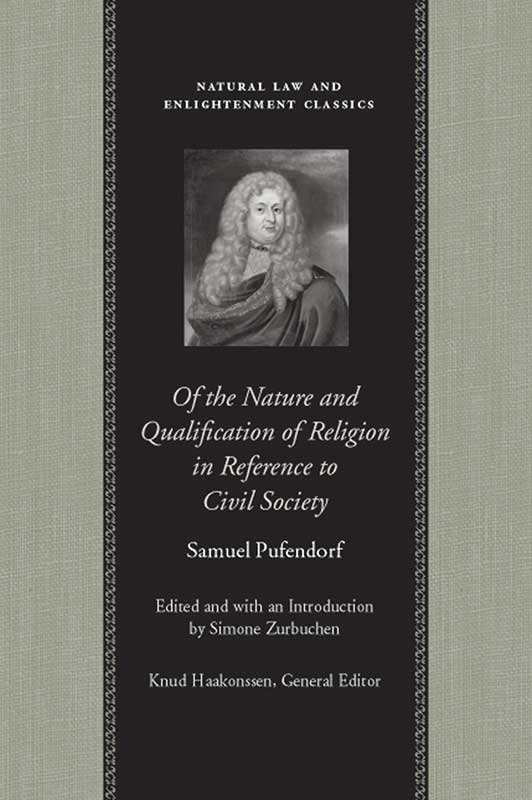
Of the Nature and Qualification of Religion, in Reference to Civil Society, trans. Jodocus Crull, ed. and with an introduction by Simone Zurbuchen (Indianapolis: Liberty Fund, 2002).

About Liberty Fund:

Liberty Fund, Inc. is a private, educational foundation established to encourage the study of the ideal of a society of free and responsible individuals.


§26.

Whether St. Peter had any Prerogative granted him before the rest of the Apostles? But of what nature soever their Power or Function might be, the same was granted in an equal degree to all the Apostles, so, that none of them could claim a particular Prerogative, or, at least not any right of Commanding the rest. For, if we peruse those several Passages in the holy Scripture, where the Apostolical Function was established, and conferred upon them, there are not the least footsteps of Inequality to be found among them. And that Passage St. Luke 22:26, 27. Epistle to the Galat. 2:9, 14. By St. Matth. 16:18. which the Romanists98 make such a stir about,99 contains nothing, that can give any legal Pretence of Superiority to St. Peter, and much less to the Roman Bishops over all the Christian Churches. St. Peter had in the abovementioned place made his Confession, That Jesus was the Son of the living God.100 This excellent Confession did deserve a suitable answer from Christ, who said, thou art Peter, as if he would say, persist in this thy Confession Peter; which does in no wise imply, that Peter should thereby have deserved those Prerogatives over the other Apostles, as the Romanists do pretend to. For, St. Peter did not make this Confession for himself only, but in the Name of all those, unto whom Christ spoke at that time. In the same manner as he spoke in the Name of the rest of the Disciples by St. John 6:69. We believe, and are sure, that thou art Christ the Son of the living God. Neither was Peter the first, that made this Confession; For, before him the same had been made by John the Baptist,101 by St. Andrew,102 Philip103 and Nathaniel.104 And it is no difficult Task to prove out of several passages of the holy Scripture, that none could be taken for a true Disciple of Christ, unless he had made this Confession;105 And our Saviour, to shew, of what consequence this Confession was, added these Words: Upon this Rock I will build my Church.106 Which is as much as to say, this Doctrine, that Jesus is the Son of God, is the main Foundation Stone, whereupon is to be built the mystical Edifice of the Christian Church. So, that no further inference can be made from these Words, than what is expressed to the same purpose by St. John, 20:31, and in the 1 Epist. of John, 2:22. c. 3:20. c. 4:2. viz. That the fundamental Article of the Christian Religion is: That Jesus of Nazareth is the true Messias, and the Son of the living God.

[98.]The Roman Catholics. [SZu]

[99.]Matt. 28:18, 19, 20; John 20:21, 22, 23; Matt. 23:8ff.; John 13:14.

[100.]Matt. 16:16. [SZu]

[101.]John 1:34, 36.

[102.]John 1:42.

[103.]John 1:45.

[104.]John 1:49.

[105.]Matt. 10:32, 33; John 11:27; Acts 4:12; 8:37; 9:20, 22.

[106.]Matt. 16:18. [SZu]