EconlibThe LibraryOther Sites |
Front Page Titles (by Subject) §13. - Of the Nature and Qualification of Religion, in Reference to Civil Society
Return to Title Page for Of the Nature and Qualification of Religion, in Reference to Civil SocietyThe Online Library of LibertyA project of Liberty Fund, Inc.Search this Title:Also in the Library:
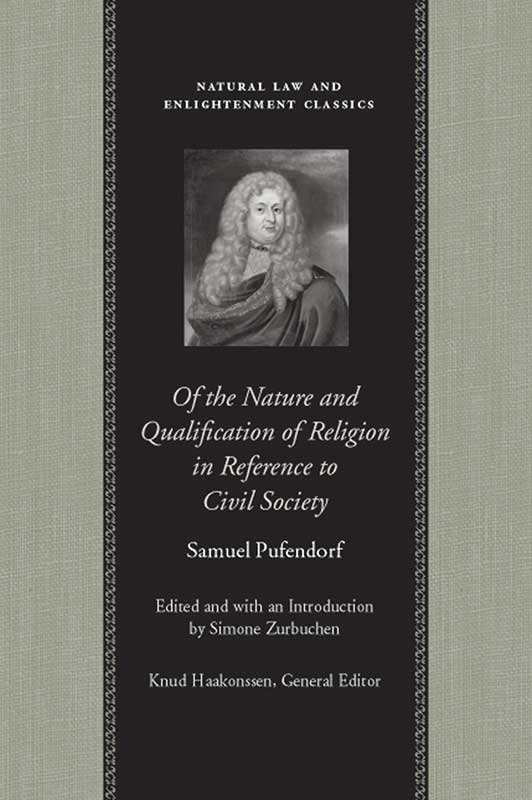
§13. - Samuel von Pufendorf, Of the Nature and Qualification of Religion, in Reference to Civil Society [1687]Edition used:Of the Nature and Qualification of Religion, in Reference to Civil Society, trans. Jodocus Crull, ed. and with an introduction by Simone Zurbuchen (Indianapolis: Liberty Fund, 2002).
About Liberty Fund:Liberty Fund, Inc. is a private, educational foundation established to encourage the study of the ideal of a society of free and responsible individuals. Copyright information:The copyright to this edition, in both print and electronic forms, is held by Liberty Fund, Inc. Fair use statement:This material is put online to further the educational goals of Liberty Fund, Inc. Unless otherwise stated in the Copyright Information section above, this material may be used freely for educational and academic purposes. It may not be used in any way for profit.
§13.What on the other hand our Saviour did, when he established his Church. But if we look upon our Saviour Jesus Christ, he acted in a quite different manner; from whence it was very evident, that his intention was not to Erect a new State here upon Earth. ’Tis true, he gained to himself a great deal of Credit and Authority by his Miracles; but these were no terrifying Miracles, or such as ever proved injurious to any. So, when his Disciples would have persuaded him, to command fire to come down from Heaven, and consume those that refused to receive him, they met with a severe Rebuke.34 The main Demonstrations he used to give them of his Divinity, always tended to the benefit of others, and the Miracles performed by him, were of such a nature, as must needs attract the love and favour of all Men; and at the same time were apparent and convincing Proofs of his Divinity, not any thing less than a Divine Power being able to cause a new Motion or Alteration in the course of Nature, without Natural means. For he went about doing good, and healing all that were oppressed of the Devil.35 All which had not the least Relation towards the laying of the Foundation of a new State. He had some Disciples, but these were few in number, unarmed, poor, of a mean Profession and Condition, and of so little Authority, that it was impossible for them to make the least pretention of setting up a State of their own, or of raising any Commotions or Disturbances in another State. And when the multitude, in acknowledgment of the benefits received by his Doctrine and Miracles, would at several times have proclaimed him King, he absconded and made his escape. The principal Care he took of his Followers, was to instruct them by his Doctrine, from whence they were called Disciples, and they in return, used to give him the Name of Master or Teacher. Neither did he Constitute any new Laws, (at least not any that could be supposed to have any reference towards the Establishment of a new State) but the Antient Law, as far as it was given to Mankind in general, was explained, and the People exhorted to a due observance of it. He did never execute the Office of a Judge,36 nay he refused to be an Arbitrator, to convince the World that his coming was intended for no such purpose. Lastly, he did himself pay Taxes to others; and, tho’ it was in his Power to prevent it, suffered himself to be Judged and Executed. All which is altogether inconsistent with the Nature and Office of a Temporal Sovereign. [34.]Luke 9:54, 55. [35.]Acts 10:38. [36.]Luke 12:13, 14; John 8:11. |

Titles (by Subject)