Econlib

The Library

Other Sites

Front Page arrow Titles (by Subject) arrow Of the Nature and Qualification of Religion, in Reference to Civil Society, &c. - Of the Nature and Qualification of Religion, in Reference to Civil Society

Return to Title Page for Of the Nature and Qualification of Religion, in Reference to Civil Society

Search this Title:

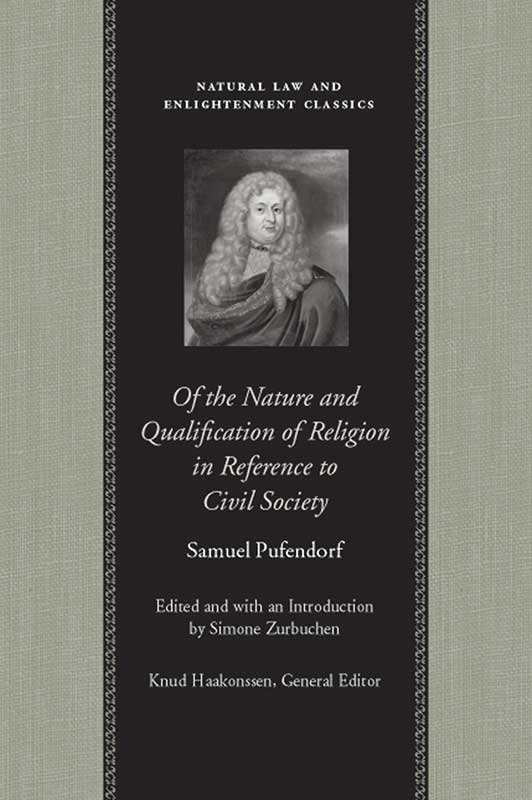
Of the Nature and Qualification of Religion, in Reference to Civil Society, &c. - Samuel von Pufendorf, Of the Nature and Qualification of Religion, in Reference to Civil Society [1687]

Edition used:

Of the Nature and Qualification of Religion, in Reference to Civil Society, trans. Jodocus Crull, ed. and with an introduction by Simone Zurbuchen (Indianapolis: Liberty Fund, 2002).

About Liberty Fund:

Liberty Fund, Inc. is a private, educational foundation established to encourage the study of the ideal of a society of free and responsible individuals.


Of the Nature and Qualification of Religion, in Reference to Civil Society, &c.

Among all those Questions, which have for many Ages past been Controverted among Christians, this may be deem’d one of the Chiefest; which Treats of the Nature, Authority, and Power of the Church; and which of the several Christian Sects ought most justly to claim the Title of the True Church. The Romanists6 keep this for their last Reserve, when Engag’d with the Protestants, That they Attribute the Name of the True Church only to themselves, and boldly stigmatize all such as are not of their Communion, with the Names of rebellious Deserters. This is the main Bulwark they rely upon; thinking it sufficient to Alledge in their own behalf; That they are not obliged so strictly to Examin, and maintain every Article of their Faith against the Protestants; since, whatever Objections may be made out of the Holy Scripture, the same ought to be rejected as Erroneous, if not agreeable with the Interpretations and Traditions of their Church; Thus making themselves both Judges and Witnesses in their own Cause. Besides this, it is to be look’d upon as a Matter of the greatest Consequence, both in regard of the Christian Church, and the Publick Safety in a State, to know exactly, what bounds ought to be prescribed to the Priestly Order in Ecclesiastical Affairs; as likewise to determin, how far the Power of Sovereigns extends it self in Ecclesiastical Matters: For, if either of them transgress their Bounds, it must of necessity prove the Cause of great Abuses, Disturbances and Oppressions, both in Church and State. I was the sooner prevail’d upon to Search into the very bottom of this Question, at this juncture of Time, when not only the Romish Priests apply all their Cunning for the rooting out of the Protestants, but also some of the greatest Princes in Christendom (setting aside the Antient way of Converting People by Reason and force of Arguments) have now recourse to open Violence; and by Dragooning, force their miserable Subjects to a Religion, which always appear’d abominable to them. But if we propose to our selves to examin this Point, according to its own solid Principles (as we ought to do) without having recourse to Ambiguous Terms and Tergiversations, it is absolutely requisite, that we trace the very Original of Religion in General; and of the Christian Religion in Particular, so as to Examin both their Natural Qualifications in reference to Civil Society. For, if this, which is to be look’d upon as the Foundation Stone, be well Secured: And we afterwards do look into the Scriptures, to investigate, in what manner Christ himself has represented his Doctrine to us; it will be no difficult Task to judge, whether, according to the Institution of our Saviour, there ought to be an Ecclesiastical Sovereignty exercised by Priests? Or, whether Princes have a Right to make use of an Absolute Power? Or can Compel their Subjects to Obedience by Force of Arms, in Matters of Religion?

§I.

Concerning Religion before Civil Societies were Instituted.That there is a Supream Being, the Author and Creator both of the Universe, and especially of Mankind, which ought to be acknowledged and worshipped as such by Menkind, as they are Rational Creatures, has been generally receiv’d, not only among Christians, but also by most of the Pagan Philosophers, that to pretend to demonstrate it here, would be Superfluous, and perhaps might be taken as done in prejudice of the judicious Reader; since, scarce any body, that is not beyond his right Wits, can be supposed, now a days, to make the least Doubt of the Verity of this Assertion. The true Knowledge of Divine Worship arises from two several Springs: For, we either by true Ratiocination, deduced out of the Light of Nature, may be Convinced of those Sentiments we ought to have of God, and what Reverence is due to him from us Mortals: Or else, some Matters, being beyond our Apprehension, by the bare Light of Nature, are by God’s special Command Revealed to Mankind. Both Kinds are to be the Subject of the following Treatise; with this Restriction nevertheless, not to insist upon each particular Head of either of them, any further, than they have relation to Civil Society.

§2.

Every Man is accountable for his Religion. The first Thing which is to be considered, both in Natural and Revealed Religion, is, That every body is obliged to worship God in his own Person, Religious Duty being not to be performed by a Deputy, but by himself, in Person, who expects to reap the Benefit of religious Worship, promised by God Almighty. For Man, being a rational Creature, owing its Off-spring to God alone, is thereby put under such an indispensible Obligation, that the Consideration of worshipping him, to the utmost of his Power, can never be entirely exstinguished in a rational Soul. And here lies the main difference betwixt that Care, which, we ought to have of our Souls, and that of our Bodies; the latter of which, may be committed to the Management of others, who being to be Accountable for all Injuries, which may befall us under their Tuition, we are thereby freed from any Guilt against our selves. So do we commit our selves, when we pass the Seas, to the Management of the Master of a Ship, by whose sole Care, without our own Assistance, we are conducted to the desired Port. But, no body can so entirely transfer the Care of his Soul, and the Exercise of Religious Worship from himself to another Man, as to make him alone Accountable for all Miscarriages, and to free himself from Punishment. Every one of us shall give Account of himself to God.7 And it is in vain for St. Paul to wish, to be Accursed from Christ, for his Brethren, his Kinsmen, according to the Flesh.8 And, though it is undeniable, That those who have been negligent in taking care of other Peoples Souls, that were committed to their Charge, shall receive Punishment; Nevertheless, these, whose Souls have been thus neglected, shall perish with them, for having put too much Trust in others, and neglected their own Salvation. As it is plainly expressed by the Prophet Ezekiel, 33:7, 8. And the Just shall live by Faith.9 And the Evangelist St. Mark, speaks without any Reservation. He that believed not, shall be damned;10 without distinction, whether you were seduced by others, or whether you have renounced your Faith for worldly Ends.

§3.

How the same is to be exercised in the free State of Nature. From whence it is evident, That, Religion having its relation to God, the same may be exercised without the Communion of a great many; And, that a Man ought not to judge of the Soundness of his Doctrine or Religion, by the Number of those that adhere to it. So, that it is manifest, That, at the beginning of the World, our first Parents might, and did really perform Religious Duties; And, that, if one alone, or a few together, live in a solitary Place, they are therefore not to be deem’d to live without Religion, because, they do not make up a Congregation. For, God being the only Judge, of what is best pleasing to him in his Worship, knows and searches the very bottom of our Hearts; And, since we are not able, without his Assistance, to perform religious Duties, the same can’t be esteem’d properly our own Invention. As those that live in the free State of Nature, are not Subject to any Human Power, So, in the same State, their Religion, having only a relation to God Almighty, unto whom alone they are bound to pay Reverence, it is free from all Human Force or Power; which, in this State of Natural Freedom, they may exercise, either according to the Dictates of Reason, or, according to Divine Revelation; and, according to the best of their Knowledge, may dispose the outward Form of their religious Worship, without being accountable to any body, but God Almighty: Neither can they be Controuled, or forced, rather to worship God according to another’s, than their own Opinion. But, if any body pretends to bring them over to his Side, he ought with suitable Arguments, to Convince them, how far he is in the Right, and they in the Wrong. There may be, besides this, another Reason be given, why no body, in what Condition soever, ought to be forced to another Man’s Religion; because the Knowledge of Truth can’t be implanted in us, without proper and convincing Arguments, such as are capable of preparing our Minds for the receiving of the True Doctrine of Religion: And, as to the Mysteries of the Christian Religion, which transcend our Reason, these must be acquired by the assistance of Divine Grace, which is contrary to all Violence. ’Tis true, a Prince may force a Subject to make an outward Confession by way of Mouth, to comply in his Behaviour, with his Commands, and to dissemble his Thoughts or to speak contrary to his Belief; but he can force no body to believe contrary to his own Opinion. For we ought to believe with all our Hearts;11 but, whatever is done in order to obtain any worldly Advantage, or to avoid an imminent Evil of this kind, can’t be done with all our Heart. But, Faith cometh by Hearing, and Hearing by the Word of God.12 Neither does our Saviour force his Word upon us; but by all gentle means, persuades us to a Compliance with his Will, according to St. Paul’s Saying: Now then we are Ambassadors for Christ, as though God did beseech you by us, we pray you in Christs stead, be ye reconciled to God.13

§4.

The first Care of religious Worship lodged in Parents. It is an unquestionable Truth, and generally received among Mankind, That one is obliged to give a helping-hand to another in several Respects: In the same manner it is with Religion; that these who by nearest of Blood, are in Duty bound, to take Care of young Peoples Education, ought at the same time to Instruct them in the true Knowledge of God, and prepare their Minds for the receiving of the Christian Doctrine. ’Tis upon this score, that this Care touches most nearly all Parents, in regard of their Children, it being the principal Part of Paternal Duty, to take effectual Care, that they may be throughly Instructed in all Matters, relating to God and his holy Word; and to be encouraged in all manner of religious Exercises: For it is too dangerous, to leave young People to their own Inclinations, till they may be capable, by the Strength of their own Reason, to learn their Duty towards God. And it would be much more dangerous, to defer it under pretence or expectation of Revelations to be made upon that account, at this time, when the Word of God is already planted and established among us: Besides, that Children soon grow head-strong and refractory, if they are not in their tender Age, accustomed to pious Exercises. Nevertheless, Parents ought not to exercise this Paternal Office any otherwise, than in a manner suitable to the Genius of the Christian Religion, which will have them not to act with Violence, but to be diligent and assiduous in Teaching, Exhorting, Praying, and announcing God’s Wrath. Wherefore, the Priestly Office was originally joined with the Paternal, in the antient Fathers of Families; and Abraham is commended both for a good Father, and a good Master of his House, because he instructed his Children in all manner of Piety, and himself Administred Circumcision.14 The like Commands were made to Parents, both in the Old and New Testament;15 and the Patriarch Jacob, removed the Idols out of his Family, not by Compulsion, but by Instructing those of his House in the Knowledge of the true God, who thereupon, voluntarily surrendered those Idols to his Disposal.16 This part of the Paternal Office, like all the rest, does cease as soon as a Son, after leaving his Father’s House, comes to set up for himself, and consequently becomes the Father of a separate Family, and enjoys the same Rights, which his Father had before over him. And, tho’ perhaps in such a Case a Father may still retain the priviledge of giving some Paternal Admonitions to his Sons, yet ought the same to be look’d upon to resemble in their Nature our last Will or Testament, which does not always imply properly a Command; but ought to be observed for its good Intentions sake, and to shew a due Reverence to the Memory of a Father, never to be neglected by any, that will not at the same time profess themselves guilty of Improbity.

§5.

Civil Societies were not Instituted for Religions sake. Out of what has been said before, it is most evident, That Civil Governments were not erected for Religions sake; or that Men did not enter into Civil Societies, that they might with more conveniency establish, and exercise their Religion. For, since Religious Exercises could be performed as well by a few, as by a great Number; and in a small Congregation as well as in a great one, it was unnecessary to erect several great Societies on that account: Besides, that those who committed open violences against others, which was the first motive that obliged Men to enter into Societies for their mutual Defence, did not aim at the Religion of Mankind; but, to robb these that were weaker than themselves of their Liberty, Life, and Fortunes. Neither does a Man’s Probity and Piety receive the least addition, by the Number of People, which join in their Devotion; For every one must be acceptable to God Almighty upon his own account; neither is a Man always deem’d the more pious, because he lives among such as are pious themselves. Those Patriarchs that liv’d before Civil Societies were erected, are no less Famous for their Piety, than those that lived afterwards under a settled Government. From whence it is evident, That Religion is not an ingenious Invention of the first Founders of Commonwealths, but as antient as Humane Race it self; it being sufficiently apparent, that Mankind did not enter into Civil Societies; till long after, being enforced thereunto, by great and weighty Reasons; tho’ at the same time, it cannot be deny’d, but that some have cunningly abused Religion, for obtaining their Ends in the State; But, Religion in it self considered, Is not made subordinate to the State; or to be deem’d a proper Instrument to serve a States Turn, and to keep the People in Obedience. And, when Religion is called, Vinculum Societatis Civilis, The Cement of Civil Society, it must be taken in this Sense; That if all Religion and Regard, which ought to be had to God’s displeasure, were abolished, there would be no Tie left, strong enough to oblige Mankind to a compliance with those Laws and fundamental Constitutions, which are the original Foundation of all Commonwealths; And, that, without the fear of being accountable to God Almighty, no Human Power alone would be prevailing enough to bridle the Enormities of some stubborn and refractory Spirits.

§6.

Subjects did not submit their Opinions in Matters of Religion, to the Disposal of their Sovereigns. It being therefore beyond question, That Commonwealths were not erected for Religions sake, it is easie to be understood, that the antient Fathers of Families, when they first submitted themselves under a Civil Government, were thereby, not obliged to surrender at the same time, their Religion in the same manner, as they did their Lives and Fortunes to their Sovereigns, for the obtaining the End of Civil Society, which was their common Security. The more, because Religion was not instituted for the obtaining of this mutual Security, and as such, do’s not contribute any thing towards the maintaining of Civil Society. Religion arises from a much more noble Spring, than Civil Government; and more strictly obliges Mankind, than any Civil Power; and therefore is unalterable in its Nature. Thus it would be not only useless, but imply a Contradiction; if a Man, who is to become a Subject to a Civil Government, should be obliged to swear Allegiance to his Sovereign, in these following Terms: J. N. N. Submit my Will entirely to your Commands; I promise to love, honour, and trust in God, according to your Pleasure; and to put more Confidence in you than in God Almighty; to set aside all your Command, all Love, Respect and Duty, which I owe to God Almighty, and to perform such things as I know to be contrary to him and his Commands. For, here ought to be remembred, what the Apostles said: We ought to obey God rather than Man.17 And, whenever Sovereigns pretend to extend thus far their Authority, they transgress their Bounds; and if they inflict any Punishment on their Subjects, for refusing to be obedient to their Commands, on this Account; such an Act ought to be look’d upon, as illegal, unjust, and tyrannical. God has verified this by extraordinary Miracles: It was an absurd and illegal Proceeding, when Darius, overpersuaded by his Courtiers, who intended to lay a Trap for Daniel, issued out his Proclamation, That no body, for thirty Days should ask a Petition of any God or Man.18 For, what concerns had the King with his Subjects; Prayers (unlawful Prayers, being not accepted of by God Almighty), especially with those made in private? For, if any one should have prayed in publick against the King, it would been a quite different Case; and such a one had deservedly received Punishment, as an Enemy to his Sovereign. Wherefore, Daniel did very well, in continuing his daily private Prayers, according to his former Custom; notwithstanding the King’s impious and foolish Command; and, was, for this Reason, by an extraordinary Miracle, delivered out of the Lions Den. In the same manner did God preserve Daniel’s three Companions in the midst of the Flames, because they refused to worship the Golden Image, according to the King’s Command:19 Though, at the same time, it is very probable, that this Image, set up by Nebuchadnezar, was not intended to be worshipped as a God; but only as a Sign or Emblem of that Eternal Being, which he would have to be Adored and Worshipped by his Subjects. Certainly, Jeroboam, could not be so much besides himself, as to imagine, or to pretend to persuade the Jews, That the Golden Calves, which he had caused to be made,20 were the same God, by whose Power they were brought out of Aegypt; But he set them up as a Token, or Representative, whereby to put them in mind of the Benefits received from God, the great Deliverer of Israel; and that they might not want places where to pay their Devotions, and perform their religious Duties. So, that, though he did not fall off from God, but only, for Reasons of State; and because he thought it belonging to his Royal Prerogative, made an Alteration in the outward Form of Worship; Yet was he, with his whole Family, rooted out of Israel, and the Jews, for having obeyed and followed their King, in his Idolatry, paid for it with the Loss of the Holy Land.21

§7.

What Power, according to the Law of Nature, belongs to Sovereigns in Ecclesiastical Affairs?Sovereigns are nevertheless, not excluded from having a certain Power and Disposal in Ecclesiastical Affairs, as they are the Supream Heads and Governours of the Commonwealth; and are therefore stil’d, the Publick Fathers, and Fathers of their Native Country. And, as has been said before, as it is one of the Principal parts of Paternal Duty, to implant Piety into their Children; so Sovereigns ought to take care, that Publick Discipline (of which the Reverence due to God Almighty, is one main Point) to be maintained among their Subjects. And, whereas the Fear of God is the Foundation Stone of Probity, and other Moral Vertues; and it being the Interest of Sovereigns, that the same be by all means encouraged in a State; and that Religion is the strongest Knot for the maintaining a true Union betwixt Sovereigns and their Subjects. (God being a God of Truth, who has commanded, that Faith and Compacts should be sacred among Men:) It is therefore a Duty incumbent upon Sovereigns, to take not only effectual Care, that Natural Religion be maintain’d, and cultivated among their Subjects; But they have also a sufficient Authority, to Enact such Laws as may enable them, to keep their Subjects from committing any thing, which tends, either to the total Destruction, or the Subversion, of the Capital Points of Religion: As if, for instance, any one should attempt to deny publickly the Existency of a God, and his Providence, to set up plurality of Gods; to worship fictitious Gods, or Idols in Gods stead, to spread abroad Blasphemies, or to worship the Devil, enter with him into a Compact, and such like Actions. For, if these are kept within the compass of Peoples Thoughts, without breaking out into publick or outward Actions, they are not punishable by the Law, neither can any Humane Power take Cognizance of what is contained only, and hidden in the Heart. And, as to what concerns those Ceremonies which have been annexed to Religious Worship, though it be undeniable, that one of the main Points, towards the maintaining a good Order in the State is, that a due Uniformity, should be observed in the same, Nevertheless, Sovereigns need not be so very anxious on this Account, because these Differences do not Overturn Religion it self; neither do they (as such considered) dispose Subjects to raise Disturbances, and Dissention in the State. Neither can Sovereigns be any great Loosers by the Bargain, if their Subjects differ in some Ceremonies, no more, than if they were divided into several Opinions, concerning some Philosophical Doctrine. But, this is beyond all doubt, that, if under a Religious Pretext, Subjects pretend to raise Factions, which may prove dangerous to the State, or hatch other secret Mischiefs; these are Punishable by the Supream Magistrates, notwithstanding their Religious Pretences; for, as Religion (in its self considered) is not the cause of Vices; so ought it not to serve for a Cloak, wherewith to cover and protect such treacherous Designs. So, the Roman Senate did acquit themselves very well in their Station, when they Abolished these Debaucheries, which were crept into the State, with the Bachanals.22 But those Sovereigns, who have transgressed these Bounds, by compelling their Subjects to a Religion of their own Invention, have, without doubt, abused that Power, wherewith they were entrusted. Neither have these Princes acquitted themselves much better in their Station, who have Persecuted their Subjects, for no other Reason, but because they Professed a Religion different from their own, without making a due Enquiry, whether their Doctrine were Erroneous or not. Thus the Proceedings of Pliny the Younger, (a Man otherwise of a very good Temper) against the Christians in Bithynia, cannot in any wise be justified; For he confesses himself, That he never was present at the Tryals of the Christians; and was therefore ignorant both of their Crime, and consequently, of what Punishment they deserved. For these are his Words: I only asked some of them several times, whether they were Christians; which they having constantly Professed they were, I ordered them to be carried to the Place of Execution; it being plain to me, That, of what Nature soever their Confession might be, such an inflexible Humour, and obstinate Behaviour, ought not to go unpunished.23

§8.

Of the Nature of revealed Religion. But the Condition of Mankind being such, That it was impossible by the sole help of Natural Religion, to attain to that Felicity which was proposed by the great Creator; it had pleased the Great and All-wise God, to reveal unto us Mortals his Will; and to instruct us by what means we may obtain his Favour, and how he expects to be Worshipped by us. It is for this reason, that no body of a right Understanding ought to make the least Scruple, but, that all such Matters as God has revealed to us, in a manner surpassing our Natural Understanding, ought to be reverenced by Mankind, and to be received with a general consent and submission. Among the several Doctrines, thus revealed, the Article of Justification, or the Purging us from Sins through the Merits of our Saviour, was one of the Principal ones. And, I am of Opinion, that these bloody Sacrifices, which from the very Beginning of the World were Instituted by God’s Command, were so many Emblems of this our Redemption by the Blood of Christ; for, without this supposition, it would seem scarce Rational, that a living Creature, sensible of Death and Pains, and which cannot be killed without great Torments, should be destroyed for the Honour of its Creator. As if Man should enter into the Work-House of an Artificer, and by destroying his Handy-Work, pretend to do him an extraordinary Honour. This most Antient way of Sacrificing (the chief Badge of True Religion, before it was Corrupted by Ignorance or Superstition) though it was no small addition to Natural Religion; yet did it cause no alteration as to the Exercise of it. For, in the State of Natural Freedom, every one had a right to Sacrifice, though at the same time, every one was not obliged to Sacrifice for himself. For, this Ceremony of Sacrificing being only an Emblem, representing the future Redemption of Mankind, one and the same Sacrifice might answer that End, in respect to all that were present at the time of the Sacrifice. From hence it was become a Custom, that the Heads of each Family used to Sacrifice for the rest; and if more Families were assembled in order to Sacrifice, it was to be Administered by him that was chosen by the rest, for that purpose. And it is observable, that the same Person that had the Right of Sacrificing, had also the Power of prescribing time and place for that Sacrifice.24 Thus when afterwards God had Ordained the Ceremony or Sacrament of Circumcision; Abraham did Administer the same in his House, as being the Father of his Family. What we have alledged concerning the Right of Sacrificing, may be proved from thence, that both Abel and Cain, after they had left their Fathers House, did Sacrifice. And by several Passages in Genesis, we are informed, That the Antient Patriarchs (being Fathers of their Families) did erect Altars. So, Micha set up a House of Gods at home, during the Anarchy in Israel, there being then neither King nor any other Man, that took care of the Publick Worship;25 thus attributing to himself (though unjustly) the same Right, which the Ancient Fathers of Families had been possess’d of in more Antient Times.

§9.

Amongst the Jews there was a strict Union betwixt the Church and State. It had pleased God, according to his Wisdom, not to send our Saviour, or the Messias into the World soon after the Creation, at a time when the whole World was not stockt with a sufficient number of Inhabitants; lest his Sufferings might be obliterated by Oblivion, or by a too long Tract of Time, turned into a Fabulous Relation: But he was to appear amongst us, after the whole Earth was filled up every where with Inhabitants, and Mankind was arrived, as it was, to its Age of Perfection. It was also thought convenient, and almost necessary, that the Messias should not appear in this World all upon a sudden, but after his Coming had been long foretold and expected, in order to raise a more ardent desire after him in us Mortals; and that he might find the easier a Reception amongst us, when his Deeds were found so agreeable to what was Prophesied concerning him, so many Ages before. And, that these Predictions or Prophesies might not, through length of time, come to decay, and be buried in Oblivion, God Almighty had in a most peculiar manner, recommended them to the Care and Custody of the Jews, amongst whom, he, as it may be said, kept his Records of Prophesies; it being the most likely, that that same Nation, from whence the Messias was one day to have his Off-spring as Man, upon Earth, would preserve them with their utmost Care, to their great Honour and Advantage. It was questionless in a great measure for this Reason, that God entered with them into so strict a League, Circumcision being made the Badge, whereby to distinguish them from other Nations: And being afterwards become a very numerous People, and freed from the Aegyptian Bondage, he himself established at once, both their Civil Government and Religion, (which was not to cease, till the appearing of our Saviour on Earth;) and this in such a manner, that there was always to remain a strict Union betwixt their Religion and State. Therefore the Administration of Religious Worship was committed to one particular Tribe amongst them, unto whom, according to God’s special Command, no Lands were allotted, lest they might thereby be inticed to mind Temporal Possessions and Riches, more than God’s Service; but were to be maintained out of the Tenths and other Revenues belonging to the Altar in which Sense God is called, The Portion of the Levites. There was also a certain place assigned for the Publick Exercise of Divine Worship, with Exclusion of all others; and their whole Religion was thus disposed by God’s peculiar Order, that the same could not be put in practice, unless it were in a free Nation, independent from any Foreign Power. This was the true Reason why the Jews, unless they would overturn the Foundation of their Religion, could not be entirely United with any Foreign State. And, as the Jewish Religion and State were of the same Date, their Laws both Ecclesiastical and Civil having been Constituted at the same time, and contained in one Book; so was the Union betwixt their Religion and State, so entire, that the first could not remain standing, after the fall of the last; and therefore the destruction of the Temple, and of the Commonwealth of the Jews, was an infallible Sign of the total abolishment of their Religion. They were called God’s People, and the Holy People, because the whole Jewish Nation publickly professed the True Religion.

§10.

Who was the Supream Head of the Jewish Church. But, because God himself had Established the Jewish Religion and Ceremonies and fortified them by very severe Laws, no body upon Earth had Power to make the least alteration in them, or to add any thing to, or to diminish from them. The Kings, Saul and Usiah paid dearly for it, because they attempted to interfere with the Levites in their Office. And those of the Jews that introduced a Foreign Religious Service, are in the Holy Scripture Branded with Infamy. So that their Kings had no further Power in Religious Concerns, than the Supream Inspection, that every one in his Station (not excepting the High Priest himself) did Exercise his Office, according to God’s Commands; and that the Ecclesiastical Constitutions were kept inviolable. Neither did the Tribe of Levi, or the Priestly Order make up a separate Body independent from the State, but they were actually considered as part of the Nation, and Subjects of their Kings; who, as we read, sometimes Deposed them for several Crimes, and if negligent in their Office, used to give them severe Rebukes. King David went further, for he, to maintain a decent Order in the Church, disposed the several Ecclesiastical Functions among the Priests and Levites, and ordered that the Singers and Door-waitors should take their places by Lott, which nevertheless was not done without the Advice of the Chief Men and Elders of the People, and the whole Tribe of Levi. In so doing, he did not assume to himself the Power of Disposing or Altering any thing in their Religion, but only over those that were Ordained by God Almighty for that Function, viz. to Establish such an Order among them, the better to enable them to Exercise their Function without Confusion.26 For, when afterwards, instead of the Tabernacle, a Temple was to be Erected, that is to say, when instead of a slight and decayed Building, a most noble and firm Structure was to be built, the same was not undertaken without God’s Advice. This Temple being the Principal of all Publick Structures, it was the King’s Care to see it Repaired in due time, who also might levy a Tax for that use, and provide for the necessary Expences of the Workmen; it is very remarkable, that we do not read in the Scriptures, that any of those Kings that introduced Foreign Service among the Jews, did ever attempt to force by Threats, or otherwise, their Subjects to such a Worship, but rather by several Allurements enticed them to follow their Example, and that such as were thus seduced, did, as well as their King, receive Condign Punishment from God, accordingly; And that such among the Jews as abhorred this Idolatry, ought not to be look’d upon as Rebellious Subjects upon that score, but as Persons that did bear this Publick Calamity with Patience. And, as those Kings, that Abolished Idolatry and Foreign Worship amongst the Jews, are highly extolled in the Scriptures, so those Impious Kings, that were the Authors of this Idolatry, were by the high Rank, they bore in the State, exempted from the ordinary Punishment, which according to God’s Ordinance, was else to be inflicted upon all others, that should attempt to introduce Idolatry. Lastly, another remarkable Observation may be made as to the Jewish Religion; that, whereas there was so strict an Unity betwixt the State and Religion, that the latter might justly be called the Foundation Stone of the first, and God had expresly enjoyned them an exact observance of it, under forfeiture of the quiet Possession of that Country, where their Commonwealth was Established; the Felicity of the State, depended absolutely from the due observance of that Religion, and the Civil Magistrates were to take cognizance of all such Matters, as might prove either dangerous or destructive to it; as it may plainly appear by the Law of God, prescribed in this behalf, in the Books of Moses.

§11.

The Genius of the Christian Religion is quite different from that of the Jews. The Christian Religion differs in many points from that of the Jews; not only because it represents our Saviour to us, as he has already appeared upon Earth, and thereby has freed us from these many Ceremonies and Sacrifices, which were so many Emblems of his future coming amongst us; but also, because the Christian Religion is, by God’s peculiar Providence, endowed with such Qualifications, that it ought, and may be received by all Nations without Prejudice, and consequently deserves the Name of an Universal Religion; whereas the Divine Worship of the Jews, was so adapted to that State, as scarce to be suitable to any other, being unaccessible to any other Nation but their own; the Christian Religion on the other hand, is now-a-days not tyed up to a certain Place or Temple, but every where Men may pray, lifting up holy hands.27 We need not appear before God with sumptuous Sacrifices; but those Sacrifices which are acceptable to God, are to be purchased without Gold or Silver. Neither is the Ministry of the Gospel granted as a peculiar Priviledge to one particular Nation or Family, but the Christians in general are called Priests before God,28 and no body is excluded from that Ministry, provided he be endued with the necessary Qualifications; except that St. Paul forbids Women to Teach.29 Lastly, Each Nation has an equal share in the Christian Religion; neither can any of them claim a peculiar Right or Prerogative before others, every one having equal share in the Merits of Christ. Here is neither Jew nor Greek; here is neither Bond nor Free, neither Male nor Female; for ye are all one in Christ Jesus.30 There is neither Greek nor Jew, Circumcision, or Uncircumcision, Barbarian, Scythian, Bond nor Free, but Christ is all, and in all.31 But because the Christian Religion is not like the Jewish, adapted to one particular State, that had its rise at the same time with this Religion, but was introduced after Civil Societies were erected throughout the World. The main point now in question is, Whether after this Religion has been introduced, it has altered the Nature of Civil Societies, or the Rights of Sovereigns; and whether by its establishment a new sort of Government, separate and independent from the Civil Power, has been introduced? Or, which is the same in effect, Whether the Church is to be considered as a State separate and independent from the Civil Government, which ought to be Governed and Maintained by Human Force and Power? By the Word State, we understand a considerable number of People, who being joyned in one Society, independent from another, are Governed by their own Laws and Governors.

§12.

How Moses behaved himself when he laid the Foundation of the Jewish Commonwealth. To trace the very Original of this point, the Behaviour of Moses, the Founder both of the Jewish Church and State, must be taken into due consideration; and how far different Jesus Christ, the Saviour of Mankind, and Founder of the Christian Church, shewed himself in his Behaviour, from Moses. Moses was commanded by God, to deliver the Posterity of the Patriarchs from the Bondage of Aegypt, and to lead them according to God’s Covenant with them, into Canaan, the Land of Promise;32 where he was to Erect a New Commonwealth, and to Establish their Ecclesiastical and Civil Laws at the same time. The better therefore to Establish his Authority not only amongst his Country-men, (over whom he had no other Lawful Jurisdiction) but also to gain Credit with the Aegyptians, that hitherto had kept the others under their jurisdiction; he did, by his Extraordinary and Miraculous Deeds, give them most evident Demonstrations of his Divine Commission, and of a secret Correspondence with God Almighty.33 These Miracles struck such a Terror into the Aegyptian King, that his Obstinacy was at last overcome; who else, in all likelihood, would not have parted, upon easie terms, with so vast a number of his Subjects; Their number being sufficient to make up a new and strong People: And the Jews moved by his Miracles, and in acknowledgment of the Benefits received from his Hands, and being sensible that God stood by him in all his Undertakings, willingly received him for their Prince and General. As long as he lived he exercised this Princely Authority in the highest degree; for, he did Constitute amongst them both their Ecclesiastical and Civil Laws, and Ordained and Established their whole Government. He used to Administer Justice, Inflict Punishments upon those that were found Criminal, he had the Power of Constituting Magistrates and others, that were to aid and assist him in his Office, and those that attempted against his Authority, he made sensible of their Folly, by inflicting most severe Punishments upon them. There was all that time no occasion for the levying of Taxes upon the People, except what was requisite for the Maintenance and Ornament of their Publick Religious Service. He was very watchful for the Preservation of the People, and if they were Attack’d by their Enemies, used to defend them by Force of Arms. Lastly, when he knew that he was shortly to depart this Life, he Constituted his Successor, who was to be their General, and under whose Conduct they were to be put into Possession of the so long desired Land of Promise; from whence it is very evident, that Moses, as long as he lived, bore the Office of a Prince, and that he was the Founder of the State or Commonwealth of the Jews.

§13.

What on the other hand our Saviour did, when he established his Church. But if we look upon our Saviour Jesus Christ, he acted in a quite different manner; from whence it was very evident, that his intention was not to Erect a new State here upon Earth. ’Tis true, he gained to himself a great deal of Credit and Authority by his Miracles; but these were no terrifying Miracles, or such as ever proved injurious to any. So, when his Disciples would have persuaded him, to command fire to come down from Heaven, and consume those that refused to receive him, they met with a severe Rebuke.34 The main Demonstrations he used to give them of his Divinity, always tended to the benefit of others, and the Miracles performed by him, were of such a nature, as must needs attract the love and favour of all Men; and at the same time were apparent and convincing Proofs of his Divinity, not any thing less than a Divine Power being able to cause a new Motion or Alteration in the course of Nature, without Natural means. For he went about doing good, and healing all that were oppressed of the Devil.35 All which had not the least Relation towards the laying of the Foundation of a new State. He had some Disciples, but these were few in number, unarmed, poor, of a mean Profession and Condition, and of so little Authority, that it was impossible for them to make the least pretention of setting up a State of their own, or of raising any Commotions or Disturbances in another State. And when the multitude, in acknowledgment of the benefits received by his Doctrine and Miracles, would at several times have proclaimed him King, he absconded and made his escape. The principal Care he took of his Followers, was to instruct them by his Doctrine, from whence they were called Disciples, and they in return, used to give him the Name of Master or Teacher. Neither did he Constitute any new Laws, (at least not any that could be supposed to have any reference towards the Establishment of a new State) but the Antient Law, as far as it was given to Mankind in general, was explained, and the People exhorted to a due observance of it. He did never execute the Office of a Judge,36 nay he refused to be an Arbitrator, to convince the World that his coming was intended for no such purpose. Lastly, he did himself pay Taxes to others; and, tho’ it was in his Power to prevent it, suffered himself to be Judged and Executed. All which is altogether inconsistent with the Nature and Office of a Temporal Sovereign.

§14.

Christ did not Constitute a new People. This will appear more clearly to us, if we duly consider that Christ never acted according to the Rules of those that intend to lay the Foundation of a new State. For, their principal and first care is to Constitute a new People, that is, to bring over to their side such a number of People, as are willing and sufficient to be joyned under one Civil Government. This Multitude of People is either Assembled at once, and drawn out of another Commonwealth, as Moses did; or by degrees brought over out of other Commonwealths, as Romulus gathered the People of Rome. But it is easie to be seen, that our Saviour’s Intention was of a quite different Nature. His Disciples were not so many in number, as to have the least resemblance with a Nation or People, neither were they instructed in those matters, which have the least relation to the Establishment of a new Commonwealth. Their dependance from him was not near the same, which Subjects have of their Prince, having never sworn Allegiance to him; but only as Disciples from their Master, being influenced by the Love and Admiration they had both for his Person and Doctrine.37 Sometimes a great Multitude of People would flock about him, but these only came to hear him Preach, and to be Spectators of his Miracles, which being done, they return’d to their respective homes. And Christ never shewed the least inclination to command over, or to withdraw them from the Obedience due to their Sovereigns. Lastly, when the time of his Death approached, his most trusty and particular Friends and Followers absconded, and durst not as much as make any publick appearance. When we therefore speak of Christians, we do not understand a certain Nation or People, subject to any particular Government, but in general, all such, as make profession of a certain Doctrine or Religion.

§15.

Christ had no Territories belonging to him. One of the main points which those that intend to Establish a new Commonwealth ought to take care of, is how to acquire considerable Territories, where their new Subjects may settle themselves and their Fortunes. So, Moses, when he saw it not fecible to set up the Jewish Commonwealth within the bounds of Aegypt, led them into the Desert, and through such places as were not subject to any particular Government; till such time, that they Conquered the Land of Canaan, and rooted out its Antient Inhabitants. Neither were the Jews, before they were put into Possession of this Country, the less free, for they were then a Nation independent from any Foreign Power; and though they sometimes marched upon the Borders of other Princes, nevertheless were they not, during that time, subject to their Jurisdiction; partly, because no body ever laid any particular claim to those Territories, or if some of them did, they marched through them like Soldiers of Fortune, ready to make good their Pretences and Titles to these Lands, by the edge of their Swords. But Christ did say, of himself, That he was so poor, as he had not where to lay his head.38 He was always so far from attempting to acquire any Possessions or Territories, or to encourage his Followers to do it, that he rather chose to live during the whole course of his life in other Territories and under Civil Jurisdiction.

§16.

Christ did not exercise the Office of a Prince. There are a great many other remarkable Circumstances from whence it may plainly be inferred, that Christ never did, nor intended, to appear, as a Prince, here upon Earth. When the Mother of the Sons of Zebedeus, begged of our Saviour, that her Sons might be prefer’d to the Chiefest Dignities in the Kingdom of Christ, he rebuked her for her ignorance, and Prophesied to his Followers a very slender share of outward Splendor and temporal Preferments, but abundance of Persecution; nay, he plainly told and enjoyned his Disciples, that they should not strive for Pre-eminency over one another, as Temporal Princes do. It shall, says he, not be so amongst you, ordering them to live in an equal and Brotherlike degree with one another.39 And, to remove, by his own Example, all remnants of Pride, he in their presence, did abase himself to that degree of Servitude, as to wash the feet of St. Peter.40 Lastly, it is of great Consequence at the first Establishment of a new Commonwealth, that its Founder be long-lived, that thereby he may be enabled, to lay a more solid Foundation of the new Government. For this reason it was that David’s Soldiers would not any longer suffer him to expose his Person in Battel, lest the light of Israel should be extinguished;41 the loss of his own Person being esteemed more than of a great many thousands. But our Saviour did surrender himself voluntarily to death after he had scarce four years appeared in Publick, and that without appointing a Successor, who was to exercise any Power or Authority over those, that followed his Doctrine.

§17.

But that of a Doctor or Teacher. As now Christ, during his abode here upon Earth, did not make the least appearance or outward shew, resembling the greatness of Temporal Princes; and, as out of all his Actions there cannot be gathered the least thing, which may prove his intention to have been to erect a new State or Commonwealth; so it is sufficiently apparent, that, during the whole course of his publick Conversation on Earth, he employed all his Time and Labour in publishing the Word of God. So that in the Quality of a Doctor or Teacher, he appeared to the Eyes of all the World; whereas his Office of being the Saviour of Mankind, was at that time understood, only by such, as were capable of applying the Antient Oracles of the Prophets to his Person.42 Furthermore, our Saviour to establish and shew his Authority, made use of such Miracles, as might be evident proofs of his Divine Power, partly, because the Antient Ceremonies which were to be abolished, were first ordained by God’s special Command; partly, because the principal Heads of his Doctrine were surpassing all Human Understanding. But, as for his way of Teaching, it was plain, and free from Vanity, without all affectation, wherein appeared nothing which justly might cause the least suspicion of fictitious Worship. Notwithstanding his Doctrine appeared thus in her Native and Pure Simplicity, yet, so powerful were its Charm, that all what Human Art, Dexterity, Eloquence has been able to invent of that kind, if compared to the solid Expressions of our Saviour, is only superficial and insipid. Neither do we find, that he made use of any outward means to promote his Doctrine. He did not call to his aid the Power and Authority of Civil Magistates, to force People to receive his Words. The Word was there, He that can take, let him take it. And how often do we read that he exclaimed to them, He that hath Ears to hear, let him hear.43 It was not God Almighty’s pleasure to pull People head-long into Heaven, or to make use of the new French way of Converting them by Dragoons; But, he has laid open to us the way of our Salvation, in such a manner, as not to have quite debarr’d us from our own choise; so, that if we will be refractory, we may prove the cause of our own Destruction. Neither, did it please Almighty God to inveigle Mankind by the Allurements of Profit and Temporal Pleasures, but rather to foretel those, that should follow his Doctrine, nothing but Adversities, Calamities, Persecutions and all sorts of Afflictions; reserving the chiefest Reward till after this Life, where also such as had neglected his Doctrine, were to receive condign Punishment. This is the most evident Proof that can be given of the intrinsick Value and extraordinary Worth of the Christian Doctrine; the natural Constitution of Mankind in general, being such as to be chiefly moved with those Objects that are present and affect our Senses; whereas those things that are represented to our Minds at a distance, are but faintly received, and often meet with dubious Interpretations. It is worth our Observation, what Method Christ made use of in his Doctrine, viz. That he taught as one having Authority, as it is expressed by Matth. 7:29. not as the Scribes, that is; he had no recourse to the Authority and Traditions of their Antient Rabbis, so as to set up for an Interpreter of their antient Laws, but he spoke Lord-like, and as a Legislator, who had a lawful Authority belonging to himself, to propose his Doctrine. It is my Will and Command, who is it that dare gain-say me? And in this one point only Christ exercised his Regal Power, as well as his Office of Teaching, when he promised great and ample Rewards to all such, as should receive his Doctrine, threatening with Eternal Damnation all those that should refuse to hearken to it. He that believed not, is condemned already, are his Words;44 quite contrary as it is with other speculative Sciences, the Ignorance of which makes no body liable to Punishments. And, in this Sense is to be taken what is related of our Saviour by St. John;45 The reason why the Jews were so bent to the Destruction of Christ, was, because they abominated his Doctrine; nor would they acknowledge him for the same Messias, which was promised so long before. But having at that time no Criminal Jurisdiction belonging to themselves, they were obliged to forge Treason and Rebellion against him, as if his design was to make himself King of the Jews. Jesus therefore being examined by Pilate concerning this Accusation, did not deny it, but witnessed a good Confession,46 viz. That his Kingdom was not of this World,47 which is as much as to say; His Kingdom was not like those of Temporal Princes, who exercise Acts of Sovereignty over their Subjects. For, if he had pretended to the same Prerogatives, he might have commanded his Servants, not his timerous Disciples, but those strong Legions of Angels, who always stand ready to his Command,48 to protect their Lord from falling into the Hands of Pilate. And when Pilate replied, That he then professed himself to be a King, he answered, That he was King, but a King of Truth, and that for this cause he came into the World, that he should bear witness unto Truth.49Pilate, by what Christ had professed, soon understood that this matter did not fall under his Cognizance, and therefore answered, What is Truth? As if he would have said, if nothing else can be objected against you, but that you make profession of Truth, I have no further business with you; for Truth is not subject to any Temporal Jurisdiction. Neither did the Laws of the Roman Empire, wherein so many Nations were comprehended, take any Cognizance at that time, of the various Opinions of their Subjects in matters of Religion, as it plainly appears out of the Acts,50 and out of the Apology of Athenagoras.51 It was for this reason that Pilate would have discharged him, if he had not at last thought it more convenient, to appease the rage of the Jews by Sacrificing him, though Innocent, to their Fury. But after Christ had once made this open Confession, he refused to make any further answer to Pilate, being sensible that Pilate was not desirous to be instructed in this Truth. The Kingdom of Christ therefore, is a Kingdom of Truth, where he, by the force of Truth, brings over our Souls to his Obedience; and this Truth has such powerful Charms, that the Kingdom of Christ needs not to be maintained by the same forcible means and Rules, by which Subjects must be kept in Obedience to the Civil Powers. And for the same reason it is, that there need not be established a particular State, in order to propagate and preserve Truth, no more, than it is necessary, to set up a separate Commonwealth, where Philosophy and other Sciences are to be taught. For, it is the true Genius of Truth, and such her intrinsick vertue, as to be convincing in it self, provided she be but represented in her genuine Shape; and the fruits, which she produces for the benefit of Mankind, be dexterously proposed to the view of the World. But the divine Truth has, beyond all others, this particular prerogative, that by vertue, and with the assistance of God’s Grace our Minds are insensibly drawn into a Belief of those things, that otherwise seem to surpass human Understanding.

§18.

The Apostles propagated the Doctrine of Christ. Christ, after having withdrawn himself from Human Conversation, did Substitute in this Kingdom of Truth his Apostles, but not in the same Rank with himself; not as Kings, but as Ministers and Heralds, to publish his Doctrine. As my Father, said he, had sent me, even so send I you.52 But how had the Father sent him? viz. To preach the Gospel to the Poor, to heal the broken Hearted, to preach Deliverance to the Captives, as it is expressed by Isaiah53 and St. Luke;54 So, that the Title of King, of Truth, was a peculiar Title, appertaining to Christ alone. He tells them, Be you not called Masters, for one is your Master, Christ.55 And their Calling was, to Teach all Nations, to observe all things whatsoever Christ had Commanded.56 St. Paul called his Function a Ministry which he had received of the Lord Jesus, to testifie the Gospel of the Grace of God.57 The Apostles had the first Rank among Christ’s Followers,58 but the word Apostle implies as much as a Missionary, or one that is sent by another. So, that they had no other Power or Authority from themselves, to Teach their Doctrine, but to Instruct others in what they had received from Christ. And, when, after the Death of our Saviour, they were quite dejected, and put into a panick Fear, He, by sending the Holy Ghost did so comfort and strengthen them, that they appeared in Publick, and in spite of the Jews, and all the Danger that threatned them, preached the Doctrine of the Gospel. But the diversity of Languages being a main obstacle towards the spreading abroad of any Doctrine,59 the Apostles were by the Holy Ghost upon Whitsunday, Endowed with the Gift of speaking various Languages,60 to enable them, to bring the Nations into one Union of Faith; It being otherwise a Maxim of State received by those that intend to lay the Foundation of a new Commonwealth, to take care, that no more than one Language be used among their Subjects. It is also worth our taking Notice of, that among those Languages which the Apostles spoke,61 there were Languages of some Nations, that were then Subjects to the Parthian Empire, which was at that time in the same degree of Enmity and Hatred with the Romans, as may now a days be observed betwixt the Germans and Turks. Notwithstanding this mortal Hatred betwixt these several Nations, and the difficulties which were to be surmounted in keeping a Correspondence betwixt them, which could not but be a main Obstacle to their being ever united under one Head or Government, the Union of Faith was introduced among them, under the Kingdom of Truth.

§19.

The Apostles had received their Power of teaching from God alone, without any dependance from any Temporal Power. The Apostles had nevertheless much more Authority for the exercising of their Functions than others, who profess Human Sciences or Doctrines; For, these cannot pretend to any lawful Authority of Teaching, in publick, unless with Consent, or at least Connivance of the Higher Powers, who may put a stop to them at Pleasure. But the Case is quite different with the Apostles, who having received their Commission of Teaching from Christ, the same cannot be annulled by any Civil Power, so, as to oblige them either to be silent, or to alter their Doctrine, when commanded; neither can they be esteemed disobedient or rebellious, if they refuse, in this Point, to follow the Commands of Civil Magistrates. It is very remarkable what Christ spoke to his Apostles by way of Preface, when he was just going to put them into Possession of their Office, These were his Words: All Power is given unto me in Heaven and in Earth.62 And that this Power might not be mistaken for a Temporal Authority, as exercised by Sovereigns over their Subjects, but to be understood of the Power of leading Mankind, and shewing them the true Way to Salvation, plainly appears out of our Saviour’s Words, when he speaks thus concerning himself to his heavenly Father: As thou hast given him power over all Flesh, that he should give eternal Life to as many as thou hast given him. And this is eternal Life, that they might know thee the only true God, and Jesus Christ whom thou hast sent.63 And in St. Luke: He that heared you, heared me, and he that despised you, despised me; and he that despised me, despised him that sent me.64 The holy Apostles therefore could not by any Civil Power on Earth be absolved from this Command of Preaching the Doctrine of Christ throughout the World, and Baptizing such as received this Doctrine. They were instructed with the Gift of doing Miracles, as a Proof of their Authority, and Verity of their Doctrine, which being now sufficiently propagated and received by so many, these Miracles are become useless: Like it is the Custom in some Countries, that new Laws are published, under the Sound of Trumpets, which is never repeated after the first Promulgation. They having then received their Authority from Christ, it was a vain Exprobration which was made to St. Paul by the Athenians, when they said: What will this Babler say?65 Neither could they be justly punished, because they went about to abolish the antiently received Rites and Ceremonies; And when they were commanded to desist from spreading their Doctrine, they might legally refuse to be obedient in this Case; For, they ought to obey God rather than Men;66 Nay, they were rather to undergo corporal Punishment, than to renounce the Doctrine of Christ.67 And those Princes, that violently opposed the Christian Doctrine, are so far from having exercised a legal Civil Authority, that they have rather made themselves guilty of a most enormous Crime against the Divine Majesty, by violating his Legats or Ministers, it being sufficiently known, that publick Ministers, sent by Temporal Princes, are esteemed inviolable.

§20.

The Apostles never assumed a Power to Command. Besides this Power of Preaching the Gospel, (even in opposition to any Civil Command) there is nothing to be met withal in the whole Apostolical Doctrine, that has the least resemblance of Command or force. ’Tis not to be denied, but that sometimes Teaching cannot so well be performed without something of Force or Command, especially among young People; But this has its off-spring from the Paternal Authority, and is from hence derived unto others. But the Apostles were to Teach whole Nations, such as were independent from others, and past all School Discipline. And what could one single Body, or perhaps two, and that without Weapons, pretend to do by Force against whole Nations and Commonwealths? It was therefore; That the Apostle said: The Weapons of our Warfare are not carnal, but mighty through God to the pulling down of Strong-holds, casting down Imaginations, and every high thing, that exalted it self against the Knowledge of God; and bringing into captivity every Thought to the obedience of Christ.68 And these Weapons are more plainly described in the foregoing 6 Chap. to be, Patience, Tribulations, Necessities, Distresses, Stripes, Imprisonments, Labours, Fastings, Watchings, Pureness, Knowledge, Kindness, the Holy Ghost, unfeigned Love; the Word of Truth, the Power of God, the Armour of Righteousness, and such like,69 as may more at large appear out of several places, especially out of the Epistle to the Ephes. 6:11, out of the 2d. to the Corinth. 8:8, 9:7. to the Coloss. 1:23, 25; and out of the 2d. to the Thessal. 3:12, 14, 15. ’Tis true, in the Parallel of the great Supper, the Master of the Feast orders his Servants, to go out, and compel them to come into his House,70 which is as much to say, as to oblige them to come in, but not by forcible Means or Threatnings;71 or to pull them in by Head and Shoulders, but in such a manner as was suitable to an invitation to so great a Feast, by Prayers and Exhortations, and making them sensible of the Majesty and Greatness both of the Master and the Feast. In the same manner as St. Paul expresses it: We are Ambassadours for Christ, as though God did beseech you by us; we pray you in Christs stead, be ye reconciled to God.72 And, what can be more evident, than that Ambassadours never pretend to any Authority over those, unto whom they are sent, but that their Negotiations ought to be accomplished by force of Reason and Perswasions. The word also of feeding, which is used by St. John implies nothing of Command, but only the due Administration of Food; especially, since our Saviour told expresly to Peter, Feed my sheep, not thine;73 lest he should be apt to imagine by the said words, he had liberty given him to use his Flock according to his own Discretion; But, to make him sensible, he was bound up to the same Rules, which the Patriarch Jacob had formerly prescribed to himself.74 Lastly, our Saviour is very plain in this Point, when he says: And whosoever shall not receive you, nor hear your Words, when you depart out of that House or City, shake off the Dust of your Feet, leaving them to receive condign Punishment for this Contempt of the Gospel, at the Day of Judgment.75 This was actually performed by St. Paul at Antiocha, and Corinth.76 But those Rules which are prescribed in the 1 Epistle to the Corinthians, Chap. 11, from v. 2, to 22, 23, 24; and 1 Corinth. Chap. 14; as also in Tim. 2:8 Ver. Chap. 5:9 Ver. and some other passages of the same nature, do not imply any Command or Legislative Power, but are only Moral Precepts, and Points of Doctrine.

§21.

Whether the power of Teaching does indirectly imply any Command. But it may perhaps be objected, That the Apostles and their Successors, might at least by indirect ways and means, exercise an Authority over Christians, viz. by denying them the Doctrine of the Gospel, which shews Men the way to Salvation, unless they would in other Matters also submit themselves to their Authority. For, who would not rather submit to any thing than to be deprived of that Doctrine, which leads us to Heaven, and frees us from eternal Punishment? But it cannot in the least be supposed, that such Extortions could ever enter into the Apostles Thoughts, who joyfully gave for nothing, what they had received for nothing, and judged it a heinous Offence in Simon, who pretended to make a Trade of the Gospel. St. Paul says: Though I preach the Gospel, I have nothing to glory of, for Necessity is laid upon me; yea, wo is unto me, if I preach not the Gospel.77 Neither do I see, which way they could have made their market by the Gospel. For, what is not understood, is not valued; if therefore they would raise in the People a desire to the Gospel, it must of necessity be first taught them. Neither is there any Reason to suppose, that the same Men, who rather would loose their Lives than neglect their Divine Commission, should be guilty of so hainous a Crime. And the Doctrine of the Gospel, being now a-days sufficiently spread abroad, it would be in vain for the Clergy of one Province or Commonwealth, to deny the Doctrine of the Gospel to its Inhabitants, in case they would not comply with their Demands; since, if they should persist in their Folly, there would not be wanting such as would supply their Places without reluctancy. Neither did Christ absolutely commit his Doctrine to the sole Management of the Priests, in such a manner, as by Tradition to be transplanted from one to another; but, he ordered it to be put in Writing, not to be kept close up by any one certain Colledge or Society, who were invested with a particular Prerogative to look into it, like it was at Rome, with the Sybilline Oracles;78 and granted a general Priviledge for every Body to peruse it, and to instruct themselves in the Christian Doctrine, and in such other Points as belonged to the Ministry of the Gospel. But if a foreign Priest should attempt to forbid the exercise of Religious Worship in another Commonwealth, scarce any body, unless quite prepossessed with Superstition, would make the least account of it. The Venetian Commonwealth has given us a notable instance of this Nature in our Age; For, tho’ the Venetians are Roman Catholicks, nevertheless did they oblige their Priests to exercise the Ministerial Function, in spite of the Pope’s Commands to the contrary.

§22.

Whether the power of Absolution imply’s any right to a Sovereignty? It seems to be a Matter of the greatest Consequence, and therefore the more to be taken notice of, when it is said: That our Saviour did give the Keys of the Kingdom of Heaven to St. Peter, and the rest of his Apostles; so, that, whatsoever they should bind on Earth, shall be bound in Heaven; and whatsoever they should loosen on Earth, shall be loosened in Heaven.79 The whole Matter, duely examined, appears to be of the highest moment, viz. to have the Power of excluding Sinners from the Kingdom of Heaven, and of admiting such as are freed by their Absolution; for what is it, that may not be obtained from a Sinner in this case, especially if the Priest refuse him Absolution, unless he promises a blind Obedience to his Demands? It ought therefore to be taken into serious consideration, what is the true meaning of this Metaphorical Locution, viz. The Keys of the Kingdom of Heaven; since the same admits of divers Explications in the holy Scripture. In the Rev. 1:18. the Son of God says of himself, That he has the Keys of Hell and of Death, which is explained by some, that he has the Power of inflicting Punishment, as if he would say: I have power to destroy both Soul and Body in Hell, as it is expressed in St. Matthew 10:28. Tho’ by this also might be understood, the power of delivering from Death and Hell, and to destroy the force of Death and Hell. It is also spoke of the Scribes, That they have the Key of Knowledge,80 which is by some applied to their Function of Teaching Wisdom to others. Tho’ this may also be understood from the holy Scripture it self, the true Spring of Knowledge and Wisdom, the Interpretation of which did in a most peculiar manner belong to their Function. In the Book of Revelation, the Son of God is said to have the Key of David, that he opened, and no Man shutteth, and shutted, and no man opened.81 And in the 22th Chapter of Isaiah, it is said of Eliakim, the Son of Hilkiah; That the Key of the House of David shall be laid upon his Shoulder; so, that he shall open, and none shall shut; and he shall shut, and none shall open.82 Where the word, Key, cannot be taken for an absolute or despotick Power, but for a Ministerial Function; like to that of a Steward, such a one as St. Paul had professed himself, and his Fellow Apostles.83 Out of these several places, if duely compared, this general Assertion may be made, that, to have the Keys of a certain thing, is as much as to say, to have the means to attain, or to come to it. But how far these Means are at our disposal, and what use ought to be made of them, must be gathered out of other Circumstances.

§23.

What is to be understood by absolving from Sins. Furthermore, it is to be considered, That the use of these Keys is appropriated to the binding and forgiving of Sins: For as soon as our Sins are taken away, (or which is the same in effect) if our Sins are forgiven, (other Means of Salvation being not neglected) the Kingdom of Heaven is open to us. But as long as the Sins remain upon us, and produce their pernicious Effects, the Kingdom of Heaven is shut up against us, nothing of unclean being to enter there. If therefore a true Judgment is to be given, of what share of Power the Apostles had in forgiving, and retaining of Sins, a due enquiry must be made, of what is to be understood, by forgiving and retaining of Sins? He, that does an unjust Act, commits an Offence both against the Legislator, whose Authority is thereby violated, and against him, who is damnified by it. Besides this, there are some Offences of such a Nature, as to touch whole Societies, as far as their Reputation is thereby impair’d, the Crime committed by one of their Members, being oftentimes attributed to the whole Body. It is therefore from the Damage, which the Legislator, a single Person, or whole Society, receive by such an Offence, that an Action lies, against the Offender; In the same manner as a Creditor has a right to sue his Debtor for a Debt, contracted with him. In which respect it is, that Sins are often called Debts in the holy Scripture. But, in this double, or sometimes, threefold Action, which arises from one Offence committed against several Persons, each is to be considered as separate from the other; so, that, tho’ one Action be taken off, the other remains notwithstanding this, in full force: For, as God does not remit Sins, without Satisfaction given from the Offender, to the offended Person;84 So, tho’ the Offender be reconciled to the offended, nevertheless is he obliged to seek for Remission of his Sin by God; And, if the Offence be hainous, and of such a Nature, as to be scandalous to a whole Society, he ought there, also to endeavour his Reconciliation, by begging forgiveness of them. Therefore, to remit a Sin, is the same Thing, as to remit an Action, or to release one from an Action, which the offended Party had against the Offender. And he, that has an Action against another, by reason of some Offence committed against him, may properly be said, to have Power to remit that Offence or Sin, as far as his Action reaches. For, God himself does not make use of his uncontrouled Power of remitting of Sins; so, as without any further Respect, and by his mere Pleasure to remit their Sins to some, and to punish others. For, to pardon Offences promiscuously, without any further regard but bare Pleasure, is in effect to render Laws ineffectual; and Laws are made to no purpose by him, who at the same time grants a License of Trespassing against them.85 And, because it was beyond all Human Power to give Satisfaction to God Almighty for our Offences, our Saviour Jesus Christ has made use of a most wonderful Moderation betwixt Justice and Mercy, in giving due Satisfaction in his own Person; So, that, whoever by the Faith appropriates the same to himself, thereby obtains Remission of his Sins from God. And, as to that part, which belongs to Men to forgive, God has commanded them not to be rigorous, if the Offender beg forgiveness, because every one of us must every day expect Forgiveness of his Sins from God Almighty; and we all commit sometimes Offences against our Neighbours, who, if they would all act rigorously with us, our Condition would be most deplorable. Wherefore we ought to forgive our Debts; as we would have others forgive us their Debts.86 Neither are we to be too rigorous against such Sinners, as have by their Offences proved scandalous to a whole Society, but if they seriously repent, we ought not to deny them our Pardon.87 It is also worth our further Observation, That the following Words; Verily I say unto you, whatsoever you shall bind on Earth, shall be bound in Heaven, and whatsoever you shall loosen on Earth, shall be loosened in Heaven, are spoken by Christ also of the Remission of an Offence by the Party offended;88 Neither does the Sense of the preceding Words allow to apply them only to his Disciples, they being spoken not only to the Apostles, but to the Believers in general.

§24.

Under whose name and authority the Apostles did exercise this power of Absolution. Supposing then that the Apostles were to remit such Sins as were not committed against them, it must necessarily follow, That they, when they remitted Sins, did it either in the name of such particular Persons, against whom the said Sins were committed, or in the name of a whole Society, or else in the name of some (Human or Divine) Legislator. Now it is certain, that no body can remit another Man’s lawful Action, without his order or consent, no more than you can lawfully take away another’s Right or Property; and therefore it is absolutely necessary, first, to make our peace with the Person offended; without which, we ought not to seek for Pardon from God Almighty; at least, he, that has offended ought to take first, a firm Resolution, to give Satisfaction, as far as is in his Power. Christ says; First, be reconciled to thy Brother, and then come and offer thy Gift.89 And St. Paul offered to make Satisfaction to Philemon, for what Damage he had received from Onesimus.90 From hence arises that general and common Rule: That if Restitution be not made, there can be no Remission of the Sin. For, it is ridiculous, and a contradiction in it self, to profess to God Almighty a true Repentance for an unjust Act, and at the same time enjoy the benefit of it. But, as for the Remission of such enormous Crimes as were committed against a whole Society, the Apostles had their share in it, as is evident out of the 1 Epistle to the Corinth. c. 5:4, 5. and 2 Corinth. c. 2:10. c. 11:29. and will be more treated of hereafter. It will be sufficient in this place to take notice, that what Authority was exercised by them in this kind, was much inferior to that power which they had received of Retaining and Forgiving of Sins. But to remit Sins in the name of those that had the Sovereign and Legislative Power in the State, did not belong to the Apostles, their Commission and Power being not to interfer with the Civil Jurisdiction, or to diminish its Prerogatives; Wherefore Civil Magistrates justly may, and do punish, Offenders according to the Laws of the Realm, notwithstanding they have made their peace with God. The only way then for the Apostles was, to forgive Sins in the Name of God, by whose Authority they had received their Commission, as is evident out of these Words: Whatsoever you shall bind on Earth, shall be bound in Heaven, and whatsoever you shall loosen on Earth, shall be loosened in Heaven.91

§25.

Of what nature this Power was. But, if we propose to form to our selves a true Idea of the Power granted to the Apostles, when the Keys of the Kingdom of Heaven were given unto them, and how far it extends it self, we must take into serious Consideration, in what manner Christ himself did remit Sins, whilst he lived among us upon Earth. This is sufficiently manifest out of several Passages in St. Matthew, 9:2. Mark, 2:3. Luke, 5:20. c. 7:47, 48, 49, 50. where our Saviour verifies his Power of forgiving of Sins, by a Miracle, which could not but be the effect of a Divine Power. Besides this, there was no Plaintiff or Defendant, there was no open or express Confession of Sin; but as soon as Christ saw their Faith, he pronounced Remission of Sin. And, if we peruse the whole New Testament, it will most evidently appear, that neither Christ nor his Apostles did forgive Sins in a judicial way, where Crimes are first examined; but where the Faith was, the forgiveness of Sins was the immediate consequence of it. He that believed in him, says St. John, is not condemned, but he that believed not, is condemned already.92 Neither is that Confession (whether tacit or express) which ought to precede the Remission of Sins, like to those Confessions, which in Judicial Courts are required to be made by Offenders, and are sure to meet with deserved Punishment; But it has a resemblance to those Confessions, that are made to Physicians, by such of their Patients as labour under a secret Distemper, hoping thereby for Relief in their Diseases. As it is expressed in the 32 Psalm, v. 3, 4, 5. of David; Neither can true Repentance be supposed without such a Confession; for, how can we ask forgiveness either of God, or our Neighbour, whom we have offended, unless we confess and acknowledge our Error.93 Lastly, it is to be observed, That Christ and his Apostles, during the time of Grace, here upon Earth, did not intend to set up a judicial Court, but to preach, and to announce repentance and forgiveness of Sins. But of the great Day of judgment, it is said, That God will proceed to Judgment in a solemn manner, there, the Supream Judge will sit upon the Throne of Judgment; there Seats are to be prepared for the Assessours, the Books are to be opened, and every one is to be judged according to his Works;94 and that without Appeal: It ought also to be taken notice of, That, tho’ we have obtained pardon for an Offence from our Neighbour, this does not always and necessarily imply a Pardon from God Almighty; for it is possible, that, notwithstanding a Pardon obtained from Men, God has not absolved us from that Offence; as for instance, if the Offender be without true Faith, or an Hypocrite: And, on the other hand, it is possible that our Offences are forgiven by God, when forgiveness has been denied us by Men; as in case, our Neighbour refuses to pardon an Offence, tho’ we beg Forgiveness, and profer Satisfaction to be made; or, a Priest, being overcome by private Passion, should deny us Absolution; When therefore the Priest says; Thy Sins are forgiven unto thee, it is not always to be taken for granted, that Christ does then make use of the same Words; For, God alone is the Judge of our Faith, and even our Thoughts; But Men can only give their Judgment according to such Circumstances, or outward Signs, as effect our Senses, which often prove deceitful, and far different from what we keep concealed within us. And, tho’ in Civil Courts of Judicature it is sufficient, if Judgment be given in a Case, according to what is proved by Evidence, notwithstanding the same may be contrary to Truth; it is quite otherwise with God Almighty, who, searching into the very bottom of our Hearts, cannot be deceived by Hypocrisie. And, tho’ the Priest should tell thee a hundred times over and over, thy Sins are forgiven unto thee, and thou art destitute of Faith, it can avail thee nothing. Lastly, it ought not to be forgotten, that, when God did give unto the Apostles the Keys of the Kingdom of Heaven, he did not thereby surrender all his Power of forgiving Sins, or of receiving penitent Sinners into his Favour; or did debar himself from making use of this Power, unless by the means of Priests, so as to reserve only to himself the Supream Prerogative of remitting of Sins, in case of an unjust refusal of the Priest; No, by no means; for if this were granted, it would be in vain for us to pray every day; Forgive us our Sins. All these things duely considered, are evident Proofs, that, when it is said, that the Keys of the Kingdom of Heaven were given unto the Apostles, it is to be understood from the Doctrine of the Gospel, which treats of the remission of Sins through our Faith in Christ; when the Apostles taught this Doctrine to the Believers, it was said of them, that they forgave Sins, in the same sense as they are said to save others by Preaching the Gospel to the Believers.95 And on the contrary, when they preach the Gospel to the Unbelieving, they are said to have bound them, so, as that they shall be bound in Heaven.96 The Apostles therefore, when they announced to the Believing the Grace of God and Forgiveness of Sins through Christ, did open the Gates of Heaven; and they shut them against such, as, being unbelieving, refused to accept this Doctrine. So, that, when a Minister of the Church applies this Doctrine of the Gospel to one particular Person, he says thus much to him: If thou believest according to thy Confession, I announce and confirm unto thee Remission of thy Sins, through the Merits of Christ; so, that thou mayest be now assured, that the same are forgiven by Christ in Heaven: But if thou not believest, thy Sins are not forgiven. For, remission of Sins is the necessary consequence of Faith, even before the Absolution is pronounced by the Priest; it being not left to the arbitrary Pleasure of Men, whether to apply the gracious Doctrine of Remission of Sins to a believing Person, or not; But, he that believes, is thereby justified before God, notwithstanding he be prevented from receiving Absolution from the Priest. Out of what has been said, it is evident, that, according to the Intention of our Saviour, these Keys of the Kingdom of Heaven were not to be made use of for the Establishment of a Temporal State, or to gain other Temporal Advantages. For, Christ ordered the Apostles to preach Remission of Sins, and give for nothing, what they had received for nothing; but not to traffick with the Word of God. Neither did they, by preaching the Gospel, make Men subject to themselves, but to Christ; Nay, St. Paul, could not understand without Indignation, that some among the Corinthians would be called from him, some from Apollo, &c.97

§26.

Whether St. Peter had any Prerogative granted him before the rest of the Apostles? But of what nature soever their Power or Function might be, the same was granted in an equal degree to all the Apostles, so, that none of them could claim a particular Prerogative, or, at least not any right of Commanding the rest. For, if we peruse those several Passages in the holy Scripture, where the Apostolical Function was established, and conferred upon them, there are not the least footsteps of Inequality to be found among them. And that Passage St. Luke 22:26, 27. Epistle to the Galat. 2:9, 14. By St. Matth. 16:18. which the Romanists98 make such a stir about,99 contains nothing, that can give any legal Pretence of Superiority to St. Peter, and much less to the Roman Bishops over all the Christian Churches. St. Peter had in the abovementioned place made his Confession, That Jesus was the Son of the living God.100 This excellent Confession did deserve a suitable answer from Christ, who said, thou art Peter, as if he would say, persist in this thy Confession Peter; which does in no wise imply, that Peter should thereby have deserved those Prerogatives over the other Apostles, as the Romanists do pretend to. For, St. Peter did not make this Confession for himself only, but in the Name of all those, unto whom Christ spoke at that time. In the same manner as he spoke in the Name of the rest of the Disciples by St. John 6:69. We believe, and are sure, that thou art Christ the Son of the living God. Neither was Peter the first, that made this Confession; For, before him the same had been made by John the Baptist,101 by St. Andrew,102 Philip103 and Nathaniel.104 And it is no difficult Task to prove out of several passages of the holy Scripture, that none could be taken for a true Disciple of Christ, unless he had made this Confession;105 And our Saviour, to shew, of what consequence this Confession was, added these Words: Upon this Rock I will build my Church.106 Which is as much as to say, this Doctrine, that Jesus is the Son of God, is the main Foundation Stone, whereupon is to be built the mystical Edifice of the Christian Church. So, that no further inference can be made from these Words, than what is expressed to the same purpose by St. John, 20:31, and in the 1 Epist. of John, 2:22. c. 3:20. c. 4:2. viz. That the fundamental Article of the Christian Religion is: That Jesus of Nazareth is the true Messias, and the Son of the living God.

§27.

Whether the Power of Excommunication implies any Sovereign Right or Jurisdiction. It also is worth our Consideration, whether the Power of Excommunication, which was used by the Apostles, and in the Primitive Church, implies any Sovereign Authority, such as ought to be exercised in a State? Unto this we answer in the Negative; provided the same be taken according to the proper Use and End of its genuine and primitive Institution. For, that this Power may with conveniency enough, be made use of, (if misapplied) to serve an ambitious Design, and to keep the poor People in awe, is sufficiently proved by Experience. It seems to me, that there was a remarkable Difference betwixt the Excommunication of the Jews, by virtue of which they were excluded from their Synagogues, and the Excommunication used among the Primitive Christians. For, among the Jews, where the Sovereigns and the People professed one and the same Religion (which also was entirely united with the State) it might easily happen, that the Exclusion from the Synagogue, did carry along with it several Inconveniencies in Civil Affairs, and might therefore not unjustly be considered at the same time, as a Civil Punishment; which, rendered the Offenders infamous in the Commonwealth; Especially, since, according to the Fundamental Constitution of that Government, there were several things belonging to Religion punishable by their civil Constitutions. But, it being already put beyond Question, that neither our Saviour, nor his Apostles, did ever pretend to any Civil Power; and that besides this, the Primitive Christians lived under the Jurisdiction of other Princes, how could their Excommunication, Ban, or what other sort of Ecclesiastical Censure was used among them, be supposed to have any influence upon the Civil State and Condition of the Christians; or to have been of the same nature and force (properly speaking) as Civil Punishments are? This will more plainly appear, if we examine those Passages, where this Matter is compleatly treated of in the New Testament: It is said in Matthew 18:15, 16, 17. If thy Brother shall trespass against thee, go, and tell him his Fault, between thee and him alone; If he shall hear thee, thou hast gained thy Brother. But, if he will not hear thee, then take with thee One or Two more, that in the mouth of two or three Witnesses every Word may be established. And if he shall neglect to hear them, tell it unto the Church, but if he neglect to hear the Church, let him be unto thee as a Heathen Man and a Publican. Certainly out of this passage, nothing can be inferr’d that has any relation to a Temporal Jurisdiction or Sovereignty; but barely shews us, how differences ought to be composed among Christians. So St. Paul ordains, that we shall rather leave Differences to the Arbitration of a Brother, or rather take wrong, than to go to Law with a Brother before the Unbelievers, to the great shame of the Christian Name.107 So, that, tho’ it is else required from the Offender to beg the Pardon of, and offer Satisfaction to the Person offended; nevertheless, if he neglect his Duty in this Point, Christ commanded, that the offended Party shall first offer a Reconciliation,108 and try before he brings his Action against the Offender, whether Satisfaction for the Injury received, and a Reconciliation may not be obtained