EconlibThe LibraryOther Sites |
Front Page Titles (by Subject) Conclusion - The Elements of Moral Philosophy
Return to Title Page for The Elements of Moral PhilosophyThe Online Library of LibertyA project of Liberty Fund, Inc.Search this Title:Also in the Library:
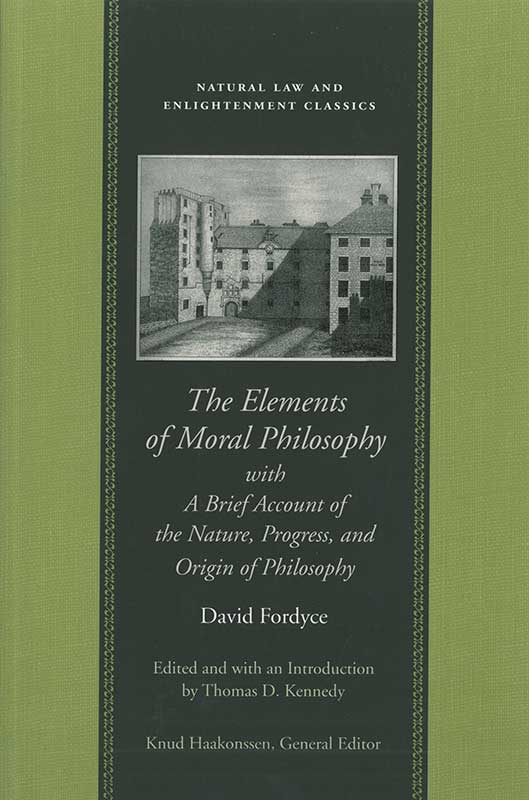
Conclusion - David Fordyce, The Elements of Moral Philosophy [1754]Edition used:The Elements of Moral Philosophy, in Three Books with a Brief Account of the Nature, Progress, and Origin of Philosophy, ed. Thomas Kennedy (Indianapolis: Liberty Fund, 2003).
About Liberty Fund:Liberty Fund, Inc. is a private, educational foundation established to encourage the study of the ideal of a society of free and responsible individuals. Copyright information:The copyright to this edition, in both print and electronic forms, is held by Liberty Fund, Inc. Fair use statement:This material is put online to further the educational goals of Liberty Fund, Inc. Unless otherwise stated in the Copyright Information section above, this material may be used freely for educational and academic purposes. It may not be used in any way for profit.
ConclusionRecapitulationWe have now considered the Constitution and Connections of Man, and deduced the several Duties resulting from both. We have investigated some of the Methods by which his Constitution may be preserved in a sound and healthful State, or restored to it. We have enquired into the FinalCauses of his Constitution, and found its admirable Harmony with his Situation. And, lastly, we have enumerated the principal Motives which inforce the Practice of the Duties, incumbent on a Creature so constituted, and so situated. ResultFrom this Deduction it appears, that “Man is a Creature endued with a Variety of Senses, Powers and Passions, subject to a Variety of Wants and Dangers, environed with many Natural, and capable of forming many CivilConnections; bound to many Duties in consequence of such a Nature, such a Situation, and such Connections, and susceptible of many Enjoyments in the Discharge of them.”—It farther appears, that “the Sum of those Duties may be reduced to such a Conduct of his Senses, Powers and Passions, as is duly proportioned to his Wants, to his Dangers, and to his Connections;—that this Conduct is most approved in the mean time, and yields the most refined and lasting Pleasures afterwards;—that particularly, the Exercise of the public Affections is attended with Enjoyments, the greatest in Dignity and Duration;—and in the largest Sum of such Pleasures and Enjoyments his highest Happiness consists. Therefore, to keep those refined Sources of Enjoyment always open, and, in cases of Competition, to sacrifice the Lower kinds, i.e. those of Sense and Appetite, to the Higher, i.e. to those of Reason, of Virtue and Piety, is not real Self-Denial, but the truest Wisdom and the justest Estimate of Happiness.—And to shut up the nobler Springs, or to sacrifice the higher to the lower kinds, is not Self-Indulgence, but the Height of Folly, and a wrong Calculation of Happiness.” The happiest YouthThereforeHe who, in his Youth, improves his Intellectual Powers in the Search of Truth and useful Knowledge; and refines and strengthens his Moral and Active Powers, by the Love of Virtue, for the Service of his Friends, his Country and Mankind; who is animated by true Glory, exalted by sacred Friendship for Social, and softened by virtuous Love for Domestic Life; who lays his Heart open to every other mild and generous Affection, and who, to all these adds a sober masculine Piety, equally remote from Superstition and Enthusiasm, that Man enjoys the most agreeable Youth; and lays in the richest Fund for the honourable Action, and happy Enjoyment of the succeeding Periods of Life. The happiest ManhoodHe who, in Manhood, keeps the Defensive and Private Passions under the wisest Restraint; who forms the most select and virtuous Friendships; who seeks after Fame, Wealth and Power in the Road of Truth and Virtue, and, if he cannot find them in that Road, generously despises them; who, in his private Character and Connections gives fullest Scope to the tender and manly Passions, and in his public Character and Connections serves his Country and Mankind, in the most upright and disinterested manner: who, in fine, enjoys the Goods of Life with the greatest Moderation, bears its Ills with the greatest Fortitude; and in those various Circumstances of Duty and Trial maintains and expresses an habitual and supreme Reverence and Love of God;ThatMan is the worthiest Character in this Stage of Life; passes through it with the highest Satisfaction and Dignity; and paves the Way to the most easy and honourable Old-age. The happiest Old-ageFinally, He who, in the Decline ofLife preserves himself most exempt from the Chagrins incident to that Period; cherishes the most equal and kind Affections; uses his Experience, Wisdom and Authority in the most fatherly and venerable manner; acts under a Sense of the Inspection, and with a View to the Approbation of his Maker; is daily aspiring after Immortality, and ripening apace for it; and having sustained his Part with Integrity and Consistency to the last, quits the Stage with a modest and graceful Triumph; This is the best, this is the happiestOld-man. The happiest LifeTherefore that whole Life of Youth, Manhood and Old-age which is spent after this manner, is the best and the happiestLife. The good Man“He, who has the strongest Original Propension to such Sentiments and Dispositions, has the best Natural Temper.” “He, who cultivates them with the greatest Care, is the most Virtuous Character.”The Virtuous, “He, who knows to indulge them in the most discreet and consistent manner, is the Wisest.”The Wise, the Fortunate Man “And He, who, with the largest Capacities, has the best Opportunities of indulging them, is the most Fortunate.” A Life according to Nature“To form our Life upon this Plan is to Follow Nature,” that is to say, “to act in a Conformity to our Original Constitution, and in a Subordination to the Eternal Order of Things. And, by acting in this manner, (so benevolently are we formed by our common Parent!) we effectually promote and secure our highest Interest.”Duty, Wisdom and Happiness are oneThus, at last it appears, (and who would not rejoice in so Divine a Constitution?) that “Duty, Wisdom and Happinesscoincide, and are one.” The Sum and Perfection of VirtueTo conclude: “Virtue is the highest Exercise and Improvement of Reason; the Integrity, the Harmony, and just Balance of Affection; the Health, Strength and Beauty of the Mind.” “The Perfection of Virtue is to give Reasonfree Scope; to obey the Authority of Conscience with Alacrity; to exercise the Defensive Passions with Fortitude; the Private with Temperance; the Public with Justice; and all of them with Prudence; that is, in a due Proportion to each other, and an entire Subserviency to a calm diffusiveBenevolence;—to adore and loveGod with a disinterested and unrivalledAffection; and to acquiesce in his Providence with a joyful Resignation.” “Every Approach to this Standard is an Approach to Perfection and Happiness. And every Deviation from it, a Deviation to Vice and Misery.” A noble and joyful CorollaryFrom this whole Review of HumanNature, the most divine and joyful of all Truths breaks upon us with full Evidence and Lustre; “That Man is liberally provided with Senses and Capacities for enjoying Happiness; furnished with Means for attaining it; taught by his Nature where it lies; prompted by his Passionswithin, and his Conditionwithout, powerfully to seek it; and, by the wise and benevolentOrder of Heaven, often conducted to the Welfare of the Particular, and always made subservient to the Good of the UniversalSystem.” F I N I S. A brief Account of the Nature, Progress, and Origin of Philosophy delivered by the late Mr. David Fordyce, P. P. Marish. Col: Abdn to his Scholars, before they begun their Philosophical course. Anno 1743/4. 1. Philosophy, a thing much talked of but little understood by the generality, is defined by Cicero the great interpreter of the Greecian Philosophy: The knowledge of things divine & humane.1 But the definition of it given by Pythagoras seems to express the nature with much more clearness & precisness. He calls Philosophy the knowledge of things which are of being, which have a real existence. Or still more distinctly, Philosophy may be described to be The Study & knowledge of the nature & laws of things, & their established connections with proper reasonings upon them. 2. The (to pan) Universe, or which system of things is independant on man, who is only a part; & perhaps a very inconsiderable one of the great whole. For the Supreme Being by whom the World was made has formed the natures & connections of things, & by laws adapted to the peculiar constitutions of his Creatures, & productive of the greatest good upon the whole, does wisely produce every change & event that happens in the Universe. The operation of the Deity by those laws or according to those settled rules, & the regular & uniform alterations of things produced by them, are named the Course or Phenomena of Nature or the providence of God. 3. The almighty God has placed upon this Earth a great variety of sensible & intellectual beings rising the one above the other in a beautiful state of perfection; yet on man alone has he bestowed senses & powers which fit him for examining the Nature & laws of the universe, with abilities to deduce from thence in some measure the knowledge of the Deity of nature, & his own obligations in duty. 4. But tho men have those superior powers they cannot attain to knowledge without labour & attention. We come into the world destitute of the knowledge of things, ignorant of ourselves & of our connections with those beings that surround us, & of the relation of things to each other. By slow degrees we receive our different perceptions or Ideas of things above us & learn by Experience what feelings we shall have in certain given circumstances, & what connections our Ideas have among themselves, & by what means alterations may be made in things without us or in the perceptions of ourselves & others; hence it is evident that setting aside sovreign instruction, true knowledge must be acquired by slow degrees from experience & observation, & that it will always be proportionate to the largeness & extent of our Experience. 5. The powers of our minds, tho noble of themselves & admirably fitted for our present state of probation, & this infancy of our existence are limited & narrow, & unable at one view to take in the whole August Drama of Nature or Providence which is presented to us & acted before us. For while we are intent upon one scene, an infinity of others skip & pass by us without being Observed, & of that to which we do attend many parts escape the notice of the most accurate Spectator. Was man therefore to owe his whole stock of knowledge to the gleanings of his own observation during this short period of his present life, his Acquisitions would be very inconsiderable; But to remedy this inconveniency the bountiful Author of our Nature has made us social creatures & by giving us power to communicate our Observations to one another, has enabled us to reap the benefit of the experience of others who have examined different parts of nature or perhaps the same part more accurately than ourselves. 6. The knowledge then of the nature, laws & connections of things is, as has been observed, Philosophy; and they who apply to the study of these, & from thence deduce rules for the conduct & improvement of human life, are Philosophers. They who consider things as they are or as they exist, & draw right conclusions from thence, are true Philosophers. But they who without regard to fact or nature indulge themselves in framing systems to which they afterwards reduce all appearances, are, notwithstanding their ingenuity & subtilty, to be reckoned only the corrupters & enemies of true learning. 7. From this short deduction concerning the nature of Philosophy, & the Origin of our knowledge, it will appear that in the early ages of the world, the beginnings of Philosophy have been very inconsiderable & its progress slow. For before Societies were constituted & arts & sciences invented & separated, the attention of the generality of mankind was turned upon procuring the necessaries of life. And their wandring & unsettled way of life before the establishment of States & politics was doubtless a very great Obstacle to the progress of knowledge which takes deepest root & spreads widest amidst Ease & Security. We may therefore expect to find the beginnings of Arts & Sciences in those places where the first Governments & societies were formed. 8. As the East Countries were first peopled & formed into Empires & Governments, Science took its rise in them, & spread from thence thro’ the rest of the world. Now the first & most Ancient kingdom seems to have been that of Egypt; for the joint testimony of all antiquity concurs in asserting that the neighbouring Nations borrowed from this Mother Land both their religion & philosophy; indeed we only grope in the dark about the high Egyptian antiquities as there are few or no monuments of Egyptian wisdom transmitted to us. The books ascribed to Hermes Trismegistis2 tho’ very antient are spurious. The way their Priests had of concealing their science & philosophy, not only in Characters unknown to the vulgar but likewise in Hieroglyphics or Sacred sculpture & other mysterious symbols which none understood but the priests, or those initiated by them, & their great shyness in admitting initiates to the mysteries, are among the principal reasons of our ignorance of the Egyptian learning. Diodorus3 informs us that their chief study lay in Geometry, Arithmetick & Astronomy; & indeed the situation, & circumstances of their Country which was Annually overflown by the Nile put them upon studying them, that they might the better ascertain & secure their property; And Arithmetic was not only necessary to assist them in their measurings & geometrical Problems, but was peculiarly necessary in the common practice & commerce of life, in so great & civilized a nation. Their Astronomy was chiefly adapted to the uses of Agriculture, & the settling their Calendar & Festivals. Politics & its inseparable attendant morals were likewise much studied here: their Architecture & the other elegant Arts of life, they seem to have carried to the utmost length, having exhibited the noblest specimens of Symmetry & grandeur in their publick works. They were likewise the first who collected Libraries, those treasures of Science, which they called The store house of the remedies of the soul. 9. Next to the Egyptians, the Assyrians, Persians & Indians are recorded for the wisdom of their Magi & Brachmans of whose principles we have but a very lame account left us. The Assyrians are reckoned among the first who applied to Letters; & the first imperial School was at Babylon, which continued till Nebuchadnezar the great & Daniel’s time. The Chaldaeans were reckoned their wise men, who were also called their Magi. Daniel was set over their Colleges & Accademies by the King; whence ’tis probable that they applied to studies of a legitimate kind, & to natural knowledge as well as to Astrology & other insignificant Arts. They were celebrated chiefly for their Skill in Geneaology & Astronomy. Pythagoras went among them to learn the motion of the Stars & the origin of the World on the two principal heads of natural Philosophy, viz. (Κοσμοσυσασις & Κοσμογονια or) the Constitution & generation of things. They thought that the matter of the world was eternal, but that it had the form & order from the divine providence. They ascribed the invention of their Philosophy to Zoroaster who reduced it to a System. The Persians did the same, whose Magi or wise men presided over the education of the royal Children. They studied philosophy, divinity & politics, & taught the period & renovation of the world. They believed that the elements & Stars of heaven were Gods, of whom they chiefly adored the Fire & Sun; & by the name of Jupiter understood the whole circumference of the heavens. The Indian Brachmans or Gymnosophists affected a solitary way of life, & underwent great Austerity. They taught a future state, & inculcated the offices of Justice & Virtue. Besides their morals, they applied to Physiology & Astronomy, & believed the formation of our World from water, but of the Universe from other principles; The Soul’s incorruptibility and the (palingenesia or) regeneration of all things. In a word all the ancient kingdoms boasted of their learned men. The Phenicians had their Sanhuniathon4 & were celebrated as the first who invented or at least introduced letters & Characters under Cadmus into Greece. They were likewise famous for their skill in Astronomy, Navigation, Arithmetic, Mechanics, & the other Arts of a civilized life; to which indeed their extensive commerce with the rest of the World did in a manner entitle them. The Chinese were celebrated for their skill in Religion, Politics & Morals, which they principally owed to their great Confucius. Even the barbarous northern nations, the Germans, Britons & the ancient Celts had their learned Druids & Bards whose knowledge was chiefly traditionary, (or patroparodotoc) for we do not hear that they committed any thing to writing, which is the reason why we know so little about their Philosophy or Maxims. 10. But leaving those things which are buried in obscurity we proceed to Greece, that favourite Country, where Arts & Sciences made quickest progress & arrived at their greatest perfection. And here we may trace the greek learning from its Original having proper records to depend on. These inform us that Greece was form’d with Colonies from Egypt and the other Eastern Nations, who we may believe carried the Religion & Arts of their Parent Country along with them; And indeed the learning of Ancient Greece wore the strongest Features of Resemblance to the Egyptian, consisting chiefly in Fables & Allegories, short but pithy sentences & dark Enigma’s. 11. The Poets Orpheus, Linus, & Hesiod are amongst the earliest Philosophers of Greece, for the Philosophic, Poetic, & often legislative characters were joined in the same persons; there being as yet no separation of the Sciences. The subjects which those old Poets sung required a considerable acquaintance with nature being the (θεαγονια or) Birth of the Gods or the generation of things. Hesiod5 whose (θεαγονια) Birth of the Gods has been preserved to our day, has interwoven with his poems many moral reflections & precepts which show him well acquainted with morals & life. Orpheus employed musick or numbers & verse, to humanize & soften the minds of his rude & savage Co-temporaries, & to insinuate his moral precepts with a more persuasive & irresistable charm. In a word all the greek Poets of note seem to have made no inconsiderable progress in Philosophy. And indeed if we consider: as an Imitator of Nature every Poet must be a Philosopher, for how can one copy what he knows not or imitate it? 12. The first who made it their business to instruct their Country men, & upon that account were dignifyed with the name of (Σοφοι or) Wise men, were the Seven famous Contemporaries, commonly called the seven wise men of Greece, viz. Thales of Miletus, Pittacus of Mytellene, Bias of Pryene, Solon of Athens, Cleobulus of Lindus, Miso of Lycaonia, & Chylo of Lacedemon. They flourished betwixt the 40th and 50th Olympiad 〈620–580 b.c.〉, & excepting Thales were all legislators in their respective States. The credit of Solon was much increas’d by a remarkable instance of his modesty, which happened on the following occasion. Some young men of Ionia bought a draught of the Milesian fishermen; when the net was drawn, there was found in it a golden Tripod of great value; hereupon there arose a dispute & the Oracle of Delphi was consulted, which returned this answer, That it should be given to the wisest. The Milesians presented it to Thales, he sent it to Bias, he again to Pittacus, & so going thro’ all the seven, it came at last to Solon, who affirming the Deity to be the wisest, consecrated the Tripod to Apollo. The knowledge of the (σοφοι) wise men was communicated in short sentences or Apothegms, several of which are transmitted to us by ancient writers, such as (γνω;θι σεαυτον) know thyself. They who have a mind to know more particulars about the early Sages may consult Diogenes Laertius & Plutarch.6 13. Thales was the founder of the Ionic Sect or School, as it was called, & flourished 500 years after the taking of Troy. He was one of the first Philosophers who travelled for the improvement of knowledge of Men & things, & who treated of nature simply without the disguise of Fable or shadowings of Allegory. He taught the immortality of the Soul, marked the solstices & Equinoxes, inscribed Triangles in Circles, & foretold the Eclipses of the Sun. He thought water the first principle of all things. And Anaxagoras his follower set a Mind over this fluid mass, & explained the digestion of this mass into order by the sole power of Gravity. The Ionic Philosophers thought that the Celestial Regions consisted of a thing subtile, or fluid; that the Planets were opaque bodies & the fixed stars firey. Nor were they ignorant of the earth’s motion. After Thales philosophy became a profession, & was taught by Anaximander & Pythagoras & his disciples. The latter was the founder of the Italic School, heard Thales, & Phericydes & flourished about the 60th Olympiad 〈540–536 b.c.〉, that is, the 6th or 7th Century before Christ. He, to wit Pythagoras, travelled likewise in search of knowledge thro’ Egypt, Chaldea & Phenicia; he spent 22 years among the Egyptian Priests, visited the Oracles of Delphi, Delos & Crete, was initiated into all the mysteries of the Barbarians, as well as Greecians, & instructed in the whole learning of the East. He left Samos, & went to the south of Italy, called at that time Magna Greecia, now the kingdom of Naples, & set up a School at Crotona about the 62d Olympiad 〈532 b.c.〉. Pythagoras formed his Philosophy on the Egyptian plan, which he delivered chiefly in numbers & numerical Symbols; for he reckoned numbers the Causes & principles of things, & accordingly held the number four (τετραχις) in great veneration, which some explain of the Jewish (τετραγραμματον or) the name Jehovah. It was not till after five years silence in a great variety of preparation in previous trials that his Scholars were admitted to the full knowledge of his Doctrine. He made great improvements in Geometry, Arithmetic & Music, & applied proportion of numbers & harmony to every thing, or at least made them his ordinary Symbols. He invented the 47th Proposition of Euclid’s first Book, & is said to have offered an Hecatomb on that account. He was so modest 〈he refused〉 the Appellation of (σοφος) Wise, & assumed that humble one of (φιλοσοφος) a lover of Wisdom. He divided Philosophy into theoretical & practical: the end of the first is truth and to wonder at nothing, & that of the other Virtue & the liberty of the Soul, which he reckoned confined in the body as in a prison. His doctrine of the Transmigration of Souls is well known. To promote the enlargement or disengagement of the mind, he prescribed a very spare diet; forbade the eating of flesh, or killing of animals either for food or sacrifice; he himself lived on honey, bread, herbs & water. His direction to enquire into the actions of the day every evening is justly celebrated. He observed so much Order design & proportion in the structure of the Universe, that he gave it the name (Κοσμος) Order. He wrote several books which are all lost. The golden verses of Pythagoras, tho they contain the sum of the Pythagorean Doctrine, were not wrote by him but by Epicharmus or Empedocles. Pythagoras thought the Earth moveable & placed the Sun in the Center, which from him is called the Pythagorean System; he placed the Comets without Air & set them among the planets, & reckoned that the heavens were fluid & oetherial, & that the stars were so many worlds. You will find more particulars concerning Pythagoras & his Doctrine related by Diogenes Laertius, Iamblicus & Porphery, who have wrote his Life, & intermixed with it many ridiculous Stories. Of the Italic School were Architus Tarentinus, Ocellus, Lucanus, Epicharmus, Empedocles, Timaeus Locrus, and a great many Others. 14. To Thales in the Ionic School succeeded Anaximander a Milesian, who invented Gnomic’s or Dialing,7 & observed the obliquity of the Zodiac & likewise observed Equinoxes. To him again succeeded Anaximenes who held that Air was the first principle of all things. After him came Anaxagoras, who tho’ born to a great Fortune, left all to apply to Philosophy. In the 20th year of his Age, the first of the 75th Olympiad 〈480 b.c.〉, he went to Athens, where he continued 30 years, & for his great wisdom got the name of (Nouc) or Mind. He was banished from Athens in the 3d year of the 82d Olympiad 〈450 b.c.〉, & retiring to Lampsachon spent the rest of his days there. Archilaus was the Scholar of Anaxagoras, master of Socrates the celebrated Athenian Philosopher. About the time of Anaximander & Archilaus flourished Xenophanes the Colophonian the founder of the Eleatic Sect, which was a miscellaneous School consisting of philosophers differing in Nation, Opinions & Manners. Xenophanes thought there were innumerable worlds, infinite Suns, & Moons eternal & unchangeable. Parmenides, one of this Sect admitted an Origin of things, & that from Fire & Earth as Elements. Herein he agreed with Archilaus; for the Eliatics differ little from the Ionics about the origin of things, if they admitted any. For some of them took away all motion, without which there can be neither generation nor corruption. Some include Leusippus & Democrates in this Sect who brought in the hypothesis of Atoms, & with that a sounder way of Philosophizing by considering the State, motion, figure, situation & bulk of bodies, estimating their powers & explaining their effects from thence, not seeking as the Italic & other Philosophers, the principles of bodies & their power among numbers, proportions, ideas & the like. Leusippus owned the earths motion about its Axis & was followed by Democrates in physics, who conversed with the Magi, the Chaldean Priests & Arabians. The Attention of the Ionics from Thales’s time, had been almost wholly employed in natural Philosophy or Physics, in which very small progress was made, for a reason to be mentioned afterwards. It was SOCRATES that gave the proper turn to learning, & therefore is justly reckoned the Father of true Philosophy. 15. SOCRATES was born at Athens in the 77th Olympiad 〈472–469 b.c.〉, his father was Sophroniscus a statuary, & his mother Phaenoreta, a midwife. He followed for some time his father’s profession, but soon discovered such a genius and love for learning that CRITO, a rich Athenian, took him from the shop & gave him a liberal Education. Having observed of how little advantage the Philosophy then in repute was in life, Socrates, as Cicero expresses it, recalled Philosophy from the hidden & Obscure subjects about which his Predecessors had busied themselves & brought it down to common Life, to enquire into Good & Evil, Virtue & Vice & their Consequences. Hence, he is said to have fetcht Philosophy from the heavens, & to have introduced it into Cities houses & families. Man was the subject of his Philosophy, & its scope was to make men wiser, better & fitter for social & private life by inculcating the duties of Religion & Virtue. His method of teaching was remarkable, being admirably adapted to human nature. It was by asking Questions, beginning at the most plain & simple & proceeding from the answers given to others of a higher, more general & abstracted nature; he himself all the while affirming nothing. His method was founded upon the belief he had of the pre-existence of Souls, whose former knowledge was lost by being immersed in the body, & brought to remembrance again by instruction, or the method of interrogation. On this account he humourously used to say that his Art had some Affinity to his Mothers; for tho barren himself he assisted in bringing forth the Births of Others, or educing those latent principles of knowledge with which the mind of man was originally stored. His modesty was so great that he constantly said that he knew nothing save only that he knew nothing; & was for this saying honoured with the title of the wisest man by the Oracle of Apollo. We are not however to conclude from this that Socrates was a Sceptic; he seems only to have had a just Sense of the weakness of human Understanding, to have shunned determining in speculative points, & thought the great end of Philosophy was to enforce with proper inducements the practice of Virtue. He saw through the absurdity of the popular religion & thought that God made the world, knew all things & governed the Universe by his providence. He taught the immortality of the Soul & supported that doctrine by a variety of arguments, & besides inculcated a future state of rewards for the good & punishments for the wicked, & in a word he made such improvements in moral Philosophy that he seemed to have been the first that had just notions of the nature of man & his duty. In order to lay the deeper foundations for a genuine Philosophy, he endeavoured to remove the rubbish that lay in his way, those false opinions, inveterate prejudices, & high pretensions to wisdom which overrun Greece at that time. For this purpose, by his interrogatory method of reasoning, from him called the Socratic way, & likewise by a delicate & refined Irony, he exposed the Sophists, those high pretenders to wisdom who, without any real knowledge, pretended to know every thing & who professed to teach the Art of Speaking for & against every thing, a Race of men who then pestered the several Cities of Greece, & took upon them the care & education of the youth. In so ridiculous a light did he place them by his well timed & artful railery, & so thoroughly did he confute the sham pretensions of those Quacks & smatterers in learning that they concerted a design to bring about his ruin. Aristophanes the Comedian at their instigation introduced him upon the Stage, & by dressing him up in a false & unnatural Character made this great man, who with a patience truly philosophical was a Spectator of the play, ridiculous to the people.8 At last one Miletus accused him before the Senate of despising the Gods whom the city believd, & introducing new deities, and of corrupting the youth by his Philosophy; to the lasting reproach of his Judges this extraordinary & virtuous person was condemned to Death. The day before the execution of this sentence he reasoned with his friends concerning the immortality of the Soul, & expressed a particular pleasure in the hopes of meeting with Homer, Hesiod & other great men, who had died before him. In the evening the executioner brought him a Cup of poison, which with a chearful & undaunted mind he drunk of, & soon after expired in the 1st year of the 95th Olympiad 〈400 b.c.〉. The Athenians were soon so much ashamed of this infamous deed that they put his Accusers to death. Tis generally thought that Socrates wrote nothing. We have a full account of his life & Philosophy in the writings of his Scholars, Xenophon, Aeschines & Plato. In the memorable things of Socrates wrote by Xenophon we have the best account of his reasoning, & likewise in the dialogues of Aeschines; for Plato in his dialogues has intermixt a great many of his own 〈ideas〉 which Socrates never taught, & has likewise adorned them with a profounder erudition, & more laboured & florid eloquence than Socrates used in his common conversation. Among his Schollars were Xenophon, Aeschines, Plato, Aristippus, Phaedo, Euclid of Megara, Cebes & many others. 16. Xenophon & Aeschines both Athenians were particular favourites of Socrates & committed his conversations in that simple & familiar way & manner in which Socrates talked & debated, some of which have happily reached our times. Xenophon was the son of Gyrgilles & was born about the 82d Olympiad 〈452 b.c.〉.9 He was in the Peloponnesian war along with Socrates & ever after followed a military life. He attended Cyrus the younger in his expedition into Asia against Artaxerxes the King of Persia; & is justly celebrated for that amazing instance of his wisdom & Valour, the conducting the extraordinary retreat of the Greeks after the defeat of Cyrus. He died at Corinth about the 105th Olympiad 〈360 b.c.〉. His books are reckoned among the purest of the Greek Classics, & discover him to have been a fine Gentleman, an able Captain & a great Scholar. Cebes of Thebes, another of Socrates’s Scholars, wrote several Dialogues one of which viz. The Tablature or Picture, that admirable draught of human life, has escaped the injury of time.10 17. Aristippus of Cyrene, a Scholar of Socrates but differing widely from the practice of his Master, founded the Cyrenaic Sect; they entirely rejected Virtue as a principle of Action, amiable in itself, & said that Justice & Honesty were only the institution of men. They made pleasure the ultimate end of all their actions, & Virtue had no farther place in their System than it was thought expedient or necessary to produce pleasure. This Sect was also called Hedonic, from the name (Ἥδονη) or Pleasure, & was divided into a great many Branches, one of which, called Theodorians from Theodorus their head, made profession of downright Atheism. Phaedo the Elian & Euclid of Megara were two other Scholars of Socrates. The first was the Author of the Eliac, & the last of the Megaric Sect. Tho’ we have no remains of the Eliac philosophy, yet we have reason to believe it differed very little from the Socratic. The Megaric Sect applied themselves mostly to the study of Logic & from thence were named (Dialektikon or) Reasoners or Logicians. 18. Antisthenes another Scholar of Socrates founded the Sect of the Cynics & had the famous Diogenes for his Scholar. They had learned from Socrates that morality was the usefullest of all Sciences, & from this they concluded absurdly enough that all other arts & sciences were to be despised. Their foundamental Maxim was to live in conformity to virtue, which they said was sufficient to make men happy. They sought Liberty & Independency as the greatest Good. The Gods, said they, stand in need of nothing & those that stand in need of few things do most resemble them. To procure this happy independency they pretended to look upon honour & Riches with perfect indifferency, & to renounce all the inconveniencies of Life. Diogenes would have no other habitation than a Tub, & when he found that he could drink out of the hollow of his hand, he threw away his wooden cup as a superfluity. Alexander the Great, coming to visit Diogenes in his Tub, asked him what he desired of him. “Nothing,” said the Philosopher, “but that you would not stand between me & the Sun.” The Cynics under pretence of following nature & living independently observed no decency in their conduct, & treated all the world with the utmost Contempt. The Stoicks shot out as a Branch from this Sect, who, from an Enthusiasm of temper pushed their Philosophy beyond the bounds of Nature, & placed Virtue in a total exemption from passion, or at least from the smallest degree of perturbation of Mind. So that they alledged their virtuous man was happy in evry state & circumstance of Life. (Liber, honouratus, pulcher, Rex denique Regum.)11 We have several noble relicks of the Stoical philosophy transmitted down to us from ancient times, in which we find the noblest precepts for the conduct of life & particularly for attaining that tranquility of mind & indifference about external things, without some degrees of which no man can be tollerably happy in this mixed uncertain & complicated scene of things. The Stoics however were more celebrated for their morals than for their Physics. They believed the conflagration of the world, called God the artificer of all things (the λογον δημιουρχον και τεχνικον) under whom they placed passive Matter. They distinguished between (σοιχεια)12 Elements & (αρχαι) Principles, reckoning the latter ungenerated, uncorporeal & uncompounded. By the former perhaps they understood the simple unformed (χυλη) Mass, & distinguished it from Body. They believed that a Fire was the first of Bodies which were made, & the rest of the Elements of it & of both all kind of mixed bodies, which, they said, were again resolved into fire. They called the Sun (πυρ ειλικρινης) Pure Fire, the Moon, (γεωδεσερα) of an earthly matter, & the Stars (πυρινα) of a firey nature, & likewise that some of them were higher than others in which they are supported by the modern Philosophy. Their Fate signified the unchangeable & immoveable order & series of things by which the Gods themselves were governed in their productions of things. 19. Of all the Scholars of Socrates, Plato made the greatest figure. He was born at Athens in the 88th Olympiad 〈428 b.c.〉. After he had heard & studied under Socrates he travelled into Egypt & Italy, & returning to Athens he taught Philosophy in the Accademy, the Gymnasium or place of exercise in the suburbs of the City, environed with woods & adorned with beautiful walks named from Accademus a private Gentleman to whom it first belonged. Inter Sylvas Accademi quarere Verum.13 Hence his followers got the name of Accademics. The Philosophy which he taught was a compound of the Socratic & Pythagoric Doctrines, & was chiefly divided into these three parts: Ethics, Physics & Dialectics. The knowledge of the platonic Philosophy is to be got from the works of its Author, which are justly held in the greatest esteem. He wrote in the way of Dialogues, in which Socrates makes one of the principal speakers, & generally confutes the bombast or subtle sophists by the depths of his Socratic reasoning, joined with an exquisite strain of raillery. His Books (De republica & Legibus) of the Commonwealth & the Laws, show him to have been an able Politician & deep Scholar. The Platonics did (as the Pythagoreans) apply more to the contemplation of Ratios & abstract proportions than of matter & its properties. We have a sketch of Plato’s Philosophy in his Timaeus. He assigned geometrical figures to the Elements, & compounds & places them geometrically. He makes three principles of all things, the (Νους) Deity, (Χυλη) Matter, & his (Ιδεα) Idea or exemplary cause, or rather his proportion & ideas. Many traces of the old learning & the Ancient world are to be found in his Timaeus, his Politicus & Phaedo, which he brought from Egypt & the pillar of Hermes. His genius in Theology & morality was by the ancients esteemed divine. 20. Arcesilaus one of the successors of Plato about the time of the 107th Olympiad 〈352 b.c.〉 founded the Middle Accademy. His way was to doubt of every thing in arguing for and against all manner of questions. He went a great deal farther than Socrates in Sceptical Philosophy, & said that he could not be certain even of this, that he knew nothing. Carneades did afterwards soften this Scepticism a little by allowing that there was no truth which did not admit of some belief, yet there were such degrees of probability as were sufficient to determine men. This was the new or third Accademy. Carneades was sent from Athens in company with Diogenes the Cynic & Critolaus the peripatetic on an Embassy to Rome about the 599th year after the building of the City. He & the other two taught in different places of the City, & were resorted to by the Roman Youth, who drank in their Philosophy with the utmost avidity, which made Old Cato the Censor move in the Senate to dispatch them as soon as possible, lest the Roman Youth who he said were grown enthusiastically mad after Greecian Arts & learning should be diverted from a military Life to the study of Philosophy. 21. Aristotle the most famous of Plato’s Scholars was born at Stagiola,14 a City of Thrace in the first year of the 99th Olympiad 〈384 b.c.〉. When he was 17 years of Age he came to Athens, where he soon distinguished himself & became a favourite disciple of Plato. In the 4th year of the 109th Olympiad 〈341 b.c.〉 at the request of King Philip he went into Macedonia and became Tutor to Alexander the great, not only in Ethics & Politics but in all the other Sciences. In the first year of the 111th Olympiad 〈336 b.c.〉 Philip dyd & Aristotle returned to Athens where he taught in the Lycaeum, (a place in the suburbs built by Pericles for exercising the Citizens in) walking up & down therein. Hence he & his schollars got the name of Peripatetics (or Walkers). He was the first who reduced the scattered precepts of Philosophy into a System & left Treatises wrote professedly on Logic, Metaphysics, Ethics & Physics. All which shew a Judgment & accuteness of penetration superior to most men. He wrote on Rhetoric, Poetry & natural History & other Subjects. In the two former treatises he discovers a great insight in the human nature & large acquaintance with fine writing. And indeed he is universally acknowledged to have been a very comprehensive & extraordinary Genius. The grand principle of his Ethics is, that every Virtue consists in the Mean or Middle between two extremes both of which are Vicious. The Peripatetic principles may be gathered from Aristotle’s writings & are well explained by Cicero in so far as they differ from the Stoical principles. To Aristotle in the peripatetic School succeeded Theophrastus, Strato, Lycon, Aristo, Critolaus, Diodorus &c. The Aristotelians believed the world to be eternal as well as to its form as to its matter; & all the creatures in it begitting & begotten in an infinite series with all its plants & various furniture. Aristotle thought the heavens were of Adamant & the Stars fixed like golden Nails in the roofs of their orbits & these Orbs chained together, & All the whole world rolled about in 24 hours time; that the planets were carried about by contrary motions, that the matter of the heavens is quite different from all other & immutable into any other. He introduced his Substantial forms & specific Qualities to explain the Actions & forces of Bodies. He said that sensation was performed by an intentional species, that Providence descended not below the Moon, that the Soul was the Εντελεχεια, a Cant word that signified nothing; he was uncertain of the immortality of the Soul. 22. Epicurus the author of another Sect named Epicureans was born in the 3d year of the 109th Olympiad 〈341 b.c.〉. He began very early to read Philosophy particularly the writings of Democritus, from whence he chiefly borrowed his Physics. Having purchased a pleasant Garden at Athens, he lived there with his friends & disciples, & taught Philosophy. He ascertained that the world was formed by a fortuitous concourse of Atoms falling & clashing one with another in infinite directions thro’ an immense void, without the interposition of an intelligent principle. Tho’ he allowed the existence of the Gods, yet he said they took no care or concern about the world or its affairs, but lived at a great distance in immortal Peace & in inglorious indolence, & by this means subverted the foundations of all religion which is built upon a sense of our Connection with God & dependance upon him, as the Almighty Maker & Governor of the World. He affirmed that Pleasure was the chief end of all our Actions & the Chief Good, & that Virtue was no farther to be followed than as it produces & tends to pleasure. But they are much mistaken, who think that Epicurus gave himself up to all manner of Debauchery; On the contrary he recommended Temperance & the other Virtues as conducive to true happiness. Yet some of his followers made a very bad use of his Doctrine, indulging themselves in the greatest sensuality, & having no notion of moral happiness. The School in the Garden was continued till the days of Augustus under the successive management of Hermochus, Polystratus, Dyonisius, Basilides &c. Epicurus made Sense the supreme Standard by which we judge of truth, said the Sun was no bigger than a foot & a half, & that the Earth was rooted to an infinite extent downward. We have a large Account of the Epicurean Doctrine in Diogenes Laertius & Cicero & Lucretius Carus an elegant Latin Poet has given us a compleat System of his Philosophy (of which he was a professed Admirer) in his poem (De rerum natura) of the nature of things. Epicurus died in the second year of the 127th Olympiad 〈270 b.c.〉. 23. Zeno, contemporary with Epicurus, founded the Stoical Sect directly opposite to the principles of Epicurus. He was at first Scholar to Crates the Cynic, then to Stilpo the Megaric & afterwards heard Diodorus, Cronus and Polemon. He set up a School in the (ποικαλη σοα)15 Painted Walk at Athens, & thence, his Disciples got the name of Stoics. The most Considerable part of the Stoical Philosophy was their Morality whose fundamental Principles were, That Virtue was the alone good & Vice the only Ill; that pleasure was not good nor pain evil; that the passions were preternatural perturbations entirely to be rooted out; that men were not born for themselves but for their Country & Society, & that the whole of mans duty was to live according to Nature. The (Απαθια or) entire freedom from the passions of human nature was certainly impossible to be attained & perhaps was more than the Stoics meant when they recommended the mastery over our appetites & passions. For they seem to have taken our passions in too limited a sense for mental disorders or such violent impulses & propensities of Soul as are inconsistent with the exercise of reason & destructive of it; & in this sense, no doubt they are carefully to be subdued. But both Zeno & Epicurus seem to have erred in not considering the whole of Mans Nature; For Epicurus viewed him only as a sensible Being capable of pleasure & pain; whereas Zeno regarded only the moral part of his Constitution. The peripatetic Philosophers seem to have had juster notions of the matter when they considered Man as a Creature formed for the enjoyment both of Natural & moral good, that is, As a Sensible & Moral Being; & said that the passions were implanted in his nature for valuable purposes, & therefore were not to be extirpated but governed by his Reason. The Stoicks imagined the World (or το παν) to be an Animal whereof God was the soul. They maintained a Fate or Destiny to which Gods & men were equally subjected. They cultivated Dialecticks, but made little progress in Physics. In short they were a natural Shoute 〈shoot〉 from the Cynics, only they refined upon & carried their Philosophy to a higher pitch. To Zeno in the Stoical School succeeded Cleanthus, Chrysippus, Diogenes, Antipater, Panatius & Posidonius. 24. Among the Old Greek Philosophers of note were Parmenides, Leusippus, Democritus & Heraclitus, who all, especially the two last, improved the corpuscular Physics which Epicurus perfected. Pyrrho, contemporary with Aristotle, having read the books of Democritus & having heard various Philosophers, gave rise to another Sect called Sceptics, Pyrronistics and sometimes Zetetics. They held nothing certain, doubting every thing, & said nothing was to be understood or comprehended. As Absurd as these principles were Pyrrho had his admirers & followers, such were Simon,16 Hecataeus, Eurylochus & Sextus Empyricus; nay we find still that he has likewise his Admirers in Modern times who carry his Philosophy to as extravagant a Pitch as the evil of man can devise or his Fancy wish. 25. Among this variety of different Sects of Philosophers it is reasonable to believe their several Systems were neither wholly true nor wholly false. Polemo of Alexandria did therefore in the reign of Augustus introduce the Eclektic Philosophy. They who embraced this method espoused none of the Systems in the Gross but took such doctrines from each as seemed most reasonable, every man judging for himself, & allowing the same liberty to others. Having now pointed out the principal Stages & periods of Philosophy among the Greecians, it remains just to touch at the Barbarian Philosophy & its Origen. The opinions of those whom the Greeks entitled Barbarians were delivered mostly without proof or reasoning & received because of the Authority of the Teacher, or the reasons are too weak & insufficient to convince. We have an instance of this in the Conflagration of the world, whose Causes & process they neither explain, nor attempted to prove its truth. The same thing may be said with regard to the periods of the World, the pre-existence & revolution of Souls. The Ancient Philosophy never laboured about Theories or the demonstration of things from their Causes or Effects, which the modern has attempted not without Success; But theirs was short & easy by way of Questions & Answers, so that it plainly appears to have been propagated by Tradition. Some derive it from the Hebrews, from Moses & Abraham; But the former himself was a Disciple of the Egyptians so that the Egyptian learning was before him. And as to the Arabian, Job who was a renowned & learned Arabian, is reckoned elder than Moses for several reasons, 1st Because that pious Man counteracted the law of Moses in offering Sacrifices for himself, after the examples of Noah & others before the Law. 2d Because there is no mention made of Moses or his exploits in his Book. 3d From the measure of his life which ought to be placed about the third age after the Deluge, for he lived about 200 years. Besides his history seems to savour of great Antiquity. He Mentions the first kind of Idolatry, that of the Sun & Moon. He speaks of Sculpture the most ancient kind of writing, when he talks of recording his Calamities; His wealth is counted by his Flocks; he mentions no Sabbath or instituted Law, & followed the precepts of Noah. Josephus derives learning from Abraham, but without proof from Sacred or prophane History. Besides ’tis improbable that he shoude instruct the Egyptians in the space of the two years he lived among them. Therefore it is more probable that the Sciences derived their Origin from a higher Source, even Noah, the common parent of the Jews & Nations. He is said to have delivered moral precepts to his descendants, called the precepts of the Noachides, & therefore why not Opinions & Doctrines also? In short it is highly probable that he knew the greatest part of the wisdom of the long lived Antidiluvian Patriarchs since he had 600 years commerce with them, & Consequently that from him as from the fountain head were derived those streams of ancient learning which flowed through the Old world, of which only some small drops have descended to us. 26. There is a Contest betwixt the Egyptians & Hebrews about their precedency & antiquity in learning. That none of the Philosophers travelled among the latter to gather knowledge is a plain evidence that they were not renowned for Letters. We do not read that they excelled in natural or mathematical knowledge, tho Solomon certainly was an eminent Naturalist. Their Schools were formed for Religion & Prophecy rather than for the Sciences. No nation did ever abound so much in prophets & inspired men. So that a divine virtue seems to have been peculiar to their Soil & Climate. They pretended to have preserved among them from the beginning a Cabala or secret Science containing the mysteries of the natural & invisible world; But two things are wanting in this Science, first the establishing & aggreeing upon certain common principles, Secondly, their ascertaining the Use & Signification of words. And indeed this boasted Science of theirs seems to have been a mysterious Gibberish or an obscure Phraseology rather than the knowledge of things. As to their four worlds of Emanation, Creation, Formation & Fabrication, we know little of them, & their explications of them are themselves inexplicable. Their ancient Cabbala might have some foundation, however deformed & vitiated by the moderns, & perhaps treated of the Origin & Gradations of things, or the scale of beings; But being traditionary it came soon to be lost & so the modern Doctors or Rabbies in order to fill up this Void, & to maintain an imaginary Character of ancient Learning threw in their multiplied fictions till at length it grew up or swelled into the enormous size of the present Cabbala. The Cabbalists thought that Gods or their Ensoph contained all things within himself at first, & only evolved or unfolded himself when the World was made, & that it perishes again by its reflux or resolution into the Divinity. (The opinion of the Stoicks was too gross, for they restricted every thing to matter, & understood by Jupiter the Simple Ether, into which they thought the whole world would be finally resolved, & then after a state of time would reassume its primitive form & appearance.) The Essenes an ancient Sect among the Jews resembled the Brachmans in their manners & studies; their Life was most simple & primitive & they applied themselves to the study of the divine nature & the Origin of things. 27. ’Tis thought by Sir Isaac Newton17 that learning flourished early in Arabia or at least in Idumaea a Country of it. Learning flourished there from the time of Job to the Age of Solomon if the Queen of Sheba was of Arabia, as is highly probable. Job was a renowned Sage among the Arabs, & had a great knowledge of nature as is evident from his book which is the first & Oldest monument of Arabic wisdom. In it are many Arabisms to be found. ’Tis probable the Magi or Wise men of the East who came to adore our Saviour at his birth were of Arabia, because the presents they brought were only of an Arabian growth, & because the East is commonly used in Scripture to signify Arabia. The Zabii or Zabaisti18 (the same with the Sabaeans & their Priests) were famous among the Arabians, & were a very ancient nation: The Jews say that Abraham was educated in their Religion at first, but that after he worshipped the true God he left them & inveighed against their Doctrines. Maimonides will have Moses to have chiefly regarded their Rites & manners in forming his Laws. Their Magi were of long Continuance & vaunt themselves to be Noachides or followers of Noah, however they worship the Sun, Moon & Native Genii or Daemones. Job seems to allude hereto when he vindicates himself from the worship of the Sun & Moon, Chap 31. Vers 26. 27. He & his friends were genuine Noachides; but the Zabians & other Arabs were degenerate ones. Both sorts however retain some of the Doctrines of the Noachides which were the Roots of Oriental learning. Pythagoras & Democritus visited them. We have little account of them for the first Ages after Christ, till in the Sixth Century with the rise of Ishmaelism or the Law of Mahomet learning began also to revive among them. For the Arabians or the Sarracens penetrating into the West & making Conquests in Europe with their Arms raised a new Empire to themselves, & by degrees imbibed the Greecian & European Philosophy. As the Aristotelian or Peripatetick Philosophy prevailed chiefly at that time, they embraced it, & propagated it afterwards with great industry & noise. Their learned men, particularly Avicenna & Averroes19 translated the works of Aristotle & gathered all the Greecian Authors they could find, insomuch that they alone seemed to possess them. As to the Sarracens at the taking of Alexandria, the great & celebrated Library, that vast collection of Ancient learning which had been collected by the Kings of Egypt for many Ages, was, by their barbarous & brutal Emperour at the instigation of his Chief Priest, ordered to be burned, & used as fewel to warm the hot baths. After the times of Mahomet the Arabian learning degenerated into Fable & Allegory. 28. When the Romans extended their Empire over Greece they became acquainted with the learning & Philosophy of that Country. They had indeed got some taste of Greecian workmanship & politeness before, by the taking of Syracuse, which was originally a Greecian City, & therefore Old Cato complains that hostile statues had been introduced into the Town from Syracuse. But those Greecian pieces of Virtuosoship were rather laid up as rarities to be gazed at, or as piles to adorn their Temples. But the Greecian learning & politic Arts scarce made any Advances till the Thousand Achaian Exiles arrived at Rome & were dispersed up & down the Country.20 They scattered the first seeds of Philosophy in that Soil which had been formerly possessed by Arms & overrun with the din of War. That Soil however being strong & fertile did, by a happy Culture & greater intercourse with Greecian Wits, bring forth a rich crop of Philosophers, Historians, Poets & Orators. As Philosophers of all Sects began to teach there, the young Romans commenced Partizans of this or the other Sect as best suited their taste & Genius. So that Among the Romans we find the learned Men widely differing in their Philosophy. Cicero the Orator, who contributed more than any other to make his countrymen acquainted with the Greek Philosophy, as is evident from his Philosophical works, was a New Academic, & in some things an Eclectic. Cato of Utica & Brutus who killed Caesar were Stoics; Lucullus was an Old Academic; Atticus & Velleius were Epicureans; Seneca the praeceptor of Nero was a strict Stoic, as was also the famous philosophical Emperor Marcus Antoninus, who was both the highest pattern of virtue & the greatest Master as well as Patron of learning. This was the state of Philosophy at Rome till the decline of the Empire when barbarity & ignorance overwhelmed the Remains of Ancient learning, & brought on a night of total and almost universal Darkness. 29. The Platonists became famous in the 3d & 4th Centuries among whom were Plotinus, Porphyrius, Iamblichus & Proclus, who spent all their time in explaining & writing Mystical & Jejune Commentaries upon the tenets of the founders of the Sect. Untill the 6th Century Aristotle was but little known in the Western World, when Boethius translated some of his writings. The Arabians, whom we have already mentioned, in the Eleventh Century introduced his Philosophy into Spain, & from thence sprung the Scholastic Peripatetic Philosophers, who overlooked & in a great measure neglected his most beautiful & usefull works, viz. his Morals, his Politics & Rhetoric & spent all their time & pains in writing huge Commentaries upon his Dialectics or Logics & Physical Works the most lame of all his performances which they employed to furnish out materials for endless debate & to support an unintelligible & monstrous System of Theology. 30. After the fall of the Roman Empire & the irruption of the Barbarous northern nations all Europe continued for many years buried in great ignorance. The small remains of knowledge that were to be found were confined to the Cells of the Monks & other Clergy. In the 8th Century the highest ambition of the Clergy was to Vie with one another in chanting the public service, which yet they hardly understood. The Emperor Charlemagne tho’ a warlick Monarch allowed a public School to be opened in the imperial palace under the direction of our famous Country man Alcuine,21 on whom he chiefly relied for introducing into France some tincture of that Philosophy which was still remaining in Brittain. As to Brittain, tho’ Learning had still some footing there in the Eighth Century, it was so totally exterminated from thence in the ninth that throughout the whole kingdom of the west Saxons no man could be found who was Scholar enough to instruct King Alfred, then a Child, in the first Elements of Reading, so that he was in his 12th year before he could name the letters of the Alphabet. When that renowned Prince mounted the Throne22 he became the great restorer of Arts in his Dominions, & gave all encouragement to learned Men. But these fair Appearances were soon Succeeded by a night of thicker Darkness which quickly overspread the intellectual world. To Common Sense & piety succeeded Dreams & Fables, visionary Legends & ridiculous pennances. The Clergy, now utter Strangers to all good learning, instead of guiding a rude & vitious Laity by the precepts of the Gospel which they no longer read, amused them with forged Miracles, or overawed them with the Ghostly terrors of Daemons, Spectres & Chimaeras. The See of Rome which should have been a pattern to the rest, was of all Christian Churches the most licentious; & the pontifical Chair often filled with men who, instead of adorning their sacred Character, made human nature itself detestable. It was not till late after the Sack of Constantinople by the Turks in the year 1453 that the writings of Aristotle began again to be universally known & studied. They were then brought away & dispersed through the West part of Europe by certain fugitive Greeks who had escaped the fury of the Ottoman Arms. The latin translations of his Books gave birth as we have said to the Scholastic Philosophy, which was neither that of Aristotle entirely nor altogether differing from his. They left natural knowledge wholly incultivated to hunt after Occult Qualities, Abstract Notions & Questions of impertinent Curiosity: By which they rendered the Logic their labours turned upon, intricate, useless & unintelligible. 31. The Scholastics were divided into two Sorts or Sects, the Nominalists, who owed their Rise to Rucelinus23 an Englishman; the other was called the Sect of the Realists, who had Duns Scotus24 for their Champion. The titles with which these scholastic Leaders were honoured by their followers on account of the sublime Reveries they taught are at once magnificent & absurd: such as the profound, the Subtile, the Marvellous, the indefatigable, the irrefragable, the Angelic, the Seraphic &c. But these titles prove rather the superlative ignorance of those times than any transcendent merit in the man to whom they were applied. Friar Bacon25 however was a great Philosopher even in these ignorant times, & made many new discoveries in Astronomy & perspective, in Mechanics & Chymistry: The Construction of Spectacles, of Telescopes, of all sort of Glasses that either magnify or diminish objects, the Composition of Gun powder (Which Bartholinus Swartz is thought to have first hit upon almost a Century later) are some of the many inventions ascribed to him. For all which he was in his lifetime Calumniated, imprisoned & opprest & after his Death called a Magician who dealt in the Black or informal Arts. The writings of Aristotle 〈during the medieval period〉 were both reckoned the fountains of all knowledge & afforded materials for infinite Debate & mutual Animosities. Sometimes they were proscribed as Heretical, & sometimes they were triumphant & acknowledged the great Bulwark of Orthodoxy. In the 16th Century they were not only read with impunity but every where taught with applause; & whoever disputed their Orthodoxy—I had almost said their infallibility—was persecuted as an Infidel & Miscreant. After the Scholastic Philosophy had been adopted into the Christian Theology, far from being of use to explain & ascertain Mysteries it served only to darken & render doubtful the most necessary truths by the Chicanery of Argumentation with which it supplied each Sect in defence of their peculiar and favourite illusions. 32. When knowledge began to dawn & the reformation diffused a new light over Europe, Universities were founded, and Professors were appointed to teach the several Sciences. Nevertheless all Ranks & parties blindly following the Aristotelian Philosophy then in fashion, they made no new advances in Learning, but contented themselves with explaining & defending the Systems of the times; Protestants as well as Papists intrenching themselves behind the Authority of Aristotle, & defending their several tenets by the Weapons with which he furnished them. This unnatural Alliance between Theology & the Peripatetic Doctrine rendered the Opinions of Aristotle sacred so that to dispute them was to pull up & remove the land marks of Faith & Orthodoxy: So that any one who attempted to remove the Awful Veil of Obscurity with which the face of nature was covered, & to strick out new lights in Science, run the hazard of Church Censure, which commonly ended in Tortures & Death. The great end of Philosophy, which is to make men wiser & better, was wholly neglected, & ones reputation as a learned Man depended upon his being able to maintain a dispute right or wrong, with a Variety of subtile sophistical Arguments. If the Disputant happened to bear hard on the System he was immediately & infallibly refuted with a metaphysical distinction, or with the Authority of Aristotle or some of the Scholastic Doctors. All this while the nature & relations of things were not observed, Philosophy then consisting not of Observations made on the Laws of Motions & properties of Bodies, but of a set of Opinions borrowed at Second hand & received without examination. If any one set about explaining the Phaenomena of nature by second Causes or the powers of Matter & Mechanism, he was immediately supposed to have removed the First Cause, or the All sustaining & all governing Providence, & consequently was condemned as an Atheist; As if it had been less honourable to the Supreme Artist to have the Symmetry & perfect Mechanism of his works thoroughly Understood than to have all the operations of nature in which He is the prime mover resolved into Occult Qualities, substantial & (I know not what) mysterious nothings. Happy is it for us that we live in an age, when people are allowed to see with their own Eyes, when the Authority of fallible men bear no weight in Philosophy & when we are directed to realities as the sole object of true knowledge. 33. Such were the dispositions of men & things when Sir Francis Bacon,26 Lord Verulam & Chancellor of England in the reign of James the Sixth, appeared upon the Stage. He was the first who saw thro’ the Cloud in which Philosophy had for many ages been wrapped up. His vast & penetrating mind soon discovered the Absurdity & fruitless insignificancy of the Philosophy then in fashion, & the impossibility of ever arriving at true knowledge in the beaten tract of Disputation & of composing Theories & Systems without a proper induction of Facts; And therefore he laboured all he could to open again, (as he expresses it) the Commerce between the Mind & things, which had been for so long time interrupted. He understood well that the Business of Philosophy was not to support Systems, but to observe & explain Nature; & thence in two words he gave a more clear & satisfying Account of Philosophy than others had done in hundreds of Volumes calling it (Interpretatio Natura) The Interpreter of Nature. My Lord’s extensive Genius led him to peruse the registers of learning in all Ages, & to consider the state of all the Sciences, their Origin, the progress & advances they had made & the things in which they were still defective. This put him upon composing that extraordinary work (De dignitate & Augmentis Scientiarum) Of the dignity & improvement of the Sciences, in which he shews us a Map of the intellectual world, what regions of it have been already discovered & cultivated, what parts remain still Terra incognita (or unknown) by what means, & with what instruments these are to be explored & consequently the great (desiderata or) blank of Science supplied & filled up; A Book which must be admired and valued, while there remains any taste for true Learning among the sons of Men. In his Book called his Novum Organum he has traced out the proper Road of experience & observation, by which alone we can obtain the true knowledge of things, & consequently a proper dominion over nature. The first Aphorism of this admirable Treatise contains more good Sense & real learning, than all the books that had been wrote on Philosophy for a Dozen of Centuries before him. It is this; “Homo, Naturae minister et interpres, tantum facil et intelligit quantum de Natura ordine, re vel mente observaverit, nec amplius scit au potest.” Literally thus, “Man, the minister & interpreter of nature can act & understand just in proportion to his experience & observation of the order of nature nor can he know or do any thing further.” Here the foundation both of our knowledge & power is laid in the observation of things & their mutual connexions. Lord Verulam is not to be considered so much the founder of a new Sect as the great Assertor of human Liberty; As one who rescued Reason & Truth from the Slavery in which all Sects alike had till then held them. He was not however the first among the Moderns who ventured to dissent from Aristotle; Ramus Patricius, Bruno, Severinus27 had already attacked the Authority of that Tyrant in learning, who had long reigned as absolutely over the opinions, as his restless Pupil had of old affected to do over the persons of men; But these Writers being of the Scholastic Tribe, invented but little that was valuable themselves. And as to the real improvements made in some parts of natural knowledge before this great man appeared by Gilbert, Harvy, Copernicus, Father Paul28 & some few others, they are well known, & have been deservedly Celebrated. We shall afterwards have an Occasion frequently to mention some other Aphorisms of this great but unhappy man, whose writings richly deserve the perusal of all such as wish to be instructed by what they read, & to know things & not words. 34. Towards the end of the 16th Century Renates de Cartes29 was the Author of a new Sect of Philosophers called Cartesians; He said that in order to find out truth we must first doubt of every thing but our own existence. Accordingly (Cogito ergo Sum) I think, therefore I am, was the only first principle or self evident truth according to his System. He maintained the Doctrine of innate Ideas & established the proof of the existence of God on the Idea of a perfect Being, which he said was natural to the human mind: alledging it was presumptuous for man to attempt to discover final causes in the works of God. Brutes, according to him, were (mera Automata or) pieces of machinery & clock work; & by the motion of their animal Spirits he solved all their actions. His physics were meerly Chimerical, not being founded on experiments, but upon Data or principles which he took for granted; Yet he was no mean Mathematician; & had he applied his geometrical knowledge to facts & the phaenomena of nature, he might have considerably improved Philosophy. The Cartesian Philosophy was for some time taught in a great many Universities, & it was heresy in Religion, as well as Philosophy, to Doubt any of his Doctrines; But his Philosophy is now quite out of fashion, & has been justly exploded by a more genuin & august Philosophy introduced & cultivated by Sir Isaac Newton, & other great Philosophers, who following the plan traced out to them by Lord Bacon have erected a noble structure of Science beautiful in itself & highly beneficial to mankind. 35. The reformation & the gradual progress of liberty especially in Great Brittain tended considerably to the improvement of the Arts & Sciences; & the great plan of Science which Ld Bacon had projected put men upon a more genuine & successful method of enquiry. Accordingly a whole train of Philosophers & enquirers into nature arose up from time to time, who following the tract pointed out to them by the aforesaid great man built up different parts of the great pile of science. In the year 1663 Charles the 2d King of England erected, soon after the Restauration, the Royal Society for promoting all kinds of natural knowledge: Their Charter bears date the 22d of April of that year. A little after that in the year 1666, Lewis the 14th King of France, did, by means of the famous Mr. Colbert our Countryman, establish the Royal Academy of Sciences at Paris, & provided Salaries for some of the members of it. In imitation of these the Emperor Leopol30 did also found his (Accademia Natura Curiosorum or) Accademy of the curiosities of nature & the King of Prussia, one of the same kind at Berlin. And the late Czar of Muscovy Peter Alexowitz commonly & very justly called the great, who excelled all other Princes in his endeavours to improve his own Country, to instruct & polish a rude & barbarous people by Arts, Sciences & Trade, erected a Society for natural Philosophy in his new built City Petersburgh, by the name of Accademia Petropolitana. These Societies have contributed not a little to the advancement of natural knowledge, that being the professed design of their institution. Accordingly the last age & this have produced a great many particular men who have enriched all the Branches of Philosophy with noble discoveries. It may perhaps look like partiality in favour of our own Country to say that Brittain may boast of the greatest Philosophers in every kind of Science that ever appeared in the world. It were endless to name them all, Let it suffice to say that some of those who shone in the foremost Rank & made the most distinguishing figure were, The honourable Mr Robt. Boyl31 that eminent Ornament in the learned World remarkable no less for his singular Piety, than for his extensive Learning & indefatigable application to the several branches of Natural knowledge; Mr. Wallis32 who improved the Doctrine of motion in all its parts so as to render it a compleat Science; But above all Sir Isaac Newton that great name in Philosophy who carried it to a higher pitch of perfection than any had done before him. We may add to these Dr. Gregory33 that celebrated Civilian professor of Astronomy at Oxford, Mr. James Gregory34 of St. Andrews, Dr. Halley,35 the famous brothers The Keils, John & James,36 Mr. Derham37 who wrote those ingenious pieces, the physics & Astrotheology, Hawksby,38 Desaguliers,39 to name no more, that excellent Experimentor Mr. Hailes40 the Author of the vegetable Statics. There were other noble Philosophers who have shone in different parts of Philosophy, viz. Mr. Lock41 the celebrated Author of the Essay on the human Understanding, who contributed more than any other to banish from the schools that unintelligible Jargon, those insignificant Subtilties & perplext Logomachies which had prevailed hitherto, & who gave us a simple but elegant history of the progress & operation of the human Mind; Cumberland42 who gave us a beautiful detail of the laws of nature in the moral world. Dr. Samuel Clark43 & many others whom it would be endless to name. 36. It may appear a Difficulty to account for the prodigious Variety of Sentiments & Sects among Philosophers, seeing Truth is one unvariable thing. But in order to explain this appearance, we need only consider, that to the Attainment of every End, certain means are to be applied, & that if the means be either not used at all or misapplied, success can never be expected. Now there is a natural & proper method of attaining to true knowledge as well as any other accomplishment, which if neglected must occasion error & contradiction. It cannot be too often repeated, that there is no real knowledge, nor any that can answer a valuable End, but what is gathered or Copyed from nature or from things themselves. That the knowledge of Nature is nothing else than the knowledge of facts or realities & their established connections. That no Rules or Precepts of life Can be given or any Scheme of Conduct prescribed, but what must suppose a settled Course of things conducted in a regular uniform manner. That in order to denominate those Rules just, & to render those Schemes successful, the Course of things must be understood & observed. & that all Philosophy, even the most didactic & practical parts of it, must be drawn from the Observation of things or at least resolved into it; Or which is the same thing, that the knowledge of truth is the knowledge of Fact, & whatever Speculations are not reduceable to the one or the other of these are Chimerical, Vague & uncertain. We may therefore ascribe the various errors of Philosophers either to the Ambition they had of becoming the founders of Sects, or the Authors of Systems, Or to a prevailing Opinion that Philosophy was good for nothing if it left any thing in the Dark; which mistake would lead people to proceed farther than they were warranted by Observation & experience; Or their mistakes may be owing to the fixing too much upon one part of Nature considered as detached from the rest, taking a particular View of one kind of Objects & Strenuously asserting them to be none other than they represented them. Whereas the true Philosopher who has got a view of the Vast extent of things, & is conscious within how narrow a Circle the faculties of the human mind are confined, & how little the wisest of Men can fully comprehend in the works of nature, will be far from entertaining high notions of the Extent or infallibility of his knowledge, but will proceed cautiously in his enquiries, & having an Attachment to truth alone, without regard to Sect or parties, & their Systems, will embrace truth wherever he finds it, how opposite so ever to his former prepossessions or his future interests. 37. From what has been already advanced in the progress of this short sketch, it appears that Philosophy is a very extensive thing, comprehending all knowledge of whatever kind. But according to the common acceptation of the words it extends only to those Branches of knowledge which are called the Sciences; such are Logic, Metaphysics, Pneumatics, Ethics & Physics. Logic is that Science, which from the observation of the nature of the Understanding & the other speculative powers of the mind, & the Laws of our Perception, & the origin of our knowledge directs us in our enquiries after truth. Metaphysics explains the general properties & relations of all Beings whatsoever, or of things as they have existence; & therefore it may be considered as an introduction to the other Sciences, explaining those general principles which are common to all. Pneumatic or Pneumatology considers the nature & properties of thinking Beings or Spirits, & under this head is comprehended natural Theology. Ethics Enquires into the active & moral part of mans constitution & thence deduces the Rule of Life & Conduct, & explains the several offices or Duties to which he is obliged by the Laws of Nature; To this Head likewise belongs the science of Politics, which treats of the nature of Society, of the foundation of Government & of the reciprocal duties of Governors & Subjects. Physics comprehends all the knowledge we have of material things, & is branched out into Mechanics, or the doctrine of Motion, Hydrostatics, or the Nature & Laws of Fluids; Pneumatics, which treats of the properties of the Air; Optics, which considers vision, light or Colours; Astronomy or the knowledge of the motions & Laws of the heavenly Bodies; Anatomy, or the knowledge of the structure of organized Bodies; & in a word, to this head are reduced all the Sciences that relate in any respect to material things. Mathematics whose Object is Quantity make likewise a part of Philosophy. This is a general View of the Sciences, their Origin, Progress & several Revolutions, By whom they were chiefly cultivated & to what pitch they are now arrived. They are all referable to one great & universal source, the System or Whole of things originally made & subjected to the government of the most simple, most perfect & most glorious of all beings, the God & Father of all, who is the original Fountain of all knowledge as well as of every other perfection, to whom we are to apply for that Light & wisdom which will conduct us in all our enquiries & crown all our Studies with Success. The several parts of these different Sciences will afford ample matter for our future Course of Philosophical Exercises. A Few advices of the late Mr Da. Fordyce to his Scholars at the end of the Session Concerning ReadingRemember that the end of all reading & learning is, To be Wise, good & useful Creatures. That no man can be a good Creature who is not Religious, or a lover of God, as well as a friend to men. In all your reading search for truth & seek knowledge, not for shew or mere talk, but for use; the improvement of your own mind, & the advantage of Others. Be concerned not to read much but to understand & digest well what you read: And do not think you understand unless you have clear & distinct Ideas, & comprehend the coherence & scope of what you read. Consider nature or the World as the Volume or Book of God in the meanest page of which his perfections are legible; & Consider Books as Copies of one or more leaves of that Stupendous Volume. Γνωθι σεαυτον (i.e. Know thyself) Remember this as the most useful maxim of wisdom, without which knowledge will breed Vanity, & learning become matter of Ostentation only. After Reading Ask yourself what you have learned from it, & often revise what you have Read. Seek rather to be master of one good Book than to glance over a Score in a Cursory manner. Timeo hominem unius Libri. 〈I fear men who know a single book.〉 Do not desire to hasten too fast in the pursuit of knowledge; Advance slowly, & your progress will be sure & lasting. When you have read much on any subject, set down your own Reflections upon it; this will ascertain & range your Ideas & improve your stile. In reading history, particularly the lives of great men, Study & imitate their most eminent & useful virtues; & examine your own Character & Disposition by observing what you admire most about them. Remember that without Diligence & the Influence of heaven, no man ever became great or good. Sine afflatu divino, nimo unguam Viz magnus extitit.44 This book is set in Adobe Garamond, a modern adaptation by Robert Slimbach of the typeface originally cut around 1540 by the French typographer and printer Claude Garamond. The Garamond face, with its small lowercase height and restrained contrast between thick and thin strokes, is a classic ;qoold-style;qc face and has long been one of the most influential and widely used typefaces. Printed on paper that is acid free and meets the requirements of the American National Standard for Permanence of Paper for Printed Library Materials, z39.48-1992. Book design by Louise OFarrell, Gainesville, Florida Typography by Impressions Book and Journal Services, Inc., Madison, Wisconsin Books printed and bound by Worzalla Publishing Company, Stevens Point, Wisconsin [1.]See note 3 to The Elements. [2.]Hermes Trismegistus, “the thrice great Hermes,” is the name given to the Egyptian god Thoth, alleged author of works on alchemy, astrology, and magic. [3.]Diodorus Siculus was a first century b.c. Greek historian whose history of the world is a major source for these lectures. [4.]Scholars dispute the existence of Sanchuniathon, whose writing on ancient Phoenicia Philo of Byblos claims to have drawn upon in his Phoenician History. [5.]Hesiod, c. eighth century b.c., provides an account of the origin of the world and the genealogy of the gods in his Theogony. [6.]Diogenes Laertius, a Greek historian of philosophy of the early third century a.d., is the author of Lives and Opinions of Eminent Philosophers. Plutarch (a.d. c. 50–c. 125) writes of the lives and characters of the Greek philosophers in Parallel Lives. [7.]Anaximander of Miletus (c. 610–c. 547 b.c.) is credited with inventing the “gnomon,” or upright pointer of the sundial to track hours and seasons. [8.]Aristophanes (c. 448–380 b.c.) ridicules Socrates in The Clouds. [9.]Laertius identifies Gryllus as the father of Xenophon. [10.]Cebes’ The Picture of Human Life was highly esteemed in the eighteenth century for its moral teaching. Robert Dodsley included a translation of The Picture at the conclusion of The Preceptor. [11.]Horace, Epistulae, bk. 1, ep. 1, line 107: “Free, honored, morally excellent, King, at last, of kings.” [12.]στοιχεια, although σοιχεια appears in the text. [13.]Horace Epistulae, bk. 2, ep. 2, line 45: “In the woods of Accademus we seek truth.” [14.]Stagira, although Stagiola appears in the text. [15.]ποικιλη στοα, although ποικαλησοα appears in the text. [16.]Timon, although Simon appears in the text. [17.]See Sir Isaac Newton, The Chronology of Ancient Kingdoms Amended, to which is Prefix’d, A Short Chronicle from the First Memory of Things in Europe, to the Conquest of Persia by Alexander the Great (London, 1728). [18.]In general, this passage follows Moses Maimonides’ The Guide of the Perplexed, part 3, chapter 29. Maimonides refers to the Sabians, a reference Shlomo Pines takes to apply generally to pagans. (See The Guide of the Perplexed, translated and with an introduction and notes by Shlomo Pines [Chicago: University of Chicago Press, 1963], 514.) It is more probable that both Maimonides and Fordyce are, like Job, referring to the ancient people of Sheba. [19.]Avicenna (Ibn Sina) (980–1037) and Averroes (Ibn Rushd) (1126–98) were the two most important Islamic philosophers of the medieval period, the former a Neoplatonist, the latter an Aristotelian intent upon correcting the Neoplatonic readings of Aristotle, such as those of Avicenna. [20.]Sicily was made a province of Rome in the first Punic war, 264–241 b.c. Under suspicion of treachery, Achaeans were resettled in Italy in 168 b.c. [21.]Alcuin/Alcuine (c. 735–804), born near York, England, was an eminent theologian and scholar who, as abbot of St. Martin’s at Tours, developed a model monastic school. [22.]Alfred the Great (849–99) ruled over Wessex 871–99. [23.]Roscelin/Roscellinus Compendiensis/Ruscelinus (1050–1125) denied the existence of universals, arguing that items denominated by the same term share no deeper metaphysical reality than their name. [24.]John Duns Scotus (John Duns, the Scot) (c. 1266–1308) was a Franciscan philosopher and theologian who, as a realist, maintained that things denominated by the same term share some metaphysical property or relation. [25.]Roger Bacon (1214–92), an English philosopher and a Franciscan, was known as Doctor Mirabilis, i.e., marvelous doctor. [26.]Francis Bacon (1561–1626) was an English statesman, philosopher, and educational reformer. [27.]Ramus Patricius, or Peter Ramus (1515–72), was professor of philosophy at the University of Paris, a critic of Aristotle, and a university reformer. Giordano Bruno (1548–1600) was an Italian philosopher of nature and a Neoplatonist. Petrus Severinus (1542–1602) was a Danish physician and follower of Paracelsus. [28.]William Gilbert (1544–1603) was an English scientist and physician noted for his studies of magnetism and electricity. William Harvey (1578–1657), an English physician, is credited with the earliest explanation of the circulation of blood. The Polish astronomer Nicholas Copernicus (1473–1543) developed the heliocentric theory of planetary motion. Father Paul (Pietro Sarpi) (1552–1623), a Venetian and a monk, was trained in philosophy, theology, and mathematics. He was a friend and benefactor of Galileo, and is said to have discovered and explained the valves of veins. [29.]René Descartes (1596–1650), a French mathematician and philosopher, developed his theories in the Discours de la Méthod (Discourse on Method) (1637) and the Meditationes de Prima Philosophia (Meditations on First Philosophy) (1641). [30.]Leopold I (1640–1705) was king of Hungary (1655–1705) and of Bohemia (1656–1705) and emperor of the Holy Roman Empire (1658–1705). [31.]Robert Boyle (1627–92), born in Ireland, was a physicist and chemist and prominent member of the “Royal Society of London, for Improving of Natural Knowledge.” [32.]John Wallis (1616–1708), an English mathematician, authored Arithmetica Infinitorum (Oxford, 1655). [33.]David Gregory (1661–1708) was the first profes |

Titles (by Subject)