EconlibThe LibraryOther Sites |
Front Page Titles (by Subject) Book I - The Elements of Moral Philosophy
Return to Title Page for The Elements of Moral PhilosophyThe Online Library of LibertyA project of Liberty Fund, Inc.Search this Title:Also in the Library:
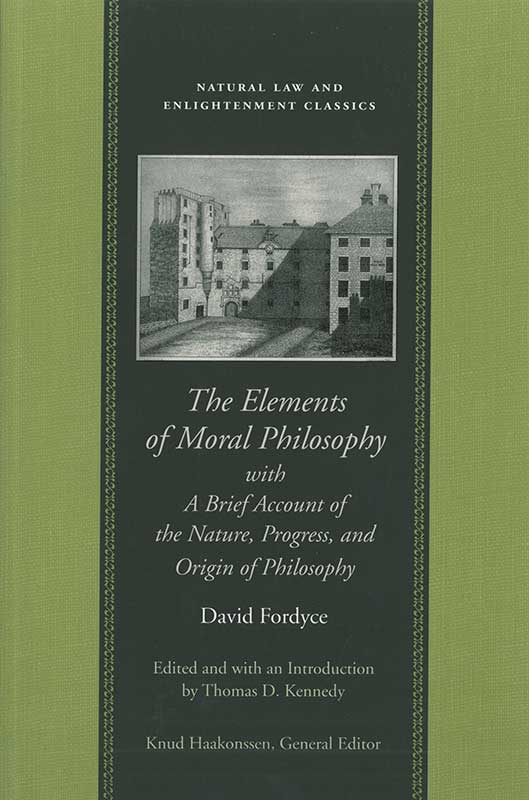
Book I - David Fordyce, The Elements of Moral Philosophy [1754]Edition used:The Elements of Moral Philosophy, in Three Books with a Brief Account of the Nature, Progress, and Origin of Philosophy, ed. Thomas Kennedy (Indianapolis: Liberty Fund, 2003).
About Liberty Fund:Liberty Fund, Inc. is a private, educational foundation established to encourage the study of the ideal of a society of free and responsible individuals. Copyright information:The copyright to this edition, in both print and electronic forms, is held by Liberty Fund, Inc. Fair use statement:This material is put online to further the educational goals of Liberty Fund, Inc. Unless otherwise stated in the Copyright Information section above, this material may be used freely for educational and academic purposes. It may not be used in any way for profit.
Book IPRELIMINARIES[Μ]άλιστα ἐπιμελητήον ὅπως ἕαστος ἡμω̑ν τω̑ν ἄλλων μαθημάτων ἀμελήσας τούτου του̑ μαθήματος καὶ ζητητὴς καὶ μαθητὴς ἔσται, ἐάν ποθεν οι̑;ός τ̕ ᾐ̑ μαθει̑ν καὶ ἐξευρει̑ν, τίς αὐτον ποιήσει δυνατὸν καὶ ἐπιστήμονα, βίον καὶ χρηστὸν καὶ πονηρὸν διαγιγνώσκοντα, τὸν βελτίω ἐκ τω̑ν δυνατω̑ν ἀεὶ πανταχου̑ αἱρει̑σθαι, [καὶ] ἀναλογι ζόμενον πάντα τὰτα τὰ νυ̑ν δὴ ῥηθήντα, ξυντιθήμενα ἀλλήλοις καὶ διαιρούμενα πρὸς ἀρετὴν βίου πω̑ς ἔχει, εἰδήναι, τί κάλλος πενίᾳ ἢ πλούτῳ κραθῃν καὶ μετὰ ποίας τινὸς ψυχη̑ς ἕξεως κακὸν ἢ ἀγαθὸν ἐζεται, [καὶ τί εὐγήνειαι καὶ δυσγήνειαο καὶ ἰδιωτει̑αι καὶ ἰσχύες καὶ ἀσθήνειαι καὶ εὐμάθειαι καὶ δυσμάθειαι]* καὶ πάντα τὰ τοιαυ̑τα τω̑ν φύσει περὶ ψυχήν ὄντων καὶ τω̑ν1 Plat. de Repub. Lib. 10. HumanKnowledge has been distributed by Philosophers into different Branches, and into more or fewer Divisions, according to the more or less extensive Views, which they have taken of the various Subjects of Human Enquiry. Partition of KnowledgeA great Philosopher* has laid it out into three general Provinces, History, Poetry, and Philosophy; which he refers to three several Powers of the Mind, Memory, Imagination, and Reason. Memory stores up Facts, or Ideas, which are the Materials of Knowledge. Imagination ranges and combines them into different Assemblages or Pictures. Reason observes their Differences, Connections, and mutual Relations, and argues concerning them. Philosophy in generalThe last is the proper Business of Philosophy, which has been defined, the “Knowledge of whatever exists,”2 or the “Science of Things Human and Divine.”3 According to this Definition, its Object comprehends the Universe or Whole of Things. It traces whatever can be known by Man concerning the Deity and his Works, their Natures, Powers, Operations, and Connections. Division of PhilosophyTherefore to give our Definition more Precision, Philosophy may be defined, the Knowledge of the Universe, or of Nature, and of its Powers, Operations and Connections, with just Reasonings deduced from thence.NaturalNatural Philosophy investigates the Properties and Operations of Body or Matter.MoralMoral Philosophy contemplates Human Nature, its Moral Powers and Connections, and from these deduces the Laws of Action; and is defined more strictly the “Science ofManners or Duty, which it traces from Man’s Nature and Condition, and shews to terminate in his Happiness.” Therefore it is called Ethics, Disciplina Morum. In fewer Words, it is the “Knowledge of ourDutyandFelicity, or the Art of being virtuous and happy.” How an ArtIt is denominated an Art, as it contains a System of Rules for becoming virtuous and happy. Whoever practises these Rules, by so doing, attains an habitual Power and Facility of becoming virtuous and happy. It is likewise called a Science,How a Science as it deduces those Rules from the Principles and Connections of our Nature, and proves that the Observance of them is productive of our Happiness. Its ObjectIt is an Art, and a Science of the highest Dignity, Importance, and Use. Its Object is Man’s Duty, or his Conduct in the several Moral Capacities and Connections which he sustains.Its Office Its Office is to direct that Conduct, to shew whence our Obligations arise and where they terminate. Its Use, or End,Its End is the Attainment of Happiness; and the Means it employs are Rules for the right Conduct of our Moral Powers.Its Means The Standard of other Arts and SciencesAs every Art and Science is more or less valuable, as it contributes more or less to our Happiness, this Moral Art or Science which unfolds our Duty and Happiness, must be a proper Canon or Standard, by which the Dignity and Importance of every other Art or Science are to be ascertain’d. It is therefore pre-eminent above all others; it is that Master-Art, that Master-Science, which weighs their respective Merits, adjusts their Rank in the Scale of Science, prescribes their Measures, and superintends their Efficacy and Application in Human Life. Therefore Moral Philosophy has been honoured with the glorious Epithets of the Directress of Life, the Mistress of Manners, the Inventress of Laws and Culture, the Guide to Virtue and Happiness, without some degree of which Man were a Savage, and his Life a Scene of Barbarity and Wretchedness. Having thus settled the Subject and End of the Science, the Elements of which we are attempting to discover, and sufficiently distinguished it from all others, it seems proper next to fix the Method of prosecuting it.The MethodMoral Philosophy has this in common with Natural Philosophy, that it appeals to Nature or Fact; depends on Observation, and builds its Reasonings on plain uncontroverted Experiments, or upon the fullest Induction of Particulars of which the Subject will admit. We must observe, in both these Sciences, Quid faciat & ferat Natura; how Nature is affected, and what her Conduct is in such and such Circumstances. Or in other words, we must collect the Phaenomena, or Appearances of Nature in any given Instance; trace these to some General Principles, or Laws of Operation; and then apply these Principles or Laws to the explaining of other Phaenomena. Therefore Moral Philosophy enquires, not how Man might have been, but how he is constituted; not into what Principles, or Dispositions his Actions may be artfully resolved, but from what Principles and Dispositions they actually flow; not what he may, by Education, Habit, or foreign Influence, come to be, or do, but what by his Nature, or Original Constituent Principles he is formed to be and do. We discover the Office, Use or Destination of any Work, whether natural or artificial, by observing its Structure, the Parts of which it consists, their Connection or joint Action. It is thus we understand the Office and Use of a Watch, a Plant, an Eye, or Hand. It is the same with a Living Creature, of the Rational, or Brute Kind. Therefore to determine the Office, Duty, or Destination of Man, or in other words what his Business is, or what Conduct he is obliged to pursue, we must inspect his Constitution, take every Part to pieces, examine their mutual Relations one to the other, and the common Effort or Tendency of the Whole. section iOf Man and His ConnectionsIn giving a rude Sketch or History in Miniature of Man, we must remember that he rises from small Beginnings, unfolds his Faculties and Dispositions by degrees, as the Purposes of Life require their Appearance, advances slowly thro’ different Stages to Maturity, and when he has reached it, gradually declines till he sinks into the Grave. Let us accompany him in his Progress through these successive Stages, and mark the Principles which actuate, and the Fortunes which attend him in each, that we may have a full View of him in each. Man’s Infant StateMan is born a weak, helpless, delicate Creature, unprovided with Food, Cloathing, and whatever else is necessary for Subsistence, or Defence. And yet, exposed as the Infant is to numberless Wants and Dangers, he is utterly incapable of supplying the former, or securing himself against the latter. But though thus feeble and exposed, he finds immediate and sure Resources in the Affection and Care of his Parents, who refuse no Labours, and forego no Dangers, to nurse and rear up the tender Babe. By these powerful Instincts, as by some mighty Chain, does Nature link the Parent to the Child, and form the strongest Moral Connection on his Part, before the Child has the least Apprehension of it. Hunger and Thirst, with all the Sensations that accompany or are connected with them, explain themselves by a Language strongly expressive, and irresistibly moving. As the several Senses bring in Notices and Informations of surrounding Objects, we may perceive in the young Spectator, early Signs of a growing Wonder and Admiration. Bright Objects and striking Sounds are beheld and heard with a sort of Commotion and Surprize. But without resting on any, he eagerly passes on from Object to Object, still pleased with whatever is most new. Thus the Love of Novelty is formed, and the Passion of Wonder kept awake. By degrees he becomes acquainted with the most familiar Objects, his Parents, his Brethren, and those of the Family who are most conversant with him. He contracts a Fondness for them, is uneasy when they are gone, and charmed to see them again. Those Feelings become the Foundation of a Moral Attachment on his Side, and by this reciprocal Sympathy he forms the Domestic Alliance with his Parents, Brethren, and other Members of the Family. Hence he becomes interested in their Concerns, and feels Joy, or Grief, Hope, or Fear on their Account, as well as his own. As his Affections now point beyond himself to others, he is denominated a good or ill Creature, as he stands well or ill affected to them. These then are the first Links of the Moral Chain, the early Rudiments, or Out-lines of his Character, his first rude Essays towards Agency, Freedom, Manhood. His ChildhoodWhen he begins to make Excursions from the Nursery, and extend his Acquaintance abroad, he forms a little Circle of Companions, engages with them in Play, or in quest of Adventures; and leads, or is led by them, as his Genius is more or less aspiring. Though this is properly the Season in which Appetite and Passion have the Ascendant, yet his Imagination and Intellectual Powers open apace; and as the various Images of Things pass before the Mental Eye, he forms a Variety of Tastes; relishes some things and dislikes others, as his Parents, Companions, and a thousand other Circumstances lead him to combine agreeable, or disagreeable Sets of Ideas, or represent to him Objects in alluring or odious Lights. As his Views are enlarged, his Active and Social Powers expand themselves in proportion; the Love of Action, of Imitation, and of Praise, Emulation, Docility, a Passion for Command, and Fondness of Change. His Passions are quick, variable, and pliant to every Impression, his Attachments and Disgusts quickly succeed each other. He compares Things, distinguishes Actions, judges of Characters, and loves or hates them, as they appear well or ill affected to himself, or to those he holds dear. Mean while he soon grows sensible of the Consequences of his own Actions, as they attract Applause, or bring Contempt; he triumphs in the former, and is ashamed of the latter; wants to hide them, and blushes when they are discovered. By means of these Powers he becomes a fit Subject of Culture, the Moral Tie is drawn closer, he feels that he is accountable for his Conduct to others as well as to himself, and thus is gradually ripening for Society and Action. His YouthAs Man advances from Childhood to Youth, his Passions as well as Perceptions take a more extensive Range. New Senses of Pleasure invite him to new Pursuits; he grows sensible to the Attractions of Beauty, feels a peculiar Sympathy with the Sex, and forms a more tender kind of Attachment than he has yet experienced. This becomes the Cement of a new Moral Relation, and gives a softer Turn to his Passions and Behaviour. In this turbulent Period he enters more deeply into a Relish of Friendship, Company, Exercises and Diversions; the Love of Truth, of Imitation and of Design grows upon him; and as his Connections spread among his Neighbours, Fellow-Citizens and Countrymen, his Thirst of Praise, Emulation, and Social Affections grow more intense and active. Mean while, it is impossible for him to have lived thus long without having become sensible of those more august Signatures of Order, Wisdom, and Goodness, which are stamped on the visible Creation; and of those strong Suggestions within himself of a Parent-Mind, the Source of all Intelligence and Beauty; and Object as well as Source of that Activity, and those Aspirations which sometimes rouze his inmost Frame, and carry him out of himself to an all-mighty and all-governing Power: Hence arise those Sentiments of Reverence, and those Affections of Gratitude, Resignation, and Love, which link the Soul with the Author of Nature, and form that most sublime and god-like of all Connections. His ManhoodMan having now reached his Prime, either new Passions succeed, or the old Set are wound up to an higher Pitch. For, growing more sensible of his Connection with the Public, and that particular Community to which he more immediately belongs; and taking withal a larger Prospect of Human Life, and its various Wants and Enjoyments, he forms more intimate Friendships, grasps at Power, courts Honour, lays down cooler Plans of Interest, and becomes more attentive to the Concerns of Society; he enters into Family-Connections, and indulges those Charities which arise from thence. The reigning Passions of this Period, powerfully prompt him to provide for the Decays of Life; and in it Compassion and Gratitude exert their Influence in urging the Man, now in full Vigour, to requite the Affection and Care of his Parents, by supplying their Wants and alleviating their Infirmities. Old AgeAt length human Life verges downwards, and Old Age creeps on apace with its Anxiety, Love of Ease, Interestedness, Fearfulness, Foresight, and Love of Offspring. The Experience of the Aged is formed to direct, and their Coolness to temper the Heat of Youth; the former teaches them to look back on past Follies, and the latter to look forward into the Consequences of Things, and provide against the worst.* Thus every Age has its peculiar Genius and Set of Passions, corresponding to that Period, and most conducive to the Prosperity of the rest. And thus are the Wants of one Period supplied by the Capacities of another, and the Weaknesses of one Age tally to the Passions of another. Passions of every AgeBesides these, there are other Passions and Affections of a less ambulatory Nature, not peculiar to one Period, but belonging to every Age, and acting more or less in every Breast throughout Life. Such are, Self-Love, Benevolence, Love of Life, Honour, Shame, Hope, Fear, Desire, Aversion, Joy, Sorrow, Anger, and the like. The two first are Affections of a cooler Strain, one pointing to the Good of the Individual, the other to that of the Species; Joy and Sorrow, Hope and Fear, seem to be only Modifications, or Exertions of the same Original Affections of Love and Hatred, Desire and Aversion, arising from the different Circumstances or Position of the Object desired or abhorred, as it is present or absent. From these likewise arise other Secondary, or Occasional Passions, which depend, as to their Existence and several Degrees, upon the Original Affections being gratified or disappointed, as Anger, Complacence, Confidence, Jealousy, Love, Hatred, Dejection, Exultation, Contentment, Disgust, which do not form Leading Passions, but rather hold of them. Their joint EffectsBy these simple, but powerful Springs, whether periodical or fixed, the Life of Man, weak and indigent as he is, is preserved and secured, and the Creature is prompted to a constant Round of Action, even to supply his own numerous and ever-returning Wants, and to guard against the various Dangers and Evils to which he is obnoxious. By these Links, Men are connected with each other, formed into Families, drawn into particular Communities, and all united, as by a common League, into one System or Body, whose Members feel and sympathize one with another. By this admirable Adjustment of the Constitution of Man to his State, and the gradual Evolution of his Powers, Order is maintained, Society upheld, and Human Life filled with that Variety of Passion and Action, which at once enliven and diversify it. The Directing PowerThis is a short Sketch of the Principal Movements of the Human Mind. Yet, these Movements are not the Whole of Man; they impel to Action, but do not direct it; they need a Regulator to guide their Motions, to measure and apply their Forces. And accordingly they have one that naturally superintends and directs their Action. We are conscious of a Principle within us, which examines, compares and weighs Things, notes the Differences, observes the Forces, and foresees the Consequences of Affections and Actions. By this Power we look back on past Times, and forward into Futurity, gather Experiences, estimate the real and comparative Value of Objects, lay out Schemes, contrive Means to execute them, and settle the whole Order and Oeconomy of Life. This Power we commonly distinguish by the Name of Reason, or Reflection, the Business of which is not to suggest any original Notices or Sensations, but to canvass, range, and make Deductions from them. The judging or approving PowersWe are intimately conscious of another Principle within us, which approves of certain Sentiments, Passions and Actions, and disapproves of their Contraries. In consequence of the Decisions of this inward Judge, we denominate some Actions and Principles of Conduct, right, honest, good, and others wrong, dishonest, ill. The former excite our Esteem, Moral Complacence, and Affection, immediately and originally of themselves, without regard to their Consequences, and whether they affect our Interest or not. The latter do as naturally and necessarily call forth our Contempt, Scorn, and Aversion. That Power, by which we perceive this Difference in Affections and Actions, and feel a consequent Relish or Dislike, is commonly called Conscience, or the MoralSense. Whether such a Power belongs to human Nature or not, must be referred to every one’s Experience of what passes within himself. These Powers different from AffectionsThese two Powers of Reason and Conscience, are evidently Principles different in Nature and Kind from the Passions and Affections. For the Passions are mere Force or Power, blind Impulses, acting violently and without Choice, and ultimately tending each to their respective Objects, without regard to the Interest of others, or of the whole System. Whereas the Directing and Judging Powers distinguish and ascertain the different Forces, mutual Proportions and Relations, which the Passions bear to each other and to the Whole; recognize their several Degrees of Merit, and judge of the whole Temper and Conduct, as they respect either the Individual or the Species; and are capable of directing or restraining the blind Impulses of Passion in a due Consistency one with the other, and a regular Subordination to the Whole System.—Let this Difference be remembered. Division of the PassionsThis is some Account of the Constituent Principles of our Nature, which, according to their different Mixtures, Degrees, and Proportions, mould our Character and sway our Conduct in Life. In reviewing that large Train of Affections which fill up the different Stages of Human Life, we perceive this obvious Distinction among them; that some of them respect the Good of the Individual, and others carry us beyond Ourselves to the Good of the Species, or Kind. The former have therefore been called Private, and the latter Public Affections. Of the first Sort are Love of Life, of Pleasure, of Power, and the like. Of the last are Compassion, Gratitude, Friendship, Natural Affection, and the like. Of the Private Passions,* some respect merely the Security and Defence of the Creature, such as Resentment, and Fear; whereas others aim at some Positive Advantage or Good, as Wealth, Ease, Fame.Defensive Passions The former sort therefore, because of this Difference of Objects, may be termed Defensive Passions. These answer to our Dangers, and prompt us to avoid them if we can, or boldly to encounter them when we cannot. Private or Appetitive PassionsThe other Classes of Private Passions, which pursue private positive Good, may be called Appetitive. However we shall still retain the Name of Private, in Contradistinction to the Defensive Passions. Man has a great Variety of Wants to supply, and is capable of many Enjoyments, according to the several Periods of his Life, and the different Situations in which he is placed. To these therefore, a suitable Train of Private Passions correspond, which engage him in the Pursuit of whatever is necessary for his Subsistence, or Welfare. Public PassionsOur Public or Social Affections are adapted to the several Social Connections and Relations which we bear to others, by making us sensible of their Dangers, and interesting us in their Wants, and so prompting us to secure them against one, and supply the other. The AppealWhether this historic Draught of Man, and of that Groupe of Figures and Connections with which he is environed be just or not, is a Matter, not so much of Reasoning, as common Sense and common Experience. Therefore let every one consult his Experience of what he feels within, and his Knowledge of what is transacted abroad, in the little, or the great World in which he lives; and by that Experience, and that Knowledge, let the Picture be acknowledged Just, or pronounced the Contrary. For to that Experience, and to that Knowledge, and to these alone, the Designer appeals. This is the first Step then to discover the Duty and Destination of Man, the having analyzed the Principles of which he is composed. It is necessary, in the next place, to consider in what Order, Proportion, and Measure of those inward Principles, Virtue, or a sound Moral Temper, and right Conduct consists; that we may discover whence Moral Obligation arises. section iiOf Duty, or Moral ObligationThe Measure of PowersIt is by the End or Design of any Power or Movement, that we must direct its Motions, and estimate the Degree of Force necessary to its just Action. If it want the Force requisite for the obtaining its End, we call it defective; if it has too much, so as to be carried beyond it, we say it is overcharged; and in either Case it is imperfect, and ill-contrived. If it has just enough to reach the Scope, we esteem it right, and as it should be. Let us apply this Reasoning to the Passions. Measure of the defensive PassionsThe Defence and Security of the Individual being the Aim of the defensive Passions, that Security and Defence must be the Measure of their Strength or Indulgence. If they are so weak as to prove insufficient for that End, or if they carry us beyond it, i.e. raise unnecessary Commotions, or continue longer than is needful, they are unfit to answer their original Design, and therefore are in an unsound and unnatural State. The Exercise of Fear or of Resentment, has nothing desirable in it, nor can we give way to either without painful Sensations. Without a certain Degree of them we are naked and exposed. With too high a Proportion of them we are miserable, and often injurious to others. Thus Cowardice or Timidity, which is the Excess of Fear, instead of saving us in Danger, gives it too formidable an Appearance, makes us incapable of attending to the best Means of Preservation, and disarms us of Courage, our natural Armour. Fool-hardiness, which is a Want of a due measure of Fear, leads us heedlesly into Danger, and lulls us into a pernicious Security. Revenge, i.e. excessive Resentment, by the Violence of its Commotion, robs us of that Presence of Mind which is often the best Guard against Injury, and inclines us to pursue the Aggressor with more Severity than Self-defence requires. Pusillanimity, or the Want of a just Indignation against Wrong, leaves us quite unguarded, and sinks the Mind into a passive enervating Tameness. Therefore, “to keep the defensive Passions duly proportion’d to our Dangers, is their natural Pitch and Tenour.” Measure of the private PassionsThe private Passions lead us to pursue some positive Species of private Good. That Good therefore, which is the Object and End of each, must be the Measure of their respective Force, and direct their Operation. If they are too weak or sluggish to engage us in the Pursuit of their several Objects, they are evidently deficient; but if they defeat their End by their Impetuosity, then are they strained beyond the just Tone of Nature. Thus Vanity, or an excessive Passion for Applause, betrays into such Meannesses and such little Arts of Popularity, as makes us forfeit the Honour we so anxiously court. On the other hand, a total Indifference about the Esteem of Mankind, removes a strong Guard and Spur to Virtue, and lays the Mind open to the most abandoned Prosecutions. Therefore, “to keep our private Passions and Desires proportioned to ourWants, is the just Measure and Pitch of this Class of Affections.” Comparative ForceThe defensive and private Passions do all agree in general, in their Tendency or Conduciveness to the Interest or Good of the Individual. Therefore when there is a Collision of Interest, as may sometimes happen, that Aggregate of Good or Happiness, which is composed of the particular Goods to which they respectively tend, must be the common Standard by which their comparative Degrees of Strength are to be measured. That is to say, if any of them in the Degree in which they prevail, are incompatible with the greatest Aggregate of Good, or most extensive Interest of the Individual, then are they unequal and disproportionate. For, in judging of a particular System or Constitution of Powers, we call that the supreme or principal End, in which the Aims of the several Parts or Powers coincide, and to which they are subordinate, and reckon them in due Proportion to each other, and right with regard to the Whole, when they maintain that Subordination or Subserviency. Therefore, “to proportion our defensive and private Passions in such measure to our Dangers and Wants, as best to secure the Individual, and obtain the greatest Aggregate of private Good or Happiness, is their just Balance, or comparative Standard in case of Competition.” Measure of the public AffectionsIn like manner, as the public or social Affections point at the Good of others, that Good must be the Measure of their Force. When a particular social Affection, as Gratitude or Friendship, which belongs to a particular social Connection, viz. that of a Benefactor or of a Friend, is too feeble to make us act the grateful or friendly Part, that Affection being insufficient to answer its End, is defective and unsound. If, on the other hand, a particular Passion of this Class counteract or defeat the Interest it is designed to promote, by its Violence or Disproportion, then is that Passion excessive and irregular. Thus natural Affection, if it degenerates into a passionate Fondness, not only hinders the Parents from judging coolly of the Interest of their Offspring, but often leads them into a most partial and pernicious Indulgence. Collision of social AffectionsAs every kind Affection points at the Good of its particular Object, it is possible there may be a Collision of Interests or Goods. Thus the Regard due to a Friend may interfere with that which we owe to a Community. In such a Competition of Interests, it is evident, that the greatest is to be chosen; and that is the greatest Interest, which contains the greatest Sum or Aggregate of public Good, greatest in Quantity as well as Duration. This then is the common Standard, by which the respective Forces and Subordinations of the social Affections must be adjusted. Therefore we conclude, that “this Class of Affections are sound and regular, when they prompt us to pursue the Interest of Individuals in an entire Consistency with the public Good,” or, in other words, “when they are duly proportioned to the Dangers and Wants of others, and to the various Relations in which we stand to Individuals, or to Society.” Thus we have found by an Induction of Particulars, the natural Pitch or Tenour of the different Orders of Affection, considered apart by themselves. Now as the Virtue or Perfection of every Creature lies in following its Nature, or acting suitably to the just Proportion and Harmony of its several Powers; therefore, “the Virtue of a Creature endow’d with such Affections as Man, must consist in observing, or acting agreeably to their natural Pitch and Tenour.” Let this suffice at least for its first rude Sketch. Balance of AffectionBut, as there are no independent Affections in the Fabric of the Mind, no Passion that stands by itself, without some Relation to the rest, we cannot pronounce of any one considered apart, that it is either too strong, or too weak. Its Strength and just Proportion must be measured, not only by its Subserviency to its own immediate End, but by the Respect it bears to the whole System of Affection. Therefore, we say a Passion is too strong, not only when it defeats its own End, but when it impairs the Force of other Passions, which are equally necessary to form a Temper of Mind, suited to a certain Oeconomy, or State; and too weak, not merely on account of its Insufficiency to answer its End, but because it cannot sustain its Part or Office, in the Balance of the whole System. Thus the Love of Life may be too strong, when it takes from the Regard due to one’s Country, and will not allow one bravely to encounter Dangers, or even Death on its Account. Again, the Love of Fame may be too weak, when it throws down the Fences which render Virtue more secure, or weakens the Incentives which make it more active and public-spirited. Limits of private AffectionsIf it be asked, “How far may the Affections towards private Good or Happiness be indulged?” One Limit was before fixed for the particular Indulgences of each, viz. their Subordination to the common Aggregate of Good to the private System. In these therefore, a due Regard is always supposed to be had to Health, Reputation, Fortune, the Freedom of Action, the unimpair’d Exercise of Reason, the calm Enjoyment of one’s self, which are all private Goods. Another Limit now results from the Balance of Affection just named, viz. “The Security and Happiness of others,” or to express it more generally, “a private Affection may be safely indulged, when, by that Indulgence, we do not violate the Obligations which result from our higher Relations, or public Connections.” A just Respect therefore being had to these Boundaries, which Nature has fixed in the Breast of every Man, what should limit our Pursuits of private Happiness? Is Nature sullen and penurious? Or does the God of Nature envy the Happiness of his Offspring? Collision of InterestsWhether there is ever a real Collision of Interests between the public and private System of Affections, or the Ends which each Class has in view, will be afterwards considered; but where there is no Collision, there is little or no danger of carrying either, but especially the public, Affections to Excess, provided both Kinds are kept subordinate to a discreet and cool Self-love, and to a calm and universal Benevolence, which Principles stand as Guards at the Head of each System. ResultThis then is the Conduct of the Passions, considered as particular and separate Forces, carrying us out to their respective Ends; and this is their Balance or Oeconomy, considered as compound Powers, or Powers mutually related, acting in conjunction towards a common End, and consequently as forming a System or Whole. Subordination of PowersNow, whatever adjusts or maintains this Balance, whatever in the human Constitution is formed for directing the Passions, so as to keep them from defeating their own End, or interfering with each other, must be a Principle of a superior Nature to them, and ought to direct their Measures, and govern their Proportions. But it was found that Reason or Reflection is such a Principle, which points out the Tendency of our Passions, weighs their Influence upon private and public Happiness, and shews the best Means of attaining either. It having been likewise found, that there is another directing or controuling Principle, which we call Conscience, or the MoralSense, which, by a native kind of Authority, judges of Affections and Actions, pronouncing some just and good, and others unjust and ill; it follows that the Passions, which are mere Impulses, or blind Forces, are Principles inferior and subordinate to this judging Faculty. Therefore, if we would follow the Order of Nature, i.e. observe the mutual Respects and the Subordination which the different Parts of the human Constitution bear to one another, the Passions ought to be subjected to the Direction and Authority of the leading or controuling Principles. In what it consistsWe conclude therefore from this Induction, that “The Constitution or just Oeconomy of human Nature, consists in a regular Subordination of the Passions and Affections to the Authority of Conscience, and the Direction of Reason.” Oeconomy of Nature, or right TemperThat Subordination is regular, when the Proportion formerly mentioned is maintained; that is to say, “When the Defensive Passions are kept proportioned to our Dangers; when the private Passions are proportioned to our Wants; and, when the public Affections are adapted to our publicConnections, and proportioned to the Wants and Dangers of others.” This last Branch is expressed somewhat differently from the two former, in order to include that most important Relation in which we stand, and those indispensible Laws of Duty which we owe to the great Author of our Nature, who, being supremely perfect and happy, has no Wants to supply, and is obnoxious to no Possibility of Change. Human Virtue and PerfectionBut the natural State, or the sound and vigorous Constitution of any Creature, or the just Oeconomy of its Powers, we call its Health and Perfection; and the acting agreeably to these, its Virtue or Goodness. Therefore, “the Health and Perfection of Man must lie in the aforesaid Supremacy of Conscience and Reason, and in the Subordination of the Passions to their Authority and Direction. And hisVirtue or Goodness must consist in acting agreeably to that Order or Oeconomy.” How conformable to ReasonThat such an Oeconomy of the Mind, and such a Conduct of its Powers and Passions will stand the Test of Reason, cannot admit of any Dispute. For, upon a fair Examination into the Consequences of Things, or the Relations and Aptitudes of Means to Ends, Reason evidently demonstrates, and Experience confirms it, that “To have our defensive Passions duly proportioned to our Dangers, is the surest way to avoid or get clear of them, and obtain the Security we seek after.”—“To proportion our private Passions to our Wants, is the best Means to supply them;—and, to adapt our public Affections to our social Relations, and the Good of others, is the most effectual Method of fulfilling one, and procuring the other.” In this Sense therefore, Virtue may be said to be a “Conduct conformable to Reason,” as Reason discovers an apparent Aptitude in such an Order and Oeconomy of Powers and Passions, to answer the End for which they are naturally formed. Connection between Affections and Ends, not the Idea of Moral ObligationIf the Idea of Moral Obligation is to be deduced merely from this Aptitude or Connection between certain Passions, or a certain Order and Balance of Passions, and certain Ends obtained, or to be obtained by them, then is Reason or Reflection, which perceives that Aptitude or Connection, the proper Judge of Moral Obligation; and on this Supposition it may be defined, as hath been done by some, the Connection between the Action and the Motive; for the End is the Motive, or the final Cause, and the Affection is the Action, or its immediate, natural Cause. A Man, from mere Self-love, may be induced to fulfil that Obligation, which is founded on the Connection between the defensive Passions and their Ends, or the private Passions and their Ends; because in that Case his own Interest will prompt him to indulge them in the due Proportion required. But if he has no Affections which point beyond himself, no Principle but Self-love, or some subtle Modification of it, what shall interest him in the Happiness of others, where there is no Connection between it and his own; or what Sense can he have of Moral Obligation to promote it? Upon this Scheme therefore, without public or social Affection there could be no Motive, and consequently no Moral Obligation to a beneficent, disinterested Conduct. But if the mere Connection between certain Passions, or a certain Order of Passions, and certain Ends, are what constitutes, or gives us the Idea of Moral Obligation, then why may not the Appositeness of any Temper or Conduct, nay, of any Piece of Machinery to obtain its End, form an equally strict Moral Obligation? For the Connection and Aptitude are as strong and invariable in the latter Instances as in the former. But as this is confounding the most obvious Differences of things, we must trace the Idea of Moral Obligation to another and a more natural Source. Idea of it from ExperienceLet us appeal therefore to our inmost Sense and Experience, “How we stand affected to those different Sets of Passions, in the just Measure and Balance of which we found a right Temper to consist.” For this is entirely a Matter of Experience, in which we must examine as in any other natural Enquiry, “What are the genuine Feelings and Operations of Nature, and what Affections or Symptoms of them appear in the given Instance.” Why the defensive Passions approv’dThe defensive Passions, as Anger and Fear, give us rather Pain than Pleasure, yet we cannot help feeling them when provoked by Injury, or exposed to Harm. We account the Creature imperfect that wants them, because they are necessary to his Defence. Nay we should in some measure condemn ourselves, did we want the necessary Degree of Resentment and Caution. But if our Resentment exceeds the Wrong received, or our Caution the Evil dreaded, we then blame ourselves for having over-acted our Part. Therefore, while we are in Danger, to be totally destitute of them we reckon a blameable Defect, and to feel them in a just, i.e. necessary Measure, we approve, as suited to the Nature and Condition of such a Creature as Man. But our Security obtained, to continue to indulge them, we not only disapprove as hurtful, but condemn as unmanly, unbecoming, and mean-spirited: Nor will such a Conduct afford any self-approving Joy, when we coolly reflect upon it. Why the privateWith regard to the private Passions, such as Love of Life, Pleasure, Ease, and the like, as these aim at private Good, and are necessary to the Perfection and Happiness of the Individual, we should reckon any Creature defective, and even blameable, that was destitute of them. Thus, we condemn the Man who imprudently ruins his Fortune, impairs his Health, or exposes his Life; we not only pity him as an unfortunate Creature, but feel a kind of Moral Indignation and Contempt of him, for having made himself such. On the other hand, though a discreet Self-regard does not attract our Esteem and Veneration, yet we approve of it in some Degree, in an higher and different Degree from what we would regard a well-contrived Machine, as necessary to form a finish’d Creature, nay to complete the virtuous Character, and as exactly suited to our present indigent State. There are some Passions respecting private Good, towards which we feel higher Degrees of Approbation, as the Love of Knowledge, of Action, of Honour, and the like. We esteem them as Marks of an ingenuous Mind, and cannot help thinking the Character in which they are wanting, remarkably stupid, and in some degree immoral. Why the publicWith regard to the social Affections, as Compassion, natural Affection, Friendship, Benevolence, and the like, we approve, admire, and love them in ourselves, and in all in whom we discover them, with an Esteem and Approbation, if not different in kind, yet surely far superior in degree to what we feel towards the other Passions. These we reckon necessary, just, and excellently fitted to our Structure and State; and the Creature which wants them we call defective, ill constituted, a kind of Abortion. But the public Affections we esteem as self-worthy, originally and eternally amiable. We approve and congratulate ourselves in proportion as we indulge them, and reckon those deserving of our Esteem and Friendship who do so. Distinction between vehement and calm AffectionsBut among the social Affections, we make an obvious and constant Distinction, viz. between those particular Passions, which urge us with a sudden Violence, and uneasy kind of Sensation, to pursue the Good of their respective Objects, as Pity, natural Affection, and the like; and those calm dispassionate Affections and Desires, which prompt us more steddily and uniformly, to promote the Happiness of others. The former we generally call Passions, to distinguish them from the other Sort, which go more commonly by the Name of Affections, or calm Desires. The first kind we approve indeed and delight in; but we feel still higher Degrees of Approbation and moral Complacence towards the last, and towards all Limitations of the particular Instincts, by the Principle of universal Benevolence. The more Objects the calm Affections take in, and the worthier these are, their Dignity rises in proportion, and with this our Approbation keeps an exact Pace. A Character, on the other hand, which is quite divested of these public Affections, which feels no Love for the Species, but instead of it, entertains Malice, Rancour and Ill-will, we reckon totally immoral and unnatural. Such then are the Sentiments and Dispositions we feel, when these several Orders of Affections pass before the mental Eye. Moral ObligationTherefore, “that State in which we feel ourselves moved, in the manner above described, towards those Affections and Passions, as they come under the Mind’s Review, and in which we are instantaneously and independently of our Choice or Volition, prompted to a correspondent Conduct, we call a State of MoralObligation.” Let us suppose, for instance, a Parent, a Friend, a Benefactor, reduced to a Condition of the utmost Indigence and Distress, and that it is in our Power to give them immediate Relief. To what Conduct are we obliged? What Duty does Nature dictate and require in such a Case? Attend to Nature, and Nature will tell, will tell with a Voice irresistibly audible and commanding to the human Heart, with an Authority which no Man can silence without being self-condemned, and which no Man can elude but at his Peril; “That immediate Relief ought to be given.” Again, let a Friend, a Neighbour, or even a Stranger, have lodged a Deposit in our Hands, and after some time reclaim it, no sooner do these Ideas of the Confidence reposed in us, and of Property not transferred, but deposited, occur, than we immediately and unavoidably feel, and recognize the Obligation to restore it. In both these Cases, we should condemn and even loath ourselves, if we acted otherwise, as having done, or omitted doing what we ought not, as having acted beneath the Dignity of our Nature;—contrary to our most intimate Sense of Right and Wrong;—we should accuse ourselves as guilty of Ingratitude, Injustice, and Inhumanity;—and be conscious of deserving the Censure, and therefore dread the Resentment of all rational Beings.—But in complying with the Obligation, we feel Joy and Self-approbation,—are conscious of an inviolable Harmony between our Nature and Duty,—and think ourselves entitled to the Applause of every impartial Spectator of our Conduct. Moral ObligationTo describe therefore what we cannot perhaps define, a State of MoralObligation, is “that State in which a Creature, endued with such Senses, Powers, and Affections as Man, would condemn himself, and think he deserved the Condemnation of all others, should he refuse to fulfil it; but would approve himself, and expect the Approbation of all others, upon complying with it.” Moral AgentAnd we call him a MoralAgent, who is in such a State, or is subject to Moral Obligation. Therefore as Man’s Structure and Connections often subject him to such a State of Moral Obligation, we conclude that he is a MoralAgent. But as Man may sometimes act without knowing what he does, as in Cases of Frenzy or Disease, or in many natural Functions; or knowing what he does, he may act without Choice or Affection, as in Cases of Necessity or Compulsion, therefore to denominate an Action Moral,Moral Action good and bad i.e. approveable, or blameable, it must be done knowingly and willingly, or from Affection and Choice. “A morally good Action then is to fulfil a Moral Obligation knowingly and willingly.” And a morally bad Action, or an immoral Action, is “to violate a Moral Obligation knowingly and willingly.” The proposed Brevity of the Enquiry will not admit of entering into the minuter Distinctions of Actions. Moral Character and Temper good and badAs not an Action, but a Series of Actions constitute a Character; as not an Affection, but a Series of Affections constitute a Temper, and as we denominate things by the gross, a fortiori, or by the Qualities which chiefly prevail in them, therefore we call that a “morally good Character, in which a Series of morally good Actions prevail”; and that a “morally good Temper, in which a Series of morally good Affections have the Ascendant.” A bad Character and bad Temper are the Reverse. But where the above-mentioned Order or Proportion of Passions is maintained, there a Series of morally good Affections and Actions will prevail. Therefore, “to maintain that Order and Proportion, is to have a morally good Temper and Character.” But a “morally good Temper and Character, is MoralRectitude, Integrity, Virtue, or the Completion ofDuty.” How we come by the Idea of Moral ObligationIf it be asked after all, “How we come by the Idea of Moral Obligation or Duty?” We may answer, that we come by it in the same way as by our other original and primary Perceptions. We receive them all from Nature, or the great Author of Nature. For this Idea of Moral Obligation is not a Creature of the Mind, or dependent on any previous Act of Volition, but arises on certain Occasions, or when certain other Ideas are presented to the Mind, as necessarily, instantaneously, and unavoidably, as Pain does upon too near an Approach to the Fire, or Pleasure from the Fruition of any Good. It does not, for instance, depend on our Choice, whether we shall feel the Obligation to succour a distressed Parent, or to restore a Deposit entrusted to us, when it is recalled. We cannot call this a compound Idea made up of one or more simple Ideas. We may indeed, nay we must, have some Ideas antecedent to it, e.g. that of a Parent—in Distress—of a Child,—able to relieve,—of the Relation of one to the other,—of a Trust,—of Right, &c. But none of these Ideas constitute the Perception of Obligation. This is an Idea quite distinct from, and something superadded to, the Ideas of the Correlatives, or the Relation subsisting between them. These indeed, by a Law of our Nature, are the Occasion of suggesting it, but they are as totally different from it, as Colours are from Sounds. By Sense or Reflection we perceive the Correlatives, our Memory recals the Favours or Deposit we received, the various Circumstances of the Case are Matters of Fact or Experience; but some delicate inward Organ or Power, or call it what we please, does, by a certain instantaneous Sympathy, antecedent to the cool Deductions of Reason, and independent of previous Instruction, Art, or Volition, perceive the Moral Harmony, the living, irresistible Charms of Moral Obligation, which immediately interests the correspondent Passions, and prompts us to fulfil its awful Dictates. The Use of Reason in Moral CasesWe need not apprehend any Danger from the Quickness of its Decisions, nor be frightened, because it looks like Instinct, and has been called so. Would we approve one for deliberating long, or reasoning the Matter much at leisure, whether he should relieve a distress’d Parent, feed a starving Neighbour, or restore the Trust committed to him? Should we not suspect the Reasoner of Knavery, or of very weak Affections to Virtue? We employ Reason, and worthily employ it in examining the Condition, Relations, and other Circumstances of the Agent or Patient, or of those with whom either of them are connected, or, in other words, the State of the Case: And in complicated Cases, where the Circumstances are many, it may require no small Attention to find the true State of the Case; but when the Relations of the Agent or Patient, and the Circumstances of the Action are obvious, or come out such after a fair Trial, we should scarce approve him who demurs on the Obligation to that Conduct which the Case suggests. Thus, suppose one to deposit with us a Sword, which he comes afterwards to reclaim, but in such Circumstances, suppose of Frenzy or Melancholy, as gives us good ground to suspect that he will use it to the Hurt of others, or of himself. In such a Case it belongs to Reason or Prudence, coolly to weigh every Circumstance, the Condition of the Proprietor, the Consequences of restoring the Deposit, and the like; nor should we on this Supposition, condemn the hesitating about the restoring it; but let the Proprietor return to himself, the Obligation to Restitution being now apparent, we should justly suspect the Demurrer of something criminal or knavish. Instinct consideredAs to that Objection against this original Perception of Moral Obligation, taken from its being an Instinct or necessary Determination of our Nature; are not the Perceptions or Determinations of Reason equally necessary? Does not every intuitive Perception or Judgment necessarily extort our Assent, when the Agreement or Disagreement of the Ideas which are compared is perceived? Instinct indeed has been considered, as something relative merely to bodily Sense and Appetite, a mere brutal Sensation or Impulse, in which the Mind, or our sublimer Powers have no Part; and therefore it is a Term that has been thought obnoxious to great Exceptions in Morals; but is a moral Power of Perception, or a moral Determination the worse for being interwoven with the very Frame, and Constitution of our Nature, for being instantaneous, uniform and steddy in its Operations or Decision? Why should such a Divine Instinct be thought less rational, less suitable to the Dignity of the Mind, than those intuitive Perceptions which are conversant about abstract Truths, and arise necessarily and instantaneously from the obvious Relations of Things? And if Reason with all its Sagacity may sometimes err, nay often does, why should any other Power of Perception be thought infallible, or be condemned as brutal and irrational if it is not? Pleasure, not the Idea of ObligationFrom what has been said it is evident, that it is not the Pleasures, or agreeable Sensations which accompany the Exercise of the several Affections, nor those consequent to the Actions that constitute MoralObligation, or excite in us the Idea of it. That Pleasure is posterior to the Idea of Obligation, and frequently we are obliged, and acknowledge ourselves under an Obligation, to such Affections and Actions as are attended with Pain; as in the Trials of Virtue, where we are obliged to sacrifice private to public Good, or a present Pleasure to a future Interest. We have Pleasure in serving an aged Parent, but it is neither the Perception nor Prospect of that Pleasure, which gives us the Idea of Obligation to that Conduct. Therefore, when we use these Terms, Obligation, Duty, Ought, and the like, they stand for a simple Idea, an original uncompounded Feeling or Perception of the human Mind, as much as any Idea whatsoever, and can no more be defined than any other simple Idea; and this Perception is not a Creature of the Mind, but a Ray emanating directly from the Father of Lights, a fair genuine Stamp of his Hand, who impressed every vital and original Energy on the Mind, or if we chuse rather to say, who ordained those Laws of Perception, by which moral Forms attract and charm us with an irresistible Power. But because the learned Dexterity of human Wit has so marvellously puzzled a plain and obvious Subject, we shall consider some of those ingenious Theories by which Moralists have deduced and explained Moral Obligation. section iiiVarious Hypotheses Concerning Moral ObligationFrom the Induction which has been made, we shall be able to judge with more Advantage of the different Hypotheses which have been contrived to deduce the Origin of Moral Obligation. The Scheme of HobbesHobbes, who saw Mankind in an unfavourable Attitude, involved in all the Distraction and Misery of a civil War, seems to have taken too narrow and partial a View of our Nature, and has therefore drawn it in a very odious and uncomfortable Light. Next to the Desire of Self-preservation, he makes the governing Passions in Man, the Love of Glory, and of Power; and from these, by an arbitrary, unnatural, and unsupported Hypothesis, contrary to common Experience, and common Language, he attempts to deduce all the other Passions which inflame the Minds, and influence the Manners of Men. All Men, says he, are by Nature equal, that is to say, according to his own Explanation, the weakest can do as much Mischief as the strongest; all desire, and have an equal Right to the same Things, and want to excel each other in Power and Honour; but as it is impossible for all to possess the same Things, or to obtain a Pre-eminence in Power and Honour, hence must arise mutual Contests, a natural Passion to invade the Property, and level the Power and Character of each other, and to raise and secure themselves against the Attempts of others.* This State of Things, in which every Man having a Right to every Thing, has likewise a Right to prevent his Neighbour by Force or Fraud; he tells us, must naturally produce a State of War and mutual Carnage. In such a State, he adds, nothing can be called unjust or unlawful; for he who has a Right to the End, has also a Right to the only Means of obtaining or securing it, which, according to him, are Force or Fraud. And this State he calls the State of Nature.—But our shrewd Philosopher subjoins, that Men being aware that such a State must terminate in their own Destruction, agreed to surrender their private unlimited Right into the Hands of the Majority, or such as the Majority should appoint, and to subject themselves for the future to common Laws, or to common Judges or Magistrates. In consequence of this Surrender, and of this mutual Compact or Agreement, they are secured against mutual Hostilities, and bound or obliged to a peaceable and good Behaviour; so that it is no longer lawful or just (the good Man means safe or prudent) to invade and encroach on another. For this would be contrary to Compact, and a Violation of his Promise and Faith.—Therefore as there could be no Injustice previous to this Compact, so the Compact, and it alone, must be the Origin of Justice, the Foundation of Duty and Moral Obligation. This is our subtle Philosopher’s Scheme! But one may ask him, What Obligation is a Man under to keep his Promise, or stand to his Compact, if there be no Obligation, no moral Tie distinct from that Promise, and that Compact, independent of and previous to both? If there is none, they must prove a mere Rope of Sand, and Men are left as loose and unsociable as ever, as much Barbarians and Wolves as before their Union. But if there is a distinct and previous Obligation to Fidelity, Honour, and a Regard to one’s Engagements, then Right and Wrong, Justice and Injustice, are antecedent to Compact.—Perhaps he will tell us that the Necessity of the Case, or a Regard to our own Safety, which is included in that of the Public, obliges us to adhere to our Engagements. We may be compelled or punished for Breach of Faith by those, to whom we transfer our Rights. Force, or superior Strength of the Majority to controul or punish the Refractory, is, no doubt, the true Origin of the Obligation, if he will speak out, and Self-love is its only Judge and Measure. And if this be all, then what Obligation is a Man under to Gratitude, Charity, Friendship, and all those Duties of Humanity, which fall not under the Cognizance or Controul of Law? What Obligations to private Veracity, Honesty and Fidelity, when a Man may be a Knave with Safety? That Scheme, therefore, which sets us loose from such Obligations, and involves us in such Absurdities, must be itself both absurd and wicked. That State of Nature which it supposes as its Foundation, is a mere Chimera, a Vision of his own Brain, which, from the Condition and Nature of the Creature, the Growth of a Family, the Rise of a Tribe or Clan, we have no Reason to believe ever subsisted; therefore the Superstructure which he has raised on that Foundation, is fictitious and chimerical. Hobbes took it for granted, that all Men were Knaves or Fools, and wanted to dress up a System of Government, agreeable to the corrupt Taste of the reigning Powers, and to the Genius of a most dissolute Court, a Government contrived to make a small Part of Mankind Tyrants, and all the rest Slaves. He measured Virtue by mere Utility, and while he pretends to be the first that discovered this Connection, and gave the only true Reason for the Practice of Honesty, he seems to have misunderstood, or wilfully overlooked its true Nature, and its inseparable Connection with the Perfection and Happiness of the Individual. Scheme of Conformity to the Divine WillAnother Set of Moralists establish Morals upon the Will or positive Appointment of the Deity, and call Virtue a Conformity to that Will, or Appointment. All Obligation, they say, supposes one who obliges, or who has a Right to prescribe, and can reward the Obedient, and punish the Disobedient. This can be none but our Creator. His Will therefore is our Law, which we are bound to obey. And this they tell us is only sufficient to bind, or oblige such imperfect and corrupt Creatures as we are, who are but feebly moved with a Sense of the Beauty and Excellency of Virtue, and strongly swayed by Passion, or Views of Interest. That Virtue, or such a Conduct of the Passions as hath been above described, is agreeable to the Will of God, is evident beyond Dispute, as that Conduct, or Scheme of Duty, is pointed out to us by our Inward Structure, and as that Inward Structure is the Effect of the Will or Appointment of the Deity. Whatever therefore is agreeable, or correspondent to our Inward Structure, must likewise be agreeable, or correspond to the Will of God. So that all the Indications, or Sanctions of our Duty, which are declared, or enforced by our Structure, are, and may be, considered as Indications, or Sanctions of the Will of our Creator. If these Indications, through Inattention to, or Abuse of the Structure, prove insufficient to declare; or if these Sanctions, through the Weakness or Wickedness of Men, prove insufficient to enforce Obedience to the Divine Will, and the Deity is pleased to superadd new Indications, or new Sanctions; these additional Indications and Sanctions cannot, and are not supposed by the Assertors of this Scheme, to add any new Duty, or any new Moral Obligation; but only a new and clearer Promulgation of our Duty, or a new and stronger Sanction or Motive from Interest, to perform that Duty, and to fulfil that Obligation to which we were bound before. It makes no Difference, as to the Matter of Obligation, after what mannar the Will of our Creator is enforced, or declared to us, whether by Word or Writ, or by certain inward Notices and Determinations of our own Minds, arising according to a necessary Law of our Nature.—By whichever of these Ways we suppose the Divine Will intimated to us, the first Question that naturally occurs to us is, “Why we are obliged to obey the Divine Will?” If it be answered, that he is our Superior, and can reward, or punish us, as we are obedient or refractory; this is resting Obligation upon the foot of Interest. If we say that he is our Creator, and Benefactor, and we ought to obey our Creator and be grateful to our Benefactor, this refers the Obligation to an inward Sense, or Perception, that Obedience is due to one’s Creator, Gratitude to one’s Benefactor. Upon what other Principle but this, can we connect those Relations, and that Obedience and Gratitude, unless we recur to the Principle of Self-interest just now mentioned? If the Scheme of Duty and Moral Obligation be thought to rest on too slight a Foundation, when built on Moral Perception, and the Affections of our Nature, because these are found insufficient to bind, or rather compel Men to their Duty, we fear the same Objection will militate against this Scheme, since all the Declarations and Sanctions of the Divine Will have not hitherto had their due Effect in producing a thorough and universal Reformation. When some speak of the Will of God, as the Rule of Duty, they do not certainly mean a blind, arbitrary Principle of Action, but such a Principle as is directed by Reason, and governed by Wisdom, or a Regard to certain Ends in Preference to others. Unless we suppose some Principle in the Deity analogous to our Sense of the Obligation, some antecedent Affection, or Determination of his Nature, to prefer some Ends before others, we cannot assign any sufficient, or indeed any possible Reason, why he should will one thing more than another, or have any Election at all. Whatever therefore is the Ground of his Choice, or Will, must be the Ground of Obligation, and not the Choice, or Will itself.—That this is so, appears plainly from the common Distinction which Divines and Philosophers make between Moral and Positive Commands and Duties. The former they think obligatory, antecedent to Will, or at least to any Declaration of it; the latter obligatory only in consequence of a positive Appointment of the Divine Will. But what Foundation can there be for this Distinction, if all Duty and all Obligation be equally the Result of mere Will? Scheme of Truth, of the Natures and Reasons of ThingsA more refined Tribe of Philosophers have attempted to lay the Foundation of Morals much deeper, and on a more large and firm Bottom, viz. the Natures and Reasons, the Truth and Fitnesses of Things. Senses and Affections, they tell us, are vague and precarious; and though they are not, yet irrational Principles of Action, and consequently very improper Foundations, on which to rest the eternal and immutable Obligations of Morality. Therefore they talk much of the abstract Natures and Reasons of Things, of eternal Differences, unalterable Relations, Fitnesses and Unfitnesses resulting from those Relations; and from these eternal Reasons, Differences, Relations, and their consequent Fitnesses, they suppose Moral Obligation to arise. A Conduct agreeable to them, or, in other words, “A Conformity to Truth they call Virtue, and the Reverse they call Vice.”* We perceive the Nature of Things by different Organs, or Senses, and our Reason acts upon them when so perceived, and investigates those Relations which subsist between them, or traces what is true, what is false, what may be affirmed, and what denied concerning them. Thus by Sense or Experience we perceive the Nature or Character of a Benefactor, and of a Beneficiary (if one may so express it) and upon comparing them together, a third Idea is suggested to us, which we call the Relation between the Benefactor and Beneficiary; we likewise perceive the Foundation of that Relation, some Benefit received. But are any of these Ideas that which we understand by the Moral Duty or Obligation, the Idea of Gratitude due to the Benefactor from the Beneficiary? This is evidently a distinct Perception, obvious to some Sense, Organ, or Power of Perception, but not the Result of Reasoning. Suppose farther, the Benefactor in Prison for a small Debt, and the Beneficiary in Affluence, Reason may suggest to the latter, that a little Share of his Wealth bestowed on the former, will make a considerable Change in his State to the better; but will Reason, mere Reason, without some degree of Affection, prompt him to such a well-placed Charity? Or will the Perception of his Relation to his Benefactor and of the Benefit received, lead him to approve such a Conduct, unless we suppose a Sense or Feeling quite different from that Perception of the intervening Relation, and of the Ground of that Relation? We might, therefore, perceive all the possible Reasons, Relations, and Differences of Things, and yet be totally indifferent to this or that Conduct, unless we were endued with some Sense or Affection, by which we approved and loved one, or disapproved and disliked the other Conduct. Reason may perceive a Fitness, or Aptitude to a certain End, but without some Sense or Affection we cannot propose, or indeed have any Idea of an End, and without an End we cannot conceive any Inducement to Action.—Therefore before we can understand the Natures, Reasons, and Fitnesses of Things, which are said to be the Foundation of Morals, we must know what Natures are meant, to what Ends they are fitted, and from what Principles or Affections they are prompted to act, otherwise we cannot judge of the Duty required, or of the Conduct becoming that Being whom we suppose under Moral Obligation. But let the Natures be once given, and the Relations which subsist among them be ascertained, we can then determine what Conduct will be obligatory to such Natures, and adapted to their Condition and Oeconomy. And to the same Natures placed in the same Relations, the same Conduct will be eternally, and invariably proper and obligatory. To call Morality a Conformity to Truth, gives no Idea, no Characteristic of it, but what seems equally applicable to Vice. For whatever Propositions are predicable of Virtue, as, that it flows from good Affection, or is agreeable to the Order of our Nature,—tends to produce Happiness,—is beheld with Approbation, and the like, the contrary Propositions are equally true, and may be equally predicated of Vice. What is Truth, but the Conformity of Propositions to the Nature or Existence and Reality of Things? And has not Vice its Nature, its Existence, its Adjuncts and Consequences, as much as Virtue? And are not Propositions conformable to them true Propositions? And therefore is not a Conduct suited to, or significative of such true Propositions, a true Conduct, or a Conduct conformable to Truth? Could we understand a Watchmaker, a Painter, or a Statuary, talking of their respective Arts, should they tell us, that a Watch, a Picture, or Statue, were good when they were true, or done according to Truth, and that their Art lay in adjusting them to Truth? Would they not speak more intelligibly, and more to the Purpose, if they should explain to us their End or Use, and in order to that, shew us their Parts both together and separately, the Bearings and Proportions of those Parts, and their Reference to that End? Is not such a Detail likewise necessary to understand Human Nature, its Duty, and End? Will the Truth, the abstract Natures and Reasons, the eternal Relations and Fitnesses of Things, form such a Detail? But suppose it could, yet what Degrees of Virtue, or Vice, does Truth admit? Truth is a simple, uniform, invariable Thing, incapable of Intension or Remission. But Virtue and Vice admit of almost infinite Degrees and Variations, and therefore cannot consist of, or be founded upon, a Thing which admits of none. For such as is the Foundation, such must the Superstructure be. Objection against the Scheme in Section 2But it is said, that, to deduce Moral Obligation from the Constitution of our Nature, and an Inward Sense, is to render it exceedingly precarious and mutable, because Man might have been differently constituted, so as to approve of Treachery, Malice, Cruelty, and then another, or a quite contrary Train of Duties would have been required, or obligatory. The AnswerThat Human Nature might have been otherwise constituted than it is, is perhaps true, but that it could have been better constituted, considering its present State and Circumstances, may be justly questioned under his Government, who does every thing in Number, Weight, and Measure, and who has poured Wisdom and Beauty over all his Works. The little Sketch that hath been given of our Nature, shews that it is admirably adapted to our present Condition, and the various Connections we sustain. We could not have subsisted, or at least not have subsisted so well, in such a Condition, nor maintained such Connections, without that successive Train of Powers and Passions with which we are endued. Without them, or with a contrary Set, we must have been miserable. And he who ordained the Condition and settled the Connections, must likewise have ordained that Conduct of Powers, and that Balance of Passions which is exactly proportioned to that Condition and to those Connections. Such an Order of Creatures being supposed, and such a Condition with such Connections being given, such a Conduct as has been traced out, must be eternally and invariably obligatory to such Creature so placed and so connected. Had Man been a different Creature, and placed in different Circumstances, a Spider for instance, or an Hound, a different Set of Duties would have then become him; the Web, the Vigilance, the rapacious Conduct of the former; the Sagacity, the Love of Game, and Swiftness of the latter, and the Satisfaction of Appetite, the Propagation and Love of Offspring common to both, would have fulfilled the Destinations of his Nature, and been his proper Business and Oeconomy. But as Man is not only a Sensible, an Active, and a Social, but a Rational, a Political, and a Religious Creature, he has a nobler Part to act, and more numerous and more important Obligations to fulfil. And if afterwards, in any future Period of his Duration, he shall be advanced to a superior Station, and take in wider Connections, the Sphere of his Duty, and the Number and Weight of his Obligations, must increase in proportion. Had a Creature, therefore, situated and connected as Man, been formed with Dispositions to approve of Treachery, Malice, or Cruelty, such a Temper or Constitution would have been evidently destructive of his Happiness. Now if we imagine the Deity prefers some Ends to others, suppose the Happiness of his Creatures to their Misery, he must likewise prefer the Means most adapted to those Ends. Therefore, supposing the Deity necessarily Wise and Good, he could not have implanted in us such Dispositions, or, in other words, could not have annexed Feelings of Approbation to a Conduct so incongruous to our State, and so subversive of our Happiness. Consequently amidst the infinite Variety of possible Constitutions, Vice could never have been approveable, and of course, not obligatory.—Therefore, “The Scheme of Human Nature above proposed, rests on the same Foundation as the Divine Wisdom and Goodness, and the Scheme of Moral Obligation erected upon it, must be equally immutable and immortal.” And that the Deity is wise and good, supremely and universally so, Nature cries aloud through all her Works. Another ObjectionBut it is farther objected against this Scheme, that Mankind differ strangely in their Moral Sentiments, some approving Treachery, Revenge, and Cruelty, nay whole Nations Theft, the Exposition of Infants, and many other Crimes of as black a Dye: therefore the Moral Sense, recommended as the Judge of Morals, is either not universal, or a very uncertain and fallacious Rule. The AnswerAs to that Diversity of Opinion, or rather of Practice, concerning Moral Obligation, we can no more conclude from thence, that the internal Perception, or Moral Sense of Right and Wrong, is not an Universal, or Certain Standard or Rule of judging in Morals, than we can infer from the different Opinions concerning the Merit of the same Performances, that there is no Standard in Painting, no certain and uncontroverted Principle of the Art. In the last, Men appeal from particular Tastes, Manners, and Customs, to Nature, as the supreme Standard, and acknowledge that the Perfection of the Art lies in the just Imitation of it; but from a Diversity in Organs, in Capacity, in Education, from Favour, Prejudice, and a thousand other Circumstances, they differ in applying the Rule to particular Instances. The same thing holds in Morals; Men admit the Rule in general, and appeal to our common Nature and to common Sense, nay seldom differ or judge wrong in impartial Cases. When at any time they misapply, or deviate from the received Standard, a fair and satisfying Account may be given of their Variations. We have heard of States which have allowed Theft, and the Exposition of lame or deformed Children. But in those States there was hardly any Property, all things were common, and to train up a hardy, shifting, sagacious Youth, was thought far preferable to the Security of any private Property. The Exposition of their Children was esteemed the Sacrifice of private Social Affection to the Love of the Public. We need not doubt but they loved their Children; but as such Children were accounted useless, and even hurtful to a Commonwealth, formed entirely upon a warlike Plan, they reckoned it gallant to prefer the public, to the strongest and most endearing private Interest. So that their Mistake lay in supposing a real Competition between those Interests, not in disavowing, or divesting themselves of parental Affection; a Mistake into which they would not have fallen had they enjoyed a more natural, refined, and extensive System of Policy. In some Countries they put their aged decrepit Parents to Death, but is it because they condemn, or want natural Affection? No; but they think it the best Proof of their Affection to deliver them from the Miseries of old Age, which they do not believe can be counter-balanced by all its Enjoyments. In short, neither Cruelty, nor Ingratitude, nor any Action under an immoral Form, are ever approved. Men reason wrong only about the Tendency, the Consequences, Materials, and other Circumstances of the Action. It may appear in different Lights or with different Sides, according to the different Views and Opinions of the Consequences which the Moral Spectator or Actor has, or according to his Passions, Habits, and other Circumstances; but still the general Rule is recognized, the Moral Quality or Species is admired, and the Deviation from the Rule condemned and disliked. Thus, Inhumanity is condemned by all, yet Persecution for the sake of religious Opinions is approved, and even practised by some under the Notion of Compassion to the Souls of the Sufferers, or to those of others who, they think, can only be thus secured against the Infection of Heresy; or under the Form of Zeal for the Honour of God, a Divine Principle, to which they are persuaded whatever is Human ought to stoop: though to every large and well-informed Mind such a Conduct must appear most barbarous and inhuman, with how pious a Name soever it may be sanctified.—No Man approves Malice; but to hate a wicked Character, or to resent an Injury, are deemed equally conducive to Private Security, and to Public Good, and appear to the Actors, even in their most outrageous Sallies, a noble Contempt of Vice, or a generous Indignation against Wrong. The Highwayman condemns Injustice, and resents the pilfering Knavery of a Brother of the Trade; but to excuse himself he says, Necessity has no Law, an honest Fellow must not starve, he has tried the Way of Industry, but in vain; the prime Law of Self-preservation must be obeyed.—From these, and the like Topics, it appears no hard Matter to account for the Diversity of Opinions concerning Moral Obligation, viz. from Mistakes about the Tendency of Actions, the Nature of Happiness, or of public or private Good, from the partial Connections Men have formed, from false Opinions of Religions and the Will of God, and from violent Passions, which make them misapply the Rule, or not attend to the Moral Quality as they ought. Therefore by separating what is foreign, and appealing to the true Standard of Nature, as ascertained above, and by observing the Reasons of those Variations which we find sometimes among Individuals, we plainly recognize the Stability of the Rule of Moral Obligation, and discern the Universality of the Sense; and the Variations, instead of being Exceptions against either, rather concur in confirming one, and demonstrating the other. ConclusionFrom the whole, we may conclude, that the Nature, the Reasons, and the Relations of things would never have suggested to us this simple Idea of Moral Obligation without a proper Sense susceptible of it. It is interwoven with the very Frame and Constitution of our Nature, and by it We are in the strictest Sense a Law to Ourselves. Nor is it left to us to trace out this Law by the cool or slow Deductions of Reason; far less is this Law the Result of subtile and metaphysical Enquiries into the abstract Natures and Relations of Things; we need not ascend to Heaven to bring it down from thence, nor descend into the Depths to seek it there; it is within us, ever present with us, ever active and incumbent on the Mind, and engraven on the Heart in the fair and large Signatures of Conscience, Natural Affection, Compassion, Gratitude, and universal Benevolence. section ivThe Final Causes of Our Moral Facultiesof Perception and AffectionThe Survey proposedWe have now taken a General Prospect of Man, and of his MoralPowers and Connections, and on these erected a Scheme of Duty, or MoralObligation, which seems to be confirmed by Experience, consonant to Reason, and approved by his most inward, and most sacred Senses. It may be proper in the next place to take a more particular View of the Final Causes of those delicate Springs by which he is impelled to Action, and of those Clogs by which he is restrained from it.—By this Detail we shall be able to judge of their Aptitude to answer their End, in a Creature endued with his Capacities, subject to his Wants, exposed to his Dangers, and susceptible of his Enjoyments; and from thence we shall be in a Condition to pronounce concerning the End of his whole Structure, its Harmony with his State, and, consequently, its Subserviency to answer the great and benevolent Intentions of its Author. Inward Anatomy of the System of the MindIn the Anatomy of this inward and more elaborate Subject, it will not be necessary to pursue every little Fibre, nor to mark the nicer Complications and various Branchings of the more minute Parts. It shall suffice to lay open the larger Vessels and stronger Muscling of this Divine Piece of Workmanship, and to trace their Office and Use in the Disposition of the Whole. The Supreme Being has seen fit to blend in the whole of Things a prodigious Variety of discordant and contrary Principles; Light and Darkness, Pleasure and Pain, Good and Evil. There are multifarious Natures, higher and lower, and many intermediate ones between the wide-distant Extremes. These are differently situated, variously adjusted, and subjected to each other, and all of them subordinate to the Order and Perfection of the Whole. We may suppose Man, placed as in a Center amidst those innumerable Orders of Beings, by his Outward Frame drawn to the Material System, and by his Inward connected with the Intellectual, or Moral, and of course affected by the Laws which govern both, or affected by that Good and that Ill which result from those Laws. In this infinite Variety of Relations with which he is surrounded, and of Contingencies to which he is liable, he feels strong Attractions to the Good, and violent Repulsions or Aversions to the Ill. But as Good and Ill are often blended, and wonderfully complicated one with the other; as they sometimes immediately produce and run up into each other, and at other times lie at great Distances, yet by means of intervening Links, introduce one another; and as these Effects are often brought about in consequence of hidden Relations, and general Laws, of the Energy of which he is an incompetent Judge, it is easy for him to mistake Good for Evil, and Evil for Good, and consequently he may be frequently attracted by such things as are destructive, or repelled by such as are salutary. Thus, by the tender and complicated Frame of his Body, he is subjected to a great Variety of Ills, to Sickness, Cold, Heat, Fatigue, and innumerable Wants. Yet his Knowledge is so narrow withal, and his Reason so weak, that in many Cases he cannot judge, in the way of Investigation, or Reasoning, of the Connections of those Effects with their respective Causes, or of the various latent Energies of Natural Things. He is therefore informed of this Connection by the Experience of certain Senses, or Organs of Perception, which, by a mechanical instantaneous Motion, feel the Good and the Ill, receiving Pleasure from one, and Pain from the other. By these, without any Reasoning, he is taught to attract, or chuse what tends to his Welfare, and to repel and avoid what tends to his Ruin. Thus, by his Senses of Taste and Smell, or by the Pleasure he receives from certain kinds of Food, he is admonished which agree with his Constitution, and by an opposite Sense of Pain, he is informed which sorts disagree, or are destructive of it; but is not by means of these instructed in the inward Natures and Constitutions of Things. Use of Appetites and PassionsSome of those Senses are armed with strong Degrees of Uneasiness or Pain, in order to urge him to seek after such Objects as are suited to them. And these respect his more immediate and pressing Wants; as the Sense of Hunger, Thirst, Cold, and the like; which, by their painful Importunities, compel him to provide Food, Drink, Raiment, Shelter. Those Instincts by which we are thus prompted with some kind of Commotion or Violence to attract and pursue Good, or to repel and avoid Ill, we call Appetites and Passions. By our Senses then we are informed of what is good or ill to the Private System, or the Individual; and by our Private Appetites and Passions we are impelled to one, and restrained from the other. Man’s outward StateIn consequence of this Machinery, and the great Train of Wants to which our Nature subjects us, we are engaged in a continued Series of Occupations, which often require much Application of Thought, or great bodily Labour, or both. The Necessaries of Life, Food, Cloaths, Shelter, and the like, must be provided; Conveniencies must be acquired to render Life still more easy and comfortable. In order to obtain these, Arts, Industry, Manufactures, and Trade, are necessary. And to secure to us the peaceable Enjoyment of their Fruits, Civil Government, Policy and Laws must be contrived, and the various Business of public Life carried on. Thus while Man is concerned and busied in making Provision, or obtaining Security for himself, he is by Degrees engaged in Connections with a Family, Friends, Neighbours, a Community, or a Commonwealth. Hence arise new Wants, new Interests, new Cares, and new Employments. The Passions of one Man interfere with those of another. Interests are opposed. Competitions arise, contrary Courses are taken. Disappointments happen, Distinctions are made, and Parties formed. This opens a vast Scene of Distraction and Embarrassment, and introduces a mighty Train of Good and Ill, both Public and Private. Yet amidst all this Confusion and Hurry, Plans of Action must be laid, Consequences foreseen, or guarded against, Inconveniencies provided for; and frequently particular Resolutions must be taken, and Schemes executed, without Reasoning or Delay. Provisions for itNow what Provision has the Author of our Nature made for this necessitous Condition? How has he fitted the Actor, Man, for playing his Part in this perplexed and busy Scene? He has admonished the Individual of private Good and private Ill by peculiar Senses, and urged him by keen Instincts to pursue the former and repel the latter. But what Provision, what Security has the Deity made for the Community, the Public? Who, or what shall answer for his good Behaviour to it? By public Senses and PassionsOur Supreme Parent, watchful for the Whole, has not left himself without a Witness here neither, and hath made nothing imperfect, but all things are double one against another. He has not left Man to be informed, only by the cool Notices of Reason, of Good or Ill, the Happiness or Misery of his Fellow-Creatures. He has made him sensible of their Good and Happiness, but especially of their Ill and Misery, by an immediate Sympathy, or quick Feeling of Pleasure and of Pain. PityThe latter we call Pity or Compassion. For the former, though every one, who is not quite divested of Humanity, feels it, in some degree, we have not got a Name, unless we call it Congratulation,Congratulation or joyfulSympathy, or that Good-humour, which arises on seeing others pleased or happy. Both these Feelings have been called in general the Public or CommonSense, Κ ιν νοημο κυνη,4 by which we feel for others and are interested in their Concerns as really, though perhaps less sensibly than in our own. ResentmentWhen we see our Fellow-Creatures unhappy, through the Fault or Injury of others, we feel Resentment or Indignation against the unjust Causers of that Misery. If we are conscious that it has happened through our Fault, or injurious Conduct, we feel Shame; and both these Classes of Senses and Passions, regarding Misery and Wrong, are armed with such sharp Sensations of Pain, as not only prove a powerful Guard and Security to the Species or Public System against those Ills, it may but serve also to lessen or remove those Ills it does suffer. Compassion draws us out of ourselves to bear a part of the Misfortunes of others, powerfully solicits us in their Favour, melts us at a Sight of their Distress, and makes us in some degree unhappy till they are relieved from it. It is peculiarly well adapted to the Condition of Human Life, because, as an eminent Moralist* observes, it is much more, and oftener in our Power to do Mischief than Good, and to prevent or lessen Misery than to communicate positive Happiness; and therefore it is an admirable Restraint upon the more selfish Passions, or those violent Impulses that carry us to the Hurt of others. Public AffectionsThere are other particular Instincts or Passions, which interest us in the Concerns of others, even while we are most busy about our own, and which are strongly attractive of Good, and repulsive of Ill to them. Such are Natural Affection, Friendship, Love, Gratitude, Desire of Fame, Love of Society, of one’s Country, and others that might be named. Now as the Private Appetites and Passions were found to be armed with strong Sensations of Desire and Uneasiness, to prompt Man the more effectually to sustain Labours, and encounter Dangers in pursuit of those Goods that are necessary to the Preservation and Welfare of the Individual, and to avoid those Ills which tend to his Destruction; in like manner it was necessary, that this other Class of Desires and Affections should be prompted with as quick Sensations of Pain, not only to counteract the Strength of their Antagonists, but to engage us in a virtuous Activity for our Relations, Families, Friends, Neighbours, Country. Indeed our Sense of Right and Wrong will admonish us that it is our Duty, and Reason and Experience farther assure us, that it is both our Interest and best Security, to promote the Happiness of others; but that Sense, that Reason, and that Experience, would frequently prove but weak and ineffectual Prompters to such a Conduct, especially in Cases of Danger and Hardship, and amidst all the Importunities of Nature, and that constant Hurry in which the Private Passions involve us, without the Aid of those particular kind Affections, which mark out to us particular Spheres of Duty, and with an agreeable Violence engage and fix us down to them. Contrast or Balance of PassionsIt is evident therefore, that these two Classes of Affection, the Private and Public, are set one against the other, and designed to controul and limit each other’s Influence, and thereby to produce a just Balance in the Whole.* In general, the violent Sensations of Pain or Uneasiness which accompany Hunger, Thirst, and the other private Appetites, or too great Fatigue of Mind as well as of Body, prevent the Individual from running to great Excesses in the Exercise of the higher Functions of the Mind, as too intense Thought in the Search of Truth, violent Application to Business of any kind, and different Degrees of Romantic Heroism. On the other hand, the finer Senses of Perception, and those generous Desires and Affections which are connected with them, the Love of Action, of Imitation, of Truth, Honour, Public Virtue, and the like, are wisely placed in the opposite Scale, in order to prevent us from sinking into the Dregs of the Animal Life, and debasing the Dignity of Man below the Condition of Brutes. So that by the mutual Reaction of those opposite Powers, the bad Effects are prevented that would naturally result from their acting singly and apart, and the good Effects are produced which each are severally formed to produce. Contrast or Balance of Public and Private PassionsThe same wholesome Opposition appears likewise in the particular Counterworkings of the Private and Public Affections one against the other. Thus Compassion is adapted to counterpoise the Love of Ease, of Pleasure, and of Life, and to disarm, or to set Bounds to Resentment; and Resentment of Injury done to ourselves, or to our Friends, who are dearer than ourselves, prevents an effeminate Compassion or Consternation, and gives us a noble Contempt of Labour, Pain, and Death. Natural Affection, Friendship, Love of one’s Country, nay, Zeal for any particular Virtue, are frequently more than a Match for the whole Train of Selfish Passions. On the other hand, without that intimate over-ruling Passion of Self love, and those private Desires which are connected with it, the social and tender Instincts of the Human Heart would degenerate into the wildest Dotage, the most torturing Anxiety, and downright Frenzy. Contrasts among those of the same ClassesBut not only are the different Orders or Classes of Affection Checks one upon another, but Passions of the same Classes are mutual Clogs. Thus, how many are withheld from the violent Outrages of Resentment by Fear? And how easily is Fear controuled in its turn, while mighty Wrongs awaken a mighty Resentment? The Private Passions often interfere, and therefore moderate the Violence of each other; and a calm Self-love is placed at their Head, to direct, influence, and controul their particular Attractions and Repulsions. The Public Affections restrain one the other; and all of them are put under the Controul of a calm dispassionate Benevolence, which ought in like manner to direct and limit their particular Motions.—Thus, most part, if not all the Passions have a twofold Aspect, and serve a twofold End. In one View they may be considered as Powers, impelling Mankind to a certain Course, with a Force proportioned to the apprehended Moment of the Good they aim at. In another View they appear as Weights balancing the Action of the Powers, and controuling the Violence of their Impulses. By means of these Powers and Weights a natural Poise is settled in the Human Breast by its all-wise Author, by which the Creature is kept tolerably steady and regular in his Course, amidst that Variety of Stages through which he must pass. Particular Perceptions or Instincts of ApprobationBut this is not all the Provision which God has made for the Hurry and Perplexity of the Scene in which Man is destined to act. Amidst those infinite Attractions and Repulsions towards private and public Good and Ill, Mankind either cannot often foresee the Consequences or Tendencies of all their Actions towards one or other of these, especially where those Tendencies are intricate and point different ways, or those Consequences remote and complicated; or though, by careful and cool Enquiry and a due Improvement of their rational Powers, they might find them out, yet distracted as they are with Business, amused with Trifles, dissipated by Pleasure, and disturbed by Passion, they either have, or can find, no leisure to attend to those Consequences, or to examine how far this or that Conduct is productive of private or public Good on the whole. Therefore were it left entirely to the slow and sober Deductions of Reason to trace those Tendencies, and make out those Consequences, it is evident that, in many particular Instances, the Business of Life must stand still, and many important Occasions of Action be lost, or perhaps the grossest Blunders be committed. On this account the Deity, besides that general Approbation which we bestow on every degree of kind Affection, has moreover implanted in Man many particular Perceptions, or Determinations, to approve of certain Qualities or Actions, which, in effect, tend to the Advantage of Society, and are connected with private Good, though he does not always see that Tendency, nor mind that Connection. And these Perceptions, or Determinations do without Reasoning point out, and antecedent to Views of Interest, prompt to a Conduct beneficial to the Public, and useful to the Private System. Such is that Sense of Candour and Veracity, that Abhorrence of Fraud and Falshood, that Sense of Fidelity, Justice, Gratitude, Greatness of Mind, Fortitude, Clemency, Decorum; and that Disapprobation of Knavery, Injustice, Ingratitude, Meanness of Spirit, Cowardice, Cruelty, and Indecorum, which are natural to the Human Mind. The former of those Dispositions, and the Actions flowing from them, are approved, and those of the latter kind disapproved by us, even abstracted from the View of their Tendency, or Conduciveness to the Happiness or Misery of others, or of ourselves. In one we discern a Beauty, a superior Excellency, a Congruity to the Dignity of Man; in the other a Deformity, a Littleness, a Debasement of Human Nature. Others of an inferior OrderThere are other Principles also, connected with the Good of Society, or the Happiness and Perfection of the Ind |

Titles (by Subject)