EconlibThe LibraryOther Sites |
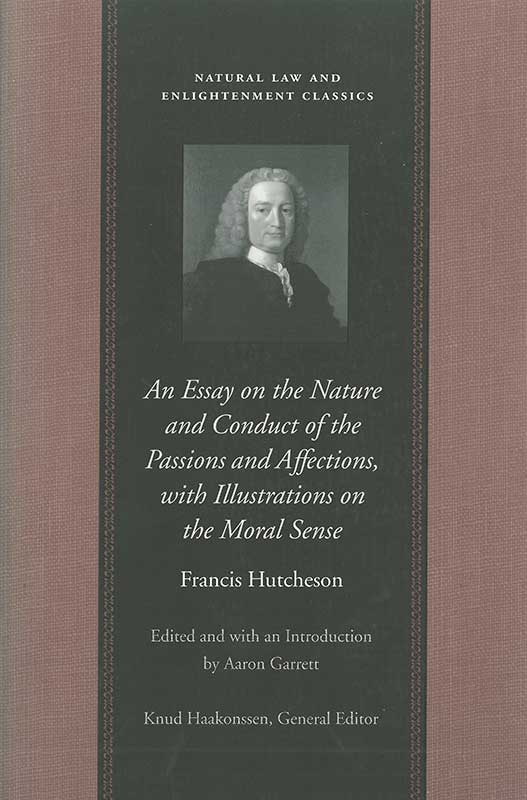
Front Page Titles (by Subject) the preface - An Essay on the Nature and Conduct of the Passions and Affections, with Illustrations on the Moral Sense
Return to Title Page for An Essay on the Nature and Conduct of the Passions and Affections, with Illustrations on the Moral SenseThe Online Library of LibertyA project of Liberty Fund, Inc.Search this Title:Also in the Library:
the preface - Francis Hutcheson, An Essay on the Nature and Conduct of the Passions and Affections, with Illustrations on the Moral Sense [1742]Edition used:An Essay on the Nature and Conduct of the Passions and Affections, with Illustrations on the Moral Sense, ed. Aaron Garrett (Indianapolis: Liberty Fund, 2002).
About Liberty Fund:Liberty Fund, Inc. is a private, educational foundation established to encourage the study of the ideal of a society of free and responsible individuals. Copyright information:The copyright to this edition, in both print and electronic forms, is held by Liberty Fund, Inc. Fair use statement:This material is put online to further the educational goals of Liberty Fund, Inc. Unless otherwise stated in the Copyright Information section above, this material may be used freely for educational and academic purposes. It may not be used in any way for profit.
the preface[iii] Altho the main practical Principles, which are inculcated in this Treatise, have this Prejudice in their Favour, that they have been taught and propagated by the best of Men in all Ages, yet there is reason to fear that renewed Treatises upon Subjects so often well manag’d, may be look’d upon as superfluous; especially since little is offer’d upon them which has not often been well said before. But [iv] beside that general Consideration, that old Arguments may sometimes be set in such a Light by one, as will convince those who were not [iv] moved by them, even when better express’d by another; since, for every Class of Writers, there are Classes of Readers adapted, who cannot relish any thing higher: Besides this, I say, the very Novelty of a Book may procure a little Attention, from those who over‐look the Writings which the World has long enjoy’d. And if by Curiosity, or any other means, some few can be engag’d to turn their Thoughts to these important Subjects, about which a little Reflection will discover the Truth, and a thorow Consideration of it may occasion a great Increase of real Happiness; no Person need be asham’d of his Labours as useless, which do such Service to any of his Fellow‐Creatures. [v] If any should look upon some Things in this Inquiry into the Passions, as too subtile for common Apprehension, and consequently not [v] necessary for the Instruction of Men in Morals, which are the common business of Mankind: Let them consider, that the Difficulty on these Subjects arises chiefly from some previous Notions, equally difficult at least, which have been already receiv’d, to the great Detriment of many a Natural Temper; since many have been discourag’d from all Attempts of cultivating kind generous Affections in themselves, by a previous Notion that there are no such Affections in Nature, and that all Pretence to them was only Dissimulation, Affectation, or at best some unnatural Enthusiasm. And farther, that to discover Truth on these Subjects, nothing more is necessary than a little Attention to what passes in our own Hearts, [vi] and consequently every Man may come to Certainty in these Points, without much Art or Knowledge of other Matters. [vi] Whatever Confusion the Schoolmen introduced into Philosophy, some of their keenest Adversaries 2 seem to threaten it with a worse kind of Confusion, by attempting to take away some of the most immediate simple Perceptions, and to explain all Approbation, Condemnation, Pleasure and Pain, by some intricate Relations to the Perceptions of the External Senses. In like manner they have treated our Desires or Affections, making the most generous, kind and disinterested of them, to proceed from Self‐Love, by some subtle Trains of Reasoning, to which honest Hearts are often wholly Strangers. [vii] Let this also still be remembred that the natural Dispositions of Mankind will operate regularly in those who never reflected upon them, nor form’d just Notions about them. [vii] Many are really virtuous who cannot explain what Virtue is. Some act a most generous disinterested Part in Life, who have been taught to account for all their Actions by Self‐Love, as their sole Spring. There have been very different and opposite Opinions in Opticks, contrary Accounts have been given of Hearing, voluntary Motion, Digestion, and other natural Actions. But the Powers themselves in reality perform their several Operations with sufficient Constancy and Uniformity, in Persons of good Health, whatever their Opinions be about them. In the same manner our moral Actions and Affections may be in good order, when our Opinions [viii] are quite wrong about them. True Opinions however, about both, may enable us to improve our natural Powers, and to rectify accidental Disorders incident unto them. And true Speculations on these Subjects must certainly [viii] be attended with as much Pleasure as any other Parts of Human Knowledge. It may perhaps seem strange, that when in this Treatise Virtue is suppos’d disinterested; yet so much Pains is taken, by a Comparison of our several Pleasures, to prove the Pleasures of Virtue to be the greatest we are capable of, and that consequently it is our truest Interest to be virtuous. But let it be remember’d here, that tho there can be no Motives or Arguments suggested which can directly raise any ultimate Desire, such as that of our own Happiness, or publick Affections (as we attempt to prove in Treatise IV;) [ix] yet if both are natural Dispositions of our Minds, and nothing can stop the Operation of publick Affections but some selfish Interest, the only way to give publick Affections their full Force, and to make them prevalent [ix] in our Lives, must be to remove these Opinions of opposite Interests, and to shew a superior Interest on their side. If these Considerations be just and sufficiently attended to, a natural Disposition can scarce fail to exert it self to the full. In this Essay on the Passions, the Proofs and Illustrations of a moral Sense, and Sense of Honour are not mention’d; because they are so, in the Inquiry into Moral Good and Evil, in the first and fifth Sections. Would Men reflect upon what they feel in themselves, all Proofs in such Matters would be needless. [x] Some strange Love of Simplicity in the Structure of human Nature, [x] or Attachment to some favourite Hypothesis, has engag’d many Writers to pass over a great many Simple Perceptions, which we may find in our selves. We have got the Number Five fixed for our external Senses, tho Seven or Ten might as easily be defended. We have Multitudes of Perceptions which have no relation to any external Sensation; if by it we mean Perceptions, occasion’d by Motions or Impressions made on our Bodies, such as the Ideas of Number, Duration, Proportion, Virtue, Vice, Pleasures of Honour, of Congratulation; the Pains of Remorse, Shame, Sympathy, and many others. It were to be wish’d, that those who are at such Pains to prove a beloved Maxim, that “all Ideas arise from Sensation and Reflection,” had so explain’d [xi] themselves, that none should take their Meaning to be, that all our Ideas are either external Sensations, [xi] or reflex Acts upon external Sensations: Or if by Reflection they mean an inward Power of Perception, as I fancy they do, they had as carefully examin’d into the several kinds of internal Perceptions, as they have done into the external Sensations: that we might have seen whether the former be not as natural and necessary as the latter. Had they in like manner consider’d our Affections without a previous Notion, that they were all from Self‐Love, they might have felt an ultimate Desire of the Happiness of others as easily conceivable, and as certainly implanted in the human Breast, tho perhaps not so strong as Self‐Love. The Author hopes this imperfect Essay will be favourably re[xii] ceiv’d, till some Person of greater Abilities [xii] and Leisure apply himself to a more strict Philosophical Inquiry into the various natural Principles or natural Dispositions of Mankind; from which perhaps a more exact Theory of Morals may be formed, than any which has yet appear’d: and hopes that this Attempt, to shew the fair side of the human Temper, may be of some little use towards this great End. The principal Objections offer’d by Mr. Clarke of Hull, against the second Section of the second Treatise, occurr’d to the Author in Conversation, and had appriz’d him of the necessity of a farther illustration of disinterested Affections, in answer to his Scheme of deducing them from Self‐Love, which seem’d more ingenious than any which the Author of the Inquiry ever yet saw in print. He takes better from Mr. Clarke, all [xiii] other Parts of his Treatment, than the raising such an Outcry against him as injurious to Christianity,3 for Principles which some of the most zealous Christians have publickly maintain’d: He hopes Mr. Clarke will be satisfy’d upon this Point, as well as about the Scheme of disinterested Affections, by what is offer’d in the Treatise on the Passions, Sect. I. and designedly placed here, rather than in any distinct Reply, both to avoid the disagreeable Work of Answering or Remarking upon Books, wherein it is hard to keep off too keen and offensive Expressions; and also, that those who have had any of the former Editions of the Inquiry, might not be at a loss about any Illustrations or additional Proofs necessary to complete the Scheme. The last Treatise had never seen the Light, had not some worthy [xiv] Gentlemen mistaken some things about the moral Sense alledg’d to be in Mankind:4 Their Objections gave Opportunity of farther Inquiry into the several Schemes of accounting for our moral Ideas, which some apprehend to be wholly different from, and independent on, that Sense which the Author attempts to establish. The following Papers attempt to shew, that all these Schemes must necessarily presuppose this moral Sense, and be resolv’d into it: Nor does the Author endeavour to over-turn them, or represent them as unnecessary Superstructures upon the Foundation of a moral Sense; tho what he has suggested will probably shew a considerable Confusion in some of the Terms [xiv] much used on these Subjects. One may easily see from the great variety of Terms, and diversity of Schemes invented, that all Men feel something in their own Hearts recommending Virtue, which [xv] yet it is difficult to explain. This Difficulty probably arises from our previous Notions of a small Number of Senses, so that we are unwilling to have recourse in our Theories to any more; and rather strain out some Explication of moral Ideas, with relation to some other natural Powers of Perception universally acknowledg’d. The like difficulty attends several other Perceptions, to the Reception of which Philosophers have not generally assigned their distinct Senses; such as natural Beauty, Harmony, the Perfection of Poetry, Architecture, Designing, and such like Affairs of Genius, Taste, or Fancy: The Explications or Theories on these Subjects [xv] are in like manner full of Confusion and Metaphor. To define Virtue by agreeableness to this moral Sense, or describing it to be kind Affection, may [xvi] appear perhaps too uncertain; considering that the Sense of particular Persons is often depraved by Custom, Habits, false Opinions, Company: and that some particular kind Passions toward some Persons are really pernicious, and attended with very unkind Affections toward others, or at least with a Neglect of their Interests. We must therefore only assert in general, that “every one calls that Temper, or those Actions virtuous, which are approv’d by his own Sense;” and withal, that “abstracting from particular Habits or Prejudices, every one is so constituted as to approve every particular kind Affection toward any one, which argues no want of Affection toward others. And constantly to approve that Temper which desires, and those Actions which tend to procure the greatest Moment of Good in the Power of the Agent toward [xvii] the [xvi] most extensive System to which it can reach;” and consequently, that the Perfection of Virtue consists in “having the universal calm Benevolence, the prevalent Affection of the Mind, so as to limit and counteract not only the selfish Passions, but even the particular kind Affections.” Our moral Sense shews this to be the highest Perfection of our Nature; what we may see to be the End or Design of such a Structure, and consequently what is requir’d of us by the Author of our Nature: and therefore if any one like these Descriptions better, he [xvii] may call Virtue, with many of the Antients, “Vita secundum naturam;”5 or “acting according to what we may see from the Constitution of our Nature, we were intended for by our Creator.” [xviii] If this Moral Sense were once set in a convincing Light, those vain Shadows of Objections against a virtuous Life, in which some are wonderfully delighted, would soon vanish: alledging, that whatever we admire or honour in a moral Species, is the effect of Art, Education, Custom, Policy, or subtle Views of Interest; we should then acknowledge
—Pers. ’Tis true, a Power of Reasoning is natural to us; and we must own, that all Arts and Sciences which are well founded, and tend to direct our [xviii] Actions, are, if not to be called Natural, an Improvement upon our Nature: yet if Virtue be look’d upon as wholly Artificial, there are I know not what Suspicions against it; as if indeed [xix] it might tend to the greater Interest of large Bodies or Societies of Men, or to that of their Governors; whereas a private Person may better find his Interest, or enjoy greater Pleasures in the Practices counted vicious, especially if he has any Probability of Secrecy in them. These Suspicions must be entirely remov’d, if we have a moral Sense and publick Affections, whose Gratifications are constituted by Nature, our most intense and durable Pleasures. I hope it is a good Omen of something still better on this Subject to be expected in the learned World, that Mr. Butler, in his Sermons at the Rolls Chapel, has done so much Justice to the wise and good Order of our Nature; that the Gentlemen, who have oppos’d some other Sentiments of the Author of the Inquiry, seem convinc’d of a moral [xx] Sense.7 Some of them have by a Mistake made a Compliment to the Author, which does not [xix] belong to him; as if the World were any way indebted to him for this Discovery. He has too often met with the Sensus Decori & Honesti,8 and with the Δύναμις αγαθοειδὴς, to assume any such thing to himself. Some Letters in the London Journals, subscribed Philaretus,9 gave the first Occasion to the Fourth Treatise; the Answers given to them bore too visible Marks of the Hurry in which they were wrote, and therefore the Author declined to continue the Debate that way; chusing to send a private Letter to Philaretus, to desire a more private Correspondence on the Subject of our Debate. I have been since informed, that his Death disappointed my great Expectations from [xxi] so ingenious a Correspondent. The Objections proposed in the first Section of Treatise [xx] IV, are not always those of Philaretus, tho I have endeavour’d to leave no Objections of his unanswer’d; but I also interspersed whatever Objections occurr’d to me in Conversation on these Subjects. I hope I have not used any Expressions inconsistent with the high Regard I have for the Memory of so ingenious a Gentleman, and of such Distinction in the World. The last Section of the Fourth Treatise, was occasion’d by a private Letter from a Person of the most real Merit, in Glasgow; representing to me some Sentiments not uncommon among good Men, which might prejudice them against any Scheme of Morals, not wholly founded upon Piety.10 This Point is, I hope, so treated, as to remove the Difficulty. [xxii] The Deference due to a Person, who has appear’d so much in the learned World, as M. Le Clerc, would seem to require, that I should make some Defense against, or Submission to, the Remarks he makes in his Bibliotheque Ancienne & Moderne. But I cannot but conclude from his Abstract, especially from that of the last Section of the Inquiry, either that I don’t understand his French, or he my English, or that he has never read more than the Titles of some of the Sections: and if any one of the three be the Case, we are not fit for a Controversy.11 In the References, at bottom of Pages, the Inquiry into Beauty is called Treatise I. That into the Ideas of moral Good and Evil, is Treatise II. The Essay on the Passions, Treatise III. And the Illustrations on the moral Sense, Treatise IV. [2.]Hutcheson likely had in mind modern Epicureans: Mandeville, Hobbes, La Rochefoucault, and others. [3.]John Clarke repeatedly criticized Hutcheson for impiety. The Foundation of Morality closes: “I have naturally a peculiar Benevolence and Veneration for Persons of Good Parts and Learning, untainted with Pride, Pedantry, or ill Nature, such as our Author from his manner of Writing appears to me to be, and therefore I am heartily grieved upon his account, to find his Doctrine bear so hard upon the Christian Religion. Had it not clash’d so visibly with that, notwithstanding it being false, his Character would have appeared much fairer in the Eye of the World than it now does, or at least will do, when his Notion comes to be more generally and thoroughly scanned.” (p. 112). [4.]This is a reference to Hutcheson’s correspondence with Burnet (who equated the moral sense with Reason). See the Introduction. [5.]“Vita secundum naturam”—“a life according to nature”—is a central Stoical ethical doctrine as well as the name of a lost treatise by Zeno of Citium (see Diogenes Laertius, Vitae Philosophorum, VII.4), with whom Cicero identifies the phrase in De Finibus Bonorum et Malorum, IV.vi [14]. [6.]Persius, Satire, III.66. “[Learn] what we are, and for what we have come to be.” It is quoted by Shaftesbury and discussed in the “Miscellaneous Reflections,” III.1 (Shaftesbury, Characteristicks, III:97-8). [7.]This refers to John Clarke’s remark, “The Doctrine of a Moral Sense, and a Natural Benevolence founded thereon, is a very pretty ingenious Speculation, which the World is obliged to our Author for; and has, in my Opinion, a good deal of Truth in it, tho’ perhaps it may not be of that Universal Extent he pleads for,” (Foundation of Morality, 97). [8.]Hutcheson likely has De Officiis I [94] in mind, but the identification of what is appropriate and what is honorable is a common Ciceronian sentiment. Shaftesbury clearly had this passage in mind when he further identified it with the venusta (the lovely or beautiful)—“The Venustum, the Honestum, the Decorum of Things, will force its way. They who refuse to give it scope in the nobler Subjects of a rational and moral kind, will find its Prevelancy elsewhere, in an inferior Order of Things,” Shaftesbury, “Sensus Communis,” IV.2 (Characteristicks, I.92) further elucidated in “Miscellaneous Reflections” III.2 (Characteristicks, III.109–114). The phrase recurs in Hutcheson’s Reflection on Laughter in the Dublin Journal (Saturday, June, 5, 1725), no. 10, 38) collected in A Collection of Letters and Essays on Several Subjects Lately Publish’d in the Dublin Journal (London: J. Darby and T. Longman, 1729), 2 v. The Greek phrase, meaning the sense of the good or right, is replaced in the third edition with “loving mankind and having the form of the good.” [9.]This refers to the exchange with Gilbert Burnet in 1725, and Hutcheson has either confused the date of the exchange with the publication date of the first edition of the Essay with Illustrations, or with four letters in the London Journal (nos. 447, 450, 463, 468) written in response to and in defense of the Essay with Illustrations. See Bernard Fabian, “Bibliographical Note,” in Bernard Fabian (ed.), Collected Works of Francis Hutcheson (Hildesheim: Georg Olms Verlag, 1990), v. II vii–viii. [10.]It is not clear to whom this remark refers, but a possible candidate is Gershom Carmichael, whom Hutcheson replaced as Professor of Moral Philosophy at Glasgow University and who did not approve of Hutcheson’s “new light” philosophy. [11.]Hutcheson received two unpleasant reviews of the Inquiry in Francophone journals, first an anonymous notice in the Bibliothètheque angloise accusing him of having plagiarized Crousaz’s Traité du beau, and then a review by Jean Le Clerc in the Bibliothèque ancienne et moderne that repeated the charge. The Traité du beau bears only a surface similarity (at best) to Treatise 1, so these reviews quite justly irked Hutcheson, who wrote a letter to the editor responding to the comments in the Bibliothètheque angloise. |

Titles (by Subject)