EconlibThe LibraryOther Sites |
Front Page Titles (by Subject) Reading List - The Illusion of the Epoch: Marxism-Leninism as a Philosophical Creed
Return to Title Page for The Illusion of the Epoch: Marxism-Leninism as a Philosophical CreedThe Online Library of LibertyA project of Liberty Fund, Inc.Search this Title:Also in the Library:
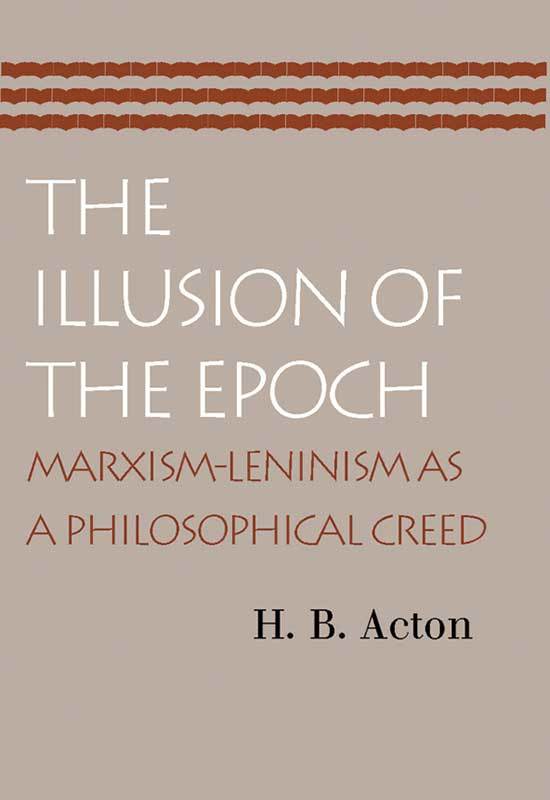
Reading List - H.B. Acton, The Illusion of the Epoch: Marxism-Leninism as a Philosophical Creed [1955]Edition used:The Illusion of the Epoch: Marxism-Leninism as a Philosophical Creed (Indianapolis: Liberty Fund, 2003).
About Liberty Fund:Liberty Fund, Inc. is a private, educational foundation established to encourage the study of the ideal of a society of free and responsible individuals. Copyright information:The copyright to this edition, in both print and electronic forms, is held by Liberty Fund, Inc. Fair use statement:This material is put online to further the educational goals of Liberty Fund, Inc. Unless otherwise stated in the Copyright Information section above, this material may be used freely for educational and academic purposes. It may not be used in any way for profit.
Reading ListThe following has no claim to be a bibliography, but is an annotated list of books and articles that I have found of particular value for the understanding of the philosophy of Marxism. Adams, H. P., Karl Marx in His Earlier Writings (London, 1940). Contains summaries of all the early writings (including the Doctoral Dissertation) and is therefore particularly useful for those who do not read German. Barth, Hans, Wahrheit und Ideologie (Zurich, 1945). This learned and skillfully constructed book deals especially with the origins of the idea of an “ideology,” and stresses the importance of this notion in Marx’s thought. It is a notable contribution to the history of ideas. Berlin, Isaiah, Karl Marx (London, 2nd edition, 1948). Especially chapters 3, 4, and 6 for a clear and perceptive introductory treatment. Bober, M. M., Karl Marx’s Interpretation of History (2nd edition, revised, Cambridge, Harvard University Press, 1950). It is essential to read the greatly revised second edition, which is a masterly exposition and criticism of Marxism by an economist. The most detailed and important criticism of the Materialist Conception of History that I know of. Bochenski, I. M., Der Sowjetrussische Dialektische Materialismus (Diamat) (Berne, 1950, 2nd revised edition, 1956). A short and clear exposition of current philosophical views in the Soviet Union, with a useful bibliography of about five hundred items. Hook, Sidney, From Hegel to Marx. Studies in the Intellectual Development of Karl Marx (London, 1936). Contains expositions of the views of those who chiefly influenced Marx’s early thought (Hegel, Feuerbach, Stirner, etc.). There is an Appendix with translations of important philosophical passages from Marx’s early writings. Hyppolite, Jean, “La Structure du ‘Capital’ et de quelques présuppositions philosophiques dans l’oeuvre de Marx.” Bulletin de la Société Française de Philosophie, 42e année, No. 6, Oct.–Dec. 1948 (Paris). The leading French Hegelian scholar uses his knowledge of Hegel to illuminate Marx’s thought. This valuable article is discussed by Aron, Bréhier, Madame Prenant, Rubel, and others. It is reprinted, without the discussion, in Hyppolite’s Etudes sur Marx et Hegel, pp. 142–68. Popitz, Heinrich, Der Entfremdete Mensch: Zeitkritik und Geschichts-philosophie des jungen Marx (Basel, 1953). A detailed exposition of Marx’s earliest writings showing their connections with the philosophy of Hegel. Popper, Karl, The Open Society and Its Enemies. Vol. 2, The High Tide of Prophecy: Hegel and Marx (London, 1945). This book is too well known to need comment from me, except to say that the detailed discussion of Marx’s social theories contained in it relates especially to methodological matters that I have not myself dealt with. The criticism is all the more telling by virtue of the sympathy shown toward some of Marx’s aspirations. Rotenstreich, Nathan, Marx’ Thesen über Feuerbach. Archiv für Rechts- und Sozialphilosophie, XXXIX/3 and XXXIX/4 (Berne, 1951). A commentary on the much-quoted “theses” in which the preeminence of “practice” in the Marxist outlook is demonstrated. Rubel, Maximilien, Pages choisies pour une éthique socialiste. Textes réunis, traduits, et annotés, précédés d’une introduction à l’éthique Marxienne (Paris, 1948). The form taken by this anthology makes it an important contribution to the interpretation of Marx. See the same author’s Karl Marx: Essai de biographie intellectuelle (Paris, 1957). Venable, Vernon, Human Nature, The Marxian View (London, 1946). A painstaking analysis and rather uncritical defense of the social theory of Marx and Engels. Wetter, Gustav A., S.J., Der Dialektische Materialismus: Seine Geschichte und sein System in der Sowjetunion (Freiburg, 1952). Translated into English from the 4th revised German edition by Peter Heath with the title Dialectical Materialism (London, 1958). A comprehensive (647 pp.) account of philosophy in the Soviet Union, containing detailed summaries and criticisms of leading books and articles published there. Indispensable for the student of Marxist-Leninist philosophy. There is a bibliography of 266 items, most of them in Russian or by Russians. The same author has a work in Italian, Il materialismo dialettico sovietico (Giulio Einaudi Editore, 1948), in which more space is given to “the classics” such as Lenin. The typeface used for this book is ITC New Baskerville, which was created for the International Typeface Corporation and is based on the types of the English type founder and printer John Baskerville (1706–75). Baskerville is the quintessential transitional face: it retains the bracketed and oblique serifs of old-style faces such as Caslon and Garamond, but in its increased lowercase height, lighter color, and enhanced contrast between thick and thin strokes, it presages modern faces. The display type is set in Didot. This book is printed on paper that is acid-free and meets the requirements of the American National Standard for Permanence of Paper for Printed Library Materials, z39.48-1992. (archival) Book design by Rich Hendel, Chapel Hill, North Carolina Typography by Tseng Information Systems, Durham, North Carolina Printed by Edwards Brothers, Inc., Ann Arbor, Michigan, and bound by Dekker Bookbinding, Grand Rapids, Michigan |

Titles (by Subject)