EconlibThe LibraryOther Sites |
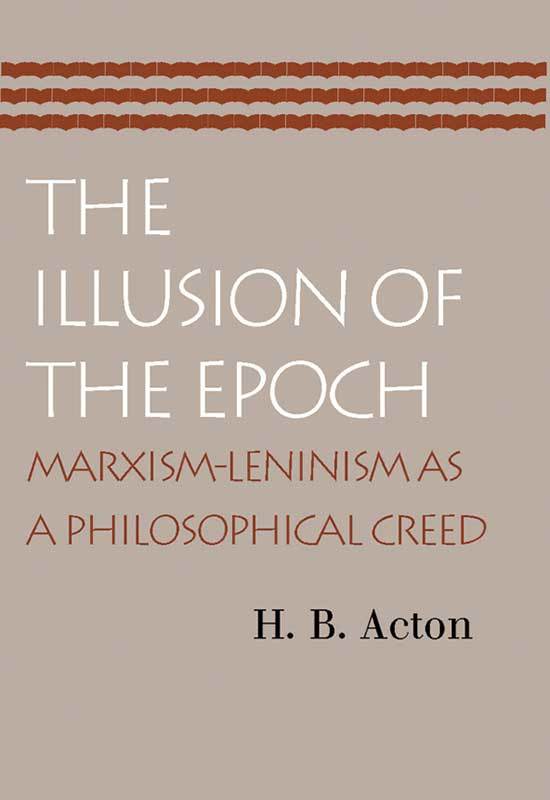
Front Page Titles (by Subject) I: Marxist Realism - The Illusion of the Epoch: Marxism-Leninism as a Philosophical Creed
Return to Title Page for The Illusion of the Epoch: Marxism-Leninism as a Philosophical CreedThe Online Library of LibertyA project of Liberty Fund, Inc.Search this Title:Also in the Library:
I: Marxist Realism - H.B. Acton, The Illusion of the Epoch: Marxism-Leninism as a Philosophical Creed [1955]Edition used:The Illusion of the Epoch: Marxism-Leninism as a Philosophical Creed (Indianapolis: Liberty Fund, 2003).
About Liberty Fund:Liberty Fund, Inc. is a private, educational foundation established to encourage the study of the ideal of a society of free and responsible individuals. Copyright information:© 1962 by H. B. Acton. The copyright to this edition, in both print and electronic forms, is held by H.B. Acton’s estate. It is reproduced here by permission and may not be reproduced in any form without written permission. Fair use statement:This material is put online to further the educational goals of Liberty Fund, Inc. Unless otherwise stated in the Copyright Information section above, this material may be used freely for educational and academic purposes. It may not be used in any way for profit.
IMarxist Realism1.Idealism and Phenomenalism“‘Naïve realism,’” writes Lenin, is “the instinctive, unconscious materialist standpoint adopted by humanity, which regards the external world as existing independently of our minds.”1 He also says: “The ‘naïve realism’ of any healthy person who has not been an inmate of a lunatic asylum, or a pupil of the idealist philosophers, consists in the view that things, the environment, the world, exist independently of our sensation, of our consciousness, of our self, and of man in general. . . . Materialism deliberately makes the ‘naïve’ belief of mankind the foundation of its theory of knowledge.”2 From these sentences it is clear that Lenin believed it was important to say that a physical world exists independently of any single mind, and independently of all human minds. To say these things, however, is to say what everyone (apart from a few Christian Scientists and perhaps some visionary philosophers) regards as obvious. Is it not quite certain that mountains, seas, and nebulae exist whether anyone is observing them or not? It is true, of course, that there are some material things, such as bridges and spoons, which owe many of their features to the men who made them. But surely they, no less than things which men have had no part in shaping, exist, once they are made, independently of their being perceived? Indeed, once this question is raised, the simple answer seems to be that what distinguishes perception from imagination or hallucination just is that what we perceive is something independent of our perceiving, whereas what we imagine or are deceived about somehow depends on some activity or defect within ourselves. We are thus inclined to say that unless the object perceived is something that exists independently of our perception, we are not really perceiving at all. Perceiving (which includes seeing, hearing, touching, tasting, smelling, or a combination of these) just is becoming aware of something independent of the perception. This is taken for granted by the vast majority of people, but by Marxists and by other philosophers who hold a realist theory of perception it is proclaimed as an important truth. It is almost as though someone were to make a parade of enunciating some such platitude as that fishes live in water. It would only be worth while asserting this if someone had denied it, and the reason for asserting the realist platitude is that in modern times some men of obvious ability and seriousness have denied it, or have appeared to do so. The non-Marxist realists are mainly concerned to show that the denial of this platitude is an error. Marxists endeavor to show that its denial is not only mistaken as a matter of theory but is practically harmful too. The circumstances in which the realist platitude came to be denied may be briefly described as follows. In the seventeenth century a number of writers, of whom Thomas Hobbes was the ablest and best known, inspired, in part, by the growth of mathematical physics, revived in a modified form the materialism which had been advocated in the ancient world by Democritus and the Epicureans. These ancient materialists had held that the physical things that to sight and touch appear solid and undivided are really composed of large numbers of ultimate, indivisible particles. In the heavier bodies the particles, which were called atoms, were closely packed together; in the lighter ones there was more empty space between them. They also held that souls were composed of similar but smaller atoms capable of slipping in between the larger atoms that composed living bodies. At death, both the atoms that formed the body and those that formed the soul became disarranged and at last dispersed, forming new bodies and new souls. These philosophers combined with their materialism a moral and psychological theory known as hedonism, according to which all living beings necessarily sought pleasure and avoided pain, the moral terms “good” and “bad” being therefore names for the pleasant and painful respectively. Thus, on their view morality consisted in the intelligent pursuit of pleasure and avoidance of pain. Materialists of the seventeenth century thought that this system of ideas, which in ancient times had been mainly a brilliant speculation, was supported by the mathematical physics of their own day. They believed that the behavior of things like rivers and billiard balls depended upon the nature and arrangement of the minute physical parts that composed them, so that an understanding of the larger scale things depended upon a knowledge of these material elements. As views such as these spread from scholars to the wider educated public, there were some who came to talk as though the sole realities were atoms and the space in which they moved, and everything else mere appearance or illusion. Heat was really a certain sort of agitation of particles, sound was really a movement of the air, and there was good authority for maintaining that even light was corpuscular in nature. Some of “the wits” of the time associated with this view about nature a cynical version of the morality of pleasure quite foreign to anything that Epicurus had taught, but nevertheless based on his views. Free-thinkers, atheists, and men of the world thus found a philosophy on which could be supported their denials of the existence of God, of the immortality of the soul, and of the freedom of the will. It was in refutation of views of this sort, as well as in refutation of the skepticism that prepared the way for them, that Berkeley constructed his “idealist” philosophy. This may be seen in his Philosophical Commentaries, the notes and arguments he recorded in preparation for his first books. Entry number 824, for example, reads: “My Doctrine rightly understood all that Philosophy of Epicurus, Hobbs, Spinoza etc. wch has been a declared enemy of Religion Comes to ye Ground.” The sub-title of his Treatise concerning the Principles of Human Knowledge runs: “Wherein the chief causes of error and difficulty in the Sciences, with the grounds of Scepticism, Atheism and Irreligion, are inquired into.” That of the Three Dialogues between Hylas and Philonous begins: “The design of which is plainly to demonstrate the reality and perfection of human knowledge, the incorporeal nature of the soul, and the immediate providence of a Deity.” His Alciphron or the Minute Philosopher, written later in life, enlarged the scope of the argument to take in the hedonism and egoism of Mandeville, the cynical author of the Fable of the Bees. Throughout Berkeley’s life it was “the modern free-thinkers” he had in mind, “the very same with those Cicero called minute philosophers;3 which name admirably suits them, they being a sort of sect which diminish all the most valuable things, the thoughts, views and hopes of men; all the knowledge, notions, and theories of the mind they reduce to sense; human nature they contract and degrade to the narrow low standard of animal life, and assign us only a small pittance of time instead of immortality. . . .”4 The master strokes in Berkeley’s idealist arguments were his denial of “material substance” and his assertion that the existence of the objects of sense experience was not distinct from their being perceived. The significance of this assertion may be seen from entry number 799 of the Philosophical Commentaries, which reads: “Opinion that existence was distinct from perception of Horrible Consequence it is the foundation of Hobb’s doctrine etc.” The arguments by which he hoped to establish idealism are complex and subtle, but for the purposes of our discussion of Marxism it must suffice to enumerate the following main contentions. (i) It may well be, Berkeley argues, that whenever we feel something hot there is normally a rapid movement of material particles in the hot thing. If, however, we attend to our experience of heat it will be seen that it is quite a different sort of thing from the movement of invisible particles. In order to attach any meaning to the view that heat is a movement of invisible particles we must first have had experience both of visible things in motion and of sensible heat, i.e., of the heat we feel when we touch something hot. So also with the movements of air which come to be called physical sound, and the movements of corpuscles which Newton held to be the basis of our experience of colors. Berkeley thus distinguished between the temperatures, sounds, and colors which we directly experience, and any entities, such as invisible particles, not directly experienced that may be regarded as their basis. The former he called “sensible qualities” (today they are generally called “sense data”), and the alleged unexperienced basis of them—not the atoms or particles themselves, but the entities supposed to have the size, shape, and motion of the particles—he called “corporeal substance.” His first contention is that, so far from the former being illusory or doubtful by comparison with the latter, any knowledge we may have of the latter can only be by means of the former. (ii) From what has been said it is clear that sense experiences cannot be dismissed as mere illusions whose reality is to be found in a hidden world of ultimate material substances. Having established that the existence of sense data is certain, Berkeley’s next task is to determine what sort of thing they are. On his view they depend on minds and are incapable of existing apart from them. His use of the word “idea” marks this dependence, although others before him had used the word in this way. His arguments for the view that ideas, i.e., sensible qualities or sense data, cannot exist, as he put it, “without the mind,” are difficult to summarize, but considerations such as the following weighed with him. Things existing independently of perceivers would have characteristics that did not vary with the position and condition of the perceiver. At any given time a liquid would have to have some definite temperature, a building some definite size and shape. In fact, however, a liquid may feel warm if the hand we plunge into it is cold, and cold if the hand we plunge into it is warm. Again, when, as we say, we look at a tall round tower on a distant hill, what we directly see is something small and flat. The same liquid cannot simultaneously be hot and cold, neither can the same tower be simultaneously big and small, round and flat. Berkeley showed, by a detailed analysis of each of our senses, that the nature of our sense experience varies with changes in ourselves. Perspectival distortions, mirror images, microscopes and telescopes, drugs and intoxicants, were all adduced by him to support the view that there is something in the very nature of sensible qualities that unfits them for existing apart from minds. (In recent years this interpretation of Berkeley’s meaning has been denied by eminent scholars, but there is no need for me to discuss this, since the interpretation I have given is that of most of Berkeley’s readers, and is that of his realist and materialist critics.) (iii) It might be suggested, however, that sense data are mental existences caused in us by independently existing physical objects. If this were so, sense data, as the mental effects of physical causes, would be incapable of existing outside minds and so could be rightly called “ideas,” but would nevertheless presuppose non-mental existences that were not sense data. Berkeley considered that such a supposition was meaningless. He challenged his readers to make clear what such non-sensible things “without the mind” could be, and thus set them the task of describing something that had no color, hardness, shape, size, speed, etc., that is, he set them the task of describing the indescribable. A “corporeal substance” that had no sensible temperature, taste, color, hardness, or shape, could be neither large nor small, rapid nor slow. Any definite characteristics attributed to it could only be described in terms of one or more of the senses, and so in terms of something that cannot exist “without the mind.” In order to avoid such attributions recourse must be had to indefinite characteristics, and it then becomes necessary to talk of something or other that has no color, no shape, no size. This, Berkeley held, was to talk to no purpose. To attribute wholly indefinite characteristics to matter was to imply that matter was nothing at all. To say that matter has characteristics that belong to sense data is to say that matter has characteristics that cannot exist “without the mind,” and this is to deny that there is any matter at all. (iv) Berkeley also argued that the notion of something existing independently of mind was a contradictory notion. For, in order to conceive of something existing independently of mind, we must conceive of it, and this, he considered, was the same thing as to conceive of something that is not conceived of, and that is contradictory. (v) The four preceding contentions make up what is sometimes referred to as Berkeley’s “immaterialism,” i.e., his denial of the existence of matter. But although Berkeley denied the existence of matter, he was not so foolish as to deny that such concrete things existed as stars, stones, animals, and fruit. These, he held, were not inaccessible nothings behind the scenes, but were the very things we saw, touched, smelled, and tasted. A cherry, for example, was not some recondite whirl of featureless atoms, but something round and red that is seen and tasted. It is not, of course, revealed in any single view, or touch, or taste; we are only entitled to say there is a cherry when we know there is a whole series of such sense data to be expected. To say there is a cherry on the tree in the garden is to say that someone who goes into the garden will see certain colored shapes and will be able to enjoy certain tastes and smells. The cherry just is the whole group (Berkeley called it a “congeries”) of sense data that we say belong to it. And in general terms the view is that material things are certain classes or series of sense data. (vi) We have so far considered Berkeley’s theory of “ideas,” but minds we have only mentioned as those things on which “ideas” depend, as those things that “ideas” must be in, since they cannot exist “without” them. It was his view that each of us has direct knowledge of mind in the experience he has of himself. Such experience is quite different from the experience we have of “ideas,” in that “ideas” are passive objects whereas mind is experienced as active subject. Apart from minds and their “ideas” there is nothing else, according to Berkeley, that we can conceive of. (vii) Nevertheless we cannot possibly deny that a world exists independent of human minds, and that parts of it continue to exist when no human minds are conscious of it. There are, for example, things buried in the earth or carried in the stars which no human being has ever been aware of. Berkeley believed that once it has been established that nothing can conceivably exist except minds and “ideas,” it follows that the parts of nature that are not “ideas” in the minds of human beings or of other finite creatures must be “ideas” in the mind of an Infinite Being. In this way, he held, the existence of God could be proved in a way not hitherto thought of. He held further that, since the only conception we have of activity is the conception we have of a mind’s acts of will, and since there can be no cause without activity, “ideas,” not being minds but merely depending on them, cannot be causes at all. What is not caused by the acts of will of finite minds can, therefore, only be caused by God’s activity. Hence, the regularities of nature are the regularities of God’s acts of will, so that as we extend our knowledge of nature we gain an indirect knowledge of the Divine decrees. According to Berkeley, therefore, just as we gain a knowledge of other men’s minds from what we see of their behavior, so we gain a knowledge of God from our exploration of the natural world. Hence the experimental sciences do not undermine religion, but continually vindicate and enrich it. We may now summarize this summary as follows. According to Berkeley, (i) there is a class of directly perceived passive entities which we may call sense data. (ii) Sense data would not exist unless minds existed, but (iii) cannot depend for their existence on non-sensible beings independent of minds since no conception of such “corporeal substances” can possibly be formed. (iv) The conception of “corporeal substance,” indeed, is self-contradictory. (v) Nevertheless, such things as stars, stones, and cherries do exist, but are not “corporeal substances,” but groups of sense data. (vi) Minds are known to exist by the direct knowledge we have of our own. (vii) The system of nature distinct from human minds is a system of “ideas” willed by God. Now Berkeley developed these views in criticism of men who, priding themselves on accepting nothing as true which experience did not guarantee, regarded matter as the sole reality and mind and sense experience as somehow illusory. Berkeley agreed that the appeal should be to experience, but thought he could show that whereas the views of materialists went beyond what experience could justify, a resolute refusal to go beyond it leads to the conclusion that matter does not exist, and that minds, both human and divine, do. For matter, as distinct from what is seen, felt, heard, etc., is a meaningless conception, whereas we know our own minds directly, and gain a knowledge of God by analogy. Thus Berkeley held that a resolute attachment to experience leads, not to materialism and atheism, but to immaterialism and theism. He has thus been regarded as a founder of the philosophical movement known as idealism. Many subsequent philosophers, however, have distinguished between Berkeley’s policy of refusing to go beyond what experience can justify, and the idealistic and theistic conclusions he thought resulted from it. They have distinguished, that is, between his attempted justification of Christian theism, and his careful analysis of experience. The latter, they have said, was the cleverest attempt hitherto made to show precisely what we refer to in experience when we talk about “things,” “perception of things,” “illusions,” “mere imaginations,” “causes,” “general ideas,” and the like. The former, however, they think does not fit in very well with the latter, if indeed it is compatible with it at all. Thus they distinguish between the empiricism in Berkeley’s philosophy, that is, the aspect of it that is an attempt to base all knowledge on experience, and the theism in it, and this latter they ignore or reject. The essence of his empiricism is that no conceptions or principles of explanation are to be admitted which refer beyond experience to something that could not be experienced. In so far as matter is something distinct from any sense datum or group of sense data, and distinct also from the minds on which they depend, it is something that could not be experienced, and therefore, according to Berkeley, nothing at all. Nevertheless, things such as stars, stones, and trees certainly exist, but they are not distinct from sense data but are rather groups of them. Any meaning that words such as “atom,” “force,” and “infinitesimal” may have must be in terms of the sense data we experience rather than in terms of matter lying beyond them. According to Berkeley, therefore, the knowledge gained in the natural sciences is a knowledge of how sense data or groups of sense data accompany one another or are signs of one another. This view of the nature of science according to which there is no matter beyond sense data, and according to which natural science is a knowledge of the regular associations and sequences of sense data, is today called phenomenalism. We may say that phenomenalism is the working out of the implications of propositions (i), (iii), and (v) above, although some phenomenalists may accept propositions (ii) and (iv) as well. Most phenomenalists would reject proposition (vi), since they would hold that, just as physical things are groups of sense data, so minds are another sort of group of sense data with which are connected feelings, feelings being a different sort of experience from sense data. All phenomenalists would reject proposition (vii), since they would hold that “God” does not stand for anything that could be experienced. If “matter” is meaningless if understood to stand for some unexperienced basis of experience, then, for the same reasons, “God” is meaningless if used to stand for some different unexperienced basis of experience. Phenomenalists have sometimes said that their view is consistent empiricism. Perhaps the best known statement of phenomenalism is that contained in J. S. Mill’s Examination of Sir William Hamilton’s Philosophy, where the existence of matter is not denied but where Berkeley’s view is upheld by defining matter as “a Permanent Possibility of Sensation.”5 On this view, to say that a physical object, say a chair, exists even when no one is observing it, is to say that in such and such circumstances, for example, by entering the room and turning on the light, it can be observed. So long as it remains possible to observe it, so long the physical thing may be said to exist. In effect, the phenomenalist defines matter as the “congeries of ideas” that Berkeley substituted for the materialists’ “material substance.” Phenomenalism is regarded as the necessary outcome of the intellectual policy of refusing to go beyond what experience guarantees. If phenomenalism is true, then the task of science is to explore the regularities of actual and possible experiences and feelings. We might say that when God and active mind are subtracted from Berkeley’s philosophy the result is phenomenalism. 2.Marxist Criticisms of Idealism and PhenomenalismA detailed discussion of these matters from a Marxist point of view is to be found in Lenin’s Materialism and Empirio-Criticism. An account of how this book came to be written is contained in chapter 4 of the Soviet History of the Communist Party of the Soviet Union, as well as in Lenin’s own preface to the first edition (1909), and Professor Deborin’s preface to volume 13 of the 1927 edition of the English translation of Lenin’s Collected Works. In brief, it appears that a number of members of the Russian Social Democratic Party had been reading books by Ernst Mach and Richard Avenarius in which, under the name of “empirio-criticism,” a phenomenalist account of matter was advocated. These Russian socialists became convinced both that phenomenalism was true and that it was compatible with Marxist materialism. Lenin considered they were wrong on both counts, and thought it most important to convict them of error. Thus he says that he wrote Materialism and Empirio-Criticism “to seek for the stumbling block to people who under the guise of Marxism are offering something incredibly baffling, confused and reactionary.”6 Lenin worked on the material for this book in the British Museum in 1908. In Materialism and Empirio-Criticism Lenin touches on many topics in a highly controversial manner. It seems to me, however, that he argues for four main positions which may be summarized as follows: (a) Phenomenalism cannot be detached from idealism. Since, therefore, the function of idealism is to provide philosophical support for religious faith (called by Lenin “fideism”), phenomenalism too is religious in its tendency, whatever its supporters may say about it. (b) Phenomenalism is false. Lenin thinks he can show its falsity, in the first place by reference to practice or action, and in the second place by showing that if it were true, then well-attested scientific theories to the effect that the world existed for a long time before living beings inhabited it, would have to be denied. (c) The denial of phenomenalism involves the assertion that matter exists, in the sense of a reality that is neither sense datum nor mind. Matter, according to Lenin, is “the objective reality which is given to man by his sensations, and which is copied, photographed and reflected by our sensations, while existing independently of them.”7 He also says: “To regard our sensations as images of the external world, to recognize objective truth, to hold the materialistic theory of knowledge—these are all one and the same thing.”8 (d) At the end of the book Lenin argues that there is no foundation for the view that materialism is being rendered untenable by new discoveries in physics, and in particular by “the electrical theory of matter.” In his view, new physical discoveries such as those that led to the abandonment of the “billiard ball” view of matter, can only lead us to the discovery of new characteristics of matter, not, as had been held by some, to its “disappearance.” In the following sections of this chapter I shall discuss the first three of these contentions. 3.Phenomenalism, Idealism, and the Religious OutlookIn effect, what Lenin (and subsequent Marxist writers) maintain is that the proposition that there can be no “material substance” (which I labelled (iii) on page 7), and the proposition that inanimate things such as tables are groups of sense data (which I labelled (v) on page 8), and which together comprise the essentials of phenomenalism, are inseparable from the other parts of Berkeley’s philosophy, so that once we accept them we open the way to theism and religion. Now this may be understood in two ways. In the first place it may be suggested that in fact phenomenalism is a step on the road to idealism and religion. On this view, what is being suggested is that whether or not idealism follows from phenomenalism and theism follows from idealism and religion follows from theism, those who accept the phenomenalist arguments either themselves pass on to idealism, theism, and religion, or at any rate encourage others to do so. In the second place it may be suggested that phenomenalism, idealism, theism, and religion are logically connected, so that were the first true, the second, third, and fourth would also have to be true. I think that Lenin held both of these views, and in this section I shall say something about each of them. First, then, as to the view that phenomenalism is in fact connected with idealism, theism, and religion. Lenin, following Engels,9 believed that idealism and materialism were the only two philosophies that counted, that idealism was a system of thought that constantly endeavored to put the best possible face on what Marx (following Feuerbach) had called the “mystifications” of priests and other agents of the ruling classes, and that the revolutionary working class must base their thought and action on materialism if they are to succeed in freeing themselves from the bonds which their masters have fastened on them. Idealism, Lenin wrote, “is merely a subtle, refined form of fideism, which stands fully armed, commands vast organizations and steadily continues to exercise an influence on the masses, turning the slightest vacillation in philosophical thought to its own advantage.”10 His objection to phenomenalism is a social one. The emergence of phenomenalism as a philosophical theory which criticizes both idealism and materialism confuses the clear-cut issue which Lenin is intent on establishing. Who is not for the working class movement is against it. Idealism, theism, and religion, Lenin thought, are obviously against it, and any other view that is not wholeheartedly materialistic, although it may not be openly and consciously against it, is so in tendency, and perhaps covertly also. Thus he concluded: “The objective, class rôle played by empirio-criticism entirely consists in rendering faithful service to the fideists in their struggle against materialism in general and against historical materialism in particular.”11 Stalin allows these thinkers even less credit than Lenin when, in chapter 4 of the History of the Communist Party of the Soviet Union, he writes: “In reality, they were hostile to Marxism, for they tried to undermine its theoretical foundations, although they hypocritically denied their hostility to Marxism and two-facedly continued to style themselves Marxists.”12 I cannot hope to deal, at the present stage, with all the issues that would need attention if this view were to be discussed fully. In particular, it will be seen that Lenin thinks it relevant to criticize a philosophical theory about perception on the ground of its possible social and political repercussions. On the face of it, this may not seem defensible, since a true theory might conceivably have bad political results, and a theory which had good political results might conceivably be false. However that may be—it is a theme discussed on page 191 below—Lenin’s generalization that phenomenalism is allied with idealism and religion is much too narrowly based. He refers to a few Russian Social Democrats who flirted with empirio-criticism and suggested that some form of religious organization was desirable in which God was equated with the social good, and also to some associates of Mach and Avenarius who were willing to be called philosophical idealists. In the history of European thought as a whole, however, the exponents of phenomenalism have generally been indifferent, if not hostile, to religion. We need only mention such thinkers as Protagoras, Hume, Bentham, James Mill, J. S. Mill, and Karl Pearson. It is worth noting that J. S. Mill, a few sentences after he has given his phenomenalistic definition of matter, writes: “But I affirm with confidence that this conception of Matter includes the whole meaning attached to it by the common world, apart from philosophical, and sometimes from theological theories.”13 It is difficult to resist the conclusion that Lenin’s attitude to phenomenalism is that of the revolutionary administrator, for whom clear-cut decisions were essential. The revolutionary workers needed a this-worldly philosophy of matter to arm them against the enervating influence of religion, and Lenin felt that those who departed from the materialist simplicities were unreliable palterers. We now pass to the contention that idealism, theism, and religious belief follow logically from the doctrine of phenomenalism. According to the phenomenalists, the only terms or expressions (apart from those of logic) that can have meaning are those which refer directly or indirectly to sense-experiences, among which, of course, are included experiences of pleasure and pain, of effort, resistance, and the like. Thus the term “matter,” if it is not used to refer to actual or possible sense-experiences, is meaningless, and the term “mind” is meaningless also, unless it is used to refer to actual or possible feelings associated with actual or possible sense-experiences. Now the term “God” is generally held to refer to an infinite, active, non-sensible spirit who transcends the natural world. Most phenomenalists, I think, would argue that meaning cannot be attached to such a term, that they cannot conceive what it would be like to experience God, and that therefore what religious people call “the worship of God” cannot be what they take it to be. If phenomenalism is true, and if God is held to be a being that could not be directly or indirectly experienced by the senses, then the existence of God cannot be meaningfully asserted or denied. To argue thus that the notion of God is meaningless is, it seems to me, to oppose the religious view of things much more radically than even atheists do. The atheist has common ground with the theist in so far as he admits that the theist’s belief has point, whereas the phenomenalist regards the dispute between them as insignificant, and when he says so both parties are disturbed. We may conclude, therefore, that this part of Lenin’s attack on phenomenalism is less effective as a social tactic than he himself supposed. For, whereas phenomenalism, by denying meaning to any conceptions except those based directly or indirectly on sense-experience, consigns both God and material substances to a common and irrelevant grave, materialism, by asserting the reality of material substances beyond sense-experience, allows also the possibility of a God that transcends sense-experience too. Phenomenalism excludes God but appears committed to some sort of idealism. Materialism excludes phenomenalism but only at the expense of making God appear a possibility. The revolutionary tactician cannot afford to ignore this dilemma. To be offset against the atheism of phenomenalism is, however, its alleged conflict with natural science. This made Lenin particularly suspicious of it, since he considered that the natural sciences provided the detailed content of materialism. Our next step, therefore, must be to consider his direct arguments against a phenomenalistic, and in favor of a realistic, theory of perception. 4.Lenin’s Criticisms of PhenomenalismMarxists hold that religion is used by the rich as a means of reconciling the poor to their poverty, and that idealism (with which, as has already been explained, they associate phenomenalism) is a deliberate attempt to reinforce this policy in the face of the religious unbelief that the natural sciences encourage. There is no doubt that they think that idealism is a dishonest view. They feel that, however subtle the arguments in its favor, it is fundamentally unbelievable. A man may deny the reality of matter with his lips, but his life and actions belie what his lips have uttered. For most men life has been a losing struggle against scarcity and disease, and for everyone the end is death. The few fortunate have material things at their command, the many unfortunate are the slaves of circumstance. Rich men and their clients, therefore, may affect to despise material things, and may even employ their leisure in demonstrating that there are none. But their ability to do these things depends upon there being food and shelter and leisure at their disposal. If they reflected on how the majority of men lived, they would realize that ingenious idealist speculations are frivolous insults to suffering mankind. It is in the light of such considerations, I think, that Lenin’s attack on phenomenalism is to be understood. In the first chapter of Materialism and Empirio-Criticism he suggests that it is characteristic of contemporary (i.e., Marxist) materialism to hold that “arguments and syllogisms alone do not suffice to refute idealism, and that here it is not a question of theoretical argument.”14 Further on he writes: “The standpoint of life, of practice, should be first and fundamental in the theory of knowledge, and it inevitably leads to materialism, brushing aside the endless fabrications of professorial scholasticism.”15 Again, in his Philosophical Notebooks Lenin comments on a passage in Hegel’s History of Philosophy in which the great idealist philosopher criticizes Epicurus for not having gone beyond “the common human understanding.” Lenin’s comment is: “Slanders against materialism. . . . Its [i.e., Idealism’s] non-agreement with ‘the common human understanding’ is the lazy whim of the Idealists.”16 Lenin also quotes with approval Feuerbach’s remark that before we can perceive we must be able to breathe and feel. He does not do so, but he might have quoted the following passage from Feuerbach’s Preliminary Theses towards the Reform of Philosophy (1842) which had undoubtedly impressed Marx: “The denial in metaphysics of the reality of space and time in the very nature of things has the most injurious practical consequences. Only a man who everywhere bases himself on time and space can achieve tact in living and practical understanding. Space and time are the basic criteria of practice. A people which excludes time from its metaphysic, which bows down before eternal existence, that is, abstract existence cut off from time, excludes time also from its politics and bows down before an anti-historical principle of stability that is contrary to right and reason.”17 In section 33 of his Foundations of the Philosophy of the Future (1843) Feuerbach had also written: “. . . Love is the true ontological proof of the existence of an object outside our heads, and there is no other proof of existence except love, and sensation in general.” From Lenin’s statements, and from those of Feuerbach from which they derive, we may extract the following main positions. (i) Even though an individual could not, from mere observation of his own sense-experiences, prove the existence of a material world existing independently of him, all his actions, as distinct from his theorizing, demonstrate in a practical way the truth of the realist platitude. (ii) Even though we were unable to find satisfactory counter-arguments to the arguments of the idealists, it would be right for us to prefer to the most brilliant of such arguments the naïve realism which we presuppose when we eat our meals and associate with our fellows. (iii) To accept the conclusions of elaborate philosophical arguments rather than what is presupposed in our dealings with the world and other men is socially disastrous and unjust. Before we consider these arguments, it should be mentioned that they are not new. In the ancient world the Stoic philosophers, seeking to uphold the practical moral certainties against the subtle arguments of the Skeptics, argued in somewhat similar terms. Zeno of Citium, the founder of the School, had spoken of the “grasp” by which real things were certainly known. Cicero, in reproducing Zeno’s view, writes: “Therefore those who assert that nothing can be grasped deprive us of these things that are the very tools and equipment of life. . . .”18 The following passage from the Moral Discourses of Epictetus stresses the superiority of practice to speculation. “Let the followers of Pyrrho or of the Academy [i.e., the Skeptics] come and oppose us. Indeed I, for my part, have no leisure for such matters, nor can I act as advocate to the commonly received opinion. If I had a petty suit about a mere bit of land, I should have called in someone else as my advocate. With what evidence, then, am I satisfied? With that which belongs to the matter in hand. To the question how perception arises, whether through the whole body, or from some particular part, perhaps I do not know how to give a reasonable answer, and both views perplex me. But that you and I are not the same persons, I know very certainly. Whence do I get this knowledge? When I want to swallow something, I never take the morsel to that place but to this;19 when I wish to take bread, I never take sweepings, but I always go after the bread as to a mark. And do you yourselves, who take away the evidence of the senses, do anything else? Who among you when he wishes to go to a bath goes to a mill instead? Ought we not to the best of our ability to hold fast also to this—maintain, that is, the commonly received opinion, and be on our guard against the arguments that seek to overthrow it?”20 In this passage we may particularly note (a) the scorn with which Epictetus says he has “no leisure for such matters,” thus suggesting that Skepticism is the fruit of irresponsible idleness; (b) the claim that practical certainty rightly overrides theoretical perplexity; and (c) the weight given to “the commonly received opinion.” In chapter 5 of the same book Epictetus had discussed the skeptical argument that there is no certain means of distinguishing between dreaming and waking, and had asserted that a man who persists in maintaining this argument is devoid of shame and modesty, and is like a drunk man who says whatever comes into his head. It would be tempting for the Marxist to say that it was because he was a slave that Epictetus came to express, eighteen hundred years ago, a view so very like the Marxist one. This temptation, however, should not be yielded to, since Epictetus was restating views which had been expressed long before his time by Stoic philosophers who were not slaves. In the eighteenth century, Thomas Reid, the philosopher of Common Sense, maintained a similar point of view. In his Inquiry into the Human Mind (1764) he wrote: “The belief of a material world is older, and of more authority, than any principles of philosophy. It declines the tribunal of reason, and laughs at all the artillery of the logician.” In his Essays on the Intellectual Powers of Man (1785) he included among his Principles of Common Sense the proposition: “That those things do really exist which we distinctly perceive by our senses, and are what we perceive them to be.” He also argued that, although Berkeley did not intend it, his philosophy would lead each individual, if he were to be consistent, to believe that he could be certain only of his own existence and must be doubtful of that of others. “It stifles every generous and social principle.”21 In our own day, Professor G. E. Moore has said that, in order to prove that there are at least two external objects, it is sufficient for a man to hold up both his hands to his own view and that of other people. In the face of the arguments of idealist philosophers, it is appropriate, he holds, to restate the realist platitude with a number of supporting explanations.22 It will be seen that Epictetus, Reid, Feuerbach, and Lenin are all, in their different ways, concerned lest certain subtle philosophical arguments should turn men from their social duties by raising doubts about the existence of matter and of other people. Epictetus had in mind those Skeptics who argued that the result of admitting their skeptical conclusions should be a holding back from human affairs, a refusal to commit oneself in the uncertainties of social life. What effects, however, could the acceptance of the skeptical or idealist arguments have on anyone’s attitude to what they had previously taken to be material things and other people? Could anyone ever seriously say: “I have been reading Hume, and have been convinced by him that there are no satisfactory grounds for believing in the independent existence of material things or of people other than myself. I shall therefore cease to eat and drink, and I shall take no further interest in such doubtfully existing beings as other people.” Hume’s own conclusion was very much less dramatic. “I dine,” he wrote, “I play a game of backgammon, I converse, and make merry with my friends; and when after three or four hours’ amusement, I wou’d return to these speculations, they appear so cold, and strain’d, and ridiculous, that I cannot find in my heart to enter into them any farther.” Arguments to show that the existence of a material world and of other people is doubtful, carry conviction, if at all, only while they are being propounded and attended to, and are overwhelmed by the ordinary affairs of living. We may compare someone in doubt whether the substance he sees before him is cheese or soap, with someone else in doubt whether cheese or soap or any material thing really exists at all. The doubt of the first man can be set at rest by smelling or tasting or in some other obvious way. It is the sort of doubt that can be fairly readily removed after a few tests have been made. The doubt of the second man is rather different, since no amount of looking or tasting will get rid of it. One reason for this is that he considers that it is always possible that some new experience will arise to conflict with what the previous tests have established. These tests, he reflects, have only been applied up to now, so that we cannot be quite sure what they will reveal when next they are made. But such a doubt, surely, is never relevant in the sphere of action, since if it were, action could never take place, but would remain ever poised on the brink of an ever receding penultimate test. If we are to act at all, we must be willing to use tests which establish reality in a finite number of moves. The skeptic’s doubts, therefore, are not of practical relevance in a world where, as we know, doubts have to be, and frequently are, brought to a settlement. Furthermore, were a skeptic to use his sort of doubt as reasons for not troubling about the material needs of other people—“if there is no matter and if there are no other people with material needs, then I need not trouble about them”—and were he to continue attending to his own material needs we should say that he was dishonest as well as irrelevant. I cannot suppose that anyone ever has argued in quite this way, but Marxist thinkers may well have believed that something of the sort was the philosophical counterpart to the wealthy Christian’s advice to the poor man to seek for heavenly rather than for earthly treasures. We can now see that there is some point in Lenin’s favorable view of the common human understanding. Skeptics and idealists must act as if they were fully assured of the existence of matter and of embodied mankind. These considerations, however, have not disposed of phenomenalism. For phenomenalism is not the view that there is no material world, nor the view that the existence of the material world is problematical, but the view that the material world is nothing but actual and possible sense data. It will be remembered that Berkeley was careful to say that he did not deny the existence of cherries; his view was that cherries are what can be seen, touched, and tasted when, say, someone goes into the garden. On his view, a cherry is the whole group of sense data that we say “belong” to it. Now arguments about practice can be used to overthrow the view that the existence of matter may be doubted or denied, but they do not succeed, as Lenin thought they did, in disposing of the view that matter just is actual and possible sense data. The sort of practical activity that Feuerbach and Lenin cited in refutation of phenomenalism were such things as loving, eating, and breathing, but these, and other practical activities, can be accounted for by the phenomenalist within his scheme. According to the phenomenalist, the activity of eating would consist of certain feelings of effort and of pressure, along with the visual, tactile, and taste sensations which link the eating with the thing that is being eaten. Similarly, in terms of what is being experienced, breathing consists of certain visual sensations of movement (e.g., the observed movements of the chest), certain auditory sensations which we describe as the sound of breathing, and, in the breather, the feelings he has when he attends to his breathing or when something interferes with it. What especially seems to be involved in action is sensations of effort meeting with some resistance. The phenomenalist will say, however, that both the effort and the resistance to it are only describable in terms of sensation. If phenomenalists were to confine their descriptions to the data of the so-called five senses, then, of course, practice would be a notion that could not be comprised in their theory. Once, however, the notion of sense-experience is extended to include pleasure and pain and the bodily feelings called “organic sensations,” practice presents the phenomenalist with no insuperable theoretical difficulties. He would claim to be giving a different account of what material things are and of what practice is from that assumed by the realist, and he would also claim that his account is superior to that of the realist, since the realist believes in things-in-themselves which are never directly experienced and transcend all possible experience, whereas the phenomenalist brings into his theory only such entities as are or could be directly experienced and cannot therefore be questioned. It does not seem to me, therefore, that the Marxist can, by appealing to practice, refute the phenomenalist who sets out to give an account of matter in purely empirical terms. We may briefly restate the argument as follows. The phenomenalist says that a material object, say a cherry, is “a permanent possibility of sensation.” The Marxist replies that we know of the existence of cherries, not by merely experiencing sense data, but by picking and eating and other such deeds. It is absurd, he may continue, to suggest that we can pick and eat permanent possibilities of sensation, and therefore practice shows that it is cherries—material things, not sense data—that are the objects of our perception. It seems to me, however, that the phenomenalist has a thoroughly satisfactory answer to this. The absurdity of talking about picking and eating permanent possibilities of sensation, he will say, depends upon giving the analysis of cherries in terms of sense data and at the same time refraining from giving the analysis of picking and eating in similar terms. If matter is reducible to actual and possible sense data, then action is reducible to actual and possible feelings and sense data. The argument from practice, therefore, has force against the doubter and denier of matter, but not against the phenomenalist, who is not really doubting or denying matter but claiming to say what it is. Let us then see whether Lenin’s other main line of criticism succeeds in refuting phenomenalism. This other line of criticism has already been briefly indicated as the view that if phenomenalism were true, then well-attested scientific theories according to which the world existed for a long time before there were living beings would have to be denied. Lenin argues23 that if the material world consists of sense data, and if, as seems to be scientifically established, sense data depend upon the existence of suitably equipped living organisms, then the material world could not have existed before there were living organisms. (Lenin writes in terms of “sensations” rather than of sense data, but this makes no difference to the argument, since sense data, like sensations, are supposed to be inseparable from percipients.) Yet the combined evidence of geology, physics, chemistry, and biology is to the effect that living organisms could not have existed in the earliest stages of the world’s history, but have evolved as favorable physical conditions developed. Avenarius had tried to avoid this difficulty by introducing the notion of an imaginary spectator, and phenomenalists in general have argued that to say there was a material world prior to the existence of beings that could be conscious of it is to say that had there been such beings they would have had such and such sensations. Lenin abusively asserts that this view is only a particularly unplausible form of idealism. His exposition is aided by quotations from philosophers who had tried to bolster up the phenomenalist position by referring to the experiences of ichthyosauruses and even of worms. “The philosophy of Mach the scientist,” he writes in another part of the book, “is to science what the kiss of the Christian Judas was to Christ.”24 Sir John Percival, a friend of Berkeley, wrote to Berkeley on 26 August 1710, just after the publication of the Principles of Human Knowledge, as follows: “My wife, who has all the good esteem and opinion of you that is possible from your just notions of marriage-happiness, desires to know if there be nothing but spirit and ideas, what you make of that part of the six days’ creation which preceded man.” Lady Percival, like Lenin, felt that there must be some incongruity in holding that ideas depend on spirits, that seas and mountains are groups of ideas, and yet that seas and mountains exist before the spirits do. But Berkeley had an answer that the modern atheistic phenomenalist cannot utilize. “. . . I do not deny,” he said, “the existence of any of the sensible things which Moses says were created by God. They existed from all eternity in the Divine intellect, and then became perceptible (i.e. were created) in the same manner and order as is described in Genesis. For I take creation to belong to things only as they respect finite spirits, there being nothing new to God. Hence it follows that the act of creation consists in God’s willing that things should be perceptible to other spirits, which before were known only to Himself. . . .”25 The ichthyosauruses and worms mentioned by Lenin were ludicrous substitutes for God, and Berkeley’s polite comments on Lady Percival’s argument (“. . . she is the only person of those you mentioned my book to, who opposed it with reason and argument”) may, with due allowances, be transferred to Lenin’s analogous objections. Lenin, I think, saw certain essential weaknesses of phenomenalism, although he did not have the patience to probe them fully and unexcitedly. Present-day phenomenalists, however, sometimes reply that their account of matter is not and is not intended to be a scientific theory at all; that as philosophers they are not concerned to make scientific statements, but rather to clear up the meaning of such notions as cause, thing, and matter, which are accepted uncritically by common sense and science alike; and that therefore, since it is not a scientific theory, it cannot conflict with any scientific theory, and hence no scientific theory can be adduced to refute it. In my opinion this argument will not do at all. For phenomenalism is a philosophical theory which has been developed in modern times largely in order to give a consistent account of that attention to experience which is held to be the fundamental feature of modern science. Phenomenalism is advocated as consistent empiricism, as the ultimate codification of the natural scientist’s instinctive procedures. The phenomenalist’s rejection of any conception of matter that goes beyond actual or possible sensations, is the philosophical counterpart of the natural scientist’s distrust of untestable hypotheses. Of all philosophical theories, therefore, modern phenomenalism, which is openly parasitic on natural science, must guard against giving an account of matter that fails to square with any important class of propositions belonging to natural science. It is not only scientific statements that can clash with other scientific statements; it is possible for a suggested analysis of the notion of matter that is held to be in accord with common sense and natural science, not in fact to be so. Therefore the objection that phenomenalism is inconsistent with certain scientific theories cannot be initially ruled out of court. The point that was worrying Lenin was this. If phenomenalism were true, then talk about the world as it was prior to the emergence of consciousness would be talk about what a potential observer would have observed had he been there to observe, although in fact he was not there at all, and could not have been there in any case since the conditions for life were not yet in existence. This view evokes immediate dissatisfaction for the following reasons. In the first place, the notion of a possible observer is not very helpful. The first difficulty concerns the term “observer.” To say that the world prior to living creatures is what living creatures would have observed had they existed before they did exist, seems to be a quite useless tautology. For to observe involves both an observer and what he observes, and if this is so, then to say that the world prior to life is what would have been observed if there had been living creatures is merely to say that if there had been observers they would have observed whatever was there to be observed. The whole question of independent existence is wrapped up in that of an observer, so that the introduction of observers, whether actual or possible, does nothing to clarify the issue. In the second place, we cannot think of a possible something without thinking of the something. If, therefore, in order to say what matter is we have to say something about possible observers, we have to say or imply something about observers. Thus, when matter is defined in terms of possible observers or possible sensations, the notion of “observer” or the notion of “sensation” is contained in the definition. Now if “father” is defined as “a male parent,” it is self-contradictory to say that someone is a father but not male. And similarly if matter is a permanent possibility of sensation, or what would be observed if an observer were in a position to observe it, it is self-contradictory to say that matter could exist apart from all possibility of sensation or observation. It might be said that even the most fervent realist would hardly wish to maintain the existence of matter that could not possibly be observed, and this is true if we interpret “possibly” widely enough. But it does not follow from this that “possibly observed,” i.e., “would be observed if . . .,” is part of the definition of “matter,” any more than it follows from the fact that it is possible for some men to jump seven feet in the air, i.e., “would jump seven feet in the air if . . .,” that that is part of the definition of “man.” By bringing observers or sensations into their definition, even if indirectly, phenomenalists are giving to observation or sensation an importance by relation to “matter” that ordinary users of the term are unwilling to confirm. This is the point at which phenomenalism is in conflict with the “ordinary human understanding,” and thus fails to do what it sets out to do, viz., to show what people mean when they speak or think about material things. However, these are matters that I cannot claim to settle in a paragraph. It must be clear, from what has already been said, that further discussion of it would require us to consider the nature of the hypothetical or if-then connection involved in saying that a material thing is what would be, or would have been, observed if an observer were to be, or had been, in a position to observe. In our own day, the problem of phenomenalism, like so many other philosophical problems, has been discussed in terms of language, in this case in terms of the merits and defects of the “physical object language” on the one hand, and the “sense datum language” (the one preferred by phenomenalists) on the other. An advantage of this approach is that it calls attention to the possibility that philosophers, in talking of sense data, are not referring to recondite entities the existence of which is unsuspected by non-philosophers just as the existence of viruses was unsuspected by everyone in the seventeenth century and by ignorant people today, but are introducing a terminology in order to make their discussion of perspectives and illusions more precise. Whether those who hold this sort of view are right in their contention that phenomenalism, in this sense, does not imply idealism is a problem I do not propose to discuss here as it would take us too far from our main subject. For the present it is sufficient to say that the sort of phenomenalism or consistent empiricism that Lenin was criticizing appears on the one hand to render meaningless the notion of a God who transcends experience, and yet appears also to require there to be some Observer (not necessarily God, but perhaps merely a Sensitive Gas) to make sense of the conception of the world that existed before the coming of animal or human life. There are other objections to phenomenalism that, with a certain amount of good will, can be extracted from Lenin’s Materialism and Empirio-Criticism, but I think that enough has been said to show that he was on pretty strong ground when he concluded it was not true. 5.The Marxist Account of PerceptionAccording to Marxists, then, matter can be known to exist, and is not reducible to actual and possible sense data. We have now to consider their positive view of it, in so far as this concerns their theory of perception. Lenin wrote that matter is “the objective reality which is . . . copied, photographed and reflected by our sensations, while existing independently of them,”26 and he considered that this was also the view of Marx and Engels. Engels had written: “The influences of the external world upon man express themselves in his brain, are reflected therein as feelings, thoughts, instincts, volitions. . . .”27 That present-day Marxists have adopted this view of sensations as “reflecting” external realities can be seen from Professor V. Adoratsky’s Dialectical Materialism, where he writes: “Our knowledge contains an absolute (unconditional and unquestionable) truth, viz. that it reflects the external world.”28 In his next sentence Professor Adoratsky writes: “The truth of our knowledge is tested and confirmed by practice.” This last also was the view of Engels and Lenin. Engels emphasized the importance of practice in perception, notably in the introduction to Socialism, Utopian and Scientific, and Lenin followed suit when he wrote: “. . . things exist outside of us. Our perceptions and ideas are their images. Verification of these images, differentiation between true and false images, is given by practice.”29 In the course of a long footnote in which he compares William James’s Pragmatism with Mach’s Phenomenalism, Lenin obviously holds it against James that he had denied that science provides an “absolute copy of reality.”30 The suggestion, therefore, is that being a reflection or copy and being verified by practice are both of them conditions of perceiving correctly. Lenin also quotes with approval the second of Marx’s Theses on Feuerbach (1845) in which Marx had written: “The question whether objective truth is an attribute of human thought is not a theoretical but a practical question. Man must prove the truth, i.e. reality and power, the ‘this-sidedness’ of his thinking, in practice.”31 In the Soviet Russian Handbook of Philosophy by Rosenthal and Yudin we read, in the article “Sensation”: “As against mechanical materialism, which tended to conceive sensation as a passive reflection in the mind of things outside, Marxism insists on sensation as an active process arising through the efforts of the organism to satisfy its needs.”32 It will be noticed that some of these quotations refer to perception or sensation, and that others appear to be concerned with the truth of theories. Now these are very different things, since theories are, at the very least, very much less elementary than perceptions or sensations are. We very much more often describe statements or theories as true than we do perceptions or sensations. It is Marxists themselves, however, who group these things together and maintain that copying and practice are involved in both, so that the expositor and critic must commence by following suit. The Marxist view of sensation, therefore, appears to be that there are material things, that among these material things there are organisms with brains, that the material things that surround the organisms with brains act on them, thus producing reflections, impressions, copies, or images, and that the reflections, impressions, copies, or images are verified or rejected as a result of practical activity. Now this view seems at first sight to be liable to an obvious objection that has very often been made against so-called “copy” theories of perception. If the percipient never has direct access to the material realities that exist outside him, but only to the copies that they produce in him, then he can never know which copies are true copies and which ones false, which are like and which are unlike their originals. He is like a Martian who has never seen a human being and is asked to pronounce on whether Gainsborough painted good likenesses. Now clearly if the Marxist theory is to escape this difficulty it must be by means of the conception of practice, and this, it seems to me, must be the importance of Lenin’s dictum: “Verification of these images, differentiation between true and false images, is given by practice.” The attempt appears to be made in two rather different ways. The first and most obvious way may be developed by means of an example. While I am very weary and thirsty, I see, as I think, the water of a mountain stream. On the Marxist view this amounts to my having an image, reflection, copy, or impression. Is it a mirage, or is it real water? I approach, dip my hand in the stream, and feel the water running through my fingers. The visual sensation is corroborated by sensations of touch, and I drink and am satisfied. I have not only touched but I have made use of the water. The copy, therefore, was a true one and my deed has proved it. There is the initial sensation, there are expectations, and there is the active putting oneself in a position to obtain sensations that corroborate or disappoint the expectations. Someone who is good at this sort of thing survives and gets pleasure from his life. Those who too often fail are miserable or die. But is there any stage in the process at which I can be said by practice to have broken through the screen of images, reflections, copies, or impressions? It may be answered that I do this when I move toward what I hope is the water. Certainly, when I move to investigate I am not passively receiving sensations, but am deliberately seeking for them. But this deliberate seeking is, on the view we are considering, something that must be terminated in more sensations, not something that enables me to reach beyond them to some material object that is not a sensation. Once Marxists accept the view that perception is by means of images, then there is nothing to distinguish their view from phenomenalism except the wish that it were not. The other way in which the notion of practice may be thought to function in the Marxist theory of perception can be seen if we suppose the theory to be that there are no mere reflections or mere copies at all, but that each separate sensation is itself active as well as passive. This view, which seems to be suggested in the passage I have quoted from Rosenthal and Yudin, might be recommended for its “dialectical” character. Activity, however, is not necessarily the same thing as practice. The opposite of activity is passivity, the merely being affected by something else, and it is possible to be active without being practically active. A being that is practically active makes changes in the world outside him by means of his practical acts. But it is possible to be theoretically active without making changes in the world by means of the theoretical acts. It is obvious that thinking is something that we do, but it seems equally obvious that, although it may lead to the sort of doing that changes things besides the doer, it is not, in itself, that sort of doing. Now seeing, hearing, and perceiving are activities of living creatures, but they are more like thinking than they are like practical activity, in that they do not consist in changing what is seen, heard, or perceived. No doubt when a creature perceives, changes go on in its body, but these are not activities and therefore not practical activities. It may be objected at this point that, having accepted the Stoic and Marxist view that skeptical doubts about perception have no practical relevance, I ought also to accept the Marxist view that perception involves practice. The two positions, however, are quite distinct. It is one thing to say that no one in fact doubts the existence of the material world in any way that is relevant to practical action, and quite another thing to say that practical action is involved in perception itself. In the Marxist theory of perception there is a notion that is altogether repugnant to common sense, viz., the notion that we directly perceive the images or copies of things rather than the things themselves. The notion of practice is then introduced in an attempt to overcome the difficulties in this philosophical theory. If it were not being argued that in perception we directly apprehend the images or copies of things, there would be no need to say that it is in practice that we know whether the copies are true ones. The same word “practice” may be used for (a) the difference between a purely theoretical argument and an argument that carries the sort of conviction that emerges in practical action, and (b) an alleged passage from mere awareness of sense data (images, photographs, copies, reflections, etc.) to the perception of independently existing physical things, and it is with (b) that the philosophical difficulties arise. Some contemporary Marxist writers appear desirous of abandoning the “copy” element in the Engels-Lenin theory of perception while retaining the emphasis on practice. Thus, Mr. Cornforth, in his Science versus Idealism,33 writes that “the objects of sense-perception, the objects known through the senses, are material objects, objects of the objective external world,” and goes on to suggest that we should not suppose “a set of special non-material sense-objects, private to the sentient mind—whether these are called ‘sense-impressions,’ ‘ideas,’ ‘sensations,’ ‘elements,’ or whatever they are called by the philosophers who invented them.” It should be mentioned, however, that in Materialism and Empirio-Criticism Lenin went out of his way to insist on this “copy” relationship. The physicist Helmholtz had suggested that the sensations that physical objects cause in the percipients of them need not be copies of their causes but only non-resembling natural signs or symbols. Lenin, however, would not accept this view (which he called “hieroglyphic materialism”34 ) and wrote: “If sensations are not images of things, but only signs or symbols, which do not resemble them, then Helmholtz’s initial materialist premise is undermined; the existence of external objects becomes subject to doubt; for signs or symbols may quite possibly indicate imaginary objects, and everybody is familiar with instances of such signs or symbols.”35 In support of this, Lenin cites the authority of Engels: “Engels speaks neither of symbols nor hieroglyphs, but of copies, photographs, images, mirror-reflections of things.”36 This would seem to suggest that Lenin believed that the sensations by means of which we perceive material objects are exactly like them, but he goes on to say: “It is beyond doubt that an image cannot wholly resemble the model, but an image is one thing, a symbol, a conventional sign, another. The image inevitably and of necessity implies the objective reality of that which it images. ‘Conventional sign,’ symbol, hieroglyph are concepts which introduce an entirely unnecessary element of agnosticism.”37 This passage shows that Lenin realized that there are different sorts of copy, and different degrees of likeness, and the question therefore arises of the sort and degree of likeness that he thought there must be between a sensation and a physical object. Soviet philosophers generally answer this by referring to the following passage in Materialism and Empirio-Criticism: “This is how science views it. The sensation of red reflects ether vibrations of a frequency of approximately 450 trillions per second. The sensation of blue reflects ether vibrations of a frequency of approximately 620 trillions per second. The vibrations of the ether exist independently of our sensations of light. Our sensations depend on the action of the vibrations of ether on the human organ of vision. Our sensations reflect objective reality, i.e. something that exists independently of humanity and of human sensations.”38 On the face of it, ether vibrations and sensations of color are very different from one another, so that it seems odd to suggest that sensed colors are copies, photographs, or mirror-images of vibrations. Soviet philosophers have given some attention to this problem; they reject the “naïve realism” according to which there would exist in the physical world colors and sounds exactly like the colors we see and the sounds we hear, but they have nothing clear to say about what sort of copy or what degree of likeness is involved.39 Lenin was more concerned to proclaim the independent existence of the physical world than to explain how sensations can copy it, and has bequeathed to his followers some pretty intractable material. However that may be, both Lenin and the Soviet philosophers who follow him distinguish between physical occurrences on the one hand and sensations that copy or reflect them on the other, so that Mr. Cornforth must have been expounding his own opinion rather than the accepted Marxist view in the passages I have just quoted. It is no great reproach to Lenin that he should have failed to put forward a coherent view about a problem that still puzzles scientists and philosophers. I suspect that his difficulties arise from his agreeing so far with his idealist and phenomenalist opponents that in perceiving we must become aware of entities (images, copies, sense contents, sense data) which are not the physical things themselves. Now we all begin by taking it for granted that it is physical things that we directly perceive—that we see and touch and hear such things as mountains, rocks, and thunderstorms. But as the result of two main lines of argument some people come to believe that what we directly perceive are entities the very existence of which we had not hitherto suspected. The first line of argument arises from considering the things that go on in and about our bodies when we perceive. Living beings, or at any rate animals, perceive, but metals, crystals, and machines do not. For in order to perceive, a suitable bodily equipment is necessary (eye, nerves, brain, etc.), and perception takes place when this bodily equipment is acted upon by some external object. It is possible, however, for something that is at any rate very like perception to take place even though there is no external object that affects the perceptive organs. For example, as Descartes pointed out, a man who has no foot may feel as though he still has a foot. This is thought to be because what finally and directly causes a perception is the nerves and brain, and these may be brought into the condition that causes perception either by an external object or by some condition within the body. Thus the perception of a tree normally arises from an organism’s being acted on by a tree, but it may on occasion arise from some injury to the brain causing a perception as if it had been caused by a tree. It is thought that what finally counts in bringing about a perception is the last link in a chain of causation running normally from a stimulus outside the body, but sometimes commencing in some other way. It is therefore concluded that what is directly perceived is never a thing like a tree, nor even a set of wave-frequencies, but something quite different, viz., a sense datum that has for its immediate cause a state of the percipient’s body. This is one line of argument to show that what we directly perceive is sense data. The second line of argument—called by philosophers “the Argument from Illusion”—briefly is that the direct objects of perception must be something other than material things, since the former frequently have properties which do not belong to the latter. For example, as I look at a penny I see, from most angles, various sorts of colored ellipse. The penny, however, is circular, and as what is elliptical cannot be at the same time circular, what I see cannot be a circular penny, but must be an elliptical sense datum. Philosophers who argue in this way then go on to consider how sense data can be related to material things. It will be seen that the common conclusion that the immediate objects of perception are sense data is reached by two different arguments, but this should not lead us to overlook their common preoccupation with illusions. A very important difference, however, is that the word “sense datum” is, in the first argument, defined in terms of physical causes, animal organisms, and their interactions, whereas in the second argument it is, as it is said, ostensively defined as what you see, hear, smell, touch, etc., quite apart from any theories about sense organs and the rest. That is to say, in the second argument “sense datum” is alleged to be defined in such a way that there could not possibly be any doubt that there are such things, since there cannot possibly be any doubt that colored shapes are seen, sounds are heard, and so on. Some form of the first argument seems to have been accepted by Engels and Lenin, so let us see where it is likely to lead us. As I have just said, in order to say, for the purposes of this argument, what a sense datum is, reference has to be made to material objects, animal organisms, and sense organs. Sense data are entities that arise when certain physical conditions are fulfilled. It would therefore be contradictory to say within the framework of that argument that, while sense data certainly existed, material things were doubtful or non-existent—just as it would be contradictory to say, in ordinary discourse, that gifts certainly existed but that the existence of donors and recipients was a matter for doubt or denial. This is not a play on the derivation of the word “datum,” but a plain statement of how the expression “sense datum” is introduced into the sort of argument we are considering. Marxists, therefore, may be regarded as making the valid point that “sense data” or “sensations” are, in this context, terms that bear their meaning by relation to other terms such as physical stimuli, animal organisms, etc., and so could not, without contradiction, be regarded as sole denizens of the world. Another feature of the argument is that perception of physical things must be indirect because it takes place after a series of causes has come into play commencing with the external object and ending with some supposed physical modification of the brain. But why should perception be regarded as indirect just because the brain’s connection with the external stimulus is indirect? It seems to me that there may well have been confusion between the indirect connection that holds between the first and last members of a chain of physical causes on the one hand, and some allegedly indirect perception on the other. It makes sense to apply the word “indirect” to some sorts of knowledge. I may be said to know a man indirectly when I know someone who knows him but have never met the man myself, and knowledge gained by inference, hearsay, or reading may be called indirect by comparison with perceptual knowledge or with acquaintance generally. But in all these cases I might possibly have had direct knowledge; I might have met the man myself, or have gained the knowledge without inference or hearsay. But direct perception is apparently quite impossible, and this suggests, although it does not prove, that the notion of indirect perception is not a clear one. Such difficulties arise, I think, because we think of a chain of causes that runs as follows: external (physical) object—sense organ—nerves—brain—change in brain cell—sense datum—perception of sense datum. The first five members of this series are physical, and then there is a jump to entities of a different status, to sense data and perceptions. And it is hard to resist the conclusion that there is a jump of this sort, since becoming conscious of something seems to be quite different from any series of merely physical changes. Sir Charles Sherrington is surely right when he says: “It is a far cry from an electrical reaction in the brain to suddenly seeing the world around me . . .,”40 but this is no reason for concluding that we see sense data rather than physical objects. Consciousness is not made any less mysterious by introducing objects of a special, half-way type for it to be directly concerned with. The second line of argument, the Argument from Illusion, raises rather different problems, and were I to dwell on them I should stretch this already long chapter beyond reasonable bounds. There is one aspect of it, however, on which I should like to comment briefly. The crux of the Argument from Illusion is that it must be sense data, objects distinct from physical objects, that are directly apprehended, since what is directly apprehended usually has features—shapes, sizes, colors, etc.—which are not features of the physical object being perceived. The elliptical shape I see cannot, according to this argument, be the circular penny; the yellow color I see when sick with jaundice cannot be the color of the white walls of my bedroom; the image of it in the mirror is not the penny in my hand; there is no stream the other side of the sandhill—what we saw was a mirage; the mad miser scratching for coins on the pavement was obviously seeing something, but it could not have been real pennies. But perhaps it is a mistake to treat all these cases in the same way. In the first place, mirages and hallucinations appear to involve illusions in a more intensive degree than do perspectival distortions, mirror images, or even jaundice. Indeed, the extension of the term “illusion” to perspectival distortions is probably due to philosophers anxious to discredit sense experience in favor of something else. So far is the word “illusion” from being apt to describe the case of the elliptical appearance of the circular penny, that we may well ask whether we could form any conception of what it would be to perceive a penny or any other physical object without perspectival distortion. How could anything look exactly the same from all sides and distances? What would it be like to see all things the same size no matter how far off they were? Again, it is very difficult to form any notion of what it could be to perceive all the surfaces of something at once, especially if the shape of each surface is always to remain the same. It would seem that physical things are essentially things that reveal themselves differently from different distances and points of view. In the second place, it is misleading in the extreme to regard mirror images as analogies for the perspectives or appearances of physical things. For whereas we can, and frequently do, see at the same time both the object itself and its reflection in a mirror, we can never at the same time see both the penny’s elliptical appearance and its circular shape. Furthermore, perspectival distortions are seen in the mirror, and are for this reason too a different type of thing. Mirrors add to the ways in which physical objects may appear, but there could be physical objects without mirrors, although physical things could not conceivably appear without appearing in different ways from different places. The mirror’s power of multiplying has fascinated the tellers of stories from Ovid to Carroll and Cocteau, and philosophers too have fallen under its spell when they allow it to dominate their account of perception. I suggest, in the third place, that hallucinations should be linked with mental images and with dreams rather than with the sort of case already mentioned—unless, indeed, some mirages are collective hallucinations. For the miser seeing imaginary pennies is like a man dreaming with his eyes open rather than like a man seeing things in a mirror. Nor is he like the man with jaundice, for unlike him he sees what is not there rather than what is there wrongly. When we close our eyes and remember or call up things that we have seen, some representative of it is, as we say, before our minds, and sometimes this representative is a sort of copy like those we experience in dreams. Thus Turner, when a boy, trained himself to form visual images of the prints he saw in shop windows so that he could draw them when he got home. Such images are, so to say, disconnected from their sources in a way in which perspectives and mirror images are not. It is one thing for an object to seem or to appear in a certain way, or even to seem what it is not, and quite another thing for a representative or image to be observed instead of its original. Those who hold that sense data are involved in all perception, and still more those who talk of “copies” or “images,” have been influenced by the spell of the enchanted mirror, and seek to describe waking life in terms of dreams and the dreamlike. I do not think it is out of place to quote, in illustration of this, the following remarks made by d’Alembert about Berkeley’s Three Dialogues between Hylas and Philonous: “At the beginning of the French translation there has been placed an allegorical engraving that is both clever and unusual. A child sees its face in a mirror, and runs to catch hold of it, thinking he sees a real being. A philosopher standing behind the child seems to be laughing at its mistake; and below the engraving we read these words addressed to the philosopher: Quid rides? Fabula de te narratur. (Why are you laughing? The story is being told about you.)”41 That Engels and Lenin held that there were sense data, and that sense data were a sort of reflection, copy, or image of physical things, cannot in the light of the texts be doubted, and I very much doubt whether Marxists today really wish to deny this. However that may be, the view that the immediate objects of perception are sense data is difficult, if not impossible, to reconcile with a realist account of perception. Thus I do not think that Engels and Lenin succeeded in putting forward an adequate account of the sort of view they wished to establish. They saw that a realist account of perception was a first step in establishing a materialist philosophy, but in stating it they did not get much beyond assertions and wishes. There is little point in repetition of the realist platitude by people who are not really interested in the arguments that have led to its denial. We can easily turn away from philosophical problems, but we can only clarify or solve them by philosophical argument. There are two historical observations I must make before concluding this chapter. (1) In the Theses on Feuerbach (which were not written for publication), and in the German Ideology (which was not published until long after Marx and Engels were dead), there are some remarks about perception of the physical world which appear to give the outlines of a theory. In the first of his Theses on Feuerbach Marx says that in all materialism up to his time, including that of Feuerbach, the object apprehended by the senses is understood “only in the form of the object or of perception (Anschauung); but not as sensuous human (sinnlichmenschlich) activity, as practice (Praxis), not subjectively.” And he goes on to say that in his Essence of Christianity Feuerbach had considered only man’s “theoretical behavior” as truly human, and had dealt with practice “only in its ‘dirty Jewish’ manifestation.” Again in the fifth of the Theses he wrote: “Feuerbach, not satisfied with abstract thought, wants perception (Anschauung): but he does not grasp our faculty of perception (Sinnlichkeit) as practical, human-sensuous activity.” This, I suggest, may be read along with passages in the German Ideology (written about the same time) in which Marx and Engels criticize Feuerbach for not seeing how the “sensible world around him is not a thing given from all eternity, ever the same, but the product of industry and of the state of society,” and go on to say that “unceasing sensuous labor and production” have made nature into something very different from what it was before man came into it. These passages are obscure, and the last one not a little foolish, but the following appear to be the points that are of importance for our present purpose. Feuerbach, whose Essence of Christianity (1841) greatly influenced Marx and Engels, had criticized Hegel for depreciating the knowledge we gain through our senses and for preferring philosophical thought to it. Furthermore, in his Essence of Christianity Feuerbach maintained that the characteristics that men attribute to God are really human characteristics in an idealized form. In particular he had said the Jewish notion of God as creative will indicated a lower stage of human development than the Christian notion of God as contemplative mind. (The phrase “dirty Jewish” does not occur in the book.) Marx appears to be saying, in his discussion of all this, that Feuerbach was right to see that perception could not be superseded by mere thought but that he should have gone further and concluded that practical activity cannot be superseded by mere theoretical contemplation. A thorough-going materialist, he is suggesting, should not admit the existence of any purely theoretical activity in human beings, since this would presuppose some disembodied spiritual force that in fact could not exist. At first sight it seems ridiculous to criticize anyone for not considering how human practical activity has changed the natural world, for it is so very obvious that it has, and we naturally suppose that work on the one hand and awareness or consciousness on the other are very different things. But Marx, in these passages, appears to assert that awareness or consciousness is somehow (he does not say how) inseparable from physical manipulation of the material world. Some Soviet Marxists in the late twenties interpreted Marx as meaning that consciousness just is behavior, but this view has not remained in favor. Nevertheless, Marx does seem to be saying that whatever consciousness may be, it is inseparable from the manipulative activities of organisms. Views of this sort are not, of course, confined to Marxists, and in recent years interesting theories have been developed in which perception is regarded as a sort of practical achievement. Marx, however, did not elaborate his suggestions, and Marxists have been faced with the necessity of making the most of the “copy” theory that they have inherited from Engels and Lenin.42 (2) In chapter 7 of the Holy Family Marx gave a brief account of the growth of modern materialism, and particularly of the French materialism of the Eighteenth Century.43 He considered Bacon44 to be the founder of the movement and went on to show how Locke’s Essay concerning Human Understanding was a decisive influence in the minds of the men who created and led the French Enlightenment, a movement which Marx described as both an attack on the Church and its doctrines and a criticism of the metaphysical thinking that had been so prominent in the preceding century. It was within this movement that the materialist views of Diderot, Helvétius, and d’Holbach were developed. Marx, in this chapter, is concerned primarily with the social bearings of French materialism, and so has no occasion to refer to views about the perception of the material world. I think, however, that a very brief account of what was said about this by the leading French thinkers of the period will throw some light on the Marxist theory. Marx, like Feuerbach, thought that the leading thinkers of the French Enlightenment had “seen through” metaphysics, and it is reasonable to suppose that they took much the same attitude to idealist accounts of perception. Now Locke had said that all our knowledge is based on “ideas.” Ideas became naturalized in France as “sensations.” But it soon became apparent that simple-minded theories about sensations and their “external causes” were liable to the criticisms that Berkeley had brought against Locke. Diderot, in his Letter on the Blind for Those Who Can See (1749), wrote: “Idealism is a system which, to the shame of the human mind and philosophy, is the most difficult to overcome, though the most absurd of all.” He therefore urged Condillac to undertake the refutation of idealism on the basis of the current empiricism, and Condillac’s Treatise on the Sensations (1754) contained the most notable attempt to do this. In effect, Condillac argued that it is by means of touch that we become aware of an external world, and he tried to show how this happens by reference to the double sensation we have when we touch some part of our own body and the single sensations we have when we touch something external to our body. “Touch,” he wrote, “teaches the other senses to judge about external objects.” This, of course, is no answer to Berkeley’s idealism, and Condillac, not very happy about it, later thought that the sensation of a resisting obstacle provided a better defense of realism. D’Alembert, too, was puzzled by the apparent conflict between empiricism and realism, and, distinguishing the question how we get knowledge of external objects from the question whether such knowledge is demonstrative, answered the first question much as Condillac had done, and the second in the negative. The existence of matter, he said, should be regarded as known to us “by a sort of instinct to which we should abandon ourselves without resistance . . . sensations were given us in order to satisfy our needs rather than our curiosity; in order to make us aware of the relation of external beings to our own being, and not to give us knowledge of those beings in themselves.” Turgot, who in 1750 thought he could refute Berkeley, subsequently gave, in the article in the Encyclopédie entitled “Existence,” a brilliant account of the phenomenalist view. In general, the empiricism of these thinkers led them to phenomenalist conclusions which they mitigated by off-hand references to instinct and practice. The little I have been able to find in the writings of Helvétius and d’Holbach that bears on this matter does not distinguish them from their more eminent contemporaries. All this suggests to me that when Marx and Engels regarded idealism as refuted by practice they meant by “practice” touching and manipulating and the survival value of discriminative sensations, much as their eighteenth century forerunners had done. [1. ]Materialism and Empirio-Criticism. English translation in V. I. Lenin: Selected Works, vol. 11, p. 127 (London, 1939). [2. ]Ibid., pp. 135–36. [3. ]Cicero uses minutus pejoratively to mean “petty,” and applies the epithet to philosophers who deny the immortality of the soul. [4. ]Alciphron, First Dialogue. 10. [5. ]Fifth edition (1878), p. 233. [6. ]V. I. Lenin. Selected Works, vol. 11, p. 90 (London, 1939). For the sake of brevity later quotations from this book will be given in the form: M. and E-C, p. . . ., the page reference being that of the Selected Works. The phrase “seek for the stumbling block” is obscure, and the rendering in the 1927 translation: “to find out what is the trouble with” is more comprehensible. [7. ]M. and E-C, p. 192. [8. ]Ibid., p. 193. [9. ]In Ludwig Feuerbach and the Outcome of Classical German Philosophy. [10. ]M. and E-C, p. 406. [11. ]Ibid., p. 406. [12. ]English translation, Moscow, Foreign Languages Publishing House, 1939, pp. 102–3. [13. ]Examination of Sir William Hamilton’s Philosophy, p. 233 (my italics). [14. ]M. and E-C, p. 104. [15. ]Ibid., p. 205. [16. ]Aus dem Philosophischen Nachlass, Exzerpte und Randglossen, ed. V. Adoratski, pp. 228–29 (Wien-Berlin, 1932). [17. ]Werke, ed. Bolin and Jodl (Stuttgart, 1903–11), II, p. 233. [18. ]Academica, II. x. 31 (Loeb edition, translated by H. Rackham). [19. ]We must suppose that at this point Epictetus gestured, first toward another part of his body, and then toward his mouth. [20. ]Arrian’s Discourses of Epictetus, |

Titles (by Subject)