Econlib

The Library

Other Sites

Front Page arrow Titles (by Subject) arrow Preface - The Illusion of the Epoch: Marxism-Leninism as a Philosophical Creed

Return to Title Page for The Illusion of the Epoch: Marxism-Leninism as a Philosophical Creed

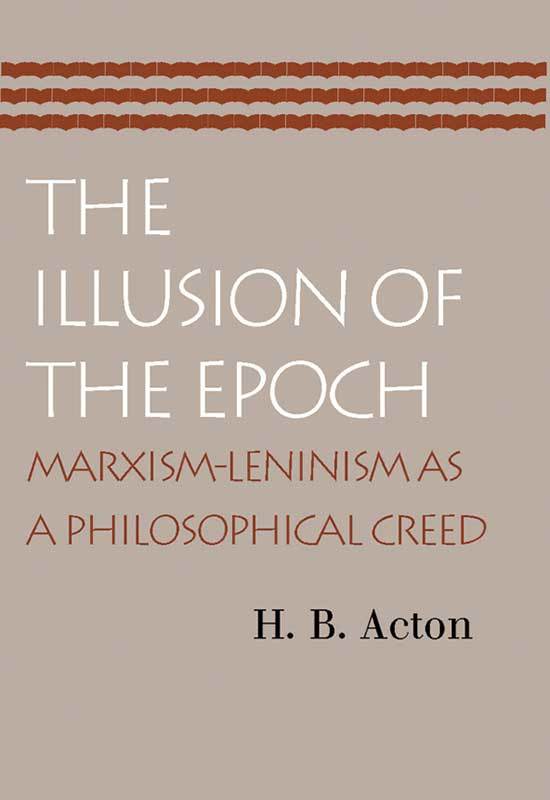
Preface - H.B. Acton, The Illusion of the Epoch: Marxism-Leninism as a Philosophical Creed [1955]

Edition used:

The Illusion of the Epoch: Marxism-Leninism as a Philosophical Creed (Indianapolis: Liberty Fund, 2003).

About Liberty Fund:

Liberty Fund, Inc. is a private, educational foundation established to encourage the study of the ideal of a society of free and responsible individuals.


Preface

The following work arose from a Seminar which I gave in the University of Chicago in the summer of 1949. I am grateful to my wife for her help in removing obscurities, to Mr. R. N. Carew Hunt for generously putting his Marxist scholarship at my disposal and for reading and commenting on the major part of the manuscript, and to Professor E. E. Turner, F.R.S., for advice in connection with Part One, Chapter II, Section 7. The Aristotelian Society has been good enough to allow me to reproduce a passage that originally appeared in their 1951–52 Proceedings.

For this second impression I have corrected some misprints and expanded footnotes and references when new editions and translations of the books referred to have made this necessary.

Mr. Emile Burns’s remark in The Marxist Quarterly (October 1955) suggesting that Engels did not regard equality as the chief element of the morality of the future raises the question of the importance of equality of reward in Marxism-Leninism. Marx applauded the Paris Commune for paying a working-man’s wage to all revolutionary functionaries no matter how important, but he also said that during the period of socialism (as distinct from the ultimate communism) payment would vary in accordance with output. Lenin regarded differential rewards as unwelcome and temporary necessities. Stalin, however, said it was un-Marxist to advocate equality of incomes during the period prior to communism (see S. Dobrin, “Lenin on Equality and the Webbs on Lenin,” Soviet Studies 1956–57). The conclusion I draw is that on the Marxist-Leninist view equality of incomes is impracticable before the advent of communism and unnecessary afterward, when there will be enough to satisfy all needs. Marxist-Leninists who live in non-Marxist societies will, of course, as Engels says, advocate equality “as an agitational means in order to rouse the workers against the capitalists on the basis of the capitalists’ own assertions” (Anti-Dühring).

Mr. John Plamenatz (The British Journal of Sociology, June 1956) makes two interesting criticisms of what I wrote. He says that Marxists are not necessarily committed to “total planning,” but only claim to have knowledge which would enable the planners to decide what to control and what to leave alone. In practice this may be so (though even democratic governments find that their plans have to take in more and more of human life), but in principle I think the Marxist ideal requires nature to be wholly tamed and humanized. Mr. Plamenatz also criticizes my view that the Marxist distinction between basis and superstructure requires what are really inseparable factors to act causally upon one another. Social factors, he says, which may be distinguishable but incapable of existing in isolation, may be related to one another in such a way that some are more fundamental than others. There is not space for me to discuss this interesting point here. All I can say is that insofar as aspects are abstractions, they are fundamental or derivative in a logical sense, according to which what is not fundamental is what is logically derivative. Discussion of this topic, therefore, takes us into the realm of sociological concepts and their logical relationships.

Since the first impression of this book, the Foreign Languages Publishing House, Moscow, has published translations in English of The Holy Family (Moscow, 1956, Lawrence and Wishart, London, 1957), and of the Economic and Philosophic Manuscripts (Moscow, no date, Lawrence and Wishart, London, 1959). Reference should also be made to Osnovy Marksistskoj Filosofii (Moscow, 1958), the joint work of a number of Soviet philosophers. A summary and brief discussion of it may be read in J. M. Bochenski’s Die Dogmatischen Grundlagen der Sowjetischen Philosophie (Reidel, Dordrecht, Holland, 1959). The Foreign Languages Publishing House, Moscow, has also published (no date given) Fundamentals of Marxism-Leninism, Manual (described as translated from the Russian and as edited by Clemens Dutt). This is also a joint work, but by a different set of Soviet authors. I do not think that either of these books renders necessary any alteration of my account of the Marxist-Leninist philosophy.

H. B. Acton