Econlib

The Library

Other Sites

Front Page arrow Titles (by Subject) arrow chapter four: On the Status Property Should Occupy in Political Institutions - Principles of Politics Applicable to All Governments

Return to Title Page for Principles of Politics Applicable to All Governments

Search this Title:

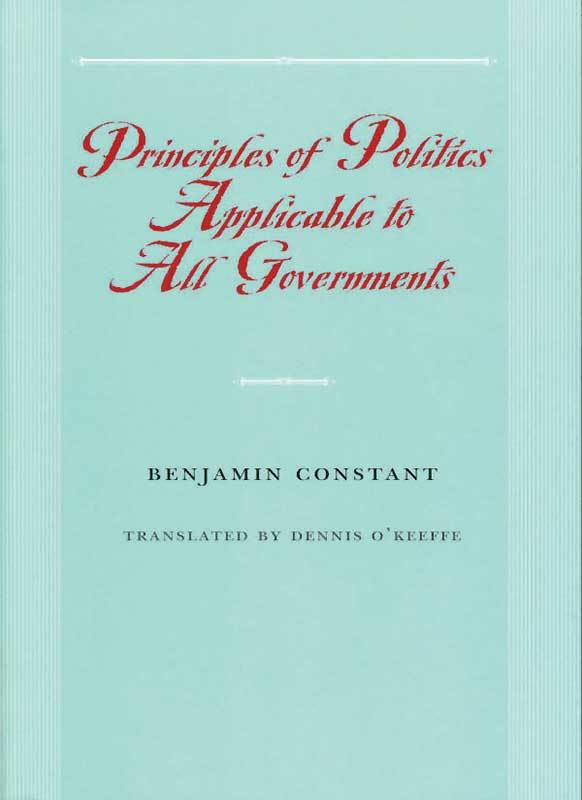
chapter four: On the Status Property Should Occupy in Political Institutions - Benjamin Constant, Principles of Politics Applicable to All Governments [1815]

Edition used:

Principles of Politics Applicable to a all Governments, trans. Dennis O’Keeffe, ed. Etienne Hofmann, Introduction by Nicholas Capaldi (Indianapolis: Liberty Fund, 2003).

About Liberty Fund:

Liberty Fund, Inc. is a private, educational foundation established to encourage the study of the ideal of a society of free and responsible individuals.


chapter four

On the Status Property Should Occupy in Political Institutions

The question being thus resolved, property being necessary, then, to the perfecting and prosperity of the social condition, it follows that it must be surrounded by all the safeguards; and power is the only sufficient safeguard. Property must not be made into an eternal cause of struggles and crimes. Better destroy it, as certain extravagant thinkers want, than tolerate it as an abuse by treating it with disfavor. These thinkers at least present a theoretical system which they believe compatible with the social State, such as they conceive it. What shall we say, however, of these hidden enemies of property who, allowing it without giving it influence, seem to set it up only to deliver it over, helpless, to the vehement hostility it provokes? What shall we think of Mably, who depicts it as a scourge and then urges us to respect it?4 This is to bequeath to society indestructible seeds of discord. Property must be in charge or annihilated. If you put power on one side and property on the other, the latter will soon be at odds with legislation. Careful reflection and government become separate. Opinion wages war with the latter.

One might say that the present state of society, mixing and mingling owners and nonowners in a thousand ways, gives to some of the latter the same interests and means as the former, that the man who works, no less than the man who owns, needs peace and security; that owners are in law and fact only distributors of the common wealth between all individuals and that it is to the advantage of all that order and peace should favor the development of all abilities and all individual resources.

The fault in these arguments is their proving too much. If they were conclusive, there would be no reason for denying foreigners political rights. Europe’s commercial relations are such that it is in the interests of the great majority of Europeans that peace [205] and contentment prevail in all countries. The overthrow of a country of any sort is as fatal for foreigners whose financial speculations have linked their fortune to that country as this overthrow could be to its own inhabitants, with the exception of its propertied class. The facts prove it. During the most savage wars, a country’s businessmen make endless appeals and sometimes efforts for the hostile country not to be destroyed. Nevertheless, a consideration so vague will not seem sufficient, in my view, to justify political rights for foreigners.

Doubtless, if you suppose that nonproprietors will always calmly examine all sides of the question, their considered interest will be to respect property and become proprietors; but if you admit the more likely hypothesis that they will often be led by their most obvious and immediate interest, this latter interest will lead them, if not to destroy property, at least to diminish its influence.

Furthermore, admitting the most favorable hypothesis, that the first concern of nonproprietors is to become proprietors, if the organization of property puts some obstacle in the way of their succeeding, or they merely imagine this to be so, their natural inclination will be to change that organization. Now, the organization of property is something you cannot disturb without harming its nature and upsetting society as a whole. We will see later how many vexatious effects the idea of a forced dissemination of property can give rise to. In short, these arguments bear only on a very small group of nonproprietors. The vast majority will always be deprived of leisure, the indispensable condition of enlightenment. Civil safeguards, individual freedom, free opinion, in a word, social protection, are owed to nonproprietors, because any political association owes them even to the foreigner it receives into its bosom; but political rights are not a protection; they bestow power. The political association must give this only to its members. To grant it to nonproprietors is not to give them a shield, but an offensive weapon.

The necessary purpose of the propertyless is to manage to become propertied. All the resources you give them they will use for this purpose. If you add to the freedom for their talents and efforts, which you [206] do owe them, political rights, which you do not, these rights, in the hands of the vast majority of them, will infallibly be used to encroach on property. They will march on it by that irregular and meretricious route, rather than following the natural route, work. This will be a source of corruption for them, and for the State, of disorder. It has been very properly observed that when the propertyless have political rights one of three things happens. Either their only motivation springs from themselves and then they destroy the society; or they are motivated by the man or men in power and they become the instruments of tyranny, which is what happens in unexceptional times; or they are motivated by those aspiring to power and become the instruments of factions. This is what happens during great political crises.

There are always two classes in a country, those who want to conserve and those who want to make gains.5 The first need only security; the second, before they need security, need force. Freedom and justice are the sole means of well-being for the former. By means of justice they conserve what they possess; and by way of freedom they enjoy it. For the latter, however, injustice and tyranny may often be the means to success. Their encroachments are by way of injustice and defended by tyranny. Machiavelli establishes that it is better to entrust the defense of freedom to those who want to make gains than to those who wish to conserve.6 But he is not talking about property. He is talking about power, and oppressive power to boot, like that of the Roman patricians or the Venetian nobles. This is no more than saying that the defense of freedom should be entrusted to those who suffer from tyranny rather than those who enjoy it.

[207] In the countries with representative or republican arrangements, it is important above all that their assemblies should comprise proprietors, whatever their further organization may be in other respects. An individual may capture the crowd through outstanding merit. The ruling body, however, to win public confidence, need material interests manifestly appropriate to their duties. A nation will always presume that people who are united are led by common interest. It will take it for granted that love of order, justice, and conservation will be the prevailing concern among proprietors. The latter are thus useful not only in terms of their inherent qualities but also of those attributed to them, as well as of the interests they are assumed to have, and of the salutary prejudices they inspire. Put the unpropertied class in charge of the State, however well intentioned they may be, and the anxiety of the propertied will hem in all their measures. The wisest laws will be suspected and hence disobeyed. The opposite sort of organization, by contrast, will reconcile popular assent, even to a government which is defective in some regards.

During the French Revolution, owners competed with nonowners in the making of absurd and spoliatory laws. This is because they feared the latter now that they had power. The owners wanted to be forgiven for being owners. The fear of losing what one has renders one every bit as cowardly or enraged as the hope of acquiring that which one has not. These faults and crimes on the part of property holders, however, were a consequence of the influence of the propertyless class.

[4. ]Honoré-Gabriel Bonnot de Mably, De la législation ou principes des lois, Livre I, Ch. 3 De l’établissement de la propriété, where Mably preaches a certain egalitarianism, and Ch. 4 Des obstacles insurmontables qui s’opposent au rétablissement de l’égalité détruite, where he gives up the idea of imposing social equality. The references are to the Oeuvres complètes de l’Abbé de Mably, Lyon, J.-B. Delamollière, 1792, t. IX.

[5. ]The same idea is seen in Madame de Staël, Des circonstances actuelles, éd. cit., p. 173: “Now, there are two elemental interests, so to speak, which split the world: the need to acquire and the need to conserve.”

[6. ]Machiavelli, Discours sur la première décade de Tite-Live, Ch. V, Oeuvres complètes, op. cit., pp. 392–394.