Econlib

The Library

Other Sites

Front Page arrow Titles (by Subject) arrow chapter three: Specious Argument in Support of Arbitrary Government - Principles of Politics Applicable to All Governments

Return to Title Page for Principles of Politics Applicable to All Governments

Search this Title:

chapter three: Specious Argument in Support of Arbitrary Government - Benjamin Constant, Principles of Politics Applicable to All Governments [1815]

Edition used:

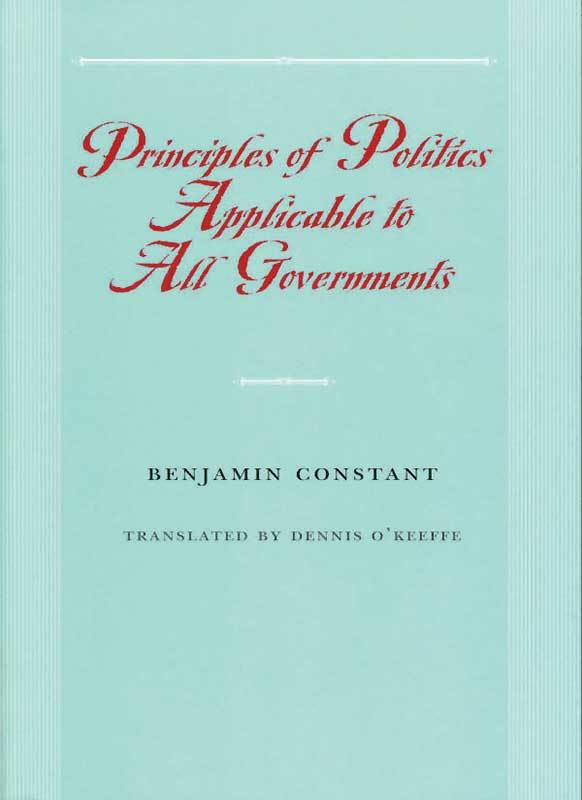
Principles of Politics Applicable to a all Governments, trans. Dennis O’Keeffe, ed. Etienne Hofmann, Introduction by Nicholas Capaldi (Indianapolis: Liberty Fund, 2003).

About Liberty Fund:

Liberty Fund, Inc. is a private, educational foundation established to encourage the study of the ideal of a society of free and responsible individuals.


chapter three

Specious Argument in Support of Arbitrary Government

The actions of government, we are told, bear down only on imprudent souls who provoke them. The man who resigns himself and keeps silent is always safe. Reassured by this worthless and specious argument, we do not protest against the oppressors. Instead we find fault with the victims. Nobody knows how to be brave even prudentially. Everyone stays silent, keeping his head low in the self-deceiving hope of disarming the powers that be by his silence. People give despotism free access, flattering themselves they will be treated with consideration. Eyes to the ground, each person walks in silence the narrow path leading him safely to the tomb. But when arbitrary government is tolerated, bit by bit it spreads out between so many participants that the least known of citizens may find his enemy in a position of power. Whatever cowardly hearts may hope for, fortunately for the morality of humankind, our safety calls for more than mere standing to one side and letting the blows fall on others. A thousand links bind us to our peers and even the most frantic egoism cannot break all of them. You think you are safe in your deliberate obscurity and your shameful apathy. But you have a son and youth gets the better of him, a brother less cautious than you permits himself a murmur, an old enemy you once wounded who has got himself a bit of power, and in his fantasies some corrupt military leader is coveting your house in Alba. What will you do then? Having bitterly condemned all struggles against the powers that be, will you struggle in your turn? You are condemned in advance both by your own conscience and by that degraded public opinion you yourself helped to create. Will you give in without resistance? But will they let you give in? Will they not exile or persecute this annoying case, this monument to injustice? Innocent people disappeared. You saw them as guilty. You prepared the road you now walk along in your turn. [99]