EconlibThe LibraryOther Sites |
Front Page Titles (by Subject) Translator's Note - Principles of Politics Applicable to All Governments
Return to Title Page for Principles of Politics Applicable to All GovernmentsThe Online Library of LibertyA project of Liberty Fund, Inc.Search this Title:Also in the Library:
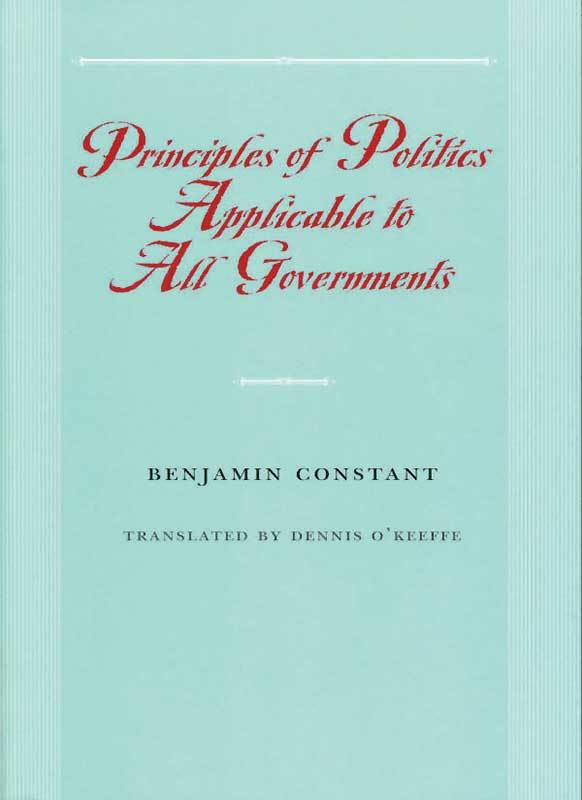
Translator’s Note - Benjamin Constant, Principles of Politics Applicable to All Governments [1815]Edition used:Principles of Politics Applicable to a all Governments, trans. Dennis O’Keeffe, ed. Etienne Hofmann, Introduction by Nicholas Capaldi (Indianapolis: Liberty Fund, 2003).
About Liberty Fund:Liberty Fund, Inc. is a private, educational foundation established to encourage the study of the ideal of a society of free and responsible individuals. Copyright information:The copyright to this edition, in both print and electronic forms, is held by Liberty Fund, Inc. Fair use statement:This material is put online to further the educational goals of Liberty Fund, Inc. Unless otherwise stated in the Copyright Information section above, this material may be used freely for educational and academic purposes. It may not be used in any way for profit.
Translator’s NotePrinciples of Politics Applicable to All Governments (1810) by Benjamin Constant (1767–1830) has never before been translated into English in its entirety. It is hard to judge why it is not better known, why it has been relatively neglected. It is written in graceful and clear prose. It is informed by very wide reading and understanding of philosophy, history, economics, politics, and law. The failure of recent scholarship to pay this enormous work more attention may be attributed to the general demise of liberal thought which began in mid-nineteenth-century France and which itself remains unexplained. Frédéric Bastiat (1801–1850), another significant social scientist, in some ways Constant’s heir, has suffered similarly from neglect by posterity. Neither man is included in The Fontana Dictionary of Modern Thought (edited by Alan Bullock et al., London, Macmillan, 1988) nor in Roger Scruton’s Dictionary of Politics (London, Macmillan, 1982). Scruton later came to regard the omission of Constant in this first edition as a serious underestimation of a writer now emerging as a formidable figure in the debate on political and economic modernity. Scruton’s 1996 edition (London, Macmillan), therefore, while it still omits Bastiat, has included a pithy summary of the main positions of Principles of Politics. This first complete translation into English of Principles of Politics is based solely on Etienne Hofmann’s 1980 edition. Constant’s book in fact appears as Tome II of this 1980 publication by Librairie Droz of Geneva, Tome I of which is a version of Hofmann’s Ph.D. dissertation on Constant. I have translated all eighteen books, together with the lengthy Additions which Constant appended to them. The latter are a series of summaries, extensions, and further thoughts on the eighteen books of the main text. My intention throughout has been to retain as much as possible of the general elegance and subtle rhetoric of Constant’s writing while seeking to render it in accurate, graceful, and accessible English. Where meaning and aesthetic effect permit, I have not only kept to an English prose as close as possible to the exact sense of the French original but have also striven where the French vocabulary has close English counterparts to use those counterparts. The only notable exception is the word “liberté” with its two possible translations in English, “freedom” and “liberty.” In most cases I have preferred the word freedom as capturing in English a truer representation of liberté with its nuanced variations in French. As far as the English language permits, I have also attempted to retain in translation even the longest of Constant’s very long sentences. There is no disadvantage to exposition and meaning in this, since even within these very long sentences there is a shining clarity to be found. Only where the length of sentence hindered intelligibility in English have I broken the construction. Thus for the most part I have kept the original structure. This translation does not attempt to reproduce Dr. Hofmann’s elaborate apparatus criticus. Most students or even professional teachers of politics do not need to know, when they are working on Constant in English, in which handwritten folio a particular passage appears in the French original. Nor are slight errors or verbal infelicities in the original text of great interest to those whose first wish is to read an accurate English version of Constant’s meaning. Thus, I have kept only those many footnotes which are intended to add to the reader’s understanding of Constant’s thinking and erudition. I have added a few footnotes of my own by way of clarification and commentary. In those instances in which Hofmann uses the French first-person plural, “nous,” I have subsituted the word “Hofmann.” Constant’s text has some errors. Sometimes there are references with inaccurate page or tome details. Sometimes there are mechanical slips in the writing. Hofmann often identifies these. I have mostly corrected them in the translation, so that the text reads more comfortably and fluently. Constant was particularly lax in referring to titles of works (and titles of chapters within works) of Jeremy Bentham. He commonly gives these titles in paraphrased or shortened form. In a work originally constructed with none of the benefits of a technology we now take for granted, it did not seem to me to the purpose that the reader in English be informed of every last little slip of administration or error in vocabulary. There is one kind of inconsistency to which, however, the attention of readers should be drawn. Sometimes in the main text Constant is not consistent with his chapter titles, which are listed at the front of each book and appear again at the head of each chapter. Sometimes the titles vary between the two locations. I have drawn readers’ attention to these differences as, potentially at least, of some conceptual importance. There would be a greater case for noting, as Hofmann’s text constantly does, which sentences and paragraphs from Principles of Politics also appear verbatim in Constant’s earlier or later works. Even these notes, however, seem likely to be of great concern only to those readers who would also be able to consult the French text at will. In the English text they would serve mostly to interrupt the flow of the reading. For this reason I have not included them. I have, however, inserted in the text Hofmann’s page numbers in brackets. The Additions, longer by far than any of the individual eighteen books of the main text, are intended by Constant both to tighten and to extend and elaborate the arguments of the main text. Constant often picks out a phrase or clause from his original text in order to expand on it in his Additions. In the English version of the Additions these key phrases or clauses appear in italics. Where the word order of English translation permits, I have translated the chosen words in the Additions with the same English used to translate the main text. Where the word order of English is different I have merely translated Constant’s chosen words in the Additions. Little meaning has been lost; and, indeed, Constant was fairly careless in his own word sequence and self-quotation. His phrases chosen from the main text to be included in the Additions are quite often abbreviated or altered in some ways. For the most part the Additions stand as commentary in their own right. Constant often emphasized other writers’ words and occasionally his own by underlining. In the English text, such underlining is indicated by the use of italics. Where Constant quotes the verbatim words of another writer, those words are shown in the new English text within quotation marks. The shortcomings of some of the basic vocabulary have simply to be accepted. Constant uses “power,” “authority,” “government,” “the governors,” the “governing class,” “social authority,” and sometimes even “force” more or less synonymously. The important conceptual distinctions which mainstream twentieth-century philosophers and social theorists, guided by Max Weber, have made between the concepts of authority and power are not there in Principles, or at least not overtly. The distinction was not new to Weber. It can be found in Machiavelli. Not till Weber, however, does the distinction become important in political writing, and Constant is not privy to it. Modern Western political science tends, under Weber’s tutelage, to see authority as a special kind of power—legitimated and lawful—above all because it is acceded to by the people over whom it is wielded. Constant is, however, though not verbally, at least conceptually in tune with the distinction. One might say that his most important adjective is legitimate. For him proper government is legitimate government, and illegitimate government is despotism. Even one arbitrary (despotic) act is for Constant a step on the road toward despotism. Constant’s most repeated theme throughout the book is the disastrous results which flow from the abandonment of the rule of law. Much of Constant’s political life was shaped by his experience of the French Revolution, and his subsequent thinking and writing were in reaction to what he regarded as a republicanism gone catastrophically astray. Constant is, like Machiavelli, whom he much admired, by preference a republican, but he is perfectly willing to admit that monarchy can be a civilized form of government. Principles of Politics deliberately eschews all constitutional questions such as republicanism versus monarchy and the various merits of different arrangements of first and second chambers, modes of election, and so on. Instead, Constant is out to construct, as the full title of his work makes clear, a lawful politics “applicable to all forms of government.” |

Titles (by Subject)