Econlib

The Library

Other Sites

Front Page arrow Titles (by Subject) arrow CHAP. XII.: Of the Power of Punishments. - Complete Works, vol. 1 The Spirit of Laws

Return to Title Page for Complete Works, vol. 1 The Spirit of Laws

Search this Title:

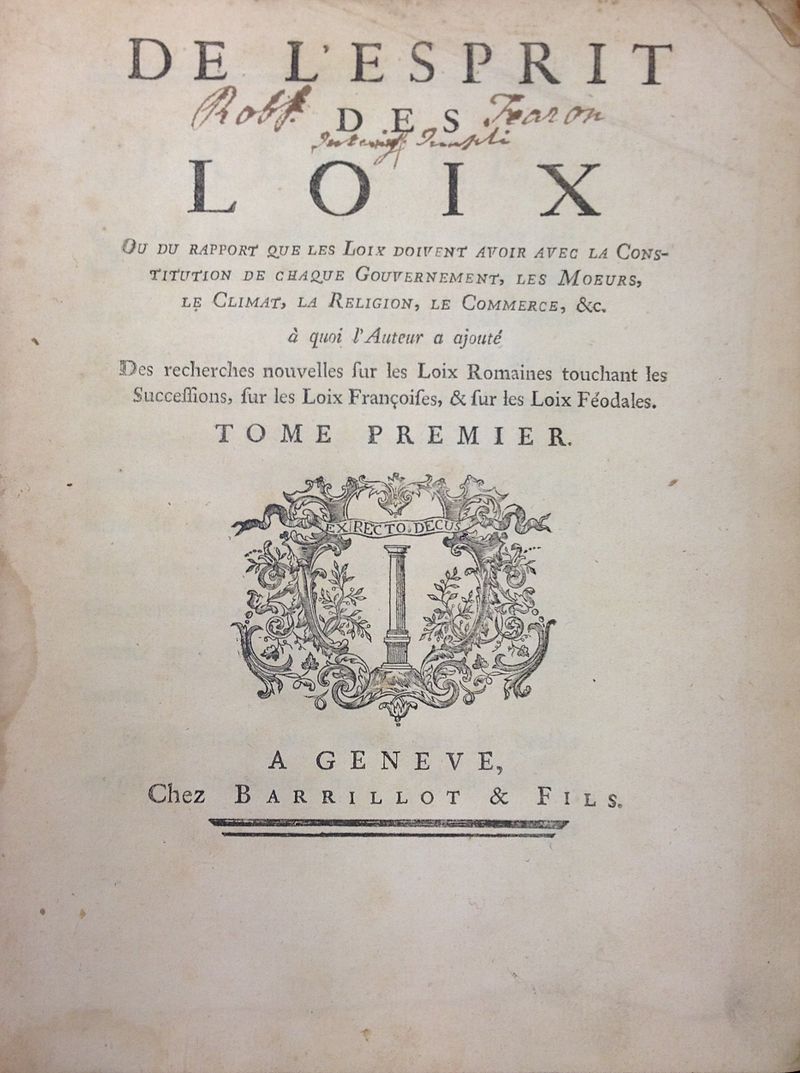
CHAP. XII.: Of the Power of Punishments. - Charles Louis de Secondat, Baron de Montesquieu, Complete Works, vol. 1 The Spirit of Laws [1748]

Edition used:

The Complete Works of M. de Montesquieu (London: T. Evans, 1777), 4 vols. Vol. 1.

Part of: Complete Works of Montesquieu, 4 vols.

About Liberty Fund:

Liberty Fund, Inc. is a private, educational foundation established to encourage the study of the ideal of a society of free and responsible individuals.


CHAP. XII.

Of the Power of Punishments.

EXPERIENCE shews, that, in countries remarkable for the lenity of their laws, the spirit of the inhabitants is as much affected, by slight penalties, as in other countries by severer punishments.

If an inconveniency or abuse arises in the state, a violent government endeavours suddenly to redress it; and, instead of putting the old laws in execution, it establishes some cruel punishment, which instantly puts a stop to the evil. But the spring of government hereby loses its elasticity; the imagination grows accustomed to the severe as well as the milder punishment; and, as the fear of the latter diminishes, they are soon obliged, in every case, to have recourse to the former. Robberies on the high-way were grown common in some countries. In order to remedy this evil, they invented the punishment of breaking upon the wheel; the terror of which put a stop, for a while, to this mischievous practice: but, soon after, robberies on the highways became as common as ever.

Desertion, in our days, was grown to a very great height: in consequence of which it was judged proper to punish those delinquents with death; and yet their number did not diminish. The reason is very natural: a soldier, accustomed to venture his life, despises, or affects to despise, the danger of losing it: he is habituated to the fear of shame: it would have been, therefore, much better to have continued a punishment which branded him with infamy for life: the penalty was pretended to be increased, while it really diminished.

Mankind must not be governed with too much severity: we ought to make a prudent use of the means which nature has given us to conduct them. If we enquire into the cause of all human corruptions, we shall find that they proceed from the impunity of criminals, and not from the moderation of punishments.

Let us follow nature, who has given shame to man for his scourge; and let the heaviest part of the punishment be the infamy attending it.

But, if there be some countries where shame is not a consequence of punishment, this must be owing to tyranny, which has inflicted the same penalties on villains and honest men.

And, if there are others where men are deterred only by cruel punishments, we may be sure that this must, in a great measure, arise from the violence of the government, which has used such penalties for slight transgressions.

It often happens, that a legislator, desirous of remedying an abuse, thinks of nothing else: his eyes are open only to this object, and shut to its inconveniences. When the abuse is redressed, you see only the severity of the legislator: yet there remains an evil in the state, that has sprung from this severity; the minds of the people are corrupted and become habituated to despotism.

Lysander having obtained a victory over the Athenians, the prisoners were ordered to be tried, in consequence of an accusation, brought against that nation, of having thrown all the captives of two galleys down a precipice, and of having resolved, in full assembly, to cut off the hands of those whom they should chance to make prisoners. The Athenians were therefore all massacred, except Adymantes, who had opposed this decree. Lysander reproached Philocles, before he was put to death, with having depraved the people’s minds, and given lessons of cruelty to all Greece.

“The Argives (says Plutarch ) having put fifteen hundred of their citizens to death, the Athenians ordered sacrifices of expiation, that it might please the gods to turn the hearts of the Athenians from so cruel a thought.”

There are two sorts of corruption; one when the people do not observe the laws; the other when they are corrupted by the laws: an incurable evil, because it is in the very remedy itself.

[]They slit his nose, or cut off his ears.

[]Xenoph. Hist. lib. 3.

[]Morals, of those who are intrusted with the direction of the state-affairs.