Econlib

The Library

Other Sites

Front Page arrow Titles (by Subject) arrow CHAP. IV.: Of the Manner of passing Judgement. - Complete Works, vol. 1 The Spirit of Laws

Return to Title Page for Complete Works, vol. 1 The Spirit of Laws

Search this Title:

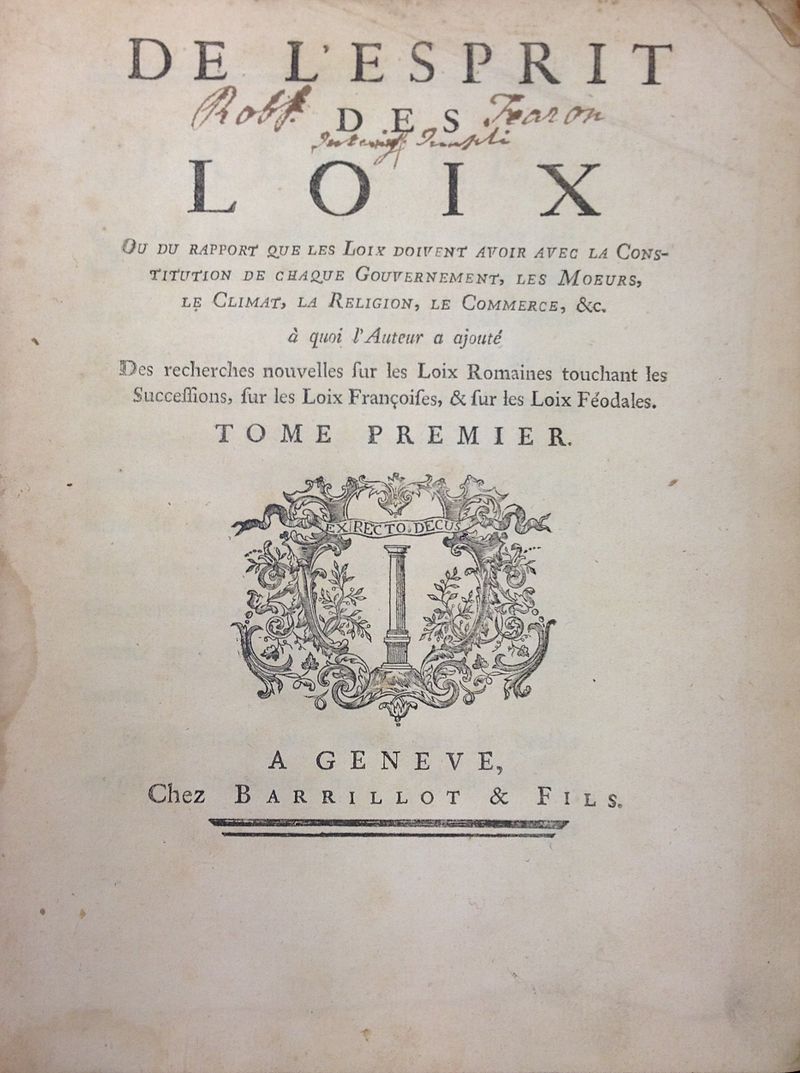
CHAP. IV.: Of the Manner of passing Judgement. - Charles Louis de Secondat, Baron de Montesquieu, Complete Works, vol. 1 The Spirit of Laws [1748]

Edition used:

The Complete Works of M. de Montesquieu (London: T. Evans, 1777), 4 vols. Vol. 1.

Part of: Complete Works of Montesquieu, 4 vols.

About Liberty Fund:

Liberty Fund, Inc. is a private, educational foundation established to encourage the study of the ideal of a society of free and responsible individuals.


CHAP. IV.

Of the Manner of passing Judgement.

HENCE arises the different manner of passing judgement. In monarchies the judges choose the method of arbitration: they deliberate together; they communicate their sentiments for the sake of unanimity; they moderate their opinions, in order to render them conformable to those of others; and the lesser number is obliged to give way to the majority. But this is not agreeable to the nature of a republic. At Rome, and in the cities of Greece, the judges never entered into a consultation; each gave his opinion one of these three ways; I absolve; I condemn; it does not appear clear to me* : this was because the people judged, or were supposed to judge. But the people are far from being civilians; all these restrictions and methods of arbitration are above their reach; they must have only one object, and one single fact, set before them; and then they have only to see whether they ought to condemn, to acquit, or to suspend their judgement.

The Romans introduced fet forms of actions , after the example of the Greeks, and established a rule, that each cause should be directed by its proper action. This was necessary in their manner of judging; it was necessary to fix the state of the question, that the people might have it always before their eyes: otherwise, in a long process, this state of the question would continually change, and be no longer distinguished.

Hence it followed, that the Roman judges granted only the simple demand, without making any addition, deduction, or limitation. But the prætors devised other forms of actions, which were called ex bona fide, where the method of pronouncing sentence was left to the disposition of the judge. This was more agreeable to the spirit of monarchy. Hence it is a saying among the French lawyers, that, in France , all actions areex bona fide.

[* ]Non liquet.

[]Quas actiones, ne populus prout vellet institueret, certas solemnesque esse voluerunt. Lib. 2, §. 6. Digest. de Orig. Jur.

[]In France, a person, though sued for more than he owes, loses his costs if he has not offered to pay the exact debt.