Econlib

The Library

Other Sites

Front Page arrow Titles (by Subject) arrow CHAP. IX.: In what Manner the Laws are relative to their Principle in Monarchies. - Complete Works, vol. 1 The Spirit of Laws

Return to Title Page for Complete Works, vol. 1 The Spirit of Laws

Search this Title:

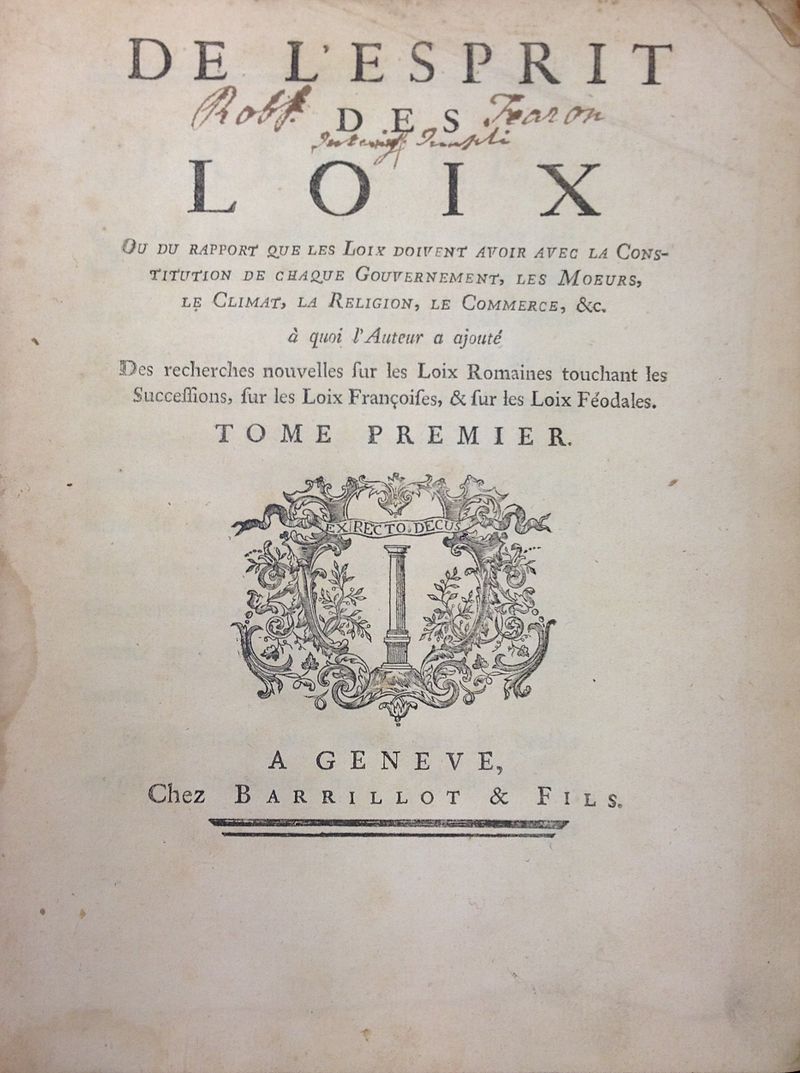
CHAP. IX.: In what Manner the Laws are relative to their Principle in Monarchies. - Charles Louis de Secondat, Baron de Montesquieu, Complete Works, vol. 1 The Spirit of Laws [1748]

Edition used:

The Complete Works of M. de Montesquieu (London: T. Evans, 1777), 4 vols. Vol. 1.

Part of: Complete Works of Montesquieu, 4 vols.

About Liberty Fund:

Liberty Fund, Inc. is a private, educational foundation established to encourage the study of the ideal of a society of free and responsible individuals.


CHAP. IX.

In what Manner the Laws are relative to their Principle in Monarchies.

AS honour is the principle of a monarchical government, the laws ought to be relative to this principle.

They should endeavour to support the nobility; in respect to whom, honour may be, in some measure, deemed both child and parent.

They should render the nobility hereditary; not as a boundary between the power of the prince and the weakness of the people, but as the link which connects them both.

In this government, substitutions, which preserve the estates of families undivided, are extremely useful, though in others not so proper.

Here the power of redemption is of service, as it restores to noble families the lands that had been alienated by the prodigality of a parent.

The lands of the nobility ought to have privileges as well as their persons. The monarch’s dignity is inseparable from that of his kingdom, and the dignity of the nobleman from that of his fief.

All these privileges must be particular to the nobility and incommunicable to the people, unless we intend to act contrary to the principle of government, and to diminish the power of the nobles together with that of the people.

Substitutions are a restraint to commerce; the power of redemption produces an infinite number of processes; every estate in land, that is sold throughout the kingdom, is, in some measure, without an owner for the space of a year. Privileges annexed to fiefs give a power very burthensome to those governments which tolerate them. These are the inconveniences of nobility; inconveniences, however, that vanish when confronted with its general utility. But, when these privileges are communicated to the people, every principle of government is wantonly violated.

In monarchies, a person may leave the bulk of his estate to one of his children; a permission improper in any other government.

The laws ought to favour all kind of commerce consistent with the constitution, to the end that the subjects may, without ruining themselves, be able to satisfy the continual cravings of the prince and his court.

They should establish some regulation, that the manner of collecting the taxes may not be more burthensome than the taxes themselves.

The weight of duties produces labour, labour weariness, and weariness the spirit of indolence.

[]It is tolerated only in the common people. See the third law, Cod. de comm. & mercatoribus, which is full of good sense.