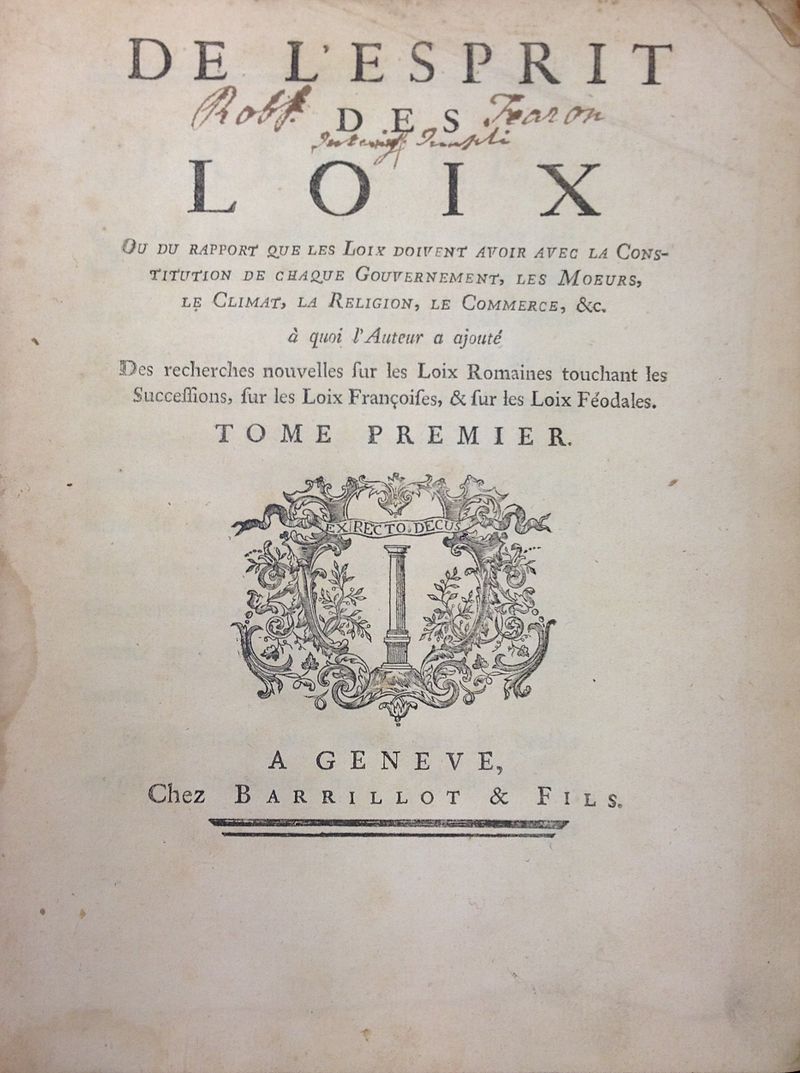
PREFACE. - Charles Louis de Secondat, Baron de Montesquieu, Complete Works, vol. 1 The Spirit of Laws [1748]
Edition used:
The Complete Works of M. de Montesquieu (London: T. Evans, 1777), 4 vols. Vol. 1.
About Liberty Fund:
Liberty Fund, Inc. is a private, educational foundation established to encourage the study of the ideal of a society of free and responsible individuals.
Copyright information:
The text is in the public domain.
Fair use statement:
This material is put online to further the educational goals of Liberty Fund, Inc. Unless otherwise stated in the Copyright Information section above, this material may be used freely for educational and academic purposes. It may not be used in any way for profit.
- An Eulogium On President Montesquieu, By Monsieur D’alembert.
- Preface.
- The Spirit of Laws.
- Book I.: Of Laws In General.
- Chap. I.: Of the Relation of Laws to Different Beings.
- Chap. II.: Of the Laws of Nature.
- Chap. III.: Of Positive Laws.
- Book II.: Of Laws Directly Derived From the Nature of Government.
- Chap. I.: Of the Nature of Three Different Governments.
- Chap. II.: Of the Republican Government, and the Laws Relative to Democracy.
- Chap. III.: Of the Laws Relative to the Nature of Aristocracy.
- Chap. IV.: Of the Relation of Laws to the Nature of Monarchical Government.
- Chap. V.: Of the Laws Relative to the Nature of a Despotic Government.
- Book III.: Of the Principles of the Three Kinds of Government.
- Chap. I.: Difference Between the Nature and Principle of Government.
- Chap. II.: Of the Principle of Different Governments.
- Chap. III.: Of the Principle of Democracy.
- Chap. IV.: Of the Principle of Aristocracy.
- Chap. V.: That Virtue Is Not the Principle of a Monarchical Government.
- Chap. VI.: In What Manner Virtue Is Supplied In a Monarchical Government.
- Chap. VII.: Of the Principle of Monarchy.
- Chap. VIII.: That Honour Is Not the Principle of Despotic Government.
- Chap. IX.: Of the Principle of Despotic Government.
- Chap. X.: Difference of Obedience In Moderate and Despotic Governments.
- Chap. XI.: Reflections On the Preceding Chapters.
- Book IV.: That the Laws of Education Ought to Be Relative to the Principles of Government.
- Chap. I.: Of the Laws of Education.
- Chap. II.: Of Education In Monarchies.
- Chap. III.: Of Education In a Despotic Government.
- Chap. IV.: Difference Between the Effects of Ancient and Modern Education.
- Chap. V.: Of Education In a Republican Government.
- Chap. VI.: Of Some Institutions Among the Greeks.
- Chap. VII.: In What Case These Singular Institutions May Be of Service.
- Chap. VIII.: Explication of a Paradox of the Ancients, In Respect to Manners.
- Book V.: That the Laws, Given By the Legislator, Ought to Be Relative to the Principle of Government.
- Chap. I.: Idea of This Book.
- Chap. II.: What Is Meant By Virtue In a Political State.
- Chap. III.: What Is Meant By a Love of the Republic, In a Democracy.
- Chap. IV.: In What Manner the Love of Equality and Frugality Is Inspired.
- Chap. V.: In What Manner the Laws Establish Equality In a Democracy.
- Chap. VI.: In What Manner the Laws Ought to Maintain Frugality In a Democracy.
- Chap. VII.: Other Methods of Favouring the Principle of Democracy.
- Chap. VIII.: In What Manner the Laws Ought to Be Relative to the Principle of Government In an Aristocracy.
- Chap. IX.: In What Manner the Laws Are Relative to Their Principle In Monarchies.
- Chap. X.: Of the Expedition Peculiar to the Executive Power In Monarchies.
- Chap. XI.: Of the Excellence of a Monarchical Government.
- Chap. XII.: The Same Subject Continued.
- Chap. XIII.: An Idea of Despotic Power.
- Chap. XIV.: In What Manner the Laws Are Relative to the Principles of Despotic Government.
- Chap. XV.: The Same Subject Continued.
- Chap. XVI.: Of the Communication of Power.
- Chap. XVII.: Of Presents.
- Chap. XVIII.: Of Rewards Conferred By the Sovereign.
- Chap. XIX.: New Consequences of the Principles of the Three Governments.
- Book VI.: Consequences of the Principles of Different Governments With Respect to the Simplicity of Civil and Criminal Laws, the Form of Judgements, and the Inflicting of Punishments.
- Chap. I.: Of the Simplicity of Civil Laws In Different Governments.
- Chap. II.: Of the Simplicity of Criminal Laws In Different Governments.
- Chap. III.: In What Governments, and In What Cases, the Judges Ought to Determine According to the Express Letter of the Law.
- Chap. IV.: Of the Manner of Passing Judgement.
- Chap. V.: In What Governments the Sovereign May Be Judge.
- Chap. VI.: That, In Monarchies, Ministers Ought Not to Sit As Judges.
- Chap. VII.: Of a Single Magistrate.
- Chap. VIII.: Of Accusation In Different Governments.
- Chap. IX.: Of the Severity of Punishments In Different Governments.
- Chap. X.: Of the Ancient French Laws.
- Chap. XI.: That, When People Are Virtuous, Few Punishments Are Necessary.
- Chap. XII.: Of the Power of Punishments.
- Chap. XIII.: Insufficiency of the Laws of Japan.
- Chap. XIV.: Of the Spirit of the Roman Senate.
- Chap. XV.: Of the Roman Laws In Respect to Punishments.
- Chap. XVI.: Of the Just Proportion Betwixt Punishments and Crimes.
- Chap. XVII.: Of the Rack.
- Chap. XVIII.: Of Pecuniary and Corporal Punishments.
- Chap. XIX.: Of the Law of Retaliation.
- Chap. XX.: Of the Punishment of Fathers For the Crimes of Their Children.
- Chap. XXI.: Of the Clemency of the Prince.
- Book VII.: Consequences of the Different Principles of the Three Governments, With Respect to Sumptuary Laws, Luxury, and the Condition of Women.
- Chap. I.: Of Luxury.
- Chap. II.: Of Sumptuary Laws In a Democracy.
- Chap. III.: Of Sumptuary Laws In an Aristocracy.
- Chap. IV.: Of Sumptuary Laws In a Monarchy.
- Chap. V.: In What Cases Sumptuary Laws Are Useful In a Monarchy.
- Chap. VI.: Of the Luxury of China.
- Chap. VII.: Fatal Consequences of Luxury In China.
- Chap. VIII.: Of Public Continency.
- Chap. IX.: Of the Condition Or State of Women In Different Governments.
- Chap. X.: Of the Domestic Tribunal Among the Romans.
- Chap. XI.: In What Manner the Institutions Changed At Rome Together With the Government.
- Chap. XII.: Of the Guardianship of Women Among the Romans.
- Chap. XIII.: Of the Punishments Decreed By Emperors Against the Incontinency of Women.
- Chap. XIV.: Sumptuary Laws Among the Romans.
- Chap. XV.: Of Dowries and Nuptial Advantages In Different Constitutions.
- Chap. XVI.: An Excellent Custom of the Samnites.
- Chap. XVII.: Of Female-administration.
- Book VIII.: Of the Corruption of the Principles of the Three Governments.
- Chap. I.: General Idea of This Book.
- Chap. II.: Of the Corruption of the Principles of Democracy.
- Chap. III.: Of the Spirit of Extreme Equality.
- Chap. IV.: Particular Cause of the Corruption of the People.
- Chap. V.: Of the Corruption of the Principle of Aristocracy.
- Chap. VI.: Of the Corruption of the Principle of Monarchy.
- Chap. VII.: The Same Subject Continued.
- Chap. VIII.: Danger of the Corruption of the Principle of Monarchical Government.
- Chap. IX.: How Ready the Nobility Are to Defend the Throne.
- Chap. X.: Of the Corruption of the Principle of Despotic Government.
- Chap. XI.: Natural Effects of the Goodness and Corruption of the Principles of Government.
- Chap. XII.: The Same Subject Continued.
- Chap. XIII.: The Effect of an Oath Among Virtuous People.
- Chap. XIV.: How the Smallest Change of the Constitution Is Attended With the Ruin of Its Principles.
- Chap. XV.: Sure Methods of Preserving the Three Principles.
- Chap. XVI.: Distinctive Properties of a Republic.
- Chap. XVII.: Distinctive Properties of a Monarchy.
- Chap. XVIII.: Particular Case of the Spanish Monarchy.
- Chap. XIX.: Distinctive Properties of a Despotic Government.
- Chap. XX.: Consequence of the Preceding Chapters.
- Chap. XXI.: Of the Empire of China.
- Book IX.: Of Laws, In the Relation They Bear to a Defensive Force.
- Chap. I.: In What Manner Republics Provide For Their Safety.
- Chap. II.: That a Confederate Government Ought to Be Composed of States of the Same Nature, Especially of the Republican Kind.
- Chap. III.: Other Requisites In a Confederate Republic.
- Chap. IV.: In What Manner Despotic Governments Provide For Their Security.
- Chap. V.: In What Manner a Monarchical Government Provides For Its Security.
- Chap. VI.: Of the Defensive Force of States In General.
- Chap. VII.: A Reflexion.
- Chap. VIII.: A Particular Case, In Which the Defensive Force of a State Is Inferior to the Offensive.
- Chap. IX.: Of the Relative Force of States.
- Chap. X.: Of the Weakness of Neighbouring States.
- Book X.: Of Laws, In the Relation They Bear to Offensive Force.
- Chap. I.: Of Offensive Force.
- Chap. II.: Of War.
- Chap. III.: Of the Right of Conquest.
- Chap. IV.: Some Advantages of a Conquered People.
- Chap. V.: Gelon, King of Syracuse.
- Chap. VI.: Of Conquests Made By a Republic.
- Chap. VII.: The Same Subject Continued.
- Chap. VIII.: The Same Subject Continued.
- Chap. IX.: Of Conquests Made By a Monarchy.
- Chap. X.: Of One Monarchy That Subdues Another.
- Chap. XI.: Of the Manners of a Conquered People.
- Chap. XII.: Of a Law of Cyrus.
- Chap. XIII.: Charles XII.
- Chap. XIV.: Alexander.
- Chap. XV.: New Methods of Preserving a Conquest.
- Chap. XVI.: Of Conquests Made By a Despotic Prince.
- Chap. XVII.: The Same Subject Continued.
- Book XI.: Of the Laws Which Establish Political Liberty, With Regard to the Constitution.
- Chap. I.: A General Idea.
- Chap. II.: Different Significations of the Word, Liberty.
- Chap. III.: In What Liberty Consists.
- Chap. IV.: The Same Subject Continued.
- Chap. V.: Of the End Or View of Different Governments.
- Chap. VI.: Of the Constitution of England.
- Chap. VII.: Of the Monarchies We Are Acquainted With.
- Chap. VIII.: Why the Ancients Had Not a Clear Idea of Monarchy.
- Chap. IX.: Aristotle’s Manner of Thinking.
- Chap. X.: What Other Politicians Thought.
- Chap. XI.: Of the Kings of the Heroic Times of Greece.
- Chap. XII.: Of the Government of the Kings of Rome, and In What Manner the Three Powers Were There Distributed.
- Chap. XIII.: General Reflections On the State of Rome After the Expulsion of Its Kings.
- Chap. XIV.: In What Manner the Distribution of the Three Powers Began to Change, After the Expulsion of the Kings.
- Chap. XV.: In What Manner Rome, In the Flourishing State of That Republic, Suddenly Lost Its Liberty.
- Chap. XVI.: Of the Legislative Power In the Roman Republic.
- Chap. XVII.: Of the Executive Power In the Same Republic.
- Chap. XVIII.: Of the Judiciary Power In the Roman Government.
- Chap. XIX.: Of the Government of the Roman Provinces.
- Chap. XX.: The End of This Book.
- Book XII.: Of the Laws That Form Political Liberty, As Relative to the Subject.
- Chap. I.: Idea of This Book.
- Chap. II.: Of the Liberty of the Subject.
- Chap. III.: The Same Subject Continued.
- Chap. IV.: That Liberty Is Favoured By the Nature and Proportion of Punishments.
- Chap. V.: Of Certain Accusations That Require Particular Moderation and Prudence.
- Chap. VI.: Of the Crime Against Nature.
- Chap. VII.: Of the Crime of High-treason.
- Chap. VIII.: Of the Bad Application of the Name of Sacrilege and High-treason.
- Chap. IX.: The Same Subject Continued.
- Chap. X.: The Same Subject Continued.
- Chap. XI.: Of Thoughts.
- Chap. XII.: Of Indiscreet Speeches.
- Chap. XIII.: Of Writings.
- Chap. XIV.: Breach of Modesty In Punishing Crimes.
- Chap. XV.: Of the Infranchisement of Slaves, In Order to Accuse Their Master.
- Chap. XVI.: Of Calumny, With Regard to the Crime of High-treason.
- Chap. XVII.: Of the Revealing of Conspiracies.
- Chap. XVIII.: How Dangerous It Is, In Republics, to Be Too Severe In Punishing the Crime of High-treason.
- Chap. XIX.: In What Manner the Use of Liberty Is Suspended In a Republic.
- Chap. XX.: Of Laws Favourable to the Liberty of the Subject In a Republic.
- Chap. XXI.: Of the Cruelty of Laws, In Respect to Debtors, In a Republic.
- Chap. XXII.: Of Things That Strike At Liberty In Monarchies.
- Chap. XXIII.: Of Spies In Monarchies.
- Chap. XXIV.: Of Anonymous Letters.
- Chap. XXV.: Of the Manner of Governing In Monarchies.
- Chap. XXVI.: That, In a Monarchy, the Prince Ought to Be of Easy Access.
- Chap. XXVII.: Of the Manners of a Monarch.
- Chap. XXVIII.: Of the Regard Which Monarchs Owe to Their Subjects.
- Chap. XXIX.: Of the Civil Laws Proper For Mixing Some Portion of Liberty In a Despotic Government.
- Chap. XXX.: The Same Subject Continued.
- Book XIII.: Of the Relation Which the Levying of Taxes and the Greatness of the Public Revenues Have to Liberty.
- Chap. I.: Of the Public Revenues.
- Chap. II.: That It Is Bad Reasoning to Say That the Greatness of Taxes Is Good In Its Own Nature.
- Chap. III.: Of Taxes In Countries Where Part of the People Are Villains Or Bondmen.
- Chap. IV.: Of a Republic In the Like Case.
- Chap. V.: Of a Monarchy In the Like Case.
- Chap. VI.: Of a Despotic Government In the Like Case.
- Chap. VII.: Of Taxes In Countries Where Villainage Is Not Established.
- Chap. VIII.: In What Manner the Deception Is Preserved.
- Chap. IX.: Of a Bad Kind of Impost.
- Chap. X.: That the Greatness of Taxes Depends On the Nature of the Government.
- Chap. XI.: Of Confiscations.
- Chap. XII.: Relation Between the Weight of Taxes and Liberty.
- Chap. XIII.: In What Government Taxes Are Capable of Increase.
- Chap. XIV.: That the Nature of the Taxes Is Relative to the Government.
- Chap. XV.: Abuse of Liberty.
- Chap. XVI.: Of the Conquests of the Mahometans.
- Chap. XVII.: Of the Augmentation of Troops.
- Chap. XVIII.: Of an Exemption From Taxes.
- Chap. XIX.: Which Is Most Suitable to the Prince and to the People, the Farming the Revenues, Or Managing Them By Commission?
- Chap. XX.: Of the Farmers of the Revenues.
- Book XIV.: Of Laws As Relative to the Nature of the Climate.
- Chap. I.: General Idea.
- Chap. II.: Of the Difference of Men In Different Climates.
- Chap. III.: Contradiction In the Tempers of Some Southern Nations.
- Chap. IV.: Cause of the Immutability of Religion, Manners, Customs, and Laws, In the Eastern Countries.
- Chap. V.: That Those Are Bad Legislators Who Favour the Vices of the Climate, and Good Legislators Who Oppose Those Vices.
- Chap. VI.: Of Agriculture In Warm Climates.
- Chap. VII.: Of Monkery.
- Chap. VIII.: An Excellent Custom of China.
- Chap. IX.: Means of Encouraging Industry.
- Chap. X.: Of the Laws Relative to the Sobriety of the People.
- Chap. XI.: Of the Laws Relative to the Distempers of the Climate.
- Chap. XII.: Of the Laws Against Suicides.
- Chap. XIII.: Effects Arising From the Climate of England.
- Chap. XIV.: Other Effects of the Climate.
- Chap. XV.: Of the Different Confidence Which the Laws Have In the People, According to the Difference of Climates.
- Book XV.: In What Manner the Laws of Civil Slavery Are Relative to the Nature of the Climate.
- Chap. I.: Of Civil Slavery.
- Chap. II.: Origin of the Right of Slavery Among the Roman Civilians.
- Chap. III.: Another Origin of the Right of Slavery.
- Chap. IV.: Another Origin of the Right of Slavery.
- Chap. V.: Of the Slavery of the Negroes.
- Chap. VI.: The True Origin of the Right of Slavery.
- Chap. VII.: Another Origin of the Right of Slavery.
- Chap. VIII.: Inutility of Slavery Among Us.
- Chap. IX.: Several Kinds of Slavery.
- Chap. X.: Regulations Necessary In Respect to Slavery.
- Chap. XI.: Abuses of Slavery.
- Chap. XII.: Danger From the Multitude of Slaves.
- Chap. XIII.: Of Armed Slaves.
- Chap. XIV.: The Same Subject Continued.
- Chap. XV.: Precautions to Be Used In Moderate Governments.
- Chap. XVI.: Regulations Between Masters and Slaves.
- Chap. XVII.: Of Infranchisements.
- Chap. XVIII.: Of Freed-men and Eunuchs.
- Book XVI.: How the Laws of Domestic Slavery Have a Relation to the Nature of the Climate.
- Chap. I.: Of Domestic Servitude.
- Chap. II.: That, In the Countries of the South, There Is a Natural Inequality Between the Two Sexes.
- Chap. III.: That a Plurality of Wives Greatly Depends On the Means of Supporting Them.
- Chap. IV.: That the Law of Polygamy Is an Affair That Depends On Calculation.
- Chap. V.: The Reason of a Law of Malabar.
- Chap. VI.: Of Polygamy Considered In Itself.
- Chap. VII.: Of an Equality of Treatment In Case of Many Wives.
- Chap. VIII.: Of the Separation of Women From Men.
- Chap. IX.: Of the Connexion Between Domestic and Political Government.
- Chap. X.: The Principle On Which the Morals of the East Are Founded.
- Chap. XI.: Of Domestic Slavery Independently of Polygamy.
- Chap. XII.: Of Natural Modesty.
- Chap. XIII.: Of Jealousy.
- Chap. XIV.: Of the Eastern Manner of Domestic Government.
- Chap. XV.: Of Divorce and Repudiation.
- Chap. XVI.: Of Repudiation and Divorce Amongst the Romans.
- Book XVII.: How the Laws of Political Servitude Have a Relation to the Nature of the Climate.
- Chap. I.: Of Political Servitude.
- Chap. II.: The Difference Between Nations In Point of Courage.
- Chap. III.: Of the Climate of Asia.
- Chap. IV.: The Consequences Resulting From This.
- Chap. V.: That, When the People In the North of Asia and Those of the North of Europe Made Conquests, the Effects of the Conquest Were Not the Same.
- Chap. VI.: A New Physical Cause of the Slavery of Asia and of the Liberty of Europe.
- Chap. VII.: Of Africa and America.
- Chap. VIII.: Of the Capital of the Empire.
- Book XVIII.: Of Laws In the Relation They Bear to the Nature of the Soil.
- Chap. I.: How the Nature of the Soil Has an Influence On the Laws.
- Chap. II.: The Same Subject Continued.
- Chap. III.: What Countries Are Best Cultivated.
- Chap. IV.: New Effects of the Barrenness and Fertility of Countries.
- Chap. V.: Of the Inhabitants of Islands.
- Chap. VI.: Of Countries Raised By the Industry of Man.
- Chap. VII.: Of Human Industry.
- Chap. VIII.: The General Relation of Laws.
- Chap. IX.: Of the Soil of America.
- Chap. X.: Of Population, In the Relation It Bears to the Manner of Procuring Subsistence.
- Chap. XI.: Of Savage and Barbarous Nations.
- Chap. XII.: Of the Law of Nations Among People Who Do Not Cultivate the Earth.
- Chap. XIII.: Of the Civil Law of Those Nations Who Do Not Cultivate the Earth.
- Chap. XIV.: Of the Political State of the People Who Do Not Cultivate the Land.
- Chap. XV.: Of People Who Know the Use of Money.
- Chap. XVI.: Of Civil Laws Among People Who Know Not the Use of Money.
- Chap. XVII.: Of Political Laws Amongst Nations Who Have Not the Use of Money.
- Chap. XVIII.: Of the Power of Superstition.
- Chap. XIX.: Of the Liberty of the Arabs and the Servitude of the Tartars.
- Chap. XX.: Of the Law of Nations As Practised By the Tartars.
- Chap. XXI.: The Civil Law of the Tartars.
- Chap. XXII.: Of a Civil Law of the German Nations.
- Chap. XXIII.: Of the Regal Ornaments Among the Franks.
- Chap. XXIV.: Of the Marriages of the Kings of the Franks.
- Chap. XXV.: Childeric.
- Chap. XXVI.: Of the Time When the Kings of the Franks Became of Age.
- Chap. XXVII.: The Same Subject Continued.
- Chap. XXVIII.: Of Adoption Among the Germans.
- Chap. XXIX.: Of the Sanguinary Temper of the Kings of the Franks.
- Chap. XXX.: Of the National Assemblies of the Franks.
- Chap. XXXI.: Of the Authority of the Clergy Under the First Race.
- Book XIX.: Of Laws, In Relation to the Principles Which Form the General Spirit, the Morals, and Customs, of a Nation.
- Chap. I.: Of the Subject of This Book.
- Chap. II.: That It Is Necessary People’s Minds Should Be Prepared For the Reception of the Best Laws.
- Chap. III.: Of Tyranny.
- Chap. IV.: Of the General Spirit of Mankind.
- Chap. V.: How Far We Should Be Attentive Lest the General Spirit of a Nation Be Changed.
- Chap. VI.: That Every Thing Ought Not to Be Corrected.
- Chap. VII.: Of the Athenians and Lacedæmonians.
- Chap. VIII.: Effects of a Sociable Temper.
- Chap. IX.: Of the Vanity and Pride of Nations.
- Chap. X.: Of the Character of the Spaniards and Chinese.
- Chap. XI.: A Reflection.
- Chap. XII.: Of Custom and Manners In a Despotic State.
- Chap. XIII.: Of the Behaviour of the Chinese.
- Chap. XIV.: What Are the Natural Means of Changing the Manners and Customs of a Nation.
- Chap. XV.: The Influence of Domestic Government On the Political.
- Chap. XVI.: How Some Legislators Have Confounded the Principles Which Govern Mankind.
- Chap. XVII.: Of the Peculiar Quality of the Chinese Government.
- Chap. XVIII.: A Consequence Drawn From the Preceding Chapter.
- Chap. XIX.: How This Union of Religion, Laws, Manners, and Customs, Among the Chinese, Was Effected.
- Chap. XX.: Explication of a Paradox Relating to the Chinese.
- Chap. XXI.: How the Laws Ought to Have a Relation to Manners and Customs.
- Chap. XXII.: The Same Subject Continued.
- Chap. XXIII.: How the Laws Are Founded On the Manners of a People.
- Chap. XXIV.: The Same Subject Continued.
- Chap. XXV.: The Same Subject Continued.
- Chap. XXVI.: The Same Subject Continued.
- Chap. XXVII.: How the Laws Contribute to Form the Manners, Customs, and Character, of a Nation.
PREFACE.
IF, amidst the infinite number of subjects contained in this book, there is any thing which, contrary to my expectation, may possibly offend, I can at least assure the public that it was not inserted with an ill intention, for I am not naturally of a captious temper. Plato thanked Heaven that he was born in the same age with Socrates; and, for my part, I give thanks to God that I was born a subject of that government under which I live, and that it is his pleasure I should obey those whom he has made me love.
I beg one favour of my readers, which I fear will not be granted me; this is, that they will not judge by a few hours reading of the labour of twenty years; that they will approve or condemn the book entire, and not a few particular phrases. If they would search into the design of the author, they can do it no other way so completely as by searching into the design of the work.
I have first of all considered mankind; and the result of my thoughts has been, that, amidst such an infinite diversity of laws and manners, they were not solely conducted by the caprice of fancy.
I have laid down the first principles, and have found that the particular cases apply naturally to them; that the histories of all nations are only consequences of them; and that every particular law is connected with another law, or depends on some other of a more general extent.
When I have been obliged to look back into antiquity, I have endeavoured to assume the spirit of the ancients, lest I should consider those things as alike which are really different, and lest I should miss the difference of those which appear to be like.
I have not drawn my principles from my prejudices, but from the nature of things.
Here a great many truths will not appear till we have seen the chain which connects them with others. The more we enter into particulars, the more we shall perceive the certainty of the principles on which they are founded. I have not even given all these particulars; for who could mention them all without a most insupportable fatigue!
The reader will not here meet with any of those bold flights which seem to characterise the works of the present age. When things are examined with ever so small a degree of extent, the sallies of imagination must vanish; these generally arise from the mind’s collecting all its powers to view only one side of the subject, while it leaves the other unobserved.
I write not to censure any thing established in any country whatsoever. Every nation will here find the reasons on which its maxims are founded; and this will be the natural inference, that to propose alterations belongs only to those who are so happy as to be born with a genius capable of penetrating into the entire constitution of a state.
It is not a matter of indifference that the minds of people be enlightened. The prejudices of the magistrate have arisen from national prejudice. In a time of ignorance they have committed even the greatest evils without the least scruple; but, in an enlightened age, they even tremble while conferring the greatest blessings. They perceive the ancient abuses, they see how they must be reformed, but they are sensible also of the abuses of the reformation. They let the evil continue if they fear a worse; they are content with a lesser good if they doubt of a greater. They examine into the parts to judge of them in connection; and they examine all the causes to discover their different effects.
Could I but succeed so as to afford new reasons to every man to love his duty, his prince, his country, his laws; new reasons to render him more sensible, in every nation and government, of the blessings he enjoys, I should think myself the most happy of mortals.
Could I but succeed so as to persuade those who command to increase their knowlege in what they ought to prescribe; and those who obey, to find a new pleasure resulting from their obedience; I should think myself the most happy of mortals.
The most happy of mortals should I think myself, could I contribute to make mankind recover from their prejudices. By prejudice, I here mean, not that which renders men ignorant of some particular things, but whatever renders them ignorant of themselves.
It is in endeavouring to instruct mankind that we are best able to practise that general virtue which comprehends the love of all. Man, that flexible being, conforming in society to the thoughts and impressions of others, is equally capable of knowing his own nature, whenever it is laid open to his view, and of losing the very sense of it, when this idea is banished from his mind.
Often have I begun and as often have I laid aside this undertaking. I have a thousand times given the leaves I have written to the winds; I every day felt my paternal hands fall . I have followed my object without any fixed plan; I have known neither rules nor exceptions; I have found the truth only to lose it again. But, when I had once discovered my first principles, every thing I sought for appeared; and, in the course of twenty years, I have seen my work begun, growing up, advancing to maturity, and finished.
If this work meets with success, I shall owe it chiefly to the grandeur and majesty of the subject. However, I do not think that I have been totally deficient in point of genius. When I have seen what so many great men both in France and Germany have written before me, I have been lost in admiration, but I have not lost my courage; I have said, with Corregio, And I also am a painter.