EconlibThe LibraryOther Sites |
Front Page Titles (by Subject) THE FEDERALIST - The Federalist (Gideon ed.)
Return to Title Page for The Federalist (Gideon ed.)The Online Library of LibertyA project of Liberty Fund, Inc.Search this Title:Also in the Library:
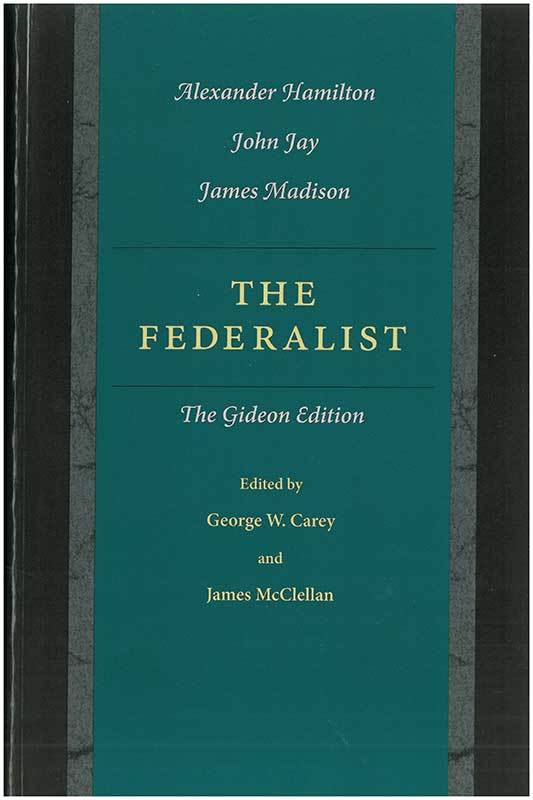
THE FEDERALIST - George W. Carey, The Federalist (Gideon ed.) [1818]Edition used:The Federalist (The Gideon Edition), Edited with an Introduction, Reader’s Guide, Constitutional Cross-reference, Index, and Glossary by George W. Carey and James McClellan (Indianapolis: Liberty Fund, 2001).
About Liberty Fund:Liberty Fund, Inc. is a private, educational foundation established to encourage the study of the ideal of a society of free and responsible individuals. Copyright information:The copyright to this edition, in both print and electronic forms, is held by Liberty Fund, Inc. Fair use statement:This material is put online to further the educational goals of Liberty Fund, Inc. Unless otherwise stated in the Copyright Information section above, this material may be used freely for educational and academic purposes. It may not be used in any way for profit.
THE FEDERALISTNo. 1IntroductionAfter full experience of the insufficiency of the existing federal government, you are invited to deliberate upon a New Constitution for the United States of America. The subject speaks its own importance; comprehending in its consequences, nothing less than the existence of the UNION, the safety and welfare of the parts of which it is composed, the fate of an empire, in many respects, the most interesting in the world. It has been frequently remarked, that it seems to have been reserved to the people of this country to decide, by their conduct and example, the important question, whether societies of men are really capable or not, of establishing good government from reflection and choice, or whether they are forever destined to depend, for their political constitutions, on accident and force. If there be any truth in the remark, the crisis at which we are arrived may, with propriety, be regarded as the period when that decision is to be made; and a wrong election of the part we shall act, may, in this view, deserve to be considered as the general misfortune of mankind. This idea, by adding the inducements of philanthropy to those of patriotism, will heighten the solicitude which all considerate and good men must feel for the event. Happy will it be if our choice should be directed by a judicious estimate of our true interests, uninfluenced by considerations foreign to the public good. But this is more ardently to be wished for, than seriously to be expected. The plan offered to our deliberations, affects too many particular interests, innovates upon too many local institutions, not to involve in its discussion a variety of objects extraneous to its merits, and of views, passions and prejudices little favourable to the discovery of truth. Among the most formidable of the obstacles which the new constitution will have to encounter, may readily be distinguished the obvious interest of a certain class of men in every state to resist all changes which may hazard a diminution of the power, emolument and consequence of the offices they hold under the state establishments . . . and the perverted ambition of another class of men, who will either hope to aggrandize themselves by the confusions of their country, or will flatter themselves with fairer prospects of elevation from the subdivision of the empire into several partial confederacies, than from its union under one government. It is not, however, my design to dwell upon observations of this nature. I am aware that it would be disingenuous to resolve indiscriminately the opposition of any set of men into interested or ambitious views, merely because their situations might subject them to suspicion. Candour will oblige us to admit, that even such men may be actuated by upright intentions; and it cannot be doubted, that much of the opposition, which has already shown itself, or that may hereafter make its appearance, will spring from sources blameless at least, if not respectable . . . the honest errors of minds led astray by preconceived jealousies and fears. So numerous indeed and so powerful are the causes which serve to give a false bias to the judgement, that we, upon many occasions, see wise and good men on the wrong as well as on the right side of questions, of the first magnitude to society. This circumstance, if duly attended to, would always furnish a lesson of moderation to those, who are engaged in any controversy, however well persuaded of being in the right. And a further reason for caution, in this respect, might be drawn from the reflection, that we are not always sure, that those who advocate the truth are actuated by purer principles than their antagonists. Ambition, avarice, personal animosity, party opposition, and many other motives, not more laudable than these, are apt to operate as well upon those who support, as upon those who oppose, the right side of a question. Were there not even these inducements to moderation, nothing could be more ill judged than that intolerant spirit, which has, at all times, characterized political parties. For, in politics as in religion, it is equally absurd to aim at making proselytes by fire and sword. Heresies in either can rarely be cured by persecution. And yet, just as these sentiments must appear to candid men, we have already sufficient indications, that it will happen in this, as in all former cases of great national discussion. A torrent of angry and malignant passions will be let loose. To judge from the conduct of the opposite parties, we shall be led to conclude, that they will mutually hope to evince the justness of their opinions, and to increase the number of their converts, by the loudness of their declamations, and by the bitterness of their invectives. An enlightened zeal for the energy and efficiency of government, will be stigmatized as the offspring of a temper fond of power, and hostile to the principles of liberty. An over scrupulous jealousy of danger to the rights of the people, which is more commonly the fault of the head than of the heart, will be represented as mere pretence and artifice . . . the stale bait for popularity at the expense of public good. It will be forgotten, on the one hand, that jealousy is the usual concomitant of violent love, and that the noble enthusiasm of liberty is too apt to be infected with a spirit of narrow and illiberal distrust. On the other hand, it will be equally forgotten, that the vigour of government is essential to the security of liberty; that, in the contemplation of a sound and well informed judgment, their interests can never be separated; and that a dangerous ambition more often lurks behind the specious mask of zeal for the rights of the people, than under the forbidding appearances of zeal for the firmness and efficiency of government. History will teach us, that the former has been found a much more certain road to the introduction of despotism, than the latter, and that of those men who have overturned the liberties of republics, the greatest number have begun their career, by paying an obsequious court to the people . . . commencing demagogues, and ending tyrants. In the course of the preceding observations it has been my aim, fellow citizens, to put you upon your guard against all attempts, from whatever quarter, to influence your decision in a matter of the utmost moment to your welfare, by any impressions, other than those which may result from the evidence of truth. You will, no doubt, at the same time, have collected from the general scope of them, that they proceed from a source not unfriendly to the new constitution. Yes, my countrymen, I own to you, that, after having given it an attentive consideration, I am clearly of opinion, it is your interest to adopt it. I am convinced, that this is the safest course for your liberty, your dignity, and your happiness. I affect not reserves, which I do not feel. I will not amuse you with an appearance of deliberation, when I have decided. I frankly acknowledge to you my convictions, and I will freely lay before you the reasons on which they are founded. The consciousness of good intentions disdains ambiguity. I shall not however multiply professions on this head. My motives must remain in the depository of my own breast: my arguments will be open to all, and may be judged of by all. They shall at least be offered in a spirit, which will not disgrace the cause of truth. I propose, in a series of papers, to discuss the following interesting particulars . . . The utility of the UNION to your political prosperity . . . The insufficiency of the present confederation to preserve that Union . . . The necessity of a government at least equally energetic with the one proposed, to the attainment of this object . . . The conformity of the proposed constitution to the true principles of republican government . . . Its analogy to your own state constitution . . . and lastly, The additional security, which its adoption will afford to the preservation of that species of government, to liberty and to property. In the progress of this discussion, I shall endeavour to give a satisfactory answer to all the objections which shall have made their appearance, that may seem to have any claim to attention. It may perhaps be thought superfluous to offer arguments to prove the utility of the UNION, a point, no doubt, deeply engraved on the hearts of the great body of the people in every state, and one which, it may be imagined, has no adversaries. But the fact is, that we already hear it whispered in the private circles of those who oppose the new constitution, that the Thirteen States are of too great extent for any general system, and that we must of necessity resort to separate confederacies of distinct portions of the whole.* This doctrine will, in all probability, be gradually propagated, till it has votaries enough to countenance its open avowal. For nothing can be more evident, to those who are able to take an enlarged view of the subject, than the alternative of an adoption of the constitution, or a dismemberment of the Union. It may, therefore, be essential to examine particularly the advantages of that Union, the certain evils, and the probable dangers, to which every state will be exposed from its dissolution. This shall accordingly be done. publius No. 2Concerning Dangers from Foreign Force & InfluenceWhen the people of America reflect, that the question now submitted to their determination, is one of the most important that has engaged, or can well engage, their attention, the propriety of their taking a very comprehensive, as well as a very serious, view of it, must be evident. Nothing is more certain than the indispensable necessity of government; and it is equally undeniable, that whenever and however it is instituted, the people must cede to it some of their natural rights, in order to vest it with requisite powers. It is well worthy of consideration, therefore, whether it would conduce more to the interest of the people of America, that they should, to all general purposes, be one nation, under one federal government, than that they should divide themselves into separate confederacies, and give to the head of each, the same kind of powers which they are advised to place in one national government. It has until lately been a received and uncontradicted opinion, that the prosperity of the people of America depended on their continuing firmly united, and the wishes, prayers and efforts of our best and wisest citizens have been constantly directed to that object. But politicians now appear, who insist that this opinion is erroneous, and that instead of looking for safety and happiness in union, we ought to seek it in a division of the states into distinct confederacies or sovereignties. However extraordinary this new doctrine may appear, it nevertheless has its advocates; and certain characters who were formerly much opposed to it, are at present of the number. Whatever may be the arguments or inducements which have wrought this change in the sentiments and declarations of these gentlemen, it certainly would not be wise in the people at large to adopt these new political tenets, without being fully convinced that they are founded in truth and sound policy. It has often given me pleasure to observe, that independent America was not composed of detached and distant territories, but that one connected, fertile, wide spreading country, was the portion of our western sons of liberty. Providence has in a particular manner blessed it with a variety of soils and productions, and watered it with innumerable streams, for the delight and accommodation of its inhabitants. A succession of navigable waters forms a kind of chain round its borders, as if to bind it together; while the most noble rivers in the world, running at convenient distances, present them with highways for the easy communication of friendly aids, and the mutual transportation and exchange of their various commodities. With equal pleasure I have as often taken notice, that Providence has been pleased to give this one connected country, to one united people; a people descended from the same ancestors, speaking the same language, professing the same religion, attached to the same principles of government, very similar in their manners and customs, and who, by their joint counsels, arms and efforts, fighting side by side throughout a long and bloody war, have nobly established their general liberty and independence. This country and this people seem to have been made for each other, and it appears as if it was the design of Providence, that an inheritance so proper and convenient for a band of brethren, united to each other by the strongest ties, should never be split into a number of unsocial, jealous and alien sovereignties. Similar sentiments have hitherto prevailed among all orders and denominations of men among us. To all general purposes we have uniformly been one people . . . each individual citizen every where enjoying the same national rights, privileges, and protection. As a nation we have made peace and war: as a nation we have vanquished our common enemies: as a nation we have formed alliances and made treaties, and entered into various compacts and conventions with foreign states. A strong sense of the value and blessings of Union induced the people, at a very early period, to institute a federal government to preserve and perpetuate it. They formed it almost as soon as they had a political existence; nay, at a time, when their habitations were in flames, when many of them were bleeding in the field, and when the progress of hostility and desolation left little room for those calm and mature inquiries and reflections, which must ever precede the formation of a wise and well balanced government for a free people. It is not to be wondered at that a government instituted in times so inauspicious, should on experiment be found greatly deficient and inadequate to the purpose it was intended to answer. This intelligent people perceived and regretted these defects. Still continuing no less attached to union, than enamoured of liberty, they observed the danger which immediately threatened the former, and more remotely the latter; and being persuaded that ample security for both, could only be found in a national government more wisely framed, they, as with one voice, convened the late convention at Philadelphia, to take that important subject under consideration. This convention, composed of men who possessed the confidence of the people, and many of whom had become highly distinguished by their patriotism, virtue, and wisdom, in times which tried the souls of men, undertook the arduous task. In the mild season of peace, with minds unoccupied by other subjects, they passed many months in cool uninterrupted and daily consultations; and finally, without having been awed by power, or influenced by any passion, except love for their country, they presented and recommended to the people the plan produced by their joint and very unanimous councils. Admit, for so is the fact, that this plan is only recommended, not imposed, yet let it be remembered, that it is neither recommended to blind approbation, nor to blind reprobation; but to that sedate and candid consideration, which the magnitude and importance of the subject demand, and which it certainly ought to receive. But, as has been already remarked, it is more to be wished than expected that it may be so considered and examined. Experience on a former occasion teaches us not to be too sanguine in such hopes. It is not yet forgotten, that well grounded apprehensions of imminent danger induced the people of America to form the memorable Congress of 1774. That body recommended certain measures to their constituents, and the event proved their wisdom; yet it is fresh in our memories how soon the press began to teem with pamphlets and weekly papers against those very measures. Not only many of the officers of government who obeyed the dictates of personal interest, but others from a mistaken estimate of consequences, from the undue influence of ancient attachments, or whose ambition aimed at objects which did not correspond with the public good, were indefatigable in their endeavours to persuade the people to reject the advice of that patriotic congress. Many indeed were deceived and deluded, but the great majority reasoned and decided judiciously; and happy they are in reflecting that they did so. They considered that the congress was composed of many wise and experienced men. That being convened from different parts of the country, they brought with them and communicated to each other a variety of useful information. That in the course of the time they passed together in inquiring into and discussing the true interests of their country, they must have acquired very accurate knowledge on that head. That they were individually interested in the public liberty and prosperity, and therefore that it was not less their inclination, than their duty, to recommend such measures only, as after the most mature deliberation they really thought prudent and advisable. These and similar considerations then induced the people to rely greatly on the judgment and integrity of the congress; and they took their advice, notwithstanding the various arts and endeavours used to deter and dissuade them from it. But if the people at large had reason to confide in the men of that congress, few of whom had then been fully tried or generally known, still greater reason have they now to respect the judgment and advice of the convention; for it is well known that some of the most distinguished members of that congress, who have been since tried and justly approved for patriotism and abilities, and who have grown old in acquiring political information, were also members of this convention, and carried into it their accumulated knowledge and experience. It is worthy of remark, that not only the first, but every succeeding congress, as well as the late convention, have invariably joined with the people in thinking that the prosperity of America depended on its Union. To preserve and perpetuate it, was the great object of the people in forming that convention, and it is also the great object of the plan which the convention has advised them to adopt. With what propriety, therefore, or for what good purposes, are attempts at this particular period made, by some men, to depreciate the importance of the union? or why is it suggested that three or four confederacies would be better than one? I am persuaded in my own mind, that the people have always thought right on this subject, and that their universal and uniform attachment to the cause of the union, rests on great and weighty reasons. They who promote the idea of substituting a number of distinct confederacies in the room of the plan of the convention, seem clearly to foresee that the rejection of it would put the continuance of the union in the utmost jeopardy: that certainly would be the case; and I sincerely wish that it may be as clearly forseen by every good citizen, that whenever the dissolution of the union arrives, America will have reason to exclaim in the words of the Poet, “Farewell! a long farewell, to all my greatness.” publius No. 3The same Subject continuedIt is not a new observation that the people of any country (if like the Americans intelligent and well informed) seldom adopt, and steadily persevere for many years, in any erroneous opinion respecting their interests. That consideration naturally tends to create great respect for the high opinion which the people of America have so long and uniformly entertained of the importance of their continuing firmly united under one federal government, vested with sufficient powers for all general and national purposes. The more attentively I consider and investigate the reasons which appear to have given birth to this opinion, the more I become convinced that they are cogent and conclusive. Among the many objects to which a wise and free people find it necessary to direct their attention, that of providing for their safety seems to be the first. The safety of the people doubtless has relation to a great variety of circumstances and considerations, and consequently affords great latitude to those who wish to define it precisely and comprehensively. At present I mean only to consider it as it respects security for the preservation of peace and tranquillity, as well against dangers, from foreign arms and influence, as against dangers arising from domestic causes. As the former of these comes first in order, it is proper it should be the first discussed. Let us therefore proceed to examine whether the people are not right in their opinion, that a cordial union under an efficient national government, affords them the best security that can be devised against hostilities from abroad. The number of wars which have happened or may happen in the world, will always be found to be in proportion to the number and weight of the causes, whether real or pretended, which provoke or invite them. If this remark be just, it becomes useful to inquire, whether so many just causes of war are likely to be given by united America, as by disunited America; for if it should turn out that united America will probably give the fewest, then it will follow, that, in this respect, the union tends most to preserve the people in a state of peace with other nations. The just causes of war for the most part arise either from violations of treaties, or from direct violence. America has already formed treaties with no less than six foreign nations, and all of them, except Prussia, are maritime, and therefore able to annoy and injure us: She has also extensive commerce with Portugal, Spain, and Britain, and with respect to the two latter, has the additional circumstance of neighbourhood to attend to. It is of high importance to the peace of America, that she observe the law of nations towards all these powers; and to me it appears evident that this will be more perfectly and punctually done by one national government, than it could be either by thirteen separate states, or by three or four distinct confederacies. For this opinion various reasons may be assigned. When once an efficient national government is established, the best men in the country will not only consent to serve, but will also generally be appointed to manage it; for although town, or county, or other contracted influence, may place men in state assemblies, or senates, or courts of justice, or executive departments; yet more general and extensive reputation for talents and other qualifications, will be necessary to recommend men to offices under the national government, especially as it will have the widest field for choice, and never experience that want of proper persons, which is not uncommon in some of the states. Hence it will result, that the administration, the political counsels, and the judicial decisions of the national government, will be more wise, systematical and judicious, than those of individual states, and consequently more satisfactory with respect to the other nations, as well as more safe with respect to ourselves. Under the national government, treaties and articles of treaties, as well as the laws of nations, will always be expounded in one sense, and executed in the same manner: whereas adjudications on the same points and questions, in thirteen states, or in three or four confederacies, will not always accord or be consistent; and that as well from the variety of independent courts and judges appointed by different and independent governments, as from the different local laws and interests which may affect and influence them. The wisdom of the convention, in committing such questions to the jurisdiction and judgment of courts appointed by, and responsible only to one national government, cannot be too much commended. The prospect of present loss or advantage, may often tempt the governing party in one or two states to swerve from good faith and justice; and those temptations not reaching the other states, and consequently having little or no influence on the national government, the temptations will be fruitless, and good faith and justice be preserved. The case of the treaty of peace with Britain, adds great weight to this reasoning. If even the governing party in a state should be disposed to resist such temptations, yet as such temptations may, and commonly do, result from circumstances peculiar to the state, and may affect a great number of the inhabitants, the governing party may not always be able, if willing, to prevent the injustice meditated, or to punish the aggressors. But the national government, not being affected by those local circumstances, will neither be induced to commit the wrong themselves, nor want power or inclination to prevent, or punish its commission by others. So far therefore as either designed or accidental violations of treaties and of the laws of nations afford just causes of war, they are less to be apprehended under one general government, than under several lesser ones, and in that respect, the former most favors the safety of the people. As to those just causes of war which proceed from direct and unlawful violence, it appears equally clear to me, that one good national government affords vastly more security against dangers of that sort, than can be derived from any other quarter. Such violences are more frequently occasioned by the passions and interests of a part than of the whole of one or two states than of the union. Not a single Indian war has yet been produced by aggressions of the present federal government, feeble as it is; but there are several instances of Indian hostilities having been provoked by the improper conduct of individual states, who, either unable or unwilling to restrain or punish offences, have given occasion to the slaughter of many innocent inhabitants. The neighbourhood of Spanish and British territories, bordering on some states, and not on others, naturally confines the causes of quarrel more immediately to the borderers. The bordering states, if any, will be those who, under the impulse of sudden irritations, and a quick sense of apparent interest or injury, will be most likely, by direct violence, to excite war with those nations; and nothing can so effectually obviate that danger, as a national government, whose wisdom and prudence will not be diminished by the passions which actuate the parties immediately interested. But not only fewer just causes of war will be given by the national government, but it will also be more in their power to accommodate and settle them amicably. They will be more temperate and cool, and in that respect, as well as in others, will be more in capacity to act with circumspection than the offending state. The pride of states as well as of men, naturally disposes them to justify all their actions, and opposes their acknowledging, correcting or repairing their errors and offences. The national government in such cases will not be affected by this pride, but will proceed with moderation and candour, to consider and decide on the means most proper to extricate them from the difficulties which threaten them. Besides it is well known that acknowledgments, explanations and compensations are often accepted as satisfactory from a strong united nation, which would be rejected as unsatisfactory if offered by a state or confederacy of little consideration or power. In the year 1685 the state of Genoa having offended Louis XIVth, endeavoured to appease him. He demanded that they should send their doge or chief magistrate, accompanied by four of their senators, to France, to ask his pardon and receive his terms. They were obliged to submit to it for the sake of peace. Would he on any occasion either have demanded or have received the like humiliation from Spain, or Britain, or any other powerful nation? publius No. 4The same Subject continuedMy last paper assigned several reasons why the safety of the people would be best secured by union against the danger it may be exposed to by just causes of war given to other nations; and those reasons show that such causes would not only be more rarely given, but would also be more easily accommodated by a national government, than either by the state governments, or the proposed confederacies. But the safety of the people of America against dangers from foreign force, depends not only on their forbearing to give just causes of war to other nations, but also on their placing and continuing themselves in such a situation as not to invite hostility or insult; for it need not be observed, that there are pretended as well as just causes of war. It is too true, however disgraceful it may be to human nature, that nations in general will make war whenever they have a prospect of getting any thing by it; nay, that absolute monarchs will often make war when their nations are to get nothing by it, but for purposes and objects merely personal, such as, a thirst for military glory, revenge for personal affronts, ambition, or private compacts to aggrandize or support their particular families, or partisans. These, and a variety of motives, which affect only the mind of the sovereign, often lead him to engage in wars not sanctioned by justice, or the voice and interests of his people. But independent of these inducements to war, which are most prevalent in absolute monarchies, but which well deserve our attention, there are others which affect nations as often as kings; and some of them will on examination be found to grow out of our relative situation and circumstances. With France and with Britain we are rivals in the fisheries, and can supply their markets cheaper than they can themselves, notwithstanding any efforts to prevent it by bounties on their own, or duties on foreign fish. With them and with most other European nations, we are rivals in navigation and the carrying trade; and we shall deceive ourselves if we suppose that any of them will rejoice to see these flourish in our hands: for as our carrying trade cannot increase, without in some degree diminishing their’s, it is more their interest and will be more their policy, to restrain, than to promote it. In the trade to China and India, we interfere with more than one nation, inasmuch as it enables us to partake in advantages which they had in a manner monopolized, and as we thereby supply ourselves with commodities which we used to purchase from them. The extension of our own commerce in our own vessels, cannot give pleasure to any nations who possess territories on or near this continent, because the cheapness and excellence of our productions, added to the circumstance of vicinity, and the enterprise and address of our merchants and navigators, will give us a greater share in the advantages which those territories afford, than consists with the wishes or policy of their respective sovereigns. Spain thinks it convenient to shut the Mississippi against us on the one side, and Britain excludes us from the St. Lawrence on the other; nor will either of them permit the other waters, which are between them and us, to become the means of mutual intercourse and traffic. From these and like considerations, which might, if consistent with prudence, be more amplified and detailed, it is easy to see that jealousies and uneasinesses may gradually slide into the minds and cabinets of other nations; and that we are not to expect they should regard our advancement in union, in power and consequence by land and by sea, with an eye of indifference and composure. The people of America are aware that inducements to war may arise out of these circumstances, as well as from others not so obvious at present; and that whenever such inducements may find fit time and opportunity for operation, pretences to colour and justify them will not be wanting. Wisely therefore do they consider union and a good national government as necessary to put and keep them in such a situation as instead of inviting war, will tend to repress and discourage it. That situation consists in the best possible state of defence, and necessarily depends on the government, the arms and the resources of the country. As the safety of the whole is the interest of the whole, and cannot be provided for without government, either one or more or many, let us inquire whether one good government is not, relative to the object in question, more competent than any other given number whatever. One government can collect and avail itself of the talents and experience of the ablest men, in whatever part of the union they may be found. It can move on uniform principles of policy. It can harmonize, assimilate, and protect the several parts and members, and extend the benefit of its foresight and precautions to each. In the formation of treaties it will regard the interest of the whole, and the particular interests of the parts as connected with that of the whole. It can apply the resources and power of the whole to the defence of any particular part, and that more easily and expeditiously than state governments, or separate confederacies can possibly do, for want of concert and unity of system. It can place the militia under one plan of discipline, and by putting their officers in a proper line of subordination to the chief magistrate, will in a manner consolidate them into one corps, and thereby render them more efficient than if divided into thirteen or into three or four distinct independent bodies. What would the militia of Britain be, if the English militia obeyed the government of England, if the Scotch militia obeyed the government of Scotland, and if the Welch militia obeyed the government of Wales? Suppose an invasion: would those three governments (if they agreed at all) be able with all their respective forces, to operate against the enemy so effectually as the single government of Great-Britain would? We have heard much of the fleets of Britain; and if we are wise, the time may come, when the fleets of America may engage attention. But if one national government had not so regulated the navigation of Britain as to make it a nursery for seamen . . . if one national government had not called forth all the national means and materials for forming fleets, their prowess and their thunder would never have been celebrated. Let England have its navigation and fleet . . . let Scotland have its navigation and fleet . . . let Wales have its navigation and fleet . . . let Ireland have its navigation and fleet . . . let those four of the constituent parts of the British empire be under four independent governments, and it is easy to perceive how soon they would each dwindle into comparative insignificance. Apply these facts to our own case. Leave America divided into thirteen, or if you please into three or four independent governments, what armies could they raise and pay, what fleets could they ever hope to have? If one was attacked would the others fly to its succour, and spend their blood and money in its defence? Would there be no danger of their being flattered into neutrality by specious promises, or seduced by a too great fondness for peace to decline hazarding their tranquillity and present safety for the sake of neighbours, of whom perhaps they have been jealous, and whose importance they are content to see diminished; although such conduct would not be wise it would nevertheless be natural. The history of the states of Greece, and of other countries, abound with such instances, and it is not improbable that what has so often happened, would, under similar circumstances happen again. But admit that they might be willing to help the invaded state or confederacy. How, and when, and in what proportion shall aids of men and money be afforded? Who shall command the allied armies, and from which of the associates shall he receive his orders? Who shall settle the terms of peace, and in case of disputes what umpire shall decide between them, and compel acquiescence? Various difficulties and inconveniences would be inseparable from such a situation; whereas one government watching over the general and common interests, and combining and directing the powers and resources of the whole, would be free from all these embarrassments, and conduce far more to the safety of the people. But whatever may be our situation, whether firmly united under one national government, or split into a number of confederacies, certain it is, that foreign nations will know and view it exactly as it is, and they will act towards us accordingly. If they see that our national government is efficient and well administered . . . our trade prudently regulated . . . our militia properly organized and disciplined . . . our resources and finances discreetly managed . . . our credit re-established . . . our people free, contented and united, they will be much more disposed to cultivate our friendship, than to provoke our resentment. If, on the other hand, they find us either destitute of an effectual government, (each state doing right or wrong as to its rulers may seem convenient) or split into three or four independent and probably discordant republics or confederacies, one inclining to Britain, another to France, and a third to Spain, and perhaps played off against each other by the three, what a poor pitiful figure will America make in their eyes! How liable would she become not only to their contempt, but to their outrage; and how soon would dear bought experience proclaim, that when a people or family so divide, it never fails to be against themselves. publius No. 5The same Subject continuedQueen Ann, in her letter of the 1st July, 1706, to the Scotch Parliament, makes some observations on the importance of the union then forming between England and Scotland, which merit our attention. I shall present the public with one or two extracts from it. “An entire and perfect union will be the solid foundation of lasting peace: it will secure your religion, liberty and property, remove the animosities amongst yourselves, and the jealousies and differences betwixt our two kingdoms. It must increase your strength, riches and trade; and by this union the whole island, being joined in affection and free from all apprehensions of different interests, will be enabled to resist all its enemies.” “We most earnestly recommend to you calmness and unanimity in this great and weighty affair, that the union may be brought to a happy conclusion; being the only effectual way to secure our present and future happiness, and disappoint the designs of our and your enemies, who will doubtless, on this occasion, use their utmost endeavours to prevent or delay this union.” It was remarked in the preceding paper, that weakness and divisions at home, would invite dangers from abroad, and that nothing would tend more to secure us from them than union, strength and good government within ourselves. This subject is copious and cannot easily be exhausted. The history of Great-Britain is the one with which we are in general the best acquainted, and it gives us many useful lessons. We may profit by their experience, without paying the price which it cost them. Although it seems obvious to common sense, that the people of such an island should be but one nation, yet we find that they were for ages divided into three, and that those three were almost constantly embroiled in quarrels and wars with one another. Notwithstanding their true interest, with respect to the continental nations, was really the same, yet by the arts and policy and practices of those nations, their mutual jealousies were perpetually kept enflamed, and for a long series of years they were far more inconvenient and troublesome, than they were useful and assisting to each other. Should the people of America divide themselves into three or four nations, would not the same thing happen? Would not similar jealousies arise, and be in like manner cherished? Instead of their being “joined in affection and free from all apprehension of different interests,” envy and jealousy would soon extinguish confidence and affection, and the partial interests of each confederacy instead of the general interests of all America, would be the only objects of their policy and pursuits. Hence, like most other bordering nations, they would always be either involved in disputes and war, or live in the constant apprehension of them. The most sanguine advocates for three or four confederacies, cannot reasonably suppose that they would long remain exactly on an equal footing in point of strength, even if it was possible to form them so at first: but admitting that to be practicable, yet what human contrivance can secure the continuance of such equality? Independent of those local circumstances which tend to beget and increase power in one part, and to impede its progress in another, we must advert to the effects of that superior policy and good management which would probably distinguish the government of one above the rest, and by which their relative equality in strength and consideration, would be destroyed. For it cannot be presumed that the same degree of sound policy, prudence and foresight would uniformly be observed by each of these confederacies, for a long succession of years. Whenever, and from whatever causes, it might happen, and happen it would, that any one of these nations or confederacies, should rise on the scale of political importance much above the degree of her neighbours, that moment would those neighbours behold her with envy and with fear. Both those passions would lead them to countenance, if not to promote whatever might promise to diminish her importance; and would also restrain them from measures calculated to advance, or even to secure her prosperity. Much time would not be necessary to enable her to discern these unfriendly dispositions. She would soon begin, not only to loose confidence in her neighbours, but also to feel a disposition equally unfavourable to them. Distrust naturally creates distrust, and by nothing is good will and kind conduct more speedily changed, than by invidious jealousies and uncandid imputations, whether expressed or implied. The North is generally the region of strength, and many local circumstances render it probable, that the most northern of the proposed confederacies would, at a period not very far distant, be unquestionably more formidable then any of the others. No sooner would this become evident, than the Northern Hive would excite the same ideas and sensations in the more Southern parts of America, which it formerly did in the Southern parts of Europe: Nor does it appear to be a rash conjecture, that its young swarms might often be tempted to gather honey in the more blooming fields and milder air of their luxurious and more delicate neighbours. They who well consider the history of similar divisions and confederacies, will find abundant reasons to apprehend, that those in contemplation would in no other sense be neighbours, than as they would be borderers; that they would neither love nor trust one another, but on the contrary would be a prey to discord, jealousy and mutual injuries; in short, that they would place us exactly in the situation in which some nations doubtless wish to see us, in which we should be formidable only to each other. From these considerations it appears that those persons are greatly mistaken, who suppose that alliances offensive and defensive might be formed between these confederacies, which would produce that combination and union of wills, of arms, and of resources, which would be necessary to put and keep them in a formidable state of defence against foreign enemies. When did the independent states into which Britain and Spain were formerly divided, combine in such alliances, or unite their forces against a foreign enemy? The proposed confederacies will be distinct nations. Each of them would have to regulate its commerce with foreigners by distinct treaties; and as their productions and commodities are different, and proper for different markets, so would those treaties be essentially different. Different commercial concerns must create different interests, and of course different degrees of political attachment to, and connection with, different foreign nations. Hence it might and probably would happen, that the foreign nation with whom the Southern confederacy might be at war, would be the one, with whom the Northern confederacy would be the most desirous of preserving peace and friendship. An alliance so contrary to their immediate interest would not therefore be easy to form, nor if formed, would it be observed and fulfilled with perfect good faith. Nay, it is far more probable that in America, as in Europe, neighbouring nations, acting under the impulse of opposite interests, and unfriendly passions, would frequently be found taking different sides. Considering our distance from Europe, it would be more natural for these confederacies to apprehend danger from one another, than from distant nations, and therefore that each of them should be more desirous to guard against the others, by the aid of foreign alliances, than to guard against foreign dangers by alliances between themselves. And here let us not forget how much more easy it is to receive foreign fleets into our ports, and foreign armies into our country, than it is to persuade or compel them to depart. How many conquests did the Romans and others make in the character of allies, and what innovations did they under the same character introduce into the governments of those whom they pretended to protect? Let candid men judge then whether the division of America into any given number of independent sovereignties, would tend to secure us against the hostilities and improper interference of foreign nations. publius No. 6Concerning Dangers from War between the StatesThe three last numbers of this work have been dedicated to an enumeration of the dangers to which we should be exposed, in a state of disunion, from the arms and arts of foreign nations. I shall now proceed to delineate dangers of a different, and, perhaps, still more alarming kind, those which will in all probability flow from dissentions between the states themselves, and from domestic factions and convulsions. These have been already in some instances slightly anticipated; but they deserve a more particular and more full investigation. If these states should either be wholly disunited, or only united in partial confederacies, a man must be far gone in Utopian speculations, who can seriously doubt that the subdivisions into which they might be thrown, would have frequent and violent contests with each other. To presume a want of motives for such contests, as an argument against their existence, would be to forget that men are ambitions, vindictive, and rapacious. To look for a continuation of harmony between a number of independent unconnected sovereignties, situated in the same neighbourhood, would be to disregard the uniform course of human events, and to set at defiance the accumulated experience of ages. The causes of hostility among nations are innumerable. There are some which have a general and almost constant operation upon the collective bodies of society. Of this description are the love of power, or the desire of pre-eminence and dominion . . . the jealousy of power, or the desire of equality and safety. There are others which have a more circumscribed, though an equally operative influence, within their spheres: such are the rivalships and competitions of commerce between commercial nations. And there are others, not less numerous than either of the former, which take their origin entirely in private passions; in the attachments, enmities, interests, hopes, and fears, of leading individuals in the communities of which they are members. Men of this class, whether the favourites of a king or of a people, have in too many instances abused the confidence they possessed; and assuming the pretext of some public motive, have not scrupled to sacrifice the national tranquillity to personal advantage, or personal gratification. The celebrated Pericles, in compliance with the resentments of a prostitute,* at the expense of much of the blood and treasure of his countrymen, attacked, vanquished, and destroyed the city of the Samnians. The same man, stimulated by private pique against the Magarensians, another nation of Greece, or to avoid a prosecution with which he was threatened as an accomplice in a supposed theft of the statuary Phidias, or to get rid of the accusations prepared to be brought against him for dissipating the funds of the state in the purchase of popularity, or from a combination of all these causes, was the primitive author of that famous and fatal war, distinguished in the Grecian annals by the name of the Peloponnesian war; which, after various vicissitudes, intermissions, and renewals, terminated in the ruin of the Athenian commonwealth. The ambitious cardinal, who was prime minister to Henry VIIIth, permitting his vanity to aspire to the triple crown, entertained hopes of succeeding in the acquisition of that splendid prize by the influence of the emperor Charles Vth. To secure the favour and interest of this enterprising and powerful monarch, he precipitated England into a war with France, contrary to the plainest dictates of policy, and at the hazard of the safety and independence, as well of the kingdom over which he presided by his counsels, as of Europe in general. For if there ever was a sovereign who bid fair to realize the project of universal monarchy, it was the emperor Charles Vth, of whose intrigues Wolsey was at once the instrument and the dupe. The influence which the bigotry of one female,* the petulances of another,† and the cabals of a third,‡ had in the cotemporary policy, ferments, and pacifications, of a considerable part of Europe, are topics that have been too often descanted upon not to be generally known. To multiply examples of the agency of personal considerations in the production of great national events, either foreign or domestic, according to their direction, would be an unnecessary waste of time. Those who have but a superficial acquaintance with the sources from which they are to be drawn, will themselves recollect a variety of instances; and those who have a tolerable knowledge of human nature, will not stand in need of such lights, to form their opinion either of the reality or extent of that agency. Perhaps, however, a reference, tending to illustrate the general principle, may with propriety be made to a case which has lately happened among ourselves. If Shays had not been a desperate debtor, it is much to be doubted whether Massachusetts would have been plunged into a civil war. But notwithstanding the concurring testimony of experience, in this particular, there are still to be found visionary, or designing men, who stand ready to advocate the paradox of perpetual peace between the states, though dismembered and alienated from each other. . . . The genius of republics, say they, is pacific; the spirit of commerce has a tendency to soften the manners of men, and to extinguish those inflammable humours which have so often kindled into wars. Commercial republics, like ours, will never be disposed to waste themselves in ruinous contentions with each other. They will be governed by mutual interest, and will cultivate a spirit of mutual amity and concord. We may ask these projectors in politics, whether it is not the true interest of all nations to cultivate the same benevolent and philosophic spirit? If this be their true interest, have they in fact pursued it? Has it not, on the contrary, invariably been found, that momentary passions, and immediate interests, have a more active and imperious control over human conduct, than general or remote considerations of policy, utility, or justice? Have republics in practice been less addicted to war than monarchies? Are not the former administered by men as well as the latter? Are there not aversions, predilections, rivalships, and desires of unjust acquisition, that affect nations, as well as kings? Are not popular assemblies frequently subject to the impulses of rage, resentment, jealousy, avarice, and of other irregular and violent propensities? Is it not well known, that their determinations are often governed by a few individuals in whom they place confidence, and that they are of course liable to be tinctured by the passions and views of those individuals? Has commerce hitherto done any thing more than change the objects of war? Is not the love of wealth as domineering and enterprising a passion as that of power or glory? Have there not been as many wars founded upon commercial motives, since that has become the prevailing system of nations, as were before occasioned by the cupidity of territory or dominion? Has not the spirit of commerce, in many instances, administered new incentives to the appetite both for the one and for the other? Let experience, the least fallible guide of human opinions, be appealed to for an answer to these inquiries. Sparta, Athens, Rome, and Carthage, were all republics; two of them, Athens and Carthage, of the commercial kind. Yet were they as often engaged in wars, offensive and defensive, as the neighbouring monarchies of the same times. Sparta was little better than a well regulated camp; and Rome was never sated of carnage and conquest. Carthage, though a commercial republic, was the aggressor in the very war that ended in her destruction. Hannibal had carried her arms into the heart of Italy, and even to the gates of Rome, before Scipio, in turn, gave him an overthrow in the territories of Carthage, and made a conquest of the commonwealth. Venice, in latter times, figured more than once in wars of ambition; till becoming an object of terror to the other Italian states, Pope Julius the Second found means to accomplish that formidable league,* which gave a deadly blow to the power and pride of that haughty republic. The provinces of Holland, till they were overwhelmed in debts and taxes, took a leading and conspicuous part in the wars of Europe. They had furious contests with England for the dominion of the sea; and were among the most persevering and most implacable of the opponents of Lewis XIV. In the government of Britain the representatives of the people compose one branch of the national legislature. Commerce has been for ages the predominant pursuit of that country. Yet few nations have been more frequently engaged in war; and the wars, in which that kingdom has been engaged, have in numerous instances proceeded from the people. There have been, if I may so express it, almost as many popular as royal wars. The cries of the nation and the importunities of their representatives have, upon various occasions, dragged their monarchs into war, or continued them in it, contrary to their inclinations, and sometimes contrary to the real interests of the state. In that memorable struggle for superiority, between the rival houses of Austria and Bourbon, which so long kept Europe in a flame, it is well known that the antipathies of the English against the French, seconding the ambition, or rather the avarice, of a favourite leader,† protracted the war beyond the limits marked out by sound policy, and for a considerable time in opposition to the views of the court. The wars of these two last mentioned nations have in a great measure grown out of commercial considerations: the desire of supplanting, and the fear of being supplanted either in particular branches of traffic, or in the general advantages of trade and navigation; and sometimes even the more culpable desire of sharing in the commerce of other nations, without their consent. The last war but two between Britain and Spain, sprang from the attempts of the English merchants, to prosecute an illicit trade with the Spanish main. These unjustifiable practices on their part, produced severities on the part of the Spaniards, towards the subjects of Great Britain, which were not more justifiable; because they exceeded the bounds of a just retaliation, and were chargeable with inhumanity and cruelty. Many of the English who were taken on the Spanish coasts, were sent to dig in the mines of Potosi; and by the usual progress of a spirit of resentment, the innocent were after a while confounded with the guilty in indiscriminate punishment. The complaints of the merchants kindled a violent flame throughout the nation, which soon after broke out in the house of commons, and was communicated from that body to the ministry. Letters of reprisal were granted, and a war ensued; which, in its consequences, overthrew all the alliances that but twenty years before had been formed, with sanguine expectations of the most beneficial fruits. From this summary of what has taken place in other countries, whose situations have borne the nearest resemblance to our own, what reason can we have to confide in those reveries, which would seduce us into the expectation of peace and cordiality between the members of the present confederacy, in a state of separation? Have we not already seen enough of the fallacy and extravagance of those idle theories which have amused us with promises of an exemption from the imperfections, the weaknesses, and the evils incident to society in every shape? Is it not time to awake from the deceitful dream of a golden age, and to adopt as a practical maxim for the direction of our political conduct, that we, as well as the other inhabitants of the globe, are yet remote from the happy empire of perfect wisdom and perfect virtue? Let the point of extreme depression to which our national dignity and credit have sunk; let the inconveniencies felt every where from a lax and ill administration of government; let the revolt of a part of the state of North Carolina; the late menacing disturbances in Pennsylvania, and the actual insurrections and rebellions in Massachusetts, declare! So far is the general sense of mankind from corresponding with the tenets of those, who endeavour to lull asleep our apprehensions of discord and hostility between the states, in the event of disunion, that it has from long observation of the progress of society become a sort of axiom in politics, that vicinity, or nearness of situation, constitutes nations natural enemies. An intelligent writer expresses himself on this subject to this effect: “Neighbouring nations (says he) are naturally enemies of each other, unless their common weakness forces them to league in a confederate republic, and their constitution prevents the differences that neighbourhood occasions, extinguishing that secret jealousy, which disposes all states to aggrandize themselves at the expense of their neighbours.”* This passage, at the same time, points out the evil and suggests the remedy. publius No. 7The subject continued, and Particular Causes EnumeratedIt is sometimes asked, with an air of seeming triumph, what inducements the states could have, if disunited, to make war upon each other? It would be a full answer to this question to say, . . . precisely the same inducements which have, at different times, deluged in blood all the nations in the world. But unfortunately for us, the question admit of a more particular answer. There are causes of difference within our immediate contemplation, of the tendency of which, even under the restraints of a federal constitution, we have had sufficient experience to enable us to form a judgment of what might be expected, if those restraints were removed. Territorial disputes have at all times been found one of the most fertile sources of hostility among nations. Perhaps the greatest proportion of the wars that have desolated the earth have sprung from this origin. This cause would exist, among us, in full force. We have a vast tract of unsettled territory within the boundaries of the United States. There still are discordant and undecided claims between several of them; and the dissolution of the union would lay a foundation for similar claims between them all. It is well known, that they have heretofore had serious and animated discussions concerning the right to the lands which were ungranted at the time of the revolution, and which usually went under the name of crown lands. The states within the limits of whose colonial governments they were comprised, have claimed them as their property; the others have contended that the rights of the crown in this article devolved upon the union; especially as to all that part of the Western territory which, either by actual possession, or through the submission of the Indian proprietors, was subject to the jurisdiction of the king of Great Britain, till it was relinquished by the treaty of peace. This, it has been said, was at all events an acquisition to the confederacy by compact with a foreign power. It has been the prudent policy of Congress to appease this controversy, by prevailing upon the states to make cessions to the United States for the benefit of the whole. This has been so far accomplished, as under a continuation of the union, to afford a decided prospect of an amicable termination of the dispute. A dismemberment of the confederacy however would revive this dispute, and would create others on the same subject. At present, a large part of the vacant Western territory is by cession at least, if not by any anterior right, the common property of the union. If that were at an end, the states which have made cessions, on a principle of federal compromise, would be apt, when the motive of the grant had ceased, to reclaim the lands as a reversion. The other states would no doubt insist on a proportion, by right of representation. Their argument would be, that a grant once made, could not be revoked; and that the justice of their participating in territory acquired or secured, by the joint efforts of the confederacy, remained undiminished. If, contrary to probability, it should be admitted by all the states, that each had a right to a share of this common stock, there would still be a difficulty to be surmounted, as to a proper rule of apportionment. Different principles would be set up by different states for this purpose; and as they would affect the opposite interests of the parties, they might not easily be susceptible of a pacific adjustment. In the wide field of Western territory, therefore, we perceive an ample theatre for hostile pretensions, without any umpire or common judge to interpose between the contending parties. To reason from the past to the future, we shall have good ground to apprehend, that the sword would sometimes be appealed to as the arbiter of their differences. The circumstances of the dispute between Connecticut and Pennsylvania, respecting the lands at Wyoming, admonish us not to be sanguine in expecting an easy accommodation of such differences. The articles of confederation obliged the parties to submit the matter to the decision of a federal court. The submission was made, and the court decided in favour of Pennsylvania. But Connecticut gave strong indications of dissatisfaction with that determination; nor did she appear to be entirely resigned to it, till by negotiation and management something like an equivalent was found for the loss she supposed herself to have sustained. Nothing here said, is intended to convey the slightest censure on the conduct of that state. She no doubt sincerely believed herself to have been injured by the decision; and states, like individuals, acquiesce with great reluctance in determinations to their disadvantage. Those who had an opportunity of seeing the inside of the transactions, which attended the progress of the controversy between this state and the district of Vermont, can vouch the opposition we experienced, as well from states not interested, as from those which were interested in the claim; and can attest the danger to which the peace of the confederacy might have been exposed, had this state attempted to assert its rights by force. Two motives preponderated in that opposition; one, a jealousy entertained of our future power; another, the interest of certain individuals of influence in the neighbouring states, who had obtained grants of lands under the actual government of that district. Even the states which brought forward claims, in contradiction to ours, seemed more solicitous to dismember this state, than to establish their own pretensions. These were New Hampshire, Massachusetts, and Connecticut. New Jersey and Rhode Island, upon all occasions, discovered a warm zeal for the independence of Vermont; and Maryland, until alarmed by the appearance of a connexion between Canada and that place, entered deeply into the same views. These being small states, saw with an unfriendly eye the perspective of our growing greatness. In a review of these transactions, we may trace some of the causes which would be likely to embroil the states with each other, if it should be their unpropitious destiny to become disunited. The competitions of commerce would be another fruitful source of contention. The states less favourably circumstanced, would be desirous of escaping from the disadvantages of local situation, and of sharing in the advantages of their more fortunate neighbours. Each state, or separate confederacy, would pursue a system of commercial polity peculiar to itself. This would occasion distinctions, preferences, and exclusions, which would beget discontent. The habits of intercourse, on the basis of equal privileges, to which we have been accustomed from the earliest settlement of the country, would give a keener edge to those causes of discontent, than they would naturally have, independent of this circumstance. We should be ready to denominate injuries, those things which were in reality the justifiable acts of independent sovereignties consulting a distinct interest. The spirit of enterprise, which characterizes the commercial part of America, has left no occasion of displaying itself unimproved. It is not at all probable, that this unbridled spirit would pay much respect to those regulations of trade, by which particular states might endeavour to secure exclusive benefits to their own citizens. The infractions of these regulations on one side, the efforts to prevent and repel them on the other, would naturally lead to outrages, and these to reprisals and wars. The opportunities which some states would have of rendering others tributary to them, by commercial regulations, would be impatiently submitted to by the tributary states. The relative situation of New York, Connecticut, and New Jersey, would afford an example of this kind. New York, from the necessities of revenue, must lay duties on her importations. A great part of these duties must be paid by the inhabitants of the two other states, in the capacity of consumers of what we import. New York would neither be willing, nor able to forego this advantage. Her citizens would not consent that a duty paid by them should be remitted in favour of the citizens of her neighbours; nor would it be practicable, if there were not this impediment in the way, to distinguish the customers in our own markets. Would Connecticut and New Jersey long submit to be taxed by New York for her exclusive benefit? Should we be long permitted to remain in the quiet and undisturbed enjoyment of a metropolis, from the possession of which we derived an advantage so odious to our neighbours, and, in their opinion, so oppressive? Should we be able to preserve it against the incumbent weight of Connecticut on the one side, and the co-operating pressure of New Jersey on the other? These are questions that temerity alone will answer in the affirmative. The public debt of the union would be a further cause of collision between the separate states or confederacies. The apportionment, in the first instance, and the progressive extinguishment, afterwards, would be alike productive of ill humour and animosity. How would it be possible to agree upon a rule of apportionment, satisfactory to all? There is scarcely any, that can be proposed, which is entirely free from real objections. These, as usual, would be exaggerated by the adverse interest of the parties. There are even dissimilar views among the states, as to the general principle of discharging the public debt. Some of them, either less impressed with the importance of national credit, or because their citizens have little, if any, immediate interest in the question, feel an indifference, if not a repugnance, to the payment of the domestic debt, at any rate. These would be inclined to magnify the difficulties of a distribution. Others of them, a numerous body of whose citizens are creditors of the public, beyond the proportion of the state in the total amount of the national debt, would be strenuous for some equitable and effectual provision. The procrastinations of the former, would excite the resentments of the latter. The settlement of a rule would in the mean time be postponed, by real differences of opinion, and affected delays. The citizens of the states interested, would clamour; foreign powers would urge for the satisfaction of their just demands; and the peace of the states would be exposed to the double contingency of external invasion, and internal contention. But suppose the difficulties of agreeing upon a rule surmounted, and the apportionment made. Still there is great room to suppose, that the rule agreed upon would, in the experiment, be found to bear harder upon some states than upon others. Those which were sufferers by it, would naturally seek for a mitigation of the burthen. The others would as naturally be disinclined to a revision, which was likely to end in an increase of their own incumbrances. Their refusal would afford to the complaining states a pretext for withholding their contributions, too plausible not to be embraced with avidity; and the non-compliance of these states with their engagements, would be a ground of bitter dissention and altercation. If even the rule adopted should in practice justify the equality of its principle, still delinquencies in payment, on the part of some of the states, would result from a diversity of other causes . . . the real deficiency of resources; the mismanagement of their finances; accidental disorders in the administration of the government; and in addition to the rest, the reluctance with which men commonly part with money for purposes, that have outlived the exigencies which produced them, and interfere with the supply of immediate wants. Delinquencies from whatever causes would be productive of complaints, recriminations, and quarrels. There is, perhaps, nothing more likely to disturb the tranquillity of nations, than their being bound to mutual contributions for any common object, which does not yield an equal and coincident benefit. For it is an observation as true, as it is trite, that there is nothing men differ so readily about, as the payment of money. Laws in violation of private contracts, as they amount to aggressions on the rights of those states, whose citizens are injured by them, may be considered as another probable source of hostility. We are not authorized to expect, that a more liberal, or more equitable spirit would preside over the legislations of the individual states hereafter, if unrestrained by any additional checks, than we have heretofore seen, in too many instances, disgracing their several codes. We have observed the disposition to retaliation excited in Connecticut, in consequence of the enormities perpetrated by the legislature of Rhode Island; and we may reasonably infer, that in similar cases, under other circumstances, a war, not of parchment, but of the sword, would chastise such atrocious breaches of moral obligation and social justice. The probability of incompatible alliances between the different states, or confederacies, and different foreign nations, and the effects of this situation upon the peace of the whole, have been sufficiently unfolded in some preceding papers. From the view they have exhibited of this part of the subject, this conclusion is to be drawn, that America, if not connected at all, or only by the feeble tie of a simple league, offensive and defensive, would by the operation of such opposite and jarring alliances be gradually entangled in all the pernicious labyrinths of European politics and wars; and by the destructive contentions of the parts, into which she was divided, would be likely to become a prey to the artifices and machinations of powers equally the enemies of them all. Divide et impera must be the motto of every nation, that either hates or fears us. publius No. 8The effects of Internal War in producing Standing Armies, and other institutions unfriendly to libertyAssuming it therefore as an established truth, that, in case of disunion, the several states; or such combinations of them as might happen to be formed out of the wreck of the general confederacy, would be subject to those vicissitudes of peace and war, of friendship and enmity with each other, which have fallen to the lot of all neighbouring nations not united under one government, let us enter into a concise detail of some of the consequences that would attend such a situation. War between the states, in the first periods of their separate existence, would be accompanied with much greater distresses than it commonly is in those countries, where regular military establishments have long obtained. The disciplined armies always kept on foot on the continent of Europe, though they bear a malignant aspect to liberty and economy, have, notwithstanding, been productive of the signal advantage of rendering sudden conquests impracticable, and of preventing that rapid desolation, which used to mark the progress of war, prior to their introduction. The art of fortification has contributed to the same ends. The nations of Europe are encircled with chains of fortified places, which mutually obstruct invasion. Campaigns are wasted in reducing two or three frontier garrisons, to gain admittance into an enemy’s country. Similar impediments occur at every step, to exhaust the strength, and delay the progress of an invader. Formerly, an invading army would penetrate into the heart of a neighbouring country, almost as soon as intelligence of its approach could be received; but now, a comparatively small force of disciplined troops, acting on the defensive, with the aid of posts, is able to impede, and finally to frustrate, the enterprises of one much more considerable. The history of war, in that quarter of the globe, is no longer a history of nations subdued, and empires overturned; but of towns taken and retaken, of battles that decide nothing, of retreats more beneficial than victories, of much effort and little acquisition. In this country, the scene would be altogether reversed. The jealousy of military establishments, would postpone them as long as possible. The want of fortifications, leaving the frontiers of one state open to another, would facilitate inroads. The populous states would, with little difficulty, overrun their less populous neighbours. Conquests would be as easy to be made, as difficult to be retained. War, therefore, would be desultory and predatory. Plunder and devastation ever march in the train of irregulars. The calamities of individuals would make the principal figure in the events, which would characterize our military exploits. This picture is not too highly wrought; though, I confess, it would not long remain a just one. Safety from external danger, is the most powerful director of national conduct. Even the ardent love of liberty will, after a time, give way to its dictates. The violent destruction of life and property incident to war; the continual effort and alarm attendant on a state of continual danger, will compel nations the most attached to liberty, to resort for repose and security to institutions which have a tendency to destroy their civil and political rights. To be more safe, they, at length, become willing to run the risk of being less free. |

Titles (by Subject)