Econlib

The Library

Other Sites

Front Page arrow Titles (by Subject) arrow LIB. XIX. - The English Works, vol. X (Iliad and Odyssey)

Return to Title Page for The English Works, vol. X (Iliad and Odyssey)

Search this Title:

Also in the Library:

Subject Area: Literature
Collection: Banned Books

LIB. XIX. - Homer, The English Works, vol. X (Iliad and Odyssey) [1839]

Edition used:

The English Works of Thomas Hobbes of Malmesbury; Now First Collected and Edited by Sir William Molesworth, Bart., (London: Bohn, 1839-45). 11 vols. Vol. 10.

Part of: The English Works of Thomas Hobbes, 11 vols.

About Liberty Fund:

Liberty Fund, Inc. is a private, educational foundation established to encourage the study of the ideal of a society of free and responsible individuals.


LIB. XIX.

    Achilles reconciled to Agamemnon goes forth to battle.

  • No sooner in her saffron robe was seen
  • Aurora, holding light above the ground,
  • Than at the ships the silver-footed queen
  • Achilles by Patroclus weeping found,
  • 5And with him many of his friends dismay’d.
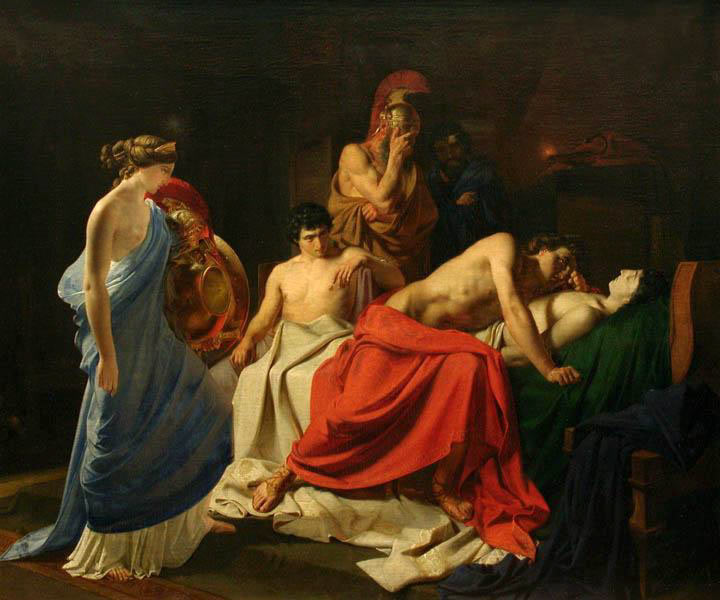
  • Then in, into the midst of them she went,
  • And laid her hand on his, and to him said:
  • My son, why do you thus in vain lament?
  • Come, since the Gods have slain him, leave him here,
  • 10And take the arms which I from Vulcan bring,
  • Such as yet mortal man did never wear;
  • Which, as she lays them down before him, ring.
  • The Myrmidons were troubled at the sight,
  • And turn’d their backs, affrighted at the show.
  • 15Achilles’ wrath was more enflamed by’t,
  • His eyes a-fire, and bended was his brow;
  • Yet when he had them in his hands was glad,
  • And with great admiration them survey’d.
  • And when enough beholden them he had,
  • 20Unto his mother he replied, and said:
  • Mother, I see such arms from Vulcan here,
  • As none but an immortal could have made,
  • And presently will put them on, but fear
  • Lest flies the body should meanwhile invade,
  • 25And in the wounds some filthy vermin breed.
  • And Thetis then replied: Son, do not fear,
  • For I myself to that will take such heed,
  • As, that although it should lie here a year,
  • It shall no worse, but rather better be.
  • 30Go you, and th’ Argive lords to council call,
  • And with king Agamemnon there agree,
  • And put your anger off before them all;
  • And spend your choler boldly on your foes.
  • This said, she to Patroclus mov’d her feet,
  • 35And dropp’d ambrosia into his nose,
  • To keep his body incorrupt and sweet.
  • Achilles then went down unto the shore,
  • And there the heroes did to council call
  • By name, though they were ready there before.
  • 40But thither at the news came th’ Argives all,
  • Steers-men and stewards of provision,
  • And all the rest to th’ council thronging in,
  • Though but to see the face of Thetis’ son,
  • So long they thought he absent now had been.
  • 45Tydides also, and Ulysses came,
  • Though of their wounds they yet not cured were,
  • Both halting, leaning on their spears, and lame.
  • The last of all was Agamemnon there,
  • Wounded by Coon, nor recovered yet;
  • 50But th’ heroes for his coming not long staid.
  • And when they were together all and set,
  • Achilles rose, and t’ Agamemnon said:
  • Atrides, what great profit got we by
  • This our unlucky strife about a maid?
  • 55I would it had her fortune been to die,
  • Before I siege unto Lyrnessus laid.
  • To Hector and the Trojans comes the gain;
  • The Greeks with grief will think on’t while they live.
  • But since it is too late now to complain,
  • 60Go forth, and orders for the battle give;
  • That I may to them go again, and see
  • If at the ships they mean to stay all night.
  • I think they will much rather wish to be
  • Within the walls of Troy than stay and fight.
  • 65This said, the Greeks were glad and courage take,
  • Assured that Achilles would them aid,
  • And Agamemnon, sitting, to them spake,
  • (Which he excus’d), and thus unto them said:
  • ’Twere fitter, Argive princes, I stood out,
  • 70That so my words you might the better hear;
  • But such a number standing are about,
  • My voice, though greater, would not reach your ear.
  • Nor were it fit for me to go about,
  • And tell my mind to each man in his ear.
  • 75T’ Achilles therefore only I’ll speak out,
  • But so, if you attend, that all may hear.
  • I often have, said he, been blamed by
  • The Greeks for taking from you your fair prize,
  • When not in me, but Jove the fault did lie,
  • 80And in Erinnys and the Destinies,
  • That did me of my wits that day bereave.
  • For what can I do when the Gods do all?
  • Jove’s daughter Atè did me then deceive,
  • From whom, on men and Gods great troubles fall.
  • 85Her feet are soft, because she never treads
  • On th’ earth; but when she mischief has to do
  • Walks in the air, and puts it in men’s heads,
  • And sometimes does shrewd turns t’ immortals too.
  • For Juno, though but of th’ female sex,
  • 90That day that Hercules was to be born,
  • Was able Jove, the best o’ th’ Gods, to vex,
  • And labour of Alcmena to adjourn.
  • For Jove before th’ immortals having said
  • That he a man that day to light would bring,
  • 95By whom his race in Greece should all be sway’d.
  • You jest, said Juno, you mean no such thing.
  • I’ll not believe’t, unless you first be sworn
  • That he shall of your seed in Greece be king,
  • That of a woman shall this day be born.
  • 100This said, straight Jove, no fraud imagining,
  • The great oath took. But after did repent.
  • And Juno from Olympus’ lofty head
  • Leapt down, and t’ Argos of Achaia went,
  • And brought the wife of Sthenelus to bed.
  • 105And there was she deliver’d of a son,
  • That was by Perseus of Jove’s descent,
  • Though she but seven months had of him gone.
  • And then to Thebes she to Alcmena went,
  • And hinder’d her that day from bringing forth.
  • 110Then up to Jupiter she came again,
  • And said, This day is born a man of worth,
  • Eurysteus, in Argos fit to reign,
  • And of your seed. And Jove in choler then
  • Took Atè by the head and swung her round,
  • 115And swore she ne’er to heav’n should come again.
  • And having said it, threw her to the ground;
  • And always after sigh’d to see the pain
  • To which Eurysteus did put his son;
  • As I do, when I see the Argives slain
  • 120By Hector, grieve to think what I have done.
  • But since that Jove has made me to offend,
  • I for my error willing am to pay.
  • Come, then, and your assistance to us lend,
  • And quickly bring your Myrmidons away.
  • 125And all that by Ulysses yesterday
  • I to you promis’d shall performed be.
  • Or presently, if you will for it stay,
  • That you th’ atoning gifts yourself may see.
  • Achilles then unto him thus replies.
  • 130As for your gifts, to give them me or no,
  • Yet only in your choice, Atrides, lies.
  • But now ’tis time we to the Trojans go,
  • To make fine speeches here is but delay.
  • But let your men o’ th’ field Achilles see
  • 135Through squadrons of the Trojans making way,
  • The Argives then encouraged will be.
  • Ulysses then t’ Achilles answered:
  • Godlike Achilles, mighty as you are,
  • Urge not the Greeks to fight till they be fed;
  • 140They fasting cannot long endure the war,
  • And likely ’tis the battle will be long,
  • Especially if Gods both sides assist;
  • And bread and wine is that which makes men strong.
  • Let therefore now the Argives be dismiss’d.
  • 145Who can, d’ye think, the toil of battle bear
  • From morning unto night, unless he first
  • With food his heart and feeble limbs do cheer?
  • He would be heavy, hungry, and athirst.
  • But he that is with food well satisfied,
  • 150Courageous is, and fight will all the day;
  • His heart and limbs are strong, and will abide
  • As long as any on the field dare stay.
  • Come, let the people now to breakfast go.
  • And Agamemnon send the presents in
  • 155Into th’ assembly where we sit, that so
  • By the Achæans all they may be seen;
  • And let him take an oath before us, that
  • Briseis’ bed he never went unto,
  • Nor all this while has done unto her what
  • 160A husband to his wife is us’d to do.
  • And you your anger henceforth bridle must.
  • And you, Atrides, feast him like a friend,
  • And for hereafter learn to be more just,
  • Nor think’t a shame for men their faults to mend.
  • 165Ulysses, said Atrides, I am joy’d
  • The counsel you have given us to hear,
  • For ’tis but reason all that you have said,
  • And I with all my heart the oath will swear.
  • And let Achilles, though in haste, stay here
  • 170With all the rest, that they my gifts may see,
  • And witnesses be to the oath I swear.
  • And for the gifts, Ulysses, presently
  • Go you yourself with good men, whom you will,
  • And bring them from my tent and set them here,
  • 175For what they are, you well remember still;
  • The same that by you promis’d from me were.
  • And you, Talthybius, provide a swine,
  • That we may offer up a sacrifice
  • To Jove, the Sun, and other pow’rs divine.
  • 180This said, Achilles to him thus replies:
  • Renowned Agamemnon, I think yet
  • Another time for feast had better been,
  • As when in war a pause we intermit.
  • And whilst yet unabated is my spleen,
  • 185We see our friends lie torn upon the ground,
  • The Greeks to battle and revenge I prompt.
  • You think my counsel therein is not sound,
  • And seek with feasting to divert them from’t.
  • But let us fasting to the battle go,
  • 190And make good cheer when we come back again,
  • And have reveng’d ourselves upon the foe;
  • For I will neither eat nor drink till then.
  • For whilst Patroclus mangled lieth here,
  • And they that love him stand lamenting by,
  • 195There nothing is that I can think good cheer
  • But slaughter, blood, and groans of men that die.
  • To this Ulysses did again reply:
  • Achilles, you have not in Greece your peer
  • For martial worth; yet elder much am I,
  • 200And more have seen; I pray you therefore hear.
  • The fare of war soon breeds satiety.
  • Much straw there is, but harvest none, or small.
  • If Jove once hold the scales unevenly,
  • Innumerable are the men that fall.
  • 205When then an end of weeping shall we see?
  • The bellies of the Argives must not mourn.
  • They that go to the war must patient be,
  • And let the dead unto their graves be borne,
  • And not weep over them above a day.
  • 210And we that safe from fight are come again,
  • When we are fed can all day fighting stay.
  • All other exhortation is vain.
  • Let therefore now the Greeks to breakfast go,
  • Which is the soldier’s best encouragement,
  • 215Then all together fall upon the foe.
  • And when he this had said, away he went,
  • And with him took Meges, Meriones,
  • Theas, Antilochus, and Thrasymed,
  • And Menalippus, and added unto these
  • 220The martial son of Creon, Lycomed,
  • And brought the presents from Atrides’ tent.
  • Sev’n tripods great, and twenty cauldrons bright,
  • Twelve horses, and sev’n women with them went,
  • And, fair’st of all, Briseis made them eight.
  • 225Talents of gold Ulysses weigh’d out ten,
  • And took the pains himself to carry that;
  • The rest was carri’d by the younger men,
  • And laid before the princes as they sat.
  • Then Agamemnon rose, and by him near
  • 230Talthybius attended with a swine,
  • From which Atrides clipt a lock of hair,
  • And lifts his hands unto the pow’rs divine.
  • O Jove, said he, the chiefest of the Gods,
  • O Sun, and Earth, and Furies underground,
  • 235That in your hands carry th’ eternal rods
  • To punish such as perjur’d shall be found,
  • My hand I on Briseis never laid,
  • Neither for bed, nor any other cause;
  • But always in my tent untouch’d she staid,
  • 240Nor ever by me once attempted was.
  • And if herein I told you have a lie,
  • Let all the dreadful torments that are due
  • To such as guilty are of perjury
  • Upon me fall. This said, the swine he slew.
  • 245Then out the stomach of the swine did cut,
  • And that Talthybius took in his hands.
  • And threw’t into the sea the fish to glut.
  • That done, Achilles up amongst them stands.
  • ’Tis thou, O Jove, said he, that spoilest all.
  • 250Briseis at my tent had stayed still,
  • Nor had her going from me mov’d my gall,
  • But that thou hadst a mind the Greeks to kill.
  • This said, the council he dissolv’d, and sent
  • Th’ Achæans to their ships to break their fast.
  • 255Then ev’ry man unto his own ship went,
  • And busy were about their short repast.
  • Meanwhile the Myrmidons the presents bear
  • T’ Achilles’ ships, and laid them in his tent,
  • And thither also brought the women were.
  • 260But th’ horses to the field his servants sent.
  • Briseis, when she saw Patroclus lie
  • With many ghastly wounds dead on the bier,
  • She flung her arms about him and did cry,
  • And her white neck, and face, and breast did tear,
  • 265And weeping over him did thus complain.
  • O dear Patroclus, whom alive I left,
  • Now when I to you am return’d again,
  • Ah me, I find you of your life bereft.
  • How fast my woes on one another fall!
  • 270The husband which my parents made me wed,
  • And three good brothers of one mother all,
  • I saw before Lyrnessus massacred.
  • And then, Patroclus, you to comfort me,
  • Told me that I should be Achilles’ wife,
  • 275And to him married in Pthia be.
  • But now since you have also lost your life,
  • I never of my woe shall see an end.
  • And then the other women wept and roar’d,
  • All for Patroclus, as they did pretend,
  • 280But inwardly their own fate they deplor’d.
  • The Greeks again about Achilles stood,
  • And urged him, ere he to battle went,
  • Himself to strengthen with a little food,
  • But could by no means get him to consent.
  • 285My friends, said he, importune me no more
  • To eat or drink before we go to fight.
  • My heart within me now is vexed sore;
  • Fear not, I shall endure from morn to night.
  • This said, the other princes from him went.
  • 290The two Atrides and Ulysses stay,
  • And Phœnix and old Nestor at his tent,
  • And King Idomeneus, his grief t’ allay,
  • But nothing they could say did any good,
  • So fiercely he was set upon the fight.
  • 295And looking on Patroclus’ body stood,
  • And then afresh lamented at the sight.
  • Sweet friend, said he, you wont were to provide
  • Good breakfast for me when I was to fight,
  • But since that comfort now I am denied,
  • 300In meat and drink I take no more delight.
  • For greater hurt cannot upon me fall,
  • Although for want of me my father die,
  • While absent from him at the Trojan wall,
  • For this accursed Helen’s sake I lie;
  • 305Nor though my son Neptolemus should die,
  • Whom I in Scyros isle left to be bred,
  • Nor thinking then that here both you and I
  • Should lose our lives; but that when I was dead
  • He should by you be to my house convey’d,
  • 310And made to know my servants and estate.
  • For Peleus now is very much decay’d,
  • If quite he have not finished his fate.
  • When this Achilles, weeping, spoken had,
  • The good old men, that also had their fears
  • 315For those they left at home, were very sad.
  • And Jove had pity on Achilles’ tears,
  • And speaking to Athena, Child, said he,
  • Your love to valiant men, I see, is gone.
  • Achilles must no more remember’d be.
  • 320Behold how for his friend he maketh moan,
  • And takes no food, though th’ other princes feast,
  • Let not his strength by hunger be decay’d;
  • Distil ambrosia into his breast,
  • And nectar. Straight Athena him obey’d.
  • 325And swift as any harpy came away,
  • And arming of themselves she found the rest;
  • But that Achilles’ strength might not decay,
  • She dropt ambrosia into his breast,
  • And nectar sweet, and out the Argives went.
  • 330As when from Jove descendeth a thick snow,
  • Which Boreas bloweth through the element;
  • Such of the armed Argives was the show;
  • So bright their burnish’d arms and helmets were,
  • The lustre up to heaven did rebound,
  • 335And smiling all about the fields appear,
  • And at the moving of their feet resound.
  • Achilles then his mighty arms puts on,
  • And grinds his teeth, and fire was in his eyes,
  • And hasted to the battle to be gone;
  • 340So much his heart did at the Trojans rise.
  • First to his legs the leg pieces he tied
  • With buckles of fine silver all along,
  • And next his breast-plate to his breast applied,
  • And on his shoulder then his sword he hung;
  • 345Then up into his hands his shield he took,
  • Large, strong, and mighty; radiant was the same,
  • And from afar it like the moon did look,
  • Or, as to seamen, on the wolds a flame,
  • That sure are of a storm when that they see,
  • 350And from their friends to scatter’d be by wind
  • To places where they not desire to be;
  • So then the buckler of Achilles’ shin’d.
  • And next he puts his helmet on his head,
  • Which shined like a comet in the air,
  • 355So finely Vulcan had it polished,
  • And made it seem to blaze with golden hair.
  • And then to try his arms if fit they were,
  • He walk’d about, and thought he wings had worn.
  • And last from out a tub he took his spear
  • 360(Which by his father formerly was borne,
  • And made by Chiron in Mount Pelion)
  • Which no man but Achilles now could wield,
  • Since Peleus’ strength decayed was and gone.
  • A fatal spear to heroes in the field.
  • 365And Alcimus then and Automedon,
  • The horses to the chariot made fast,
  • And harness’d them and put their bridles on,
  • And back unto the seat the reins they cast.
  • With whip in hand then mounts Automedon,
  • 370And after him Achilles not long staid,
  • Yclad in armour shining like the sun,
  • And roughly to his horses speaking said,
  • Xanthus and Balius take heed I pray,
  • A little better of your char’oteer,
  • 375Than of Patroclus you did yesterday,
  • Whom dead and stript you left behind you here.
  • This said, his sprightly head low Xanthus hung,
  • Till on the ground his golden mane was laid.
  • And Juno human speech gave to his tongue.
  • 380And to Achilles then he spake and said,
  • Yes, great Achilles, we will save you now:
  • But know ye, that your utmost day is nigh;
  • Not by our faults; the Gods will have it so,
  • And, which cannot be shunn’d, your destiny.
  • 385And that Patroclus is disarm’d and slain,
  • ’Twas not because we lazy were or slow,
  • But that Priamides might honour gain,
  • Apollo slew him with his silver bow.
  • For we could have gone faster than the wind,
  • 390If that could to him any good have done.
  • The thread of life which for him was design’d
  • Was by the Destinies drawn out and spun.
  • This then said Xanthus, but could not proceed.
  • His speech the Furies from him took again.
  • 395Xanthus, replied Achilles, there’s no need
  • For you to prophecy my death in vain.
  • I know already that I here must die,
  • Far from my parents; yet I mean to stay
  • Till I have made the Trojans hence to fly.
  • 400This said, his Myrmidons he led away.