Econlib

The Library

Other Sites

Front Page arrow Titles (by Subject) arrow LIB. XVIII. - The English Works, vol. X (Iliad and Odyssey)

Return to Title Page for The English Works, vol. X (Iliad and Odyssey)

Search this Title:

Also in the Library:

Subject Area: Literature
Collection: Banned Books

LIB. XVIII. - Homer, The English Works, vol. X (Iliad and Odyssey) [1839]

Edition used:

The English Works of Thomas Hobbes of Malmesbury; Now First Collected and Edited by Sir William Molesworth, Bart., (London: Bohn, 1839-45). 11 vols. Vol. 10.

Part of: The English Works of Thomas Hobbes, 11 vols.

About Liberty Fund:

Liberty Fund, Inc. is a private, educational foundation established to encourage the study of the ideal of a society of free and responsible individuals.


LIB. XVIII.

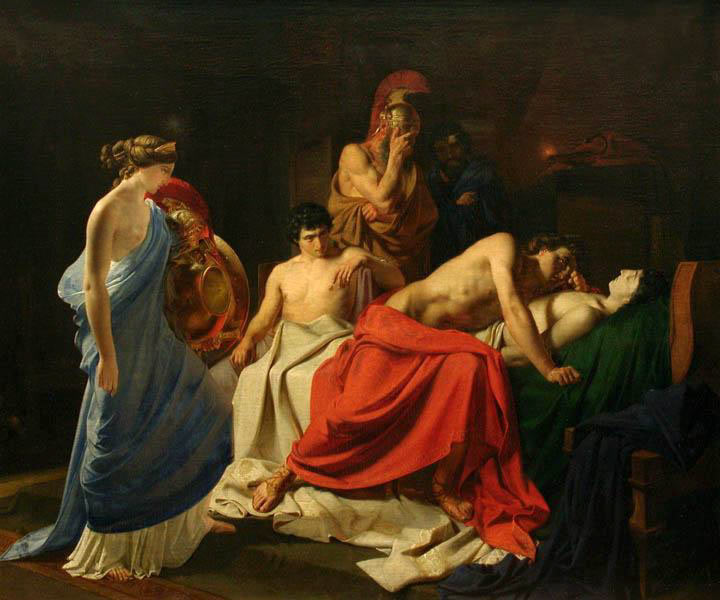
    The grief of Achilles, and new armour made for him by Vulcan.

  • Whilst at the ships the Greeks and Trojans fought,
  • Antilochus came to Achilles’ tent,
  • And found him to the Argive ditch gone out,
  • Presaging in his mind the sad event,
  • 5And saying to himself, Ah me, what’s this?
  • The battle to the ships is come again;
  • Pray God it be not as I fear it is,
  • The Greeks are routed and Patroclus slain.
  • My mother told me that the best of all
  • 10The Myrmidons by th’ Trojans should be slain.
  • I bad him not assault the Trojan wall,
  • Nor fight with Hector, but come back again.
  • As speaking to himself Achilles stood,
  • Antilochus unto him weeping came,
  • 15The news, said he, I bring you is not good;
  • I cannot without tears relate the same.
  • Slain is Patroclus. On the ground he lies,
  • And now they fighting are with swords and spears
  • Who shall his body have, with mighty cries,
  • 20Though naked; for his armour Hector wears.
  • At this sad news dark were Achilles’ eyes;
  • And up he takes the dust with both his hands,
  • And throws it on his head; then down he lies,
  • His face and coat sullied with dust and sands,
  • 25And tore his hair. And then the lovely prey
  • Of captive women, that had taken been
  • By him and by Patroclus before Troy,
  • Affrighted from Achilles’ tent came in,
  • And over him they beat they breasts and moan’d.
  • 30On t’ other side Antilochus was fain
  • To hold his hands, so mightily he groan’d;
  • Lest otherwise he should himself have slain.
  • His mother Thetis hearing him complain,
  • Though sitting in the deepest of the seas,
  • 35Wept out aloud, and presently her train
  • About her came of the Nereiades.
  • Glauca, Thaleia, and Cymodoca,
  • Nesæa, Speio, Thoa, Halia,
  • And Æmioreia, and Cymothoa,
  • 40Melita Iæra, and Amphithoa,
  • And Doto, Proto, Actæa, Agava,
  • Doris, Dexamena, Dynamena,
  • And Callianeira, and Amphinoma,
  • Pherusa Apseudes, and fair Panopa,
  • 45Nemertes, and the milk-white Galatæa,
  • And Clymene there was, and Callianassa,
  • And Mæra, Orithvia, and glorious Amatheia,
  • And, not to name them all, fair Janassa
  • With all the rest, and fill’d the silver cave,
  • 50And beat their breasts, and round her stood dismay’d.
  • And Thetis then th’ account unto them gave
  • Of her great grief, and thus unto them said:
  • Hear me, Nereiades, my sisters dear,
  • And be acquainted with my misery.
  • 55Ah, wretched Goddess that I was, to bear
  • The best of all the heroes; and when he
  • Was quickly grown up to a goodly height,
  • Send him unto the war at Ilium
  • Against the Trojans for the Greeks to fight,
  • 60From whence he never should again come home;
  • But spend his little time of life in woe,
  • And I can nothing do for his relief.
  • And now I mean to visit him, and know,
  • Since he not fights, what cause he hath of grief.
  • 65This said, she with her nymphs went from the cave.
  • The sea before them her smooth water tore,
  • And gentle passage to the Goddess gave,
  • Till they were landed on the Trojan shore,
  • Where lay Achilles’ ships upon the sand;
  • 70And straight up to Achilles Thetis went,
  • The nymphs attending on her hand in hand,
  • And seeing him so grievously lament,
  • She held him by the head, and to him said,
  • Why weep you thus, sweet child; what is’t you ail?
  • 75For that which formerly to Jove you prayed
  • Against th’ ingrateful Greeks, I did prevail.
  • To th’ ships they have been beaten from the field,
  • And know in what great need they stand of you,
  • And have in heaps been by the Trojans kill’d.
  • 80To this Achilles answ’ring said, ’Tis true,
  • But in my life what pleasure can I find,
  • Since sweet Patroclus slain is by his foes,
  • On whom of all men most I set my mind,
  • And Hector in his arms triumphing goes;
  • 85Those mighty arms, giv’n by the Gods that day
  • That you were pleas’d a mortal man to wed,
  • To Peleus. Oh, had you been away,
  • And he a mortal woman married!
  • You had not for your son been grieved then,
  • 90That never to you should return again.
  • Nor do I wish to live with mortal men,
  • But till I with my spear have Hector slain.
  • By what you say, said Thetis to her son,
  • Short-liv’d you are. Your own fate then is nigh.
  • 95I care not, said Achilles, when that’s done
  • I shall be very well content to die.
  • For since I never must return again,
  • And no defence in me Patroclus found,
  • Nor other good men by the Trojans slain,
  • 100I but a needless weight am to the ground.
  • Oh that contention lost for ever were,
  • And choler to the heart of man so sweet,
  • Which often make the wisest men to err!
  • In Agamemnon and myself I see’t.
  • 105But since ’tis past, let’s put it out of mind.
  • For dead he is, and cannot live again.
  • And now I’ll see if Hector I can find,
  • That has my dearest friend Patroclus slain,
  • And then let Jove do what himself thinks good.
  • 110For Hercules could not avoid his fate,
  • Who most of mortals in his favour stood,
  • But died by destiny and Juno’s hate;
  • And so shall I, when my day shall arrive,
  • Lie still when dead. But now let me gain fame
  • 115Amongst th’ Achæans while I am alive.
  • And make some Trojan or some Dardan dame
  • With both her tender hands to tear her cheeks,
  • And sigh, and with her tears her beauty blot,
  • And know my hand from that of other Greeks,
  • 120And when I with th’ Achæans am, when not.
  • And therefore, mother, dearly as you love me,
  • Endeavour not to make me here abide.
  • For from my purpose you cannot remove me.
  • Unto Achilles Thetis then replied,
  • 125Dear child, your purpose I’ll not reprehend,
  • Patroclus’ body from the foe to save,
  • Nor that the Argive people you defend.
  • But now you know your arms the Trojans have,
  • And Hector weareth them; but shall not long.
  • 130The latest of his days is to him nigh.
  • But go not you into the bloody throng,
  • Till here again you have me in your eye.
  • This said, she turn’d to the Nereiades,
  • And to them said, Nereiades, dive you
  • 135To Nereus, at the bottom of the seas,
  • And all you see has happ’ned to him show.
  • For I up to Olympus must be gone
  • To Vulcan, if such favour I can gain,
  • To get a good new armour for my son.
  • 140This said, the nymphs to sea return’d again,
  • And Thetis to Olympus went her way.
  • Meanwhile the Greeks before the Trojans fly
  • With mighty cries, and never stopt till they
  • Were at the ships, and to the wide sea nigh.
  • 145Nor was Patroclus’ body rescued yet;
  • For now afresh the Trojans to them came,
  • Which did another fiercer fight beget,
  • And Hector fell upon them like a flame.
  • Thrice laid he hold upon Patroclus’ foot,
  • 150And forc’d he was as oft to let it fall
  • To kill some others, then again came to’t,
  • But from the body went not back at all.
  • No more could Hector driven be away
  • From the dead body by th’ Ajaxes two,
  • 155Than can a hungry lion from his prey
  • For anything the herdsmen griev’d can do.
  • And Hector had Patroclus’ body got,
  • And gained had thereby a great renown,
  • But Juno, though the other Gods knew not,
  • 160T’ Achilles in great haste sent Iris down.
  • T’ Achilles straight she came, and to him said,
  • Up, terrible Pelides, to the war,
  • And your beloved friend Patroclus aid;
  • For at the ships they fighting for him are.
  • 165The Greeks to save his body are in pain,
  • The Trojans fain would drag him into Troy,
  • And Hector most of all that has him slain,
  • And from his shoulders take his head away
  • And stick it up upon the Trojan wall,
  • 170Leaving his corpse a prey to dog and kite.
  • Think what reproach will then upon you fall.
  • Lie then no longer here, but rise and fight.
  • Achilles then replied. Iris, said he,
  • Tell me what God or Goddess sent you down.
  • 175Juno, said Iris, sent me; none but she.
  • To all the rest my coming is unknown.
  • And then Achilles to her said again,
  • Since they have got my arms how can I fight?
  • And Thetis bids me from the war abstain
  • 180Till she return again into my sight,
  • Who is to Vulcan for new armour gone,
  • And here’s no other armour for me fit
  • But Ajax’s; who, I hope, has it on,
  • And for Patroclus now has use of it.
  • 185We know, said Iris, armour you have none.
  • But as you are, upon the ditch appear.
  • The Trojans from the corpse will soon begone,
  • And leave it to the Greeks for very fear.
  • This said, the Goddess Iris vanished.
  • 190Achilles rose, and Pallas to him came,
  • And on him puts her shield, and on his head
  • A golden cloud, from which arose a flame.
  • As when an isle invaded is by foes,
  • The citizens to call their neighbours in
  • 195Make fires, the smoke up to the heaven goes
  • By day; by night the flame; and far are seen;
  • Upon Achilles’ head stood such a flame,
  • And then unto the ditch he went and shouted,
  • And farther off Athena did the same.
  • 200The Trojans, when they heard it, strait were routed.
  • As clear as any trumpet in the wars,
  • They heard Achilles’ voice, and were afraid,
  • And in disorder turn’d about their cars,
  • But at his flaming head were most dismay’d.
  • 205Thrice shouted he, thrice they disorder’d were;
  • And slain were of the Trojans twelve brave men
  • By their own cars and spears encumber’d there.
  • In so much haste they turn’d to fly. And then
  • The Greeks the body laid upon a bed
  • 210And bier, and standing by his side lament.
  • And tears abundance there Achilles shed,
  • And that he sent him had did now repent.
  • The sun by Juno hasten’d quench’d his fire;
  • The Argives on the place stay quietly;
  • 215The Trojans to without the ditch retire,
  • And from the cars the weary steeds untie.
  • Then presently the chiefs to counsel call
  • Before they sup, and standing on their feet,
  • This apparition so scar’d them all,
  • 220That none amongst them had a mind to sit.
  • And first unto them spake Polydamas
  • Panthoides, Hector’s friend; both born one night.
  • He better counsellor than Hector was,
  • But Hector better was than he to fight.
  • 225My friends, be well advised now, said he,
  • It is not safe here on the plain to stay
  • Until the morning light again we see,
  • So near the Argive ships, so far from Troy.
  • Whilst this man absent was in discontent
  • 230With Agamemnon, and forbore to fight,
  • The Greeks were easy foes; to th’ ships I went
  • Myself, and willingly lay out all night;
  • But if Achilles hither now should come,
  • We must not only here fight for our lives;
  • 235So proud he is, he’ll go to Ilium,
  • And for the city fight and for our wives.
  • Let’s to the city go. ’Tis as I say,
  • And nothing keeps him from us but the night.
  • And if he here shall find us when ’tis day,
  • 240Some of us will acknowledge I say right.
  • And many flying, wish, when ’tis too late,
  • They were within the walls of Ilium,
  • Whom dogs and kites shall eat without the gate.
  • But to my ears may never such news come.
  • 245But if you will be ruled all by me,
  • Into the market-place of Troy by night
  • We’ll bring our strength, and, soon as we can see,
  • Stand arm’d upon the tow’rs prepar’d to fight.
  • Then let him from the ships come fight at Troy,
  • 250And drive about the walls and do his worst,
  • And having tir’d his horses go away;
  • Take it he shall not, dogs shall eat him first.
  • Then Hector frowning on him, thus replies:
  • Again, said he, I from you must dissent,
  • 255Since you to shut ourselves in Troy advise.
  • We have already there too long been pent.
  • Troy once was counted rich in brass and gold;
  • But since Jove angry was, all that is gone,
  • In Phrygia and in Mœonia sold,
  • 360And little left in Ilium to be won;
  • But since the Greeks are beaten and dismay’d
  • By th’ hand of Jove, your fear is out of season,
  • Nor will you by the Trojans be obey’d,
  • Nor shall you; though the Trojans thought it reason.
  • 265And therefore take my counsel, which is this.
  • Go now and ev’ry man his supper take
  • In rank and file there where he placed is;
  • And set good guards, and keep yourselves awake.
  • If any Trojan for his goods lament,
  • 270He may the same upon the town bestow
  • In service of the public to be spent,
  • Rather than be possessed by the foe;
  • And armed in the morn go to the fleet,
  • And sharply charge the Greeks by break of day.
  • 275And if indeed Achilles there we meet,
  • He were not best oppose us in our way;
  • For from him I will neither fly nor shrink,
  • But either honour from him bear away,
  • Or he from me. Mars common is, I think,
  • 280To them that fight; and slain are they that slay.
  • This said, the Trojans heard with great applause,
  • Fools as they were; Pallas had made them mad.
  • But none of them commend Polydamas,
  • That given them much better counsel had.
  • 285The Trojans presently to supper went,
  • The Greeks all night about Patroclus stand;
  • And there began Achilles to lament.
  • And on Patroclus’ breast he laid his hand.
  • As when a lion coming to his den,
  • 290Misses the tender whelps he left behind,
  • He roars, and furiously goes out again,
  • And through the vallies hunts, the thief to find;
  • Such fierce thoughts on Achilles’ heart then lay,
  • And sighing, to the Myrmidons he spake:
  • 295Oh, what did I to old Menœtius say!
  • How vain a promise did I to him make;
  • I said, when we had sack’d the town of Troy,
  • That I to Opus would bring back his son,
  • Enriched with his portion of the prey.
  • 300But all we hope from Jove is seldom done.
  • For both of us have the same destiny,
  • With our heart’s blood to dye the Trojan plain,
  • And as he lieth now, so shall I lie,
  • And never to my parents come again.
  • 305But since, Patroclus, you the first are dead,
  • Your funeral I will not celebrate,
  • Till I have brought you Hector’s arms and head,
  • Whose bloody hand deliver’d your sad fate,
  • And have twelve of the noble youths of Troy
  • 310Beheaded in revenge. Till then stay here,
  • Where Trojan captive women, night and day
  • Bewailing you, shall stand about the bier.
  • This said, he order gave for water hot,
  • To cleanse Patroclus’ body from the gore.
  • 315Into a cauldron, said he, water put,
  • And make a fire, and set the cauldron o’er.
  • Into a cauldron water then they put,
  • And made a fire, and set the cauldron o’er.
  • The flame about it goes; the water’s hot.
  • 320Then washed from the body was the gore,
  • And then again they laid him on the bed;
  • From head to foot in linen they him fold,
  • And on him laid a fair white coverlid,
  • His wounds first fill’d with unguent nine years old.
  • 325About the body of Patroclus stay’d
  • Achilles and the Myrmidons, all night
  • Lamenting him. Then Jove to Juno said,
  • You have Achilles brought again to fight
  • Against the Trojans, on the Argives’ side.
  • 330Are they your children, that you love them so?
  • And Juno then to Jupiter replied:
  • Harsh Cronides, what words do you let go?
  • Since mortal men, that know much less than we,
  • May to a friend do good, and hate a foe,
  • 335Why may not I, that boast myself to be
  • The wife and sister of great Jove, do so,
  • And make my foes, the Trojans, feel my hate?
  • Whilst Jove and Juno were discoursing thus,
  • The Goddess Thetis come was to the gate
  • 340Of Vulcan’s undecaying famous house
  • Of shining brass, with brighter stars thick set,
  • That ’mongst the houses of the heaven shone.
  • But he was at his work-house in a sweat,
  • And at his bellows swaying up and down.
  • 345For tripods twenty he had laboured,
  • With golden wheels, to go and come again
  • At his command; but had not finished
  • The ears and chains, which he was making then.
  • And whilst this bus’ness Vulcan was about,
  • 350Thetis was come, and at the gate did stand.
  • And Charis, Vulcan’s wife, then going out,
  • Saw her, and straightway took her by the hand.
  • Thetis, said she, ’tis strange to see you here;
  • Much honour’d, and a welcome guest you are,
  • 355Come in, and pleased be t’ accept our cheer.
  • Then led her in and brought her to a chair,
  • A dainty chair, with foot-stool join’d thereto,
  • And then unto her husband’s shop she hied,
  • For, Thetis, said she, you have work to do.
  • 360And Vulcan, glad, to Charis thus replied:
  • Is Thetis here, that sav’d me from mishap!
  • When for my lameness thrown down from the sky,
  • Thetis was pleas’d to catch me in her lap,
  • When else I had been in great misery.
  • 365I wrought for her, and for Eurynome,
  • Nine years, and made them many pretty things,
  • Within a rock encompass’d by the sea,
  • As buckles, clasps, fine boxes, beads, and rings,
  • Which neither mortal nor immortal knew,
  • 370But only Thetis and Eurynome.
  • And now to Thetis I must pay what’s due,
  • The ransom of my life, for saving me.
  • Go you, and entertain her well, while I
  • My tools take up, and bellows set away.
  • 375This said, the bellows he took and set by,
  • But in a chest his working tools did lay.
  • Then with a sponge he wip’d his hands and face,
  • His brawny neck, and hairy breast, and on
  • He puts his coat, and with his staff, apace,
  • 380Though halting goes, and waited was upon
  • By maids of massy gold, endu’d with wit,
  • And speech, and strength, and learn’d in heav’nly art;
  • And went to Thetis and did by her sit,
  • And joyful at her presence was his heart,
  • 385And laid his hand on hers, and to her said,
  • Thetis, so welcome to me there is none;
  • Tell me wherein you think I can you aid,
  • And if it can be done, it shall be done.
  • And then to Vulcan Thetis answered:
  • 390No Goddess ever was distress’d like me,
  • Whom Jove made subject to a mortal’s bed,
  • And Peleus’ wife constrained me to be,
  • Who lies at home decrepid now and spent,
  • And when I borne unto him had a son,
  • 395Of all the heroes the most excellent,
  • And of his breeding care omitted none,
  • And when he grown was to a goodly height,
  • He sent was to the war at Ilium,
  • Against the Trojans for the Greeks to fight;
  • 400From whence he never shall again come home.
  • Though yet he live, he takes therein no joy,
  • And I to comfort him no power have,
  • Since Agamemnon taken has away
  • Her whom the Greeks for honour to him gave.
  • 405And then my son no longer would him aid;
  • And by the Trojans beaten were the Greeks;
  • And Agamemnon then sent gifts, and pray’d,
  • And by ambassadors his favour seeks.
  • Then though to th’ fight himself he would not go,
  • 410Yet he his armour to Patroclus gave,
  • And Myrmidons t’ assist him ’gainst the foe,
  • And to the Scæan gate the Trojans drave.
  • And by Patroclus taken had been Troy,
  • Had he not then been by Apollo slain,
  • 415That unto Hector gave a glorious day,
  • And th’ armour of my valiant son to gain.
  • Which makes me now come hither, to request
  • That you would make new armour for my son,
  • A shield, a helmet, armour for the breast,
  • 420And for the legs; for those he had are gone.
  • Then to her answer’d Vulcan, Do not fear.
  • Oh, that when for him the harsh Fates enquire,
  • To hide him from them I as able were
  • As make him arms, for mortals to admire.
  • 425This said, unto his shop he went, and bad
  • His golden serving statues blow the fire.
  • For twenty bellowses in all he had
  • To blow as he should, and his work require.
  • And then into the fire he threw in tin,
  • 430And brass, and silver fine, and precious gold;
  • And to the socket puts the anvil in,
  • And th’ heavy hammer in one hand did hold,
  • Into his other hand the tongs he takes,
  • And forges first a mighty shield and strong,
  • 435And many various figures in it makes,
  • And fastens to the same a silver thong,
  • And bound the edge about with triple brass.
  • The shield itself consisted of five plies,
  • And with great art described in it was
  • 440The surface of the earth, the sea and skies,
  • The sun, the moon at full, and all the train
  • Of heaven, Pleiades, and Hyades,
  • Orion, and the bear, men call the Wain,
  • That only never dives into the seas,
  • 445But always to Orion has an eye.
  • And in it were two cities. In the one
  • Good cheer and weddings, and great melody,
  • And women at their doors stand looking on
  • To see the bridegroom as he passed by,
  • 450And lusty youths, that dancing with them go,
  • To citterns and to pipes, and Hymen cry,
  • And turn as swift as tops upon the toe.
  • And full of people was the market-place,
  • Assembled at the hearing of a cause.
  • 455A man was slain. And this was then the case.
  • One said that he had satisfied the laws,
  • The other said that nothing he had paid;
  • And on this issue they will both be tried,
  • And have their proofs before the judges laid,
  • 460And clamour great of friends was on each side.
  • The cryers when they stilled had the cry,
  • Into the judges’ hands their sceptres gave,
  • And in the midst, of gold two talents lie,
  • For him that has the better cause to have.
  • 465Before the other town two armies stood.
  • The foe resolved was to plunder it;
  • The town, to save it, offer’d half their good,
  • The other to accept it thought not fit.
  • Then up unto the walls the towns-men sent
  • 470Their women, children, and their men grown old,
  • And all the rest out from the city went,
  • And Mars and Pallas with them, all in gold,
  • And taller than the multitude by odds,
  • Who in respect of them seem’d very low,
  • 475For men are much inferior to the Gods.
  • Then they before the gate to council go.
  • The enemies themselves in ambush laid
  • At th’ watering place upon the river’s brink,
  • And scouts sent out, which not far from them staid,
  • 480To tell them when the cattle came to drink.
  • And when they were informed they were nigh,
  • And shepherds two, that did suspect no harm,
  • They on the shepherds and the cattle fly.
  • At which the other army took th’ alarm,
  • 485And rising up from council, with their horse
  • Pursued, and soon they overtaken were,
  • And then began the fight. Without remorse
  • They one another slay with sword and spear.
  • And there disorder plac’d was and debate;
  • 490And one borne wounded out, another found,
  • Another dead was dragg’d away by Fate,
  • With bloody coat and armour on the ground.
  • So lively seemed to the eye their features,
  • In fighting and in fetching off their slain,
  • 495One would have thought they had been living creatures,
  • And that the fight had real been. Again
  • Describ’d was in the same a spacious ground,
  • And men at plough; and at each ridge’s end,
  • At turning of the plough about, they found
  • 500A man that for them did with wine attend.
  • And then again the plough about they wind,
  • And lab’ring to the other end go back;
  • And as they plough, still what they leave behind,
  • Though golden ’twas, to th’ eye appeared black;
  • 505A wonder ’twas. Besides, in the same shield
  • Pourtrayed, was a goodly close of wheat,
  • And many reapers working on the field,
  • That threw it to the ground in handfuls great;
  • And boys that follow’d took it from the ground,
  • 510And put it in the hands of binders three,
  • By whom they made were into sheaves and bound,
  • Which standing by, their lord was glad to see.
  • His squires not far off standing were aside;
  • And at a tree a cow kill’d of the best,
  • 515A supper for the reapers to provide,
  • And to the women gave it to be dress’d.
  • And in’t a golden vineyard was pourtray’d:
  • The grapes that on it hung were black, and all
  • The vines supported and from drooping staid
  • 520With silver props, that down they could not fall.
  • A ditch there was about it black, and on
  • The same a hedge, the colour of it tin,
  • And path unto it there was only one,
  • By which the fruit in vintage was brought in.
  • 525And on it boys and girls described were,
  • After a fiddle play’d on by a boy,
  • That sing, dance, whistle, and full baskets bear,
  • Of Bacchus’ gifts, unto the house with joy.
  • And in it was a herd of bulls and kine,
  • 530Part gold, part tin, and herds-men four of gold,
  • That to the pasture drave them with dogs nine,
  • T’ a sedgy river; where two lions bold
  • Upon the horned herd came from a wood,
  • And ’mongst the foremost seiz’d upon a bull;
  • 535The dogs went to them near, and barking stood:
  • Then roars the bull. The lions tear and pull.
  • And in the same he pasture made for sheep
  • Within a valley large, with lodges good,
  • And folds, and cover’d houses them to keep
  • 540In safety from the wild beasts of the wood.
  • And in it was a dancing place pourtray’d,
  • Like that which Dædalus had made before
  • For Ariadne, while in Crete he staid,
  • And on it dancing youths and maidens store
  • 545Go hand in hand. The girls, some clad in fine
  • White linen were, and some in coats well spun
  • Of glossy wool, that with the oil did shine;
  • And ev’ry one a garland gay had on.
  • The boys with silver hangers were adorn’d,
  • 550And golden swords, and with their well-taught feet
  • Sometimes they dancing in a circle turn’d,
  • Sometimes divided in two ranks they meet.
  • And round about of people stood a throng,
  • And in the lovely dance took great delight.
  • 555And in the midst two tumblers sung the song,
  • And many wond’rous things did in their sight.
  • With the ocean then he all environed.
  • The shield now done, he went about the rest,
  • And made a helmet strong fit for his head,
  • 560And formed was of massy gold the crest,
  • And breast-plate shining brighter than the fire,
  • And pieces for his legs of ductile tin.
  • And when he all had done to his desire,
  • He from his forge return’d, and brought it in,
  • 565And in the hands of Thetis puts the same;
  • Which she received from him joyfully.
  • Then straightway from Olympus down she came,
  • As swift as at a fowl a hawk can fly.